




Percentage of Completion Method is one of the well-known payment methods in the construction industry. It is because, this type of payment that is helpful to maintaining long-term financial projects, such as the construction industry.
For many Philippines construction companies, this method improves financial reporting, cash flow visibility, and project monitoring. This article will explain the Percentage of Completion Method and how to optimize it for construction’s financial flow.
 Key Takeaways
- Percentage of Completion Method (PCM) is an accounting method that recognizes revenue and expenses based on project progress.
- PCM is a payment method for long-term construction projects with measurable progress, defined contract values, and reliable cost estimates.
- Contractors can calculate project completion using cost-to-cost, efforts-expended, or units-of-delivery approaches, depending on project requirements.
- ScaleOcean Construction Accounting ERP Software helps construction companies streamline invoicing, budgeting, & cost tracking in one integrated system.

1. What is the Percentage of Completion Method?
The Percentage of Completion Method is an accounting method to recognize revenue and expenses based on long-term projects. As a result, it is commonly applied in the Philippines for the construction industry that has long-term contracts.
Contractors estimate project completion using several measurements, such as project costs incurred, labor hours completed, or units delivered. After the work’s done for several percent, then the company recognizes revenue and expenses for the report.
In addition, the PCM method is often connected with accounting for construction businesses because construction accounting requires detailed monitoring of project budgets, contracts, progress billing, and cost allocation.
This approach is also aligned with IFRS 15 Revenue from Contracts with Customers, which allows revenue to be recognized over time when performance obligations are satisfied and project progress can be measured reliably.
2. When Should the Percentage of Completion Method be Used?

After understanding the PCM, it is also important to know when this accounting approach should be applied. This method is commonly used for medium and large-scale construction projects. Here are some conditions suitable for applying PCM:
- The contract value is clearly defined.
- Project costs can be estimated accurately.
- Payment terms are agreed upon.
- The project duration extends across multiple accounting periods.
- Contractors can measure project progress consistently.
Many Philippines contractors use this method for infrastructure developments, office buildings, condominiums, roads, bridges, and government projects because these projects usually involve phased work completion and progress billing.
This accounting approach also aligns with various construction billing methods where contractors issue invoices based on project milestones or completion percentages.
Further, companies who are handling long-term projects with partial payment arrangements or retainage in Construction practices may benefit from the Percentage of Completion Method because it helps monitor tracking.
3. Percentage of Completion Method Formula
The formula used in percentage of completion method is determined by how much revenue and expense should be recognized during an accounting period. There are several common approaches used to calculate the PCM:
a. Cost-to-Cost Approach
The cost-to-cost approach is the most widely used method in construction accounting. This method compares costs incurred to date against the total estimated project cost. The formula is:
POC = (Costs incurred to date/total estimated costs) x 100
To make the calculation of this method easier, here is the example: if a contractor has spent PHP 5 million out of an estimated total project cost of PHP 10 million, the project is considered 50% complete.
b. Efforts-Expended Calculation
Another calculation to do in the Percentage of Completion Method is the effort-expended method. This is to measure labor hours, machine hours, or other efforts-related metrics completed during a project. The formula is:
POC = (Effort expended to date/estimated total effort) x 100
Therefore, here is an example of an effort-expended method: if workers have completed 4,000 labor hours out of an estimated 8,000 total labor hours, the project is considered 50% complete.
c. Units-of-Delivery
Another calculation method that is used in Percentage of Completion is units-of-delivery. This is to calculate project completion based on measurable items such as the number of apartments completed. The formula usually used is:
POC = (Number of units delivered to date/total contracted units) x 100.
This method is commonly used for repetitive construction projects such as housing developments and modular construction. For example, if a contractor completes 30 housing units out of 100 planned units, the project is considered 30% complete.
4. Percentage of Completion Method and Potential for Abuse
Even though the Percentage of Completion Method makes financial bookkeeping easier, it carries some potential risks of through manipulation or inaccurate estimations. Some common risks include:
- Inflated project progress reporting.
- Underestimated project costs.
- Premature revenue recognition.
- Manipulation of financial statements.
- Delayed recording of project losses.
For this reason, Philippines construction companies should establish strong internal controls, conduct regular evaluations, and maintain transparent documentation for all transactions.
To support transparency, many contractors also implement construction accounting software to improve tracking accuracy, automate monitoring, and reduce manual calculation errors during financial management.

5. Percentage of Completion Method Example
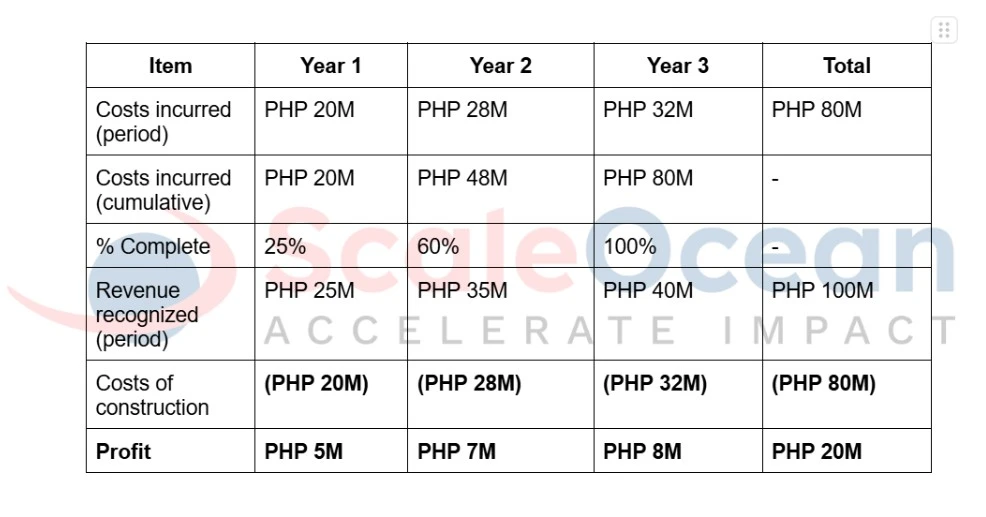
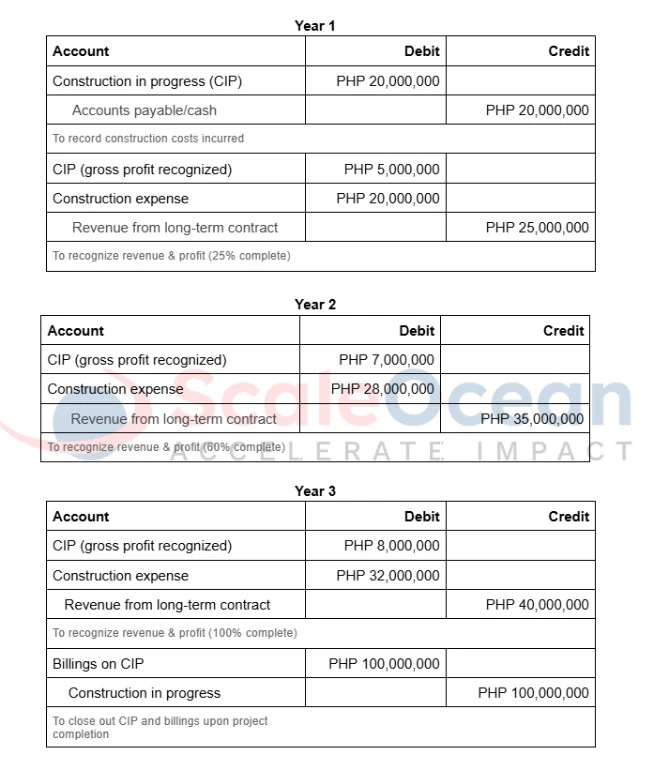
Suppose a construction company in the Philippines signs a contract to build a commercial building for PHP 100 million. The expectation for the project to complete is three years, and the total estimated construction cost is PHP 80 million.
The company applies the cost-to-cost approach to determine the percentage of completion each year rather than using the completed contract method, which would defer revenue recognition until project completion. Here is the example of Percentage of Completion Method:
Formulas (cost-to-cost approach):
- % complete = Cumulative costs incurred ÷ Total estimated cost × 100
- Revenue (cumulative) = % Complete × PHP 100M contract price
- Revenue (current period) = Cumulative revenue – Revenue recognized in prior years
- Profit (period) = Period revenue − Period costs incurred
Year 1
- Percentage of Completion = (20 million ÷ 80 million) x 100 = 25%
- Revenue Recognized = 25% x PHP 100 million = PHP 25 million
- Gross Profit = PHP 25 million – PHP 20 million = PHP 5 million
Year 2
- Percentage of Completion = (48 million ÷ 80 million) x 100 = 60%
- Revenue Recognized: 60% x PHP 100 million = PHP 60 million
Because PHP 25 million was already recognized in Year 1, the additional revenue recognized in Year 2 is: PHP 60 million – PHP 25 million = PHP 35 million
- Gross Profit = PHP 35 million – PHP 28 million = PHP 7 million
Year 3
- Cumulative costs incurred = PHP 20 million + PHP 28 million + 32 million = PHP 80 million
- Percentage of Completion = PHP 80 million ÷ PHP 80 million x 100 = 100%
- Revenue Recognized = PHP 100 million – PHP 60 million = PHP 40 million
- Gross Profit = PHP 40 million – PHP 32 million = PHP 8 million
Summary Schedule
Journal Entries
6. In Conclusion
The Percentage of Completion Method (PCM) helps construction companies recognize revenue and expenses based on project progress. This method is commonly used for long-term projects because it provides more accurate financial reporting.
However, not every accounting method is applicable for every construction project. While PCM is ideal for long-term projects with measurable progress, some companies may prefer the Completed Contract Method (CCM) for shorter contracts.
To make the accounting process more efficient, many construction firms use construction accounting platform. These systems help automate invoicing, budgeting, cost tracking, and reporting in one platform.
ScaleOcean Construction Accounting ERP Software can help Philippines construction companies simplify accounting processes, manage budgets, and monitor project progress more effectively.
Businesses can also request a free demo to explore the software’s features and benefits to enhance accounting and budgeting management for construction projects.
FAQ:
1. What is the PoC method?
The Percentage of Completion (PoC) method is an accounting approach that recognizes revenue and expenses as a long-term project progresses rather than when it is completed.
2. What is the formula for the percentage completion method?
The percentage of completion method formula divides costs incurred to date by total estimated project costs, then multiplies the result by 100% to determine project progress.
3. What is an example of percentage of completion?
For example, if a project’s estimated cost is ₱800,000 and ₱400,000 has been spent, the project is 50% complete using the cost-to-cost method.
















.png)