




Inventory control refers to a process within warehouse operations that ensures products are of the right quality and readily available. This process is crucial for growing businesses in the Philippines, particularly in the retail, manufacturing, and e-commerce sectors.
As these companies scale, maintaining accurate inventory becomes increasingly essential. Effective inventory control improves warehouse efficiency and enhances customer satisfaction. In this article, you’ll explore enhancing inventory control for businesses in the Philippines.
 Key Takeaways
- Inventory control is the process of monitoring and maintaining the right inventory levels to reduce costs and improve stock accuracy.
- The importance of inventory control is reducing unnecessary cost, increasing greater visibility, and improving warehouse productivity.
- Inventory control techniques include ABC analysis, FIFO and LIFO, Just-in-Time (JIT), Just-in-Case (JIC), Economic Order Quantity (EOQ), and Safety Stock.
- ScaleOcean WMS ERP Software helps businesses automate inventory control with real-time stock monitoring, AI-powered warehouse management, and comprehensive reporting.

1. What is Inventory Control?
Inventory control is the process of monitoring, organizing, and storing inventory to maintain the right amount of stock for business operations. The goal is to ensure products are available when needed while avoiding unnecessary carrying costs and inventory losses.
Unlike simply counting products, inventory control involves tracking every item entering and leaving the warehouse. Businesses often use technologies such as barcode systems to streamline data capture, monitor stock movement in real time, and reduce manual errors.
To further automate tracking across different product categories, modern facilities frequently adopt QR code scanning solutions. These tools allow warehouse teams to access instant product details and update stock status on mobile devices.
Each product is usually assigned a unique Stock Keeping Unit (SKU), allowing warehouse teams to identify, locate, and manage inventory efficiently. Businesses also continuously monitor their inventory level to determine when products should be reordered.
For businesses in the Philippines, inventory control is particularly valuable because supply chain disruptions, seasonal demand, and inter-island distribution can impact product availability. Maintaining accurate records enables companies to respond quickly to market demand.
2. What is the Importance of Inventory Control?

Inventory control plays a critical role in maintaining inventory levels and keeping business operations healthy. It helps companies balance product availability with inventory costs while improving overall warehouse performance.
Based on a study published in the Mediterranean Journal of Social Sciences, organizations that implement effective inventory control management see measurable gains, including easier storage and retrieval of materials, and improved sales effectiveness.
This is relevant with the Philippines’ growing businesses, as data from Philippines Statistics Authority, shows that wholesale and retail trade grew by 4.6% in the first quarter of 2026, which alone makes up more than half of the national economy.
Therefore, as trade and retail businesses keep growing, having effective inventory control in place is becoming even more important. It helps companies track stock accurately, avoid losses, and grow sustainably over time.
a. Reduced Costs
One of the biggest advantages of inventory control is its ability to reduce unnecessary business expenses. With capabilities, companies can avoid purchasing more products than they need. However, poor inventory planning often leads to several costly issues, including:
- Excess storage costs.
- Product expiration or obsolescence.
- Inventory shrinkage.
- Emergency purchasing expenses.
Effective inventory control also helps businesses prevent stockout, ensuring products remain available to meet customer demand. This minimizes lost sales opportunities and reduces the need for urgent replenishment from suppliers.
b. Increased Visibility
Inventory control gives businesses greater visibility into stock movement and product availability. Therefore, with clear inventory data, managers can make informed decisions based on real-time information rather than manual estimates.
Improved visibility also makes it easier to monitor the current inventory level of every product. With this clarity, warehouse managers can quickly generate an accurate BIR Inventory List, identify slow-moving items, and forecast future demand far more accurately.
Having these real-time insights enables teams to schedule stock replenishment before inventory reaches critical levels. This proactive approach prevents unexpected stockouts and keeps fulfilling orders without interruption.
Additionally, having accurate inventory records helps businesses avoid overstocking. This allows warehouse space and working capital to be used more efficiently. Moreover, the benefits significantly help managers to maintain warehouse work smoothly.
c. Improved Warehouse Productivity
The third important part of controlling inventory is to enable warehouse employees to complete daily tasks more quickly and accurately. Also, modern systems often implement RFID scanning devices to automate item tracking, reducing travel time, and shipping activities.
Businesses can further improve warehouse productivity by maintaining an appropriate amount of safety stock. This extra inventory helps operations continue smoothly during supplier delays or sudden increases in customer demand.
For companies operating in the Philippines, maintaining sufficient buffer stock is also beneficial when transportation disruptions or seasonal demand fluctuations that affect supply chains. Preparing for these can minimize operational delays which improve service levels.
3. Inventory Control Vs. Inventory Management
Although these terms are often used interchangeably, they serve different purposes within the warehouse industry. Below here are some of differences of inventory control and inventory management, so you’ll understand the purposes their serving easier:
| Order Picking | Warehouse Picking |
|---|---|
| Focuses on monitoring inventory accuracy and stock levels. | Covers the complete planning and movement of inventory throughout the supply chain. |
| Concentrates on warehouse operations. | Includes purchasing, forecasting, warehousing, and distribution. |
| Prevents stock shortages and excess inventory. | Optimizes the entire inventory lifecycle. |
| Primarily handles inventory tracking. | Supports business planning and supply chain decisions. |
In simple terms, inventory control is one part of broader inventory management. While inventory management develops overall inventory strategies, inventory control ensures those strategies are executed accurately inside the warehouse.
4. 6 Best Techniques for Inventory Control

Businesses use various inventory control techniques depending on their operations, product types, and customer demand. It’s to make sure every business will complete every order smoothly. Here are some of the techniques for inventory control:
a. ABC Analysis
The first common technique in inventory control is ABC analysis. When using this technique, the categorization of inventory based on value and business importance. For example, here are how the ABC analysis used for:
- Category A: High-value products requiring close monitoring
- Category B: Medium-value products with moderate control
- Category C: Low-value products with simpler inventory management
Therefore, this approach allows businesses to prioritize resources on products that have the greatest financial impact. As a result, companies can reduce holding costs and maximize profit margins without tying up capital in slow-moving stock.
b. FIFO and LIFO
The second well-known techniques for managing inventory are FIFO and LIFO. FIFO (First In, First Out) means older inventory is sold or used before newer stock. It is commonly applied to food, pharmaceuticals, cosmetics, and other products with expiration dates.
Additionally, LIFO (or Last In, First Out) assumes the newest inventory is used first. Although less common in warehouse operations, some businesses apply it depending on accounting practices and inventory characteristics.
c. Just-in-Time (JIT)
The third technique is JIT or Just-in-Time method, this technique purposely to minimize inventory by receiving products only when they are needed for production or customer orders. It’s also offers some benefits, which are:
- Lower storage costs.
- Reduced excess inventory.
- Improved cash flow.
However, JIT requires reliable suppliers and accurate demand forecasting. As a result, businesses must build strong vendor relationships and leverage data-driven insights before fully adopting this model.
d. Just-in-Case (JIC)
Unlike JIT, Just-in-Case (JIC) maintains additional inventory to prepare for unexpected demand spikes or supply chain disruptions. This technique is particularly useful in the Philippines, where weather events or inter-island logistics can temporarily disrupt supply chains.
e. Economic Order Quantity (EOQ)
The fifth common method used for handling inventory is EOQ or Economic Order Quantity. EOQ determines the ideal purchase quantity that minimizes both ordering and inventory holding costs. Further, calculating optimal order can reduce unnecessary purchasing.
f. Safety Stock
The sixth technique of handling inventory is safety stock, which refers to extra inventory maintained to protect against unexpected demand or supplier delays. Businesses often calculate safety stock based on:
- Historical demand.
- Supplier lead times.
- Seasonal fluctuations.
- Sales forecasts.
Maintaining sufficient safety stock helps prevent stock shortages while improving customer service. Moreover, it acts as a crucial safety net against unexpected demand surges or supplier delays.

5. The role of Inventory Control Systems
Business nowadays usually has to manage orders from all of the country or multiple locations, thus they tend to rely on inventory control systems to automate inventory monitoring and improving warehouse efficiency.
The inventory control system keeps a record of inventory transactions, monitors inventory movements and generates inventory reports. These systems, along with other warehouse technologies like barcode scanning and ERP integration, substantially decrease manual tasks.
a. Periodic Inventory Control System
A periodic inventory control system records inventory only after predetermined inventory review dates. This is the best way for smaller businesses with smaller sales volume, some of the features include:
- Manual inventory updates.
- Lower implementation cost.
- Designed for small businesses.
- Limited real-time visibility.
Although simple, periodic systems can result in delayed inventory information and higher risks of stock discrepancies. This is why many businesses eventually upgrade to inventory management software for an automated stock management process.
b. Perpetual Inventory Control System
A perpetual inventory control system updates inventory perpetually whenever a product is received, transferred, or shipped. This automation gives businesses instant visibility, minimizes human error and prevents stockout. The systems have the following features:
- Real-time inventory updates.
- Automated barcode scanning.
- Continuous inventory tracking.
- Instant reporting and analytics.
- Integration with ERP and warehouse systems.
Perpetual inventory systems provide improved visibility and enable quicker decision-making, particularly for growing businesses in the Philippines. Therefore, this agility allows growing companies to remain competitive with increasing customer demand.
6. In Conclusion
Inventory control is essential for businesses seeking to improve inventory accuracy, cutting down on costs and ensuring smooth operations. Furthermore, proper inventory management practices can help to avoid stock-outs and improve customer satisfaction.
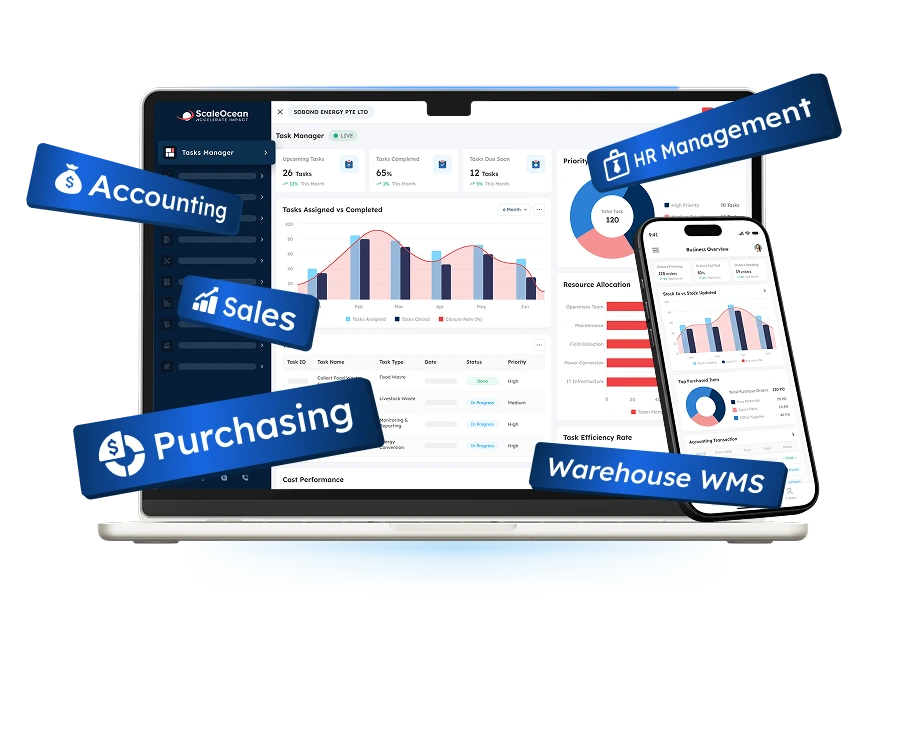
When your business expands, keeping track of inventory becomes difficult. ScaleOcean WMS ERP Software allows businesses to simplify and streamline inventory management by integrating with ERP systems and real-time tracking within one software platform.
If you’re looking to improve warehouse efficiency and inventory accuracy, request a free demo of ScaleOcean WMS ERP Software to see how it can support your business operations.
FAQ:
1. What do you mean by inventory control?
Inventory control tracks stock levels and customer demand to ensure the right products are available in the right quantities. It helps businesses reduce shortages, avoid excess inventory, and improve operational efficiency.
2. What are the 4 types of inventory control?
Common inventory control methods include ABC analysis, FIFO, LIFO, batch tracking, and safety stock. Each technique helps businesses optimize stock levels, improve inventory accuracy, and reduce unnecessary carrying costs.
3. What is KPI for inventory control?
Inventory control KPIs measure stock performance, including inventory turnover, stock accuracy, stockout rate, carrying cost, order fulfillment rate, and days of inventory on hand. These metrics help businesses optimize inventory and improve efficiency.
















.png)