




Inventory list BIR is an annual report that is submitted to the Bureau of Internal Revenue (BIR) which serves to confirm the business’ inventory and financial information. It is particularly suitable for retail stores especially in the Philippines.
Knowing the format, deadline, annexes, and how to submit are important in order to prevent compliance problems. This guide provides details on what and how to prepare your inventory list with BIR.
 Key Takeaways
- The BIR inventory list is an annual return to be filed pursuant to RMC No. 57-2015 of inventory-holding businesses and tangible asset-rich taxpayers to verify.
- Submissions of BIR inventory list is generally due 30 days after the close of the taxable year, meaning January 30 for calendar-year businesses.
- Businesses are required to adopt the specific format depending on their industry; Annex A, Annex B-, Annex C and Annex D.
- Automated software such as ScaleOcean Atlas eases compliance, making multi-warehouse records easier to access and provide accurate data.

1. What is Inventory List BIR?
The BIR inventory list is a complete statement of the inventory as well as other related information submitted to the BIR by the taxpayer. This could be products, materials, finished products, resale property facilities, depending on the company.
As per Revenue Memorandum Circular (RMC) No. 57-2015, the BIR shall ask for an annual inventory list and schedules with regard to property taxes of covered taxpayers. Also, the information should be correlated with the amounts reported on the financial statements and annual income tax returns.
This is especially crucial for companies that will have a large volume of inventory like retail stores, manufacturers, and construction companies. Having a reliable inventory stock control process would make your preparation easier as your stock data is already sorted and traceable at the end of the year.
2. Who Must Submit a BIR Inventory List?

The requirement is based on RMC No. 57-2015, and applies to taxpayers with balance sheets full of tangible assets, especially those taxpayers having 50 percent or more of their total assets in working current assets. Businesses commonly submit their inventory list include:
- Businesses Holding Stock-in-Trade: Manufacturing businesses (raw Materials, goods in process, and finished goods) and merchandising, wholesale, and retail businesses (goods held for resale).
- Real Estate and Construction Companies: Real estate developers reporting saleable units and project data, construction companies, and contractors reporting project related inventory schedules.
- Tangible-Asset-Rich Taxpayers: Taxpayers who are not inventory holders who are required to file the inventory tax return in either the prescribed BIR form or in the appropriate form based on the nature of their business.
This requirement can thus apply to big companies as well as smaller Philippine businesses such as retailers and online sellers, depending on their business registration and inventory operations.
Do Businesses with Zero Inventory Still Need to File?
Yes. Even when the company is a typical inventory company and it doesn’t actually have any inventory on the last day of the taxable year, it is still required to file an inventory list. It is always better to file a “nil” report than to not file one.
A retailer can for instance sell every product before December 31 and not stock any product at the end of the year. The business should keep records to justify zero balance instead of simply leaving the BIR without an explanation and follow the submission procedure applicable to the situation.
3. What is the BIR Inventory List Submission Deadline?
The Inventory list BIR deadline is generally 30 days after the close of the taxable year, based on Section 13 of Revenue Regulations No. V-1 as cited in RMC No. 57-2015. For businesses using a calendar year ending December 31, this means the inventory list is generally due by January 30 of the following year.
For BIR inventory list deadline 2027, a calendar-year taxpayer whose taxable year ends on December 31, 2026 would generally have until January 30, 2027 to submit its inventory list. Businesses using a fiscal year should instead count 30 days from the close of their applicable taxable year.
4. Examples of Downloadable BIR Inventory List Formats
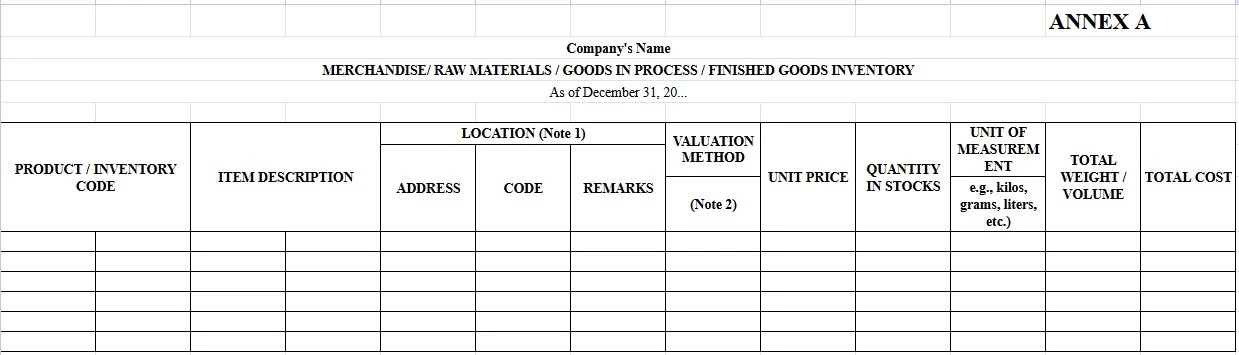
The BIR inventory reporting requirements are based on different forms by industry per RMC No. 57-2015. For instance, the following information on an inventory schedule (Annex A) could be arranged as follows:
- Annex A
Annex A
Annex A Template
- Annex B
Annex B
Annex B Template
- Annex B-1
Annex B-1
Annex B-1 Template
- Annex C

Annex C
Annex C Template
- Annex D
Annex D
Annex D Template
5. Some Requirements in a BIR Inventory List
An inventory submission must include all accurate information which can be compared to the company’s accounting records. Depending on the relevant annex and type of business, it may contain important information such as:
- Taxpayer/company information,
- Taxable year covered,
- Inventory location,
- Product or inventory code,
- Inventory description,
- Unit of measurement,
- Quantity on hand,
- Valuation method,
- Unit cost or price,
- Total inventory cost,
- Applicable remarks,
- Other schedules required for the taxpayer’s industry,
- Notarized certification under Annex D.
The information should match with your books, financial statements and annual income tax return. In particular, RMC No. 57-2015 highlights the reconciliation of the information provided with the financial statements and the annual income tax return.
This is where accurate inventory tracking becomes valuable. When stock movements are recorded consistently throughout the year, you can reduce the risk of discrepancies when preparing the year-end report.
Businesses can use an inventory management KPI to assess areas such as stock accuracy, turnover, and inventory efficiency. When it’s recorded consistently throughout the year, you can reduce the risk of discrepancies when preparing the year-end report.
6. The Annexes of a BIR Inventory List
The BIR has various annexes which are applicable to different businesses and information types. Determine which annex is relevant to your operations before you start preparing your submission.
| Annex | Who Uses It | What It Covers |
|---|---|---|
|
Annex A |
Manufacturing, retail, and wholesale businesses. |
Inventory of merchandise, raw materials, goods in process, and finished goods. |
|
Annex B |
Real estate companies. |
Inventory of saleable units with corresponding costs and realized gross profit per project. |
|
Annex B-1 |
Real estate companies. |
Reconciliation of saleable units per project with trade accounts receivable |
|
Annex C |
Construction contractors. |
Inventory schedule specific to ongoing construction projects. |
|
Annex D |
All covered taxpayers. |
Notarized certification accompanying the submitted USB or DVD-R. |
a. Annex A (Manufacturing, Retail and Wholesale)
The most popular format is the one known as Annex A, designed for companies that produce, distribute, or sell tangible products. It needs a complete breakdown of inventory variations for each one of them, along with their quantity, unit cost, and total values.
b. Annex B (Real Estate: Inventory and Costing)
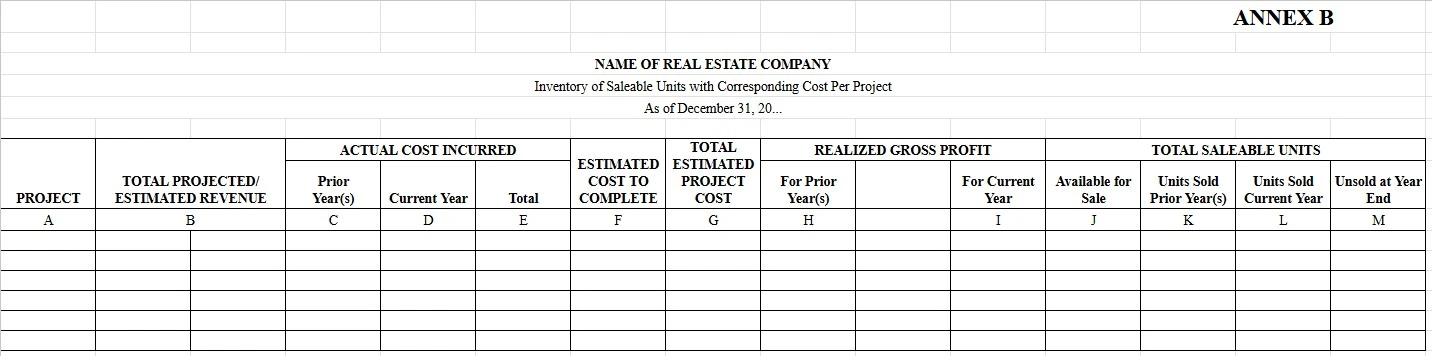
Annex B reports saleable units and project costs for each real estate project. It includes projected revenue, costs incurred in prior and current years, total costs to date, and estimated costs to complete.
It also records realized gross profit and unit movement, including total units available for sale, units sold in prior years, units sold during the current year, and unsold units at year-end.
c. Annex B-1 (Real Estate: Receivables Reconciliation)
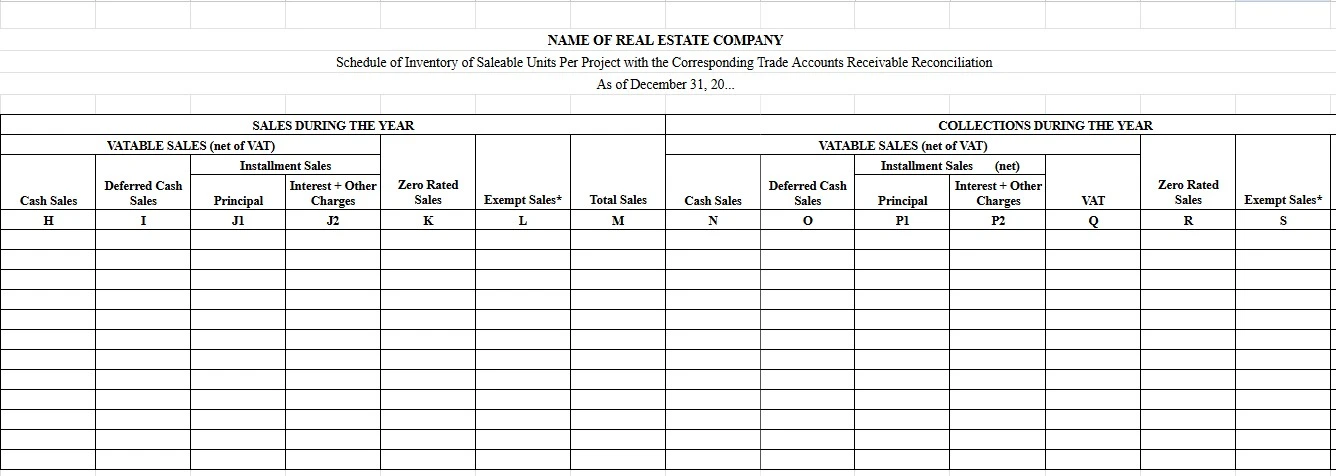
Annex B-1 works with Annex B to reconcile saleable units per project with related trade accounts receivable. It records beginning and ending receivables, sales during the year, and collections during the year.
Therefore, this schedule also classifies transactions by sales category, including full-payment, deferred cash, installment, zero-rated, and exempt sales under applicable BIR rules.
d. Annex C (Construction Contractors)
Annex C reports the outstanding receivables and gross profit earned on each project according to the percentage of completion method, as opposed to finished goods remaining on the books in a warehouse.
e. Annex D (Notarized Certification)
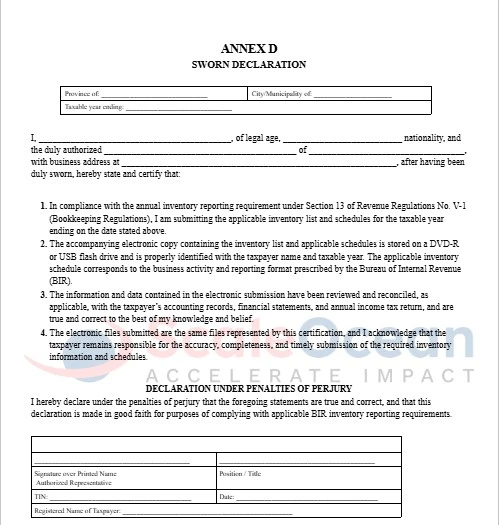
Annex D isn’t an inventory schedule itself; it’s the notarized certification that must accompany your USB flash drive or DVD-R, signed by an authorized representative attesting that the data submitted is true and correct.
 Also Read: Inventory Management: Meaning, Types, & Benefits
7. Penalties for Non-compliant BIR Inventory Lists
A submission that is late, incomplete, inaccurate, or not in the prescribed format may expose the taxpayer to penalties under the National Internal Revenue Code, as amended.
According to RMC No. 57-2015, submission of an information or document not in the proper form could result in the same being treated as not received by the BIR and thus be subject to penalties. It also refers to penalties under Sections 250 and 255 of the NIRC.
The amount of the compromise penalty may be different depending on the taxpayer’s situation and the applicable schedule. The amounts of RMC No. 57-2015 run from ₱1,000 to ₱25,000 depending on relevant taxpayer and current BIR rules. Possible consequences include:
- Compromise penalties.
- Additional BIR documentation requests.
- Delays during tax compliance reviews.
- Questions about inventory and cost of sales.
- Exposure for the audit on reported balances that cannot be supported. Therefore, maintaining accurate records through a perpetual inventory system can help businesses support reported inventory balances and respond to BIR documentation requests.
The penalty may be subject to certain conditions and may vary from case to case; therefore, businesses should check with the BIR or a qualified tax expert on the applicable amount of the penalty.
8. How to Submit Inventory Lists to BIR?
The procedure for inventory lists submitted to BIR usually entails the following steps: (1) preparing the proper inventory schedule, (2) filling out the Certification and (3) filing the inventory lists using the proper BIR filing avenues. A practical process is:
- Determine Business Focuses: Review business activity, inventory, accounting period and BIR requirements.
- Identify the Correct Annex: Select the appropriate Annex A, B/B-1, and/or C for your industry and reporting needs.
- Conduct a Year-End Inventory Count: Ensure that the amount and quality of inventory is correct at the end of the taxable year.
- Reconcile the Data: Ensure that your physical inventory is in line with your stock records, accounting records, financial statements, and annual income tax return. Whether you use a periodic inventory system or a perpetual inventory system, reconciling these records helps uncover discrepancies prior to official filing.
- Prepare the Prescribed Format: Fill in the required information on BIR inventory list/ schedules on the prescribed format.
- Prepare the Notarized Certification: Fill in the relevant Annex D certification and get it notarized as necessary.
- Save the Soft Copies: The soft copies are to be saved on a labeled DVD-R or USB flash drive (per RMC No. 8-2023).
- Submit to the Appropriate BIR Office: The non-large taxpayers shall submit to the concerned Revenue District Office (RDO) while the taxpayers under Large Taxpayers Service (LTS) shall submit to the appropriate LTS Office. Also, check with your RDO for the current procedure before submitting. The BIR also offers online provision and guidance for some inventory related reports and notices via its TRRA Portal.

9. Common Mistakes to Avoid in Making / Submitting Inventory Lists
It is best to prepare the inventory list a few days before the deadline, to minimize the risk of errors. Therefore, it’s recommended that the finance team knows the do’s and dont’s to avoid these common problems.
- Using the Wrong Format: Avoid relying on outdated Excel templates found online. Please refer to current BIR requirements and ensure that the format is suitable to a particular business type.
- Reporting Inaccurate Quantities: Before reporting, do an accurate physical inventory and ensure that your inventory records align with your physical count.
- Ignoring Multiple Locations: Consolidate and verify inventory across stores, branches, and warehouses. A centralized warehouse inventory audit process can help identify discrepancies before filing.
- Using Inconsistent Valuation: Make sure inventory amounts are consistent with your accounting records and applicable stock valuation method. Avoid adjusting figures simply to make reports match.
- Forgetting the Notarized Certification: Check that the required notarized certification and other supporting documents are complete before submitting the inventory list.
- Waiting until January to organize inventory: Track inventory movements throughout the year so year-end reporting does not require last-minute manual data gathering. Implementing BIR-capable inventory software can automate these processes, helping eliminate manual calculation errors and ensuring seamless tax compliance.
10. How ScaleOcean Atlas Streamlines Your BIR Inventory List Process
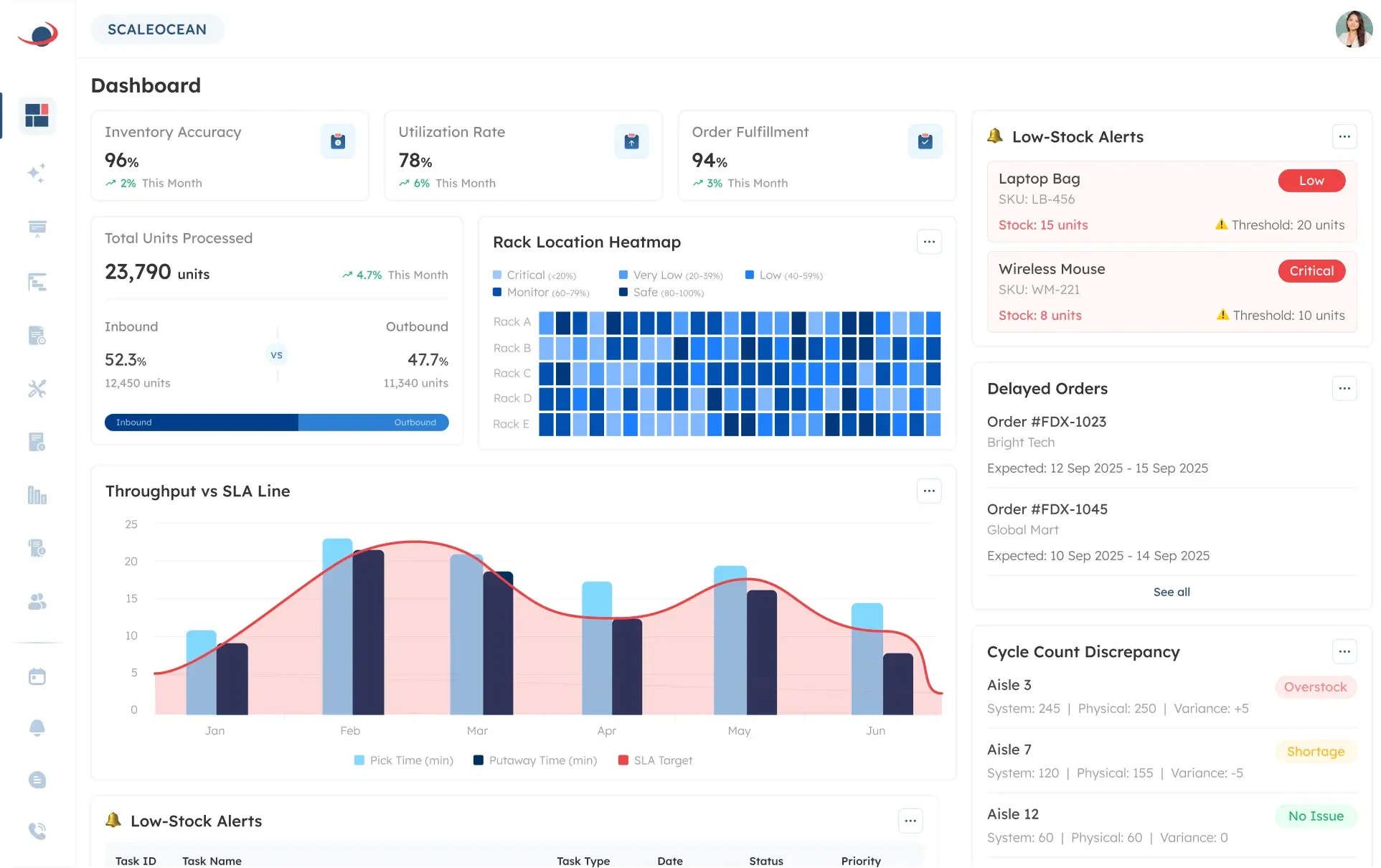
Preparing a BIR inventory list becomes more challenging as businesses grow, especially when they manage more SKUs, warehouses, branches, purchases, and stock movements. Manual records can make it harder to reconcile inventory data and increase the risk of errors during year-end reporting.
The inventory module of ScaleOcean Atlas helps businesses organize inventory data in one centralized system, making it easier to monitor stock levels, movements, locations, and inventory costs.
With better inventory visibility, businesses can also reduce discrepancies of inventory. ScaleOcean Atlas can support more consistent inventory control throughout the year, so teams do not have to manually gather the data before the BIR deadline.
Schedule a consultation to explore how ScaleOcean Atlas can help improve inventory accuracy and streamline your BIR inventory list preparation. Key features include:
- Real-Time Inventory Tracking: Monitor stock quantities and movements across warehouses, branches, and other inventory locations.
- Centralized Inventory Records: Keep product information, stock balances, and inventory movements organized in one system for easier year-end reconciliation.
- Automated Inventory Recording: Reduce manual data entry by recording inventory movements from purchases, sales, returns, transfers, and other transactions.
- Warehouse Management: Manage inventory across multiple warehouse locations and maintain better visibility of where products are stored.
- Inventory Audit Support: Compare recorded inventory with physical counts and identify discrepancies before preparing the BIR inventory list.
- Inventory Valuation: Maintain more consistent inventory costing records to support accurate Stock Valuation and financial reporting.
- Barcode and RFID Integration: Improve product identification and stock counting while reducing manual data-entry errors.
- Inventory Reporting: Generate organized inventory information that can make it easier for teams to gather and reconcile the data needed for BIR reporting.
11. In Conclusion
The inventory list BIR is an important annual compliance document for Philippine businesses that maintain merchandise, raw materials, supplies, goods in process, finished goods, or other applicable inventory.
The general rule is that it is due within 30 days of the end of the taxable year (30 January for calendar year businesses). Taxpayers should complete their ending inventories for the year ended 31 December 2027, and submit by 30 January 2027, for FY 2027.
Fill your BIR inventory list using the proper format, fill the appropriate annexes and compare the report with your account records. For this seamless process, ScaleOcean Atlas can assist in a more accurate and efficient inventory listing.
Schedule a consultation with the ScaleOcean team to discuss your Philippine warehouse and inventory requirements, reporting workflow, and business goals.
FAQ:
1. How can I download the BIR inventory List?
Use official templates and forms (Annexes A, B-1, C, D) from the BIR website using RMC No. 57-2015 or trusted local tax compliance portals where copies of the forms are downloadable in Excel.
2. What to include in an inventory list?
Fill in the key information about each item, such as SKU codes, product descriptions, storage areas, quantities, unit prices, valuation criteria, and total values, which align with your financial statements.
3. How to submit inventory list to BIR 2027?
For calendar-year businesses, submit soft copy Excel files on a labeled USB or DVD-R to your RDO or through BIR TRRA Portal by Jan. 30 along with a notarized Annex D certification.
















.png)