Barangay Business Permit plays a significant role in the local permitting procedure for businesses. It goes about the work of getting several local permits and clearances before they can be legally run.
This document, also called a Barangay Business Clearance, is required to get a Mayor’s Permit. Under the Local Government Code, cities and municipalities can only issue a business license after receiving clearance from the barangay where the business operates.
Knowing the required documents, application process, fees, and renewal procedures helps business owners apply efficiently. Understanding how to get a Barangay Business Permit is essential for doing business in the Philippines.

Key Takeaways
- A Barangay Business Permit is a certification of a business’s barangay clearance before being applied for the respective City or Municipal Business Permit.
- Requirements for Barangay Business Permits will differ among the LGUs, but in most cases, they will require an ID, business registration papers, and proof of address.
- The applicable fees may vary by LGU and business type, so businesses should check their local fee schedule to determine the amount they need to pay.
- ScaleOcean Atlas helps businesses centralize operational records and workflows, making it easier to organize information needed for business compliance.
Schedule a consultation
What is a Barangay Business Permit?
The barangay clearance for applying for local business permit is commonly known as a Barangay Business Permit. It validates the presence or the operation of a business in the barangay and that there is no objection from the barangay to operate the business.
This clearance is generally applicable to businesses engaged in commercial activities like in the sale of products, provision of services, manufacturing or processing of goods within the barangay. It is not to be mistaken for the Mayor’s Permit or Business Permit issued by the Mayor’s or Municipal’s office.
The legal basis is Section 152(c) of Republic Act No. 7160, or the Local Government Code of 1991. Provides that a business can only be given a license or permit by a municipality after receiving a clearance from the barangay where the business will be licensed or conducted.
Under Section 11(f) of Republic Act No. 11032 (the Ease of Doing Business Act), business permits are now obtained, issued and collected at the city/municipality, and barangay share of business permit fees are given to the barangay.
Moreover, the term used for the document differs from one local government unit (LGU) to another with some referring to it as a Barangay Business Permit, and others as a Barangay Clearance or Barangay Business Clearance. The best way to do this is to use the term and method for application your local government employs.
Barangay Business Permit vs. Barangay Clearance: What is the Difference?
For businesses, there is usually no difference. Barangay Business Permit is an informal name for the clearance needed before applying for a Mayor’s Permit. Some local government units may call it a Barangay Business Clearance, but it refers to the same requirement.
The confusion arises because “barangay clearance” is a broader term. Barangays also issue clearances for individuals, such as for employment or ID applications, which are completely separate from what a business needs.
|
Barangay Business Permit/Business Clearance |
General Barangay Clearance |
| Who needs it |
Business owners |
Individual residents |
| Purpose |
Shows the barangay has no objection to the business operating in the area |
Certifies a resident’s good standing for personal or employment purposes |
| Used for |
Applying for the Mayor’s/Business Permit |
Job applications, IDs, and other personal requirements |
Who Needs to Secure a Barangay Business Permit?

Now, any business set up in a barangay will need to obtain a barangay clearance to obtain the Mayor’s Permit for the business. Section 152(c) of the Local Government Code covers any business or activity located or conducted in the barangay, here are the categorized:
- Sole proprietorships registered with the Department of Trade and Industry (DTI).
- Companies and associations that are registered with the Securities and Exchange Commission (SEC).
- Cooperatives that had been registered with the Cooperative Development Authority (CDA).
- Small and home-based businesses, e.g. sari-sari stores, food stalls, online sellers from homes.
- Retail, service, manufacturing, and office-based businesses.
This requirement applies to both new and existing businesses. New businesses require the clearance in order to obtain their first Mayor’s Permit and existing operations require annual renewal of the permit in conjunction with their municipal business permit.
For businesses with several branches, a separate clearance for every branch must be acquired, based on the barangay of each branch. Keep in mind that requirements and application process may differ from one local government unit (LGU) to another.
In many cities and municipalities, the clearance is now integrated and processed through the local Business Permits and Licensing Office (BPLO) rather than at the barangay hall. Always verify the correct application venue with your LGU.
What is the Legal Basis for the Barangay Business Permit?
The Barangay Business Permit is supported by several Philippine laws and government guidelines. Key legal references include:
- Republic Act No. 7160 (Local Government Code of 1991): Section 152(c) requires a barangay clearance before a city or municipality can issue a business license or permit for an activity conducted within the barangay.
- Seven-working-day Processing Period: Section 152(c) provides that the barangay should act on a clearance application within seven working days. If it is not issued, the city or municipality may issue the applicable permit.
- Republic Act No. 11032 Ease of Doing Business and Efficient Government Service Delivery Act of 2018: The Ease of Doing Business Act promotes faster and simpler government transactions, including processes related to business registration and local permitting.
- Local Barangay Ordinances and Procedures: Cities, municipalities, and barangays may set their own requirements, fees, and procedures. Businesses should check with their local permitting office for the latest rules.
Barangay Business Permit Requirements
Before applying for a Mayor’s Permit, a business generally needs to secure a Barangay Business Clearance from the barangay where it operates. This clearance confirms that the barangay has no objection to the business operating within its area.
The requirement can apply to different types of businesses, from small sari-sari stores to larger companies. For businesses opening a new branch, securing the barangay clearance is typically one of the first steps to do. Here are the requirements:
- Proficient barangay clearance and business clearance application form.
- Valid government-issued ID.
- With Community Tax Certificate (CTC) if necessary.
- For sole proprietorships, DTI Business Name Certificate is required.
- Corporation or Partnership Registration with the SEC.
- Documentation of business place or ownership.
- Lease contract (if premises are leased).
- Previous barangay clearance, for renewals.
- Existing mayor’s/business permit, renewal.
- Other documents as required by the local ordinance.
The Department of the Interior and Local Government (DILG), which oversees local government units (LGUs), outlines standard guidelines for local processes. Its official service guide lists a valid ID and a Community Tax Certificate as key requirements for a Barangay Business Clearance.
Requirements can vary depending on the LGU and type of business. Some businesses may also need additional permits or supporting documents based on their activities and local regulations.
How to Apply for a Barangay Business Permit
The process for obtaining a Barangay Business Permit can differ between LGUs. Some still process applications primarily through barangay or city/municipal offices. Here are some common steps to apply Barangay Business Permit:
Step 1: Confirm Where to File — Barangay Hall or City Hall
First, you can identify the location of your LGU business clearances. Applicants could come to the barangay hall where the business is situated. Some of the cities and municipalities include business permitting systems which allow the application and payment to be made through the city or municipality’s website.
Step 2: Complete the Barangay Business Clearance Application Form
Complete the necessary application with the business details. Business name and address, owner or authorized representative and business registration details you might need to provide depending on the form.
Step 3: Submit Your Documentary Requirements
Return completed form and documentation to the appropriate office. The barangay or LGU reserves the right to check the documents for the business location, business ownership, business registration and other information requested by the local rules.
Step 4: Pay the Assessed Fees
The Barangay/LGU will evaluate the fee(s) applicable after reviewing the application. Where reasonable, Barangay may collect fees for the clearance under the Local Government Code, and specific charges are provided for under applicable local ordinances.
Step 5: Claim Your Barangay Business Clearance
After receiving approval from the application and payment of pertinent fees, claim the barangay business clearance. Preserve a note of the original and a copy, if applicable. Clearance may be required at the next step in the local business permitting process.
Step 6: Proceed to Your Mayor’s Permit Application
The barangay clearance is a general requirement for city or municipal business permit. Local business taxes, regulatory fees and other relevant taxes may be considered at this time by the LGU. DILG guidance explicitly mentions the barangay clearance requirement as related to the issuance of business permits.
How Much is a Barangay Business Permit?
There aren’t any obvious country-wide charges for every company. This may vary according to several factors, such as barangay ordinance, city/municipal ordinance, type of business, size of business/capitalization, and local charges.
For instance, a DILG published service guide in a specific locality had a clearance fee of ₱500 as provided for in its local barangay ordinance. It’s a good example as to why businesses should not view a fee from another city/barangay as a national standard.
It is also important not to confuse the barangay clearance fee with the DTI business name registration fee, since they are separate charges paid to different offices. To get the most accurate amount, refer to your barangay’s current fee schedule, or contact your local business permitting office.
Barangay Business Permit Sample
There is no standard nationwide template for a Barangay Business Permit and it may vary from one LGU to another. For actual applications, always use the official form that is provided by the barangay or local government unit. Here’s an example of a Barangay Business Permit:
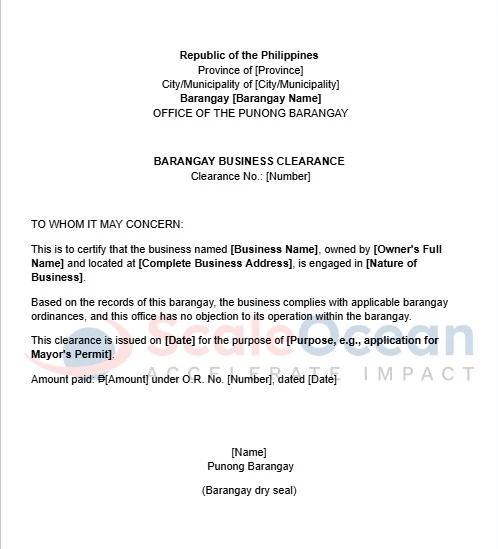
Template-Barangay Business Sample
Barangay Permit Sample
Note: The example provided above is intended for educational and illustrative purposes only. As barangay business permits differ between local municipalities, please consult with your local barangays regarding the template / sample that applies within that specific region.
How Long is a Barangay Business Permit Valid?
The validity of a Barangay Business Permit is usually for a period of one (1) year. But the period of validity is subject to the local policy of the barangay. Some of the conditions of Barangay Business Permit includes:
- Many barangays have clearances that are only good for the year you apply for, from January 1st to December 31st of the year of application.
- Some barangays, on the other hand, calculate the one-year validity from the actual date the clearance was issued.
- For business-related clearances, the validity is generally aligned with the annual business permit cycle and often expires on January 31 following the year of issuance.
Therefore, it is usually recommended to renew your Barangay Business Clearance annually, usually in January along with your Mayor’s Permit/Business Permit renewal to keep business compliance with the regulations.
How to Renew Your Barangay Business Permit
Renewal is generally simpler when the business information has not changed, but businesses should still verify the current requirements with their LGU. A typical renewal of Barangay Business Permit process may include:
- Check the renewal schedule of your barangay or LGU.
- Prepare the previous barangay clearance and other required documents.
- Update the application form if necessary.
- Submit the renewal documents.
- Pay the applicable fees.
- Obtain the renewed barangay clearance.
- Complete the corresponding business or mayor’s permit renewal.
However, if the business has moved locations, changed its ownership structure, added activities, or changed other material information, additional documents may be required.
It is also worth checking whether your LGU has adopted online processing. DILG reported that eLGU can support online access to business permits and barangay business clearances in participating LGUs.
What Happens If You Operate Without a Barangay Business Permit?
Operating without the required local permits can create compliance problems for a business. The potential consequences depend on the applicable local ordinance, business activity, and circumstances. These may include:
- Delays in obtaining or renewing the business permit.
- Local penalties or surcharges.
- Additional compliance requirements.
- Possible enforcement action under applicable local rules.
- Difficulty demonstrating that the business has completed required local registrations.
The barangay clearance requirement itself is established under the Local Government Code. The law also gives barangays authority to impose reasonable fees and allows local governments to regulate businesses through applicable ordinances.
For this reason, businesses should not assume that having a DTI business name registration or SEC registration alone is enough to operate. DTI explicitly explains that business name registration provides a business with legal identity, while a business or mayor’s permit is still needed to actually operate where required.
In Conclusion
Barangay Business Permit is an important step in the local business permitting process in the Philippines. It has secured the required barangay-level clearance before proceeding with the applicable city or municipal permit.
The procedure is generally simple but such requirements, fees, forms and processing channels may vary from one LGU to another. It is advisable to not depend on a generic requirement, but to review their local ordinance and existing instructions.
When each process is handled individually, it can be difficult for a business to maintain organization as it grows with regard to permits, registrations, financial records, inventory, and other operational information.
A centralized business management platform such as ScaleOcean Atlas for managing documents can help businesses bring key operational processes into one system, depending on the modules and workflows they need.
If your business is looking to improve how it manages operations and administrative workflows, schedule a consultation with ScaleOcean Atlas to discuss how the platform can be configured around your business requirements.
FAQ:
1. How to register a small business in barangay?
Visit the barangay where your business operates and apply for a Barangay Business Clearance. Prepare the required documents, such as a valid ID, business registration documents, and proof of address, based on your LGU’s checklist.
2. Is a business permit different from a barangay permit?
Yes. A barangay clearance is a clearance obtained from the barangay, and is usually needed to acquire a city or municipal business permit. Permit issued by city/municipality for doing a business or as a mayor.
3. How many days to process a business permit?
The processing time will depend on the LGU, type of application and completeness of documents. Local Government Code provides for a seven-day period for a barangay clearance, and the total process of obtaining a business permit may be longer.