Sales journal is an account used for tracking the credit sales of a business in one place. The sale of invoices or related accounts is tracked instead of recording every sale transaction in the general journal.
Understanding the components of a sales journal and how it relates to invoices, subsidiary ledgers, and the BIR can streamline your business processes to the perspective of accounting and bookkeeping services in the Philippines.
Also, this guide to the sales journal includes the sales journal format, a sales journal example, and how to record sales in a journal entry as well as a simple VAT example to make your finances a lot easier.
Key Takeaways
A sales journal records credit sales in an organized format, helping businesses track sales, customer receivables, and related accounting entries.
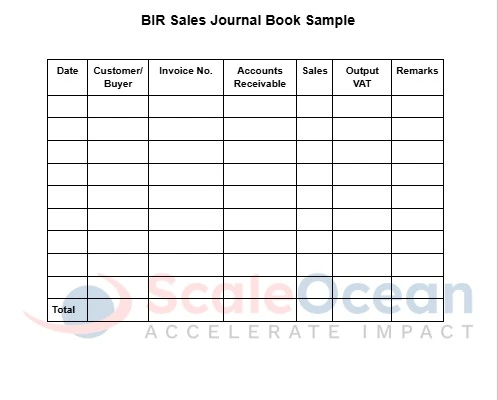
A BIR sales journal book sample with no entries may assist organizations to organize the sales transactions but the format must be changed according to the system.
Scale Ocean Atlas has the feature of providing the tool to collect, manage and organize all information relating to your accounting, invoicing, sales, and finances.
A sales journal is a special journal used to record a sale by a business. It simplifies tracking revenue and accounts receivable by grouping like transactions, removing the need to record each credit sale separately. Here is typically recorded in each entry:
Date of the sale.
Invoice number.
Customer name.
Amount charged, including VAT where applicable.
Credit terms, such as 30 days.
After this has been done the total of the sales journal is posted to the debit of the accounts receivable and to the credit of the sales account in the general ledger. The spread of the column total is posted to each customer in the subsidiary ledger.
What Transactions Go Into a Sales Journal?
The sales journal usually contains transactions that satisfy the sales-journal business’s set of rules. The specific books and mode of recording vary according to the type of accounting system of the business and the BIR requirements. Usually it includes:
Credit Sales of Merchandise: Accounts for items that are sold but not paid for at the time of sale, instead being paid for at a later date.
Sales Invoice Transactions: Records sales supported by a sales invoice issued and its related transaction details.
Accounts Receivable Sales: These are sales transactions where the customer agrees to pay at a future date.
VATable Credit Sales: For VAT-registered businesses, the journal can separately list sales amount and the corresponding output VAT.
Sales Returns and Allowances: These can be entered in a sales returns and allowances journal or by using proper adjustment entries.
2. Sales Journal Format: The Standard Columns
The simple sales journal format is intended to record the information needed to credit sell sales. Different business may have different column headings, but the majority will use the following:
Date: Shows when the sale occurred.
Customer/Account Debited: Customer to which accounts receivable increases.
Invoice Number: Provides a reference to the sales invoice.
Description: Briefly explains the goods or services sold.
Accounts Receivable: Records the total amount receivable from the customer.
Sales: Records the revenue from the transaction, usually exclusive of VAT when VAT is separately recognized.
Output VAT: Records VAT collected from a taxable sale, when applicable.
Other Accounts: Used when the transaction requires additional account classifications.
A simple format may look like this:
Date
Customer
Invoice No.
Accounts Receivable
Sales
Output VAT
Oct. 2
ABC Trading
SI-1001
₱11,200
₱10,000
₱1,200
Oct. 3
XYZ Retail
SI-1002
₱22,400
₱20,000
₱2,400
Total
₱33,600
₱30,000
₱3,600
3. How to Record Sales in a Sales Journal
Recording sales in a journal entry seems less daunting when you understand what’s involved in a sales transaction, along with what order they’re recorded. Typically, data regarding sales is processed from the sales invoice into the general ledger.
A. Issue the Sales Invoice
The first step is to document the sale using the appropriate invoice. For Philippine businesses, invoicing requirements are governed by the Tax Code and related BIR regulations.
RR No. 7-2024 clarifies the requirements for VAT invoices, accounting requirements, and preservation of books and accounting records. The invoice should indicate the data specified under the relevant BIR regulations.
B. Enter the Transaction in the Sales Journal
Post the transaction to the sales journal after the invoice. The following example illustrates credit sales of a VAT-registered business where goods purchased cost 10,000 before 12% VAT is added:
Accounts Receivable: ₱11,200
Sales: ₱10,000
Output VAT: ₱1,200
As a result, the sales journal entry will show the amount to be collected from the customer and show that the sale revenue and output VAT are separate.
C. Post to the Customer’s Accounts Receivable Subsidiary Ledger
The individual transaction should also be posted to the customer’s subsidiary ledger. This gives the business a customer-level record showing invoice number, sale date, amount charged, or payments received. This subsidiary ledger provides a more practical way to monitor who still has an unpaid balance.
D. Total the Journal and Post to the General Ledger
At the end of the month, total each column and confirm that Accounts Receivable equals Sales plus Output VAT. Then post the totals to the general ledger by debiting Accounts Receivable and crediting Sales and Output VAT Payable. The Accounts Receivable control account should match the sum of all customer balances in the subsidiary ledger.
E. The Equivalent General Journal Entry for a Sale
While a sales journal can be a time saver for repetitive sales transactions, you should also be aware of the general journal entry it replaces. The generic one is shown below, a 10,000 VAT exclusive credit sale:
Account
Debit
Credit
Accounts Receivable
₱11,200
–
Sales Revenue
–
₱10,000
Output VAT
–
₱1,200
Total
₱11,200
₱11,200
The debit is the total of what the customer owes, and the credits split the income from the VAT amount.
4. Sales Journal Example
A sales journal example can help illustrate how a credit sale is recorded, including the calculation of VAT. For this example, assume a Philippine VAT-registered business sells goods worth ₱10,000 before VAT on credit. With a 12% VAT, the output VAT is calculated as follows:
Sales amount: ₱10,000
Output VAT: ₱10,000 × 12% = ₱1,200
Total amount receivable: ₱10,000 + ₱1,200 = ₱11,200
The ₱11,200 represents the total amount the customer owes, while ₱10,000 is recognized as sales revenue and ₱1,200 as output VAT.
Sales Journal Example for a Philippine Business (With VAT)
Based on these calculations, the business can record each credit sale in the sales journal by separating the sales amount, output VAT, and total accounts receivable, as shown below:
Date
Customer
Invoice No.
Accounts Receivable
Sales
Output VAT
Oct. 2
ABC Retail
SI-1001
₱11,200
₱10,000
₱1,200
Oct. 5
XYZ Store
SI-1002
₱16,800
₱15,000
₱1,800
Oct. 8
Mabuhay Trading
SI-1003
₱22,400
₱20,000
₱2,400
Total
₱50,400
₱45,000
₱5,400
5. The BIR Sales Journal: What Philippine Businesses Need to Know
Many businesses treat the sales journal as routine bookkeeping. In the Philippines, it is also a compliance record. Under RR No. 7-2024, which implements the Ease of Paying Taxes (EOPT) Act:
VAT-registered taxpayers must maintain a Subsidiary Sales Journal and a Subsidiary Purchases Journal.
Daily sales and purchases must be recorded in these journals.
All books of accounts, including subsidiary books, must be preserved for five years.
Manual and loose-leaf books are kept in hard copy, while computerized books are kept in electronic copy.
Another factor is the format of your books matters as well. Based on RMC No. 65-2025, new business registrants can choose manual, loose-leaf, or computerized books of accounts. Each format has its own requirement:
Manual books: Can be registered without a separate permit.
Loose-leaf books: Need a Permit to Use before use.
Computerized books: Need an Acknowledgement Certificate before use.
Both authorizations are issued only after a TIN is assigned, so they can’t be processed together with TIN issuance. Using loose-leaf or computerized books without them can make a business liable for improper recording from day one. Knowing which rules apply is the first step toward sales records that hold up in a BIR audit.
Who Needs to Keep a Sales Journal for BIR?
Under Section 232 of the National Internal Revenue Code (NIRC), every person or entity subject to internal revenue tax must keep books of accounts. In practice, this applies to:
Corporations: Must keep and register books of accounts with the BIR.
Partnerships: Subject to the same Section 232 requirement.
Sole proprietors: Must maintain registered books for their business.
Freelancers and self-employed professionals: Also covered if they are registered with the BIR and subject to internal revenue tax.
VAT-registered taxpayers: The sales journal is a firm requirement. On top of the general journal, general ledger, and cash receipts and disbursements books, they must keep a subsidiary sales journal and a subsidiary purchase journal.
Non-VAT businesses: Still need books of accounts, but the exact set depends on their registration type and size.
Businesses with gross annual sales, earnings, receipts, or output above ₱3 million: Under Section 232(A), their books must be audited by an independent CPA.
6. BIR Sales Journal Book Sample (Free Template)
A BIR sales journal book sample can help businesses organize credit sales and maintain a consistent record of their transactions. The template below provides a simple structure that businesses can customize based on their accounting process and applicable BIR requirements.
A sales journal can simplify recurring sales transactions, but it also adds another bookkeeping process to manage. Consider both sides before deciding how to structure your accounting workflow:
Pros
Cons
Keeps similar credit sales together for easier review.
Allows recurring transactions to be summarized before posting to the general ledger.
Works alongside subsidiary ledgers to monitor customer balances.
Totals can be compared with invoices and ledger balances.
Requires consistent recording and maintenance.
A sales journal is mainly designed for specific types of sales transactions.
Manual processes can cause duplicated or missed transactions.
High transaction volumes can make manual journals cumbersome.
8. Common Mistakes When Keeping a Sales Journal
Even small bookkeeping mistakes can create big reconciliation issues down the road. Catching and preventing errors early on can go a long way in ensuring accuracy in your books. Read on to learn about some of the biggest errors to avoid:
Recording the Wrong Invoice Number: The references being wrong can cause many complications with identifying exactly which transaction the invoice relates to.
Mixing Cash and Credit Sales: A sales journal is generally used for transactions that meet the business’s sales-journal criteria, so cash sales should be handled according to the accounting system’s established procedure.
Incorrect VAT Calculation: Separating sales from output VAT incorrectly can affect financial records and tax reporting.
Skipping Subsidiary Ledger Updates: Failing to update customer balances can make accounts receivable difficult to reconcile.
Posting the Wrong Amount: The total receivable should agree with the amount supported by the invoice.
Duplicate Entries: Recording the same invoice more than once can overstate sales and receivables.
9. Automating Your Sales Journal with Accounting Software
If your company only has a handful of sales each month it could still be manageable to have a sales journal by hand. But when you begin to make sales on a much larger scale, tracking invoices, customer balances, VAT & transactions in the ledger all start to take longer.
We have the technology to make this easier for you by linking sales activity to invoicing, accounts receivable, general ledger and financial reporting. In what business can you load all your accounting data into one place.
For Philippine businesses, having connected records can also make it easier to trace sales invoices and related accounting entries when reviewing financial data. It is also recognized under applicable BIR requirements or acknowledgment rules.
For businesses looking to move beyond manual bookkeeping, ScaleOcean Atlas Accounting Software offers an integrated approach to managing accounting and financial processes.
To explore accounting automation, book a consultation with the ScaleOcean Atlas team to tailor a system for your operations. You can also review ScaleOcean Atlas’s core features to see how it can optimize your daily finance workflow:
Integrated Accounting: Connects sales, invoicing, accounts receivable, general ledger, and financial reporting within one system.
Sales and Receivables Management: Helps businesses record sales transactions and monitor customer balances from a centralized platform.
Invoice Management: Keeps sales invoices and related financial records connected for easier transaction tracking.
VAT and Tax Management: Helps organize applicable VAT and tax-related data alongside sales and accounting records.
General Ledger Management: Centralizes accounting entries to support consistent posting and financial recordkeeping.
Financial Reporting: Provides access to financial data and reports for reviewing transactions and monitoring business performance.
Centralized Financial Data: Reduces repetitive data entry by keeping related accounting information within a connected system.
In Conclusion
A sales journal gives businesses a structured way to record and organize credit sales. It connects sales invoices with accounts receivable and the general ledger, making it easier to monitor transactions and keep financial records consistent.
It should also comply with the applicable BIR rules and regulations on the use of invoices, books of accounts and accounting records of Philippine business. As the number of transactions increases, accounting software can help streamline this process by linking sales, receivables, invoicing and reporting in one system.
For businesses looking to streamline their accounting processes, ScaleOcean Atlas for Accounting provides integrated accounting capabilities that can connect financial data with other business operations.
1. What is the difference between a sales journal and a purchase journal?
A sales journal is for credit sales to customers, and a purchase journal is for credit purchases from suppliers. Both are special journals for daily, repeating transactions.
2. Are sales journal and revenue journal the same?
They may be used for a similar term, but a sales journal documents credit sales. A revenue journal may be used more generally, to record income from various sources.
3. How to fill out a sales journal?
Input the transaction date, customer name, invoice number, amount due, sale and total VAT. Make sure that each of these has a corresponding sales invoice, then post them in their respective ledgers.
4. How to write a sales journal BIR?
Use one of these book formats to record sales with transaction date, invoice number, customer name, sale amount and VAT amount. Businesses should comply with the recent BIR requirements for the books and accounting system they are registered with.













 Key Takeaways