




Warehouse storage racking system is one of the techniques used in warehouse management. This system eventually aids companies to save products, maximize storage area, and improve products accessibility.
An organized warehouse is crucial to ensure efficiency in order fulfillment for all customers. Furthermore, this article will provide directions on how to maximize space and utilize warehouse racking systems for business in the Philippines.
 Key Takeaways
- Warehouse racking system is a storage solution that organizes inventory, maximizes warehouse space, and improves product accessibility for more efficiency.
- The different types of racks in warehouses include selective, double-deep, drive-in/drive-thru, push back, pallet flow, and cantilever racks.
- Warehouse racking systems integrate technologies such as AS/RS, barcode/RFID, modular racking, and WMS to improve inventory operational efficiency.
- ScaleOcean Warehouse Management ERP Software helps businesses optimize warehouse racks with real-time inventory tracking and AI-powered recommendations.

1. What is a Warehouse Racking System?
A warehouse racking system is a building system that is designed to organize products, cartons or raw materials inside the warehouse. It utilizes vertical storage to gain area in the warehouse and ensure efficient access to inventory.
Racking systems are designed to organize products in specific areas within the warehouse to provide efficient storage and retrieval, rather than stacking them on the floor.
This rationalised approach thus optimises storage space and minimises wasted movements of warehouse personnel. Warehouse racking systems are utilized in a variety of industries for businesses in the Philippines, including:
- Manufacturing.
- Food and beverage.
- Retailers and wholesalers.
- Third-party logistics (3PL).
- Pharmaceuticals.
- E-commerce fulfillment centers.
The warehouse racking system enhances its functionality even further when it’s paired up with a warehouse management software, enabling businesses to keep a check on where the items are located, monitor the flow of goods, and optimize the operations.
2. What are the Benefits of Warehouse Racking?

A properly designed warehouse racking system can offer much more than just a way to store items. It directly boosts warehouse productivity and assists in effective inventory management. Here are some of the advantages of a warehouse racking system:
- Maximizes Warehouse Space: Makes maximum use of the vertical space in a warehouse to hold more inventory without increasing the warehouse square footage.
- Improves Inventory Accessibility: Organizes products into designated storage locations, making them easier to locate and retrieve. Applying effective inventory warehouse organization ideas further improves stock visibility, reduces search time, and supports faster order fulfillment.
- Supports Better Warehouse Safety: Minimizes the danger of unstable stacking, obstructed aisles, and product damage.
- Speeds Up Warehouse Operations: Automates the receiving process in warehouse, reducing the time needed for this stage of warehouse operations.
- Reduces Inventory Errors: Minimizes misplaced inventory and supports accurate stock counting
- Supports Business Growth: Allows for expansion of storage space with extra levels of racking rather than moving to a bigger warehouse.
Moreover, the Philippine Department of Labor and Employment (DOLE) stating some of requirements to ensure safe working conditions to minimize occupational risks, and this system enables companies to provide for their workplace safety needs with better racking systems.
3. The Different Types of Racks in Warehouses
| Warehouse Rack Type | Best For | Key Advantage | Consideration |
|---|---|---|---|
| Selective Racks | Mixed inventory. | Direct pallet access. | Needs wider aisles. |
| Double-Deep Racks | Medium inventory turnover. | Higher storage capacity. | Requires reach forklifts. |
| Drive-In/Drive-Thru | Bulk inventory. | Maximum storage density. | Limited pallet access. |
| Push Back Racks | Medium SKU variety. | Fast pallet retrieval. | Higher installation cost. |
| Pallet Flow Racks | FIFO inventory. | Automatic stock rotation | Requires regular maintenance. |
| Cantilever Racks | Long or bulky materials. | Easy handling of oversized items | Not for palletized goods. |
There are several types of racks storing systems in the warehouse. This is because every business has different needs for different warehouse layouts, depending on the amount or the size of products. Here are some of the types of racks used in warehouse:
a. Selective Racks
Because selective pallet racks allow immediate access to each pallet, they are the most common type of warehouse racking system. This system is flexible for warehouses where different products can be easily retrieved or stored.
Moreover, it is a popular racking solution for retail distribution centers, manufacturing warehouses, third-party logistics (3PL) and electronic commerce fulfillment centers where items are moved often.
Best for:
- Retail warehouses.
- Distribution centers.
- Various inventory types and SKUs.
- Fast-moving products.
Advantages:
- Access to all pallets directly.
- Easy installation and expansion.
- Compatible with all standard forklifts.
- Supports efficient inventory management and order picking workflow.
- Ideal for companies with a large number of SKUs.
Considerations:
- Needs more space between aisles than high density storage.
- Provides less storage density compared to drive-in or double-deep racks.
b. Double-Deep Racks
Double-deep racks are an extension of selective racks, in which pallets are placed two layers deep rather than one. This setup allows businesses to store more without enlarging their warehouse, so there are less aisles to be used.
Best for:
- Warehouses that have a medium inventory turnover.
- Businesses storing similar products.
- Manufacturers who have palletized stock.
Advantages:
- Provides up to 30-40% more storage space than selective racks.
- Makes better use of available warehouse space.
- Reduces aisle requirements.
- Saves space in the warehouse for greater storage density and cost effectiveness.
Considerations:
- Needs specialized reach forklift.
- There is no direct access to all pallets.
- Less ideal for warehouses that have multiple SKUs.
c. Drive-In / Drive-Thru Racking
Drive-in and drive-thru racking systems enable forklifts to access and retrieve pallets directly from the rack system without the need to drive around the rack. The difference between these systems is in how inventory moves, here are some differences:
- Drive-In Racking: This is a Last-In, First-Out (LIFO) racking system, with pallets being loaded and unloaded from the same side.
- Drive-Thru Racking: The inventory system is a First-In, First-Out (FIFO) system, with forklifts coming and going from different sides of the rack.
Best for:
- Cold storage warehouses.
- Food and drink producers.
- Bulk inventory storage.
- Products that are not very distinctive.
Advantages:
- Maximizes storage density.
- Significantly reduces aisle space.
- Efficient in storing large stock of similar products.
- Reduces the cost of warehouse space.
Considerations:
- Can only be accessed directly at individual pallets.
- Not recommended for warehouses that have a large variety of SKUs.
- Needs experienced forklift operators.
d. Push Back Racks
Push back racks are inclined rails equipped with stacked carts with the ability to push pallets forward automatically when the front pallet is removed. A number of pallets can be stored in each lane of the storage area.
Best for:
- Medium SKU variety.
- Warehouses that have a moderate level of inventory turnover.
- Manufacturing & wholesale distribution.
- Multiple pallet quantities of products.
Advantages:
- Optimizes storage space and minimizes aisle space.
- Higher loading and retrieval rates of pallets compared with drive-in racks.
- Forklifts are kept out of the racking system for increased safety.
- Applicable to Last In First Out (LIFO) inventory management system.
- Minimizes forklift time on travel (increasing warehouse productivity).
Considerations:
- Low exposure levels, limiting the range of applications for installation.
- Not suitable for businesses that need FIFO inventory management.
- Requires pallets that will have uniform size and weight for smooth operation.
e. Pallet Flow Racks
Pallet flow racks are high-density storage systems that automatically roll pallets from loading to picking areas with the help of gravity. This will be very efficient for rotation methods as one pallet comes out another comes in.
Pallet flow racks are a popular solution in industries where maintaining product freshness or expiration date is crucial, like the food and beverage, pharmaceutical and cold storage industries, as they work in a ‘First In, First Out (FIFO)’ inventory system.
Best for:
- Food and beverage warehouses.
- Pharmaceutical distribution.
- Cold storage facilities.
- Inventory that needs to be managed using the FIFO principle with high volumes.
Advantages:
- Supports First-In, First-Out (FIFO) inventory rotation.
- Minimizes product spoilage and out-of-date stock.
- Maintains optimum storage density and reduces aisle space.
- Improves pallet pick up and replenishment.
- Shortens forklift travel time, thus enhancing warehouse efficiency.
Considerations:
- More expensive to install than traditional pallet storage racks.
- Needs quality rollers and maintenance
f. Cantilever Racks
The cantilever rack is a warehouse system that works best for long, bulky and irregularly shaped items that won’t fit on conventional pallet racks. They are popularly used in warehouses that have oversized products to store.
Best for:
- Lumber and timber.
- Steel pipes and metal bars.
- Furniture and cabinetry.
- Construction materials.
- Long or oversized products.
Advantages:
- Provides easy access to long and bulky materials.
- Accommodates products with various lengths and dimensions.
- Simplifies loading and unloading using forklifts or cranes.
- Maximizes vertical storage for oversized inventory.
- Available in single-sided or double-sided configurations to optimize warehouse layouts.
Considerations:
- Not suitable for regular palletized inventory
- Must accommodate adequate aisle space for long materials
- Careful planning of load capacity so that there is no arm overloading.
4. How to Choose Warehouse Racks Efficiently?
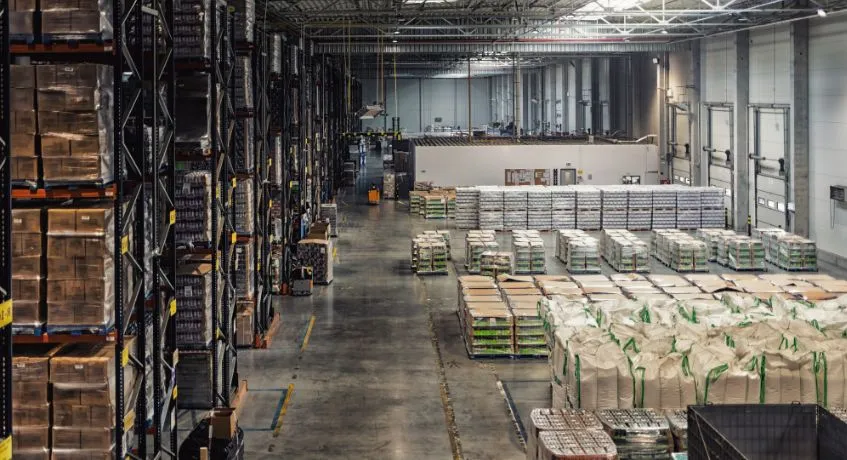
Before implementing racks systems, businesses should evaluate their warehouse requirements to ensure the selected racking system supports long-term efficiency. Here are the factors to consider before investing in warehouse racks:
a. Consider the Size of Your Warehouse
The size and layout of your warehouse directly affect the type of racking system you should install. Assess the available floor area, ceiling height, aisle width, and loading zones to determine how much storage capacity.
For warehouses with limited floor space, high-density systems such as double-deep or drive-in racks can maximize vertical storage. Meanwhile, larger warehouses handling a wide variety of products may use racks that provide direct access to every pallet.
b. Allocated Budget
In addition, warehouse racking is a long-term investment, so businesses should consider more than the initial purchase price. Installation costs, maintenance, future expansion, and equipment compatibility all contribute to the total cost of ownership.
While selecting racks, it’s recommended to consider high-density systems like pallet flow or push back racks that may deliver greater long-term savings. Therefore, the budgets that flow into this will become a positive investment for business growth.
c. Your Inventory Rotation
The third factor is inventory movement, which is one of the most important factors when selecting warehouse racks. Businesses should choose a system that aligns with their inventory rotation method to improve stock accessibility, for example:
- FIFO (First-In, First-Out): Best suited for pallet flow racks or drive-thru racking, commonly used in food, beverage, and pharmaceutical industries.
- LIFO (Last-In, First-Out): Ideal for drive-in and push back racks, where the most recently stored pallets are retrieved first.
- Mixed inventory with multiple SKUs: Selective racks provide direct access to every pallet, making them suitable for warehouses with diverse products.
Furthermore, matching the racking system with your inventory flow helps improve storage efficiency, reduce product obsolescence, and support better warehouse management.
d. Forklift and Other Equipments
Not every warehouse racking system is compatible with the same material handling equipment. Before installation, businesses should evaluate the type of forklifts they use, including lift height, turning radius, load capacity, and aisle width requirements.
For example, double-deep racks require reach forklifts, while drive-in systems demand skilled forklift operators capable of maneuvering within the rack structure. Ensuring equipment compatibility improves operational safety and maintains smooth operations.
 Also Read: What is Material Management? Functions, Types, & Example
5. How Much does Warehouse Racking Cost?
One of the most common questions businesses ask in considering a racking system is, “How much does warehouse racking cost?”. And the answer depends on several factors, as every warehouse has unique storage requirements. The total cost is influenced by:
- Type of warehouse racking system.
- Warehouse size and layout.
- Rack height and number of storage levels.
- Load capacity requirements.
- Safety accessories and rack protection.

6. The Technology Used in Warehouse Racking Systems
Not only a factor to consider, you also should know the latest technology used in warehouse racking systems to make sure the business is running smoothly. Here are the modern technologies in warehouse management:
- Automated Storage and Retrieval System (AS/RS): Automated machines or robotic shuttles to store and retrieve pallets or cartons with minimal manual intervention to improve picking accuracy.
- Barcode / RFID: Secondly, barcode and Radio Frequency Identification (RFID) technologies enable businesses to identify products to improve inventory accuracy and reduce manual errors.
- Modular Racking Systems: Modular racks are designed with adjustable components that can be reconfigured for this ideal solution for growing warehouses with changing inventory requirements.
- Warehouse Management System (WMS): Another important technology used is WMS. It digitally maps rack locations and tracks inventory movement in real time. It helps warehouse staff identify, optimize rack utilization, and putaway process in the warehouse.
7. Warehouse Management System by ScaleOcean Atlas Simplifies Inventory
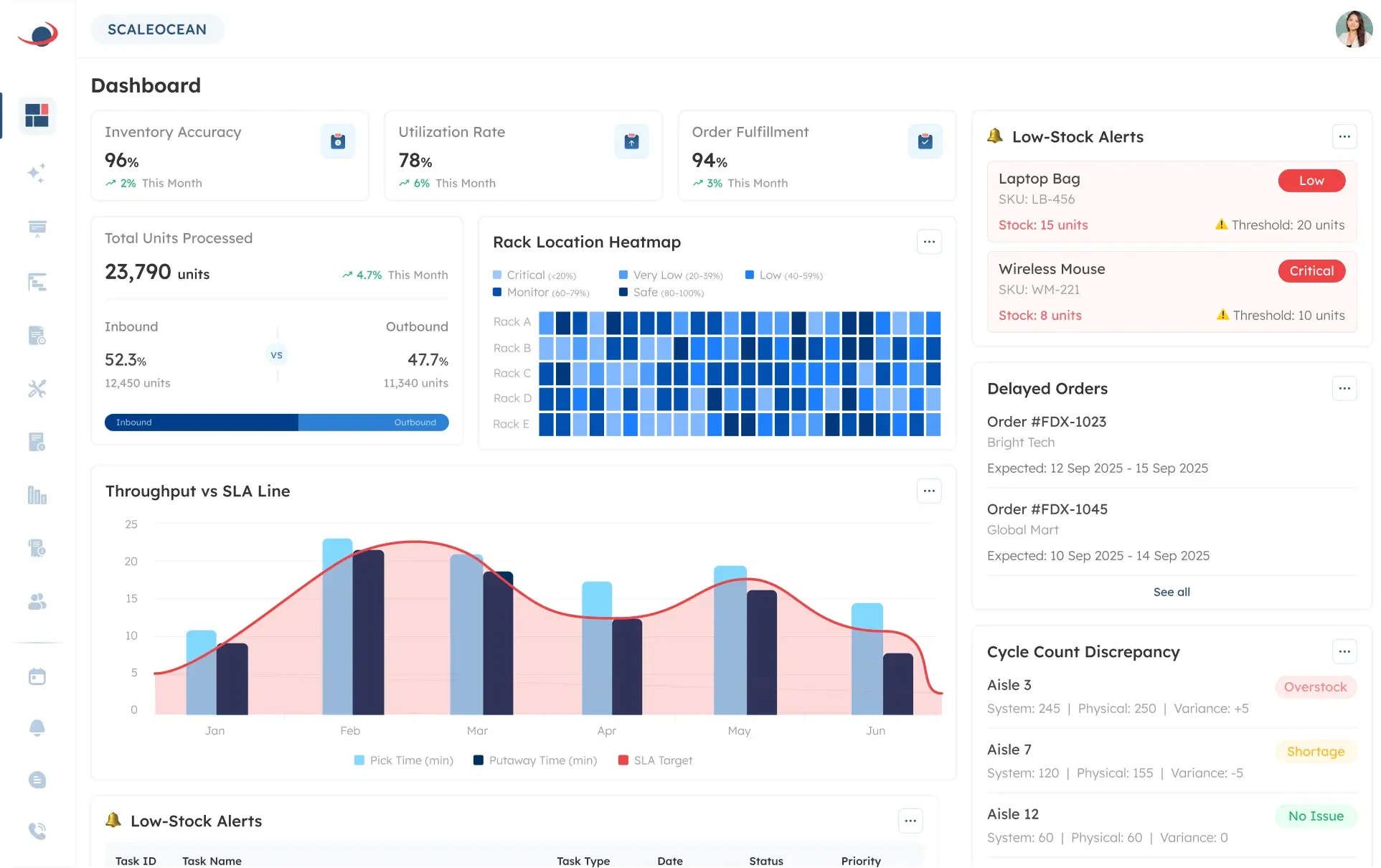
Managing warehouse racks manually becomes increasingly difficult as inventory grows. Businesses may encounter problems such as misplaced products, inaccurate stock or longer order fulfillment times.
To address these challenges, ScaleOcean Atlas for Warehouse Management helps businesses streamline warehouse operations through real-time inventory tracking and intelligent automation.
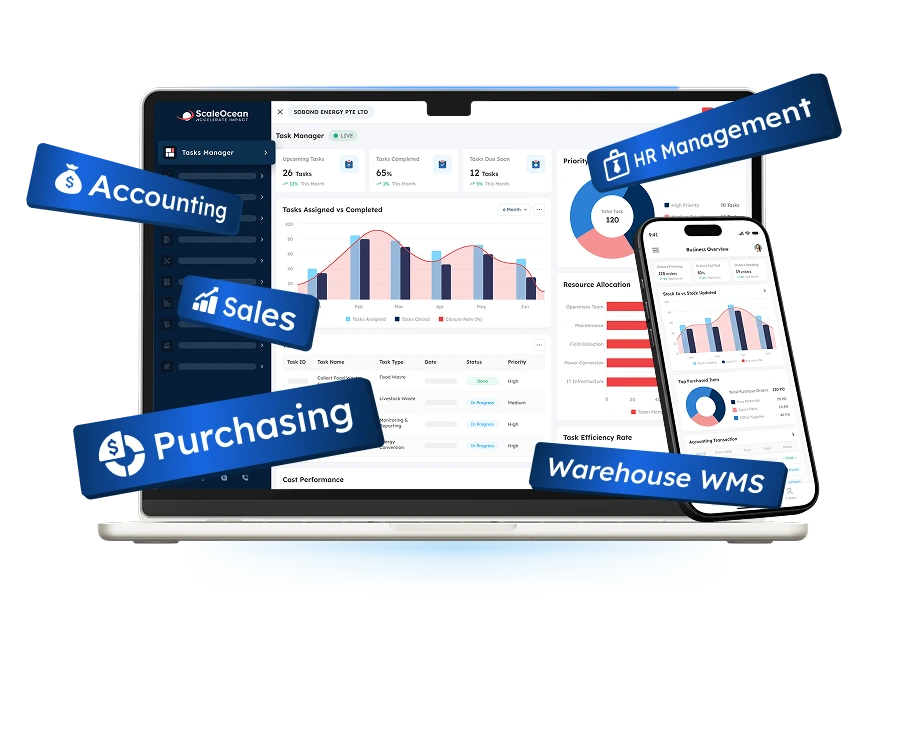
As part of the ScaleOcean Atlas Software, it integrates warehouse management with sales, procurement, accounting, and reporting. These capabilities ensure seamless end-to-end business operations in every flow.
Moreover, ScaleOcean Atlas for warehousing also embedded with ScaleMind AI. This to improve automation warehouse operation, for example, it can suggest optimal storage locations during putaway and reduce manual work.
Businesses looking to enhance their warehouse operations can also schedule a consultation with us to see how ScaleOcean Atlas WMS optimizes rack management and inventory. Some of ScaleOcean Atlas for warehousing’s features include:
- Real-Time Inventory Tracking: Monitors stock quantities and rack locations across multiple warehouses, providing real-time visibility into inventory movement and availability.
- Rack Location Management: Assigns products to designated rack locations, making inventory easier to locate while improving warehouse organization and retrieval speed.
- Barcode and QR Code Integration: Automates inventory updates during receiving, storage, picking, and shipping to reduce manual entry errors and improve inventory accuracy.
- ScaleMind Intelligent Recommendations: Suggests the most efficient storage locations based on available rack capacity, product characteristics, and inventory movement to maximize warehouse space.
- ERP Integration: Connects warehouse operations with purchasing, inventory, production, and sales modules in one centralized platform, ensuring seamless data synchronization across the business.
8. In Conclusion
A warehouse racking system is a critical investment for businesses looking to enhance operational efficiency. By understanding the different types of racks in warehouses and evaluating other factors, businesses can select the most suitable storage solution.
To maximize the benefits of a warehouse racking system, businesses should also adopt a digital solution that provides real-time inventory visibility and streamlined warehouse processes.
ScaleOcean Atlas for warehousing helps companies manage rack locations, monitor inventory movement, optimize storage utilization, and automate warehouse operations within a single integrated platform.
If you’re ready to improve your warehouse efficiency and gain complete control over your inventory, schedule a consultation and discover how it can support your business growth.
FAQ:
1. What is the best layout for a warehouse racking?
A U-shaped warehouse layout is commonly preferred because it improves product flow, maximizes storage space, and supports efficient receiving, storage, picking, and shipping operations.
2. What is the standard size of a warehouse racking?
Warehouse racking sizes vary depending on pallet dimensions, load capacity, and ceiling height. Standard pallet racks typically range from 8 to over 30 feet tall with beam lengths between 96 and 144 inches.
3. What is the spacing for racking in a warehouse?
Warehouse racks should have adequate spacing for forklifts, product handling, and fire safety. Common guidelines recommend at least 6 inches between back-to-back racks, though local building and fire regulations may require more.
















.png)