




Perpetual inventory system provides a continuous approach to inventory management. This calculating inventory method updates inventory records whenever purchases, sales, returns, or other stock movements occur.
Moreover, for businesses in the Philippines dealing with high transaction volumes or fast-moving products, this approach can provide more accurate inventory records. This article will explore how to optimize inventory with the perpetual inventory method.
 Key Takeaways
- A perpetual inventory system continuously updates inventory records whenever purchases, sales, returns, or other stock movements occur.
- A perpetual inventory system works by recording inventory purchases, goods received, sales transactions, returns/adjustments, and reconciling physical stock.
- The advantages of the perpetual method within warehouse management is real-time tracking, minimizing stockouts, improving forecasting, and automating transactions.
- ScaleOcean Atlas can automate perpetual inventory processes by connecting inventory transactions across purchasing, warehouse, sales, and accounting activities.

1. What is the Perpetual Inventory System?
A perpetual inventory system updates stock levels automatically with every sale or restock. When an item is sold, stock drops instantly, and its cost is logged right away as cost of goods sold (COGS).
Unlike a periodic inventory system, where businesses generally determine inventory levels through physical counting at the end of a period, perpetual inventory provides an ongoing record of stock quantities and values.
For example, imagine a Philippine retail business selling appliances. If the business receives 50 refrigerators from a supplier, its inventory records immediately increase by 50 units. When five refrigerators are sold, the system deducts five units from the available inventory and records the related cost of goods sold.
This means management does not have to wait until the end of the month or year to get an indication of its current stock position. A perpetual system can be maintained manually, but it becomes much more practical when supported by inventory software.
With digital tools, transactions from purchasing, sales, warehouses, and other business functions can be connected so that inventory records are updated automatically. The approach is also relevant to Philippine businesses that need organized accounting and inventory records.
This approach is especially relevant for Philippine businesses that need organized accounting records and must generate a accurate inventory list BIR for tax compliance.
2. How Does the Perpetual Inventory System Work?

The basic principle is to focus on every inventory movement that changes the recorded stock balance. Instead of recording purchases and sales separately it updates its inventory records as transactions occur. The process of perpetual works as follows:
1. Record Inventory Purchases
When goods are purchased for resale, the inventory account is increased based on the applicable purchase cost. This step is part of ongoing inventory valuation, since each purchase directly changes the recorded value of stock on hand. For example, a retailer purchases 100 units of a product at ₱500 per unit. The inventory value increases by ₱50,000.
2. Record Goods Received
When products arrive at the warehouse, the business verifies the quantity and records the receipt in its inventory system. Barcode scanning or RFID technology can make this process faster and reduce manual entry.
3. Record Sales Transactions
When a product is sold, the inventory quantity decreases automatically. Under the perpetual method, the related cost of goods sold is also recorded at the time of the sale. This creates two accounting effects:
- The business recognizes revenue from the sale.
- The business recognizes the cost of the inventory sold and reduces inventory.
4. Record Returns and Adjustments
Customer returns, supplier returns, damaged goods, stock transfers, and inventory adjustments can also affect the inventory balance. For example, if a customer returns a product in sellable condition, the inventory quantity can be added back and the corresponding cost of goods sold reversed.
5. Reconcile Records with Physical Stock
Although the system continuously tracks inventory, businesses should still perform physical counts. The purpose is to compare actual stock in the warehouse with the quantity recorded in the system.
Differences may occur because of damage, incorrect receiving, misplaced items, or transaction errors. This is particularly important for businesses with multiple warehouses or branches in the Philippines.

3. The Difference: Perpetual and Periodic Inventory System
The Perpetual and periodic inventory system are two different approaches to recording and monitoring inventory. The biggest difference is when inventory information is updated. Below here are the differences between perpetual and periodic system:
| Factor | Perpetual Method | Periodic Method |
|---|---|---|
| Inventory Updates | Continuously after transactions. | Usually updated at the end of an accounting period. |
| Physical Counting | Still required for reconciliation. | Central to determining ending inventory. |
| Cost of Goods Sold | Recorded with each sale. | Determined at the end of the period. |
| Stock Visibility | Near real-time. | Limited between physical counts. |
| Technology Requirement | Generally higher. | Can be simpler. |
| Best Suited For | High-volume or complex operations. | Smaller businesses with simpler inventory needs. |
4. Advantages of Perpetual Inventory System
Businesses that implement perpetual inventory can gain better visibility and inventory control over their stock. Therefore, this method offers other benefits of managing inventory, the following are some of its major advantages:
a. Real-time Tracking
One of the biggest benefits of perpetual inventory is continuous visibility into stock levels. This is when a sale, purchase, return, or transfer occurs, the inventory record can be updated immediately.
Moreover, real-time tracking makes it easier for managers to determine which products are available. For Philippine retailers selling through physical stores and online channels, this visibility can help reduce stock discrepancies.
Businesses can further improve tracking by using barcode inventory software, which allows employees to scan products instead of manually entering SKU numbers and quantities.
RFID can also be used for businesses that need to track large volumes of products. With RFID Software integration, companies can capture inventory information without relying exclusively on manual scanning.
b. Minimized Downtime & Stockouts
Another benefit of perpetual systems is to balance stock levels. It’s because stockouts can affect both revenue and customer satisfaction. If a popular product runs out unexpectedly, businesses may lose sales while customers look for alternatives.
For example, a grocery business can set a reorder point for frequently purchased products such as beverages, canned goods, or household essentials. Once stock falls below the threshold, the system can alert the purchasing team.
c. Improved Inventory Forecasting
Historical inventory and sales data can help businesses identify demand patterns. For example, a retailer may discover that certain products sell faster during Christmas, payday periods, or promotional campaigns.
Businesses can use these insights to improve purchasing and inventory planning. This can be particularly useful in the Philippines, where businesses may experience seasonal demand.
d. Automated Transaction Recording
Recording inventory manually can become time-consuming when a business processes hundreds of transactions. Moreover, an automated system can connect warehouse and accounting activities. With this, business workflow can be visible in real-time without manual input.
 Also Read: What is Inventory Tracking? A Guide for Filipino Businesses
5. Are There Challenges to the Perpetual Inventory System?
Yes, there are several challenges when implementing a perpetual inventory system in warehouse management. Further, businesses should consider several challenges before implementation. Here are the challenges and solutions for perpetual system:
a. High Upfront Investment
Implementing a perpetual inventory system can require investment in software, hardware, barcode scanners, RFID equipment, POS integration, and system implementation.
For a small Philippine business with only a few products, these costs may not provide enough immediate value. However, larger businesses with multiple warehouses or high transaction volumes may find long-term efficiency.
b. Necessary Labor Upskilling
Another challenge of implementing perpetual methods is when employees need to understand the new system works. Thus, warehouse staff may need training on the new system and inventory recording.
Without proper training, even an advanced system can produce inaccurate data. For this reason, businesses should include employee training as part of the implementation plan rather than treating it as an afterthought.
c. Does Not Invalidate Physical Inventory Reconciliation
The third challenge of this method is a common misconception that perpetual inventory eliminates the need for physical inventory counts. But actually, it does not. The system tells you what the records say should be available.
A physical count tells you what is actually available. Therefore, businesses should view physical counting as a control mechanism that validates the perpetual records, rather than as something the system makes unnecessary.
Also Read: What is Inventory Audit? Definition and Procedures
6. When Should Perpetual Inventory System be Used?
A perpetual inventory system might be appropriate for businesses that require ongoing insight into inventory levels and need to track every inventory management KPI. It can be particularly useful for:
- Businesses with Frequent Transactions: For businesses that make numerous sales during the day, it’s beneficial to have real-time inventory updates. For instance, a retail store in Manila that is expanding can track what products are in stock without having to do a physical inventory every so often.
- Supermarkets and Grocery Stores: Companies that deal in thousands of products with rapidly moving inventory can benefit from perpetual inventory to keep a closer watch on product levels.
- Manufacturing Companies: The system can be used by manufacturing companies to keep track of raw materials, work-in-progress, and finished goods throughout the manufacturing process. This gives more clarity on the flow of materials from acquisition to manufacturing and finally to finished goods.
- Multi-branch businesses: Businesses that have stores or warehouses in various locations can use a system that can be centralized inventory management across the different stores or warehouses.
- Pharmacies & Healthcare Businesses: Businesses that need to monitor product quantities, batches, and expiration dates can use perpetual inventory to maintain more accurate stock records and identify products that require attention. A study published in the American Journal of Health-System Pharmacy found that a large tertiary hospital’s oncology pharmacy saw a statistically significant 6.02% increase in inventory accuracy after implementing an EHR-integrated perpetual inventory system, underscoring its value for healthcare settings where precise stock visibility directly affects patient care.
In smaller businesses, it should be based on the actual inventory requirements as well as the size of the business. For instance, a sari-sari store in the Philippines that carries a few products might be able to use manual or periodic inventory.
7. The Formula of Perpetual Inventory System
There isn’t really a specific “formula” to the perpetual inventory system; it’s an ongoing system of updates, not periodic calculations. But the core formula used to track inventory value in real time is:
Ending Inventory = Beginning Inventory + Purchases – Cost of Goods Sold (COGS)
Here are the definitions of each part:
- Beginning Inventory: Inventory on hand at the start of the period.
- Purchases: New stocks received from suppliers in that period.
- COGS: The cost of the items that were sold.
This formula is calculated automatically behind the scenes as transactions are made, and thus the “Ending Inventory” number is always up-to-date.
Related formula, COGS in a perpetual system:
COGS = Beginning Inventory + Purchases – Ending Inventory
But because perpetual systems track each unit’s cost as it moves (via FIFO, LIFO, or weighted average costing), COGS is actually derived transaction-by-transaction rather than solved algebraically at the end.
8. Perpetual Inventory System Journal Entry Example in PHP
Another key aspect of managing inventory with the perpetual method is understanding its flow and core elements. Below is an example of an inventory audit using the perpetual method:
Here’s an example for perpetual inventory, A retail store in Quezon City sells phone cases. Here’s its stock movement for the week:
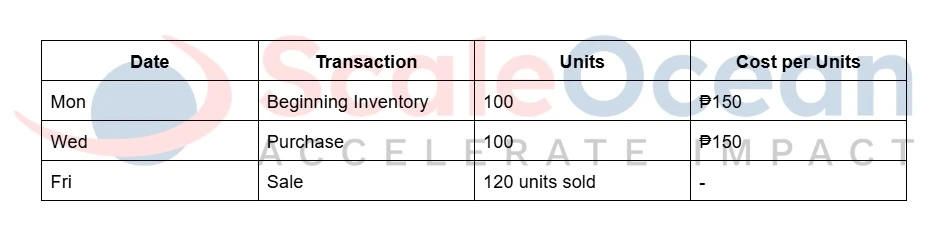
Method 1: FIFO (First-In, First-Out)
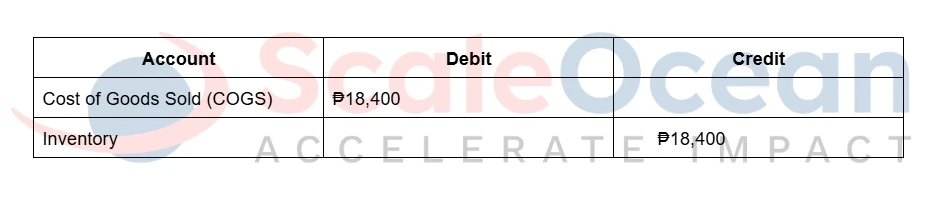
FIFO assumes the oldest stock is sold first. So the 120 units sold on Friday come from:
- 100 units @ ₱150 (all of Monday’s batch)
- 20 units @ ₱170 (from Wednesday’s batch)
- COGS= (100 × ₱150) + (20 × ₱170) = ₱15,000 + ₱3,400 = ₱18,400
Journal entry for the sale:
- Remaining inventory: 80 units @ ₱170 = ₱13,600
Method 2: Weighted Average Cost (WAC)
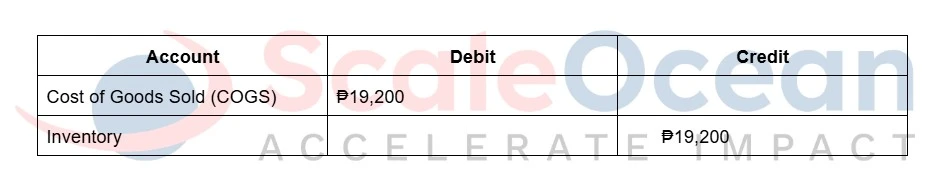
WAC blends all units into one average cost before calculating COGS.
- Average cost= (100 × ₱150 + 100 × ₱170) ÷ 200 units = ₱32,000 ÷ 200 = ₱160 per unit
- COGS= 120 units × ₱160 = ₱19,200
Journal entry for the sale:
- Remaining inventory: 80 units × ₱160 = ₱12,800
9. Transition to a Perpetual Inventory with ScaleOcean Atlas
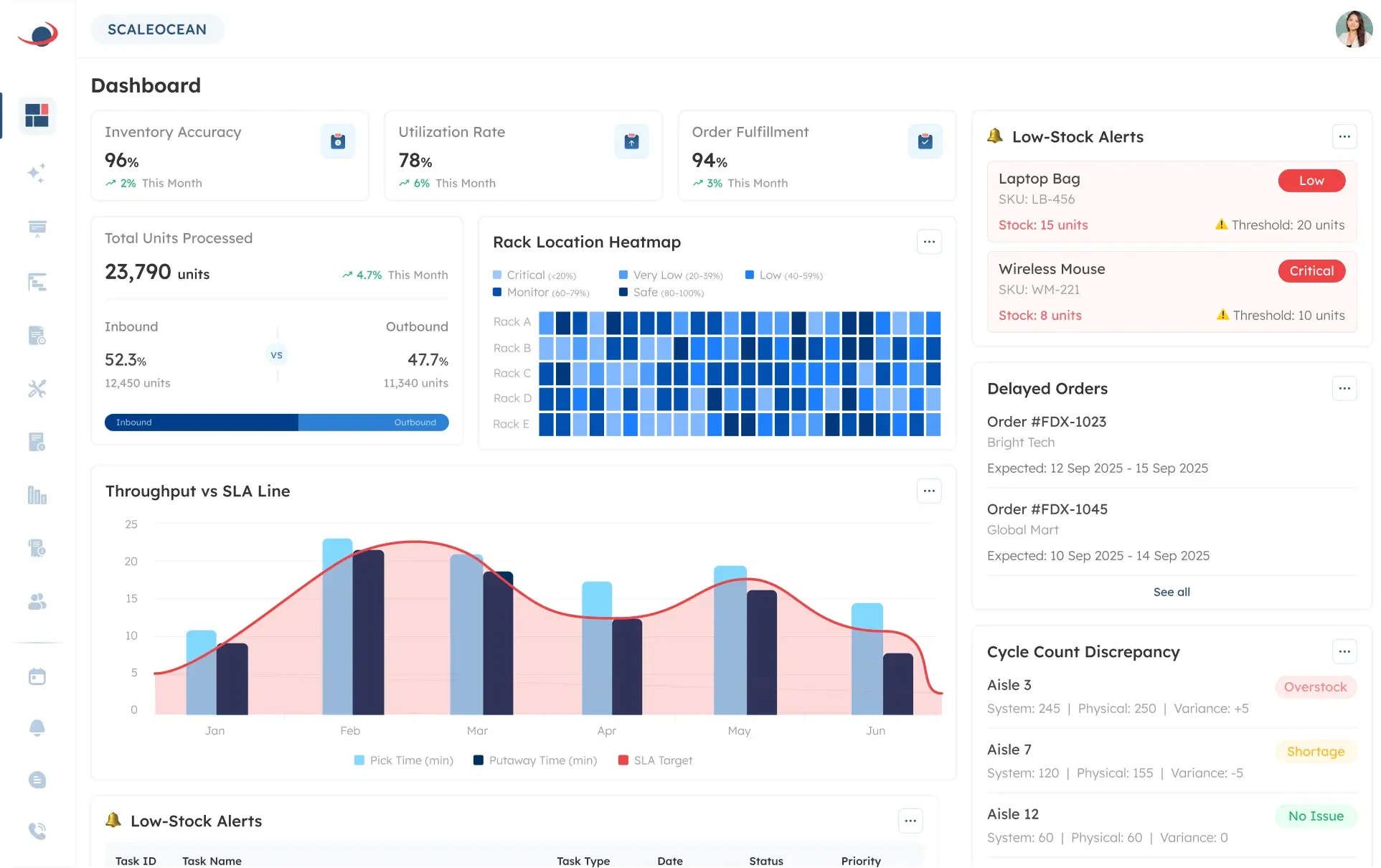
As inventory increases, manually updating stock records can become difficult. With a lot of warehouses, and multiple purchases, returns, and stock transfer, it’s hard to keep the inventory accurate without a system in place.
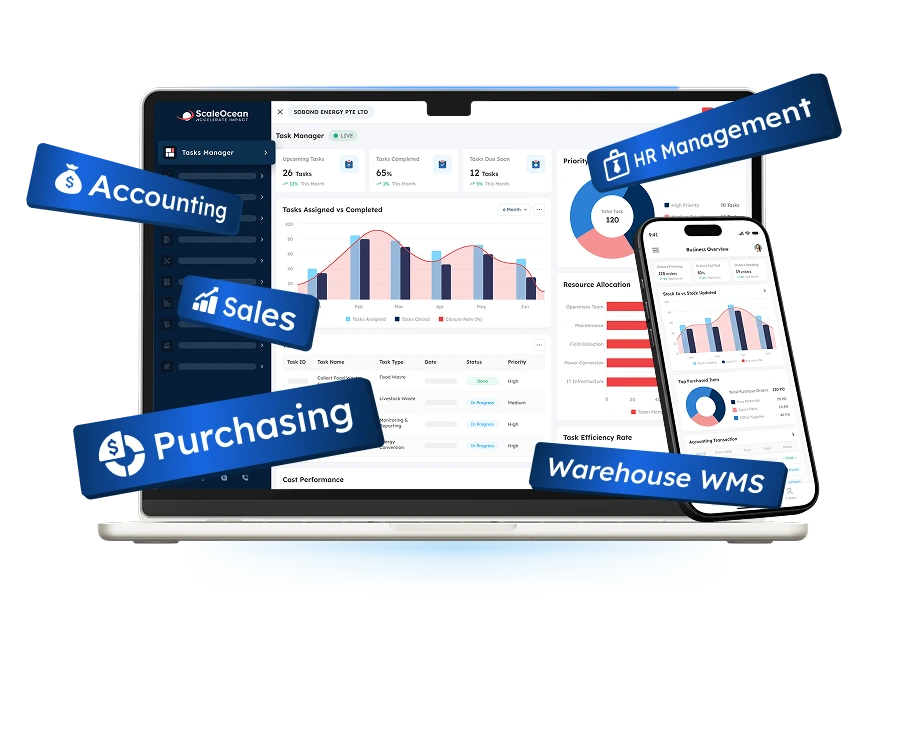
The Inventory module of ScaleOcean Atlas helps businesses implement a more efficient perpetual inventory process by automatically updating the inventory on the system whenever any transactions take place.
Furthermore, ScaleOcean Atlas is also equipped with ScaleMind, an AI-powered that analyzes inventory data, detects unusual stock movements, and offers actionable insights to aid in inventory planning and decision-making.
Schedule a consultation to see how ScaleOcean Atlas can simplify perpetual inventory management while improving inventory accuracy and operational visibility. Its features include:
- Real-Time Inventory Tracking: Automatically track inventory levels as they change due to purchases, sales, returns, and transfers, providing businesses with more visibility into inventory.
- Automated Inventory Recording: Streamline inventory transactions by bridging the gap between purchase, sale, warehouse and accounting.
- Integrated Procurement & Accounting: Connect purchasing, inventory, sales, and finance in one platform while automatically recording inventory costs and Cost of Goods Sold (COGS).
- Barcode and RFID Integration: Use barcode scanning and RFID technology to identify products and record inventory movements more efficiently, reducing the risk of manual entry errors.
- Batch & Lot Traceability: Trace products by batch/lot to enhance product traceability, stock rotation and monitoring of products with specific expiration dates.
- AI-Powered Inventory Insights: Use ScaleMind to analyze inventory trends, identify unusual stock movements, and support more informed replenishment and inventory planning decisions.
10. In Conclusion
A perpetual inventory system is a method used to track inventory when it comes in and out of the business. When inventory is purchased, sold, or transferred, the transaction can be recorded at that time instead of waiting till the end of the accounting period to make an update.
This can help Philippine businesses manage inventories more efficiently, particularly for businesses with numerous products or channels. The inventory data is more current, enabling businesses to make informed decisions on their stocking levels.
With the increasing complexity of inventory operations, the right technology can make the job a lot easier. The inventory module of ScaleOcean Atlas unifies inventory, warehouse, purchasing, sales, and accounting in a single platform, which helps businesses to minimize manual effort and have a better view of their stock.
Book a consultation with ScaleOcean Atlas and discover how it will help your business to deal with perpetual inventory in an efficient manner.
FAQ:
1. How do you calculate perpetual inventory?
The formula is Beginning Inventory + Purchases – COGS = Ending Inventory. A perpetual system automatically updates stock levels and COGS whenever a transaction occurs.
2. What is a good example of perpetual inventory?
A supermarket using barcode scanners is a common example. When a cashier scans a product, the POS system automatically deducts the item from inventory and updates the records.
3. What are the disadvantages of perpetual inventory?
Perpetual inventory can involve high implementation costs, technology dependence, and errors from scanning or data entry. Physical counts are still needed to identify theft, damage, and other discrepancies.
















.png)