




Incentive contract is an agreement to pay one party as a result of meeting a goal, for example; completing a job early, reducing budgets, maintaining quality standards, or exceeding performance requirements.
This kind of construction contract is to coordinate the interests of project owners and contractors. Furthermore, this contract can prove to be a crucial solution for infrastructure or commercial initiatives in the Philippines that require efficiency and accountability.
 Key Takeaways
- An incentive contract is a performance-based agreement that rewards contractors for achieving specific goals.
- Main types of incentive contracts include fixed price, cost reimbursement, schedule-based incentive contracts, and performance-based incentive contracts.
- Incentive contracts help improve cost control, reduce delays, encourage innovation, enhance accountability, and align project objectives.
- ScaleOcean Construction ERP Software helps construction companies manage contracts, budgeting, procurement, project documentation.

1. What is Incentive Contract?
An incentive contract is a contract in which extra incentives or rewards are given if certain project goals are met. The objectives could be tied to things like cost reductions, project completion, or operational efficiency.
Additionally, this type of contract is intended to incentivize contractors, suppliers, or service providers to deliver more than the minimum contracted to deliver. Instead of receiving only a fixed payment, the contractor has an opportunity to earn additional rewards.
In the Philippines, incentive-based contracting approach is usually tied to accountability, efficiency, or value for money. The procurement procedures in the country put transparency and good contracts at the forefront, so the performance approach is relevant.
2. The Types of Incentive Contracts

In the construction sector, it’s due to the fact that each project is different, and has various incentive structures. The most appropriate form of this contract varies depending on the level of complexity of the project. Here are some types of incentive contracts:
a. Fixed Price Incentive Contract
The first type is a fixed price incentive contract, which sets up target cost and profile at the start of the project. Under this agreement, if the contractor completes the project within the target cost and meets all the requirements, both parties share the savings based on the agreed rules.
b. Cost Reimbursement Incentive Contract
Another type that project managers should know is cost reimbursement incentive contract. Under this agreement, the project owner reimburses allowable project costs while providing incentives for achieving specific objectives such as cost control or schedule acceleration.
c. Scheduled-Based Incentive Contract
The third type of the contract agreement is the scheduled-incentive contract. This contract rewards contractors for completing milestones or the entire project ahead of schedule. In contrast, delays may trigger financial penalties depending on the agreement.
d. Performance-Based Incentive Contract
The fourth type of incentive agreement is a performance-based incentive contract. This agreement focuses on measurable outcomes rather than project activities. The incentives may be tied to productivity levels, quality metrics, or operational efficiency.
3. Benefits of Incentive Contracts
One of the purposes of incentive contracts is the same as construction bond which to motivate all parties and make sure the project runs smoothly. There are several advantages to both owners and contractors with incentive contracts. Here are some of the main benefits of incentive contracts:
- Improved Cost Project: One of the main benefits of incentive contracts is controlling cost. This type of contract encourages contractors to handle resources efficiently and unnecessary expenses.
- Reduces Delays: Furthermore, incentive contracts will often include bonuses for early completion or milestone achievement, which can help to reduce delays.
- Promotes Innovation and Efficiency: Another advantage of such contract is that it encourages innovation and efficiency in building methods, technologies or workflows that may increase productivity.
- Aligns Project Objectives: The fourth benefit is to support project owners and contractors to have similar goals. Both parties benefit when project objectives for cost, schedule, or quality are achieved, in this regard.
- Enhances Accountability and Transparency: Last but not least of the incentive contract benefits is better reporting, documentation and project performance.
 Also Read: 8 Construction Contract Types Used in the Philippines
4. Challenges of Incentive Contracts
Even though incentive contrast serves benefits for all the parties involved in the project agreement. But there are some issues contractors or owners need to deal with under these contracts. Some of challenges with incentive contracts are:
- Difficult Measurement: Under this contract, determining a fair and objective measurement is not always easy; the industry can be complicated and results are affected by several factors.
- Potential Disagreements: This sort of contract can lead to dispute agreement due to miscommunication of project scope, but the agreement ensures that both parties receive benefits from the agreement.
- Higher Administration: In addition, incentive contracts can involve more administration and monitoring of project performance to ensure accurate tracking.
- Complex Calculations: Incentive contracts may require careful verifications due to complex calculations of bonuses, cost-sharing or performance rewards.
- Neglecting Project Priorities: The fifth challenge is this type of contract can lead to contractors focusing more on work related to incentives and less on primary projects.
Some stakeholders may address these challenges by setting up clear indicators, mechanisms and communication upfront in the projects.
To ensure accurate records, approvals and performance documentation throughout contract execution, many organizations also use digital systems like construction document control software.
5. Clauses in Incentive Contracts

There are a number of clauses that should be included in the incentive contract documents before applying incentive contracts. There are several important aspects that should be included in a well-written contract to ensure clarity. These are some clauses from incentive contracts:
a. Performance Requirement Clause
First, the document within the incentive contract should define the measurable standards that contractors must achieve. In this, metrics may include project completion dates, cost targets, quality standards, or productivity goals.
b. Incentive Clause
In addition, the incentive clause in the contract should specify the rewards availability when performance targets are achieved. This should include outlined bonus amounts, calculations method, and payment schedules.
c. Penalty Clause
The third is the penalty clause, which establishes consequences for failing to meet contractual obligations. These may include financial deductions, delayed payments, or other corrective actions. This balances rewards and encourages compliance with requirements.
d. Dispute Resolution Clause
The fourth clause is a dispute resolution clause, this is because disagreement may occur regarding performance measurement or incentive calculations. The dispute resolutions clause outlines procedures for mediation, arbitration, or legal proceedings.
e. Adjustment Clause
The last clause that should be included is the adjustment clause for changing conditions. It is because construction projects often encounter some adjustment for changing situations. This clause therefore allows modifications to incentive targets or contracts terms.

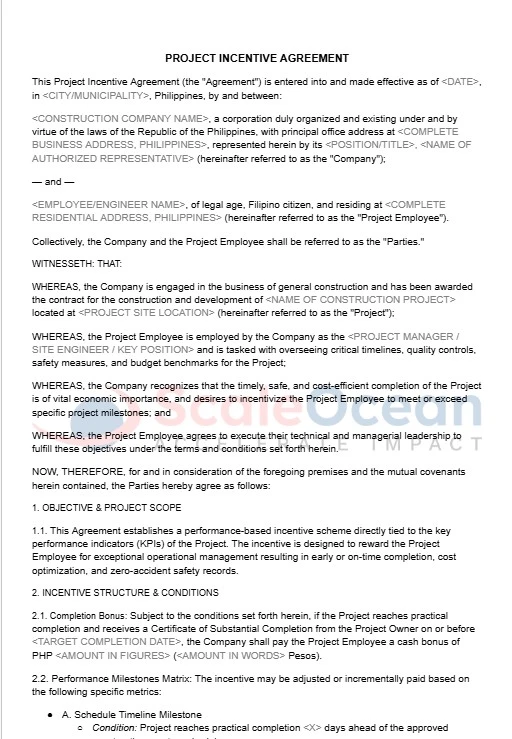
6. Incentive Contract Example
Every construction project may require a different type of incentive contract depending on its complexity, specific requirements, and the agreement between the parties involved. The following example illustrates how an incentive contract may be structured:
7. When Should You Use Incentive Contracts?
Incentive contracts are most effective when project outcomes can be measured objectively and when both parties are committed to achieving shared goals. Below here are some situations for considering using incentive contract:
- Critical Schedules: The right time to use incentive contracts is when the project completion deadline is approaching. Owners may offer rewards for meeting or exceeding schedule targets to prevent delays and accelerate project delivery.
- Managing Cost: The second situation of applying this agreement is when managing budgets is a key concern. Under this agreement, contractors can control resource utilization.
- Clear Defined Metrics: The third is when project goals can be measured using criteria, such as completion dates, costs savings, or quality benchmarks.
- Innovations and Efficiency: Therefore, projects that benefit from improved processes, new technologies, or creative problem-solving can use incentive contracts to motivate contractors.
- Reasonably Allocated Risk: Moreover, this type of contract is effective when both parties understand their responsibilities and can share project risks clearly.
In addition, incentive contracts may also be considered for public infrastructure projects when objectives can clearly be measured. However, project managers should ensure that the objectives must be aligned with the Government Procurement Act (Republic Act No. 9184).
In many construction projects, incentive contracts may be used alongside other contractual structures depending on project requirements. For example, owners may compare incentive arrangements with GMP construction contracts when cost certainty is important.
Some projects may also consider time-materials contract when the scope of work is not fully defined. And also, some project managers tend to use this when they need greater flexibility during project execution.
Alternatively, a design-build contract may be suitable for projects that benefit from a single entity managing both design and construction responsibilities, helping improve coordination, and streamline project delivery.
8. In Conclusion
An incentive contract is a performance-focused agreement that rewards contractors for achieving objectives such as cost savings or quality improvements. Therefore, incentive contracts can improve efficiency, accountability, and project outcomes.
However, successful implementations require clear performance metrics, transparent evaluation processes, and effective monitoring systems. As construction projects become more complex, organizations rely on digital solutions to manage contracts and documentations.
One solution that can help construction companies streamline project management is ScaleOcean Construction ERP Software. The platform integrates contract management, budgeting, procurement, and helping teams improve operational efficiency.
Request a free demo today to enhance project progress and optimize budgeting. Through the demo, teams can observe how ScaleOcean integrates contract management, budgeting, and workflow to boost efficiency, collaboration, and financial management.
FAQ:
1. What is an incentive contract?
An incentive contract is a type of agreement that rewards contractors for achieving specific project goals, such as reducing costs, meeting deadlines, or maintaining quality standards. Additional compensation is typically tied to performance results.
2. What is an incentive contract example?
An example of an incentive contract is a construction project that offers a bonus when the contractor completes the work ahead of schedule while meeting the required quality, safety, and performance standards.
3. What are the main types of incentive contracts?
The main types of incentive contracts are Fixed Price Incentive Contracts, Cost Reimbursement Incentive Contracts, Schedule-Based Incentive Contracts, and Performance-Based Incentive Contracts, each designed to reward different performance outcomes.
















.png)