




Types of construction contracts are legal agreements that define responsibilities, payment terms, and project scopes between parties involved in a construction project. Every construction project should follow legal rules whether its residential, commercial, or industrial projects.
Moreover, understanding what is a construction contract and the different types of contracts in construction helps project owners, contractors, and developers follow the guidelines to make sure the building is well-built and maintains safety.
 Key Takeaways
- Construction contracts are legal agreements that define project scope, payment terms, responsibilities, and risk allocation between project owners and contractors.
- Understanding different types of contracts in construction helps project stakeholders choose the most suitable agreement.
- Common types of construction contracts include cost-plus, time & materials, lump sum, unit price, GMP, design-build, incentive, and IPD contracts.
- ScaleOcean Construction ERP Software helps construction companies manage contracts, project documentation, scheduling, and financial data.

1. What is Construction Contract?
A construction contract is a legally binding agreement between two or more parties involved in a construction project. The contracts determine the scope of work, project timeline, payment terms, and quality requirements.
The purpose of construction contracts is to establish a clear framework for project execution and help protect both the client and contractor while the project is still on-going. Furthermore, with this document parties involved can minimize misunderstanding and control the project.
2. Why are Construction Contracts Important?
Construction contracts are important to make sure the project proceeds according to the agreement between clients and contractors, in which it creates construction bond between all the parties involved. Without a formal contract, project risks can increase significantly, and some parties may be more likely to breach the agreement. Here are some reasons why construction contracts are important:
- Stating project scope and requirement clearly.
- Establishing payment schedules and pricing methods.
- Allocating risks between project owners and contractors.
- Reducing disputes and legal conflicts.
- Improving accountability among project participants.
- Maintaining project budgeting and cost control.
3. The Components of a Construction Contract

When preparing documents for a construction project, it is recommended that project managers also consider proper contract agreements with construction document management software. There are several components to make sure the project works smoothly. Here are some components of the construction contracts:
- Project Scope: The first component that should be in the construction contract is project scope. This is the most important part because it helps maintain project progress and keeps the work on track to ensure the results are as agreed upon by the parties.
- Contract Price: The second important part of the contract is the project price. The agreement should clearly indicate how the contractor will be compensated, including payment schedules and pricing methods.
- Project Schedule: Another important component in construction contracts is project schedule. This section usually includes project milestones, deadlines, and completion dates.
- Roles and Responsibilities: Moreover, the contracts should specify the obligations of project owners, contractors, consultants, suppliers, and subcontractors.
- Change Orders: Therefore, the fifth component should be in construction contracts stating the modifications to the original scope, including the approval and prices structure.
- Risk Allocation: In addition, the contract agreement should identify which party is responsible for delays, unforeseen, conditions, safety incidents, or cost overruns.
- Dispute Resolution: Finally, in the construction contract also should determine the procedures for resolving disagreements, through mediation, arbitration, or legal action.
4. Types of Construction Contracts

There are several different types of the contracts in construction, and each serves different purposes depending on project requirements, risk levels, and budget considerations. Below are several types of construction contracts that usually used in construction project:
a. Cost-Plus Construction Contract
Under a cost-plus contract, the project owner reimburses the contractor for actual costs and pays an additional fee or percentage for profit. This type of contract is often used when project scope is not fully defined at the start.
Cost-Plus Benefits:
- Cost-plus is flexible for project execution.
- It is also suitable for evolving project requirements.
- Therefore, it is also helpful in making good decisions for construction projects.
Cost-plus Drawbacks:
- However, this type of contract serves less cost certainty.
- It also requires detailed cost monitoring.
b. Time & Materials Construction Contract
The second type of construction contract is time and materials contract. This contract is based on the actual labor hours and materials used during project execution. It’s typically applied to projects such as renovations, emergency repairs, or uncertain scope requirements.
Time & Materials Benefits:
- Time & materials contract is flexible for changing project conditions.
- This type of contract is also easy to begin working quickly.
- In addition, it is also suitable for small or complex projects.
Time & Materials Drawbacks:
- Time & Materials also has some drawbacks, in which it is difficult to predict final costs.
- It also requires careful monitoring of labor and material usage.
c. Lump Sum Construction Contract
Another common type is lump sum contract or also known as fixed-price contract. This contract establishes a predetermined total project cost before construction begins. It’s one of the contracts that offers cost certainty for project owners.
Lum Sum Benefits:
- Lum sum can predict project budget.
- This contract can also simplify payment management.
- In addition, this type of document contract can reduce financial uncertainty.
Lum Sum Drawbacks:
- Lum sum also has some limitations which it’s limited for design changes.
- Within this contract, contractors may include contingency pricing.
d. Unit Price Construction Contract
The fourth type of construction contract is called unit price construction contract. This contract is based on completed work quantities multiplied by agreed unit rates. This is usually used for infrastructure projects that involve roads or drainage systems where quantities may vary.
Unit Price Benefits:
- Unit price benefits contract is flexible for varying project quantities.
- This type of contract offers transparent pricing structure.
Unit Price Drawbacks:
- Unit price drawbacks are final costs depend on actual quantities completed.
- The drawbacks of this contract type require accurate quantity tracking.
e. Guaranteed Maximum Price (GMP) Construction Contract
The next contract type is GMP Contract, which it establishes a maximum project cost that the owner will pay. This contract balances cost control and project flexibility, making it increasingly popular for large commercial developments.
Guaranteed Maximum Prime Benefits:
- This contract can limit the owner’s financial exposure.
- In addition, this contract also encourages cost efficiency.
- This contract also provides greater budget certainty.
Guaranteed Maximum Prime Drawbacks:
- However, this construction type needs more complex contract administration.
- GMP also requires accurate cost estimations.
f. Design-Build Construction Contract
The next contract method of construction is design and build contract, this combines design and construction responsibilities under a single entity. Instead of hiring separate designers and contractors with one organization responsible for delivering the entire project.
Design-Build Construction Contract Benefits:
- This type of contract serves faster project delivery.
- This construction contract also improves collaboration.
- Another benefit of this contract is to simplify communication between teams.
Design-Build Construction Contract Drawbacks:
- This contract allows less owner involvement in design decisions.
- This contract also limited competitive design options.
g. Incentive Construction Contract
The seventh type of construction legal agreement is incentive contract. This contract rewards contractors for achieving predefined performance goals related to cost savings or project completion.
Incentive Contract Benefits:
- This incentive contract can give benefits that motivate cost efficiency.
- This also encourages innovations.
- In addition, it also improves project outcomes.
Incentive Contract Drawbacks:
- This type of construction requires measurable performance metrics.
- It needs more complex contract management.
h. Integrated Project Delivery Construction Contract
Finally, another type of construction contract is Integrated Project Delivery (IPD). It is a collaborative contract model where owners, designers, and contractors work together. Within this contract, all parties share project risks and rewards.
Integrated Project Delivery Benefits:
- This type of construction contract enhances collaboration between teams.
- This contract also reduces project conflicts.
- Additionally, this type of construction contract has better project outcomes.
Integrated Project Delivery Drawbacks:
- One of the drawbacks of this contract is it has complex implementation.
- This contract also requires strong stakeholder cooperation.
5. Construction Contracts & Philippine Regulations
Construction contracts in the Philippines are subjected to various laws and regulations that help establish fair business practices, maintain construction quality, and protect the interest of both project owners and contractors.
The primary legal basis for construction contracts is the Civil Code of the Philippines (RA 386), which governs contract, obligations, and liabilities between parties. Construction agreements must also comply with industry-specific regulations.
Understanding these regulations can help construction companies prepare compliant agreements and reduce potential legal risks during project execution. Here are some regulations regarding construction contracts in the Philippines:
- PCAB Licensing (RA 4566/PD 1746).
- Civil Code of the Philippines (RA 386).
- National Building Code (PD 6541).
- Contractor’s License Law (RA 4566).
- Alternative Dispute Resolution Act (RA 9285).
- New Government Procurement Act (RA 12009).
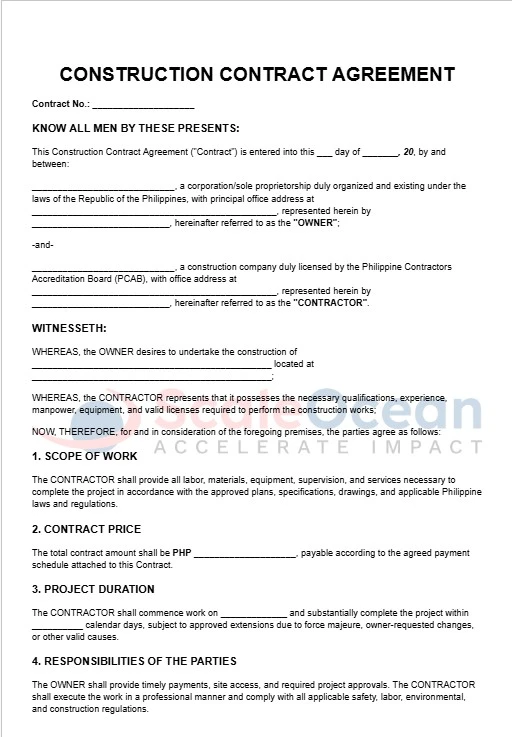
6. Philippine Construction Agreement Contract Example
A well-written agreement helps everyone in a project understand the work, payment terms, and responsibilities. The format may change depending on the project, but most construction contracts include similar sections. Here’s an example of construction contract agreement:
7. Generate Contracts Automatically with ScaleOcean
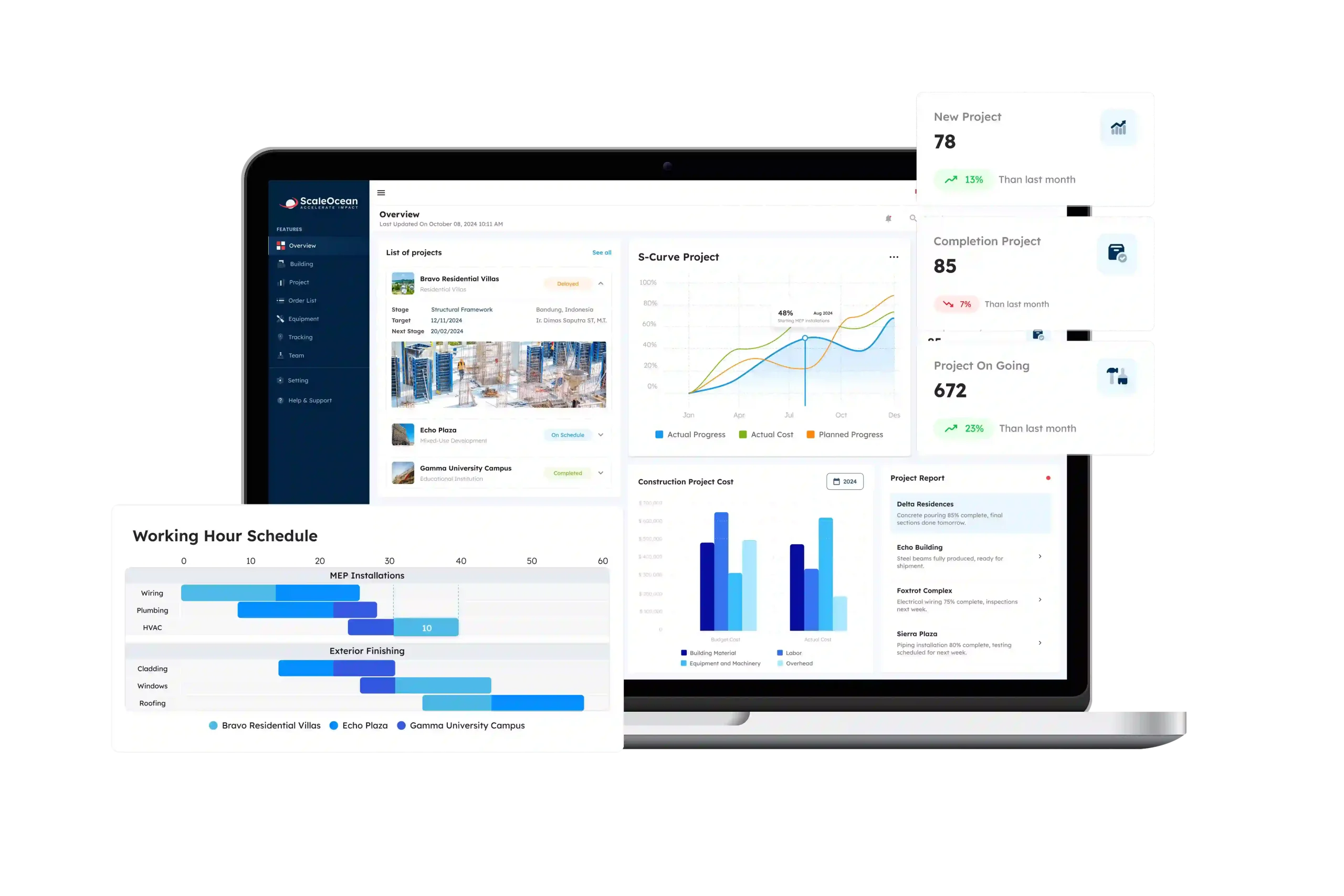
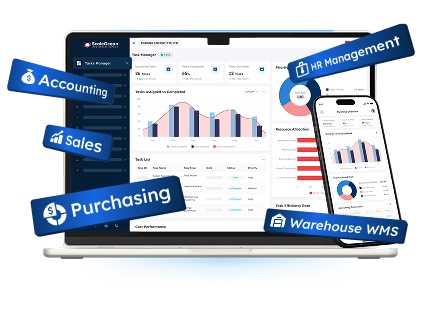
ScaleOcean is a cloud-based construction ERP software that helps construction companies manage project documentation, contract agreements, and project administration efficiently.
The systems within the ScaleOcean is designed to centralized construction documentation in one platform, helping companies manage multiple contract revisions, approval process, and budget adjustments.
Moreover, ScaleOcean streamline business processes such as construction contracts, administrative tasks, and financial documents through centralized digital systems that improve document control, collaboration, and project visibility.
Companies can also request a free demo before implementation to better understand how ScaleOcean can support their contract management and documentations needs. Here are some features of ScaleOcean that can enhance contract agreements in construction project:
- Centralized Document: Within ScaleOcean, it can store contracts, project documents, permits, and supporting files in one platform.
- Contract Tracking: In addition, it also can helps manage contract revisions and maintain accurate document records throughout the project lifecycle.
- Approval Workflow Management: Therefore, it streamlines document review and approval processes to reduce administrative delays.
- Project Budget Integration: Moreover, it also connects contract agreements with project budgets and financial data for better cost control.
- Cloud-Based Accessibility: Finally, the most important ability of ScaleOcean is enable teams to access contract and project documents from everywhere.
8. In Conclusion
Understanding the various types of construction contracts is important for maintaining clear project scope and achieving the best result. Moreover, each contract type offers unique advantages, risk allocations, and cost structures that suit different requirements.
In addition, it is vital to use construction software to boost project productivity and make sure clarity between parties involved. Such software provides a centralized platform where stakeholders can access all information in real-time.
With these construction solutions, businesses can rely on ScaleOcean Construction ERP Software for integrated tools that connect project planning, procurement, and budgeting. The integration within this software can eliminate data silos and maintain accurate documents.
Request a free demo today and discover how ScaleOcean can help your business manage construction projects more effectively.
FAQ:
1. What is a contract in construction?
A construction contract is a legally binding agreement between a project owner and contractor that defines the scope of work, payment terms, timeline, responsibilities, and project requirements to ensure both parties meet their obligations.
2. What are the standard forms of contract in construction?
A construction contract should include the project scope, contract price, payment schedule, timeline, roles and responsibilities, change order procedures, risk allocation, and dispute resolution terms.
3. What are the various types of construction contracts?
Common construction contract types include Lump Sum, Cost-Plus, Time and Materials, Unit Price, Guaranteed Maximum Price (GMP), Design-Build, Incentive, and Integrated Project Delivery (IPD) contracts.
















.png)