




Concrete slab foundation or known as slabs, is a flat layer of concrete that serves as both the base and the floor of a building. It is commonly used in houses and small commercial buildings because it is affordable and easy to maintain.
This article will guide you through everything you need to know, from the definition and thickness standards. Therefore, you can understand it clearly and apply it effectively in your construction projects.
 Key Takeaways
- Concrete slab foundation is a flat concrete base that supports a building and also acts as its floor, making it a simple and efficient foundation type.
- Concrete slab foundations offer benefits such as faster construction, lower costs, pest resistance, and reduced maintenance, making them suitable for residential projects.
- There are different types of slab foundations, such as slab-on-grade, slab-on-fill, T-shaped, and post-tension slabs, each designed for specific conditions.
- ScaleOcean Construction ERP Software can help streamline planning, budgeting, and resource management to improve overall construction project efficiency.
1. What is Concrete Slab Foundation?
Concrete slab foundation is a single layer of concrete, typically reinforced with steel bars or mesh, that rests directly on the soil. It serves as both the foundation and the floor of a building.
Common systems include slab-on-grade, poured at ground level, and slab-on-fill, where soil is compacted before pouring. Compared to other foundation types, slab foundations are quicker and easier to build.
In the Philippines, the construction of foundations, including concrete slab foundations, must comply with the Presidential Decree No. 1096 (National Building Code of the Philippines). The code establishes minimum standards for building safety, materials, and construction practices to ensure public safety and durability.
2. How Thick is a Concrete Slab Foundation?
The thickness of a concrete slab foundation generally ranges between 4 to 6 inches (100 to 150 mm). This range is commonly used in practice to provide sufficient strength while maintaining cost efficiency.
As mentioned before, in the Philippines, slab thickness is not determined by a fixed standard alone. Under the Presidential Decree No. 1096 (National Building Code of the Philippines), the thickness of a slab foundation depends on several important factors:
- Soil condition, whether it is soft, loose, or well-compacted.
- Load requirements of the structure, including dead loads and live loads, help engineers determine whether a slab foundation or a raft mat foundation is more appropriate.
- Engineering design standards and local building regulations.
Because of this, engineers may recommend thicker slabs, spread footing systems, or deeper footings for heavier buildings or areas prone to flooding and ground instability. The final thickness is always based on proper structural analysis to comply with national standards.
3. Advantages of Concrete Slab Foundation
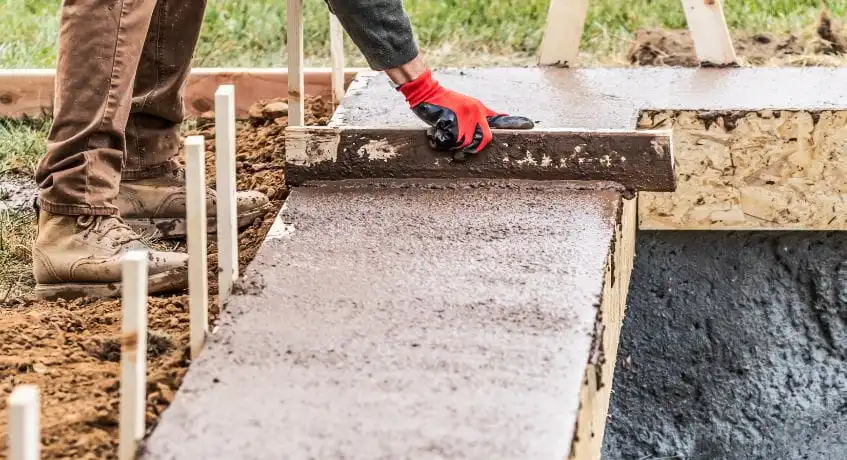
This type of construction foundation offers several advantages that make them a practical choice for many construction projects. With its simple design, this type of foundation supports faster construction while still providing reliable structure Here are some of the advantages:
a. Reduced Implementation Time
First, concrete slab foundations are built faster than other types. It doesn’t need deep excavations, because slab foundations only need basic ground preparation. This also applies to slab-on-fill systems, where compacted soil helps speed up the process.
b. Protection Against Pests
Moreover, it creates a solid barrier between the building and the soil, making it harder for termites and other pests to get inside. This is especially important in the Philippines, where warm and humid weather increases pest activity.
c. Less Risk of Water and Gas Leakage
Not only protection against pests, it is also built with moisture barriers, which it uses to prevent water from seeping into the building. This is useful in areas with heavy rain or flooding. It can also reduce the entry of harmful gases from the ground.
d. Lower Maintenance Fees
In addition to its benefits, this foundation usually needs less maintenance because there are no underground spaces to manage. This makes repairs less frequent and more affordable. It is a big advantage for developers in the Philippines because it needs less preservation.
4. Disadvantages of Concrete Slab Foundation
Even with its benefits, slab foundation has some limits that should be considered before using it. Knowing these drawbacks helps ensure the foundation fits the building’s needs and site conditions.
a. Potential Cracking of Slabs
The downside of this is it can develop cracks over time due to soil movement, temperature changes, or improper construction. In the Philippines, this risk can increase because of frequent rain, moisture changes, and shifting soil conditions.
b. Infestation is Still Possible
Although it reduces pest entry, they do not completely eliminate it. Termites and insects can still find their way through small cracks, gaps, or utility openings. This is why regular inspection and preventive pest control are still necessary
c. No Basements
Another disadvantage of slab foundation is that it is built directly on the ground, unlike a basement foundation, which provides additional space below the structure. It means there is no space for a basement. This limits additional storage, utility areas, or extra living space that could be useful for some property owners.
d. Unsuitable for Large Buildings
A further drawback is that it is generally for light to medium loads, while heavier structures may require a pile foundation to transfer loads to deeper soil layers.
For large buildings, high-rise structures, or projects with heavy loads, this type of foundation may not provide enough support, making a caisson foundation a more suitable alternative in some conditions.
5. Types of Concrete Slab Foundation
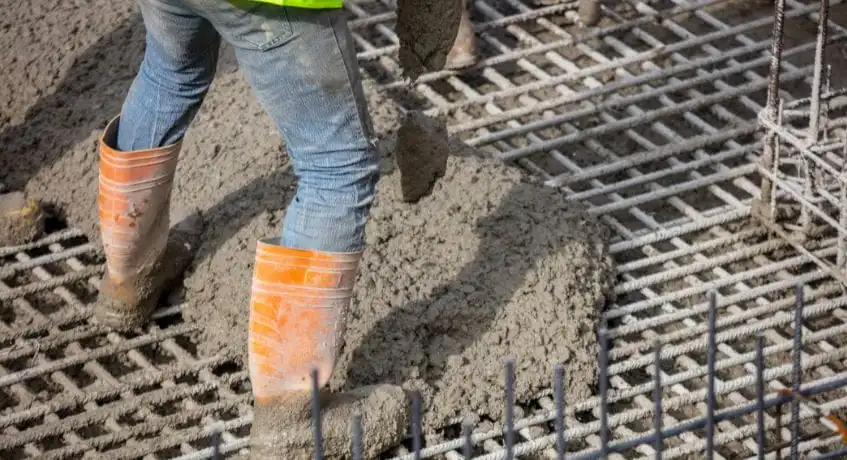
There are several types of concrete slab foundation, each designed for different soil conditions, climate factors, and building requirements. Understanding these types helps builders choose the most suitable foundation.
a. Slab-on-Grade
This is the most common type of slab foundation. The concrete is poured directly on a prepared ground surface that has been compacted. It is widely used in the Philippines for houses and small buildings because it is simple, cost-effective, and quick to build.
b. T-Shaped
A T-shaped foundation has a wider base (footing) below the slab, forming a “T” shape. The footing supports the load, while the slab sits on top. This type is mainly used in colder countries where the ground can freeze.
c. Frost-Protected
Frost-protected slabs are designed to prevent damage caused by freezing soil. They use insulation to keep the ground temperature stable and avoid cracking. Since the Philippines has a warm climate and no freezing conditions, this type is not commonly used.
d. Post-Tension Slab
A post-tension slab uses steel cables inside the concrete that are tightened after the concrete hardens. This process makes the slab stronger and more flexible. It helps reduce cracking and can handle soil movement better.
6. When is Concrete Slab Foundation Used?
Concrete slab foundations are commonly used when construction needs to be fast, simple, and cost-effective. This type of foundation works best in projects where the ground conditions are suitable and the building load is not too heavy.
Meanwhile the other type of foundations such as strip foundations may be preferred for certain load-bearing wall applications. Thus, concrete slab foundations are ideal for:
- Residential homes and low-rise buildings.
- Areas with stable or moderately stable soil.
- Projects with limited construction time.
- Tropical regions like the Philippines.
Overall, it is a practical choice for many urban and suburban developments in the Philippines, especially when efficiency and cost control are important. It is providing reliable support for residential and small-scale buildings.
7. In Conclusion
Concrete slab foundation is a reliable and efficient solution for many construction projects, especially in the Philippines. It offers faster construction, lower costs, and sufficient durability when designed and built properly.
To manage construction projects more effectively, using a reliable system like ScaleOcean construction ERP Software can help streamline planning, budgeting, and resource allocation in one integrated platform.
You can also request a free demo to see how the system supports your projects from start to finish and improves overall efficiency in your construction operations.
FAQ:
1. What are the three types of slab foundations?
The three common types of slab foundations are Slab-on-Grade, T-Shaped, and Frost-Protected. Each type is designed for different conditions. Slab-on-grade is the most widely used.
2. Does a concrete slab need a foundation?
Yes, a concrete slab still needs a proper base to stay stable. Before pouring concrete, the ground must be prepared with a compacted layer, usually made of gravel. This base helps prevent shifting and cracking over time.
3. What is the best material to put under a concrete slab?
Gravel is the most recommended material for the base of a concrete slab. It is usually placed at a thickness of around 4 to 6 inches, but it can be thicker for heavier structures or poor soil conditions.


















.png)