




Spread footing is one of the techniques of the shallow foundations to strengthen the base foundation. The way it helps is by transferring a building’s weight to the ground. This reduces pressure on the soil and makes the structure more stable.
It is commonly used in houses and commercial buildings with firm and reliable soil. Before using spread footing, it’s important to know the benefits & the factors to consider. This article helps you to understand the most efficient way to manage spread footing projects.
 Key Takeaways
- Spread footing is a type of shallow foundation that distributes the building load over a wider area to ensure stability and reduce soil pressure.
- There are several types of spread footing, such as isolated, combined, strap, and mat footing, each designed for different structural needs.
- Spread footing offers advantages like cost efficiency, simple construction, and even load distribution, making it a practical choice for many projects.
- ScaleOcean Construction ERP Software can help improve planning, budgeting, and project management for reliable construction projects.
1. What is Spread Footing?
Spread footing is a shallow concrete foundation that supports buildings by spreading their weight over a wider area. It is placed beneath columns, walls, or other structural parts to keep the structure stable.
This type of foundation is suitable where the underlying soil has sufficient bearing capacity which rely on deeper soil layers for support. In the Philippines, the standardization of soil tests is regulated by the Department of Public Works and Highways (DPWH) under Department Order No. 75, Series of 2024.
This regulation mandates a geotechnical investigation to determine the soil’s bearing capacity to ensure stability. Because of these safety standards, spread footing remains as a reliable solution for buildings in many areas of the Philippines.
2. Considerations of Spread Footing Foundation
There are several factors to consider before choosing a spread footing foundation. The most critical considerations involve soil bearing capacity and total building load. Here are factors to consider before applying footing:
- Soil Bearing Capacity: Measurement of soil bearing capacity is the most important factor to consider. It measures the soil’s strength to ensure the base can support the weight of the building without sinking or collapsing.
- Frost Line: The second factor is consideration of frost line. In cold regions, the footing must be placed below the frost line to prevent frost heave. This helps the soil less affected by cold temperature.
- Shear and Flexure: The third important factor is analysis of shear and flexure. Spread footings must resist internal stresses from structural loads. For example, shear can cause sliding or cracking, while flexure causes bending due to uneven loads.
Beyond these factors, you should consider using digital software to manage your project before implementing spread footings. ScaleOcean Construction ERP Software helps you optimize everything from budgeting to real-time progress tracking.
3. Types of Spread Footing
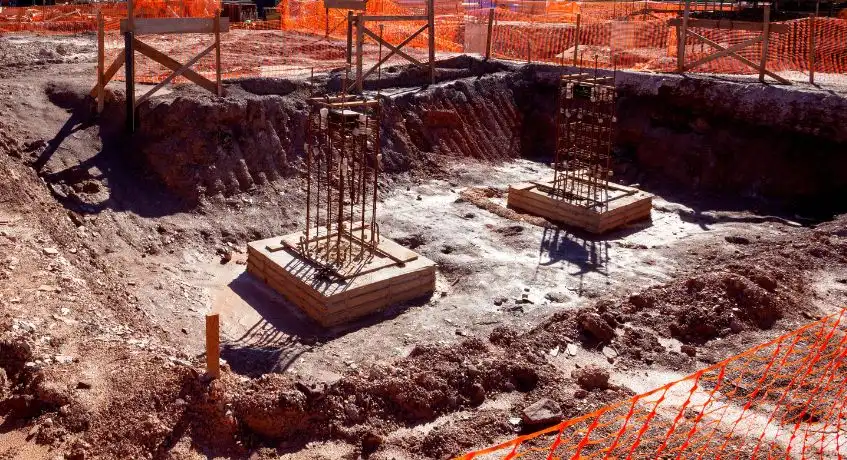
There are several types of spread footing, each design for specific structural needs. Hence, choosing the right type depends on a few factors like load distribution and soil strength. Here are some of the types of spread footing:
a. Wall Spread Footing
This type supports load-bearing walls by spreading the weight evenly along the length of the wall. It is used in residential buildings, especially for concrete or masonry walls. Wall spread footing helps prevent uneven settlement along the wall line and functions similarly to strip foundations used beneath load-bearing walls.
b. Isolated Spread Footing
The second type is isolated spread footing or also known as pad footing. In general, it is placed under individual columns. As a result, it becomes one of the most widely used foundation types in small to medium structures.
c. Combined Footing
The third type is combined footing. It supports two or more columns when they are close together. This type ensures that loads are distributed evenly when separate footings would overlap or become impractical.
d. Strap Footing
The next type of spread footing is strap footing. This footing connects two isolated footings with a beam (strap) to balance uneven loads. The strap beam does not transfer load directly to the soil but helps distribute forces between footings.
e. Grillage Footing
For buildings that require high load capacity usually use grillage footing. It uses layers of beams (usually steel or reinforced concrete) arranged in perpendicular directions to distribute heavy loads.
f. Continuous Strap Footing
Thereafter, spread footing also focuses on providing continuous support across multiple columns. It is designed to handle a series of columns in a line in order to improve load distribution and structural alignment.
g. Inverted Arch Footing
Additionally, this type uses an arch shape to transfer loads efficiently. The arch helps distribute loads sideways and reduces pressure directly beneath the footing. Inverted arch footing is usually used in areas where the soil strength is limited.
h. Mat Footing
The last type is mat footing, also known as a raft mat foundation, which supports the entire structure by covering a large area. It is ideal for weak soils where individual footings may not be sufficient.
This type of footing is commonly used in projects that do not require a basement foundation and is suitable for soft or compressible soils often found in some coastal areas of the Philippines.
4. Advantages of Spread Footing
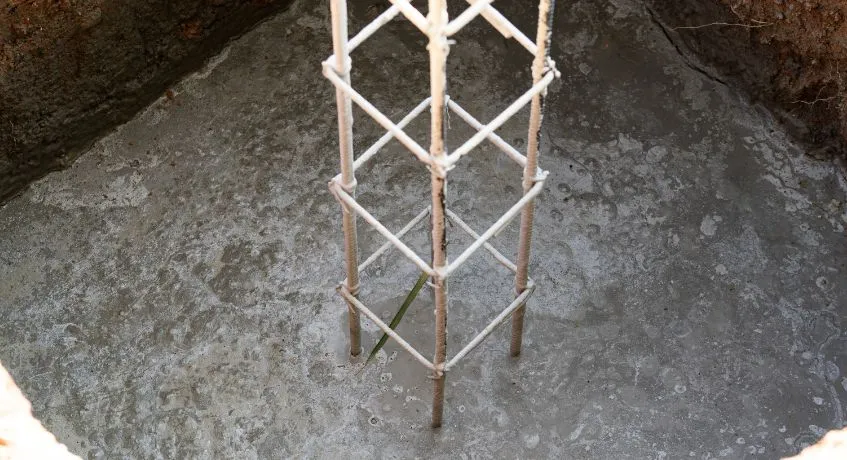
There are several benefits of spread footing and it’s suitable for light building construction. In addition, its simple design and efficient load distribution make it one of the most practical systems used in construction foundation.
a. Cost-Effective
Spread footing is one of the most affordable foundation types. It requires less excavation and fewer materials compared to deep foundation systems such as a caisson foundation. It also involves simpler construction methods, which can reduce labor costs and construction time.
b. Frost Damage can be Reduced
Although frost is not a major concern in the Philippines, proper depth and design can still protect the foundation from temperature-related ground movement in cooler regions. Thus, placing the footing at an appropriate depth helps maintain soil stability.
c. Even Weight Distribution
The third advantage helps maintain structural alignment and prevents issues such as cracks in walls or floors. Proper load distribution is especially important in areas with varying soil conditions, as it improves overall building stability and performance, it is similar to the function of a concrete slab foundation in supporting structures.
5. Disadvantages of Spread Footing
While spread footing is widely used, it also has some limitations that need to be considered during planning and designing. Understanding these drawbacks helps avoid potential structural issues, here are some of disadvantages of spread footing:
a. Cannot be Used for All Soil
Spread footing is not suitable for soft, loose, or highly compressible soils. In such conditions, pile foundations may be more suitable to transfer structural loads. Otherwise, excessive loads this may lead to uneven settlement.
b. Subject to Torsion, Moment, & Pull-Out
The second disadvantage is if the design didn’t apply perfectly, the structural stresses may cause torsion (twisting), bending moments, and pull-out forces. These stresses may lead to cracks, tilting, or even partial failure of the foundation if not properly addressed.
6. In Conclusion
Spread footing is a practical and reliable choice for homes or light commercial buildings that do not require a basement foundation. However, proper planning, soil analysis, and design are essential to maximize its benefits and avoid potential issues.
For smoother project management, you can use digital solutions like ScaleOcean Construction ERP Software. ERP Software can help streamline planning, budgeting, and execution.
With these advantages, your projects can run more efficiently and accurately. You can request a free demo to see how ScaleOcean can support your construction operations from start to finish.
FAQ:
1. What is another name for spread footing?
Spread footing is often called an isolated footing or pad footing. It is commonly used to support a single column, with a concrete base that spreads the load to the soil.
2. What is the difference between spread footing and continuous footing?
Spread footing usually supports individual columns, with the load centered on the footing. In contrast, continuous footing supports walls and runs along their length, often with the load not perfectly centered.
3. What are the basic requirements for spread footings?
Spread footings are usually designed to be close to square in shape for better stability. For column footings, the length should not be more than twice the width, unless site conditions or design needs require a different shape.


















.png)