

Managing cash flow in a business in Singapore can often feel like an overwhelming task. Many business owners struggle to keep track of every financial transaction, leading to stress and confusion. The general ledger in accounting is a powerful solution to this problem.
A general ledger (GL) serves as a comprehensive record of a company’s financial transactions, categorizing them according to account types such as assets, liabilities, equity, revenue, and expenses. This organization aids in the preparation and analysis of financial statements.
By understanding the ledger in accounting and how it functions, you can improve the team’s decision-making, manage expenses, and remain compliant with financial regulations. In this article, we’ll explore what a general ledger is and the different types available, and provide some handy templates to help you get started!
 Key Takeaways
- General Ledger (GL) provides a summary of all transactions recorded using the double-entry bookkeeping system.
- Thegeneral ledger with the double-entry bookkeeping method, in which each transaction is documented as both a debit and a credit, with this balance: (Assets = Liabilities + Equity)
- Thetypes of general ledger include income, expenses, assets, liabilities, and equity.
- The general ledger records all financial records, starting from centralized financial, transaction records, income statements, balance sheets, cash flow, and Summarized Financial statements

What Is a General Ledger (GL)?
A general ledger (GL) provides a summary of all transactions recorded using the double-entry bookkeeping system. It records the impact of every transaction on at least two accounts: one account receives a debit, while a different account receives a credit. The total amount debited must always equal the total amount credited.
The ledger also serves as a comprehensive accounting record that aggregates all activities and financial transactions of a business, consolidating all accounts into a single location. It is utilized to generate financial statements, including balance sheets and income statements.
The general ledger categorizes transactions according to account types, such as assets, liabilities, equity, revenue, and expenses. In accounting, a general ledger is crucial because it is primarily utilized for generating various accounting records and also provides a centralized and detailed record of all financial activities, enabling you to track some types of general ledger.
Therefore, all of the transactions in the company are initially recorded in a general journal as journal entries, which are subsequently transferred to the general ledger. GL accounts include all debit and credit transactions related to them, along with detailed information about each transaction, such as the date, description, and possibly a brief explanation of the transaction.
This comprehensive tracking ensures that your financial statements, such as the balance sheet and income statement, are accurate and reliable. The ledger in accounting works by recording each transaction in two accounts: a debit in one and a credit in another, maintaining the accounting equation. This double-entry accounting book helps detect errors and ensures that the books are balanced.
In the context of financial management, the general ledger is a key component that organizes financial data into accounts, each representing specific types of financial transactions. The Chart of Accounts provides a comprehensive list of all the accounts within the general ledger, helping businesses categorize their financial activities.
Additionally, the general ledger often incorporates data from sub-ledgers, such as accounts payable or accounts receivable, which offer detailed insights into specific financial areas, ensuring accurate tracking and reporting of transactions.
What Are the Types of General Ledger?
A general ledger is divided into multiple accounts to provide a structured and detailed view of a company’s financial transactions, enhancing both accuracy and clarity. To have a better understanding, let’s have a look at each type of GL in accounting, including:
1. Assets
Assets in the ledger, such as cash, inventory, accounts receivable, buildings, and equipment, are crucial in accounting. Keeping track of these is key to knowing how much the company is worth and gaining investor trust.
Prepaid expenses are also considered assets, as they represent payments made in advance for goods or services to be received in the future. These are classified as current assets and gradually recognized as expenses as the service is used.
For instance, cash is a current asset recorded at its real-time value, while equipment might depreciate over time.
You won’t want to overlook intangible assets like intellectual property because they add major value, especially in tech sectors. A well-kept record of assets shows financial stability and growth potential.
2. Liabilities
The liabilities in the general ledger example, loans, expenses, and accounts payable, cover the company’s owes. Companies in Singapore’s liabilities in the ledger accounting help keep an eye on debts and manage cash flow effectively.
Based on Investopedia, loans, for example, are long-term liabilities, while accounts payable are short-term due to quicker repayment periods. Accurate records help you stay prepared for financial obligations and aid in planning future payments. It also reassures investors and creditors that your business is financially responsible.
3. Equity
Equity such as retained earnings, and capital contributions are stake in the business, also calculated as the difference between total assets and liabilities. Showcasing equity entries highlights the business’s financial value after debts are settled, crucial for attracting investors.
This includes retained earnings and reinvested profits, reflecting growth over time. Tracking equity signals financial stability and growth potential, making it vital for evaluating shareholder wealth and company value. For businesses in Singapore, it might mostly reflect initial investments, while established firms show accumulated profits.
4. Revenue
Revenue, for example, sales income and service fees, reflects all income from the operations of businesses. Under the accrual accounting method, sales revenue is logged when goods are delivered, while service revenue is noted upon completion.
Monitoring revenue helps identify which areas drive growth and which need improvement. This aids in budgeting, forecasting, and performance evaluation, enabling strategic adjustments to achieve revenue targets.
5. Expenses
Expenses such as rent, salaries, and utilities are incurred in running your business and fall under expenses. Tracking these helps identify where to optimize or cut costs. Salaries are operating expenses, while loan interest is a financial expense.
Clear expense records are crucial for budgeting and resource allocation. Analyzing trends helps you adjust budgets and reduce unnecessary costs, boosting profitability and promoting sustainable growth.
What Information Does a General Ledger Provide?
Every financial step will be recorded in the ledger to make it easier for you to manage it. With this, you can organize data systematically, monitor financial health, and ensure its accuracy, as well as generate important reports for decision-making. These are the pieces of information recorded in the general ledger:
1. Centralized Financial Data
A ledger serves as the central repository for all financial data. By consolidating financial information in one place, it simplifies the tracking and planning of business needs.
This centralization helps in making informed decisions, such as pricing products based on absorption costing or determining the financial resources required to achieve business goals. Having all data in one location makes it easier to monitor and analyze financial performance.
The ledger in accounting pulls together data from various sources, ensuring that every financial transaction is accounted for. This comprehensive approach allows businesses to maintain a clear and organized record of their financial activities, which is essential for accurate financial planning and reporting.
2. Comprehensive Transaction Records
Every financial transaction your business undertakes, whether it’s a purchase, sale, or payment, is recorded chronologically in the ledger in accounting. These transactions often start from records like the purchase journal before being transferred to the ledger. This chronological recording ensures that all transactions are documented in the order they occur, providing a detailed history of financial activities.
This data forms the foundation for all subsequent accounting processes and reports. By maintaining a complete record of transactions, the ledger in accounting supports the creation of accurate financial statements and helps in tracking the financial stability of the business. This detailed record-keeping is crucial for transparency and accountability in financial management.
3. Income Statement Preparation
To generate an income statement, you need a summary of all income and expenses over a specific period. The ledger records all sales revenue, operating costs, and non-operating income and expenses, providing the necessary data to create this summary.
The ledger in accounting provides detailed records and ensures that all income and expenses are accurately captured, allowing for precise financial analysis. This helps businesses understand their profitability and make informed decisions to improve financial performance.
4. Balance Sheet Compilation
A balance sheet provides a snapshot of your business’s financial position at a specific point in time. It includes assets, liabilities, and equity account balances, all of which are recorded in the ledger in accounting.
By summarizing these balances, the ledger in accounting helps create a comprehensive balance sheet that reflects the resources available to the business and its financial obligations.
The balance sheet is an essential tool for assessing the economic resilience of a business. It provides insights into the company’s assets, liabilities, and equity, helping stakeholders understand the overall financial stability and make strategic decisions.
5. Cash Flow Statement Creation
The ledger is important for preparing cash flow statement reports because it records all cash transactions that occur in a business. It gives information about the cash flow from the operational, investment, and financing activities.
It is essential for managing cash flows to implement the managing cash flows structure, making it easier to project the managing cash flows.
Furthermore, the inclusion of a cost breakdown structure into the managing cash flows can help to analyze the costs incurred for each managing cash flows activity.
Therefore, the ledger in accounting can assist a firm to supervise the flow of cash and to make correct decisions related to cash management. It is vital for a company to be economically sustainable and to develop in the future.
6. Summarized Financial Reports
At each level of the ledger, transactions such as accounts receivable, the trial balances are extracted. From the trial balances, you can generate several reports on your company’s performance.
The process of summing transactions is important, as they are used for trend recognition, analysis of financial data and costs, and the compiling of accurate financial statements.
The ability of the ledger to sum up information from many transactions into data useful for producing financial reports is invaluable.
However, it gives an efficient insight into the financial business of the company so that whoever chooses to use this report will have accurate and reliable information for decision-making purposes.
How Is a General Ledger Organized?
So what is a general ledger? It’s a systematic organization that facilitates reporting and also it promotes business’s grasp of financial control. To make any long-term financially good decisions making, you should know what the composition of the GL is in Singapore.
1. The Accounts in a GL are Organized into Five Main Categories
Such as assets, liabilities, equity, revenue, and expenses. This classification offers a concrete layout of the finance, thereby helping in proper accounting of every activity. This organizes the accounts according to the financial chart of accounts.
2. Each Category Helps Organize and Track Financial Transactions Systematically
By categorizing transactions into five main categories, you can maintain a structured and transparent financial record. It also simplifies financial reporting examples.
Having just five accounts, each covering a broad expense or income grouping, means that you can keep an accurate and honest record of your financial affairs.
It is also easier to prepare financial reports, such as profit and loss statements, which show the business’s development, trends in expenses, and an easier way to conform with accounting standards.
3. The Ledger is Broken Down into Accounts, Account Balances, and Financial Transactions
The ledger provides a collection of separate accounts that contain all the financial details, including account balances for the various assets, liabilities, equity, revenue, and expenses of a business.
A ledger is kept up to date by recording the financial details of every sale, purchase, or expense in that specific account.
How Does the General Ledger in Accounting Work?

You are the main records keeper and the ledger. It can keep track of all the money coming in and going out and record all transactions. Just know what a general ledger is and what it does.
1. Recording Transactions
All money going through the business is tracked. If you make a sale, spend money, buy an asset, or incur a liability, a note is made in the accountant’s ledger, including the date, how much, and which accounts the change is credited to and debited from.
If you keep records, you will be able to look at your business’s financial position any time you want, which puts you in a better position to make important decisions.
Also, the company will be using the ledger quite often, so accurate transaction recording will be a vital part of the company following monitoring procedures for financial statements and statutory requirements.
2. Double-Entry Bookkeeping
The ledger is based on the double-entry system in bookkeeping or accounting. Double-entry bookkeeping provides control over the accounting equation and helps make sure that the numbers will always balance.
This is one of the most important elements to keep in mind when considering bookkeeping vs. Accounting.
Balances: Credits must balance Debits, so if they do not, then you can easily identify where the differences are and take appropriate action. This gives you an overview of all the transactions that are occurring in your business.
3. Categorizing Accounts
Transactions are entered into different accounts such as income, expenditure, asset, liability, and capital accounts. This classification separates transactions into different groups and helps to generate the financial statements.
There are individual ledgers for each account, which are a part or subset of the ledger in accounting. Organize your transactions by category and learn more about your key businesses, including your profit and loss statement report and expense management.
Categorizing transactions makes it easier to do audits and check your reports. A consistent account category allows your report to provide an accurate representation of your business’s financial position.
4. Posting Entries
In accounting, after transactions have been journalized, they are posted to the ledger. Posting is the process of transferring the journal entries to the ledger accounts.
Daily posting is the best way to keep your books current and is in real time, providing you with the (financial position) of your business.
Keeping your ledger current in accounting will enable you to make informed decisions promptly. Daily posting will also aid you in producing your financial statements and reports.
5. Trial Balance
From time to time, you will create what is known as a trial balance to check that the total of debit balances is equal to the total of credit balances. If the trial balance does balance, then this shows that the ledger in accounting is in order before financial statements can be created.
The trial balance is a fundamental element of the accounting process, because it is used to check the accuracy of your bookkeeping. Running a trial balance on a consistent basis can help you to spot problems with your accounting and rectify mistakes before they cause significant issues.
6. Preparing Financial Statements
The data contained in the ledger will be utilized for the compilation of the primary financial statements, including the balance sheet, income statement, and statement of cash flows.
Precise financial statements are vital for interested parties (investors, creditors, management) to evaluate the financial soundness of your business. This way, you can make appropriate decisions that are in your best interest.
7. Regular Review and Reconciliation
The accountant must check and reconcile the ledger, the process of comparing and matching records in the ledger with bank statements and other financial documents to ensure accuracy and clarity. Regular reconciliation catches and corrects any potential errors.
Hold average reviews in a period of time to make sure that there is accuracy in your accounts. It also helps to determine suspicious transactions and fraud.
Keeping accurate and reconciled records helps you financially manage and make good business decisions for the long-term success of your business.
How a General Ledger Functions With Double-Entry Bookkeeping
The general ledger operates by using the double-entry bookkeeping system, which means every transaction is recorded as both a debit and a credit. This helps to keep the accounting equation in balance. You can use the following equation to balance double-entry data:
(Assets = Liabilities + Equity)
The double-entry system accounts for every transaction by making debits equal to credits and balancing out accounts. When a business makes a sale, the system will record it by crediting revenue and debiting cash.
The ledger records all of a company’s transactions, including things like inventory and accounts payable, in one organized place. This makes for an easy way to look up any one transaction.
The Function of General Ledger in Singapore’s Businesses
The general ledger is the central hub for all the financial data in your company and a single source of truth for every transaction made.
The ledger’s importance can be measured by how accurately it maintains your company’s accounts, makes sure you comply with the law, and helps you plan financially. It also makes a lot of tasks much easier.
1. Financial Reporting
Your ledger provides all the information you need to create financial statements such as the balance sheet, income statement, financial leverage, and the cash flow statement.
The various reports you create will enable stakeholders to make informed decisions based on your company’s financial situation and performance.
Your financial reports need to be as transparent and trustworthy as possible, which is why using the GL to record and present the data accurately is so crucial.
2. Budgeting and Forecasting
The data in your GL can be used to analyze your company’s financial performance over a specific time period. This information will allow you to develop a budget and create forecasts for the future by establishing realistic financial goals that your business will strive for.
Budgets and forecasts are important as they will assist in managing cash flow, allocating finances to different parts of the business, and helping you to identify potential problems.
Using the information you have collected can aid you in making smart choices and allocating finances accordingly, which will help your business’s stability.
3. Internal Controls
By ensuring all of your transactions are recorded in the GL, you establish that the data is accurate. This can help prevent many kinds of fraud, errors, and discrepancies from happening within your company, which leads to greater overall efficiency.
A business is at a greater risk if they don’t have good internal controls, as assets may not be secure, a company might be operating outside the law, and inefficiencies in the business can take a turn for the worse.
Keeping track of these transactions with the GL makes them harder to hide and helps prevent anything out of the ordinary from occurring.
4. Tax Compliance
Your tax returns will only be as accurate as the records you keep. For tax compliance purposes, it’s critical to maintain detailed records in the ledger. This includes things like records of any income or expense you incur from sales.
It is very important for you to have correct financial records to avoid any tax implications under the IRAS tax Singapore legislation.
By recording the relevant tax implications of every transaction you make with your ledger, you can ensure that your company does not receive any penalties or be forced to pay extra tax in the future, helping you remain fully compliant.
5. Performance Analysis
When businesses analyze their ledger records, it helps them understand how their company’s finances have performed over a specific period of time. It’s beneficial to be able to compare current performance to past performance to identify where improvements can be made.
It’s useful for business owners to be able to analyze this information and make relevant adjustments to the way the business is operating in order to grow. Making sure all financial transactions are recorded correctly in the ledger helps make this information easily obtainable.
6. Audit Preparation
Having all of your company’s financial transactions recorded properly in the ledger allows auditors to quickly access them in case you undergo an audit. This saves them a lot of time and ensures that any financial statements your business uses accurately represent the company’s finances.
When performing an audit, an auditor will use your ledger as a guide and may look at the transactions it records in order to find any irregularities in your accounts and see how you account for them. This will provide recommendations and help improve your company’s financial procedures.
7. Cash Flow Management
Any business must have control of its cash flow. The ledger tracks all cash inflows and outflows, so you can ensure you always have enough liquid capital in the business to cover outstanding liabilities.
A close eye on your business’s cash flow will help make sure you have enough cash in hand to make payments, investment decisions, or simply cope with ongoing operational costs. All these things will require an accurate recording of each cash flow in the ledger.
8. Decision Making
The ledger gives business owners a comprehensive insight into the financial condition of their company. From this information, you can make key business decisions regarding investments, potential cost-saving actions, and future expansion.
It is important to analyze different choices before making a financial decision to calculate the potential impact and see which choice presents the best option.
All the decisions made with the help of the ledger will be based on your business’s integrity, avoiding any potentially costly decisions that can impact your company’s finances.
9. Compliance and Governance
A ledger system helps to comply with legal financial regulations and contributes towards proper governance of a company.
The GL, recording all of a company’s financial transactions, should ensure all applicable rules and legislation are adhered to so that you don’t face penalties and legal issues.
Compliance is very important to safeguard your business and your company’s image from potential damages. It also helps to ensure that the company’s finances are run responsibly and transparently.
10. Historical Record
The ledger in accounting provides a chronological history of all financial transactions carried out within a business.
These historical records are extremely valuable when performing analysis of past results to help guide the business through present decisions and identify trends which can predict what the future holds.
The ledger in accounting records the business’s finances, both recent and old, which can then be looked at time and time again.
Examples of General Ledger Entries
The General Ledger is a collection of records that are kept of all the transactions that are occurring within an organization; it deals with all accounts relating to assets, liabilities, equity, revenue, and expenses.
These are all made within the General Ledger by means of the entries mentioned above. Examples of General Ledger Entries are given below:
When purchasing office supplies for 500 from a supplier on credit, the accountant would increment the accounts supplies account by 500, but also credit accounts payable by 500 to balance the equation, thus assets = liabilities + equity.
All records entered into the ledger are based upon the transaction date, description, amount of the transaction, whether a debit or credit is needed, and vendor name (if applicable), as these pieces of information are also used to create reports such as the financial statement, balance sheet, cash flow statement, and financial leverage.
Example of Ledger in Accounting Implementation
Implementing a ledger is an important step in accounting as it serves as the foundation for managing financial transactions in an orderly manner.
For businesses in Singapore, a ledger provides a reliable method for combining accounts, monitoring cash flow, and preparing financial statements with precision. Here’s an example to make it easy for you to get started.
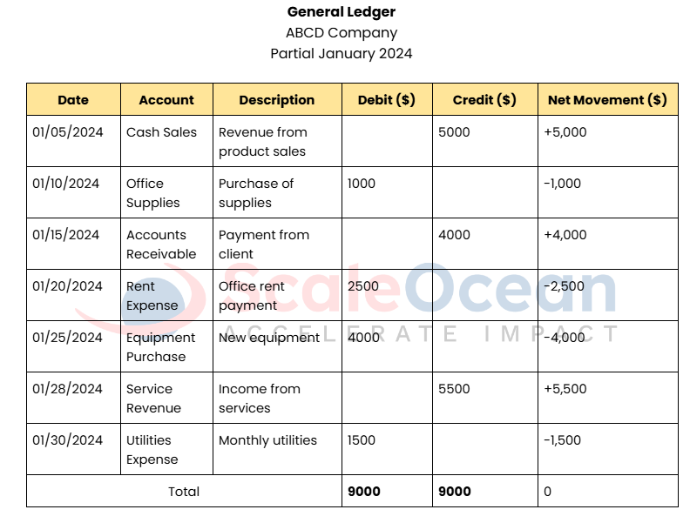
This ledger details each income and expense transaction. A transaction is posted as either a debit or a credit so that the end result is a net movement of zero.
Transactions such as ‘Cash Sales’ and ‘Service Revenue’ reflect increases in the company’s revenues and are credited, positively affecting the company’s cash flow.
Expenses such as ‘Office Supplies’, ‘Rent Expense’, ‘Equipment Purchase’ and ‘Utilities Expense’ are debited to represent operational and capital expenditures which decrease the balance. ‘Accounts Receivable’ is credited to increase cash flow by way of client payments.
With total debits and credits of $9,000, this balanced ledger displays detailed information of cash flow, which is vital for complying with various regulations as well as for smart decision-making processes.
The utilization of technology will have a great impact in simplifying and streamlining your GL process.
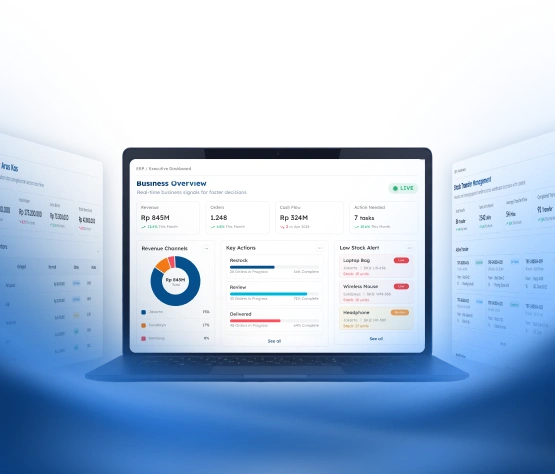
Modern ERP or enterprise resource planning software facilitates easy data entry, automates most of the calculations, and minimizes errors of human nature, allowing for the creation of real-time transaction entry and automatic classification into their relevant entries.
This technology is accessible to various industries, such as construction ERP. The automation features, such as automated alerts on pending entries and cash flow smart features, ensure you have an up-to-date cash flow statement at all times.
General Ledger Template for Singapore Companies
The process of setting up a ledger from scratch, especially if your business handles large volumes of transactions, can be time-consuming. Using a well-structured accounting ledger ensures consistency and efficiency when managing your financial data. Below is a template for your reference:
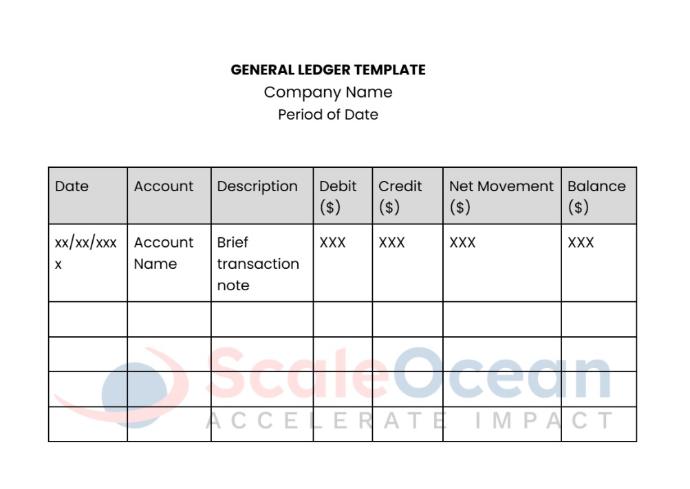
Every column mentioned in the table will help you capture a distinct aspect of each financial transaction. This information would then give you a complete financial picture.
The Date column is designed to maintain a chronological order of every transaction, whereas the Account column assigns every transaction its appropriate accounting category (e.g., revenue, expense, asset). A brief note about each financial transaction can be included in the Description column.
The Debit and Credit columns highlight the amounts that contribute to the increase and decrease, respectively, whereas the Net Movement column defines the immediate cash flow impact from each transaction.
The Balance column provides you with an ongoing balance which represents the cumulative impact of all your financial transactions up to a specific point in time.
This template ensures that each transaction, be it income, expense, or any adjustment, is documented. Using this helps you gain full visibility over your cash flow, allowing you to prepare your financial statements like the balance sheet and income statement accurately.
Conclusion
We know that the general ledger is an indispensable tool for any business; all of the company’s financial transactions are presented in a coherent way within it.
It ensures accuracy, transparency, and orderliness when compiling your financial reports. The accounting ledger gives a bird’s-eye view of assets, liabilities, equity, revenue, and expenses, facilitating informed business decision-making.
The advent of technology in business management has undoubtedly streamlined and simplified the process of creating and maintaining a ledger, especially with the introduction of the Enterprise Resource Planning (ERP) system.
ERP software combines and integrates many functions in a business process. Using it enables you to overcome many of the usual challenges that arise when recording and tracking your financial transactions.
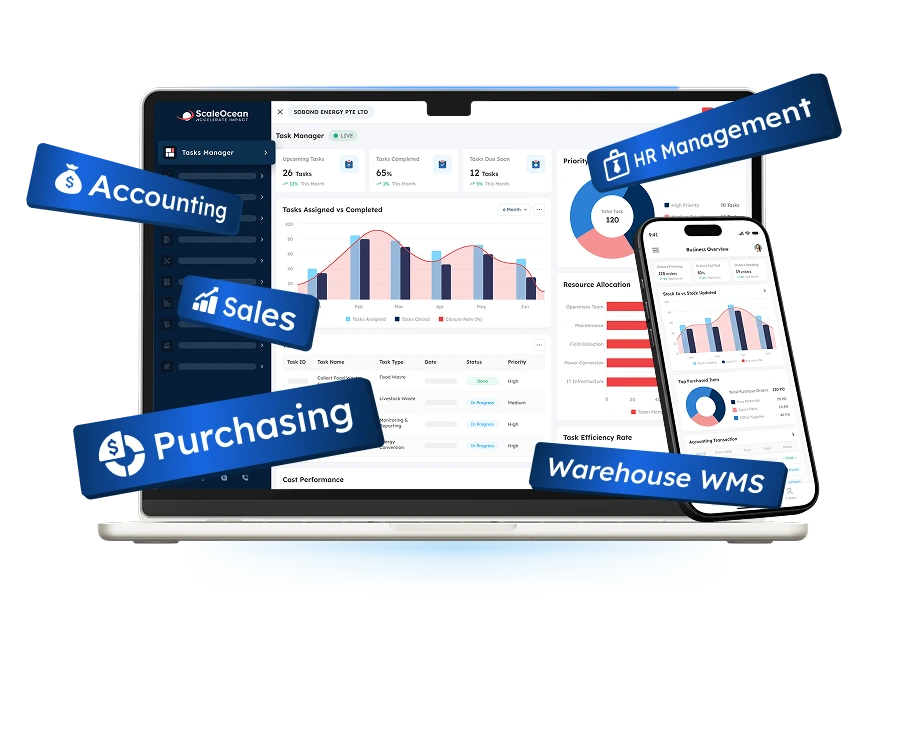
In this context, ScaleOcean ERP for accounting software could automate your real-time entries. It would make it easier to deal with complicated finance transactions and allow more time for strategic planning.
Feel free to experience this technology for yourself; just click on the demo or consultation link above, sign up for your free trial, and see the transformation in your business.
FAQ:
1. What are the 5 parts of the general ledger?
A general ledger organizes accounts into five categories: assets, liabilities, owner’s equity, revenue, and expenses. These classifications, listed in the chart of accounts, help businesses track financial activities, maintain accurate records, and ensure proper financial reporting.
2. What is an example of a GL account?
A GL account categorizes financial transactions in a general ledger. Examples include asset accounts like Cash, Accounts Receivable, and Inventory, as well as liability accounts such as Accounts Payable and Notes Payable, helping businesses track financial positions accurately.
3. Is general ledger debit or credit?
A general ledger records all business accounts and transactions using debits and credits. Debits, recorded on the left, increase assets and expenses, while credits, on the right, increase liabilities, equity, and revenue. Balancing requires subtracting total debits from total credits.
4. What are the 4 C’s of general ledger?
The 4 C’s in a general ledger refer to the Chart of Accounts, Calendar, Currency, and Accounting Convention. These elements define financial structure, reporting periods, transaction currency, and accounting system principles, ensuring consistency and accuracy in ledger processing and financial management.





















.png)