Employee engagement has become one of the most important factors in modern workforce management. Companies no longer compete only through products or pricing. They compete through people. When employees feel connected to their work and aligned with company goals, they contribute more consistently and perform at a higher level.
Companies that actively manage engagement and apply proper employee engagement strategies often achieve stronger productivity, lower turnover, and a healthier workplace culture. However, engagement does not happen automatically. It requires a clear strategy, shared responsibility, and consistent measurement.
So this article explores what employee engagement truly means, why it plays a critical role in corporate success, who holds responsibility for building it, and the key models companies use to measure and strengthen it effectively.
Key Takeaways
Employee engagement refers to employees’ emotional commitment and active involvement in their work, influencing how strongly they align with organisational goals and performance expectations.
Employee engagement is important because it directly impacts productivity, retention, workplace culture, innovation, and overall business performance across all levels of the organisation.
Employee Engagement Key drivers such as leadership quality, career development, recognition, work environment, and work-life balance significantly influence overall employee engagement and long-term commitment.
Employee engagement is the level of emotional commitment, involvement, and enthusiasm employees have toward their work and organisation. Engaged employees do not simply complete assigned tasks. They take ownership of their roles and actively contribute to company success.
Highly engaged employees are emotionally connected to their work, aligned with organisational goals, and motivated to perform beyond minimum expectations. They care about outcomes and consistently look for ways to improve results.
Measuring engagement is an important part of workforce management, helping leaders understand whether employees feel connected to their roles or have become disengaged and unmotivated.
Why Is Employee Engagement Important?
Employee engagement directly impacts business performance, retention, and workplace culture. Organisations with high engagement levels often experience better operational results and stronger team morale. When employees feel valued and involved, they contribute more consistently and align their efforts with company objectives.
Strong employee engagement leads to:
Increased productivity and efficiency
Lower employee turnover and recruitment costs
Improved customer satisfaction and service quality
Stronger teamwork and internal communication
Reduced absenteeism and workplace burnout
Better innovation and problem-solving
The urgency becomes clearer when looking at regional data. Gallup reports that 67% of employees in Southeast Asia are not engaged, highlighting a widespread gap between workforce potential and actual performance.
Without engagement, even skilled employees may only perform at a basic level. With engagement, organisations unlock discretionary effort, meaning employees willingly give more than what their job description requires.
How Are Engaged Employees Different From Other Employees?
Engaged employees show distinct behaviours compared with their peers. They are intrinsically motivated, often going above basic job duties and taking initiative to help their company succeed.
They act as advocates, speak positively about their workplace, and contribute innovatively to problem-solving. In contrast, disengaged employees may simply meet minimum requirements or, in some cases, negatively impact productivity and team morale.
Who is Responsible for Employee Engagement?
Employee engagement is a shared responsibility that involves both leaders and individual team members. While leaders are tasked with creating an environment that motivates and supports their teams, each employee also plays a vital role in fostering their own engagement.
Knowing what employee engagement is and how to improve it is critical for them. This collaboration is essential for building a workplace culture where everyone feels valued and invested in their work, leading to greater productivity and job satisfaction.
Managers and Companies
Managers and companies play a major role in creating the conditions for engagement. By providing clear expectations, regular feedback, supportive leadership, development opportunities, and a positive workplace culture, they influence how connected employees feel to their work and the company, as analysed with workforce analytics.
Individual Employees
Employees also share responsibility for their own engagement. They can seek feedback, pursue growth opportunities, build relationships, and take initiative in their roles. When individuals actively invest effort and communicate openly with managers, they contribute more strongly to a positive work environment.
What is an Employee Engagement Model?
An employee engagement model is a structured framework that companies use to understand, measure, and improve engagement. These models help companies identify key drivers of engagement, guide strategy, and track progress over time.
They also offer benchmarks so businesses can compare their engagement results with others and apply best practices effectively.
Aon Hewitt’s Engagement Model
The Aon Hewitt model deals with three behaviours that workers perform when they’re saying, staying, and striving.
Say: Staff leave with a favourable impression of the company.
Stay: They plan to continue to work with the organisation.
Strive: They expend effort, try very hard and perform beyond minimum standards.
This model shows the important components of work experience. Such as quality of life, opportunities, rewards, and company practices, that drive engagement outcomes.
Gallup’s Q12 Model
Gallup’s Q12 model comprises 12 questions that explore the clarity of expectations, recognition, growth opportunities, connection to purpose and connection to peers.
The answers to these questions provide companies with insight into an employee’s level of engagement and what areas to focus on. Given its track record and demonstrated correlation with business results, this model is very popular.
Deloitte’s Employee Engagement Model
Deloitte’s model suggests taking 5 key points to develop an “irresistible workplace“: meaningful work, hands-on management, positive work environment, growth opportunities and trust in leadership. These aspects are powerful when they are present, and staff are more likely to feel appreciated and involved throughout the day.
The Quantum Workplace Model
Companies can gauge and enhance engagement using the 3 areas of the Quantum Workplace model, commonly known as the e9 engagement model. For example, the role of employees, the teams they work with, how the organization supports them, etc.
It provides a 360-degree perspective on engagement to enable leaders to create specific plans for action and improvement.
4 Levels of Employee Engagement
Employee engagement isn’t a simple on/off switch; it’s a gradient. Depending on leadership skills, working conditions, career prospects and corporate culture, employees can move between levels as part of their work.
These four levels present an opportunity for organizations to gauge where there is a need for support and create specific strategies that can support engagement between teams.
1. Highly Engaged
Employees who are highly engaged have a strong emotional connection to the work and a strong emotional connection to the business. They are part of the company’s mission and take action toward the company’s goals. They are motivated to do their work mainly for the satisfaction of knowing they have done something worthwhile and look for opportunities to give something back.
They typically:
Show an initiative in tackling and addressing problems proactively.
Repeat above the level of performance standards/expectations.
Participate in offering ideas to enhance the effect on processes and products.
Be loyal and committed to the organisation in the long-term.
Strongly contribute to creating a positive team spirit and work atmosphere.
Serve as a mouthpiece for the company to the inside and outside.
These staff members can sometimes be seen as catalysts for performance and ambassadors for the work culture in an organisation.
2. Moderately Engaged
Moderately engaged workers perform work at a moderate level, and their performance is consistent. Their relationship with the organisation, however, is likely to be less significant with regard to their emotions. They are regular contributors but possibly do not often show a high level of effort.
They generally:
Perform to meet part of the performance criteria consistently.
Relax and enjoy with the group when needed.
Take actions in line with company policies and procedures.
Demonstrate moderate excitement in new programs and efforts.
Be neutral and cooperative about different things.
It is this group that, with sensible development plans and increased recognition, can become more involved.
3. Disengaged
Unengaged staff are a level below emotionally attached workers in terms of emotional commitment to their work. They can finish tasks as assigned; however, they are not motivated to help improve. With the lapse of time, disengagement can have an impact on the performance of individuals and groups.
Common characteristics include:
Performing at the minimum standard of the job.
Displays a lack of initiative/or originality
Very little input into discussions/cooperation.
Less orientation of efforts towards organisational objectives
Resistance to further tasks that are put on them
Early intervention can help students disengage and reverse the course of the situation before it gets worse.
4. Actively Disengaged
Engaged staff mean their work makes them feel satisfied or frustrated. This is not a case of disengaged workers who are simply passive, but might have negative feelings and spread the bad news to others. However, if not addressed, the deflated members of the workforce can negatively affect employee morale and productivity.
They may:
Publicly criticise company policies or leadership decisions
Resist change andorganisationall improvements
Oppose changes and improvements to the organisation
Spread dissatisfaction among colleagues
Show minimal commitment to organisational objectives
Companies need to act on this level in a timely fashion, engaging in positive dialogue, performance management, and leadership assistance.
Serving as indicators of workforce dynamics, it’s crucial to understand these levels of engagement. But the amount without empirical evidence is insufficient. Companies need to be aware of those factors that affect engagement, as well.
Let’s now take a look at the key contributing factors to employee engagement and how they influence employee motivation and performance.
What Are the Factors Behind Employee Engagement?
There are several factors which shape people’s motivation to be engaged in their jobs. Companies that proactively support those drivers build commitment, optimal performance and a culture of health.
Strong and Transparent Leadership: Consistently and clearly communicating intentions and setting clear expectations foster trust and alignment across teams.
Work Environment: One that is supportive, respectful and promotes collaboration, open communication and feelings of safety.
Clear Career Development: Motivate employees to invest in their careers with clear growth paths, training and prospects for promotion.
Regular Recognition: Frequent awards of recognition given with regular frequency encourage employees to carry on in a good way.
Motivating Work: Meaningful, Challenging Tasks with Autonomy: Higher emotional engagement and intrinsic motivation.
Commitment to Companies: The company when the employees believe in the mission and values, they hold a greater sense of belonging and pride.
Work-Life Balance: Reasonable workloads and flexible policies help prevent burnout and maintain lifelong productivity.
Company Performance: Improved organisational results boost employee confidence, security, and engagement overall.
What Causes an Employee Engagement Strategy to Fail?
Even the best intentions can fall short if the engagement strategy has flaws. Organisations invest in engagement programs but still struggle to strengthen employee connection. Understanding common failure points may help leaders avoid repeating the same mistakes.
No Clear and Reliable Engagement Framework
Engagement efforts fail when they lack a structured model or clear goals. Without a reliable framework, companies may implement scattered initiatives that don’t align with business needs or employee expectations. This leads to poor results, inconsistent measurement, and disengaged teams.
The challenge becomes even more evident when looking at industry data. Research by Quantum Workplace found that only 45% of respondents say organisations use consistent performance tools across their business. This lack of standardisation often results in fragmented evaluations, unclear expectations, and disengaged employees.
Employee Feedback Is Not Acted Upon
Collecting feedback is only effective if actions follow. When employees share concerns or ideas but see no meaningful change, trust erodes and motivation drops. Engagement strategies must include transparent feedback loops with visible follow-up steps to build credibility and show employees that their voices matter.
Inappropriate Employee Software Selection
Choosing the wrong tools can also undermine engagement efforts. Software that is hard to use, functionally limited, or not aligned with organisational needs will frustrate employees rather than support them. Engagement platforms should be intuitive, reliable, and suit the communication and recognition goals of the company.
One way to avoid this pitfall is to use a unified system like ScaleOcean’s talent management software, which combines HR, performance data, and engagement capabilities in a single platform, centralising employee information and workflows. ScaleOcean helps HR teams reduce manual effort, improve data accuracy, and respond to feedback faster. ScaleOcean strengthens engagement outoutcomes and minimisese risk of choosing unsuitable standalone tools.
How Should Organisations Measure Employee Engagement?
Measuring engagement requires a combination of quantitative and qualitative methods. Data alone doesn’t tell the full story unless it’s connected to meaningful insights that guide action.
Companies should align engagement metrics with clearly defined Key Performance Indicators (KPIs)to ensure employee motivation connects directly to business results. Below are effective ways companies can assess engagement levels:
Employee Surveys: Regular surveys with well-designed questions help capture sentiment, motivation, and satisfaction levels. Tools like Gallup’s Q12 or custom internal surveys allow for trend analysis over time.
Pulse Checks: Short, frequent check-ins provide real-time insights into employee mood and emerging issues, enabling faster response than annual surveys alone.
One-on-One Conversations: Direct dialogue between managers and employees uncovers deeper qualitative insights and uncovers issues that numbers alone might miss.
Performance Metrics: Metrics such as productivity, absenteeism, turnover, and quality of work can signal engagement levels when analysed alongside survey results.
Participation Rates: Engagement can be inferred by the rate of participation in company events, training programs, or collaborative activities. Higher participation often reflects higher engagement.
Feedback Implementation Tracking: Measuring whether feedback leads to action shows not just how engaged employees feel, but also whether the organisation values and responds to their input.
Effective measurement creates a baseline and helps companies track improvements over time, making engagement strategies more strategic and data-driven.
Employee Engagement Strategies and Best Practices
Companies cannot rely on one-time programs to improve engagement. They need structured, consistent employee engagement strategies that align with business goals. The following employee engagement best practices may help companies create sustainable engagement that drives performance.
Foster Open Communication
Open communication builds trust and transparency. Leaders should share company goals, challenges, and updates clearly and consistently. Encourage two-way dialogue through regular check-ins, town halls, and feedback sessions. When employees feel heard, they are more likely to stay committed and contribute ideas.
Provide Development Opportunities
Employees engage more when they see growth potential. A robust talent management strategy ensures that growth opportunities are clearly mapped to employee aspirations, directly boosting engagement.
Offer training programs and mentorship that align with both individual career goals and organisational needs. Growth opportunities increase long-term commitment and reduce turnover.
Recognition and Reward
Recognition reinforces positive performance and behaviour. Acknowledge achievements publicly and privately to show appreciation. Rewards do not always need to be financial. Consistent appreciation, career opportunities, and meaningful incentives can significantly boost motivation.
Empower Employees
Empowered employees take ownership of their work. Give them autonomy in decision-making and encourage initiative. When employees have responsibility and trust, they become more confident and engaged in delivering results.
Focus on Well-Being
Employee well-being directly affects productivity and morale. Promote work-life balance, manageable workloads, and supportive organisations that prioritise mental and physical health to create more sustainable engagement over time.
Reinforce Key Areas of Strength
Identify what already works well within the company. Strengthen high-performing teams, effective leadership practices, and successful engagement initiatives. Building on those aspects can create faster improvement than focusing only on weaknesses.
Link Engagement Initiatives to Business Results
Engagement strategies must connect to measurable outcomes such as productivity, retention, and customer satisfaction. When leaders link engagement to performance metrics, they justify investment and maintain strategic focus.
Treat Engagement as a Strategy, Not Just an Activity
Engagement should not be a one-time survey or event. It requires long-term planning, leadership involvement, and continuous monitoring. Companies that treat engagement as a strategic priority integrate it into their culture and decision-making processes.
Building an Employee Feedback Mechanism
Create structured feedback channels such as surveys, pulse checks, and one-on-one discussions. Act on feedback transparently. Employees remain engaged when they see their input leads to real improvements.
Leverage Managers to Boost Engagement
Managers directly influence the daily employee experience. Train leaders to provide clear expectations, constructive feedback, and consistent support. Strong managerial relationships increase trust, accountability, and overall engagement across teams.
Overall, consistently applying employee engagement best practices ensures that engagement efforts remain structured, measurable, and aligned with long-term business objectives.
How to Create an Employee Engagement Action Plan
An effective employee engagement strategy requires more than surveys and good intentions. Instead, companies need a structured action plan that turns insights into measurable improvement. By following a clear process, leaders can stay focused, align engagement efforts with business goals, and maintain long-term momentum.
1. Review: Interpreting Employee Feedback
To begin with, gather employee feedback from multiple sources such as engagement surveys, pulse checks, performance reviews, and one-on-one meetings. Rather than reacting to isolated comments, take time to identify recurring themes and meaningful patterns.
In addition, segment the data by department, job level, or tenure to uncover specific engagement gaps. For instance, frontline employees may experience different challenges compared to managers. By combining quantitative scores with qualitative insights, organisations gain a more accurate and balanced understanding before moving forward.
2. Priorities: Defining Key Focus Areas
Once the data has been reviewed, the next step is to define clear priorities. While it may be tempting to address every issue at once, focusing on too many areas can dilute impact.
Instead, select two or three high-impact issues that directly influence productivity, employee retention, or team morale. At the same time, ensure these priorities align with overall business objectives. This focused approach allows resources to be used efficiently and makes progress easier to measure.
3. Team Alignment: Working with Your Team
After defining priorities, involve employees in shaping the solution. Openly share key findings and explain why certain areas have been selected for improvement.
Moreover, encourage discussion and invite suggestions from team members. When employees contribute ideas, they feel valued and become more invested in the outcome. As a result, engagement initiatives gain stronger buy-in and greater long-term success.
4. Action Plan: Turning Ideas into Steps
Next, translate priorities into concrete actions. Clearly outline what needs to be done, who will be responsible, and when each task should be completed.
At the same time, define measurable success indicators such as improved engagement scores,reduced absenteeism, or higher productivity levels. Breaking larger initiatives into smaller milestones also helps maintain focus and track progress more effectively. In this way, the strategy moves from discussion to execution.
5. Follow-Ups: Keeping Momentum Going
Finally, maintain momentum through consistent follow-up. Engagement should evolve, so schedule regular check-ins, progress reviews, or pulse surveys to monitor improvement.
Equally important, communicate updates transparently. Let employees know what actions have been taken and what results have been achieved. When employees see visible follow-through, trust increases, and engagement efforts become part of the company’s ongoing strategy rather than a one-time project.
6. Using Software Solutions to Track Employee Engagement
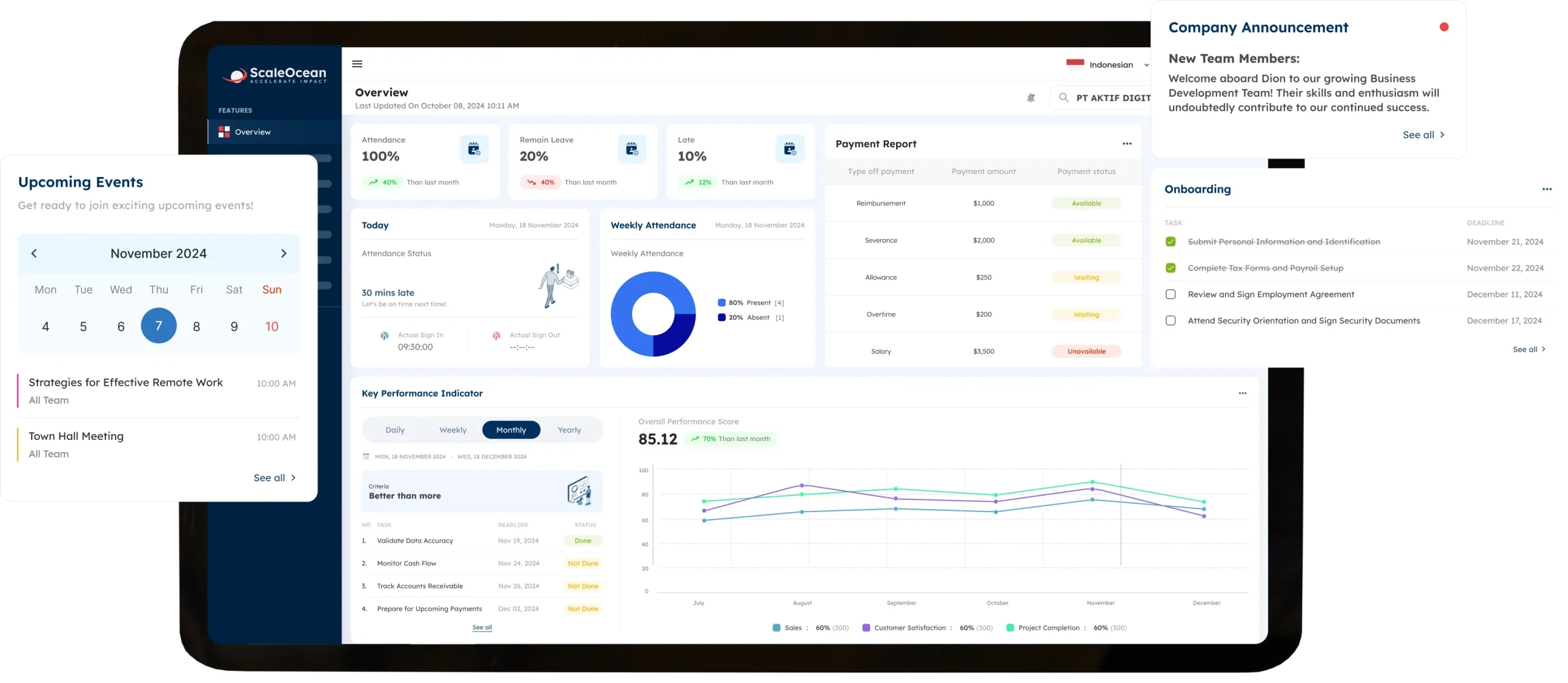
Companies can strengthen their engagement action plans by using structured digital tools. ScaleOcean’s talent management ERP softwaremakes tracking employee engagement more accurate and efficient through an integrated ERP-based platform.
As an all-in-one solution, ScaleOcean integrates seamlessly with HR management, payroll, and ATS systems. Companies can manage attendance data, productivity records, performance history, and compensation within a single connected ecosystem.
The system offers customizable modules that adapt to specific company types, cultures, and workflows. Its easy-to-use interface and unlimited user access allow companies toimplement engagement tracking across departments without limitations.
Scaleprioritisesitizes data security and supports compliance with Singapore’s Personal Data Protection Act (PDPA), ensuring sensitive employee information remains protected. The platform also aligns with CTC grant requirements, helping organisations modernise their workforce management systems with eligible support.
ScaleOcean enhances engagement tracking through powerful features:
Real-Time Performance Management: Set employee targets and KPIs, conduct periodic evaluations, and monitor individual and team achievements within one integrated dashboard.
Training and Development Tracking: Manage training programs, track competency development, and support continuous skill improvement.
Real-Time Sentiment Measurement: Use E-NPS (Employee Net Promoter Score) to measure how likely employees are to recommend the company as a workplace.
Learning and Development Integration: Map current employee competencies to promotion requirements and personalised learning paths linked to individual performance profiles.
Analytics and Local Compliance: Use AI-driven analytics to identify early signs of disengagement and visualise engagement levels across departments while maintaining regulatory compliance.
To explore how ScaleOcean’s talent management software can be tailored to your specific business needs, you can schedule a consultation and request a free demo with ScaleOcean’s professional team today.
Conclusion
Employee engagement is the emotional commitment employees have toward their work and organisation, directly impacting productivity, retention, and overall business performance. To sustain its growth and operational stability, a company must actively manage and consistently track engagement levels.
In addition, to manage engagement effectively, businesses need the right systems in place. ScaleOcean’s ERP-based talent management software helps organisations track performance, monitor sentiment, and integrate HR data in one secure platform.
With real-time insights and customizable modules, companies can turn engagement strategies into measurable results. If you are ready to strengthen employee engagement with a smarter, integrated approach, request afree demoof ScaleOcean today and see how it can support your workforce transformation.
FAQ:
1. What are the 5 C’s of employee engagement?
To build strong employee engagement, leaders should focus on the 5 Cs: Care, Connect, Coach, Contribute, and Congratulate. This article explains each of these key elements and how they help foster a motivated and committed workforce.
2. Why does employee engagement matter for Singapore businesses?
Employee engagement matters because engaged employees are more likely to stay, perform well, and support business growth. For Singapore companies, it also helps reduce hiring costs in a competitive talent market.
3. What are the core drivers of employee engagement?
The main drivers of employee engagement include strong leadership, recognition, career development, work-life balance, fair rewards, open communication, and a positive workplace culture.
4. What is the best way to improve employee engagement in Singapore?
The best approach is to combine data, communication, and action. Singapore companies should identify employee needs, review engagement metrics, support flexible work, and build a fair, growth-focused workplace.













 Key Takeaways