With business dynamic changes and increased internal mobility in the current era, crossboarding can sometimes be a logistical issue. It can take employees time to adapt to new roles, colleagues, or even to a new system, which can result in lower output, dissent, and disengagement.
From our experience, we found that research atMaharshi Dayanand University suggests that slow adaptation can cause an organization’s sto leade up to an overall lack of agility, particularly in competitive markets, in addition to impacting the performance of the individual.
However, this does not need to be the case. An effective crossboarding approach can help ease the transition for the employees so they can get started quickly in their new jobs.
In this article, we’ll be looking at why employee transition is slow on crossboarding, what are the problems businesses encounter during the transition, and how businesses can make the process smoother and more effective to ensure employees have a successful transition without hassles.
Key Takeaways
Crossboarding is a formal process for transitioning current employees to new internal roles.
The main benefits of a strong crossboarding program include significantly lower recruitment costs and a notable increase in overall employee engagement and loyalty.
A successful process requires several key steps to support a smooth and effective transition.
Crossboarding challenges, such as managing team workloads and resistance to change, are crucial and can be achieved through a well-structured handover plan.
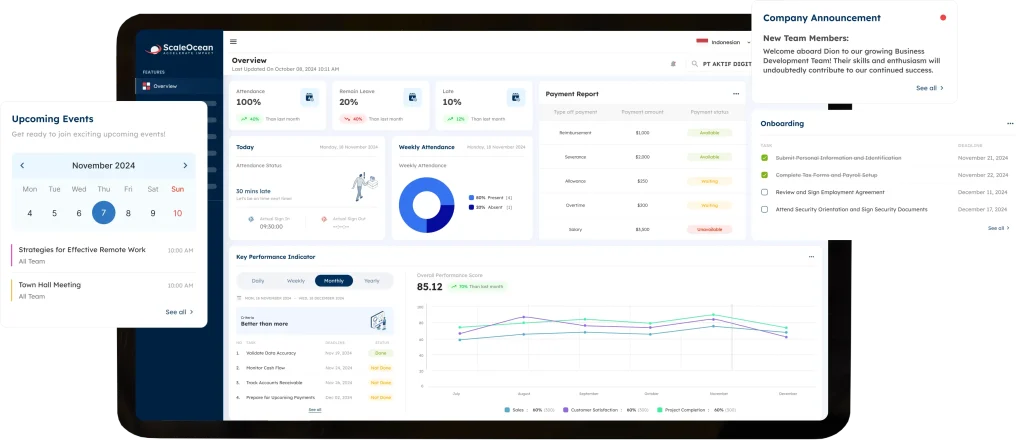
ScaleOcean’s Talent Management Software helps streamline your internal mobility strategy and manage crossboarding with custom workflows and centralized communication.
Crossboarding refers to one that a company expects a current employee to move into a new job role, but still within the same company.
It’s anything but a simple role change; it’s a systemized method, essentially, that way to make certain they’re arranged and successful in that transfer. It’s a sort of internalonboarding process, and that makes perfect sense when it comes to employee crossboarding.
Yes, they know the company culture, but they will also need the express support to learn about their new role, how they fit into the team dynamics, and how they will measure up to all other facets of the previous and the new job responsibilities.
Crossboarding vs. Onboarding and Offboarding
It’s not uncommon to find crossboarding along with other HR tasks, but this activity, seen carefully, is quite different. For example, the onboarding process is about the people who are just starting, people who are brand new to the culture, brand new to interacting with the people,e and it’s a very labour-intensive process.
Then there is the offboarding process, which is basically for the employees who are departing from the company altogether and bidding goodbye. Getting a known asset or known employee to fit into a new role in the same company is where it really excels with talent mobility within the company; that’s known as the crossboarding approach.
Crossboarding assumes the existing employee has knowledge of the company culture and aims to integrate the employee into a new specific context. Now let’s take apart the difference between crossboarding, onboarding, and offboarding:
Aspects
Crossboarding
Onboarding
Offboarding
Definition
The process of transitioning an employee to a new role or division within the same organization.
The process of integrating a new employee into an organization.
Ensuring new hires feel welcomed and are properly trained to be productive quickly.
Focus
Employee adaptation to a new role, team, or responsibility.
Introducing the new hire to company culture, policies, and job responsibilities.
Managing exit procedures, knowledge transfer, and maintaining a positive relationship with the departing employee.
Timing
Occurs when employees move within the company
Takes place when a new employee is hired.
Occurs when an employee resigns, retires, or is laid off.
Goal
Ensure smooth transitions, minimize disruption, and help employees quickly integrate into their new role.
Equip employees with the tools, knowledge, and resources to succeed in their new role.
Ensure a smooth transition, secure company assets, and gather feedback for improvement.
Key Challenge
Slow adaptation and learning curves affect performance and organizational agility.
Ensuring new hires feel welcomed and are properly trained to be productive quickly.
Maintaining employee morale and securing company data during the departure process.
What are the Benefits of Crossboarding?
But if you are just beginning to consider implementing a formal employee crossboarding program, be aware that there are lots of valuable benefits to it that can help any company. Crossboarding can actually be a practical strategic talent management initiative that contributes to the overall talent development and retention process.
Faster Productivity
If you already have cross-trained employees, then you’ve got a pretty good idea of what it’s like inside the company, something that’s definitely an advantage. This typically equates to a quicker ramp-up period when taking on a new position and role compared to an outsider, so it’s a valuable advantage for both organisational efficiency and team integration.
They don’t require the same amount of cultural induction as others, so they can jump immediately into what they have to do in their new tasks and responsibilities; this saves time. At least that time to productivity window gets a little shorter in real life, with the internal move reduced in complexity and effectiveness for all concerned.
Lower Costs
You might have to pay for someone to join a team because you don’t have them already, and it’s not the simple equation of just a pay rate for the individual; it’s the money that you spend on advertising, interviewing, and possibly agency fees, all for the person coming in.
An effective part of your resource allocation and budget management as an HR, Crossboarding is an effective way of cutting down on hiring costs while tapping into your existing talent pool, an important side of smart budget management.
On top of that, it also means you can save on those ‘hidden’ costs that come with shrilo hires since you know you already have someone who’s proven through experience to be a good employee, so it’s also a huge peace of mind. It’s a more cost-effective method of staffing and sustaining the stability and success of your organisation, and it makes good business sense.
Higher Engagement
You’re basically giving employees some of the clearest avenues to grow from within, so it’s super important they understand you have their future in mind and there’s a clear path to it.
Such a dedication to their development can sometimes improve employee satisfaction and, in turn, a great deal greater morale within the company, highlighting improved culture and loyalty generally.
And when they really see room to expand on, develop, and advance within the company, say, naturally, they are more likely to be engaged and be loyal to it, which is what we all want. It substantially influences not only your positive overall retention rates but also your ability to work with employees who are loyal to you, which is essential for growth and stability.
What are the Examples of Crossboarding?
The term crossboarding is not too fancy, used throughout the season, and it can be found everywhere in an organisation. As such, this is a list of a few common situations that are similar to what you may encounter or experience yourself in your work environment.
Promotion to a Leadership Role
If someone is done as an individual contributor, right, they’re given a management job; they’re a classic crossboarding example; you see them all the time as an individual contributor. The thing is that they don’t just need to know how to perform new work, but they actually need to know how to run a team, and that is a whole different ball game.
And that includes a ton of new skills, such as having an effective support team or anything to do with performance management, even just the way you communicate. A significant paradigm shift in their personal renewed and new business sense.
Move to a Different Department
If an employee takes a leap from the department, such as changing from marketing to sales, that’s a huge transition and requires a lot of support, right? Regardless, they are entering an entirely new world, a new way of doing business, and a new function or process in the department.
So in this scenario, this kind of employee crossboarding will be, in part, essentially about introducing them to the tools, new work processes, or your team, and of course, particularly, new performance measurements. That’s quite often a pretty effective way to sort of fill in those skill gaps in-house.
Assumes a New Role
This also happens a lot, with one person’s job just expanding quite a bit without a new job title. Probably they are the ones to take on a big new project or perhaps a significant client, and that certainly requires a formal change procedure to get them comfy.
It is the one that assures that they have proper materials, understanding, and comprehension in order to really accomplish all that they’re tasked with and empowered to do. Just making sure that they don’t feel completely out of control or like a nobody is on their side, this is an incredibly key component of employee health in talent management.
Adapting to Organizational Restructuring
Well, when there are mergers or major restructuring, I suppose lots of people are going to see their job descriptions and what they do really change. Having a well-defined and structured crossboarding plan is the absolute most important here, you know, helping them through all these changes and acclimatize to the new team configurations.
This, in turn, helps ensure continuity, which is obviously good for the business, as this can be significant organisational distractions that are minimised. Come off it, it’s really important to keep everyone’s spirits up and prevent productivity from dropping off a cliff from the roof raps during such events.
What are the Steps for a Successful Crossboarding Process
It’s no accident if a crossboarding process, whereby they take up a new role within the organization, is successful. A modicum of planning is required, and then a bit of patience. Having a definite course of action, such as a reliable road map, can significantly ensure that a personnel change in some company is smooth.
1. Selecting the Right Candidates
The initial step is to first spot in-house team members who would be willing and able, as well as really interested in working up in the organization. So you might need to get involved in performance reviews to begin the pivotal conversations.
It is really the most essential first step to be taken when embarking on any successful crossboarding endeavors – matching an individual’s abilities to what the business truly requires, and with what they hope the individual would achieve themselves.
2. Training and Development
When someone has been picked, there’s little doubt they would require a personalized training program, one that specifically looks at any ability deficit that may arise when considering the requirements of the new position.
This can take the form of any formal schooling, or perhaps a proper mentorship program, or even hands-on experience on the job; all of the matter is getting them ready successfully for their new duties.
3. Providing Necessary Resources
The expectation that the employee actually will have needed tools, software, and information at their fingertips for the new work is so fundamental, and yet often overlooked.
Everything from making sure their logins are set up right off the bat, even their introductions to the key stakeholders, the initial stuff is very important.
4. Clear Communication
Also, it is crucial to communicate these changes as much as possible, not only to the employee but to the current team as well as the new team. All stakeholders should fully understand the transition schedule and particularly the new reporting structure.
This transparency reduces the amount of confusion and allows everyone’s expectations to be set accordingly, and makes it easier to make the transition to the new team.
5. Skill Assessment
A proper skill assessment done prior to transition and after transition is a good idea. It’s really useful to identify the specific elements for which the employee requires some additional growth and support; this tends to happen pretty often with internal recruitment.
This too provides you with solid data for assessing their performance, growth, and learning in their new position, and, let’s face it, what better way to have that available than to have it at your fingertips for good talent management.
6. Continuing Support and Follow-Up
Now that they’ve joined thein-housee team, it’s important to keep making cross-board visits to have regular check-ins and feedback in order to be successful in the long term.
It’s a continuous support system as it helps to deal with any hurdles that may crop up, thereby making the employee feel taken care of, and thereby the company is putting its dough into the mouth of the employees’ professional growth and development.
The crossboard can help in the assignment of roles in the workplace and can also help in communication. Seamless employee transition and optimized workflows come from ready-to-use organizations along with ScaleOcean’s talent management software and workflows, which will be easy to integrate and optimize the efficiency of your organization.
Try ScaleOcean’sfree demotoday to see how our solution can simplify your crossboarding process.
Crossboarding Considerations
When you’re really looking at a crossboarding strategy, it’s just so important to move past the simple logistical stuff. You really need to think about the broader impact on the organization itself, and even its culture, too, which can often get overlooked.
For example, making sure the process for internal mobility, for any employee crossboarding, is really fair and transparent- that’s key. It helps to avoid anyone feeling like there’s favoritism, and a very clear policy on internal mobility can really manage employee expectations and keep morale up across the entire company.
And don’t forget, you also need to really think about the knowledge transfer from the employee’s old role, especially when someone’s moving to a new internal position. You absolutely have to have a plan, a solid one, to backfill their previous responsibilities; this prevents any major disruptions in workflow and keeps team performance on track.
Challenges and Solutions in Crossboarding
Every organizational shift, much like crossboarding itself, tends to bring its own unique set of challenges, really. Knowing what these potential hurdles are is definitely the first step towards building out some effective and practical solutions, which help in talent management.
Managing Workload Challenges
Challenges: Overwhelming tasks and prioritization issues
Solutions: Implement effective task prioritization methods, such as the Eisenhower Matrix (urgent vs. important) or ABC analysis, to categorize tasks based on their significance and urgency. Encourage employees to focus on high-priority tasks first and delegate or defer less important work.
Handling Resistance to Change
Challenges: Lack of communication
Solutions: Establish clear, transparent communication channels. Regularly update employees about the reasons for change, the expected outcomes, and how it will affect their roles. Encourage feedback and questions to address concerns proactively.
Maintaining Equitable Compensation
Challenges: Market-driven pay adjustments
Solutions: Ensure internal equity by adjusting pay scales to reflect both market rates and internal benchmarks. Regularly update compensation structures based on market trends and ensure that employees understand the rationale behind any changes.
Tools and Technologies for Crossboarding
Clearly, technology, in particular, can have a significant impact when it comes to smoothness when you’re speaking about crossboarding. The correct tools in place create a much smoother transition process for both the employee and his boss, and it actually helps everyone in the HR department a little bit as well, without some extra headaches for everyone.
Digital Tools for Training
When it comes to training for a new job, Learning Management Systems (or LMS as they’re commonly referred to) are pretty effective; they’re able to provide really personalized training modules. They do have the ability to let employees learn at their own pace, which is great, and track their progress along the way, which helps keep things on course.
You see, it’s a real way, of course, to remedy any gaps that do occur within the skills learnt during the early assessment period, when it comes to employee crossboarding. It also provides everyone with a well-defined learning curve, which is quite a crucial element for success.
Monitoring and Evaluation Tools
Next, there’s performance management software, and that really is essential in being able to monitor an employee’s new position as they get more comfortable. Regular feedback gives them the right goals, right within the system, and that helps keep them on the right track, which is always what we want.
We foundresearch in Lviv, Ukraine, that revealed that by integrating predictive analytics and big data, organizations can better anticipate issues such as talent shortages and employee dissatisfaction, strengthening overall HR resilience.
HRIS Software
Moving on to HRIS software, a solid Human Resource Information System, it really can automate quite a lot of those administrative tasks, making things much smoother. This type of system is great for handling payroll changes, updating reporting lines, and sorting out access permissions, all of which ensure a really seamless operational transition during crossboarding.
This is where it all makes sense: for organisations that specialise in crossboarding employees, the best onboarding software in Singapore can work wonders. Much of this software, such as SuccessFactors Crossboarding, actually contains specific crossboarding modules that are just tailor-made for this function.
Manage Crossboarding Easily with ScaleOcean
ScaleOcean’s Talent Management Software is a highly customizable workflow and personalized dashboards that help businesses easily adapt to the diverse needs of cross-border teams.
ScaleOcean’s system ensures that employee data flows seamlessly between borders, while the flexible dashboard provides a clear, real-time overview of key metrics and progress. This combination of automation and adaptability empowers HR teams to manage talent effortlessly.
Plus, it aligns with the Match for CTC grant requirements, qualifying your business for grants of up to 70%, making it a cost-effective choice for forward-thinking organizations looking to maximize both talent management and financial support.
Below are the key features of ScaleOcean’s Talent Management Software:
End-to-End Talent Lifecycle: ScaleOcean’s HRMS module covers the entire employee lifecycle. For crossboarding, this system automates transitions between departments without interrupting historical employee data.
AI-Powered Skills Mapping: ScaleOcean’s AI ERP feature allows the system to perform competency analysis to match existing employees with new positions (internal mobility) more accurately than manual processes.
Centralized Employee Database: Ensures that payroll data, leave records, and KPIs from the previous position are seamlessly integrated into the new role, whether in a different location or department, which is crucial for enterprise standards in Singapore.
Training & Development Integration: Facilitates the reskilling or upskilling needs typically associated with crossboarding, ensuring employees are prepared for their new roles.
Talent Mobility: Enables internal mobility by making it easier to move talent across departments or job roles within the organization.
These features work together to optimize the overall employee experience, from recruitment and onboarding to performance and retention, offering a holistic approach to talent management.
Conclusion
So, as we’ve seen, crossboarding is much more than just an internal shuffle. It’s a really powerful strategy for developing your talent, improving retention, and making your organization more agile and resilient.
By investing in a structured process, you’re showing your employees that you are invested in their long-term career path, which is a huge deal for engagement. ScaleOceansimplifies crossboarding by providing tailored solutions that align with your business needs, helping you retain top talent and enhance organizational efficiency.
Experience firsthand how ScaleOcean can help your team move seamlessly across departments, improving productivity and engagement. Schedule a free demo now and see how our solution can transform your talent management process!
FAQ:
1. How to set up a crossboarding checklist at the company?
To set up a crossboarding checklist, outline key tasks for each stage: pre-crossboarding (prepare resources), onboarding (introduce team, roles), integration (ensure smooth role transition), and post-crossboarding (follow-up and feedback). Assign responsible parties and timelines for each task.
2. How does existing HR software affect the crossboarding process?
If HR tools are disconnected, crossboarding can become slow and manual. HR teams may need to update employee data, access rights, reporting lines, and training plans separately, increasing the risk of delays or errors.
3. What type of transition requires crossboarding?
Crossboarding is useful for promotions, department transfers, role changes, internal project moves, branch relocation, and restructuring. Each transition needs a different workflow depending on the employee’s new responsibilities.
4. What is the 30-60-90 onboarding rule?
An organized onboarding document known as a “30-60-90 day plan” describes what new employees should learn, do, and contribute to within their first three months of employment. It helps managers set clear goals and provides team members with a tangible road map for catching up.












 Key Takeaways
 The term crossboarding is not too fancy, used throughout the season, and it can be found everywhere in an organisation. As such, this is a list of a few common situations that are similar to what you may encounter or experience yourself in your work environment.
 Every organizational shift, much like crossboarding itself, tends to bring its own unique set of challenges, really. Knowing what these potential hurdles are is definitely the first step towards building out some effective and practical solutions, which help in talent management.