


Every financial transaction is recorded in at least two accounts as equal and opposite effects (a debit and a credit) in double-entry accounting. It keeps books “balanced” and helps prevent fraud and errors.
Double-entry accounting is critical for increasing openness and reliability in financial reporting for organizations. Singapore’s strong economy, strategic location, and role as a global financial hub make it an appealing destination for enterprises globally.
The city-state does well in financial services with a score of 78.7 out of 100, with key strengths in the areas of operational efficiency (83.2) and public services (79.3) according to The World Bank. There is effective legal enforcement (73.7), and the groundwater environment is transparent, making it one of the easiest areas to do business.
Proper financial reporting is not only necessary but also vital to long-term success. Double-entry accounting is a cornerstone of financial precision, ensuring that each transaction is precisely recorded with the appropriate debits and credits. As firms in Singapore expand and innovate, double-entry accounting remains critical to successful financial management and decision-making.
 Key Takeaways
- Double-entry accounting is a bookkeeping approach in which each financial transaction impacts at least two accounts and records every financial transaction twice, one as a debit and one as a credit.
- The advantages of Double-entry accounting include ensuring accuracy, enhancing financial reporting, detecting errors, preventing fraud, and supporting informed decision-making.
- The disadvantages of Double-entry accounting include a complex system, resource-intensive, and requiring extensive training.
- ScaleOcean Accounting Software provides firms with an efficient, streamlined approach to financial administration, including strong automation and real-time reporting tools.

What is Double-Entry Accounting?
Double-entry accounting is a bookkeeping approach in which each financial transaction impacts at least two accounts and records every financial transaction twice, one as a debit and one as a credit. This keeps your books perfectly balanced, giving organizations an organized and reliable financial record. The golden rule for this whole system is the formula:
Assets = Liabilities + Equity
Using this system gives you a crystal-clear view of your finances. It cuts down on errors and ensures you stay compliant. Tracking assets, debts, and equity accurately makes your financial reporting much more reliable for long-term stability.
Advantages of Double-Entry Accounting
Double-entry accounting provides various benefits that assist organizations in keeping accurate and dependable financial records. Its organized architecture ensures that each transaction is recorded in two accounts, improving financial accuracy and transparency.
With the advancement of cloud accounting, businesses can now leverage digital platforms to automate and streamline this process, reducing errors and enhancing real-time financial oversight.
This strategy helps generate accurate financial reporting, identify discrepancies, and maintain efficient operations, supporting key metrics like the accounts payable turnover ratio to improve decision-making and risk management.
1. Accuracy and Error Detection
Double-entry bookkeeping records each transaction twice, making that of identifying any imbalance of recorded transactions in and out of a financial account. It allows businesses to promptly identify and fix errors, which helps maintain accurate financial information and boosts overall trustworthiness. It can also be used to coordinate an organization’s internal controls and outside audits better since it has an easy internal trail of audits.
2. Comprehensive Financial Reporting
A form of bookkeeping, the double-entry accounting method allows the organisation to produce, in the accrual accounting, many financial reports (income statement, balance sheet). These statements provide useful information about the financial health of the business.
It aids in the understanding and assessment of the business’s profitability, liquidity, and overall financial health for decision-makers. The detailed reporting also delivers to the stakeholders exact financial details, thereby supporting strategic planning and decision-making for financial investments.
3. Fraud Prevention
At the very least, the double-entry accounting balance of the general ledger reporting is a safeguard against fraud. The differences between the debits and credits are more easily apparent, allowing more opportunity for fraudulent operations to remain unnoticed.
This helps to make things clearer and minimizes the chances of your financial stress. It also lets management keep track of all financial transactions that take place daily, giving them a sense of what has been transacted.
Disadvantages of Double-Entry Accounting
Double-entry accounting is very beneficial, but it has some disadvantages as well, which an organization should consider. It can be complicated and time-consuming, and may be challenging for smaller enterprises or individuals with limited bookkeeping skills.
It may need a certain level of complexity and resources, which may make it challenging for smaller businesses or organizations that have less accounting expertise. These smaller businesses might require more time and capital to train/ hire a professional to adopt the double-entry bookkeeping system, which may require precious time and money for anything other than their primary business.
1. Complexity
Double-entry accounting can be difficult to understand for persons with no accounting expertise. It requires a certain knowledge of the accounting principles, skills in the correct application of the rules of use of the system. This could simply be too difficult for those who are not familiar with bookkeeping and accounting.
As a result, firms may need to spend on employee training or hire professional accountants to verify that the system is used correctly and regularly. This additional skill may pose a challenge for small enterprises and startups with limited resources.
2. Resource Intensive
Implementing and maintaining a double-entry accounting system can be time-consuming, particularly for companies with high transaction volumes or a small accounting team.
Small organizations, in particular, may struggle to dedicate enough resources to keep this system running regularly. This frequently necessitates hiring specialist accounting personnel or outsourcing to third-party companies, both of which can raise operating costs.
3. Training Requirements
Double-entry accounting requires extensive training for employees to fully grasp accounting principles. Staff must be equipped with the skills to accurately record debits and credits, understand the accounting equation, and maintain balance sheets. Without this knowledge, financial discrepancies may arise.
Lack of proper training can result in errors that distort financial reports, including profit loss statements, leading to inaccurate financial analysis. These mistakes can ultimately affect decision-making, compliance, and overall financial health. Businesses must invest in continuous training to minimize these risks.
Types of Business Accounts in Double-Entry Accounting
Double-entry accounting keeps records of many types of business accounts for these transactions. These enable each transaction to occur in two or more accounts (one debit and one credit), and guarantee the proper balance of the accounting equation.
The knowledge in the above stories is essential for proper financial reporting and decision-making in general and particularly in the context of IFRS. These are the various kinds of business accounts:
- Asset Accounts: Reflect the company’s resources, like cash, inventory, and property. They are split into current assets (convertible to cash within a year) and non-current assets (long-term investments). Proper management ensures liquidity and supports a strong cash flow statement report.
- Liability Accounts: Show the company’s financial obligations to third parties, such as loans and accounts payable. They are divided into current liabilities (due within a year) and non-current liabilities (due after a year), ensuring obligations are met without harming financial stability.
- Equity Accounts: Reflect the owner’s interest in the business, including capital investments, retained earnings, and other contributions. They indicate the company’s net value and are vital for stakeholders to assess the financial health and solvency of the company.
- Revenue Accounts: Track income generated from the company’s main operations, such as sales of products or services. They play a key role in income statement reporting, helping measure performance, calculate net income, and guide pricing strategies for growth and financial viability.
- Expense Accounts: Monitor the costs associated with running a business, including rent, payroll, utilities, and supplies. Effective management of expenses ensures profitability and operational efficiency, highlighting areas where costs can be optimized.
Double-Entry Accounting Rules 101

The link between debits and credits is central to double-entry accounting’s fundamental principles. Debits boost asset and expense accounts while lowering liabilities, equity, and revenue accounts.
Credits, on the other hand, have the reverse effect because they reduce assets and expenses while raising liabilities, equity, and revenue. This dual recording keeps the accounting equation balanced, resulting in a complete and accurate depiction of a company’s financial status, which is also crucial when analyzing a company’s financial leverage.
The accounting equation, which specifies that assets must always equal the total of liabilities and equity, is the basis for double-entry accounting. This equation ensures that all transactions are appropriately documented and the financial accounts are balanced.
Maintaining this balance allows firms to produce credible reports, track their financial health, and make educated decisions that promote long-term success.
Double-Entry vs. Single-Entry Accounting
Smaller shops often use single-entry accounting because it’s simple and focuses mostly on cash flow. While it’s easy to manage, it doesn’t give you the full story, making it a bit tough to see how the business is really doing over the long haul, especially when creating balance sheets.
Double-entry accounting gives you the big picture by recording every transaction as both a debit and a credit. This balanced approach creates super accurate financial reports, including balance sheets, giving you the transparency you need to make much smarter decisions.
How Double Entry Accounting Works With a Practical Example
Double-entry accounting – a transaction is entered at least twice, and in at least two accounts, for there to be equalities. For instance, a business may buy inventory worth S$1,000 on credit, which would impact both asset and liability accounts. Since the company now has more inventory on hand, its variance in the inventory account will be positive S$1,000.
Out of the transaction, another side is on the company’s book, and the accounts payable account is credited with S$1,000, which means that the company may pay the supplier. This credit entry serves to make a true record of its obligation on behalf of a company.
In the world of double-entry accounting, both a debit and a credit are added, thereby ensuring equality of the accounting equation (Assets = Liabilities + Equity). This way, the financial statements are open and precise, making it easier to keep track of financial condition and make informed business decisions.
Boost Efficiency with ScaleOcean Accounting Software
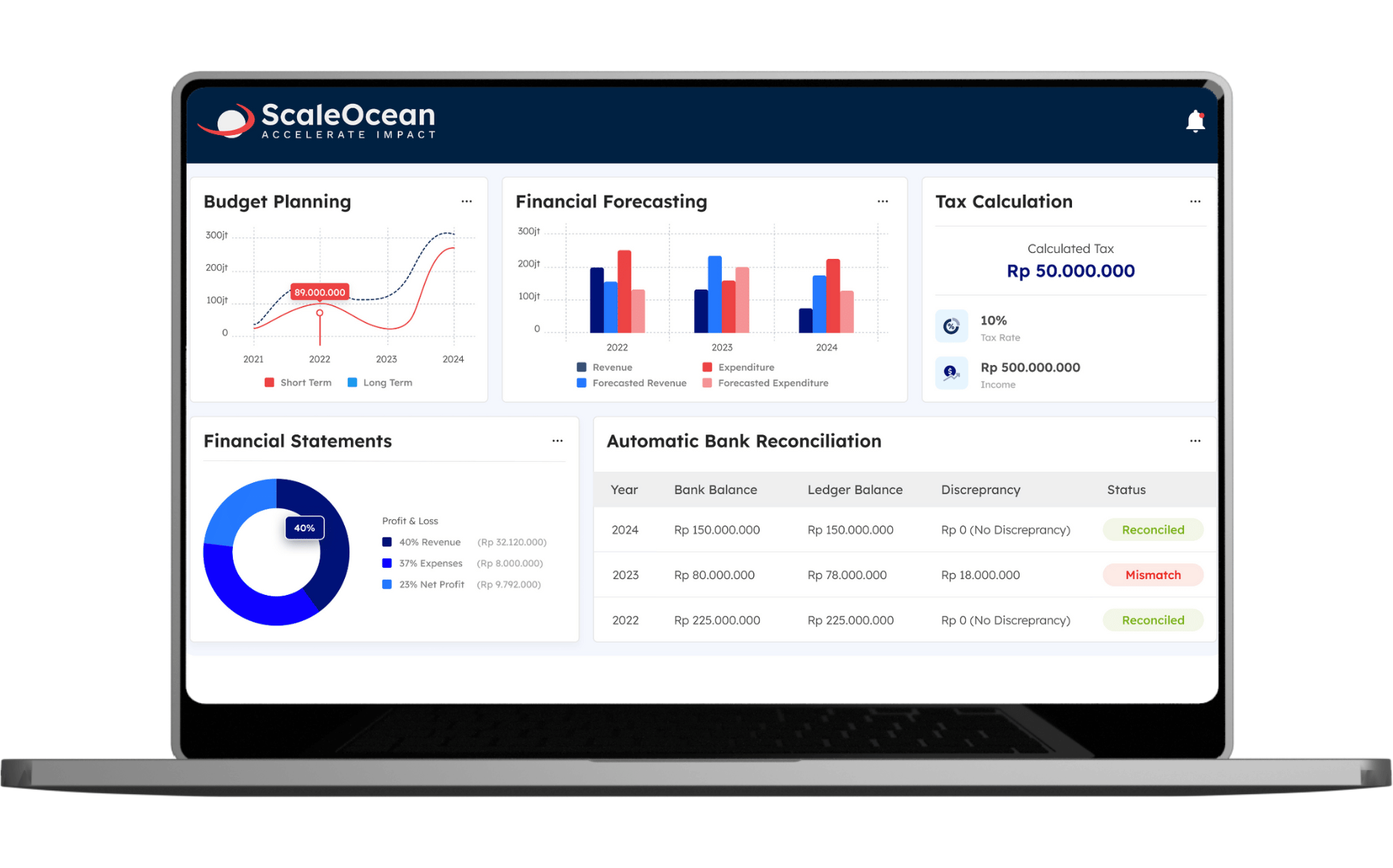
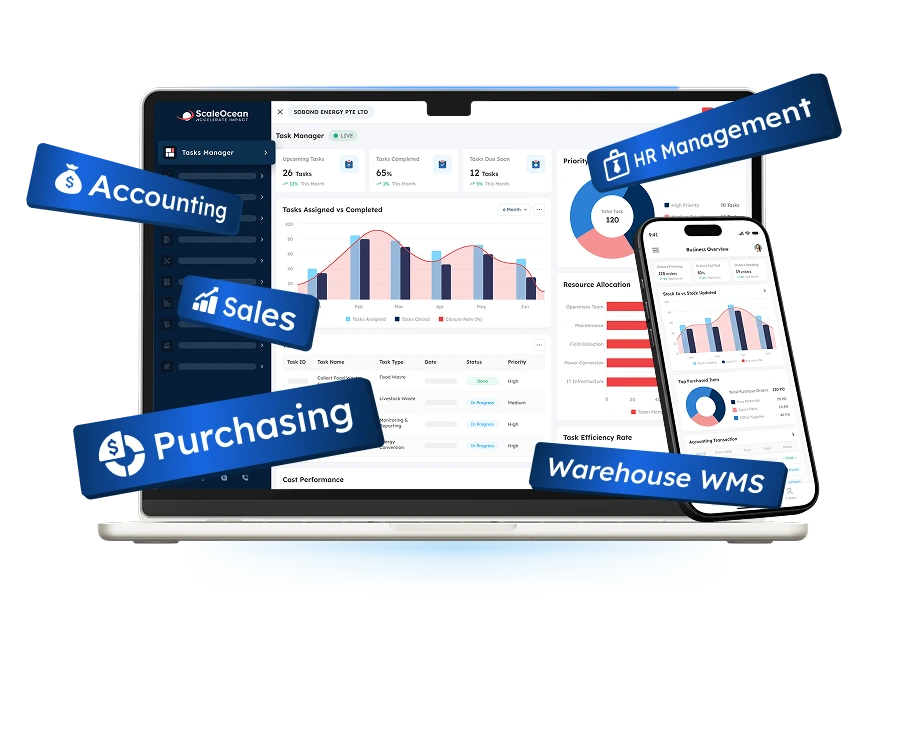
ScaleOcean Accounting Software is an automated and real-time reporting system, providing a streamlined and efficient method for companies to manage their finances. It offers unique features when compared with other accounting software available in the market; these unique features contribute to its ability to support businesses in effectively processing their financial tasks.
You can call it the “Swiss army knife of accounting automation”, ScaleOcean’s user-friendly design and a wide range of features can make complex accounting tasks easier, more accurate, and reduce human effort.
Businesses can also use the CTC (Cost to Company) grant to lower installation costs and ensure that the software provides the most value. The following are some of the key advantages of ScaleOcean’s accounting solution:
- Unlimited User Without: Without extra fees, onboarding new members feels effortless. Because pricing stays flat, sudden spikes in activity change nothing. As companies shift over time, the platform adapts without friction, with per-user costs gone, and budget strain fades away.
- All-in-One Solution – Complete Modules According to Needs: With over 200 specialized modules and 1,000+ features, ScaleOcean provides an all-in-one solution that adapts to the unique needs of any business, ensuring that every aspect of financial management is covered.
- Auto-pilot for Entire Business Operations: The software is equipped with automation features that handle routine operations, allowing businesses to focus on growth while ScaleOcean manages day-to-day financial tasks efficiently.
- Inter-Branch Integration: ScaleOcean facilitates seamless integration across multiple business branches, ensuring that all financial data is connected and easily accessible on one unified platform, which is ideal for businesses with multiple locations or subsidiaries.
Conclusion
Adapting to technology innovations is critical for organizations looking to remain competitive in today’s fast-paced marketplace. Embracing digital solutions such as ScaleOcean enables businesses to use cutting-edge technology to improve financial management.
Businesses can expedite their accounting procedures and receive a full view of their financial activity by leveraging capabilities such as real-time reporting and automation.
Fulfilling stakeholders’ expectations and ensuring long-lasting results relies on transparency and compliance. Companies with advanced financial reporting systems will have financial data that is accurate, readily accessible, and meets industry standards.
It provides a complimentary trial to anyone who wants to test out these benefits, knowing whether they will use ScaleOcean or not. Our free demo will give you a glimpse into the huge benefits these financial management innovations can offer your business and make it successful in the long term.
FAQ:
1. What is the golden rule of double-entry accounting?
The fundamental principles of accounting are (1) debit expenses and losses, credit incomes and gains, (2) debit the recipient, credit the provider, and (3) debit what comes in, credit what leaves. These principles, originating from Luca Pacioli, form the foundation of double-entry accounting.
2. What are common double-entry bookkeeping mistakes?
While double-entry bookkeeping ensures accurate financial tracking, errors such as confusing debits and credits, categorizing expenses incorrectly, typing mistakes, or neglecting bank reconciliation can lead to flawed financial records and potential compliance problems.
3. What are the 5 basic principles of bookkeeping?
Basic Principles of Bookkeeping:
1. Precision: The Core of Financial Reliability
2. Consistency: Building Confidence in Every Statement
3. Clarity: Trustworthy Transparency
4. Responsibility: Beyond Just Figures
5. Understanding: The Human Element Over AI
4. What are the 4 types of errors in accounting?
Accounting errors typically fall into data entry mistakes, errors of commission, errors of omission, and errors of principle. Among these, errors of principle are the most complex and can cause financial statements to fail to comply with Generally Accepted Accounting Principles (GAAP).





















.png)