

Production is migrating away from mass production and into increased flexibility with the process. The flexible manufacturing system (FMS) allows the company to manufacture different quantities of its end products and also various product permutations without a stoppage of production.
In response to the demand for automation and efficiency, we have found a report by BCC Research that estimates the global market for flexible manufacturing systems is more than $14.2 billion in 2024. A major dissection of the change that is what competitive production has come to mean when it comes to flexible infrastructure.
Therefore, in this article, the concept of Flexible Manufacturing System, constituents, and a few of their practical applications in various industries, such as the automobile industry to aerospace industry, will be explained. Further, the benefits of implementing an FMS will be discussed, and solutions such as ScaleOcean will be mentioned as examples of solutions to optimize such complex systems.
 Key Takeaways
- Flexible Manufacturing System (FMS) enables manufacturers to adapt quickly to product changes, volume shifts, and customization demands with minimal downtime and improved operational flexibility.
- The types of Flexible Manufacturing Systems, such as sequential, random, dedicated, and modular, are designed to match different production volume and product variety requirements.
- Flexible manufacturing improves productivity by reducing setup time, increasing equipment utilization, minimizing errors, and supporting consistent quality in high-mix production environments.
- ScaleOcean supports flexible manufacturing by integrating production, inventory, and financial data into one unified platform for better visibility, coordination, and operational control.

What Is a Flexible Manufacturing System (FMS)?
Flexible Manufacturing System (FMS): This is an automated approach to manufacturing that allows for fast and flexible product changeovers, product mix, and production rates, with minimal manual reconfiguration and downtime.
It suits the requirement for high speed and standardization, and connects with low-volume, manual machines to feed a centralized computer system to various CNC machines, robot machines, and automatic guided vehicles (AGVs). FMS improves the efficiency, shortens the lead time, and cuts the stock, in addition to allowing high-quality and customised production.
The first one is to be able to change parts quickly between different varieties or products without the need to use manual product adjustments, which would otherwise be cumbersome. That’s why FMS is ideal for businesses that demand efficiency and flexibility.
How Does a Flexible Manufacturing System Work?
FMS starts functioning immediately when the order of production is made. The Central computer determines and identifies machines and tools that the machines need to operate and the order of operations needed to create the product. It automatically loads the required programs on the right workstation and keeps a watchful eye on all parts by means of barcode or radio-frequency identification tags.
Automated movements for material using equipment such as Automated Guided Vehicles (AGVs), conveyors, or rail-guided carts. This device is programmed to enable the machine to send and collect parts when and where appropriate. The re-routing mechanism of the FMS dynamically re-routes the parts according to the machine’s current status (whether the machine is busy or down).
Similar operations such as cutting, drilling, joining, etc., and sometimes even in-process inspection, are performed at those work stations by using CNC machines or robots. Tool changes and the quality inspection process are highly automated, and the status of the process and data are reported in near real time to the central computer, typically via SCADA. This coordination helps to create good production quality, efficiency, and flexibility.
Who Invented the FMS?
Jerome H. Lemelson (1923- 1997) was an industrial engineer and inventor from the USA, who is considered as the father of flexible manufacturing. The inbuilt system of his design was a robot system for welding, riveting, conveying, and measuring the product being manufactured.
Systems modeled after his design began to be implemented on factory floors in the US and Europe in the late 1960s and became widespread during the 1970s.
In 1965, Theo Williamson once again refined the technology by making a patented invention with a specific system that includes a numerically controlled machine. The innovations they developed moved manufacturing from hand-on-the-wheel information to a computer-integrated automated control.
What Are the Different Types of Flexible Manufacturing Systems?
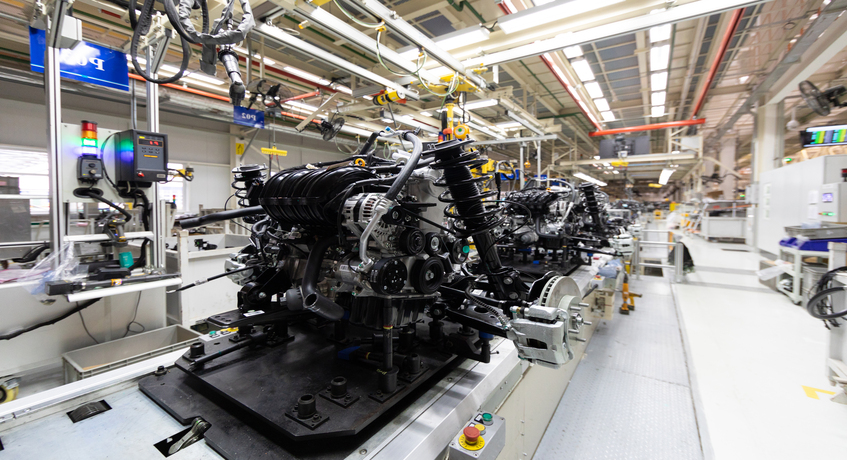
Flexible Manufacturing Systems come in various configurations, each designed to meet specific production needs. Depending on factors like production volume, product variety, and operational complexity, different types of FMS offer unique advantages to optimize manufacturing efficiency and flexibility.
Understanding these types can help businesses select the best system for their specific manufacturing goals. There are several types of FMS configurations, each suited for different production volumes and variety requirements.
Understanding these types can help businesses select the best system for their specific manufacturing goals. There are several types of FMS configurations, each suited for different production volumes and variety requirements within your manufacturing options management strategy.
Sequential FMS
In a Sequential FMS, parts move through a fixed sequence of workstations. This setup is similar to a traditional transfer line but offers slightly more flexibility. It is best suited for producing a specific family of parts with a defined workflow.
Random FMS
A Random FMS is capable of handling a significant variety of part configurations in any order. The system effectively manages random production schedules. It requires highly sophisticated computer control software to route parts dynamically to available machines.
Dedicated FMS
This system produces a limited variety of parts over an extended period. With manufacturing analytics, a Dedicated FMS can maximize throughput for a specific product family. Although less flexible than a random system, it is faster and more efficient for defined production batches.
Random Order/Engineered FMS
This type creates a specific sequence for different parts but allows for random variations within that sequence. It balances the structure of a sequential system with the versatility of a random one. It is often used when there is a known mix of products that frequently repeats.
Modular FMS
A Modular FMS allows manufacturers to expand their system by adding new modules as needed. This approach is cost-effective for growing smart factory companies. It lets businesses start small and scale up their flexible manufacturing capabilities over time.
What is a Flexible Manufacturing Cell?
A flexible manufacturing cell (FMC) typically includes two or three machines with processing stations and parts handling capabilities. Although simpler and less advanced than an FMS, an FMC still offers flexibility, such as rerouting products between machines if one fails and adjusting to higher production volumes.
In contrast, a flexible manufacturing system (FMS) is larger, consisting of four or more machines along with additional support components like wash stations for parts and pallets, plus storage areas. It’s equipped with a more sophisticated computer system that offers enhanced functions like monitoring and diagnostics.
When choosing a flexible manufacturing solution for your business, consider both FMC and FMS based on your size, resources, and available space. While an FMS provides greater flexibility, it requires more space, involves a steeper learning curve due to its complexity, and typically demands a higher investment and stronger commitment from senior management.
Flexible Manufacturing System (FMS) Components
A Flexible Manufacturing System is composed of several critical subsystems that work together seamlessly to enable efficient and adaptable production processes. These components coordinate to manage everything from material handling to machine operations and system control.
Understanding the main parts of an FMS is essential to grasping how the system achieves its flexibility and productivity. An FMS relies on four primary subsystems working in unison. The table below details these key components.
| Components | Functions |
|---|---|
| Workstations | These are the physical production sites, such as CNC machining centers and assembly stations. They perform the primary value-added operations like cutting, welding, or inspection to transform raw materials into finished parts. |
| Material Handling & Storage Systems | This includes automated guided vehicles (AGVs), conveyors, and robots. They act as the system’s circulatory network, moving parts and tools between workstations and storage areas to ensure a continuous production flow. |
| Computer Systems | The central nervous system of the FMS. It coordinates all activities, schedules production tasks, manages machine traffic, and tracks real-time data to ensure the system operates efficiently and without collisions. |
| Managers & Operators | Human oversight remains critical for system success. Skilled personnel are needed to program the machines, perform maintenance, make strategic production decisions, and intervene when the automated systems encounter complex issues. |
Flexible Manufacturing Examples
Various industries adopt flexible manufacturing systems to address their specific production challenges and demands. By implementing adaptable solutions, such as Industrial Internet of Things, businesses can efficiently handle changes in product design, volume, and variety while maintaining high quality and reducing downtime.
A clear flexible manufacturing system example can be seen in the automotive industry, where multiple vehicle models are produced on the same line. From automotive to electronics and aerospace, flexible manufacturing enables companies to stay competitive and responsive in dynamic markets.
FMS in the Automotive Industry
Car manufacturers use FMS to produce different vehicle models on the same assembly line. Robots can quickly switch welding tools to accommodate different chassis designs. This reduces the downtime previously needed to retool for a new car model.
FMS in Aerospace Manufacturing
In aerospace, flexible manufacturing systems and additive manufacturing examples are found in aerospace manufacturing, where precision parts require frequent reprogramming. The aerospace sector uses flexible manufacturing to machine complex titanium and aluminum parts.
Precision is critical, and production volumes are often lower than in automotive. FMS allows aerospace companies to switch between different aircraft components efficiently.
FMS in Electronics Production
Electronics manufacturers face short product lifecycles and high demand for customization. FMS allows them to assemble various circuit board configurations rapidly. It helps companies like Canon respond quickly to competitor moves and new technology trends.
FMS in Medical Device Manufacturing
Medical devices, such as ventilators or surgical tools, often require strict quality control and variable batch sizes. FMS enables manufacturers to ramp up production of specific devices during emergencies. Companies like Medtronic utilize flexible cells to adapt to surgical device variations.
FMS in Consumer Goods
Consumer goods are one of a flexible manufacturing system example. Companies in this industry use flexible manufacturing to handle seasonal demand and packaging variations. For example, a food processor might use the same line for different product recipes. This flexibility is vital for maintaining low inventory while meeting diverse customer tastes.
FMS in Heavy Equipment
Heavy machinery manufacturers, such as those making tractors or excavators, use FMS for machining large engine blocks. These parts are heavy and expensive to move manually. Automation ensures precision and safety while handling these massive components.
FMS in Chemical Processing
In chemical processing, flexibility allows plants to switch formulations safely and quickly. Automated control systems adjust temperature and mixture ratios for different products. This reduces waste and ensures compliance with safety regulations for various chemicals.
Companies That Use FMS
Many leading global corporations have integrated flexible manufacturing solutions into their operations to improve adaptability and efficiency. According to a market report by Market Growth Reports, Asia-Pacific is the leader of the top region, with 35% of installed Flexible Manufacturing System capacity.
These companies benefit from the ability to quickly adjust production processes, handle product variations, and meet changing market demands without compromising quality. They have mastered the true definition of what is flexible manufacturing system.
By embracing flexible manufacturing, they stay competitive and responsive in dynamic industries. Here are some notable examples of companies successfully using these systems in their production workflows.
- Ford Motor Company: Uses flexible robotic welding in body shops to quickly shift production volumes and switch between vehicle models.
- Bosch: Uses FMS in their compressor and motor assembly lines, enabling fast switching between product variants.
- Intel: Leverages FMS for producing precision metal parts used in chip fabrication equipment, ensuring extremely tight tolerances.
- Boeing: Employs FMS for the production of diverse aircraft components made from titanium and aluminum, requiring precise CNC machining.
- John Deere: Implements flexible manufacturing for drive systems and chassis components to manage seasonal demand.
- Siemens: Utilizes FMS to manufacture Simatic controllers, allowing quick adjustments in circuit board assembly configurations.
As seen across different industry examples, flexibility is critical to maintaining efficiency and consistency in modern production. ScaleOcean manufacturing ERP software supports this need with flexible manufacturing software and modular system solutions that can be tailored to your specific processes and workflows.
So, explore how ScaleOcean can fit your manufacturing operations and request a free demo today.
Pros and Cons of an FMS
Adopting a flexible manufacturing system offers numerous advantages but also involves certain trade-offs that businesses need to consider. Ultimately, answering what is flexible manufacturing system is comes down to its ability to increase adaptability while maintaining consistent output.
However, it also requires substantial investment, space, and skilled personnel to manage its complexity. So understanding both the benefits and potential challenges is crucial for making an informed decision about integrating FMS into your manufacturing operations.
| Pros | Cons |
|---|---|
| High Efficiency: Increases machine utilization up to 80% compared to traditional systems. | High Cost: Requires significant initial capital investment for equipment and software. |
| Flexibility: Adapts to changes in volume and product mix instantly. | Complexity: Difficult to plan and implement correctly without expert guidance. |
| Lower Labor Cost: Reduces direct manual labor requirements and human error. | Skill Gap: Requires highly trained technicians to operate and maintain systems. |
| Reduced Inventory: Minimizes work-in-progress and storage needs, freeing up cash. | Maintenance: System downtime can be expensive to fix if not managed well. |
Comparing the Flexible Manufacturing System with Other Production Methods
Choosing the right production strategy requires more than looking at output speed or automation level. Manufacturers must evaluate demand variability, product complexity, capital investment, scalability, and long-term adaptability.
A system that performs exceptionally well in stable, high-volume environments may struggle when product variations increase or market conditions shift. This is why flexible Manufacturing Operations Management (MOM) is essential for maintaining efficiency and responsiveness.
A Flexible Manufacturing System (FMS) is positioned between traditional mass production and highly specialized rigid automation. It balances efficiency with adaptability, making it particularly suitable for industries where product lifecycles are shorter and customization is common.
Understanding how flexible manufacturing compares with other production methods clarifies when it is the right strategic investment.
FMS vs. Traditional Manufacturing
Traditional manufacturing, often called mass production, is ideal for high volumes of a single product. However, it lacks the ability to change products quickly. Flexible manufacturing sacrifices some raw speed for the ability to handle a high mix of products.
FMS vs. Rigid Automation
Rigid automation is fixed and efficient, but cannot adapt. If a product design changes, rigid systems often need to be scrapped or heavily rebuilt. An FMS is designed to evolve, allowing software updates to handle new physical tasks.
FMS vs. Lean Manufacturing
Lean manufacturing focuses on eliminating waste, while flexible manufacturing focuses on adaptability. These two often work together. An FMS supports lean goals by reducing waiting times and overproduction, as the system only produces what is needed.
How is the Flexible Manufacturing System Set Up? An Implementation Guide
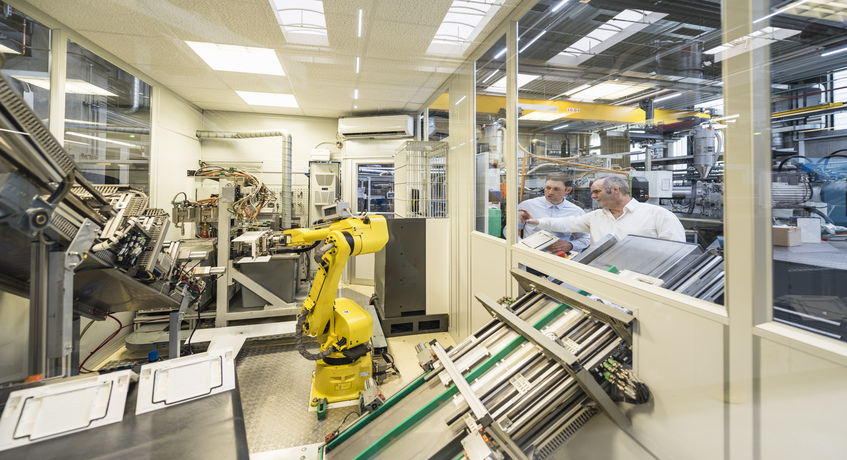
A Flexible Manufacturing System is set up through several structured phases to align production goals and system design. It integrates computer-controlled machines, automated material handling, and centralized software to produce multiple products with minimal downtime.
Companies typically adopt FMS when traditional production lines become too rigid. If demand fluctuates, product designs change frequently, or customers expect shorter lead times, fixed manufacturing layouts start to struggle.
Flexible manufacturing addresses this by combining automation with adaptability. It allows manufacturers to switch between product variants, adjust batch sizes, and optimize workflows without rebuilding the entire production line.
Step 1: Identifying Production Requirements Goals
The first step is to assess your current production bottlenecks and operational constraints. Clarify whether your primary objective is higher volume, greater product variety, faster lead times, or a combination of these factors. This evaluation determines the appropriate Flexible Manufacturing System configuration, capacity level, and degree of automation required.
Step 2: Planning the FMS Configuration and Workflow
Next, engineers design the layout of workstations and material paths. This phase involves simulation software to predict workflow efficiency. You must decide between a sequential, random, or modular configuration.
Step 3: Choosing and Integrating System Components
Select the specific CNC machines, robots, and conveyors that fit your plan. Integration is key, so the software must communicate flawlessly with the hardware. This is often the most technical phase of the setup.
Step 4: Workforce Training and Skill Development
Flexible manufacturing replaces manual labor with skilled monitoring. Workers need training to operate the central computer and maintain robots. Investing in your team is as important as investing in the machinery.
Step 5: System Testing, Refinement, and Performance Optimization
Before full-scale operation, the system undergoes rigorous testing. Engineers tweak the software to eliminate lags or routing errors. Continuous monitoring ensures the system reaches its peak flexible manufacturing potential.
Implementation example:
Makino has report a flexible manufacturing system is at Prince Industries, a precision contract manufacturer located in Carol Stream, IL, USA. The principles behind Prince Industries’ machine components, assemblies, and fabrications are used in several applications, including automotive, medical, and industrial controls. They needed to:
- Minimise machine set-up times
- Process low to medium volumes of orders on a high-mix basis
- Make changes to customers’ requests more responsive
- Identifying Production Requirements Goals
With clear-cut goals to reduce downtime and changeovers, increase throughput, and enhance part quality consistency, Prince was at the top of their agenda. This preparatory work is important in order to avoid conducting any physical activities. There is a great need for this advanced planning and scheduling system to help devise an effective setting before actually making any physical changes.
2. Choosing and Integrating System Components
The company has invested in the acquisition of advanced and integrated machines to build its FMS, such as an MMC2 modular machining complex featuring 161 pallet stations (the heart of the system), two horizontal machining centers (HMC) with automatic tool changers, and more machining centers for heavy and specialized machining work.
3. Choosing and Integrating System Components
There are multiple machines in each of his work cells, some of which are aimed at higher-mix production runs, and others at quicker machine changeover for higher-volume productions.
Housed in FMS systems as the one developed for Prince, these are commonly found with: Central scheduling software that dynamically schedules itself; Auto tool change coordination; Material handling & pallet management systems.
4. Workforce Training and Skill Development
For Prince, it is important to coordinate between the operator and tool change with the FMS software, so software details are not made public because it is deemed to be a trade secret. These allow the system to switch from work jobs with a quick time and not affect the production.
5. System Testing, Refinement, and Performance Optimization
After the system implementation, FMS was available, and the machines were able to be operated continuously (up to ~24 hours), and throughput rose to ~6 parts/hr – no more scrap or rejections.
Machine efficiency increased due to more than 20 hours/day > 7+ hours/day pre-implementation, reduced set up/change over time (reduced by ~20-30%), responsive setup and response of the machine to start producing quickly, and Quality gain as the reject rate was zero after the implementation.
Does Flexible Manufacturing Improve Productivity?
Yes, flexible manufacturing significantly improves productivity for high-mix production environments. By eliminating setup time between batches, machines spend more time working and less time waiting. This leads to higher OEE (overall equipment effectiveness).
Furthermore, flexible manufacturing reduces errors caused by human fatigue. Automated inspection stations ensure that quality remains consistent, reducing the time and cost associated with rework.
While flexible manufacturing already enhances productivity, its impact becomes even greater when supported by an integrated digital system. Connecting machines, planning, inventory, and financial data ensures that every operational improvement is aligned and measurable across the business.
This is where software like ScaleOcean plays a crucial role. By providing a unified platform to manage and synchronize manufacturing processes, companies can extend the productivity gains of flexible manufacturing beyond the shop floor and translate them into stronger overall business performance.
Optimize Flexible Manufacturing Implementation with ScaleOcean
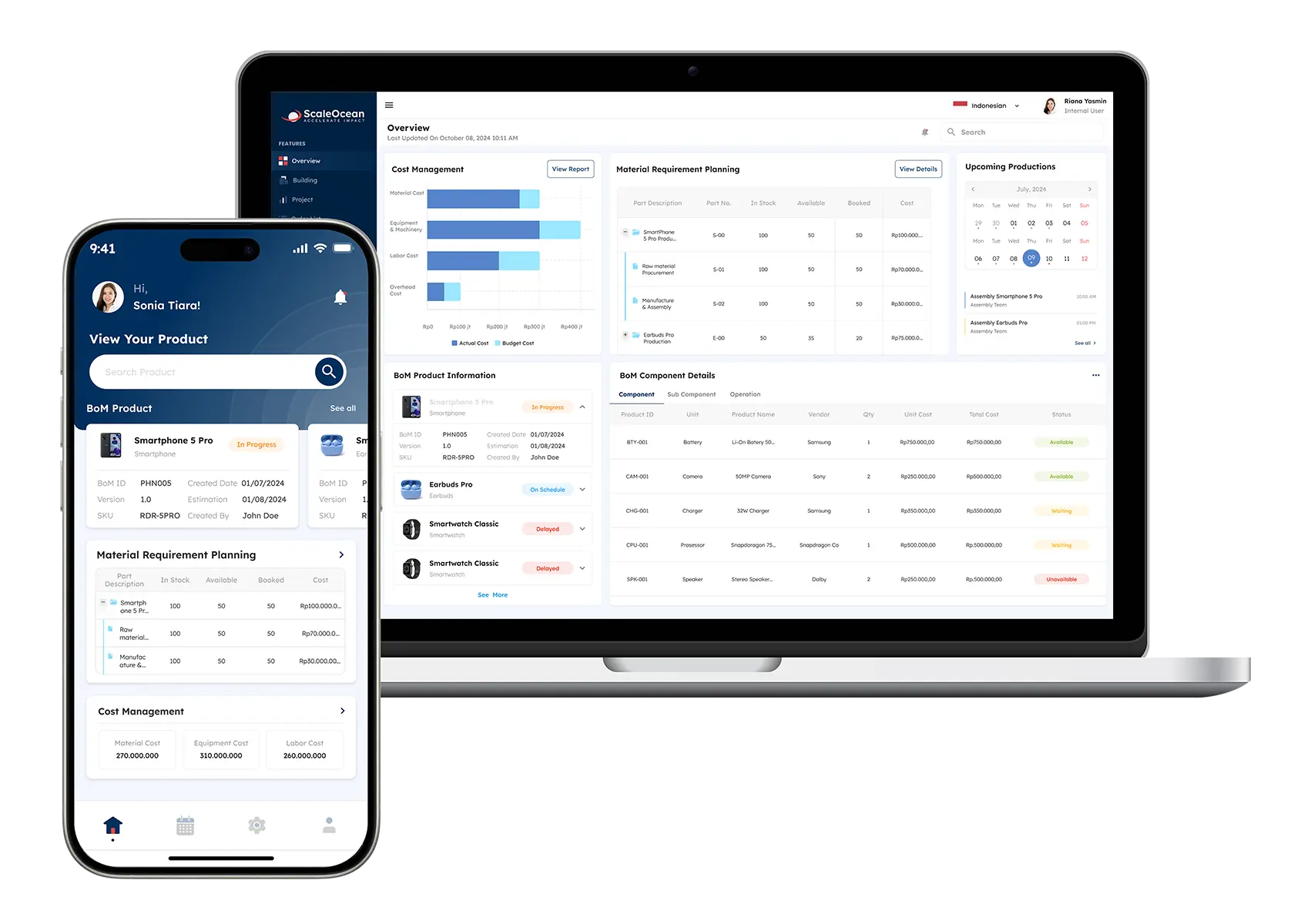
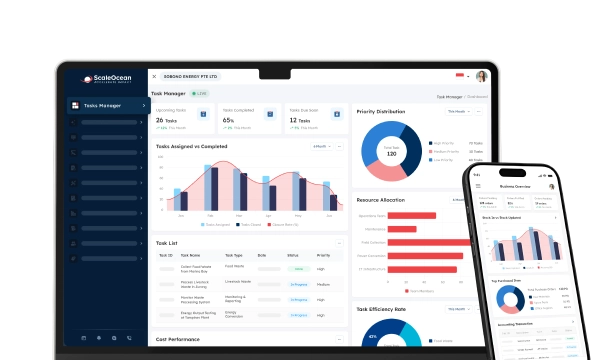
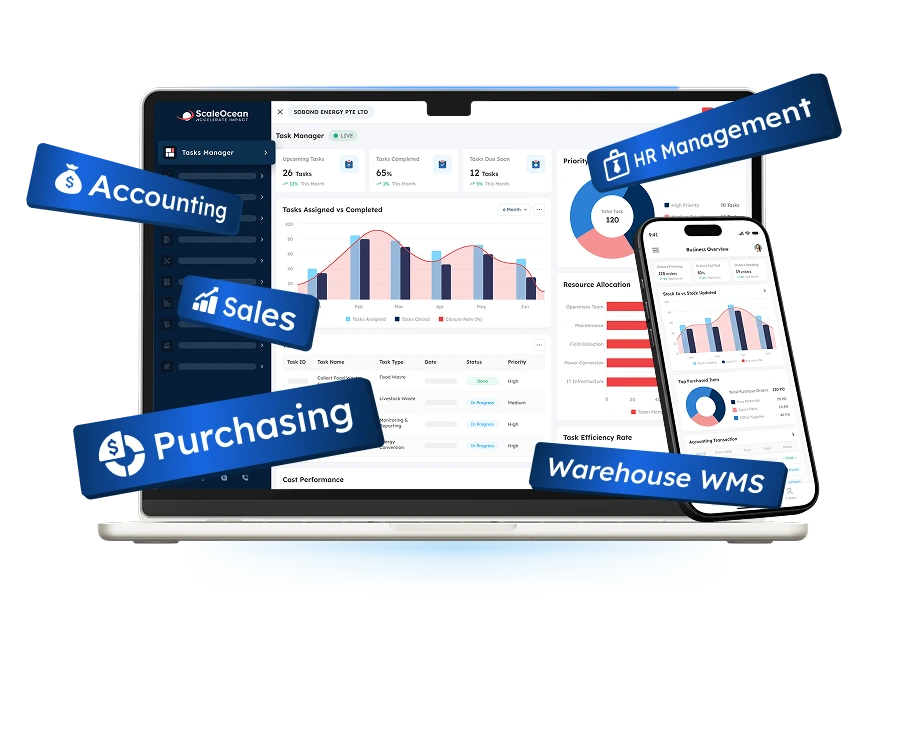
ScaleOcean’s manufacturing ERP system delivers a comprehensive solution to optimize the implementation of a Flexible Manufacturing System. It provides a true 360° view of manufacturing operations.
Having end-to-end IIoT integration, it enables real-time machine connectivity, full data visibility, and seamless integration with existing enterprise platforms already used across the company.
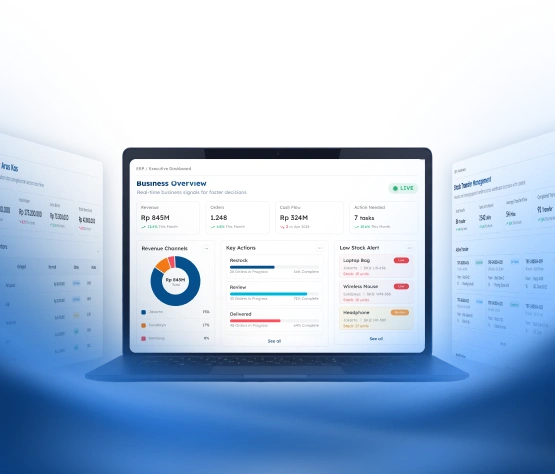
As an all-in-one solution, ScaleOcean centralizes every production process within a single system, one database, and one unified dashboard. From planning and procurement to execution and financial tracking, flexible manufacturing operations run cohesively without fragmented tools or disconnected data.
The system is fully customizable to match each company’s workflow, production processes, and operations. It offers customizable dashboards, advanced smart configuration for each division, unlimited user access, and an intuitive interface designed for ease of use across departments.
In addition, ScaleOcean aligns with the requirements of the Company Training Committee (CTC) Grant, making it eligible for funding support and helping reduce the financial burden of digital transformation initiatives.
Key features of ScaleOcean manufacturing software:
- AI Smart MRP: ScaleOcean’s manufacturing software uses AI-enhanced MRP to analyze historical data and real-time production information to predict material needs and optimize planning. This reduces unexpected stockouts, accelerates line changeovers, and prevents costly production delays.
- Advanced Production Planning & Scheduling (APS): Automatically adjusts production schedules to accommodate urgent orders or priority shifts. It instantly responds to machine availability constraints and resource conflicts, ensuring continuous workflow and optimal utilization of equipment.
- IoT and IIoT Integration: Connects directly to CNC machines and PLC controllers to capture real-time production data. It monitors machine status, tracks performance metrics, and manages automated tool changes. This provides full shop floor visibility and enables data-driven decision-making.
- Multi-Level Inventory Management & Traceability: Ensures raw materials, sub-assemblies, and finished goods are consistently available across all production levels. Provides end-to-end traceability for compliance with ISO standards and medical manufacturing regulations, which is essential for quality assurance and regulatory audits.
- Predictive Quality Management System: Analyzes production flow and operational data to detect defects at an early stage. Supports achieving OEE (Overall Equipment Effectiveness) targets by minimizing waste, reducing rework, and preventing quality-related downtime.
By combining flexible system design with practical implementation support, ScaleOcean helps manufacturers streamline the setup and optimization of flexible manufacturing environments. Its user-friendly platform adapts to various types of production across Singapore’s manufacturing sector.
In addition, ScaleOcean makes it easier to manage your workflows, improve your visibility, and maintain your operational control. See how ScaleOcean can support your manufacturing transformation and request a consultation today.
Conclusion
Flexible manufacturing is being increasingly adopted by companies with varying needs and higher product diversity. For companies that have varying needs and higher product diversity, flexible manufacturing is increasingly a necessity. One approach with the benefits of adaptability combined with automation is a Flexible Manufacturing System (FMS), which results in faster changeover, quality, and improved overall equipment effectiveness (OEE) and optimized overall manufacturing.
Manufacturers should have an integrated digital backbone to reap these benefits to the fullest extent. Much like the ScaleOcean that brings together all the essential elements of IIoT data, production planning, inventory management, and financial control in one system, one database, one dashboard for complete visibility and coordinated operations, Oneflow integrates all the essential elements of IIoT into one system, one database, and one dashboard, all within one single system.
But before thinking about flexible manufacturing, why not explore and consider solutions that ScaleOcean can offer to get you thinking about flexible manufacturing? Contact us today and get a free demo on how it works to increase your measured efficiency and goals.
FAQ:
1. What is a downside of flexible manufacturing?
One major drawback of a Flexible Manufacturing System is the high initial investment required for equipment, software, and integration. In addition, designing and configuring the system specifications can take considerable time and expertise before full implementation.
2. What is the main purpose of FMS?
The main purpose of a Flexible Manufacturing System is to enable efficient production while adapting quickly to changes in product type, mix, or volume. It allows manufacturers to maintain productivity and quality without extensive downtime for reconfiguration.
3. What equipment is used in a flexible manufacturing system?
An FMS typically includes industrial robots, CNC machines, automated tool changers, inspection stations, assembly units, and material handling systems. Each workstation performs specific operations that transform raw materials into finished products.
4. How is a flexible manufacturing system used today?
Today, Flexible Manufacturing Systems are widely used in industries that require high customization, precision, and operational control. Sectors such as automotive, aerospace, defense, food processing, and electronics rely on FMS to manage complex production demands efficiently.





















.png)