

Advanced planning and scheduling (APS) is a manufacturing planning system that optimizes production schedules by considering demand, capacity, materials, and constraints. The competition is getting more and more aggressive, and there is a requirement for AP to happen more quickly and precisely.
Market demand for APS solutions continues to grow as manufacturers prioritize digital transformation and operational efficiency. In fact, our team found that Market.us reported that the global APS software market is projected to grow from USD 1.3 billion in 2023 to USD 3.4 billion by 2033, representing a CAGR of 10.0% during the forecast period.
However, most Singaporean manufacturing enterprises face difficulties rescheduling production plans in response to fluctuating demand. They have to manually reschedule plans, which consumes a lot of time and affects production operations.
In addition, a lack of deep insight into the extent of available capacity of machinery, workforce, and materials causes planning conflicts across the factory. Consequently, the company more often endures delays and missed delivery deadlines, cost bottlenecks, and a decline of efficiency.
So, to respond faster and plan better, it is more and more common to apply advanced planning and scheduling in manufacturing. This way, the manufacturing company can optimize machine efficiency while ensuring a stable quantity and on-time delivery.
 Key Takeaways
- Advanced planning and scheduling (APS) is a manufacturing planning system that optimizes production schedules by considering demand, capacity, materials, and operational constraints simultaneously
- Essential APS components include demand planning, capacity planning, production sequencing, schedule management, and scenario analysis capabilities.
- APS improves manufacturing performance through dynamic scheduling, scenario simulation, visibility, faster decision-making, and reliable delivery planning.
- Various APS tool solutions support different manufacturing requirements, ranging from small businesses to complex enterprise production environments.
- ScaleOcean Manufacturing ERP Software combines APS, production management, and operational visibility to improve scheduling accuracy and manufacturing efficiency.
What is Advanced Planning and Scheduling?
Advanced planning and scheduling is a software-enabled methodology for generating optimal production plans under real-world constraints. While traditional scheduling tools are used only to generate schedules, APS systems consider several parameters before producing them.
The system takes into account the machine capacity, labor availability, material stock, production priority, and the due date of the customer. Therefore, producers develop a feasible schedule aligned with the actual shop environment and the company’s goals.
In addition to understanding what advanced planning and scheduling is, APS continuously updates schedules when conditions change, for example, in the event of an emergency order, equipment breakdown, or disruption of supplies. This allows a flexible manufacturing system operation due to the need of productivity in society.
As manufacturing environments grow more complex, APS offers greater planning accuracy than spreadsheets. Accordingly, companies can optimize resources, reduce lead times, and ensure more predictable deliveries.
 Also Read: What Is a Smart Factory? A Complete Guide
How does Advanced Planning and Scheduling Work?
APS gathers data from multiple sources, including ERP systems, inventory records, production orders, and shop floor monitoring systems such as SCADA. It uses these data to synthesize production schedules with minimal intervention.
Once again, the system proposes feasibility constraints such as machine availabilities, capacities, workforce, material availability, and due dates. Hence, the schedules generated by the APS are feasible rather than optimal.
Advanced planning and scheduling in manufacturing can dynamically replan schedules on the fly when disruptions happen. Afterward, in the event of unanticipated circumstances, the usual schedule is modified to incorporate new operational data. Consequently, planners can readily find an alternative solution and reduce disruption.
In addition, APS provides visual planning dashboards that support company-level decision-making. As shown in various manufacturing analytics examples, production managers gain clearer insights into capacity utilization, bottlenecks, and future scheduling requirements.
Essential Components of Advanced Planning & Scheduling

The Advanced Planning and Scheduling system functions in conjunction with various modules of the manufacturing process. To know what advanced planning and scheduling is, the essence of all the components in this group is the ability of plan, which ultimately results in better scheduling, utilization, and operational efficiency.
Instead of functioning alone, these elements constantly transmit information to each other during the planning process. Therefore, manufacturers can maintain integrated production plans that account for customer demand, capacity constraints, material availability, and delivery dates.
1. Demand Planning
Demand planning helps predict future customer requirements by analyzing current market trends and sales figures. This prediction enables manufacturers to prepare themselves for future demand.
Additionally, demand planning can accurately lead to minimizing the imbalance of stock as well as fluctuations of production in enterprise operations. As a result, companies can effectively allocate their resources and simultaneously avoid stock-outs and high inventory costs.
2. Capacity Planning
Capacity planning makes use of the production resources, including machine availability, labor, and manufacturing plants that are available. Planners thus evaluate the state of production to determine whether targets remain attainable within current operations.
In addition, capacity planning foresees bottlenecks so that if something is not moving well in the factory, it can be detected in advance. So, companies can act proactively and increase production performance.
3. Production Sequencing
Sequencing of production refers to the ordering in which production jobs and work orders are carried out. Hence, organizations can minimize setup time and optimize the utilization of OEE (Overall Equipment Effectiveness) throughout the production cycle.
Furthermore, it allows the manufacturer to schedule tables and move urgent jobs forward without compromising the integrity of the other schedules. Consequently, delivery speeds and operational stability improve.
4. Production Schedule Management
Production schedule management, developed to oversee and regulate manufacturing processes along the entire production lifecycle, will reduce the possibility of miscoordination of shop floor operations and planning decisions.
And, schedule management allows for quick response to variations in plant operations. Thus, all-plants planners can keep the schedule up to date and reduce schedule delays.
5. Scenario Analysis
Scenario analysis enables the manufacturer to compare different planning options before making operational decisions. Consequently, the firm can identify possible scenarios and pinpoint the most effective approach.
In addition, through scenario analysis, the uncertainty is alleviated by simulation of various production situations. As a result, the best decision of the most appropriate production mode can be made with the least losses.
Why is Advanced Planning & Scheduling Important for Manufacturing?
Evolving customer demand, uncertain supply chains, and resource constraints continually challenge manufacturing operations. As a result, enterprises need better tools that enable quicker and more precise planning decisions.
APS overcomes these obstacles through intelligent scheduling, helping manufacturers cope with the operational constraints and the demands of the business. In this way, manufacturers will become more efficient and responsive and have better-controlled processing environments.
1. Providing “What If” Scenario Simulation
An advanced planning and scheduling system enables planners to experiment with various production scenarios before implementing operational changes. As a consequence, it allows companies to assess potential risks and benefits without affecting the execution of existing production.
By using simulation capabilities, organizations can plan contingency procedures efficiently for the incident. So companies can be more resilient during large disasters and move faster by making planning decisions.
2. Dynamic Sequencing
Dynamic sequencing retraces the order, and the priorities of the production are adjusted while following the initial order when an unexpected event occurs. Thus, producers react very efficiently to sudden order delays, equipment failures, or a lack of raw materials.
In addition, when machines are not being installed, automated adjustments greatly minimize manual intervention and scheduling delays. So companies achieve better control over their operation.
3. Capable-to-Promise (CTP)
Capable-to-Promise assesses delivery capacity and is used to confirm delivery dates to customers only after capacity has been checked and found available. This allows sales teams to communicate delivery dates that are more realistically achievable.
In addition, CTP provides us with an excellent opportunity to diminish the risk of delivery while increasing the feeling of trust and satisfaction among customers through the integration of the production planning system and the customer order handling system.
4. Full Access, Visibility, and Control
Advanced planning and scheduling deliver centralized visibility to all production schedules, resources, and performance monitoring. Given this, executives would have full insight into the group’s manufacturing operations.
High levels of visibility also allows teams to detect bottlenecks or inefficiencies more quickly, enabling corrective action before they affect production performance.
5. Faster Response to Change
Conditions at the manufacturing site tend to vary due to fluctuations in demand, supply interruptions, or equipment failures. As a result, the planning system would have to be flexible to accommodate the change.
The production schedule is constantly kept up to date with real-time operational information and constraints in APS. As a result, suppliers can respond more quickly to unplanned production variations with less disruption.
6. Better Customer Service
Precise production planning enables the company to fulfill orders systematically and on schedule, delivering every time. Consequently, the customer gets their product on the specified time.
In addition, APS supports the manufacturers in delivering accurate delivery commitments throughout the order cycle. As a result, firms meet customers’ expectations and improve service quality.
Efficiency Comparison: Traditional Scheduling vs. Modern APS Systems
Many standard scheduling systems are used to define material flow and production planning activities, such as spreadsheets, calculations, and the planner’s experience. Today, production scheduling systems are difficult to apply due of extended manufacturing processes.
They make use of real-time information, automated optimization, and constraint-based planning to develop statistical production schedules. As a result of these developments, producers can have stronger control over them. They can also make quicker, more accurate decisions.
| Scheduling Aspect | Traditional Scheduling (Excel / Standard ERP) | Modern APS System |
|---|---|---|
| Response to Disruptions | Production schedules become unstable, and planners must manually revise schedules through lengthy coordination meetings. | Automatically performs dynamic rescheduling within minutes using real-time operational constraints and priorities. |
| Capacity Management | Uses infinite capacity assumptions and often ignores actual machine, labor, and material limitations. | Applies finite capacity planning based on the actual availability of machines, workforce, and materials. |
| Production Visibility | Limited visibility across departments makes bottlenecks difficult to identify before they impact operations. | Provides real-time visibility into production status, resource utilization, and bottlenecks across facilities. |
| Multi-Plant Coordination | Each factory often creates schedules independently, leading to imbalances and delays in transfers between sites. | Enables centralized planning and synchronized scheduling across multiple plants and production locations. |
| Material Availability Planning | Material shortages are often discovered after production schedules have already been released. | Considers inventory levels, supplier lead times, and material constraints when generating schedules. |
| Production Sequencing | Production sequences are manually arranged based on the planner’s experience and assumptions. | Optimizes job sequencing automatically to reduce setup time and improve throughput. |
| Decision-Making Speed | Schedule adjustments can take hours or even days during major disruptions. | Generates optimized alternatives quickly, enabling faster and more confident decision-making. |
| Inventory & Storage Management | Excess inventory and storage congestion frequently occur due to poor schedule synchronization. | Aligns production schedules with storage capacity and logistics requirements to minimize excess inventory. |
Unlike traditional approaches, APS regularly assesses all the factors-machine capacity, the availability of materials, workforces, and customer priorities-at the same time. As a result, companies can take pre-emptive actions rather than hours of fiddling with schedules.
Moreover, APS entails transparency at all levels of the production network and enables the taking of decisions based on scenarios. Consequently, manufacturers achieve increased productivity, more efficient resource utilization, and dependable delivery performance.
Advanced Planning & Scheduling Use Case Examples for Manufacturers

APS provides benefits across manufacturing settings by offering solutions to operational issues that existing scheduling tools cannot address. The following examples illustrate what advanced planning and scheduling is and how manufacturers enhance their agility, efficiency, and bottom line using APS.
1. Dynamic Rescheduling Due to Real-Time Disruption (Agility)
Sudden disruptions, such as machines breaking down, a lack of workers, and late delivery of materials, among others, can quickly affect the schedule. APS reschedules automatically to reflect the new operational constraints and resources.
Planning simulations enable forecasters to consider multiple what-if scenarios before rolling out modifications at the factory. In effect, this allows the manufacturers to preserve delivery promises without compromising their plant tenacity and service agility.
2. Synchronizing Multi-Stage Production with Mixed Constraints (Mixed-Model Scheduling)
Some manufacturers have linked production stages, as they may have different resources and operational solutions. In this case, coordination among the several processes using only spreadsheets might not be so effective.
The APS integrates the flow of production, taking into account the special constraints inherent to the various steps of the manufacturing process. Therefore, enterprises can optimize output, minimize production delays, and address scheduling issues that manual planning cannot solve.
3. Optimizing Limited Storage Space in Processed Food Manufacturers (Cold Chain & Food Manufacturing)
Food manufacturers, especially when handling perishables, have storage space constraints-often because refrigeration space constraints require production schedules to match logistics and warehouse inventories.
APS considers production planning, including the availability of the cold room and the schedule of delivery, along with stock flow necessities. Thus, manufacturers reduce congestion of storage, incorporate FIFO rules, and avoid product deterioration.
Our team found that in an IPM article, Tyson Foods cut machine downtime by 25% and boosted service levels by 5% after adopting an APS engine to manage RTE and RTC production. The system automated allergen sequence optimization, enforced separation rules, eliminated cross-contamination risks, and saved a full day of planning weekly.
4. Energy-Aware Scheduling and Sustainability Based on Schedules (Energy-Aware Scheduling)
The natural place for this type of feature is to help reduce energy costs for a manufacturer using high-power machinery and thermal processing equipment. Production can directly affect utility consumption and the bottom line.
APS reschedules high-energy-consumption processes during off-peak electricity tariff periods to reduce costs. It reduces the cost of running the business and supports sustainability and environmental goals.
5. S&OP Collaboration with Factory Shops
Companies often have difficulty in developing production plans that are both feasible and consistent with sales forecasts. It will result in mismatches between the plan and the execution, as well as inventory problems.
APS automatically translates demand forecasts into an operational plan. Consequently, the manufacturer’s efficiency can be increased by adapting production planning to market demand and strengthening the interaction between business and production.
6. Justifying Government Grant Eligibility (EDG Grant Alignment) Through Scheduling Digitalization
For product makers hoping to secure digital transformation funding, demonstrable increases in operational efficiencies following the adoption of a new technology will remain a key criterion for securing and reporting on grants. Proven boosts in productivity thus become a must for grant funding and optimization.
APS offers comprehensive benchmark data on scheduling efficiency, lead time reduction, and resource utilization over time. Thus, companies can claim concrete productivity increases to justify government grant applications and legal requirements.
Examples of Advanced Planning and Scheduling Tools Commonly Used in Manufacturing
Manufacturers can choose from various advanced planning and scheduling system solutions depending on their operational complexity, production requirements, and business objectives. Therefore, selecting the right platform requires evaluating scheduling capabilities, integration options, scalability, and implementation needs.
Some APS solutions focus primarily on production scheduling, while others combine scheduling with broader ERP and manufacturing management functions. The following software highlights several APS tools commonly used by manufacturers across different industries and business sizes.
1. ScaleOcean – For Enterprise & Industry-Focused
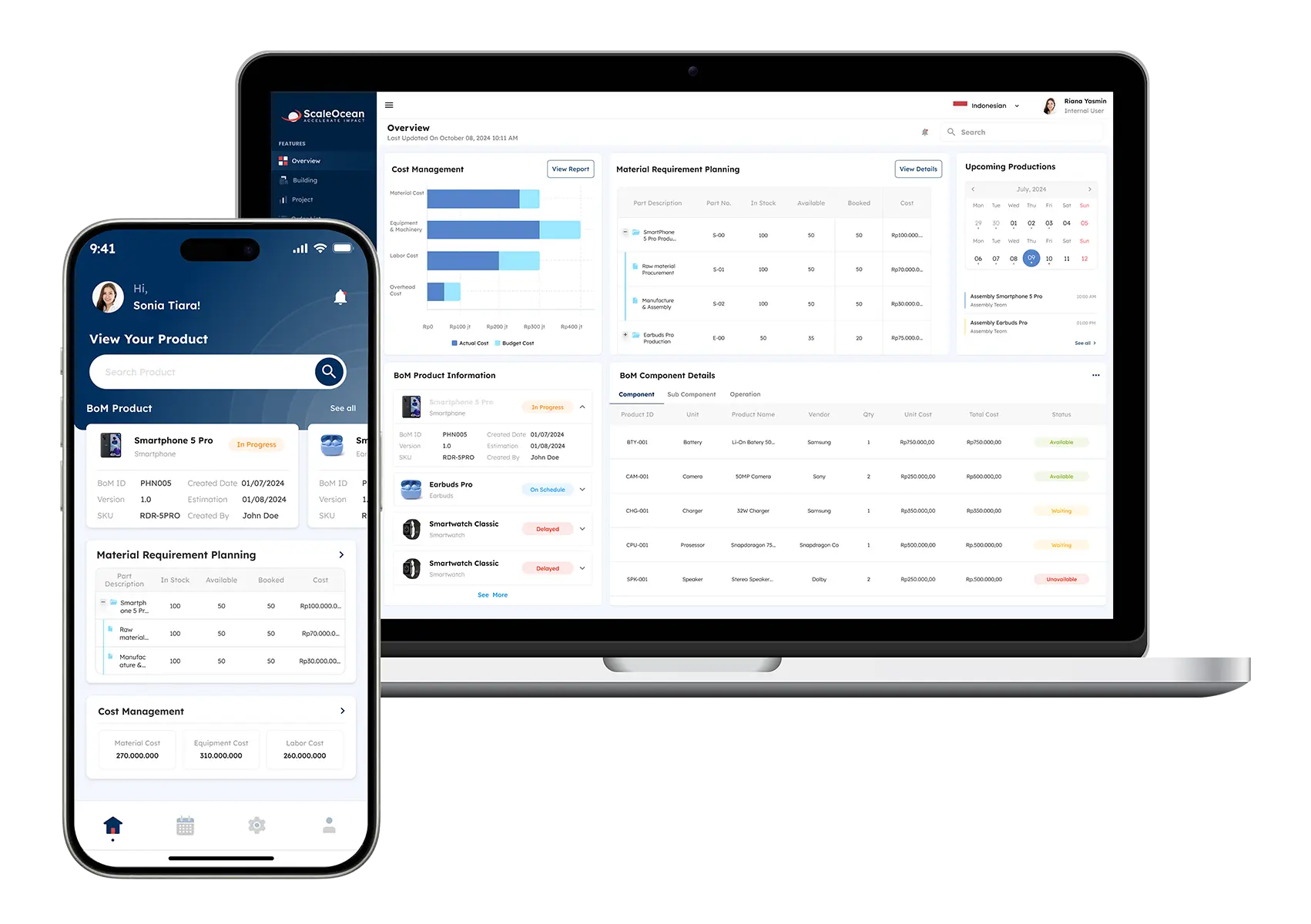
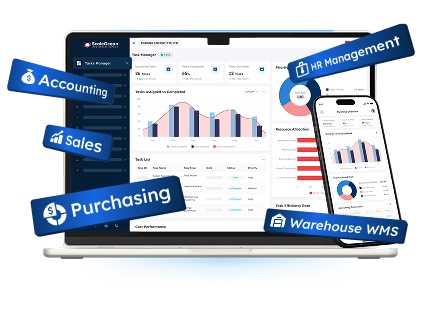
ScaleOcean Manufacturing ERP Software combines advanced planning and scheduling tools with integrated ERP capabilities that connect inventory, procurement, manufacturing, warehousing, and finance. Furthermore, configurable workflows support unique production rules, capacity constraints, approvals, and scheduling priorities.
The platform provides real-time operational visibility, flexible API integrations, and unlimited user access across departments. Additionally, ScaleOcean supports Singapore GST compliance, aligns with local financial reporting standards, and may qualify for EDG digitalization grants covering up to 50%.
You can request a free demo today to see how ScaleOcean streamlines production planning, capacity management, and scheduling decisions through a fully integrated manufacturing platform.
Key Features of ScaleOcean Manufacturing ERP Software:
- Multi-Constraint & Finite Capacity Scheduling: Creates realistic production schedules based on machine, labor, tooling, and material constraints simultaneously.
- Dynamic Setup & Changeover Optimization: Reduces setup, cleaning, and tooling changeover time by intelligently grouping similar production orders.
- Real-Time What-If Scenario Modeling: Simulates disruptions, urgent orders, and supply delays before applying schedule changes to operations.
- Dynamic Capable-to-Promise (CTP): It calculates reliable delivery dates using live capacity, production workloads, and supplier lead-time information.
- Interactive Visual Schedule Board: Provides drag-and-drop scheduling with visual capacity monitoring for faster planning and decision-making.
| Pros | Cons |
|---|---|
|
|
Best For: Medium to large-sized packaging businesses looking for a customizable ERP for the manufacturing industry platform that can adapt to unique manufacturing workflows, support business expansion, and improve cross-department operational visibility.
2. Acumatica – For Dedicated Manufacturing Modules
Acumatica advanced planning and scheduling software helps manufacturers coordinate production, inventory, and capacity planning within a cloud-based ERP environment. It provides scheduling tools that support production visibility and operational planning.
The platform combines manufacturing management with business processes such as inventory control and purchasing. As a result, organizations can manage planning activities from a centralized system.
Key Features:
- Limited capacity scheduling
- Material requirements planning
- Production order management
- Inventory visibility
| Pros | Cons |
|---|---|
|
|
Best For: Mid-sized manufacturers that need production planning, inventory management, procurement, and financial operations within a single cloud-based ERP platform. It is commonly considered by companies seeking business-wide process integration alongside manufacturing scheduling capabilities.
3. MRPeasy – For SMB-Focused
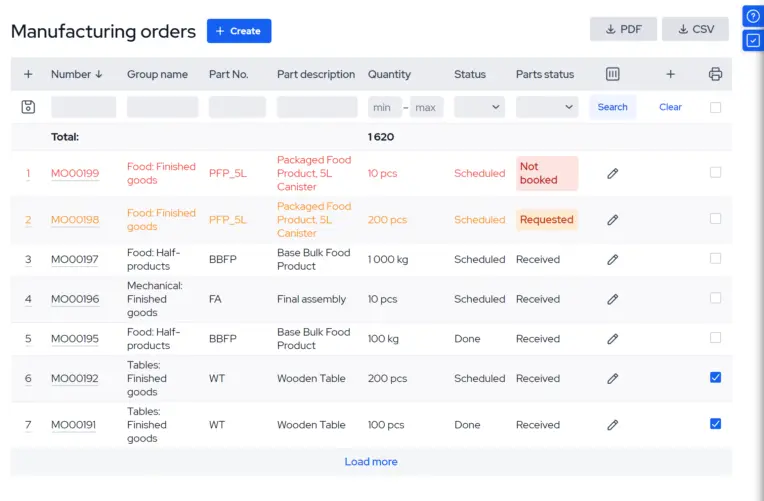
MRPeasy advanced planning and scheduling software is designed for manufacturers seeking straightforward tools for production planning and inventory management. It focuses on providing essential planning capabilities without excessive complexity.
The system helps businesses manage production schedules, purchasing activities, and inventory levels from a centralized platform. Consequently, smaller manufacturers can improve planning accuracy and operational visibility.
Key Features:
- Production planning
- Inventory management
- Purchasing management
- Shop floor reporting
| Pros | Cons |
|---|---|
|
|
Best For: Small manufacturers, workshops, contract manufacturers, and growing businesses that require production planning and inventory control without the complexity typically associated with enterprise manufacturing systems.
4. Siemens Opcenter APS (Preactor) – Specialized Standalone
Siemens Opcenter APS software focuses on optimizing production scheduling in manufacturing environments. It helps organizations create detailed schedules while considering operational constraints.
The platform specializes in advanced scheduling scenarios and supports manufacturers with complex production requirements. Therefore, planners can improve resource utilization and production coordination.
Key Features:
- Finite capacity planning
- Constraint-based scheduling
- Production sequencing
- What-if scenario analysis
| Pros | Cons |
|---|---|
|
|
Best For: Large manufacturers operating complex production environments with multiple production lines, resource constraints, and advanced scheduling requirements. It is often evaluated by enterprises seeking dedicated APS functionality separate from their ERP system.
Future Trends in Advanced Planning & Scheduling
As manufacturing becomes more digital, advanced planning and scheduling tools continue to expand beyond production scheduling. This is why innovators implement new tools to gain flexibility, access to information, and clear decision-making.
In addition to the above trends, escalating customer demands, supply chain complexities, and sustainability standards are shaping the next generation of APS systems, as outlined below. The following trends will impact manufacturing planning approaches in the future.
- AI-Powered Scheduling Optimization: Machine learning will analyze production data and automatically suggest scheduling adjustments to increase throughput, better utilize resources, and improve delivery metrics.
- Real-Time Digital Twin Technology: Manufacturers will employ digital models of manufacturing processes to test potential operational modifications and their outcomes before applying them on the shop floor.
- Greater Integration with Industry 4.0 Systems: APS systems will integrate more closely with the Industrial Internet of Things, MES, and smart factory environments to enable real-time planning decisions.
- Predictive Supply Chain Planning: Advanced analytics will enable manufacturers to anticipate material shortages, supplier delays, or demand changes before they occur and plan accordingly.
- Sustainable-Driven Scheduling: Manufacturers will leverage APS technology more extensively to enhance energy efficiency, eliminate waste, and pursue Environmental, Social, and Governance goals.
- Cloud-Native and Multi-Site Planning: Cloud-based APS platforms will enable global visibility and control across multiple factories, warehouses, and regions.
- Enhanced Collaboration Across Business Functions: The APS system will improve coordination among sales, procurement, production, and operations teams, enabling them to work as a single team.
Conclusion
APS enables manufacturers to generate viable production schedules from the capacity constraints and demand. The solutions found allow the firm to be more accurate in its capacity planning and more flexible. In doing so, the company expects to achieve better delivery performance and greater responsiveness.
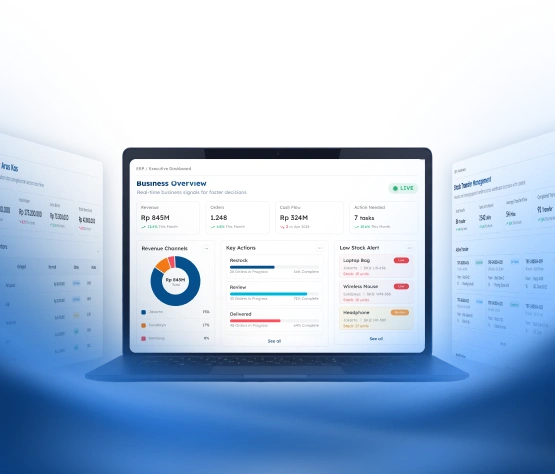
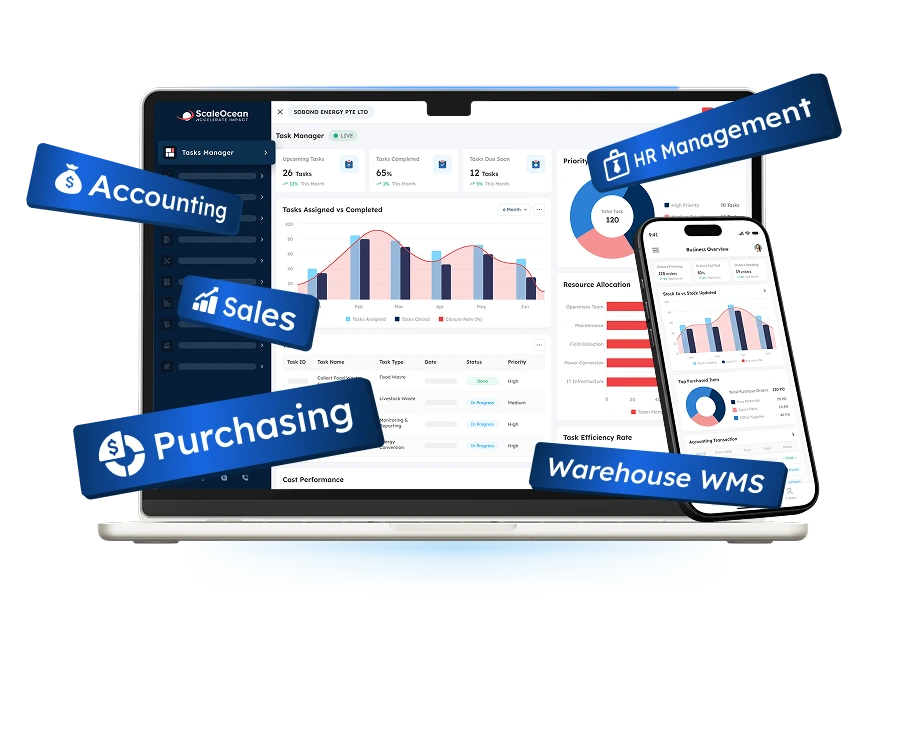
ScaleOcean’s Manufacturing ERP Software integrates Advanced Planning and Scheduling with real-time visibility and configurable workflows to help manufacturers with planning. It automates production, inventory, procurement, warehousing, and finance management, integrating these processes into a single scalable solution.
ScaleOcean also helps local manufacturing companies comply with Singapore GST regulations and local financial reporting requirements. Try out a free demo today and find out how ScaleOcean can streamline your production schedules, make better use of resources, and provide greater visibility into manufacturing activities.
FAQ:
1. What are the fundamental differences between the planning module in a standard ERP system and an APS system?
Standard ERP systems handle transactional data and plan production under infinite-capacity assumptions, meaning they ignore real-world limits. In contrast, APS systems act as intelligent engines that perform finite-capacity scheduling. It simultaneously factors in real-time constraints on machines, tools, labor, and materials.
2. Our factory has a very high product variety with low volumes (High-Mix, Low-Volume). Is APS suitable for this type of industry?
Yes, APS is highly suitable and critically needed for High-Mix, Low-Volume (HMLV) manufacturing. HMLV environments suffer from frequent setups, complex routing changes, and unpredictable bottlenecks. An APS system optimization engine instantly maps thousands of product permutations against actual constraints to minimize changeover times.
3. We currently rely on Excel/Spreadsheets for scheduling. How difficult will it be to transition from Excel to an APS system?
The technical transition is straightforward, but cultural adaptation is the primary challenge. Your team must shift from manual, error-prone spreadsheets to trusting automated algorithmic outputs. Success depends on cleaning your data (accurate bills of materials and cycle times) so the system can generate realistic schedules.
4. Can the APS system be integrated with our existing internal systems or software?
Absolutely. Modern APS solutions are built to integrate seamlessly via APIs, database connections, or middleware. It operates as a bridge between the business layer and the shop floor. It pulls raw customer demand and inventory records from your ERP and pushes optimized sequence instructions directly down to your MES.





















.png)