


SCADA (Supervisory Control and Data Acquisition) is a system that helps businesses automatically monitor, control, and collect operational data. Today, many industries rely on SCADA because manual monitoring often slows response times and increases operational risks.
According to the data our team found on Fortune Business Insights, the global SCADA market was valued at USD 12.90 billion in 2025. It is expected to grow significantly, reaching USD 26.59 billion by 2034. This growth highlights the increasing importance and adoption of SCADA systems across various industries.
Many companies still struggle with limited real-time visibility across operational activities. As a result, managers often face delayed decisions, unexpected downtime, and operational inefficiencies that negatively affect productivity and business continuity.
Additionally, businesses frequently depend on manual systems that remain vulnerable to human error and inconsistent reporting. Consequently, companies experience inaccurate operational data, slower coordination, and difficulty maintaining consistent industrial performance.
Therefore, companies increasingly adopt SCADA systems to improve monitoring accuracy and operational control. So, in this article, we will explore what is SCADA, how SCADA enables faster problem identification, supports automation processes, and helps businesses maintain efficiency across interconnected industrial environments.
 Key Takeaways
- Supervisory Control and Data Acquisition (SCADA) is a type of industrial control system used for monitoring and controlling operational processes.
- SCADA functions support real-time monitoring, automation, alerts, and reporting to maintain stable industrial performance continuously across operations and facilities.
- SCADA applications across industries improve operational visibility, infrastructure coordination, equipment reliability, and centralized industrial management efficiency.
- SCADA components and implementation levels support industrial communication, automation, supervision, and enterprise operational coordination processes efficiently
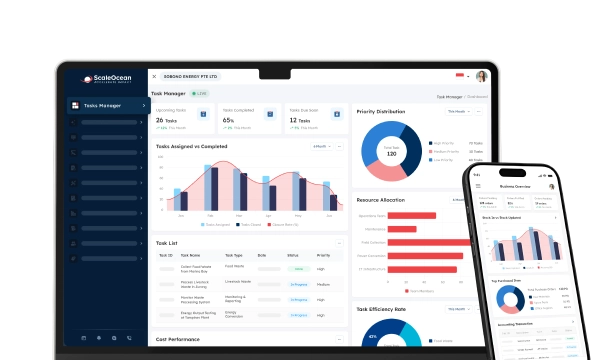
- ScaleOcean Manufacturing ERP Software integrates SCADA operations, production, inventory, and analytics for centralized industrial management and operational efficiency.

Understanding SCADA (Supervisory Control and Data Acquisition)
Supervisory Control and Data Acquisition (SCADA) is a type of industrial control system used for monitoring and controlling operational processes. Moreover, it continuously gathers data from machines, sensors, and industrial equipment.
The systems are widely used across various industrial sectors, including manufacturing, energy, logistics, water treatment, and transportation. This means businesses can monitor their operations from a single central point while enhancing efficiency, minimizing downtime, and accurately reporting on them.
A SCADA system combines hardware and software to control industrial processes. By integrating manufacturing analytics into visual dashboards, operators can monitor performance and respond quickly to abnormal events or equipment failures.
A Basic SCADA Diagram
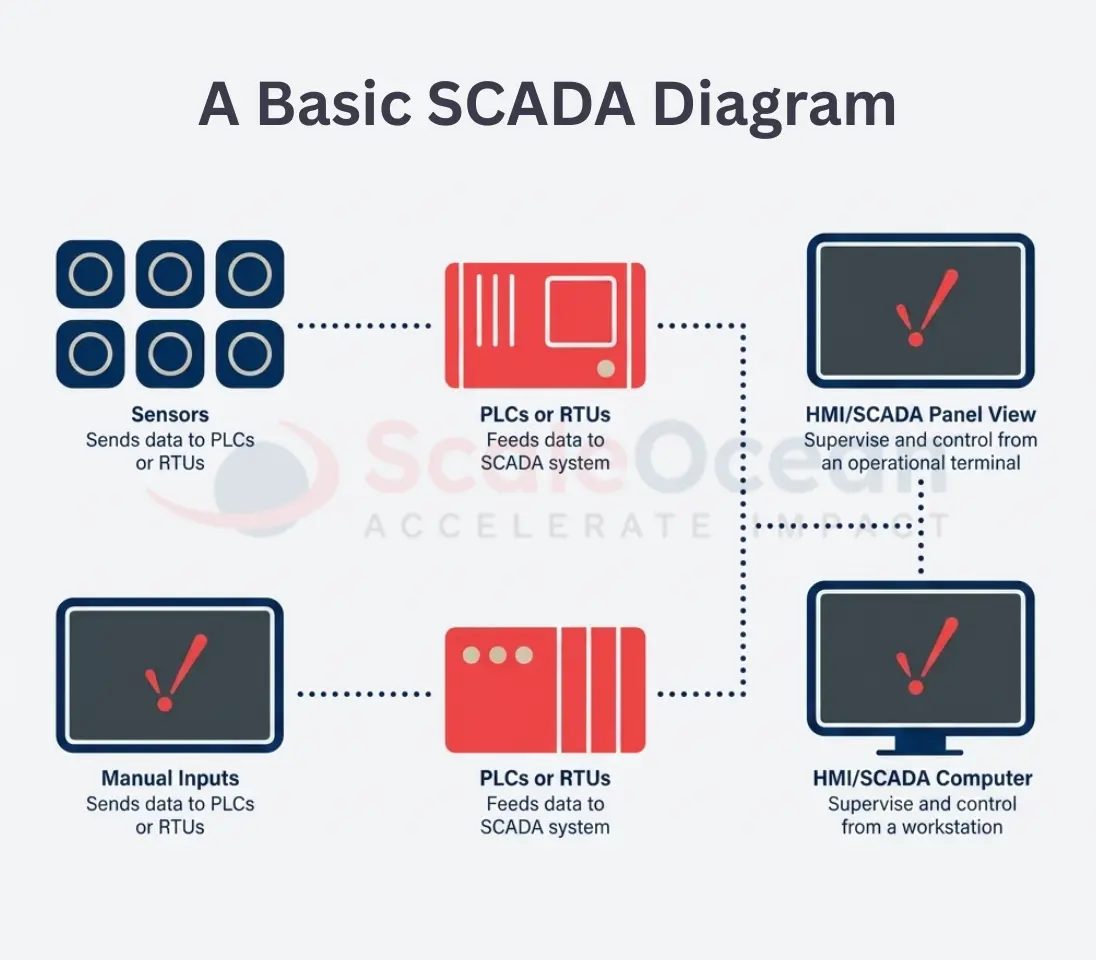
A basic SCADA diagram commonly shows sensors, manual inputs, PLCs or RTUs, and HMI or monitoring panels connected. Based on the diagram above, each component efficiently supports centralized operational monitoring.
Additionally, sensors and manual inputs send operational data directly to PLCs or RTUs for continuous processing. Then, the HMI or SCADA computer displays operational information, enabling operators to supervise and control activities more quickly.
How Does a SCADA System Work?
The working principle of the systems is to continuously gather operational data from industrial equipment via sensors and controllers. This information is then passed through to communication networks, which feed it into centralized systems, where the operators can directly monitor performance and operational conditions.
Once operational data is received, the software will process and visualize it through dashboards or graphical interfaces. As a result, operators can detect abnormalities promptly, track equipment status, and make operational decisions efficiently.
Also, SCADA systems can automate operational responses when predefined conditions are met during industrial operations. Systems may, for example, trigger alarms, automatically stop machines, or change how they are operated without manual intervention.
So, businesses implement the syste, to ensure consistent operations and avoid relying on manual monitoring. Furthermore, automation in monitoring can dramatically increase productivity for companies, reduce operational downtime, and enhance industry safety.
 Also Read: What Is a Smart Factory? A Complete Guide
Functions of SCADA Systems
SCADA system can be used to monitor, control, report, and analyze industrial operations. As a result, companies have better visibility into their operations, even though they must manage their processes across different departments and industrial units efficiently.
Furthermore, the system enables organizations to reduce downtime by detecting abnormalities earlier and reacting promptly. Thus, the companies can be more productive, more economical, and more stable in their industrial activities over the long term.
Real-Time Monitoring
SCADA continuously monitors machines, sensors, and industrial processes, providing immediate information on operational conditions. Therefore, businesses detect operational anomalies more quickly and make more accurate decisions under various operational conditions.
In addition, it captures and tracks all operational activities in real time, providing accurate performance information on centralized dashboards. Furthermore, managers, in particular, can assess equipment condition directly and consistently ensure better operational coordination and productivity.
Process Automation
SCADA automates repetitive industrial activities using predefined operational parameters and response actions. Thus, businesses can minimize human intervention and enhance consistency, productivity, and process efficiency in industrial settings.
The system automatically controls industrial processes, reducing the likelihood of human error. In addition, companies enhance production quality, speed up daily operations, and ensure more efficient industrial performance.
Management of Alerts and Future Events
SCADA can automatically detect operational abnormalities and notify of the alarm at any time abnormal conditions occur. As such, operators are quicker to respond to problems, with reduced operational disruption and effective mitigation of potential industrial risks.
It tracks operational history and can detect trends in past events to make more accurate predictions. Furthermore, companies can plan preventive maintenance without downtime or interruptions, thereby achieving ongoing operational stability.
Analysis and Reporting
SCADA continuously analyzes the collected industrial information to detect trends, inefficiencies, and operational risks. As a result, companies get a better understanding and can optimize their operations and industrial performance in the long term.
The system can automatically generate detailed operational reports from real-time and historical industrial data. Moreover, managers can accurately measure operational performance, helping them make better business decisions and consistently comply with regulatory requirements.
Difference SCADA and Other Automation Systems in the Industry
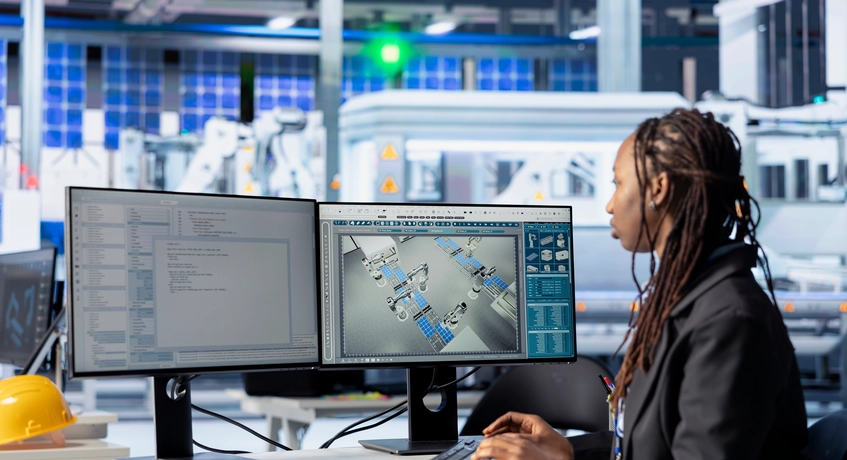
Industrial automation systems can be used for various purposes, depending on the business’s needs and the level of operational complexity. As a result, businesses need to understand the differences between what is SCADA and other industrial systems to choose appropriate operational technologies.
Plus, each automation system offers different features for data analysis, control, monitoring, and operational coordination. This helps businesses better understand what is SCADA and the core operations of each system, enabling them to implement more efficient industrial solutions.
SCADA and Manufacturing Execution System (MES)
SCADA is mainly concerned with the control and monitoring of industrial processes from operational devices and equipment in the field. On the other hand, MES systematically controls production workflows, scheduling, and manufacturing execution processes throughout production environments.
Moreover, the system provides continuous visibility into machines and operations in the industrial sector. Unlike that, MES focuses on production efficiency, quality management, and workflow coordination to effectively support manufacturing performance and operational productivity.
| Aspects | SCADA | MES |
|---|---|---|
| Main Function | Monitors and controls industrial operations | Manages manufacturing execution processes |
| Operational Scope | Machine and equipment monitoring | Production workflow management |
| Data Focus | Real-time operational data | Production and quality data |
| Primary Users | Operators and supervisors | Production managers |
| Key Benefit | Faster operational visibility | Better production coordination |
SCADA and Programmable Logic Controller (PLCs)
SCADA and Programmable Logic Controllers (PLCs) can be used together in industrial automation systems to enhance efficiency. PLCs are primarily responsible for machine-level control, and SCADA for monitoring activities at a wider, centralized level.
Also, PLCs execute operation commands quickly, based on a preprogrammed control logic, in industrial equipment at all times. SCADA can gather, visualize, and analyze operational information for operators, effectively supporting centralized supervision and operational decision-making.
| Aspects | SCADA | PLCs |
|---|---|---|
| Main Function | Supervises operational activities | Controls machine-level operations |
| Operational Scope | Centralized monitoring systems | Individual equipment control |
| Data Handling | Collects and visualizes data | Processes operational commands |
| System Role | Supervisory system | Control device |
| Key Benefit | Operational visibility | Fast machine automation |
SCADA and Distributed Control Systems (DCS)
Typically, SCADA systems can efficiently control operations at multiple geographically dispersed industrial sites from a centralized control point. On the other hand, DCS systems are used to directly control continuous industrial processes within a single facility, typically characterized by stable, integrated operations management.
Furthermore, SCADA provides excellent communication features for remote operations, monitoring, and data collection. At the same time, DCS always ensures accurate process control and stability in manufacturing plants and on continuous production lines.
| Aspects | SCADA | DCS |
|---|---|---|
| Main Function | Remote monitoring and supervision | Continuous process control |
| Operational Scope | Multiple remote locations | Single industrial facility |
| Communication Focus | Remote data transmission | Internal process coordination |
| System Flexibility | Highly scalable and distributed | Highly integrated locally |
| Key Benefit | Better remote visibility | Stable process control |
SCADA and Energy Management System (EMS)
The primary concern of the SCADA system is to monitor and control the operation, equipment, and performance of industrial processes from a central location. EMS, on the other hand, is primarily responsible for managing energy consumption, distribution, and efficiency optimization in industrial plants on an ongoing basis.
In addition, EMS can help businesses reduce energy losses and significantly enhance energy efficiency and sustainability efforts. But, SCADA combines monitoring, automation, alarm management, and industrial reporting functions all in one.
| Aspects | SCADA | EMS |
|---|---|---|
| Main Function | Tax on consumption of goods and services | Tax on wealth transfer across generations |
| Operational Scope | Applied to sales transactions | Applied to inheritance or gifts |
| Data Focus | Ongoing, transaction-based | Occasional, event-based |
| Main Objective | End consumer, collected by businesses | An individual transferring wealth |
| Key Benefit | Broad, applies to most goods and services | Narrow, applies to specific estate transfers |
The Birth of SCADA
The first SCADA systems were developed in the 1960s, when industries needed more efficient ways to monitor operations remotely. In the past, businesses relied on manual supervision, which frequently led to significant delays, inefficiencies, and inconsistencies in operations.
In the early industrial era, these factories were equipped with decentralized control systems with no overall operational visibility and communication efficiency. As a result, operators had problems with monitoring equipment conditions, responding rapidly to failures, and maintaining operational stability.
Engineers created systems that effectively centralize operational monitoring and automate data collection for the industry. Furthermore, business organizations were able to improve the supervision of their operations, reduce manual workload, and enhance the accuracy of industrial control in their facilities.
In industrial environments, the systems were initially implemented on large-scale mainframe computers using restricted communication technologies. But these systems still offered many operational benefits, including faster industrial decision-making and centralized monitoring.
The Development of SCADA
As industrial technologies and communication systems advanced across industries worldwide, the systems also evolved rapidly. As a result, companies could continuously enjoy increased visibility of their operations, faster data transfer, and more reliable industrial automation.
In the 1970s and 1980s, the number of programmable logic controllers and distributed computing technologies in a SCADA environment grew. Hence, companies gained greater operational flexibility and considerably reduced their reliance on costly centralized computing infrastructure.
Further, internet technologies revolutionized the systems in the 1990s and early 2000s in all industrial sectors worldwide. This enabled operators to access the site remotely, report in real time, and communicate effectively between industrial sites.
In today’s world, the integration of cloud computing, advanced analytics, and Industrial Internet of Things technologies into modern systems is a success. Furthermore, companies continuously enhance their operational efficiency, predictive maintenance, and data-driven industrial decision-making processes.
Modern SCADA Systems
Modern systems integrate advanced monitoring technologies, automation capabilities, and real-time industrial communication in a central operational platform. As a result, businesses can monitor industrial processes more effectively and consistently enhance their operational responsiveness and productivity.
Also, the latest systems can integrate with the cloud, providing remote access across various operational environments. As a result, managers and operators can maintain continuous operational control and monitor industrial performance from various locations.
The need for cybersecurity has also become an important aspect of contemporary systems due to escalating cyber threats across industrial systems worldwide. Therefore, enterprises have to adopt more robust security measures to safeguard their operational data and ensure the reliability of industrial systems.
In addition, state-of-the-art systems continuously incorporate the latest advances in analytics and predictive maintenance to optimize operations. This, in turn, helps companies minimize downtime, increase equipment reliability, and contribute to OEE (Overall Equipment Effectiveness in industrial facilities.
What is the new SCADA®?
The New SCADA® is a new generation of SCADA technologies that are more flexible, scalable, and connected to industrial operations today. Modern SCADA platforms can easily integrate with the cloud, be accessed on mobile devices, and accommodate advanced industrial analytics.
Further, as industries continue to need greater operational visibility and centralized control, businesses are increasingly turning to modern SCADA solutions. Hence, companies successfully enhance their industrial responsiveness and operate their production areas with scalability in a connected setup.
Today’s systems also focus on interoperability between industrial devices, enterprise systems, and operational technologies. As a result, businesses can operate more efficiently and improve the accuracy of industrial data and organizational decision-making on an ongoing basis.
Furthermore, the New SCADA® enables digital transformation projects with the latest levels of automation, remote monitoring, and intelligent reporting. This benefits companies by improving productivity, operational resilience, and industrial competitiveness in increasingly data-driven global operating environments.
Ignition HMI/SCADA Software
Ignition HMI/SCADA software is a modern industrial platform optimized for efficient centralized monitoring, control, and visualization of operational data. In addition, businesses choose Ignition for its unlimited devices and tags, as well as scalable industrial integration.
Moreover, Ignition offers web-based operational access, allowing operators and managers to observe industrial operations remotely and continuously. Companies benefit greatly from this, as it helps them make decisions in the industrial field quickly and facilitates organizational responsiveness.
Ignition SCADA Architecture
The Ignition SCADA architecture features a centralized server system that efficiently integrates industrial devices, databases, and visualization interfaces. As a result, businesses can better manage their operational data and continue to streamline interactions between industrial systems and operational users.
Furthermore, the architecture is modular and can be integrated, allowing companies to expand their operational scope without rebuilding their existing industrial platforms. Consequently, businesses can scale more effectively and maintain operational flexibility in industrial environments with a flexible manufacturing system.
Use Cases and Examples of SCADA Systems and SCADA System Applications
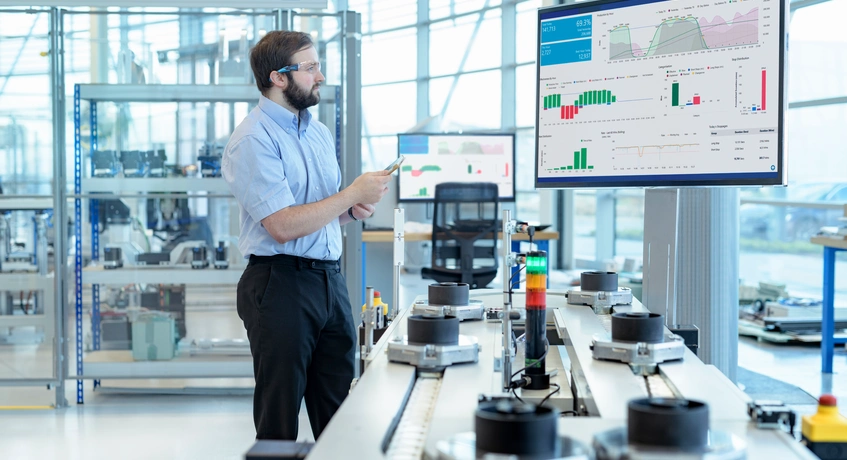
SCADA systems support many industries by continuously improving operational visibility, automation, and centralized industrial monitoring capabilities. Consequently, businesses manage industrial processes more efficiently, reduce operational risks, and significantly improve decision-making accuracy.
Additionally, modern industries increasingly integrate SCADA with cloud computing, artificial intelligence, and IIoT (Industrial Internet of Things) technologies effectively. Therefore, companies improve operational responsiveness while supporting digital transformation initiatives across complex industrial environments globally.
SCADA in Oil and Gas
Oil and gas companies use the system to remotely monitor pipelines, drilling activities, storage facilities, and production operations. Consequently, operators improve operational safety while significantly reducing risks of equipment failures, leaks, and production interruptions.
According to mrt.com, companies in the Permian Basin have recently implemented AI-driven platforms integrated with existing SCADA infrastructure to optimize water management and operational decision-making. Moreover, TotalEnergies expanded real-time monitoring technologies across upstream assets to strengthen operational efficiency and methane detection initiatives.
SCADA in Smart Cities
Smart cities implement systems to efficiently manage street lighting, traffic control, water distribution, and public infrastructure monitoring. Therefore, cities improve operational coordination while continuously supporting sustainable urban development and better resource management.
According to a Nasdaq article, the City of Helsingborg collaborated with Itron to deploy smart monitoring technologies to improve streetlight management and citywide operational visibility. However, reports from Dehradun highlighted implementation challenges related to the sustainability of smart infrastructure and the effectiveness of operational maintenance.
SCADA in Smart Manufacturing
Smart manufacturing facilities use SCADA systems to monitor production lines, automate operational workflows, and continuously analyze industrial performance data. Consequently, manufacturers improve operational efficiency while significantly reducing downtime, waste, and manual production management activities.
Furthermore, Manufacturing companies have increasingly adopted smart factory technologies globally, supported by artificial intelligence, the Industrial Internet of Things, and SCADA integration capabilities.
SCADA in Transportation
The transportation industry uses SCADA systems to centrally monitor railway operations, traffic systems, airport facilities, and logistics infrastructure. As a result, operators improve transportation reliability while maintaining operational safety and efficiently reducing disruptions across transportation networks.
Additionally, smart transportation systems increasingly integrate SCADA technologies with centralized operational monitoring and automated traffic management capabilities effectively. Therefore, transportation operators improve infrastructure coordination while consistently supporting faster responses to operational abnormalities and service interruptions.
SCADA in Building
Buildings use the system to automatically manage heating, ventilation, air conditioning, lighting, and security systems. Consequently, facility managers improve energy efficiency while continuously maintaining operational comfort, safety, and centralized building supervision.
Modern commercial buildings increasingly integrate SCADA with smart sensors and cloud-based monitoring platforms, as mentioned in an article from Emerson. Therefore, organizations significantly improve operational efficiency while reducing energy consumption, maintenance costs, and operational disruptions across building environments.
SCADA in Water and Wastewater Management
Water and wastewater facilities implement a system to continuously monitor pumps, pipelines, reservoirs, and treatment processes. Consequently, operators improve operational reliability while maintaining water quality standards and significantly reducing manual monitoring activities.
Recently, smart city initiatives have increasingly effectively integrated SCADA technologies into water distribution and environmental monitoring infrastructures. However, several urban projects also revealed operational challenges in advanced planning and scheduling, sustainability monitoring, and infrastructure utilization across wastewater management systems.
SCADA in Power Generation, Transmission, and Renewable Energy
The power generation and renewable energy industries use SCADA systems to continuously monitor substations, transmission networks, solar facilities, and battery storage infrastructure. Therefore, operators improve grid stability while maintaining operational efficiency and enabling faster responses to electrical disturbances.
Energy companies successfully introduced advanced SCADA platforms, such as the one covered by Solar Power World Online, designed specifically for utility-scale solar and battery energy storage operations. In addition, governments are increasingly investing in SCADA modernization to improve smart grid visibility, remote monitoring, and reliability.
Additionally, many industries require integrated operational systems to simultaneously support SCADA monitoring, production coordination, inventory management, and maintenance activities. Therefore, ScaleOcean Manufacturing ERP Software helps businesses centralize operational data and significantly reduce disconnected workflows and manual reporting.
ScaleOcean Manufacturing ERP Software helps industries efficiently integrate SCADA monitoring with production, inventory, maintenance, and operational analytics systems. Request a free demo today to optimize SCADA implementation and improve operational efficiency across industries.

Components of a SCADA System.
SCADA systems comprise multiple integrated components to control industrial processes. This results in greater visibility into the business and improved communication between industrial equipment and centralized monitoring solutions.
Furthermore, in industrial applications, each SCADA component is responsible for a specific task to ensure the system’s reliable operation. As a result, companies successfully operate their processes more in coordination, respond faster, and perform more efficiently across interconnected processes.
Human Machine Interface (HMI) & The Supervisory System
Human-Machine Interfaces and supervisory systems have enabled operators to efficiently monitor industrial activities from central graphical dashboards. Businesses, therefore, gain greater operational visibility and respond more quickly to operational irregularities and industrial performance problems.
Moreover, HMI platforms provide operational data such as machine availability, alarms, production status, and historical performance in a visual format. Thus, operators can monitor industrial processes more accurately and maintain sound operational control and decision-making.
Remote Terminal Units (RTUs)
The Remote Terminal Units collect operational data directly from industrial equipment and continuously transmit it to the centralized SCADA system. This means that enterprises can track assets in the field and communicate over long distances within their operating environment.
Furthermore, RTUs can process the field data they receive and automatically execute supervisory commands, enabling remote operation. As a result, industries become more responsive to operational needs and have much lower reliance on manual monitoring and intervention.
Programmable Logic Controllers (PLCs)
Programmable Logic Controllers (PLCs) continuously operate industrial equipment by following a preprogrammed control logic and operational instructions. As a result, companies achieve greater operational consistency, minimize manual effort, and achieve a much higher level of reliability in industrial processes.
Besides, PLCs are quick and efficient at processing operational data and are well-suited to automating machines in industrial production environments. Thus, the industries maintain stable performance and continuously improve production speed, equipment coordination, and process accuracy.
Sensors and Actuators
In industrial systems, operational data such as temperature, pressure, flow rates, and equipment conditions are continuously measured by sensors. As a result, businesses can access the most up-to-date operational data to track and manage industrial decision-making effectively.
Meanwhile, in the SCADA environment, actuators will automatically perform operational functions in response to supervisory actions issued by the SCADA system. Thus, industries can respond to automation efficiently and continue to enhance operational control, productivity, and stability in industrial processes.
Communication Network
In SCADA, communication networks are used to continuously share operational data among devices, controllers, and central systems. As a result, enterprises can ensure smooth industrial communication, real-time monitoring, and operational coordination.
Besides, communication networks can support both wired and wireless industrial communication technologies in operational environments. As a result, industries gain operational flexibility while consistently ensuring accurate data transmission and stable industrial connectivity.
Inputs
Inputs are the information that is continually gathered from industrial equipment, sensors, manual commands, and monitoring devices. As a result, the systems can effectively collect accurate operational data and manage centralized supervision and industrial automation.
In addition, the input signals assist the operator in monitoring industry performance and initiate an automatic response to the operation when predetermined conditions are satisfied. Thus, businesses always achieve higher industrial responsiveness, process reliability, and operational accuracy.
How to Implement SCADA Systems.
The deployment of the system requires a well-organized operational plan, interoperable industrial communication, and dependable automation structures in operational environments. Thus, enterprises enhance their monitoring, keep their industrial automation scalable, and maintain central operational visibility.
Furthermore, a typical SCADA implementation uses a hierarchical approach to operational levels, systematically organizing industrial control and management activities. So, companies can achieve better operational coordination and more consistent communication among industrial devices, supervisory systems, and enterprise management systems.
Level 0: Field Devices
Level 0 consists of field devices such as sensors, actuators, meters, and industrial instruments deployed directly in operational environments. As a result, businesses can accurately gather real-time operational metrics and continue to support industrial monitoring and automation processes.
Also, these devices monitor operating conditions and automatically transmit industrial data to higher levels of the SCADA control system. As a result, industries have prompt, accurate operational visibility and enhanced responsiveness in industrial production and monitoring.
Level 1: Direct Control
The Level 1 is a continuous direct industrial control management system with programmable logic controllers and remote terminal units. As a result, companies can automate machine processes more efficiently, minimize human participation, and significantly enhance the consistency of industrial processes.
Furthermore, controllers can process operational commands and continuously execute automatic responses according to predefined industrial logic. For this reason, industries achieve better operational stability and can reliably coordinate their machines to ensure the performance of industrial automation.
Level 2: Plant Supervisory
Level 2 is dedicated to centralized supervision of the plant through HMI platforms and SCADA monitoring software, efficiently. As a result, operators will have direct visibility into industrial performance and will coordinate continuously throughout their operations.
Also, supervisory systems automatically gather and display the operational information from lower levels of industrial control. Thus, businesses improve operational decision-making and respond more quickly to industrial abnormalities and production problems.
Level 3: Manufacturing Executing System
At level 3, Manufacturing Execution Systems are integrated into the mix to efficiently manage production scheduling, workflow coordination, and operational reporting. This results in enhanced manufacturing productivity and a constant focus on manufacturing and quality management.
Moreover, MES platforms are highly effective at coordinating operational activities across plant supervision systems and enterprise management infrastructures. As a result, industries enhance production planning and continuously ensure correct manufacturing execution and operational efficiency.
Level 4: Enterprise Resource Management
Level 4 links SCADA with enterprise resource management (ERM) to facilitate efficient business coordination and organizational planning. As a result, businesses are continually working to improve operational integration while maintaining the ability to make informed strategic choices based on data across various business functions.
Furthermore, enterprise management systems can analyze operational data throughout inventory, financial, purchasing, and production planning. Thus, the businesses enhance organizational effectiveness and consistently align with industrial and administrative processes.
How Can ScaleOcean Help SCADA System Implementation in Industry?
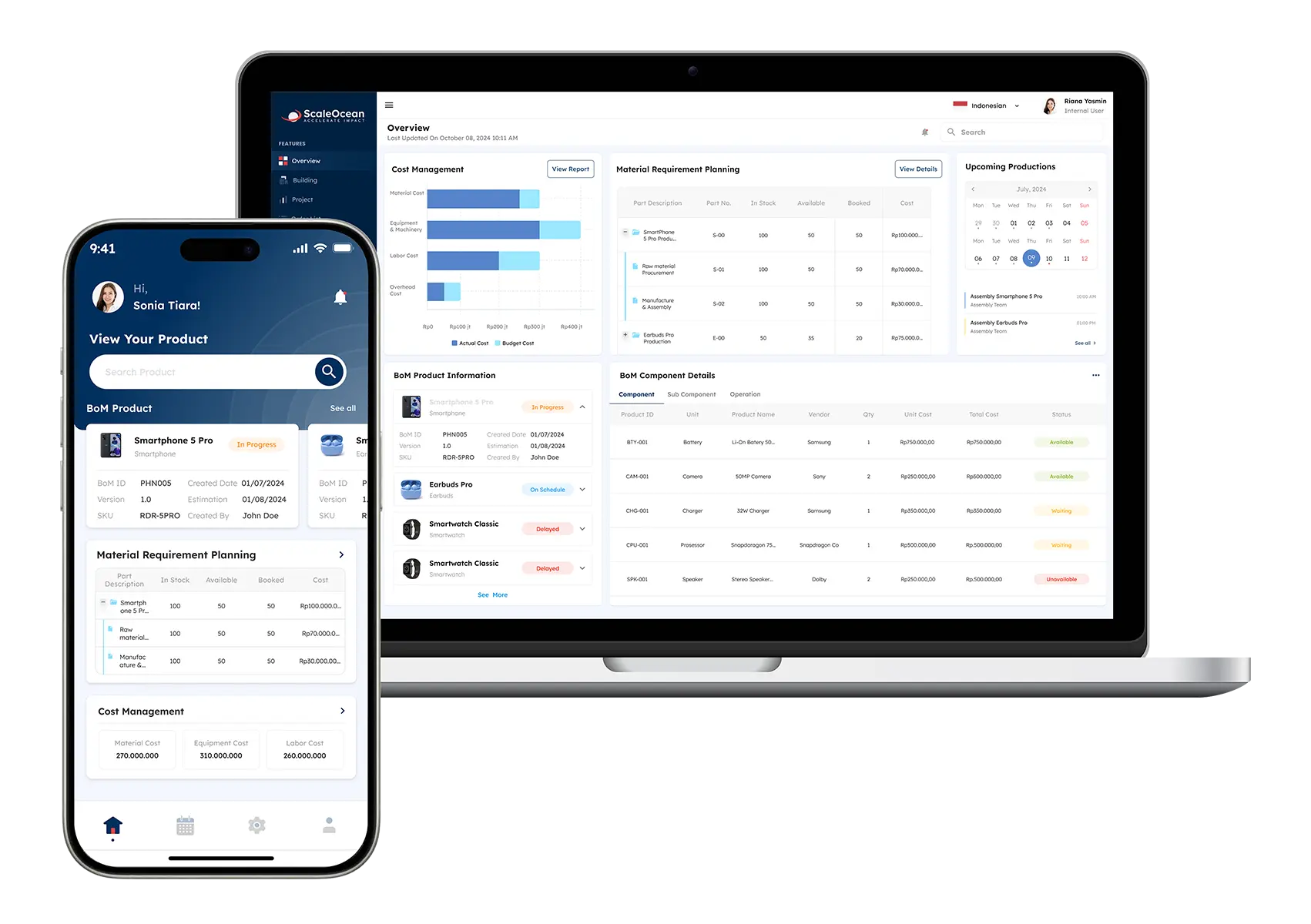
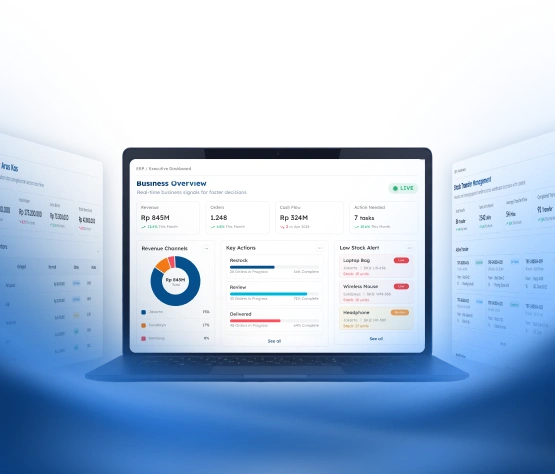
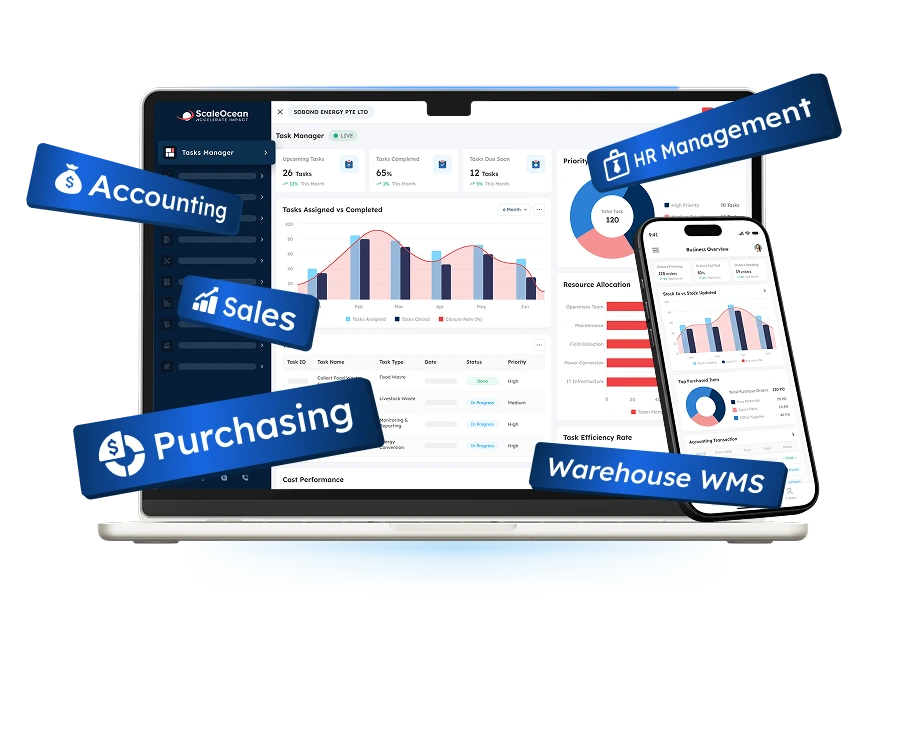
SCADA implementation requires continuous, seamless integration among industrial monitoring systems and enterprise management platforms. Therefore, ScaleOcean Manufacturing ERP Software provides an all-in-one integrated solution that helps businesses manage SCADA data, operational coordination, and industrial processes more efficiently.
Additionally, SCADA systems depend heavily on automation, centralized visibility, and accurate operational analysis to consistently improve industrial performance. Consequently, ScaleOcean supports businesses through integrated automation and business intelligence capabilities that effectively improve operational efficiency.
Key Features of ScaleOcean Manufacturing ERP Software for SCADA:
- Predictive Maintenance: ScaleOcean analyzes SCADA operational data continuously to predict potential equipment failures before disruptions occur. Consequently, businesses reduce unexpected downtime while significantly improving machine reliability and the efficiency of maintenance planning.
- OEE Dashboard: ScaleOcean provides a real-time Overall Equipment Effectiveness visualization to monitor availability, operational performance, and production quality accurately. Therefore, companies improve productivity measurement while consistently maintaining better operational efficiency across industrial environments.
- Energy Monitoring: ScaleOcean continuously tracks machine energy consumption through SCADA operational data integration. Consequently, businesses reduce unnecessary energy use while supporting sustainability initiatives and improving operational efficiency in the industry.
- Mobile Alerts & Notifications: ScaleOcean sends instant operational notifications whenever SCADA systems automatically detect critical equipment conditions or operational abnormalities. Therefore, operational teams respond faster, improving industrial safety and significantly reducing operational disruptions.
- Inventory Integration: ScaleOcean continuously synchronizes SCADA production output with warehouse and inventory management systems. As a result, businesses improve inventory accuracy and support efficient production planning and operational coordination.
Conclusion
SCADA systems efficiently improve operational monitoring, automation, real-time visibility, and industrial decision-making across interconnected environments. Consequently, businesses consistently reduce operational risks while increasing productivity, maintenance efficiency, and long-term industrial performance.
Additionally, implementing SCADA systems requires integrated management, accurate reporting, and continuous operational coordination. Therefore, ScaleOcean Manufacturing ERP Software helps businesses synchronize production, inventory, maintenance, and operational analytics more efficiently.
ScaleOcean also supports industrial automation through centralized visibility, predictive analysis, and integrated monitoring. Request a free demo today to optimize SCADA implementation and improve industrial operational efficiency comprehensively.
FAQ:
1. What does a SCADA system do?
SCADA (Supervisory Control and Data Acquisition) is a system architecture that allows industrial organizations to monitor, control, and manage processes, machinery, and plants.
2. Is SCADA a PLC?
PLCs (Programmable Logic Controllers) handle real-time control of individual devices or small processes. SCADA systems, in contrast, oversee broader operations by collecting and analyzing data across larger industrial processes.
3. What is OT vs ICS vs SCADA?
OT (Operational Technology) security protects systems, ICS (Industrial Control Systems) security safeguards machinery and data, and SCADA security focuses on real-time control and public safety. Together, they ensure the safety, integrity, and control of industrial and operational environments.
4. Is SCADA outdated?
Many industries still use outdated SCADA systems. While vendors offer minor updates, core technologies often remain unchanged, increasing cybersecurity risks and reducing operational efficiency.





















.png)