
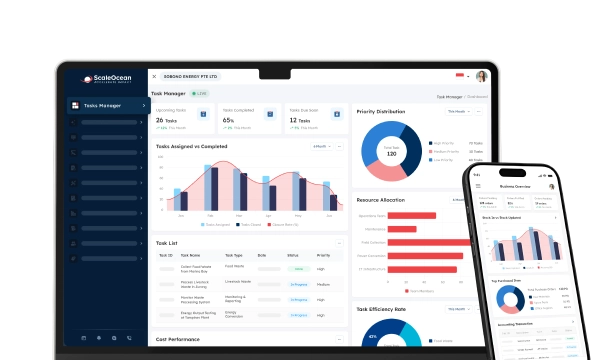

Amidst Singapore’s rapid digital transformation, Cloud ERP has emerged as a new foundation for modern business management. Originating from traditional on-premises ERP systems in the early 1990s, Cloud ERP has evolved with advances in the internet and cloud computing.
It enables companies to manage finances, operations, and supply chains in an integrated manner through a flexible online platform. However, many companies that have not yet made the switch to Cloud ERP still face various obstacles.
Such as high IT infrastructure costs, fragmented systems, limited real-time data access, and difficulties adapting to regulatory changes and the dynamic business scale in Singapore. Cloud ERP offers a solution, offering cost efficiency, scalability, data security, and comprehensive business visibility.
To that end, we’ve outlined a comprehensive article on Cloud ERP as the future of enterprise resource planning software, discussing the benefits, trends, and why companies should choose a Cloud ERP solution to stay competitive in the digital age. Learn more here!
 Key Takeaways
- Cloud ERP is an ERP system delivered as a service over the internet, unifying core business processes like finance and supply chain.
- The importance of using cloud ERP software for business can support your company, including cost efficiency, accessibility and mobility, scalability, automatic updates, and more.
- Top 5 Cloud ERP providers examples, such as ScaleOcean, SAP, NetSuite, Acumatica, and Microsoft Dynamics 365
- Using ScaleOcean’s cloud ERP solutions may help your business optimize procedures, stimulate innovation, and drive long-term success.
What is Cloud ERP?
Cloud ERP is a cloud-based system that centralizes and manages essential business functions, such as finance, human resources, and supply chain, through an internet connection rather than on local servers.
Hosted on a provider’s cloud platform and is basically delivered as a service or software as a service (SaaS). It enables companies to benefit from greater flexibility, easy scalability, reduced initial investment through a subscription-based model, and real-time access to data from any location.
By unifying multiple operational processes into a single, web-accessible platform, Cloud ERP serves as a centralized data hub and enterprise software system that supports higher efficiency and more informed business decisions.
Cloud ERP vs. On-Premises ERP
Cloud ERP or SaaS ERP is hosted by the vendor’s cloud storage, allowing easy remote access and quick recovery while eliminating the need for physical hardware. It typically comes with lower initial costs, as companies avoid huge infrastructure or maintenance spending. It offers scalability and flexibility instantly.
On-Premises ERP is hosted and stores data locally, requiring significant upfront investments in hardware, maintenance, and security. Scaling an On-Premises system often demands substantial infrastructure changes. Plus, data security relies heavily on potentially constrained internal IT teams.
When choosing a type of ERP, businesses must look closely at data storage, implementation costs, scalability, and security. We found a report from Business Research Insights that says the global ERP market is projected to reach $105.4$ billion USD by 2029, fueled by the growing shift towards cloud solutions.
The Importance of Cloud ERP for Medium-to-Large Companies

For mid-to-large-sized businesses, Cloud ERP plays a critical role in sustaining growth while maintaining operational control. It is a transformative solution, offering benefits across sectors.
It streamlines operations, enhances decision-making, and ensures a competitive edge by simplifying the steps to earn Singapore’s official CSA CyberEssentials & CyberTrust Marks.
The benefits of Cloud ERP go beyond just tech upgrades. They truly empower businesses to optimize resources and encourage innovation. Here are some key benefits that highlight why Cloud ERP is a vital resource for modern businesses:
- Cost Efficiency: Cloud ERP lowers initial expenses on hardware, installation, and maintenance, avoiding large capital investments. The pay-as-you-go model lets businesses pay for only what they use. Integrated ERP finance modules streamline financial processes, making it a smart choice for SMEs and startups.
- Accessibility and Mobility: It enables businesses to access their systems and data from anywhere, at any time. Employees can collaborate effortlessly, especially with remote teams. SaaS ERP further enhances this flexibility, boosting productivity and ensuring uninterrupted operations across locations. For instance, managers can check financial reports, monitor inventory, or approve transactions while on the move. Such features are essential for businesses in fast-paced environments where quick responses are critical.
- Scalability: Cloud ERP is designed to grow alongside your business. Whether you’re expanding your operations, entering new markets, or adapting to seasonal fluctuations, the system can easily adjust resources as needed. In contrast to on-premises systems, which often require hefty investments for expansion, cloud-based ERP solutions can adapt to your changing needs without additional infrastructure. So, customizing hybrid ERP systems enhances scalability by combining cloud flexibility with on-premise control for tailored growth.
- Automatic Updates: With cloud-integrated ERP, businesses can always access the latest features and updates without needing to intervene manually. Providers take care of upgrades and security patches, enabling companies to concentrate on their core operations rather than IT upkeep. This proactive strategy minimizes downtime and helps businesses stay competitive. When considering custom ERP vs off-the-shelf ERP maintenance, automatic updates ensure both systems remain up-to-date and efficient.
- Data Security: Data security is a primary concern for Cloud ERP providers, who utilize advanced encryption, multi-factor authentication, and regular backups to protect sensitive information. Additionally, compliance with international data protection regulations provides an extra layer of reassurance. For companies in regulated industries, adopting Cloud ERP ensures they meet necessary standards while maintaining operational integrity.
- Improved Collaboration: Cloud ERP genuinely enhances teamwork by giving teams a centralized platform to share real-time data. Whether it’s reports or inventory details, everyone stays on the same page, making it much easier to collaborate and work efficiently across all departments and locations. Mobile ERP access further enhances this by allowing employees to collaborate on the go, improving communication, decision-making, and reducing errors or misunderstandings.
- Enhanced Data Analytics: Built-in analytics tools within Cloud ERP give businesses valuable, real-time insights into operations. By tracking key metrics, companies can easily analyze performance, spot trends, and identify areas for improvement. These data-driven insights lead directly to smarter business decisions.
- Faster Implementation: Compared to traditional on-premises systems, Cloud ERP is much quicker to implement. Since cloud solutions are pre-configured, they don’t need the same infrastructure setup. This lets businesses get up and running faster, reducing the time it takes to achieve a return on investment (ROI).
Types of Cloud ERP
Cloud ERP comes in a variety of deployment models, suited for different company requirements, financial plans, and protection concerns.
Knowing the following variations may help a company discover the best way to stabilise prices, customizations, scaling up, information handling, as well as its enterprise software.
- Multi-tenant SaaS: Permits many companies to share one replica in the software and infrastructure while protecting personal data in different ways. Offering lower expenses, automated upgrades, speedier setup, and shared best practices, the most suitable choice for organisations aiming for performance and scalability.
- Single-tenant SaaS: Offers a devoted replica of the software for one firm. Even if it can be located up within the clouds, this will supply improved control and customizability and also tighter compliance. It fits companies with complicated needs or regulatory issues.
- Public Cloud: Deployed utilizing shared cloud facilities from service providers like MicrosoftAzure, Google Cloud, and Amazon Web Services (AWS). Supplies quick setup as well as great deals of versatility that enable organisations to adapt resources on-demand with no requirement for managing hardware.
- Private Cloud: Used within the infrastructure only for one company (managed either inside or outside the organisation). It will certainly give the organisation greater control and data security. It’s ideal if businesses have strict data management as well as business regulatory requirements.
Key Components of Cloud ERP
Cloud ERP systems provide a variety of modules that enhance business operations and facilitate improved decision-making. These components work together smoothly, allowing organizations to oversee various functions from a single platform. By utilizing these tools, companies can increase efficiency, reduce expenses, and align with their strategic objectives.
According to ERPnews, essential Cloud ERP components consist of HR for handling employee life cycles, CRM for enhancing customer interactions, and Business Intelligence for gaining data-driven insights. These modules help businesses remain agile and competitive in an ever-changing market.
- Financial Management: This module enhances accounting, budgeting, and financial reporting, giving businesses clear insights into their financial status. It ensures compliance and makes tax reporting easier, helping companies maintain financial clarity.
- Human Resource Management (HRM): Cloud ERP consolidates employee records, payroll, and recruitment processes, leading to improved workforce management. Automation reduces administrative tasks and boosts employee engagement.
- Supply Chain Management: Manage inventory, procurement, and logistics effectively with Cloud ERP’s supply chain modules. Integrated supply chain features allow businesses to accurately forecast demand, reducing the risk of stock shortages or surplus inventory. The process of ERP consolidation enhances this by streamlining procurement and distribution, leading to better coordination with suppliers and vendors.
- Manufacturing and Production: Cloud ERP covers every aspect of manufacturing, from planning to quality control. By tracking production metrics in real-time, businesses can boost productivity and reduce waste.
- Customer Relationship Management (CRM): CRM modules assist businesses in fostering stronger customer relationships by managing interactions and analyzing behaviors. It also ensures a smooth customer experience by integrating with support and service systems.
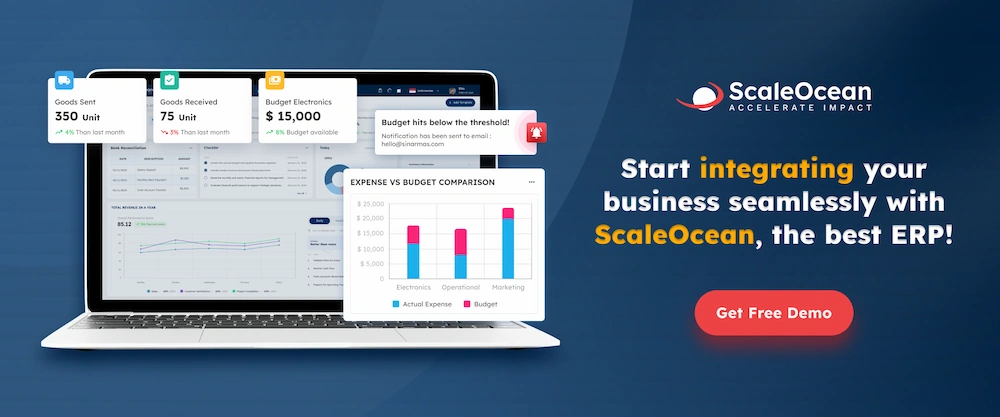
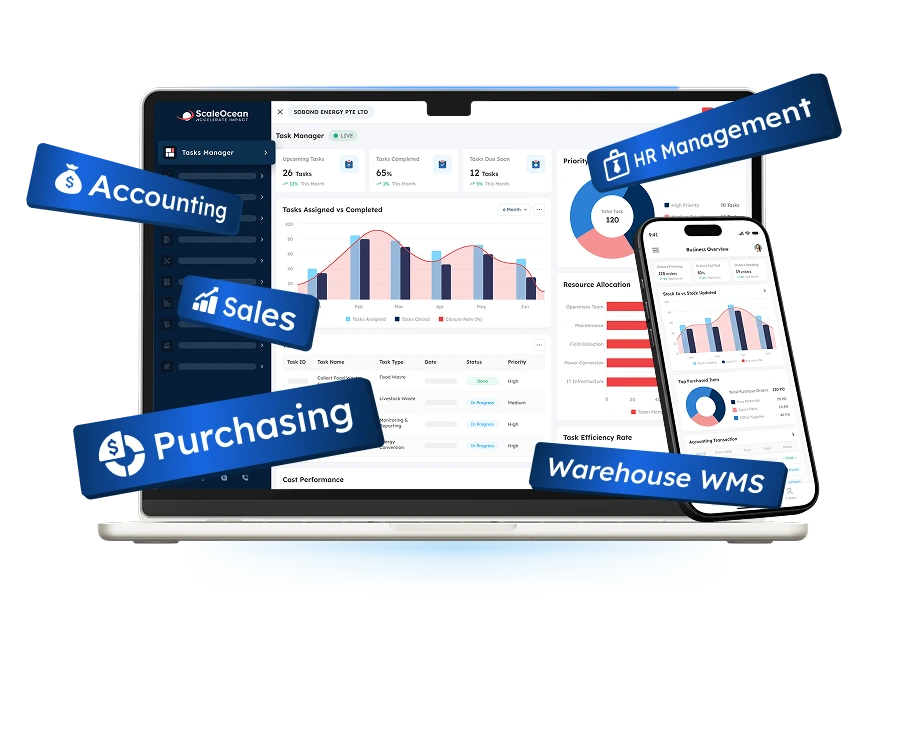
From these components, you can use integrated cloud ERP software to comprehensively manage all processes within a single platform. You can use ScaleOcean’s comprehensive cloud ERP software solution, which can unify core business functions such as finance, sales, inventory, and human resources into a single, secure digital ecosystem.
By leveraging a cloud-based architecture, ScaleOcean ensures that these key components are not just siloed tools but are deeply interconnected, allowing for real-time data synchronization across departments. Request a free demo to get this comprehensive solution for your business.

Is Saas ERP Secure?
Cloud-based ERP systems or Software-as-a-Service (SaaS) are generally very secure, often more secure than traditional on-premises systems.
However, security in the cloud is a shared responsibility, and it depends on how you manage it. While vendors secure servers and software, companies are responsible for who they allow to access users and data.
Why It’s Often More Secure:
- Expert Management: Vendors employ elite security teams to monitor threats 24/7. This is especially true for large companies with critical data that should be stored in on-premises systems.
- Automatic Patching: Security updates are applied automatically. With on-premises systems, companies often lag in applying patches, leaving the door open to hackers.
- Physical Security: Data is stored in highly protected data centers with biometric access, backup power, and disaster recovery.
- Compliance: Leading vendors maintain rigorous certifications such as SOC 1/2, ISO 27001, and GDPR compliance by default.
Why Companies Should Choose the Cloud ERP?
Why choose Cloud ERP? It offers remarkable cost savings by removing the need for expensive hardware and ongoing IT maintenance. With its subscription model, businesses can better predict costs and free up vital resources for key growth initiatives, like market expansion.
Transitioning to a cloud ERP for large businesses in Singapore truly boosts mobility by allowing enterprise teams to access data from anywhere securely. It simplifies updates, ensuring your business can easily use the latest technology, while an ERP software demo can show how it streamlines large-scale operations.
When Should You Move Your Business to Cloud ERP?

Knowing when to migrate to Cloud ERP is vital for a seamless and effective implementation. Delaying the transition can impede growth, while jumping in too soon may overextend resources.
Identifying key indicators is essential for businesses to determine the right moment for the switch. Timing the migration correctly allows for better resource management and reduces the risk of disruptions during the process. Here are some typical situations that signal the need to transition to Cloud ERP:
- Rapid Business Growth. The adaptability of Cloud ERP allows businesses to add new users, incorporate features, and manage larger data volumes. Two-tier ERP scalability enhances this by offering flexible, tiered solutions for both local and global needs. This scalability guarantees smooth operations without the need for substantial infrastructure investments.
- Outdated Systems. When traditional enterprise systems fail to meet current business requirements, migrating to a cloud-based solution becomes a strategic choice. SaaS platforms offer expanded features, like automation, real-time information, and enhanced integrations, all in line with modern operational requirements.
- Real-Time Data Needs. Real-time analytics enable managers to monitor important performance metrics and respond quickly to market changes. These platforms provide consolidated data access, which minimizes the need for manual data collection and processing. This feature improves cross-departmental collaboration and enables informed decision-making. Companies that use real-time analytics may improve workflows, increase customer satisfaction, and grasp opportunities faster than their competition.
- Compliance Requirements. It provides advanced reporting capabilities and secure data management in accordance with legal norms. Built-in compliance tools reduce the risk of penalties while increasing transparency with stakeholders. Companies that implement these solutions may demonstrate accountability while protecting sensitive data, resulting in increased trust from investors and clients.
Top 5 Cloud ERP Provider Examples
As you can see, picking out the appropriate Cloud ERP Vendor is really crucial.
In fact, quite many from below’s listing are some widely known software providers that make up part of the top 10 Cloud ERP companies out there, with many unique strengths, advantages, and also areas of niche which offer to certain types of industries and company dimensions in Singapore.
To better assist the business in figuring out exactly how to prepare as well as opt for the ERP that fits perfectly, listed here are 5 common cloud ERP examples:
1. ScaleOcean’s Cloud ERP
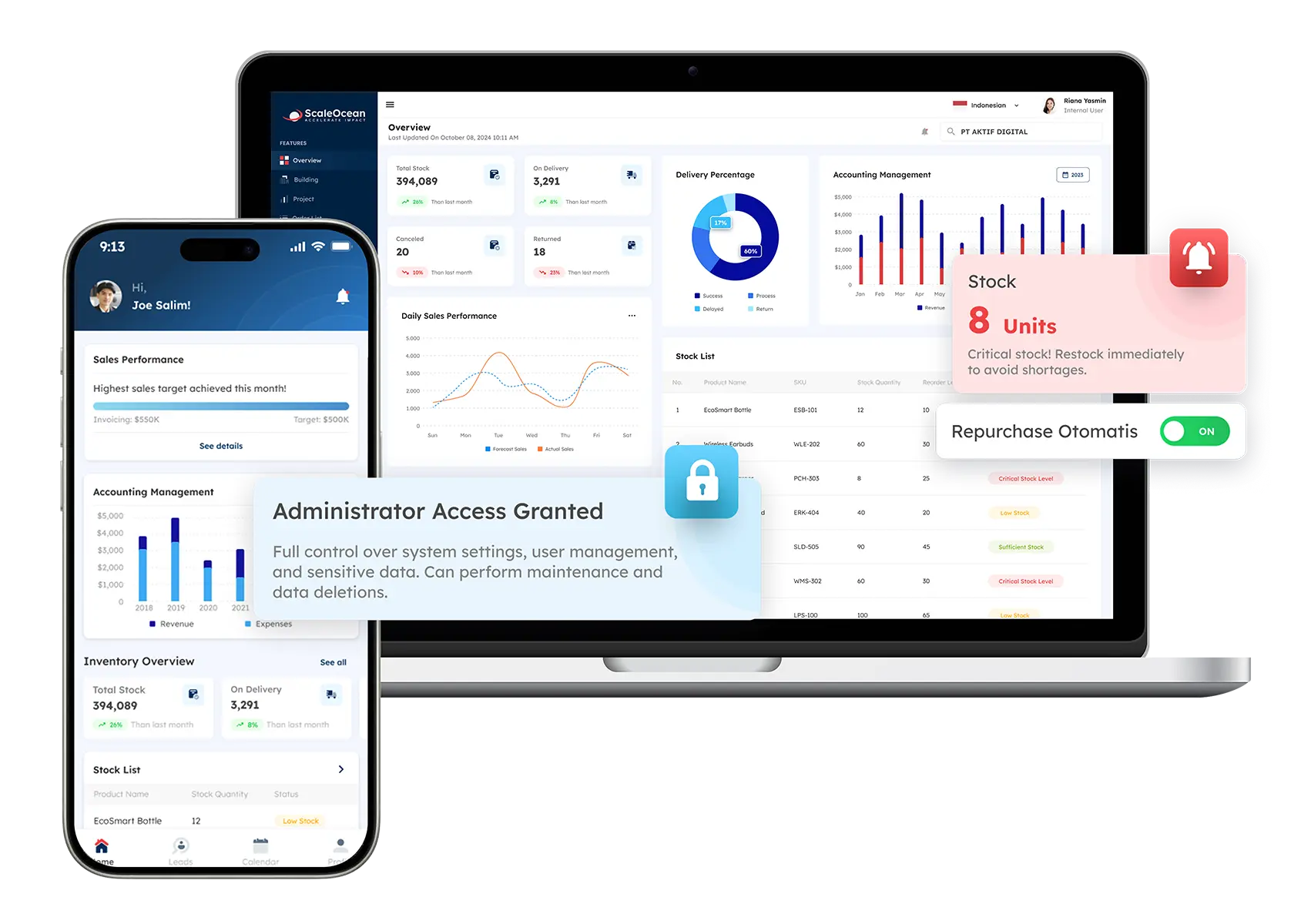
ScaleOcean’s cloud ERP is a major supplier in Singapore, helping businesses streamline and consolidate their essential processes. Its flexible platform meets the needs of our dynamic market, ensuring efficiency and long-term success. They empower enterprises with personalized solutions.
Learn how ScaleOcean’s unique ERP solutions may help your business optimize procedures, stimulate innovation, and drive long-term success. ScaleOcean also offers a free demo today, so you can see ScaleOcean’s full potential for your company.
Key Features:
- Data Integration Across Modules: Integrates business functions like finance, sales, and inventory for real-time data sharing and decision-making.
- Scalability and Flexibility: Scalable and adaptable, ScaleOcean’s Cloud ERP grows with your business without major disruptions.
- Real-time Reporting and Analytics: Provides real-time analytics for informed decision-making and performance tracking.
- Security and Data Backup: Ensures data security with encrypted cloud storage and automated backups to protect against data loss.
- Customizability and Automation: Customizable workflows and dashboards, with automation to increase efficiency and reduce manual tasks.
Many companies have successfully optimized their business processes using ScaleOcean Cloud ERP software. One such company is PT. Bukaka Inti Aircon is an HVAC specialist. ScaleOcean has successfully transformed manual and fragmented operations into an efficient, data-driven business.
By centralizing accounting, sales, work orders, and job costing, the company eliminates data silos and gains the real-time visibility needed to effectively manage field operations.
Ultimately, integration with ScaleOcean Cloud ERP can improve operational efficiency while providing the financial accuracy needed to protect profit margins and support sustainable growth. To see the full story, watch the following video.

| Pros | Cons |
|---|---|
|
|
Best For: ScaleOcean is ideal for medium-to-large businesses across manufacturing, retail, and services. It offers a highly customizable cloud ERP with strong financial and supply chain integrations, providing real-time data visibility and excellent process efficiency.
2. SAP Cloud ERP System
SAP’s Cloud ERP system enables businesses to manage various functions such as financials, supply chain, and analytics, serving a multitude of industries with a tool that streamlines business operations and helps analyze company data.
SAP’s solutions often incorporate automation into workflows and also facilitate real-time data sharing that contributes to more efficient business operations. These solutions utilize a modular approach that allows companies of all sizes to hand-pick certain tools that best suit their business.
Key Features:
- Cloud-based ERP platform for enhanced flexibility.
- Comprehensive financial management tools.
- Real-time data sharing across departments.
- Process automation for increased efficiency.
- Analytics capabilities for better decision-making.
| Pros | Cons |
|---|---|
|
|
Best For: SAP’s Cloud ERP solutions are ideal for mid to large enterprises in numerous industries like manufacturing, retail, and professional services who seek to leverage a scalable and flexible system to streamline operations.
3. NetSuite Cloud-Based ERP Solution
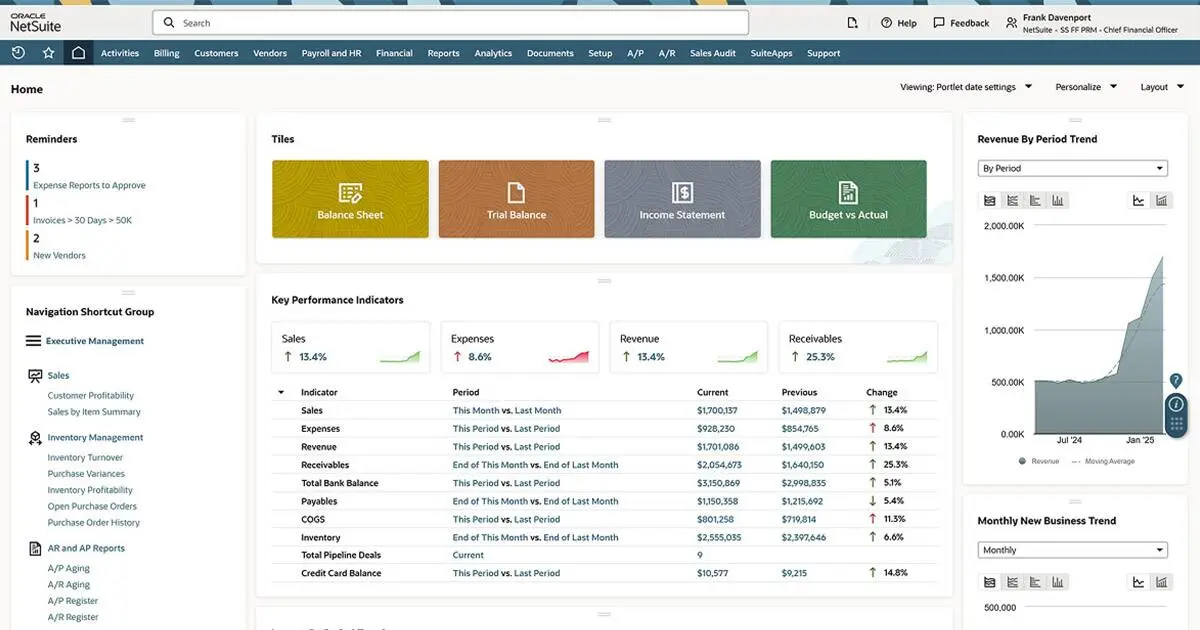
NetSuite’s cloud-based ERP system seamlessly integrates finance, customer relationship management (CRM), and inventory control, enabling companies to improve decision-making based on access to accurate, real-time data across all departments.
The platform was built with scalability and business growth in mind and is made up of multiple modules that organizations can modify according to their individual needs, improving workplace collaboration and efficient business workflows.
Key Features:
- Integrated finance and customer management.
- Real-time data sharing across departments.
- Inventory control and supply chain management.
- Customizable for different business processes.
- Cloud-based platform for flexibility and accessibility.
| Pros | Cons |
|---|---|
|
|
Best For: The cloud-based ERP solution is best suited for mid- to large enterprises in industries like retail, manufacturing, and wholesale distribution that need a unified financial, CRM, and inventory solution to operate smoothly.
4. Acumatica Cloud ERP Platform
The best-performing Cloud ERP for SMBs, Acumatica’s suite offers robust accounting, project management, and inventory control solutions.
Firms that need a cloud-native platform can get an enterprise-wide solution that manages various operational processes such as accounting, project tracking, and inventory controls through Acumatica’s easily accessible and highly configurable tools.
Acumatica’s modular design helps businesses select the features they need, personalizing the system around their internal administration requirements.
Key Features:
- Cloud-based platform for SMBs.
- Accounting and financial management tools.
- Inventory and project management features.
- Customizable to fit different business needs.
- Real-time data access for better decision-making.
| Pros | Cons |
|---|---|
|
|
Best For: Acumatica’s Cloud ERP is ideal for small to medium-sized businesses (SMBs) in sectors such as retail, manufacturing, and distribution. Companies looking for a scalable, cloud-ready system that excels in accounting, inventory, and project management benefit significantly from Acumatica.
5. Microsoft Dynamics 365 Cloud-Based ERP
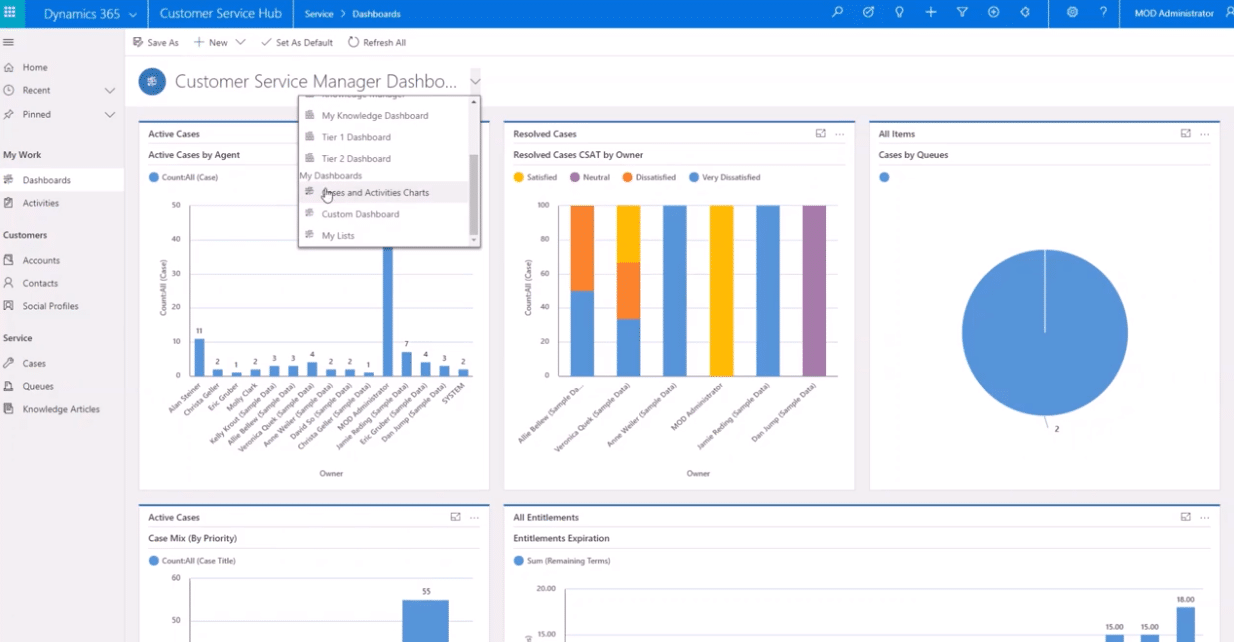
As both an ERP and CRM cloud system, Microsoft Dynamics 365 integrates key business processes such as finances, operations, customer support, and sales onto a unified cloud platform, helping businesses manage day-to-day activities and customer interactions more effectively.
Its seamless integration with existing Microsoft tools makes it a convenient option that leverages a business’s current software to improve efficiency and access up-to-date data.
Key Features:
- Integrates ERP and CRM functions into one system.
- Real-time data access for improved decision-making.
- Automation capabilities to streamline workflows.
- Compatibility with other Microsoft tools.
- Cloud-based for flexibility and accessibility.
| Pros | Cons |
|---|---|
|
|
Best For: Microsoft Dynamics 365 caters to mid to large-scale enterprises that need an integrated ERP and CRM solution that seamlessly complements their Microsoft software environment, fostering improved efficiency and data management.
How to Choose The Right Cloud ERP for Your Company?
The right cloud ERP solution can help your business reach new levels. Follow this step-by-step guide to select a cloud ERP that works best for your organization, considering important criteria such as business needs, scalability, integration, support, security, and costs.
Evaluate Business Needs and Internal Processes
First, you need to understand the ins and outs of your business’s operations and internal procedures. Identify the departments or workflows that are underperforming and assess where an ERP system can enhance productivity and streamline your day-to-day tasks.
By meticulously cataloging your company’s particular requirements, you can accurately pinpoint which ERP features are essential.
Pinpointing ERP system failures in cloud-based solutions and strategizing around business objectives ensures your ERP system aligns seamlessly with your overall company vision and offers significant long-term benefits.
Functional Fit with Industry & Business Scale
Your chosen ERP should offer functionalities-from financials and supply chain management to human resources-tailored to the unique demands of your industry.
Scalability, however, remains paramount for businesses of any size, allowing a system to easily expand or contract with the ebb and flow of your business without adding unnecessary complexity.
Scalability & Integration Capabilities
One key aspect when considering a Cloud ERP solution is scalability. Ideally, a system should expand to meet the growing and changing needs of your business.
It should handle more information and more users without suffering performance degradation as your company develops, offering the flexibility you need moving forward. Invest in a system that can grow alongside your business.
The ERP solution must integrate well with the applications you already use-like your customer relationship management (CRM) system, human resources software, or accounting solutions-to allow for easy and streamlined data exchange across all your software applications.
Vendor Support & Implementation Planning
When selecting your ERP system, your chosen vendor’s support and implementation strategy is of great importance. Look for a company with a solid track record of outstanding customer support and training resources.
They must be prepared to allocate dedicated resources to assist in training your staff and guide you through the process of implementation and transition.
The vendor should also offer a clear, detailed, and documented implementation plan that will help minimize system downtime as you switch over to the new platform.
The vendor’s plan should specify the type of support that will be available to you during the go-live period, ensuring that you’re able to effectively use all the features of the new system after deployment.
Data Security, Compliance & Cloud Infrastructure
Security should be a top priority for any Cloud ERP system. Make sure to select an ERP that utilizes high standards of security, data encryption, and multi-factor authentication.
It is important to investigate the cloud infrastructure utilized by your ERP provider to verify that it adheres to all relevant industry standards and local data privacy regulations, especially if your business handles sensitive client data or operates in heavily regulated industries like finance or healthcare.
Your chosen ERP system’s cloud infrastructure must be able to support your operations securely and at peak performance.
Total Cost of Ownership (TCO) & Return on Investment (ROI)
When assessing the cost of an ERP system, don’t just look at the sticker price. Be sure to compute the Total Cost of Ownership (TCO) of the ERP solution.
TCO should include all expenditures, including the licensing fees, plus any training, support, maintenance, and hardware costs associated with the ERP system throughout its lifecycle.
You should also consider the business impact the Cloud ERP will have on your organization and calculate your Return on Investment (ROI), in the form of cost savings, efficiencies, and increased revenue gained from better decision-making, improved processes, and higher profits.
Common Mistakes When Choosing a Cloud ERP System
Selecting the wrong ERP platform can disrupt your operations and drain your financial resources. Understanding what common mistakes companies should actively avoid when evaluating and selecting a cloud ERP system ensures you choose a scalable platform that truly fits your workflow.
Choosing the wrong ERP platform could cause serious disruptions to your business and financial resources.
Knowing and understanding what common mistakes companies should actively avoid when evaluating and selecting a cloud ERP system helps you to select a scalable ERP system that genuinely fits your processes.
Be cautious of these typical pitfalls when evaluating ERP software for your business:
- Not defining business needs first: Picking ERP without a clear list of requirements leads to misalignment and costly customizations later.
- Focusing only on initial cost: Prioritizing cheap upfront pricing misses long‑term value, support, and total cost of ownership.
- Failing to compare Cloud vs On‑Premise properly: Not assessing strengths and weaknesses of each deployment can result in the wrong choice for your business.
- Overemphasizing features alone: Choosing based on feature lists instead of business impact and usability can lead to a system that isn’t fit for purpose.
- Involving the wrong stakeholders: Excluding key departments or decision-makers means critical needs are overlooked during evaluation.
The Future of Cloud ERP in Singapore
Singapore is a world leader in technology and an important global business hub, which is why it’s been at the forefront of Cloud ERP adoption. Initiatives like Singapore business grants even support companies in implementing this technology that’s key to business success.
The landscape for Cloud ERP is constantly evolving with new functionalities and improvements emerging to better serve businesses. Here’s how new technological trends and advancements will be shaping the next wave of Cloud ERP in Singapore:
Technological Trends
New technologies like Artificial Intelligence (AI) and the Internet of Things (IoT) will play an even bigger role in Business Resource Planning tools. AI can make smarter business decisions by offering predictive analytics and can help streamline processes.
With IoT integration, your ERP can pull data from devices in real-time to provide a clearer picture of your supply chain and assets.
With all of these new advances, your business can react to market changes faster and improve operations, making your ERP smarter and more flexible.
Innovative Features
The newest ERP systems will include innovative features like predictive analytics and machine learning to make ERP tools simpler and easier to use.
The ERP can better predict trends in the market so that businesses can make more confident decisions and also use machine learning to carry out complex actions with little to no help from a user, reducing errors and making tasks faster.
Many of the newest ERPs have new intuitive UIs, so it will be simple and easy to navigate these ERP platforms.
Digital Transformation
ERP systems play an important role in driving industrial digital transformation across Singapore.
These solutions serve as a powerful integrated system that supports management and operations as businesses go increasingly digital, ensuring that businesses thrive in the evolving landscape and continue the quest to achieve a digital economy and encourage innovation.
Companies using these latest ERP solutions have flexibility; they can ensure they easily meet Singapore’s strict AI Governance Framework and are equipped to handle all of their unique enterprise workflows in an efficient manner by integrating advanced technology.
This means that the best ERP platforms will be crucial as Singapore continues on its path to complete digital transformation.
Conclusion
Cloud ERP offers businesses a competitive edge, particularly in an ever-changing market such as Singapore’s. ERP software integrates multiple business functions, allowing for easy, real-time access to data, informed decision-making, and more streamlined processes.
Businesses adopting ERP software have access to the flexibility and scalability required to stay ahead in a fast-evolving digital era. For companies looking to implement Cloud ERP, selecting the right provider and an adaptable system is crucial.
ScaleOcean’s Cloud ERP is customized to various business needs and ensures effortless scalability. To see how it can optimize your business operations, get a head start by trying ScaleOcean’s free demo today!
FAQ:
1. How does Cloud ERP scale with the number of users in my company?
Cloud ERP can be scaled up or down with ease by adapting licenses to user demand. Through cloud infrastructure, business performance remains consistent regardless of user numbers.
2. What industries see the most advantage from cloud-based ERP systems?
Manufacturing, retail, logistics, professional services, and health care industries benefit the most from cloud-based ERP, as these have seamless integration, instant access to data, and lower requirements for IT maintenance.
3. How many user seats can a Cloud ERP efficiently support?
Cloud ERP is scalable from a handful of users to tens of thousands, depending on the vendor. Because of its cloud architecture, the performance of a large number of users remains optimal.
4. Can Cloud ERP adapt to both small and large enterprise operations?
Yes, Cloud ERP can be used by any business, big or small. Cloud ERP has flexible modules that can be purchased using a subscription-based billing system. These modules can be scaled up or down according to business requirements.



















.png)