

An annual report is a detailed document that outlines a business’s financial results, business objectives accomplished, business activities, and plans for a given fiscal year. It is used to gather the three strands of financial data, management insights, and governance disclosures to give stakeholders a good overview of business performance.
Organizing an annual report can be difficult for many companies because of the diversity of financial information, siloed operations, and tedious manual reporting. Information is often required to be brought together from various departments within a business before being able to produce accurate reports for management, investors, and regulatory purposes.
Businesses can streamline annual reporting with a structured reporting process and integrated systems. This single platform links financial data, operational performance, and business activities, which can enhance reporting processes, boost transparency, and streamline reporting preparation.
From the data we collected from the Singapore Business Federation (SBF), over 70% of the businesses surveyed have reported that rising costs and operational difficulties are major issues that impact business performance. This underlines the value of having the correct information about your business and a good reporting system, which will help facilitate sound decision-making.
Read this article to understand what an annual report is, its key components, Singapore reporting requirements, examples, and how businesses can prepare more structured annual reports.
 Key Takeaways
- An annual report is a comprehensive document that presents a company’s financial performance, operational achievements, governance practices, and strategic direction during a specific financial year.
- Key components of an annual report include company overview, financial highlights, management discussion and analysis, financial statements, corporate governance, risk disclosures, and auditor’s report.
- Annual reports, annual returns, and financial statements serve different purposes. An annual report provides a broader business overview, while annual returns focus on statutory company information and financial statements present detailed financial results.
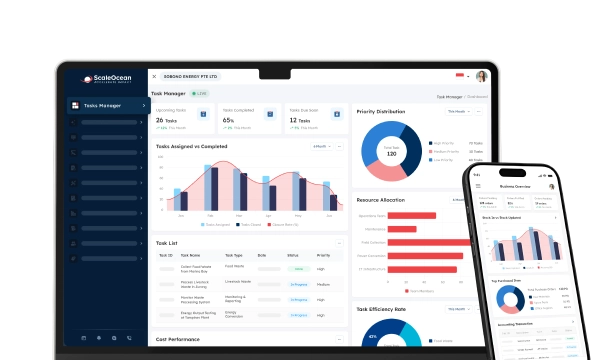
- ScaleOcean Atlas helps businesses simplify annual report preparation by connecting financial and operational data, improving reporting accuracy, and reducing manual consolidation across departments.
What Is an Annual Report?
An annual report is a formal document that summarizes a company’s financial results, operational performance, governance practices, and strategic progress over one financial year. It provides stakeholders with insights into how the company performed, managed resources, and planned future growth.
Annual reports are typically produced for shareholders and regulatory disclosure of listed companies. Normally, these reports will contain financial statements that have been audited, management comments, corporate governance information, and other disclosures that are required under applicable regulations.
The reporting format may differ for private companies as a result of the nature of their business, regulatory provisions, and stakeholder needs. Many companies produce internal or stakeholder reports to review their financial health or performance, but not all companies publish public annual reports.
 Also Read: What is Financial Reporting and Why is it Important?
What Is the Purpose of an Annual Report?
An annual report is more than just a financial statement. It enables companies to share their results and offer investors clear and accurate data regarding the company’s growth throughout the year long. The report includes important financial information like cash flow and revenue, giving stakeholders a good view of the company’s financial status and performance.
An annual report can also be used to help businesses review their performance, track trends, assess risks, and make plans for the future. Financial and operational data are presented in a structured format, enabling businesses to remove the need to have reports from various departments that are not connected and provide them with a clearer view of their performance.
The role of an annual report is also vital to ensure that there is transparency and clarity with stakeholders like shareholders, investors, lenders, and business partners. Business disclosures, including financial statements, governance programs, risk management strategies, and other matters, can help companies show that they are accountable and trusted by their stakeholders.
Annual reports are beneficial for businesses that are required to report, as they help meet regulatory and governance needs and include required financial disclosures and supporting documentation. A structured reporting process allows businesses to keep accurate records, ensure they’re ready for audits, and ensure that vital financial information is reviewed and reported correctly.
What Are the Key Components of an Annual Report?

Typically, a full annual report will include financial details, management commentary, operational success, and governance disclosures. The composition of the report might vary from company to company, but some sections are common to most annual reports.
1. Company Overview and Corporate Information
The company overview introduces the business background, industry position, principal activities, and organizational structure. It helps readers understand the company’s operations before reviewing financial performance.
This section commonly includes company details such as business activities, subsidiaries, leadership structure, registered information, and key milestones achieved during the reporting period. Businesses may also include financial information such as the cash flow statement to provide insights into cash movements, liquidity position, and financial performance during the year.
2. Chairman’s or CEO’s Statement
The chairman’s or CEO’s statement provides management’s perspective on the company’s performance, challenges, and strategic direction.
It normally focuses on key accomplishments, market conditions, operational difficulties, and future priorities. This section explains the rationale behind business decisions, in addition to the numbers.
3. Financial and Operational Highlights
Financial and operational highlights summarize the company’s key achievements during the financial year. This may include revenue growth, profitability, customer expansion, operational improvements, or major business milestones.
By presenting important metrics in a simplified format, companies can help stakeholders quickly understand overall business performance.
4. Management Discussion and Analysis
Management Discussion and Analysis (MD&A) explains the factors influencing business performance. It provides context behind financial results, including market conditions, operational changes, business risks, and growth strategies.
This section allows management to explain why certain financial outcomes occurred and how the company plans to respond to future opportunities or challenges.
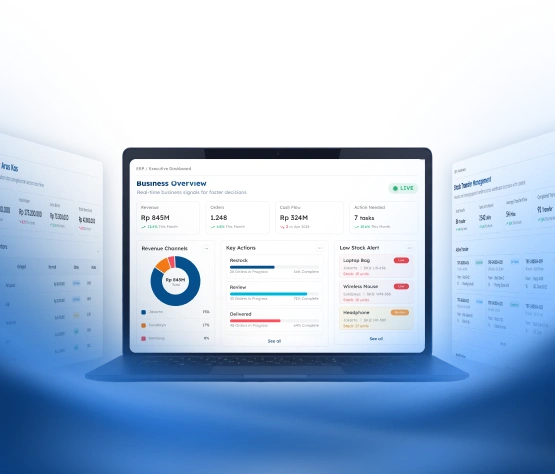
To support a more transparent and data-driven reporting process, businesses can leverage integrated ERP solutions like ScaleOcean Atlas, which helps consolidate financial and operational data across departments. With real-time visibility into key business metrics and helps prepare more comprehensive reports to support long-term growth.
5. Financial Statements and Explanatory Notes
Financial statements provide detailed information about a company’s financial position and performance.
For example, the balance sheet provides information about assets, liabilities, and equity, helping stakeholders understand the company’s financial position at the reporting date.
6. Corporate Governance and Risk Disclosures
Corporate governance sections in an annual report explain how a company manages leadership responsibilities, internal processes, and business risks. This section provides stakeholders with greater visibility into the company’s governance framework, decision-making structure, and approach to maintaining accountability.
This can incorporate board information, governance practices, risk governance, and internal policies that can aid responsible business practices.
7. Independent Auditor’s Report
The independent auditor’s report provides an external assessment of whether the financial statements have been prepared according to applicable accounting standards.
For companies requiring audits, this section provides additional confidence that reported financial information has been reviewed independently. Accurate financial records supported by a structured general ledger also help ensure that reported transactions are properly recorded and traceable during the review process.
Who Uses an Annual Report?
The annual report serves as a tool for investors, lenders, management, employees, and regulators to review a company’s financial condition, to inform business decisions, and to hold management accountable.
1. Shareholders
Annual reports are used by shareholders to analyze the performance of the company on an annual basis and to gain insight into how the management has used company resources. The report is used for them to assess the financial performance, business strategies, governance, and future plans for growth.
The annual reports are essential in providing the shareholders with transparency about the company’s financial performance and significant events for the year.
2. Investors
Investors rely on annual reports to assess a company’s financial health, growth potential, and investment risks. Information such as revenue trends, profitability, operational performance, and management strategies helps investors evaluate the company’s stability and future direction.
A well-written annual report provides investors with a broader perspective on the company than just the numbers. Having up-to-date and linked financial information will help businesses make more transparent reports and deliver more reliable information to stakeholders.
With integrated ERP workflows, businesses can easily expand their finances and operations in one place and maintain a more consistent data set, report with greater accuracy, and provide visibility within their business for stakeholders.
3. General Management
The management teams review performance annually in the report and draw up business plans for the upcoming year. Financial results, operational successes, and failures can be determined by reviewing the report, and this can help leaders to maximize business performance.
Yearly reports can also be used to assess the actual performance and adjust the business goals for the following financial year.
4. Employees
Employees can use annual reports to better understand company performance, business direction, and organizational achievements. Sharing business progress helps create greater transparency and allows employees to understand how their contributions support overall company goals.
For larger organizations, annual reports can also communicate strategic priorities, operational changes, and long-term business plans.
5. Lenders and Financial Institutions
Banks and financial institutions may review annual reports when assessing a company’s financial stability, repayment capability, and creditworthiness. Information about profitability, cash flow, assets, and liabilities helps lenders evaluate financial risks before providing funding.
Accurate annual reporting supported by proper documentation can strengthen confidence between businesses and financial partners. Applying accrual accounting practices also helps companies record financial transactions more accurately by reflecting income and expenses in the appropriate reporting period.
6. Business Partners
Business partners, suppliers, and other stakeholders may use annual reports to understand a company’s reliability, market position, and operational capability. This information can support decisions related to partnerships, long-term collaboration, and business relationships.
By providing transparent information about company performance and governance, annual reports help strengthen trust among external stakeholders.
Annual Report vs. Annual Return vs. Financial Statements
Although the terms annual report, annual return, and financial statements are often used together, they serve different purposes. An annual report provides a broader overview of company performance and activities, while annual returns focus on statutory company information, and financial statements present detailed financial results.
Understanding the differences helps businesses prepare the correct documents based on their reporting obligations and stakeholder requirements.
| Aspect | Annual Report | Annual Return | Financial Statements |
|---|---|---|---|
| Main Purpose | Provides an overview of company performance, strategy, governance, and financial results. | Provides updated company information required for statutory filing purposes. | Shows detailed financial performance and position of the company. |
| Main Users | Shareholders, investors, management, employees, and business partners. | Regulators, company officers, and authorized stakeholders. | Management, investors, lenders, auditors, and regulators. |
| Information Included | Company overview, CEO statement, financial highlights, governance, risks, and audited financial statements. | Company profile, registered details, shareholders, officers, and statutory information. | Balance sheet, income statement, cash flow statement, equity changes, and financial notes. |
| Regulatory Purpose | Required for SGX-listed companies and commonly used for stakeholder communication. | Required filing with ACRA for applicable Singapore companies. | Prepared according to applicable accounting standards and audit requirements. |
How to Prepare an Annual Report: A Step-by-Step Guide
Prepare an annual report by following a structured, phase-by-phase process that combines operational storytelling with verified financial data. A structured preparation process helps businesses reduce reporting errors, improve efficiency, and create a more reliable document for stakeholders.
1. Define the Reporting Scope and Timeline
The first step in the process of making an annual report is to establish the scope, goals, required sections, and target audience. The audience for the report should be determined to know how detailed and transparent the report needs to be, and what the stakeholders’ needs are in terms of information.
Having a definite timeline also helps in ensuring that all the phases, ranging from the financial data collection to the department review, the management approval, and publication, are completed in a timely manner. Good reporting will also avoid delays and allow for more responsible team coordination.
2. Collect Financial and Operational Data
It is essential for companies to bring together key financial and operational data from different business functions in order to gain a holistic overview of the business. This includes information on revenue, expenses, profitability, business achievements, risk information, and corporate governance information.
A standard process should be used by companies to collect the information, ensuring the annual report is comprehensive and accurate because it is likely that it will be based on data from a number of teams. The central business information may also help decrease manual business information consolidation and disparities among various reports.
3. Reconcile Accounts and Consolidate Financial Data
Before preparing the annual report, financial records should be reviewed and reconciled to ensure that all figures accurately reflect the company’s financial position. This process includes verifying transactions, reviewing account balances, and ensuring financial information follows applicable accounting standards.
You may also consolidate business units, subsidiaries, or different parts of your business. With financial consolidation, you can bring all of the information together into one, so that your stakeholders don’t have to see the financial information of each business unit.
4. Prepare Financial Statements and Management Commentary
When the financial data has been completed, all enterprises can prepare the relevant financial statements and explanations for management. Financial statements are information about income and expenses, assets and liabilities, equity, and cash flow; financial data and explanations are information about the factors affecting the performance of a business.
The management discussion provides additional context behind the numbers by highlighting achievements, challenges, market conditions, and strategic decisions. This helps stakeholders understand not only what happened during the financial year but also why certain results occurred.
5. Complete the Audit and Internal Review
For companies subject to audit requirements, financial statements must be reviewed by independent auditors to verify whether they have been prepared according to applicable accounting standards. The audit process provides additional assurance regarding the reliability and accuracy of reported financial information.
In addition to external audits, internal teams should conduct reviews to confirm that all sections of the annual report are accurate, complete, and consistent. Reviewing key financial records such as the income statement helps ensure that reported revenue, expenses, and profitability figures are properly reflected in the annual report.
6. Finalise, Approve, and Publish the Report
The final stage involves completing the annual report layout, obtaining management approval, and preparing the document for distribution. Businesses should review all disclosures, financial statements, and supporting information to ensure the report meets stakeholder expectations and applicable requirements.
After approval, the annual report can be published and shared with relevant stakeholders. A well-prepared report not only fulfils reporting obligations but also helps businesses communicate their achievements, strategies, and future direction more effectively.
Businesses can simplify annual report preparation with ScaleOcean Atlas, which connects financial data, operational information, and reporting workflows in one platform. With real-time visibility and structured approval processes, businesses can improve reporting accuracy and efficiency.
Annual Report Requirements in Singapore

The information required in an annual report is the same in Singapore regardless of the kind of company, listing status, and any reporting requirements. In addition to choosing the appropriate reporting standards, companies must also consider their filing deadlines and audit requirements.
1. Requirements for SGX-Listed Companies
SGX-listed companies must publish an annual report that includes financial information and disclosure about the company’s governance, along with any other information required under the rules of SGX (SGX listing rules). The purpose of an annual report is to give shareholders an overview of the performance of a company’s business, including its risks and governance.
Under SGX Mainboard Rule 707, issuers must issue their annual report to shareholders and submit it to SGX at least 14 days before the date of the Annual General Meeting (AGM). The AGM is generally required to be held within four months after the end of the company’s financial year for listed issuers.
A listed company’s annual report usually comprises the company’s audited financial statements, the company’s directors’ statement, the directors’ report, management discussion and analysis, corporate governance disclosures, where applicable, disclosures relating to sustainability issues, where applicable, and any other information required by the SGX rules.
Business disclosures must also give investors enough detail to allow them to assess the performance of businesses, their position and risk profile, and their future prospects.
2. Reporting Obligations for Private Companies
Most private companies in Singapore would not be required to prepare a public annual report in the same way as listed companies on the SGX. However, certain companies may still be required to submit financial statements, keep proper accounting records, and submit annual returns to ACRA.
Most companies in Singapore are required to prepare financial statements. Smaller companies that qualify under certain criteria are eligible for an exemption from audits, but still need to keep proper books and prepare financial statements following the relevant accounting standards.
SME companies or private companies can choose to prepare internal or stakeholder-focused annual reports to update on business performance, financials, and direction to management, shareholders, lenders, or business partners. The structure and depth of content can be tailored to business needs, unlike what SGX disclosure obligations stipulate.
3. Reporting Deadlines and AGM Requirements
The timeline for the annual report depends on whether the company is listed, private, or subject to specific regulatory requirements. Businesses should plan their reporting schedule carefully to allow sufficient time for financial closing, account review, audit processes, management approval, and final preparation.
For SGX-listed entities, the yearly report should be published before the AGM by the deadline set by the laws governing SGX companies. The AGM is meant to give shareholders an insight into the performance of the company and the directors’ update on the company’s performance.
For private companies, AGM requirements may differ depending on the company’s circumstances and applicable exemptions. Companies must still ensure that required filings, including annual returns and financial information where applicable, are submitted to ACRA within the required deadlines.
Maintaining a structured reporting process helps businesses avoid delays, improve document accuracy, and ensure that annual reporting obligations are managed more efficiently. Using integrated systems can also help companies organize financial information, supporting documents, and operational data required during annual report preparation.
Singapore Regulatory Information to Include in Annual Reports
Annual reports prepared by Singapore businesses should include relevant financial, corporate, and governance information based on the company’s reporting obligations. The required disclosures may vary depending on factors such as whether the company is listed on SGX, its business structure, and applicable regulatory requirements.
SGX companies typically provide a more detailed disclosure in an annual report to help facilitate investor transparency and communication with the capital markets. Private companies may not have any reporting obligations or reporting entities aside from the statutory filing and presentation of financial statements and other corporate information in Singapore.
Singapore companies generally prepare financial statements according to applicable accounting standards, including Singapore Financial Reporting Standards (SFRS) or Singapore Financial Reporting Standards (International) (SFRS(I)), depending on their reporting requirements.
Common disclosures encompass a variety of financial statement items, similar to the statement of financial position, statement of profit or loss, statement of cash flows, statement of changes in equity, and notes to the financial statements. Corporate governance and risk disclosures give insights into how a company manages its management, internal processes, and business risks.
Information on sustainability may also be part of annual reports, which is common in the case of listed companies. Such disclosures offer details on the company’s sustainability efforts, environmental and social policies, and its commitment to business sustainability over time.
For companies subject to audit requirements, the annual report should include the directors’ statement and independent auditor’s report. These sections provide assurance that financial information has been prepared properly and reviewed according to applicable accounting standards.
How to Read and Analyse an Annual Report
To analyse an annual report effectively, businesses and stakeholders should review several key areas to understand financial performance, operational progress, and future direction:
- Review Company Overview and Business Strategy: Start by understanding the company’s main activities, revenue sources, target markets, and growth priorities. This provides context for evaluating whether financial performance aligns with strategic objectives.
- Analyse Key Financial Metrics: Review important financial indicators such as revenue, profit, expenses, assets, liabilities, and cash flow. Comparing these metrics across multiple financial years helps identify business trends, growth opportunities, and potential concerns.
- Evaluate Management Commentary: Management discussions provide additional context behind financial results. This section helps stakeholders understand major achievements, operational challenges, market conditions, and future strategies planned by the company.
- Compare Performance Over Time: Comparing annual report results across different years provides a clearer view of business performance. Analysing revenue growth, profitability, efficiency, financial strength, and strategic progress helps identify important long-term trends.
Businesses can simplify annual report analysis with ScaleOcean Atlas, which connects financial information, operational data, and reporting workflows within one integrated platform. With real-time visibility and structured data management, companies can improve reporting accuracy and gain deeper insights for strategic decision-making.
Annual Report Example
An annual report structure involves reviewing how a Singapore-listed company presents its financial performance, corporate governance practices, and audited financial statements. Annual reports are prepared as a comprehensive communication document to help shareholders, investors, and stakeholders understand the company’s performance and future direction.
One example is DBS Group Holdings Ltd, a company listed on the Singapore Exchange (SGX). DBS publishes a comprehensive annual report that combines financial highlights, management commentary, corporate governance disclosures, sustainability information, and audited financial statements.
The structure of DBS’s annual report provides an example of how a Singapore-listed company organizes important business information:
- Company Overview and Strategic Direction
The annual report begins by introducing the company’s business profile, operating segments, strategic priorities, and key developments during the financial year. This section helps stakeholders understand the company’s position, business model, and areas of focus before reviewing detailed financial information.
For businesses preparing their own annual reports, this section provides context about the company’s activities, market presence, and strategic objectives.
- Financial Highlights
The financial highlights section summarizes important performance indicators from the reporting period. DBS presents key financial metrics such as revenue, profit, assets, business growth, and other performance indicators to provide readers with a quick overview of its financial achievements.
The purpose of this section is to help stakeholders understand the company’s overall financial performance before reviewing detailed financial statements. It also allows readers to identify major changes compared with previous financial periods.
- Management Commentary and Business Review
This section provides management’s explanation of the factors influencing company performance. DBS’s management commentary discusses business conditions, strategic initiatives, operational achievements, and challenges faced during the financial year.
Unlike financial statements that mainly present numerical results, management commentary explains the reasons behind those results. This helps stakeholders understand how management responds to market changes and plans future business strategies.
- Corporate Governance and Risk Management
The corporate governance section explains how DBS manages leadership responsibilities, accountability, and internal governance practices. It includes information about the board of directors, board committees, governance framework, and risk management approach.
For listed companies, this section plays an important role in demonstrating transparency and responsible management practices. It allows stakeholders to understand how decisions are made and how potential business risks are addressed.
- Audited Financial Statements
The audited financial statements provide detailed information about the company’s financial position and performance. In DBS’s annual report, this section includes financial statements such as the statement of financial position, statement of profit or loss, statement of cash flows, statement of changes in equity, and accompanying notes.
The purpose of this section is to provide verified financial information prepared according to applicable accounting standards. The supporting notes also explain accounting policies, significant transactions, and other details needed to interpret the reported figures accurately.
- Independent Auditor’s Report
The auditor’s report provides an independent assessment of whether the financial statements have been prepared properly and present a fair view of the company’s financial position.
This section gives stakeholders additional confidence that the financial information included in the annual report has undergone external review according to applicable auditing standards.
By reviewing DBS’s annual report structure, businesses can understand how Singapore-listed companies combine financial information, management insights, governance disclosures, and audited statements into a complete reporting document.
Annual Report Template for Singapore Business
An annual report template helps businesses organize important financial, operational, and governance information into a structured format. While the content and level of detail may vary depending on the company type and reporting obligations, the following template provides a practical framework that Singapore businesses can customize to their requirements.
Important Note: This template is an example of annual report structure and narrative. Financial highlights shown below are illustrative examples only and do not replace complete financial statements, audit requirements, or regulatory disclosures. Businesses should verify their reporting obligations based on their company status and applicable Singapore regulations.
Annual Report Template PDF
A ready-to-use PDF template to help Singapore businesses organize financial, operational, and governance information.
Annual Report Template Docs
A ready-to-use Docs template to help Singapore businesses organize financial, operational, and governance information.
Common Challenges in Annual Report Preparation
Preparing an annual report requires businesses to collect, verify, and consolidate large amounts of financial and operational information. However, many companies still face challenges during the reporting process due to disconnected systems, manual processes, and complex reporting requirements.
1. Data Fragmentation
Many businesses store financial and operational information across different systems, departments, or spreadsheets. Finance teams may need to collect data from accounting systems, operational platforms, sales records, and other sources before preparing the annual report.
This fragmented approach can make it difficult to maintain a complete view of company performance. It also increases the time required for data collection and creates a higher risk of missing or outdated information.
2. Inconsistent Figures
Annual reports require accurate and consistent financial information across different sections. However, businesses may encounter discrepancies when different departments use separate records, reporting methods, or data sources.
Inconsistent figures can affect the reliability of financial reporting and require additional time for verification. Teams may need to investigate differences between reports, including discrepancies in the profit and loss statement, before finalizing the annual report. This can delay reporting timelines and increase the effort required for financial review and approval.
3. Delayed Reconciliations
Account reconciliation is an important step before preparing financial statements and annual reports. However, businesses may experience delays when reviewing transactions, confirming balances, or resolving discrepancies between financial records.
Late reconciliations can slow down the reporting timeline and reduce the time available for management review, audit preparation, and final approval.
4. Multiple Entity Reporting
Businesses operating through multiple subsidiaries, branches, or business units often face additional complexity when preparing annual reports. Each entity may maintain separate financial records, operational data, and reporting processes.
Consolidating information from multiple entities requires careful coordination to ensure accuracy and consistency. Without a structured reporting process, businesses may spend significant time combining data manually.
5. Spreadsheet Dependency
Many companies still rely heavily on spreadsheets to organize financial information, track adjustments, and prepare reporting documents. While spreadsheets can be useful for simple tasks, they become difficult to manage when businesses handle large amounts of data or complex reporting requirements.
Excessive spreadsheet usage may increase the risk of formula errors, version conflicts, and limited collaboration between teams. A more integrated approach can help businesses improve reporting efficiency and accuracy.
6. Limited Audit Visibility
During the audit process, businesses need to provide supporting documents, transaction records, and explanations for financial information presented in the annual report. However, limited visibility into historical data and approval processes can make audit preparation more challenging.
Without proper documentation and tracking mechanisms, teams may spend additional time searching for records and verifying financial information requested by auditors.
How ERP Software Supports Annual Report Preparation
Preparing an annual report requires accurate financial data, operational information, and supporting documentation from multiple areas of the business. However, companies that rely on disconnected systems may experience difficulties consolidating information, verifying figures, and maintaining reporting consistency.
An ERP system helps businesses centralize financial and operational data within one integrated platform. By connecting accounting, sales, procurement, inventory, project management, and other business functions, ERP software provides a more structured foundation for annual report preparation.
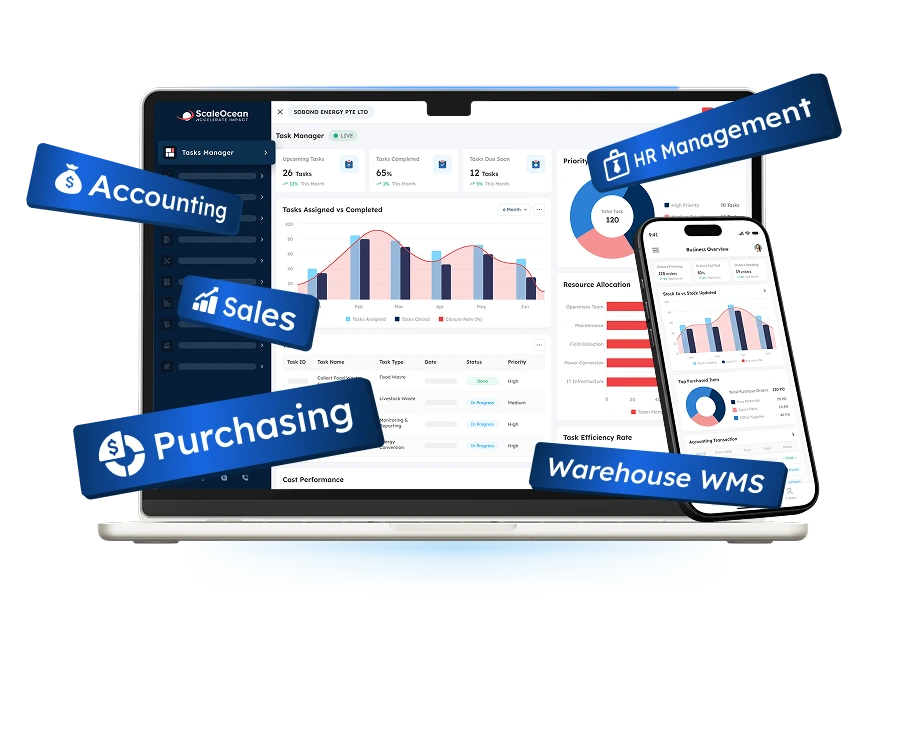
ScaleOcean Atlas supports annual report preparation by connecting financial and operational workflows through a configurable ERP platform. The system helps businesses manage accounting records, reporting dashboards, approval processes, and operational data within one centralized ecosystem, allowing teams to access more consistent information during reporting activities.
With integrated workflows, businesses can improve visibility into important reporting areas such as revenue tracking, expense management, asset records, and financial performance analysis. ScaleMind-powered insights can also support management teams by identifying patterns from connected business data and helping them make more informed decisions.
This system has been optimized and complies with PDPA regulations and local financial reporting standards, including IRAS and GST requirements where applicable. Schedule a consultation with ScaleOcean to explore how integrated ERP workflows can support more efficient annual report preparation.
Conclusion
An annual report is a structured document that presents a company’s financial performance, operational achievements, governance practices, and strategic direction during a specific financial year. It helps stakeholders understand business progress while providing transparency regarding company performance and management decisions.
However, preparing an accurate annual report can be challenging due to fragmented data, inconsistent records, manual reconciliation processes, and complex reporting requirements. By adopting integrated systems, businesses can centralize information, improve reporting accuracy, and simplify the preparation process.
ScaleOcean provides businesses with a more efficient way to manage financial and operational information required for annual reporting. This helps companies streamline reporting workflows by connecting accounting, operations, and business data in a single configurable platform. Schedule a consultation with our team to explore how ERP solutions can support your annual report preparation process.
Frequently Asked Questions: Annual Report
1. Is an annual report mandatory in Singapore?
An annual report is generally required for SGX-listed companies as part of their disclosure obligations to shareholders and the market. Private companies may have different requirements and are not always required to publish a public annual report in the same format, although they may still need to prepare financial statements and statutory filings based on their obligations.
2. When must Singapore companies publish their annual reports?
For SGX-listed companies, annual reports must generally be issued to shareholders and submitted to SGX at least 14 days before the Annual General Meeting (AGM). The AGM is generally held within four months after the end of the financial year. Private companies follow applicable filing deadlines based on their regulatory requirements.
3. Are annual reports required to be audited?
The requirement for an audit depends on the company’s type, size, and applicable regulations. Some Singapore companies may qualify for an audit exemption if they meet specific criteria, while companies with audit obligations must include audited financial statements and an independent auditor’s report in their annual reporting process.
4. Where can I find annual reports of Singapore companies?
Annual reports of SGX-listed companies are commonly available through company investor relations websites and SGX filings. These reports usually include financial statements, management commentary, corporate governance information, and other disclosures required for stakeholders.
5. Can ERP software help prepare annual reports?
Yes. ERP software can support annual report preparation by connecting financial, operational, and business data within one platform. With centralized information, businesses can improve data accuracy, simplify consolidation processes, and generate more reliable reports for management review and stakeholder communication.





















.png)