
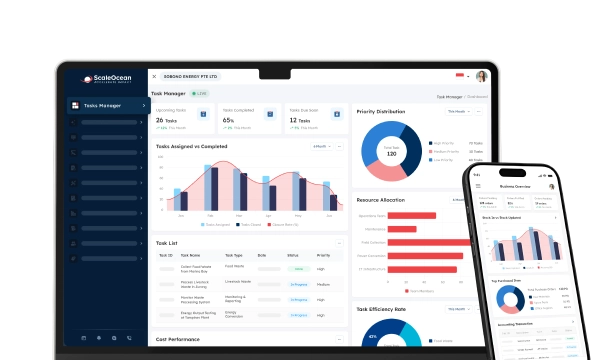

An Enterprise Resource Planning (ERP) system is basically a unified digital engine that keeps your entire operation in sync. Merging finance and supply chains, it gives you the real-time visibility needed to master complex logistics.
Operating without this unity often leads to chaos. Based on the data we found from Research Nester, as the Singapore ERP market hits $938 million with 12.7% growth CAGR through 2037, firms ignoring this tech face massive data silos and errors that bleed profits, making it very difficult to scale fast.
To fix these issues, an ERP is essential for turning disorganized data into a clear strategy. By using this software, your business can automate workflows and stop budget leaks, ensuring you stay ahead in an increasingly digital world.
This article explains what an ERP system is, why it is essential for businesses, and highlights the best ERP software to help you choose the best solution, including ScaleOcean, SAP, Oracle, Epicor, Microsoft Dynamics 365, and more. Here is the complete explanation!
 Key Takeaways
- ERP software is an all-in-one solution that connects essential business functions like finance, HR, and inventory management.
- The benefits of using ERP software include increased productivity, seamless integration, process automation, real-Time insights, reduced security risk, expedited reporting, and more.
- To choose the right ERP software, assess your business needs, evaluate vendor experience, consider cost, ensure compatibility, and balance customization with core functionality.
- Best ERP Software Singapore recommendation, including: ScaleOcean, SAP, Oracle, Epicor, Microsoft Dynamics, Infor, IFS, SYSPRO, and Odoo.
- ScaleOcean ERP provides an all-in-one integrated system that can be tailored to your business needs and any type of business you have.
What is the Meaning of Enterprise Resource Planning (ERP)?
Enterprise Resource Planning (ERP) is a powerful tool that helps businesses manage essential operations like finance, HR, and inventory. By centralizing data, ERP systems make it easier for teams to collaborate and track everything in real time.
With an ERP system, businesses can share data across departments, enabling faster, more accurate decision-making. This results in less duplication of work and improved efficiency, ultimately saving both time and money.
An ERP suite doesn’t stop at core functions. It also includes tools for sales, customer management, and supply chain optimization. This all-in-one approach helps businesses stay on top of operations while making it easier to plan for growth and success.
What is ERP Software?
ERP software is an all-in-one solution that connects essential business functions like finance, HR, and inventory management. By bringing everything together in one place, it helps businesses run smoothly and makes decision-making a lot easier.
With ERP, all your data is stored in one central system, so everyone across different teams has access to the same information. This makes it simple for employees to collaborate and ensures everyone stays on the same page.
This software helps businesses automate tasks and manage resources more effectively. It reduces the chance of errors, streamlines processes, and gives you real-time insights, making it easier to plan for the future and drive business growth.
According to the data we found from Finance Online, 95% of businesses see improved processes after adopting ERP software, and 93% experience greater operational efficiency thanks to better data accessibility. This highlights the real impact ERP can have on your business.
The Evolution and History of ERP
 The history of ERP began in the 1960s with Material Requirements Planning. These early systems focused on inventory control in manufacturing, helping firms manage raw materials and production schedules through basic computing power.
By the 1990s, the term ERP was officially coined as systems expanded beyond the factory floor. These platforms began to integrate accounting, HR, and sales data into one database, allowing for a much more holistic view of the firm.
Today, ERP has evolved into cloud-based solutions powered by AI and real-time data. Modern systems are highly mobile and flexible, enabling businesses to manage complex global operations from anywhere while staying ahead of the curve.
Types of ERP Software Systems
It is important to choose an ERP system in Singapore according to the type that suits your business needs. Various types of ERP systems can help companies decide which solutions align best with their operational goals.
Below, we explore the main types of ERP systems commonly used by businesses today, including:
On-Premise ERP
On-premise ERP software is installed and maintained on a company’s own servers. This type of ERP system offers complete control over data security, customization, and updates. However, it requires high upfront costs, including hardware and IT personnel.
Additionally, maintenance, upgrades, and system management are the responsibility of the company, which can lead to higher long-term costs. On-premise ERP is often preferred by large enterprises with complex needs and stringent data compliance requirements.
Cloud-Based ERP
Cloud-based ERP is hosted on remote servers and accessed through the internet. It offers scalability, lower initial costs, and easy updates since the vendor handles maintenance. With reduced ERP cost compared to traditional systems, businesses can access the system from anywhere, enhancing flexibility and collaboration.
The downside is reliance on internet connectivity, and concerns about data security and compliance may arise for certain industries. This ERP type is ideal for growing companies looking for cost-effective solutions with minimal IT overhead.
Hybrid ERP
Hybrid ERP combines the best of both on-premise and cloud-based ERP systems. Organizations use a mix of cloud and on-site solutions, tailoring the ERP system to their specific needs. For example, a company might store sensitive data on-premises while using cloud-based software for other functions like CRM or supply chain management.
Hybrid ERP allows for greater flexibility and scalability but requires careful integration between the two environments. This option suits companies with unique regulatory or operational needs.
Industry-Specific ERP
Industry-specific ERP systems are designed to address the unique needs of particular industries, such as manufacturing, healthcare, or retail. These ERPs offer specialized features, functions, and modules tailored to an industry’s requirements, even for mining industry software.
For example, ERP software for a manufacturing company might include modules for production planning, inventory management, and compliance tracking. While highly specialized, these systems can offer a more streamlined approach, but they may lack the flexibility of general ERP systems in Singapore for businesses that expand into different sectors and industries.
Multi-Cloud ERP
Multi-cloud ERP utilizes multiple cloud services from different providers, rather than relying on a single vendor. This ERP type offers redundancy, flexibility, and avoids vendor lock-in.
With this type, companies can select best-in-class solutions from different providers for specific business functions, such as using one service for financial management and another for supply chain operations.
However, managing multiple cloud environments with these ERP types can increase complexity and integration challenges. To prevent ERP software failures, the organization must ensure seamless data flow between systems, with proper planning and integration strategies in place for smooth operations.
Open Source ERP
Open-source ERP software is available with a source code that can be modified, customized, and enhanced by developers. This system is highly flexible, as businesses can tailor it to their specific requirements.
It also eliminates licensing fees, making it an affordable option. However, implementing and maintaining open-source ERP requires significant technical expertise, and businesses must manage updates, security, and troubleshooting on their own. This is also suited for companies with dedicated IT resources looking for customization without high costs.
List of Best ERP Software in Singapore
Here is a list of the top 18 ERP software in Singapore that you can easily choose according to your business needs, including:
| Vendor | Best For | Standout Features | Pricing |
|---|---|---|---|
| ScaleOcean ERP | ERP all-in-one solutions for medium- to large enterprises | Highly customizable for various modules, unlimited users, and tailored to business needs | flat pricing tailored to business, with no per-user charges |
| SAP | ERP for SMEs businesses | Integrated financials, inventory, CRM, and real‑time analytics | Approx. from SGD 61–98/user/month |
| Oracle | ERP for a large business | Cloud ERP, strong reporting, and multi-subsidiary management | Starts around ~SGD 999/month platform + ~SGD 99/user |
| Epicor | ERP for Manufacturing & Distribution | Industry‑specific features, such as production, supply chain, and distribution | Pricing on request |
| Microsoft Dynamics 365 | ERP for Businesses in the Microsoft ecosystem | Integrates ERP with the Office/Microsoft ecosystem and scalable cloud business | Central: from approx. ~SDG 70–100/user/month |
| Infor ERP | ERP for industry-specific | Cloud ERP with real‑time analytics and machine learning | Pricing on request |
| IFS AB | ERP for Asset‑intensive & project‑centric enterprises | Unified ERP + EAM + FSM | Custom pricing |
| Odoo | Modular ERP for SMBs | Open‑source and integrated with accounting, inventory, projects, and CRM | Paid hosted plans vary by modules/users |
| Acumatica | ERP for construction, distribution, and field‑centric firms | Cloud ERP, CRM, project accounting | Usage‑based pricing; vendor quote |
| Sage X3 | ERp for mid‑market & enterprise | Finance, supply chain, and project management | Custom enterprise pricing |
| Deskera | ERP for SMBs | Integrated accounting, CRM, HR | Subscription‑based (vendor quote) |
| Synergix Technologies | ERP for Singapore service & trading firms | Cloud/on‑premise, fully integrated with local support | Custom pricing |
| ERPNext | ERP for cost‑effective open‑source | ERP modules (accounting, CRM, inventory, manufacturing) | Custom pricing |
| Bevootech | ERP for local ERP solutions | Cloud ERP with CRM integration | Custom pricing |
| SYSPRO | ERP for manufacturing & distribution | Industry modules & analytics | Enterprise pricing |
| Workday | ERP for Large enterprises with HR and finance focus | HRIS and financials, secure compliance | Premium cloud subscription |
| Katana | ERP for Manufacturing | Shop floor, inventory, BOM | SaaS with tiered pricing |
| Tigernix | ERP for localised service | Tailored solutions for SMBs | Custom pricing |
The Best 18 ERP Software Systems
With a clear understanding of the transformation of enterprise resource planning in Singapore, your next step is choosing the right vendor. Singapore boasts a diverse range of ERP vendors, each offering unique strengths and features, which you can explore further through an ERP comparison.
In the following section, we highlight the 18 best ERP software in Singapore to help you find the perfect solution for your business needs, including:
1. ScaleOcean ERP Software
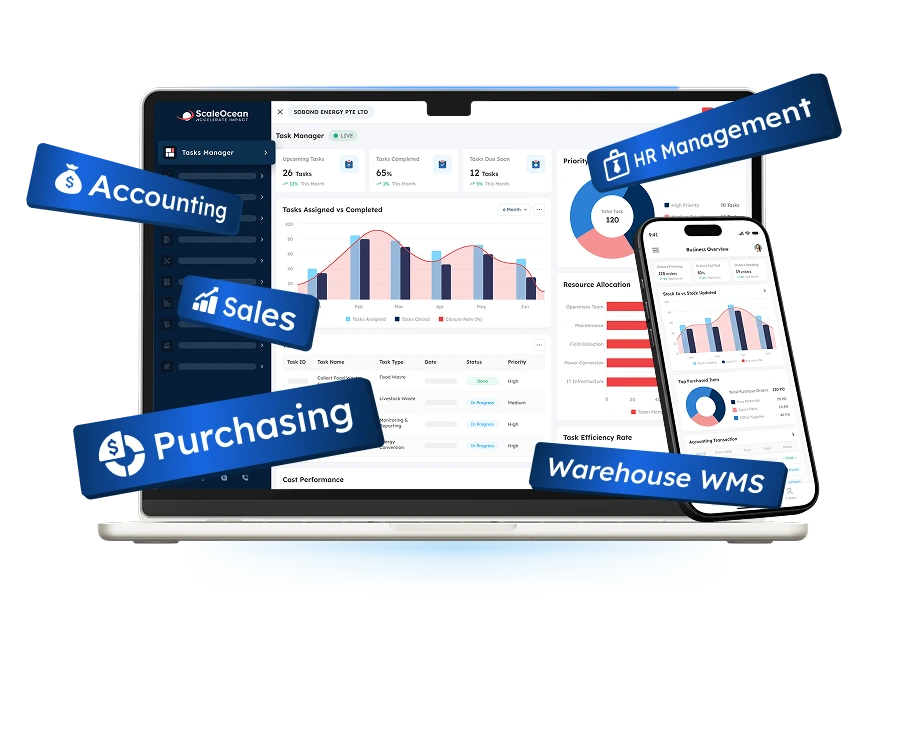
ScaleOcean ERP is a comprehensive software system designed to streamline and automate key business functions, including financial management, sales, procurement, inventory, production, and human resources.
Scaleocean ERP Software also offers a variety of customizable modules and features tailored to your business needs and specifications. So, you don’t need to implement all the modules; you can choose the ones that best suit your business.
All of the modules can also integrate operations into a single platform, which enhances data security, improves efficiency, and supports informed decision-making while reducing redundancies and errors.
Singaporean businesses can make use of ScaleOcean’s cost-effectiveness, scalability, and adaptability to remain competitive in a fast-paced market. Trusted by mid-sized and large enterprises across industries like manufacturing, retail, and F&B, ScaleOcean offers reliable and efficient ERP solutions tailored to diverse needs.
ScaleOcean also supports companies looking to leverage the CTC Grant by aligning their transformation efforts with government-backed initiatives. Additionally, ScaleOcean also provides a free demo, allowing organizations to explore its capabilities and understand how it may meet their specific operating demands.
Key Features:
- Unlimited User Access: No additional charges for more users.
- Built-In BI & AI Integration: Advanced analytics and automation capabilities.
- Flexible Hosting Options: Supports cloud and on-premise setups.
- Cross-Platform Mobile Accessibility: ERP access on iOS and Android devices.
- Comprehensive Data Security: Multiple layers of user access control.
Many companies have successfully implemented ScaleOcean ERP software to optimize their business processes across the board. One such company is Sobono Group. They have relied on ScaleOcean ERP as a smart solution for all their operational challenges.
You can see how ScaleOcean optimizes business processes at Sobono Group in the following video:

| Pros | Cons |
|---|---|
|
|
Price: The pricing is flat with no hidden costs, adjusted according to the scope and complexity of the implementation, ensuring transparency and fairness for businesses of all sizes.
Best For: Ideal for medium to large professional services companies that require seamless integration and a flexible configuration system.
2. SAP Business One
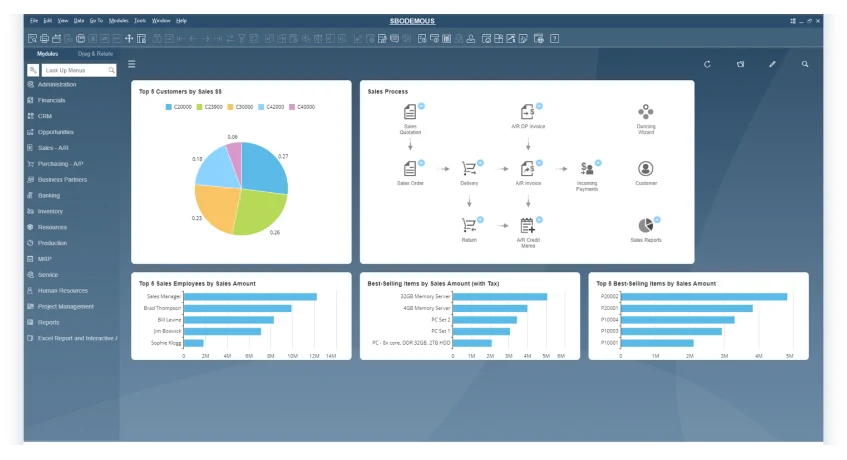
SAP Business One is a European multinational software company since 1972, based in Walldorf, Germany. offering ERP solutions with a modular approach that adapts to various business needs.
AP software becomes an ERP comparison designed for SMEs in Singapore and helps streamline processes and provide real-time insight, also making it an ideal AI ERP software for small and medium-sized enterprises, which can be proven in an SAP review.
Key Features:
- Financial Management
- Inventory Management
- Customer Relationship Management (CRM)
- Reporting and Analytics
- Mobile Access
| Pros | Cons |
|---|---|
|
|
Price: Approximately SGD 61–98 per user per month, making it a cost-effective ERP for small to medium-sized enterprises.
Best For: Perfect for SMEs looking for an ERP system that helps streamline operations with comprehensive tools tailored to their business size and needs.
3. NetSuite ERP
NetSuite-Oracle ERP is a choice for businesses in Singapore looking for a scalable ERP solution. As the most deployed true Cloud ERP system, NetSuite with ERP features can also support fast-growing companies with its modular, cloud-based platform, offering comprehensive financial and operational management capabilities.
Key Features:
- Financial Management
- CRM Integration
- E-commerce Solutions
- Real-Time Analytics
- Supply Chain Management
| Pros | Cons |
|---|---|
|
|
Price: Starts around SGD 999 per month for the platform, with an additional SGD 99 per user.
Best For: Best suited for large businesses that need a scalable ERP solution that integrates various business functions, from financials to customer relations.
4. Epicor
Epicor is a Texas-based ERP software leader since 1972, providing seamless integration and streamlining key processes with ERP features to enhance operational and integrated financial management, CRM, inventory, and supply chain. This software specializes in solutions for manufacturing, distribution, retail, and service industries in Singapore.
Key Features:
- Financial Management
- Supply Chain Management
- Production Management
- Business Intelligence and Analytics
- Customization Tools
| Pros | Cons |
|---|---|
|
|
Price: Pricing available upon request, tailored to the business’s specific needs and scale.
Best For: Perfect for manufacturing and distribution companies, offering robust tools for managing operations, inventory, and financials across complex industries.
5. Microsoft Dynamics NAV
Microsoft Dynamics NAV 365 Business Central for Singapore companies offers a comprehensive ERP solution. This cloud-based platform seamlessly integrates with other Microsoft products like Office 365 and Power BI, providing small and medium-sized food businesses with centralized management of financials, operations, and inventory.
Key Features:
- Financial Management
- CRM Integration
- Supply Chain Management
- Real-Time Analytics
- Mobile Access
| Pros | Cons |
|---|---|
|
|
Price: Central pricing starts from approximately SGD 70–100 per user per month.
Best For: Ideal for businesses already within the Microsoft ecosystem, as it offers seamless integration with Microsoft products and a user-friendly interface for service and finance operations.
6. Infor
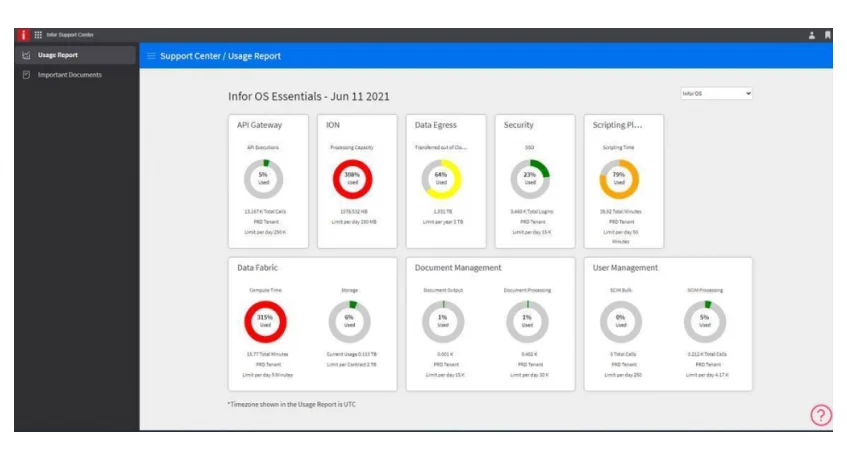
Infor ERP offers a robust solution tailored to the food industry, providing specialized tools for operations management. Infor’s software, used either on-premises or as a service, helps streamline supply chain, project management, and manufacturing processes for food businesses.
Key Features:
- Financial Management
- Supply Chain Management
- Human Capital Management
- Customer Relationship Management
- Advanced Analytics
| Pros | Cons |
|---|---|
| 1. Industry-specific functionality 2. Provide reporting and analytics 3. Customizable dashboard |
|
Price: Custom pricing, tailored to the size and needs of the business.
Best For: Best suited for industry-specific ERP, providing tailored solutions for sectors such as manufacturing, healthcare, and distribution, ensuring deep functionality for specialized needs.
7. IFS AB
IFS AB offers a comprehensive ERP solution ideal for food businesses in Singapore, focusing on streamlining key operations like finance and supply chain management. This ERP comparison can help small and medium-sized companies eliminate technical complexity and drive efficient digital transformation.
Key Features:
- Asset Lifecycle Management
- Project Management
- Manufacturing Management
- Service Management
- AI-Driven Analytics
| Pros | Cons |
|---|---|
|
|
Price: Custom pricing, adjusted according to the enterprise’s needs and scale.
Best For: Designed for asset-intensive and project-centric enterprises, providing powerful tools for managing large-scale projects, assets, and operations across multiple industries.
8. Odoo
Odoo is an open-source ERP system designed for small businesses and offering a comprehensive suite of integrated apps for CRM, POS, e-commerce, accounting, and more. this ERP software provides tailored solutions for diverse business needs, and flexibility allows for customization, ensuring it meets the unique needs of any organization.
Key Features:
- Modular Design
- Integrated Business Functions
- Open-Source Platform
- E-commerce Integration
- Real-Time Analytics
| Pros | Cons |
|---|---|
|
|
Price: Paid hosted plans vary depending on the number of modules and users.
Best For: A flexible, modular ERP system ideal for SMBs, providing affordable and customizable solutions to streamline business operations in various sectors.
9. Acumatica
Acumatica is an ideal ERP solution for growing food businesses in Singapore, offering cloud-based technology that meets the needs of small and medium enterprises. With a strong focus on user experience, Acumatica stands out in enterprise management, helping businesses streamline operations and improve efficiency.
Key Features:
- Role-Based Views and Dashboards
- Advanced Inventory Management
- Project Accounting
- Customer Relationship Management (CRM)
- Financial Management
| Pros | Cons |
|---|---|
|
|
Price: Usage-based pricing, with vendor quotes provided based on needs.
Best For: Tailored for construction, distribution, and field-centric firms, offering a scalable ERP solution to manage projects, financials, and operations efficiently.
10. Sage X3
Sage X3 is a powerful ERP solution that streamlines complex processes for food businesses in Singapore. With its flexibility and comprehensive features in finance, supply chain, and manufacturing, Sage X3 is designed for mid-market businesses looking to optimize operations across distribution, manufacturing, and services.
Key Features:
- Financial Management
- Supply Chain Management
- Manufacturing Management
- Customer Relationship Management
- Business Intelligence and Analytics
| Pros | Cons |
|---|---|
|
|
Price: Custom pricing, designed for enterprises that need robust ERP features.
Best For: Perfect for mid-market and enterprise-level businesses that require advanced ERP capabilities, offering flexibility and scalability for complex operations.
11. Deskera
Deskera’s system can help financial organizations streamline processes and improve overall management, delivering a competitive edge. Deskera can be your ERP comparison that is designed as a solution for the financial management services industry and banking to help businesses streamline operations and enhance efficiency.
Key Features:
- Accounting Management
- Inventory Management
- Payroll Processing
- Sales and Marketing Automation
- Supply Chain Management
| Pros | Cons |
|---|---|
|
|
Price: Subscription-based pricing, with quotes available from the vendor.
Best For: A comprehensive ERP solution for SMBs, offering features such as financial management, CRM, and HR tools to help small businesses grow and streamline their operations.
12. Synergix Technologies
Synergix Technologies is a system established in 1990 and a provider of cloud-based software in Singapore. Offering robust ERP solutions for businesses across various industries, Synergix Technologies helps companies streamline operations and improve efficiency. it also helps businesses streamline operations and achieve growth.
Key Features:
- Modular System
- Cloud & On-Premise Deployment
- Integrated Accounting
- Automated Workflows
- Mobile Access
| Benefits | Weaknesses |
|---|---|
|
|
Price: Custom pricing tailored to the unique needs of each business.
Best For: Ideal for service and trading firms in Singapore, offering localized ERP solutions to streamline operations and enhance efficiency across various sectors.
13. ERPNext
ERPNext is a Singapore-based open-source ERP system launched in 2008 that integrates sales, inventory, accounting, and project management. This software can also become an ERP comparison to help businesses streamline operations and improve efficiency across departments. Its scalability makes it a reliable ERP software for growing companies.
Key Features:
- Accounting Module
- Inventory Management
- Human Resources
- Project Management
- Manufacturing Module
| Pros | Cons |
|---|---|
|
|
Price: Custom pricing, offering flexibility to meet business requirements.
Best For: Best for businesses seeking a cost-effective open-source ERP solution, with strong features for accounting, inventory, HR, and project management.
14. Bevootech
Bevootech is the best ERP software in Singapore, specializing in both traditional and modern business solutions, offering powerful solutions for various industries.
This software provides cloud-based ERP for retail, construction, and manufacturing, and leverages CRM tools to streamline business operations. Their expertise ensures businesses achieve scalable growth with efficient software solutions.
Key Features:
- Comprehensive CRM Integration
- Multi-Industry Support
- Inventory & Supply Chain Management
- Cloud-Based & On-Premise Deployment
- Payroll & HR Capabilities
| Benefits | Weaknesses |
|---|---|
|
|
Price: Custom pricing, based on the specific needs and scale of the business.
Best For: Best for businesses looking for local ERP solutions that offer tailored features and functionalities specific to the regional market.
15. Syspro
Syspro ERP is an integrated enterprise resource planning system tailored for the manufacturing and distribution sectors. It integrates core business processes, including financial management, inventory control, and supply chain operations, into a unified platform, enhancing efficiency and real-time data visibility.
Key Features:
- Advanced Inventory Management
- Supply Chain Management
- Financial Management
- Manufacturing Management
- Customization Capabilities
| Pros | Cons |
|---|---|
|
|
Price: Enterprise pricing, offering solutions tailored for large businesses.
Best For: Ideal for manufacturing and distribution companies that need robust ERP systems to streamline operations, manage inventory, and optimize financial workflows.
16. Workday
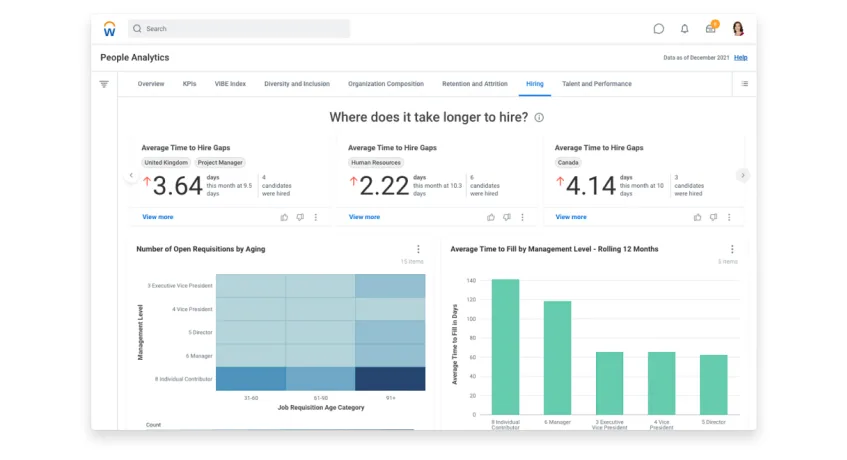
Workday is a cloud-based enterprise resource planning (ERP) solution that integrates human capital management (HCM) and financial management into a unified platform. It streamlines processes such as payroll, talent management, and analytics, enhancing operational efficiency and providing real-time insights.
Key Features:
- Human Capital Management
- Financial Management
- Payroll Processing
- Advanced Analytics
- Talent Management
| Pros | Cons |
|---|---|
|
|
Price: Premium cloud subscription, providing advanced features for large enterprises.
Best For: Best suited for large enterprises focusing on HR and finance, offering a comprehensive ERP solution with powerful tools for workforce and financial management.
17. Katana
Katana is an ERP solution tailored for contemporary manufacturers and businesses reliant on inventory, offering both cloud-based and on-premise deployment options. Its user-friendly interface enhances production planning, inventory oversight, and sales monitoring.
Katana can also be your ERP comparison to make it particularly suitable for small and medium-sized enterprises (SMEs) in Singapore that desire real-time insights and operational efficiency.
Key Features:
- Real-Time Inventory Tracking
- Production Planning
- Multi-Channel Sales Integration
- Accounting System Compatibility
- Cloud & On-Premise Deployment
| Benefits | Weaknesses |
|---|---|
|
|
Price: SaaS with tiered pricing based on the business needs.
Best For: Ideal for manufacturers looking for an easy-to-use, integrated ERP system to manage production, inventory, and order fulfillment processes efficiently.
18. Tigernix
TigernixERP is a cloud-based ERP solution designed to unify and optimize business operations, including inventory management, finance, accounting, work in progress, and customer relationship management. It offers a robust and flexible platform to enhance operational efficiency and data accuracy.
Key Features:
- Inventory Management
- Finance and Accounting Modules
- Salesforce Integration
- Supply Chain Management
- Cloud-Based Platform
| Pros | Cons |
|---|---|
|
|
Price: Custom pricing, adjusted to meet the specific needs of each client.
Best For: Perfect for businesses seeking a localized ERP solution, offering tailored features to optimize operations in various service-oriented industries.
It’s important to choose the most appropriate ERP software for your business needs and the type of company you run. Implementing the right system will result in optimal business processes with maximum use of advanced technology.
You can use the ScaleOcean AI ERP software that can fit your business specifically, so you don’t have to worry about selecting the best for your business. Provide a consultant and free demo with the ScaleOcean team to get the best solutions.

Main Benefits of Using ERP Software
The use of ERP software in Singapore companies is an important thing that can provide a competitive advantage by combining important operations into one platform. Just like it did in the case study ScaleOcean for PT. Bukaka Inti Aircon.
With this, you can monitor all business processes easily and in an integrated manner, aligning with the latest ERP trends that emphasize greater efficiency and automation. Here are some of the benefits of ERP software:
- Increased Productivity: By centralizing operations, ERP software reduces repetitive tasks. This allows your team to focus on high-value work and boosts overall output, including key ERP financial module benefits like streamlined financial processes.
- Seamless Integration: It connects different departments into a single platform. This removes silos and ensures that data flows smoothly across the entire company.
- Process Automation: Routine workflows like invoicing and payroll become automated. This saves significant time and lowers the chance of costly human errors.
- Reduced Security Risk: Advanced encryption and access controls protect sensitive data. Centralizing info makes it much easier to monitor and defend against threats.
- Expedited Reporting: Generating complex reports takes seconds instead of days. This speed helps managers quickly review performance and meet critical deadlines.
- Real-Time Insights: Live data allows you to track project status as it happens. These instant updates empower your team to make smarter, data-driven decisions.
- Consistent Infrastructure: Using one unified system provides a standard user experience. This simplifies IT management and ensures all departments work in harmony.
- Improved Agility: The software helps your business adapt quickly to market shifts. You can pivot strategies and reallocate resources without any operational lag.
- Growth and Flexibility: Scalable modules allow the system to expand as your business grows. You can add new features and users to support long-term company expansion.
Key Functions and Modules of ERP Systems in Singapore
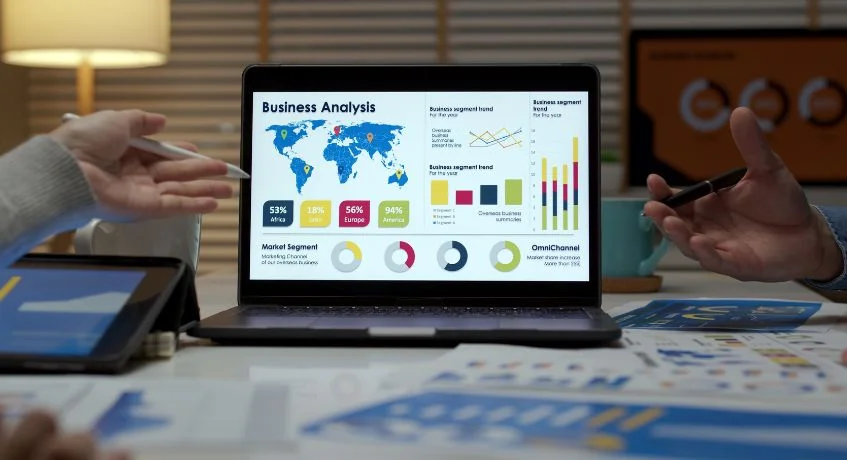
ERP software encompasses various functions and modules designed to automate, streamline, and integrate core business processes. These modules work together to provide a unified system. The ERP consolidation process further enhances this by simplifying management and improving efficiency across all functions.
Here are the key functions and modules of ERP systems in Singapore, including:
Financial and Accounting
The financial and accounting module helps businesses manage financial transactions, track budgets, and ensure compliance with regulations. It automates processes like invoicing, payments, and reconciliations.
This ERP module provides real-time financial data for accurate reporting and improved financial decision-making. Top enterprise software in Singapore often includes robust financial and accounting modules that help businesses streamline financial management.
These tools enable real-time tracking of transactions, budgeting, and regulatory compliance, providing businesses with the insights needed for effective decision-making and financial control.
Human Resources
The HR module of ERP software manages employee information, payroll, benefits, recruitment, and performance. It automates HR tasks such as attendance tracking, benefits management, and performance appraisals.
This module streamlines HR processes, improving employee management and compliance with labor laws which you can also utilize grant management software to streamline your compliance for grants for your company.
Supply Chain Management
Supply chain management in ERP optimizes inventory control, order fulfillment, procurement, and logistics. It provides visibility into the entire supply chain, helping businesses track materials and products in real-time.
This module reduces lead times, minimizes stockouts, and improves supplier relationships. You can utilize ERP software for oil and gas industry.
Customer Relationship Management
The CRM of the ERP module helps manage customer interactions, sales pipelines, and marketing campaigns. It provides a 360-degree view of customer data, enabling businesses to deliver personalized services.
You can use SaaS ERP, a type of ERP that can help enhance this by centralizing information, boosting satisfaction, and sales conversions.
Project Management
ERP’s project management module helps plan, execute, and monitor projects efficiently. It tracks milestones, resource allocation, and budgets, ensuring projects are completed on time and within budget.
This module strengthens cross-team collaboration and delivers real-time insights for managing project risks more effectively. The ScaleOcean vs. Oracle comparison provides further insight into how each system supports complex business operations.
Business Intelligence
The business intelligence module analyzes data to provide actionable insights into business performance. It includes tools for data visualization, reporting, and forecasting.
This module helps businesses identify trends, make data-driven decisions, and gain a competitive edge by turning data into strategic knowledge. It also supports grant management by providing detailed analytics on funding allocation, project performance, and compliance tracking.
It enables businesses to efficiently monitor grant usage, assess project outcomes, and generate necessary reports for stakeholders, ensuring transparency and accountability.
Inventory and Warehouse Management
The inventory and warehouse management ERP module helps businesses track and control their stock levels across various locations. It automates processes like order tracking, stock counting, and replenishment.
This module optimizes inventory turnover, reduces stockouts, and improves warehouse organization for efficient order fulfillment.
Sales and Distribution
ERP’s modules of sales and distribution streamlines the order-to-cash process, from order creation to invoicing and shipping. It manages customer orders, tracks sales performance, and ensures timely deliveries.
This module improves sales efficiency, reduces errors, and enhances customer satisfaction by providing real-time order status.
Asset Management
The asset management ERP module tracks an organization’s physical assets throughout their lifecycle, managing acquisition, maintenance, depreciation, and disposal.
A two-tier ERP software approach can further enhance this by integrating local and corporate asset management for better efficiency and compliance.
Manufacturing
The manufacturing module helps manage production planning, scheduling, and execution. It tracks raw materials, work-in-progress, and finished goods, ensuring that production runs efficiently.
These ERP modules enhance visibility into production processes, reduce downtime, and optimize resource allocation to meet demand while minimizing costs.
With ScaleOcean’s software, businesses can further streamline their operations, ensuring production is optimized to meet demand efficiently. By leveraging the full capabilities of ScaleOcean, companies can reduce costs, enhance productivity, and stay ahead in a competitive market.
Key ERP Trends to Watch
The digital landscape is shifting rapidly, pushing ERP systems in Singapore to become more intelligent and adaptable than ever before. Staying updated on these trends is vital for any firm that wants to maintain a sharp competitive advantage.
To keep your business at the forefront of innovation, keep a close watch on these emerging ERP developments:
AI in ERP
AI is making its way into ERP systems, bringing smarter data processing and decision-making capabilities. With AI features like predictive analytics and automation, businesses can streamline their operations and reduce the chance of human error.
By analyzing large amounts of data in real time, AI-powered ERP systems help businesses get actionable insights and recommendations. This allows teams to make more informed decisions, stay agile, and improve their overall operations across departments.
Industry-Specific Integration
More ERP solutions are now tailored to meet the unique needs of specific industries. From manufacturing to healthcare and retail, these specialized ERP systems in Singapore address the specific challenges businesses face, helping them manage operations more effectively.
Industry-specific ERPs come with built-in features and tools that handle everything from compliance to inventory management, making them a perfect fit for companies with complex industry requirements. This trend helps businesses save time, boost productivity, and manage challenges with ease.
Cloud-First Approach
The shift to cloud-based ERP systems is growing fast, offering businesses flexibility, lower costs, and the ability to scale effortlessly. With a cloud-first approach, companies can access their data from anywhere without the burden of expensive hardware or complex setups.
Cloud-based systems also make software updates and maintenance much simpler, ensuring businesses are always using the latest version of their ERP. This approach enhances real-time collaboration, improves security, and provides employees with seamless access to the data they need.
Personalized User Experience
ERP systems are increasingly focusing on personalizing the user experience, allowing employees to tailor dashboards and workflows to fit their needs. This makes the software easier to use, boosting employee satisfaction and adoption.
Customizing an ERP system helps employees focus on the most important tasks for their role, making it more efficient and intuitive. By providing a more personalized interface, businesses reduce training time, improve productivity, and make sure the software works for every user.
Things to Consider When Choosing the Best ERP Software Singapore
Companies need to consider many factors when choosing the best ERP software in Singapore. This is because each business has unique needs, such as integration with existing systems, scalability, and flexibility to adapt to market developments. Here are some important factors to consider:
- Centralized Database: ERP systems unify all data into a single source of truth. This removes silos, ensuring every team uses the same real-time info.
- Integration Modules: These link finance, HR, and supply chain into one platform. It cuts down on manual entry while improving overall data accuracy.
- Real-Time Data: Businesses get instant insights into their operations. This allows for faster decision-making and keeps the company agile and competitive.
- Automated Workflows: The system automates routine tasks like invoicing and orders. This saves time, reduces human error, and boosts team productivity.
- Data Analysis & Reporting: Advanced tools track KPIs and identify market trends. Organizations can generate detailed reports to monitor performance easily.
- Mobile Accessibility: Employees can access data and perform tasks from anywhere. This flexibility improves communication and responsiveness while on the go.
- Scalability: The system grows alongside your business. The implementation of ERP ensures it adapts to new users and complexities, preventing the high cost of replacing software later.
- Customization: Modern ERPs, like custom ERP and off-the-shelf ERP software, offer options to modify workflows and reports. This ensures the software fits your business needs perfectly.
- User Interface & Usability: A simple, intuitive design helps teams learn the system fast. This minimizes training time and encourages daily user engagement.
- Security & Data Protection: Strong encryption and authentication protect sensitive info. Regular updates ensure your data stays safe from potential breaches.
How to Choose the Right ERP Software Singapore
Choosing the right Singapore ERP software is an important decision that can significantly impact your business operations and efficiency. By understanding the different types of ERP available and focusing on your specific requirements and priorities, you can ensure that the solution you choose is in line with your objectives and growth plans.
Here are the important things to consider when picking ERP software vendors, including:
Assess Your Business Requirements
Before selecting an ERP system in Singapore, it’s important to identify the specific functional needs of your business. Ensure that the software addresses the key areas, such as finance, inventory, or HR, that align with your operations.
In this way, you can be sure that the ERP system will support your business goals and offer value.
Evaluating ERP Vendor Experience and Track Record
Consider the ERP vendor’s track record, especially with companies similar to yours in terms of size and industry. A vendor with experience in your industry will better understand your needs and challenges, particularly in providing the right ERP modules.
Their proven success can provide confidence that they can deliver a system that works for your business
Considering the Cost and Budget for ERP Systems
The cost of ERP software in Singapore should fit within your company’s budget while delivering the necessary functionality. Factor in not only the initial purchase price but also ongoing maintenance, upgrades, and training costs.
A cost-effective ERP solution can provide long-term value without overstretching your financial resources.
Ensuring Compatibility with Existing Systems
Ensure that the ERP system integrates effectively with your company’s existing software and processes. This reduces the need for major adjustments or disruptions to current operations.
A well-integrated ERP system with mobile ERP system accessibility can boost overall efficiency and facilitate better data sharing across departments.
Understanding the Need for Customization in ERP Software
Consider the extent to which your business may need to adjust the business management software. Some businesses require more specialized features to address specific operational needs, while others can operate efficiently with standard functionality.
Finding a balance between specialized features and core functionalities is essential during ERP implementation to ensure flexibility without introducing unnecessary complexity.
Conclusion
From an explanation about what an ERP system is, the types, the benefits, and also the recommendations of the best ERP software in Singapore, it can be understood that businesses should have a modern and high-tech ERP system.
With competition intensifying and operational complexities growing, choosing the right ERP system can redefine your success. Best ERP Software ScaleOcean stands out among top vendors, offering a scalable and innovative platform designed to streamline your processes and drive efficiency.
By leveraging its cutting-edge features, you can enhance decision-making, reduce manual tasks, and achieve seamless growth. Don’t let your business lag in this era of digital transformation.
Take the first step toward operational excellence by accessing ScaleOcean’s free demo today. Experience firsthand how it can revolutionize your business and position you as a leader in your industry.
ERP Software FAQ:
1. What are the ERP software that focus on a certain business size?
Industry-specific ERP solutions, often called vertical ERPs, are pre-configured with workflows, compliance standards, and specialized modules tailored to a particular sector’s unique needs.
1. Manufacturing ERP Solutions connect the shop floor and back office by integrating Materials Requirement Planning (MRP) with Manufacturing Execution Systems (MES), such as: ScaleOcean, Infor, and Epicor
2. Retail-focused ERPs emphasize omnichannel commerce, delivering a seamless experience across physical stores, mobile apps, and online platforms, such as ScaleOcean, Microsoft Dynamics 365 Commerce, and Brightpearl by Sage
2. What are the ERP software that focus on a certain business size?
ERP software is generally categorized by the “tier” or business size it serves. The examples are:
1. Small Businesses & Startups (Tier 3) such as Odoo, Zoho One, and QuickBooks
2. Mid-Market & High-Growth Companies (Tier 2), such as ScaleOcean, Oracle, and Microsoft Dynamics 365
3. Large Enterprises (Tier 1), such as ScaleOcean, SAP S/4HANA, and Oracle
3. What is the best ERP software in Singapore?
Here’s a list of the top ERP software:
1. ScaleOcean Best ERP Software Singapore
2. ERPNext Software
3. Microsoft Dynamics 365
4. Acumatica Cloud ERP
4. How do I choose an ERP system?
The following should be covered in an ERP selection criteria checklist, include:
1. Data and analytics capabilities
2. User experience and interface
3. Language and currency support
4. Automation features
5. Support for upper management and users
6. Mobility options
7. Integration with existing systems
8. Ease of customization


















.png)