Central Provident Fund (CPF) is Singapore’s compulsory social security savings scheme for Singapore citizens and permanent residents to save for their retirement, health, and housing requirements. CPF contributions are made by employers and employees, based on the applicable wages and the employee’s age and prevailing contribution rates.
Managing CPF is not as easy as placing a percentage on monthly salary by their employers. Prior to calculating the appropriate contribution, payroll teams should take note of the age of the employee, whether they are permanent residents in Singapore or whether their wages are Ordinary Wages (OW) or Additional Wages (AW), and applicable wage ceilings.
These considerations apply in large companies, where employee numbers are large, payroll setups vary from year to year, and employee populations are changing. Manual calculation could involve using an outdated age-based rate, misclassifying wages, not recognizing an age-based rate change, or failing to make timely CPF contributions.
According to the data our team gathered from CNA, Singapore’s labour force participation rate for people aged 60 to 69 reached 59.7% in 2024, placing the country among the top five OECD countries. With more senior employees remaining in the workforce, businesses need reliable payroll processes that account for age-based CPF contribution changes.
Read this article to understand what CPF is, how CPF contributions work, the 2026 contribution rates and wage ceilings, how to calculate CPF, common payroll mistakes, upcoming 2027 changes, and best practices for managing CPF accurately.

Key Takeaways
- CPF is Singapore’s mandatory social security savings system that helps eligible employees build funds for retirement, healthcare, and housing, with contributions from both employers and employees.
- CPF contributions vary based on employee age, citizenship or PR status, and CPF-applicable wages. Employers must also consider Ordinary Wage and Additional Wage ceilings when calculating contributions.
- Accurate CPF payroll management requires updated employee records, correct contribution rates, timely submissions, and clear reconciliation and approval processes to reduce calculation and compliance errors.
- ScaleOcean Atlas supports integrated payroll and accounting workflows, helping businesses connect employee data, payroll calculations, CPF-related processes, approvals, and financial records within one ERP environment.
Schedule a Consultation!
What Is CPF (Central Provident Fund) in Singapore?
CPF (Central Provident Fund) is Singapore’s compulsory social security savings scheme. It enables Citizens and PRs who are in the workforce to save on a monthly basis with contributions from both employers and employees.
CPF savings are used for a number of long-term needs such as retirement, medical care, and home ownership. Before 55 years old, there are contributions to the Ordinary Account (OA), Special Account (SA), and MediSave Account (MA). A Retirement Account (RA) is opened when someone is 55 years old.
CPF is also an important aspect of the employers’ payroll obligations, as the contribution amounts are linked to the employee’s age, citizenship or PR status, wage, and employment contracts. This means that companies can’t use one contribution rate for all employees.
How Does CPF Work in Singapore?
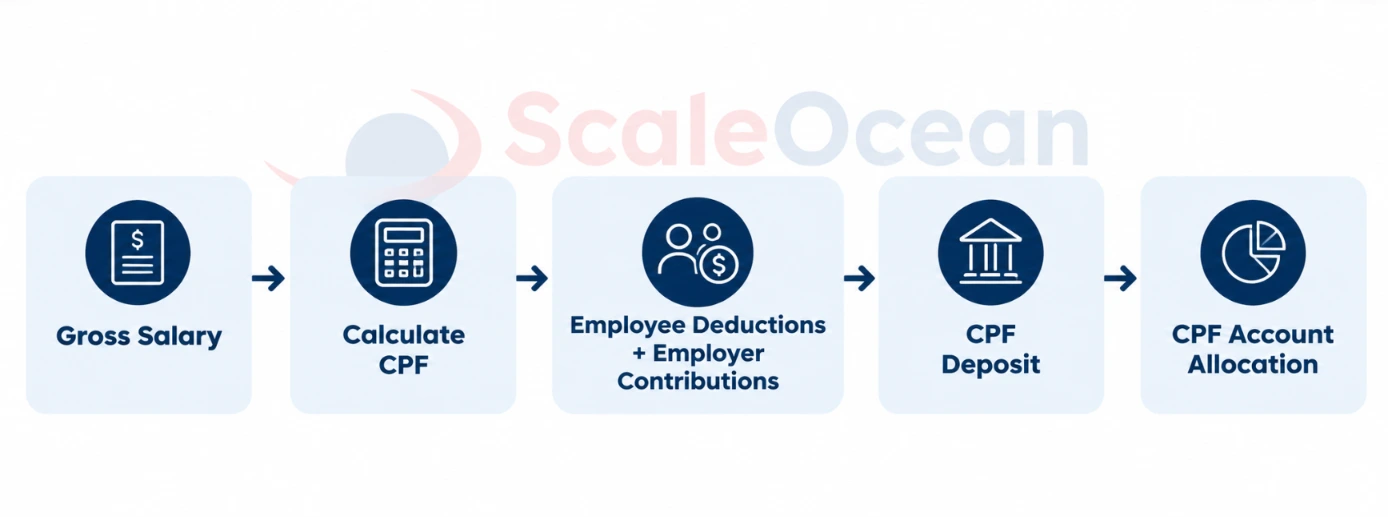
CPF payroll processing may be considered a series of steps, beginning with payments to employees and ending with contributions going to the right CPF accounts.
1. Employer and Employee Contributions
If there is a place of business, the employer and employees contribute to CPF. The employer will have to pay the total sum to the CPF Board and may claim the employee contribution from the employee’s pay.
This percentage will depend on the age, citizenship (PR) status, year of PR status, and income of the employee. Therefore, it is essential for payroll teams to have up-to-date employee information so that they can calculate monthly contributions.
2. CPF Submission to the CPF Board
Employers pay for CPF through the different methods of payment allowed. For example, CPF EZPay allows the employer to input employee wage data, automatically calculate contribution amounts, and pay using payment options that are supported.
CPF contributions are due at the end of the calendar month, and enforcement is triggered when the contribution is delayed beyond the 14th of the next month. Late payments will be subject to a monthly interest rate of 1.5% in accordance with the rules.
3. Allocation Into CPF Accounts
Once contributions are made to CPF, they are distributed to the relevant CPF accounts based on the member’s age and the current CPF allocation rules. The younger members are more likely to get a higher percentage in the OA, and the older members are more likely to contribute to the retirement and health care.
The special account will be closed when the child reaches 55 years of age, and a retirement account will be established. Any savings that are made in the SA and subsequently the OA will be contributed to the RA at the applicable Full Retirement Sum, after applying the CPF rules.
Who Needs to Contribute to CPF?
Singapore Citizens (SCs) and Singapore Permanent Residents (SPRs) who are working with a contract of service in Singapore under the age of 65 must pay Central Provident Fund (CPF) contributions, provided their monthly total wages exceed $50.
1. Singapore Citizens
Employers typically have to contribute to CPF for their Singapore citizens who are employed in Singapore under a contract of service and earn more than $50 a month. This also applies to full-time, part-time, temporary, or contract workers.
The employee’s age and wages then determine the applicable contribution rate. Payroll teams should therefore maintain accurate birth dates, wage components, and employment records before processing monthly CPF. They should also account for separate obligations such as the foreign worker levy when managing employees who fall under applicable work pass requirements.
2. Singapore Permanent Residents
Singapore permanent residents are also covered by CPF. However, employees in their first and second years of PR status generally contribute at graduated rates, while full rates apply from the third year onwards.
So, PR status is a vital data element in payroll. If an employee progresses to the next phase of the PR status, the correct CPF calculation can also differ; therefore, keeping employee records up to date is crucial for the HR and payroll teams.
3. Part-Time, Casual and Temporary Employees
Part-time, casual and temporary workers are not necessarily exempt from CPF coverage. CPF contributions will be incurred if the employee is a Singapore citizen or permanent resident, on a contract of service (monthly income greater than $50).
The contribution rate is not based on the type of employment. Employers should rather assess the employee based on his/her citizenship or PR status, age, wage level, and the relevant CPF rules.
4. Directors Receiving Salary
The CPF contribution will also be applicable to company directors who satisfy the employment requirement under the prescribed employment relationship. MOM exempts the following types of employees from making CPF contributions, such as company directors.
It is important that payroll personnel distinguish between the director’s salary/wages and directors’ fees, as they may be subject to different tax and CPF policies. Clearly defining by classification guards against mis-processing and reporting of payroll.
5. Are Foreign Employees Required to Pay CPF?
Foreign employees who are not Singapore citizens or permanent residents generally do not receive CPF contributions. For example, employment pass holders are not covered by CPF simply because they work in Singapore.
However, once a foreign employee obtains Singapore permanent resident status, CPF contributions become payable and graduated rates generally apply during the first two years of PR status.
What Are the CPF Contribution Rates in 2026?
The 2026 full contribution rates below apply to Singapore Citizens and Singapore Permanent Residents from their third year onwards, with monthly wages above $750. The employee’s age determines both the employer and employee shares.
The age-based structure means that payroll teams must keep employee birth dates accurate and apply the correct effective rate for each age group.
| Employee Age |
Employer |
Employee |
Total |
| 55 and below |
17% |
20% |
37% |
| Above 55 to 60 |
16% |
18% |
34% |
| Above 60 to 65 |
12.5% |
12.5% |
25% |
| Above 65 to 70 |
9% |
7.5% |
16.5% |
| Above 70 |
7.5% |
5% |
12.5% |
How CPF Rates Change With Employee Age
CPF rates have been progressively lowered as workers progress into older age groups, although the rates for those who are senior at work are raised accordingly. In 2026, employees aged 55 to 60 have a total rate of 34%, while those aged 60 to 65 have a total rate of 25%.
Employers should therefore check the employee’s birthday and the change in CPF rates, rather than take it for granted that the employee will continue to have the same percentage throughout the period of employment. As the employee enters into a new age group, the contribution rate may change.
What Are the CPF Wage Ceilings in 2026?
CPF benefits may not be applicable to all of the employee’s annual pay. The CPF system categorizes wages into Ordinary Wages and Additional Wages and has different wage ceilings.
Ordinary Wage Ceiling
The Ordinary Wage (OW) ceiling is $8,000/month, which will be the case in 2026. CPF contribution for OW is capped at $8,000 per month if the employee is paid over $8,000 in OW during the month.
For instance, if an employee earns $9,000 in Ordinary Wages in one month, the CPF calculation will not use the standard rate to calculate the CPF amount on the entire amount of $9,000 earned. The maximum OW amount is $8,000.
Additional Wage Ceiling
Additional Wages refers to wages paid in the form of annual bonuses not considered to be Ordinary Wages. Additional Wage Ceiling means the amount of $102,000 minus the total of the Ordinary Wages that is subject to CPF for the year.
This implies that bonus may be subject to CPF based on the employee’s Ordinary Wages for the year. Payroll departments should not rely on bonus data alone and should instead take annual wage data into account.
Why CPF Wage Ceilings Matter for Payroll
Wage ceilings will impact both the employee’s CPF deduction as well as the employer’s CPF cost. Even if the correct percentage is used and the applicable ceiling is not, the contribution may still be erroneous.
The $8,000 cap on OW in 2026 is also the final step in a phased increase that was previously announced. The maximum salary for an annual period will still be $102,000.
How to Calculate CPF Contributions
To calculate your actual employee and employer Central Provident Fund (CPF) rates, use the CPFB CPF Contribution Calculator.
CPF Contribution Formula
The basic calculation can be expressed as:
Employee CPF = CPF-applicable wages × employee rate
The important point is that CPF-applicable wages may differ from the employee’s total gross compensation because businesses need to account for wage classification and applicable ceilings. Contribution rates can also differ according to age and PR status.
CPF Board also applies rounding rules. Total CPF contributions are rounded to the nearest dollar, while the employee’s share is rounded down to the nearest dollar.
CPF Calculation Example for a Monthly Salary
Based on the data our team got from CPF Board’s 2026, employees aged 55 and below with monthly wages above $750 have a 37% total CPF contribution rate, comprising 17% from the employer and 20% from the employee.
For example, assume a Singapore Citizen employee aged 45 earns $6,000 in CPF-applicable wages in a month:
- Employee CPF: $6,000 × 20% = $1,200
- Employer CPF: $6,000 × 17% = $1,020
- Total CPF contribution: $6,000 × 37% = $2,220
- Employee take-home amount before other deductions: $6,000 − $1,200 = $4,800
This is a simplified monthly calculation and makes some assumptions that the employee’s wages fall within the applicable ceiling and that the employee is eligible for the full rate of 2026.
How CPF Changes the True Cost of Hiring
When estimating the actual employment cost of a Singapore citizen or permanent resident employee, employers should include their CPF contribution. Gross wages of an employee are not the total cost to the employer.
For instance, an employer that pays $6,000 to an employee aged 55 or under will be required to pay an extra $1,020 CPF as part of the 17% employer contribution, in addition to any other employer contributions like SDL and other applicable costs.
What Are the Four CPF Accounts?
CPF savings are allocated among various accounts based on a member’s age at the time of contribution and the applicable allocation rules. The OA, SA, and MA are established before the age of 55, and the RA is established at the age of 55.
| CPF Account |
Primary Purpose |
Examples of Usage |
| Ordinary Account (OA) |
Housing, retirement and other approved purposes |
Home purchase, housing loan payments, education, approved investments |
| Special Account (SA) |
Retirement savings |
Retirement savings and approved retirement-related investments |
| MediSave Account (MA) |
Healthcare financing |
Hospitalisation, approved medical expenses, MediShield Life and other approved healthcare-related premiums |
| Retirement Account (RA) |
Retirement income |
Retirement savings and CPF LIFE-related retirement payouts |
How Are CPF Contributions Allocated?
Central Provident Fund (CPF) contributions are divided among your Ordinary Account (OA), Special Account (SA) or Retirement Account (RA), and MediSave Account (MA).
CPF Allocation by Age
The allocation of CPF changes with age groups. For younger members, a greater percentage is used to fund the OA, and more and more is used for retirement and healthcare as members get older.
Allocation rules are thus different from contribution-rate rules. Employers work out the total contribution first, and then the CPF Board allocates the contribution between the member’s applicable accounts.
What Happens to CPF Allocation After Age 55?
At age 55, the member’s SA is closed, and an RA is created. Savings from the SA and then OA are transferred to the RA up to the applicable Full Retirement Sum.
From 2026, CPF contributions that would otherwise go to the SA for members aged 55 and above are fully allocated to the RA up to the Full Retirement Sum. If the member has already set aside the FRS, those contributions are channelled to the OA.
What Can CPF Savings Be Used For?

CPF (Central Provident Fund) savings in Singapore can be used for various key pillars including housing, healthcare, retirement, protection, and investments.
1. Retirement
One of CPF’s key objectives is retirement. CPF savings can be used to provide monthly retirement payouts using CPF LIFE and other appropriate retirement schemes built up during working years.
The amount that is available for retirement is dependent on the accumulated amounts, interest, transfers, withdrawals, and applicable to the member for retirement. CPF Board says that CPF LIFE offers payouts over a lifetime starting at the member’s payout eligibility age, in monthly amounts.
2. Housing
Eligible OA savings can support various housing-related expenses. Depending on the property and rules, members may use their OA savings for the purchase of a home, down payment, housing loan, and some related costs.
Whilst the use of CPF savings is not directly governed by the business, it is important to understand this purpose, as it helps to explain why CPF plays an important role in Singapore’s employment and social security framework.
3. Healthcare
Healthcare provides savings for approved healthcare expenses. CPF Board notes that this can support expenses such as hospitalisation and selected medical treatments, as well as certain approved insurance premiums.
This also becomes increasingly relevant as employees age. Employers therefore need to understand that CPF is not simply a retirement contribution but part of a broader social security system. Businesses can manage these age-based payroll requirements more systematically with payroll software in Singapore.
4. Education and Approved Investments
OA savings can be used for certain approved education expenses, while CPF members may also invest eligible OA and SA savings through the CPF Investment Scheme, subject to the applicable requirements.
These uses are governed by CPF rules and eligibility conditions. Employees should check the applicable CPF scheme before assuming that all balances can be withdrawn or used for a particular purpose.
When Must Employers Pay CPF?
Employers in Singapore must make Central Provident Fund (CPF) contributions following specific timelines and regulations:
1. Monthly CPF Submission Deadline
CPF contributions are due at the end of each calendar month. Employers should therefore prepare payroll calculations early enough to review employee information, contribution amounts, and payment details.
Enforcement action can apply when contributions remain unpaid after the 14th of the following month. If the 14th falls on a Saturday, Sunday, or public holiday, the next working day applies.
2. How Employers Submit CPF
Employers can use CPF EZPay to submit CPF contributions and make payments. The service supports employee detail management, wage input, automatic computation, submission tracking, and payment through supported channels.
For larger payroll operations, employers can also use supported file-transfer methods. The appropriate submission method depends on the organisation’s payroll setup and workforce requirements.
3. What Happens If CPF Contributions Are Late?
Late CPF payments can result in interest and enforcement action. CPF Board’s current guidance states that late payment interest is charged at 1.5% per month, while MOM also outlines possible fines and other penalties for non-compliance.
Late submissions can also create administrative work because payroll teams may need to investigate the cause, correct wage information, calculate outstanding amounts, and reconcile the payment with employee records.
Common CPF Payroll Mistakes Employers Should Avoid
Employers in Singapore must avoid critical Central Provident Fund (CPF) and payroll mistakes that trigger penalties from the CPF Board, MOM, or IRAS.
1. Applying the Wrong Age-Based Contribution Rate
CPF contribution rates change according to employee age. Applying the rate for an employee’s previous age group can result in an incorrect employee deduction and employer contribution.
This becomes more important for companies with large workforces because payroll teams may need to process different rates simultaneously. Accurate employee master data and automated age-based rules can reduce this type of manual error.
2. Misclassifying Ordinary and Additional Wages
Ordinary Wages and Additional Wages follow different CPF ceiling rules. Treating a bonus or other Additional Wage as ordinary monthly salary can therefore affect the amount subject to CPF.
Payroll teams should review how each payment qualifies under CPF rules before processing it. The distinction becomes especially important during months that include bonuses, commissions, overtime, or other variable compensation.
3. Using the Wrong SPR Contribution Rate
New Singapore permanent residents generally follow graduated contribution rates during their first two years. Applying the full third-year rate too early can produce an incorrect CPF calculation.
The issue can arise when HR updates the employee’s PR status but does not maintain the corresponding PR effective date. Payroll teams should therefore keep citizenship and PR information connected to the employee’s payroll profile.
4. Missing Employee Status Changes
Employee status can change during employment. Examples include becoming a Singapore Permanent Resident, reaching a new age group, changing employment arrangements, or receiving different wage components.
If payroll records do not reflect these changes promptly, the system may continue applying outdated rules. A structured employee master-data process can help HR and payroll teams identify changes before the next payroll cycle.
5. Calculating CPF Manually Across Large Workforces
Manual CPF calculations become harder to maintain as employee numbers increase. HR teams may need to compare age groups, PR years, wages, wage classifications, ceilings, and effective dates for hundreds or thousands of employees.
Automated payroll calculations can reduce repetitive work by applying predefined rules consistently. The main value is not simply faster calculation but reducing the number of payroll decisions that depend on manual spreadsheet checks.
6. Missing CPF Submission Deadlines
Even an accurate CPF calculation can create a compliance problem if the employer does not submit and pay on time. Payroll teams should therefore include CPF submission and payment as part of the monthly payroll close process.
A clear approval calendar can give finance and HR teams enough time to review contribution totals before payment. This also creates an opportunity to correct discrepancies before they become late submissions.
CPF vs Other Employer Payroll Obligations in Singapore
CPF is only one component of Singapore payroll obligations. Employers should distinguish it from levies and income reporting requirements because each serves a different purpose and follows different calculation rules.
CPF vs SDL
CPF supports eligible employees’ social security savings, while the Skills Development Levy (SDL) funds workforce development and training initiatives. Unlike CPF, SDL applies to all employees working in Singapore, including foreign employees.
| Aspect |
CPF |
SDL |
| Purpose |
Social security savings |
Workforce upgrading and training |
| Who is Covered |
Generally Singapore Citizens and PRs |
All employees working in Singapore |
| Calculation |
Depends on age, status, and CPF-applicable wages |
0.25% of monthly total wages |
| Minimum |
CPF rules apply based on wage level |
$2 per employee |
| Maximum |
Subject to CPF wage ceilings and rates |
$11.25 per employee |
| Payment |
Paid to CPF Board |
Collected by CPF Board on behalf of SWDA |
SDL is therefore an additional employer obligation rather than a substitute for CPF.
CPF vs Foreign Worker Levy
CPF generally applies to Singapore citizens and permanent residents, while the foreign worker levy applies to eligible work permit holders. Employers paying the foreign worker levy do not pay CPF contributions for those foreign workers, although SDL still applies.
| Aspect |
CPF |
Foreign Worker Levy |
| Main Purpose |
Social security savings |
Regulate foreign worker employment |
| Typical Employee Group |
Singapore Citizens and PRs |
Eligible Work Permit holders |
| Employer Contribution |
Based on CPF rates |
Monthly levy |
| Age-Based Rate |
Yes |
Levy depends on applicable worker and sector factors |
| Employee Deduction |
Employee share can be recovered |
Levy is an employer obligation |
| Relationship to SDL |
Separate obligation |
SDL still applies |
Employers should therefore avoid treating CPF, SDL, and the foreign worker levy as interchangeable payroll costs.
CPF vs Income Reporting
CPF focuses on mandatory contributions, while income reporting provides employment-income information to IRAS. Employers have separate responsibilities for reporting employee earnings through the applicable IRAS processes.
| Aspect |
CPF |
Income Reporting |
| Main Purpose |
Calculate and submit CPF contributions |
Report employee employment income |
| Main Authority |
CPF Board |
IRAS |
| Main Data |
CPF-applicable wages and contribution details |
Employment income and applicable benefits |
| Frequency |
Monthly contribution cycle |
Annual employment-income reporting |
| Common Employer Process |
CPF submission |
IR8A/AIS reporting |
IRAS requires employers to prepare employment-income information for applicable employees, with AIS employers submitting electronically by 1 March of the following year.
What CPF Changes Should Employers Prepare for in 2027?
From 1 January 2027, CPF contribution rates will increase for employees aged 55 to 65. For employees aged 55 to 60, the total rate will rise from 34% to 35.5%, comprising 16.5% from the employer and 19% from the employee.
For employees aged 60 to 65, the total rate will increase from 25% to 26%, with the employer share rising to 13% and the employee share to 13%. There will be no change to the rates for employees aged 55 and below, above 65 to 70, or above 70.
The increases for employees aged 55 to 65 will be fully allocated to the retirement account up to the full retirement. If the employee has already set aside the FRS, the additional contributions will be channelled to the OA.
Employers should thus review the payroll rules prior to 2027, with a focus on those employees nearing or coming into the payroll rule-affected age groups.
Best Practices for Managing CPF Contributions Accurately

To ensure this, it is essential to adhere to legal requirements for CPF contribution management, to operate efficiently with automated payroll solutions, and to submit contributions in a timely fashion.
1. Keep Employee Citizenship and PR Status Updated
Employee citizenship and PR status can directly affect CPF eligibility and contribution rates. HR teams should therefore update these fields as soon as an employee’s status changes.
For new PRs, the effective date is particularly important because the first two years use graduated contribution rates. A structured employee master-data process can help payroll teams maintain the correct status throughout the employee lifecycle.
2. Automate Age-Based Contribution Rules
Payroll departments should not use base pay rates for all employees. Automated rules can determine the rate at which the CPF should be deducted from the employee’s payroll, depending on factors such as the employee’s age.
For companies with numerous employees, this can minimize the repetitive checking and simplify the rate change application process. ScaleOcean Atlas enables flexible payroll rules and automated payroll calculations, enabling HR teams to design the payroll process for age-related payroll as part of a wider HRIS workflow.
3. Separate Ordinary and Additional Wages
Payroll systems need to differentiate between ordinary wages and additional wages in order to apply the CPF ceiling limits. This is especially crucial in the case of bonuses, commissions, or other variable payments to employees.
Configurable payroll structures are available, which allow businesses to distinguish and use the appropriate payroll rules for different parts of the payroll. This aids HR teams in keeping a more transparent calculation process when monthly salaries and extra compensation are given in the same payroll cycle.
4. Reconcile Payroll Before CPF Submission
The process of reconciling the payroll should be done prior to submission, not after. All teams can check employee records, wages, deductions, CPF amount, and the payroll total to see if there are any discrepancies.
ScaleOcean Atlas integrates HRIS and payroll with financial workflows, enabling payroll data to be synced with financial records. This combined setup can assist the finance team to synchronize the cost of the workforce with their financial records instead of having to maintain two separate datasets, one for payroll and one for accounting.
5. Maintain Payroll Approval and Audit Trails
A controlled payroll process should display the person who reviewed the payroll information, the person who approved the payroll, and the date of the changes. This establishes a greater sense of responsibility should there be an accounting error caused by Finance or HR.
Organizations can have more control over payroll changes and contribution approvals with role-based access, approval workflows, and audit trails. When several HR and finance users are involved in the payroll cycle, these controls can be helpful.
6. Integrate Payroll With Accounting Records
Both employee deductions and employer payroll are affected by CPF; hence, the payroll data should be linked to the companies’ accounting records. This assists the finance teams in matching payroll liabilities and employer contributions with financial statements.
For enterprises managing multiple entities, ScaleOcean Atlas can connect HRIS, payroll, accounting, and financial workflows within one ERP environment. This system has been optimized and complies with PDPA regulations and local financial reporting standards, with support for relevant IRAS and GST processes where applicable. Schedule a consultation with ScaleOcean to explore how integrated payroll and accounting workflows can support your organisation.
Conclusion
The Central Provident Fund (CPF) is Singapore’s mandatory social security savings system, with contributions from eligible employees and employers supporting retirement, healthcare, and housing needs. For employers, CPF calculations depend on factors including employee age, citizenship or PR status, wages, and applicable wage ceilings.
The main payroll challenges arise when businesses manage these rules manually across a large workforce. Incorrect age rates, PR status changes, OW and AW classification, wage ceilings, and submission deadlines can all affect CPF accuracy. Employers can reduce these risks through accurate employee records, automated calculations, structured approvals, and regular payroll reconciliation.
ScaleOcean Atlas connects HRIS, payroll, accounting, and financial processes within an integrated ERP environment. Its configurable workflows, automated payroll calculations, role-based access, approval controls, and multi-entity capabilities can support businesses managing complex payroll structures. Schedule a consultation with ScaleOcean to discuss your CPF, payroll, and broader HRIS requirements.
FAQ CPF in Singapore:
1. How much CPF does an employer pay in Singapore?
For Singapore Citizens and Singapore Permanent Residents from their third year onwards with monthly wages above $750, the employer contribution in 2026 ranges from 17% to 7.5%, depending on employee age. Employees aged 55 and below have the highest employer rate of 17%.
2. How much CPF does an employee pay?
In 2026, eligible employees with monthly wages above $750 contribute between 20% and 5%, depending on age. Employees aged 55 and below contribute 20%, while employees above 70 contribute 5% under the full-rate table.
3. Do Employment Pass holders receive CPF?
Generally, no. Employment Pass holders who are not Singapore Citizens or Permanent Residents are not covered by mandatory CPF contributions. CPF becomes applicable when a foreign employee obtains Singapore Permanent Resident status, subject to the applicable graduated rates during the first two years.
4. What is CPF LIFE?
CPF LIFE is Singapore’s national longevity insurance scheme that provides eligible members with lifelong monthly payouts from their payout eligibility age. The payouts are supported by savings set aside in the Retirement Account and the CPF LIFE scheme.
5. Will CPF contribution rates change in 2027?
Yes. From 1 January 2027, CPF contribution rates will increase for employees aged above 55 to 65. The total rate will rise from 34% to 35.5% for employees aged 55 to 60 and from 25% to 26% for those aged 60 to 65.