AI recruitment software is a digital hiring solution powered by AI that helps with various recruitment tasks like candidate sourcing, resume screening, matching skills, engagement, scheduling interviews, assessments, and recruitment analytics. It accelerates the hiring information processing time for recruitment with the cooperation of a human team.
Singapore businesses face increasing pressure to identify candidates based on relevant skills rather than relying only on academic qualifications. High application volumes, specialised talent requirements, fragmented candidate databases, slow screening, and administrative recruitment work can make it difficult for HR teams to maintain hiring speed without sacrificing evaluation quality.
A suitable AI recruiting platform can address these challenges by automating repetitive hiring tasks while connecting candidate information across the recruitment workflow. Instead of using AI only to generate job descriptions or rank resumes, companies can evaluate platforms based on sourcing, screening, scheduling, interview intelligence, analytics, governance, and integration capabilities.
Our team’s data from MOM’s Job Vacancies 2025 shows that academic qualifications were not the primary factor in 79.6% of the job vacancies for 2025, and 16.0% of the job vacancies for PMETS were not filled within 6 months and a half. These statistics help to reinforce the importance of skills matching and skills assessment of candidates by Singapore employers.
Take the time to read this article to learn what AI recruitment is, how it operates, and some examples to help you grasp how AI recruitment works before you compare the best software solutions for Singapore businesses.
AI recruitment software is a technology platform that utilizes Artificial Intelligence to aid in various recruitment processes. It can assist recruiters in sourcing candidates, screening resumes, skill matching, communicating with applicants, scheduling interviews, and analyzing recruiter data, depending on the solution.
These platforms can handle a significant amount of recruitment data and can automatically match candidates to job requirements, instead of manual candidate reviews. This allows the recruiter to spend more time on those candidates that more closely match the criteria.
AI recruitment software can also automate mundane tasks in the recruitment process. For instance, it could offer candidate updates, set up interview appointments, create evaluations, or supply insights into hiring gains based on the present hiring data.
But AI should augment, not supplant, human judgment. Recruiters will still be expected to read the recommendations and make a fair assessment of the candidates and then make the final hiring decision based on the skills, experiences, and job requirements.
Also Read: What is a Recruitment Management System (RMS)?
AI recruitment software leverages AI, machine learning, and natural language processing to streamline and enhance the hiring process. It is an intelligent assistant rather than replacing the human decision-maker; it is used to process large amounts of data and repetitive tasks.
AI sourcing tools can be used to search candidate databases, employee databases, job applications, and other approved sources to find individuals with the necessary skills and experience to fill an open role. Some platforms also support the recruitment process by identifying previous applicants that might be a match for new positions.
This approach allows recruiters to search beyond manually reviewed applications. Instead of starting each hiring process from an empty pipeline, teams can use existing candidate information and skills-based matching to identify potential talent more efficiently.
AI screening systems analyse resumes and candidate profiles against job requirements. Depending on the platform, the system can compare skills, experience, qualifications, job history, and other predefined criteria before ranking or recommending candidates.
This puts the recruiters in a better position to review a candidate list that has been prioritized, rather than sifting through each one in turn. While the matching criteria are a useful resource, companies should also thoroughly examine the criteria since vague requirements can affect the quality of the AI recommendations.
AI recruitment platforms can utilize chatbots, email, SMS, or other channels to connect with the candidates. These tools can respond to frequently asked questions, store candidate data, perform preliminary screening, and supply job updates.
When there are lots of applications to review, automated engagement can ensure that recruiters keep the lines of communication open. It is also a great way for candidates to get a response from the recruiters outside of their working hours, and it doesn’t require the recruiters to answer all routine enquiries manually.
AI scheduling tools coordinate candidate and interviewer availability, identify suitable time slots, send invitations, and manage changes. This reduces the back-and-forth communication that often slows the recruitment process.
Some platforms also connect scheduling with candidate screening. Once a candidate meets predefined criteria, the system can automatically move the applicant to the next stage and initiate interview scheduling. This can also support capacity planning software by helping businesses align hiring activities with workforce requirements.
There are AI recruitment tools that have structured interviews via chat, voice, or video. The system can ask questions (known or adaptive), tally the answers according to the rules of a particular role, and give a structured output to the recruiting team/recruiter.
Role-specific skills, communication, behavior, or technical skills can also be assessed using the appropriate assessment instruments. Businesses must determine what key assessment factors actually predict job performance before turning to AI-generated outputs to inform hiring.
From candidate, pipeline, recruiter, and hiring data, AI recruitment software can put it together into recruitment analytics. These insights can help teams pinpoint bottlenecks, evaluate sourcing channels, track time to hire, and learn where candidates drop off during the hiring process.
For more sophisticated platforms, there could be recommendations made based on skills, availability of candidates, recruitment patterns, or workforce needs. These recommendations can help inform hiring strategy, but HR teams should continue to apply proper human review in their hiring decisions.

AI recruitment value pillars are the essential value and strategic benefits provided by AI in talent acquisition.
There are AI recruitment tools that have structured interviews via chat, voice, or video. The system can ask questions (known or adaptive), tally the answers according to the rules of a particular role, and give a structured output to the recruiting team/recruiter.
Role-specific skills, communication, behavior, or technical skills can also be assessed using the appropriate assessment instruments. Businesses must determine what key assessment factors actually predict job performance before turning to AI-generated outputs to inform hiring.
Automated screening reduces the amount of manual work required to review large numbers of applications. The system can extract candidate information, compare it with predefined criteria, and prioritize profiles for recruiter review.
The quality of the result depends heavily on the criteria and data that the organisation provides. Therefore, recruiters should regularly review screening rules and avoid treating AI rankings as automatic hiring decisions.
AI scheduling removes much of the administrative work involved in coordinating candidates and interviewers. The system can check availability, suggest suitable slots, send notifications, and handle rescheduling.
This capability becomes particularly valuable when recruitment teams manage multiple roles or large applicant volumes. It can also help reduce candidate waiting time between screening and interview stages, creating a smoother transition into onboarding software in Singapore once candidates are hired.
Interview intelligence uses AI to structure, summarise, or analyze interview information. Depending on the platform, it can generate transcripts, highlight relevant responses, provide scorecards, or help recruiters compare candidates against predefined criteria.
Companies should define clear evaluation standards before using interview intelligence. Structured criteria can make reviews more consistent while still allowing hiring managers to apply professional judgement.
An ATS primarily organises recruitment information and tracks candidates through hiring stages, while AI recruitment software adds artificial intelligence and automation to activities such as sourcing, matching, screening, scheduling, and assessment.
Some modern platforms combine both capabilities, so the distinction increasingly depends on the depth of automation and intelligence provided.
| Aspect | AI Recruitment Software | ATS |
|---|---|---|
| Primary Focus | AI-assisted hiring, automation, matching, and candidate evaluation | Candidate tracking and recruitment workflow management |
| Candidate Sourcing | Can use AI to discover and match potential candidates | Usually focuses on job posting and applicant collection |
| Screening | AI can rank, match, score, or summarise candidates | Often relies on filters, workflows, and recruiter review |
| Candidate Engagement | May provide conversational AI, automated outreach, and follow-ups | Usually provides standard communication and workflow tools |
| Interview Scheduling | Can automate scheduling and rescheduling using AI | May provide calendar or self-scheduling functionality |
| Assessments | Can support AI-assisted interviews and skills assessments | Usually stores or connects assessment results |
| Analytics | Can provide AI-generated recommendations and hiring insights | Primarily provides recruitment reports and pipeline analytics |
| Human Oversight | Should retain human review for important hiring decisions | Recruiters and hiring managers remain responsible for decisions |
The following comparison focuses on the practical role, target company size, core strengths, and publicly available pricing of each platform. Pricing can change by region, hiring volume, users, modules, and implementation scope, so businesses should confirm the final quotation before purchasing.
| Platform | Best For | Key Strengths | Pricing |
|---|---|---|---|
| ScaleOcean | Medium and large enterprises | AI-assisted recruitment connected with wider HR and ERP workflows | Custom quote |
| Zoho Recruit | Small and medium businesses | AI matching, sourcing, screening, automation, and integrations | From US$25/recruiter/month annually |
| Workable | Small to large businesses | ATS, candidate sourcing, AI tools, reporting, and HR functionality | From US$299/month for Standard |
| Humanly | Medium and large high-volume hiring teams | Conversational AI, screening, scheduling, and AI interviews | Platform or outcome-based pricing |
| Braintrust AIR | Large enterprises | Conversational voice interviews and structured scoring | Volume-based pricing |
| SeekOut | Medium and large recruiting teams | AI sourcing, talent intelligence, matching, and talent rediscovery | From US$149/month annually for Recruit Core |
| HireVue | Medium and large enterprises | AI-assisted interviews, assessments, and hiring science | Custom quote |
| Jobvite | Medium and large businesses | ATS, recruitment marketing, AI matching, CRM, and analytics | Custom quote |
| X0PA AI | Medium and large businesses | AI matching, screening, automation, analytics, and AI agents | From US$28,000/year |
| Phenom | Large enterprises | Talent experience, AI sourcing, screening, scheduling, and talent intelligence | Custom quote |
| Eightfold AI | Large enterprises | Skills intelligence, AI sourcing, talent acquisition, and agentic AI | Custom quote |
| PeopleCentral | Small, medium, and Singapore-focused businesses | AI recruitment connected with HRMS and payroll | HireCentral add-on; quote varies by scope |
Choosing the right AI recruitment software depends on your hiring volume, recruitment priorities, level of automation, and integration needs.
The following 12 platforms offer different approaches to AI-powered sourcing, screening, candidate engagement, interviewing, and talent management, allowing businesses to compare options based on their specific requirements.

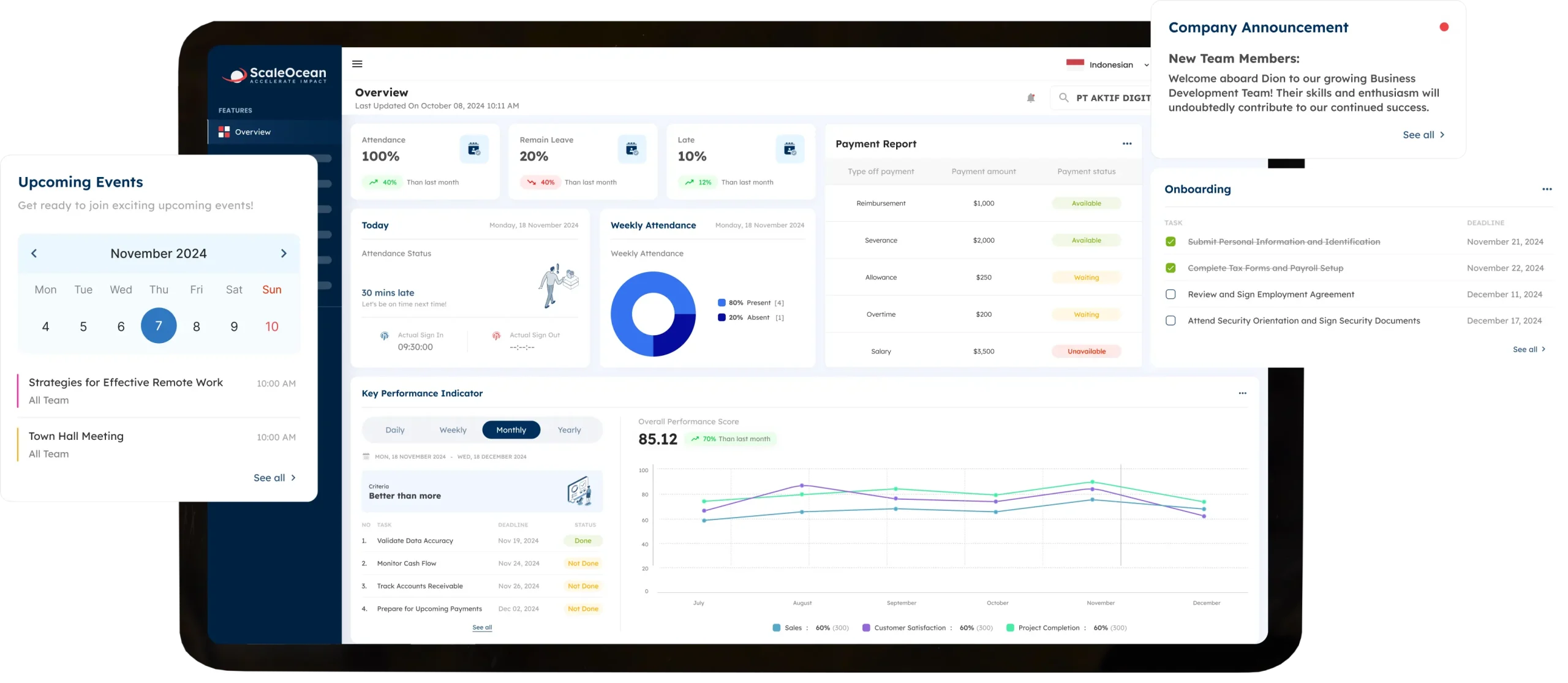
ScaleOcean is an ERP solution provider with its flagship product, ScaleOcean Atlas, designed to connect recruitment with broader HR and business processes. Rather than treating recruitment as an isolated activity, Atlas can connect candidate management with onboarding, employee records, payroll, attendance, performance, learning, and other workforce processes.
For enterprise hiring teams, ScaleOcean Atlas provides a talent management dashboard that can bring candidate pipelines, recruitment stages, workforce information, and talent indicators into a connected environment. Its recruitment capabilities include AI-assisted CV screening, candidate matching, hiring pipeline tracking, talent pool management, psychotest assessment, and onboarding workflows.
ScaleMind supports recruitment analysis, candidate screening, skills matching, talent-gap analysis, and workforce insights within the broader Atlas environment. The platform also supports configurable hiring workflows, role-based access, approval structures, and recruitment-to-talent-lifecycle integration. Schedule a consultation with ScaleOcean to discuss your recruitment workflow, AI requirements, integrations, and implementation scope.
Key Features:
| Pros | Cons |
|---|---|
| Connects AI-assisted recruitment with HR, payroll, performance, learning, and other workforce processes. | Its broader ERP scope may exceed the requirements of a small business seeking only basic recruitment automation. |
| Supports configurable recruitment workflows and approval structures. | Implementation requires process mapping and configuration to establish the appropriate workflow. |
| Combines candidate screening, matching, talent pools, and employee lifecycle management. | Pricing depends on modules, integrations, implementation scope, and business requirements. |
| Provides integrated recruitment and talent management across the employee lifecycle. |
Best for: Medium and large enterprises, multi-entity businesses, large HR teams, and organisations that want recruitment connected with broader talent management and ERP processes.
ScaleOcean is suitable for organisations that want AI-assisted recruitment within a broader talent management environment. ScaleMind helps recruiters screen candidates, match skills with job requirements, summarise profiles, and generate recruitment insights, while Atlas connects hiring pipelines with talent pools, onboarding, performance, learning, payroll, and other HR workflows.
Zoho Recruit is an applicant tracking and recruitment software that integrates a candidate management system with sourcing, screening, hiring pipeline, assessment, automation, and Artificial Intelligence (AI) features. It utilizes AI for candidate matching, AI content generation, screening bots, candidate engagement, and interview summaries.
It offers a range of recruitment needs with its standard and enterprise plans. The Enterprise version has AI candidate matching, recruitment automation, advanced analytics, candidate portals, and more customization options.
Key Features:
| Pros | Cons |
|---|---|
| Combines ATS capabilities with AI-assisted matching and recruitment automation. | Some advanced AI capabilities are available only in higher-tier plans. |
| Provides sourcing, screening, assessment, and candidate engagement tools. | Active job and feature limits vary by plan. |
| Offers a broad integration ecosystem. | Complex recruitment structures may require additional configuration. |
Best for: Small and medium businesses that need a structured ATS with AI-assisted recruitment capabilities.
Zoho Recruit suits businesses that want an ATS with AI-assisted candidate matching, sourcing, screening, candidate engagement, and recruitment automation in one recruitment platform.
Workable integrates applicant tracking, candidate sourcing, recruitment workflows, hiring plans, reporting, and HR functionality. It has AI-powered tools for candidate assessment, sourcing, and other recruitment processes.
The platform also features job distribution, resume parsing, interview scheduling, interview kits, scorecards, custom hiring pipelines, reporting, and calendar and business system integrations.
Key Features:
| Pros | Cons |
|---|---|
| Combines recruitment, sourcing, ATS, AI, and HR functionality. | Some AI functionality operates through separate usage limits or credits. |
| Provides job distribution and candidate sourcing capabilities. | Some recruitment capabilities require higher plans or additional functionality. |
| Supports structured hiring pipelines and interview evaluation. | Highly customised enterprise workflows may require additional configuration. |
Best for: Small and medium businesses that want recruitment and HR capabilities together, with larger organisations able to use broader functionality.
Workable provides a broad recruitment environment that combines ATS functionality, sourcing, AI-assisted candidate evaluation, hiring workflows, reporting, and HR management.
Humanly is an AI recruiting tool built specifically for high-touch recruiting. It uses conversational AI to automate candidate engagement, screening, scheduling, and interviewing.
It has an AI Recruiter and AI Interviewer that can qualify candidates, answer questions, schedule interviews, conduct structured interviews, and provide them for recruiter review. It also offers talent management capabilities concerning candidate pipelines and re-engagement.
Key Features:
| Pros | Cons |
|---|---|
| Strong focus on high-volume candidate engagement and screening. | More specialised toward high-volume recruitment than broader HR management. |
| Automates screening, scheduling, and AI interviews. | Businesses may need an existing ATS or additional HR systems. |
| Supports conversational recruitment across multiple channels. | Pricing depends on platform configuration or hiring volume. |
Best for: Medium and large companies with high-volume hiring requirements across areas such as healthcare, retail, hospitality, logistics, and customer support.
Humanly suits teams that need to automate candidate conversations, screening, interview scheduling, and structured interviews when applicant volumes place pressure on recruiters.
Braintrust AIR is enterprise candidate-screening AI interview software. It performs conversational interviews, assesses answers from a certain perspective, and supplies structured information for the recruiters to review.
AIR can be integrated with an ATS platform and keep recruiters engaged in the selection of candidates. It’s designed to be used for conversational interviews, candidate scoring, semantic search, role-specific evaluation, and recruiter review.
Key Features:
| Pros | Cons |
|---|---|
| Provides structured conversational voice interviews at enterprise scale. | Focuses more heavily on screening and interviewing than full HR management. |
| Provides structured candidate scoring and interview information. | Human review remains necessary for important hiring decisions. |
| Supports ATS integrations and enterprise recruitment workflows. | Pricing is based on interview volume rather than a simple per-user plan. |
Best for: Large enterprises and recruitment teams that need high-volume AI-assisted interviewing and structured candidate screening.
Braintrust AIR is suitable for organisations that want to automate structured first-round interviews while keeping recruiters responsible for reviewing candidate information and making advancement decisions.
SeekOut is an AI-powered recruiting platform for talent sourcing, discovery, talent intelligence, engagement, and recruitment workflow. It streamlines the recruitment process with its AI features, which allow recruiters to search candidate profiles, find matching competencies, and identify potential candidates.
It also offers talent rediscovery, inbound candidate assessment, AI screening, market intelligence, recruitment reporting, and the overall talent acquisition process based on the chosen plan.
Key Features:
| Pros | Cons |
|---|---|
| Strong candidate sourcing and talent intelligence capabilities. | Advanced ATS integration and full-funnel functions may require higher-tier plans. |
| Provides AI search and matching across large candidate pools. | Costs can vary based on seats and selected functionality. |
| Supports talent rediscovery and AI screening. | Some plans focus more heavily on sourcing than complete recruitment management. |
Best for: Medium and large recruiting teams that need advanced sourcing, talent intelligence, and passive candidate discovery.
SeekOut is suitable for recruitment teams that prioritise AI-powered sourcing, talent discovery, passive candidate engagement, and talent rediscovery across large candidate pools.

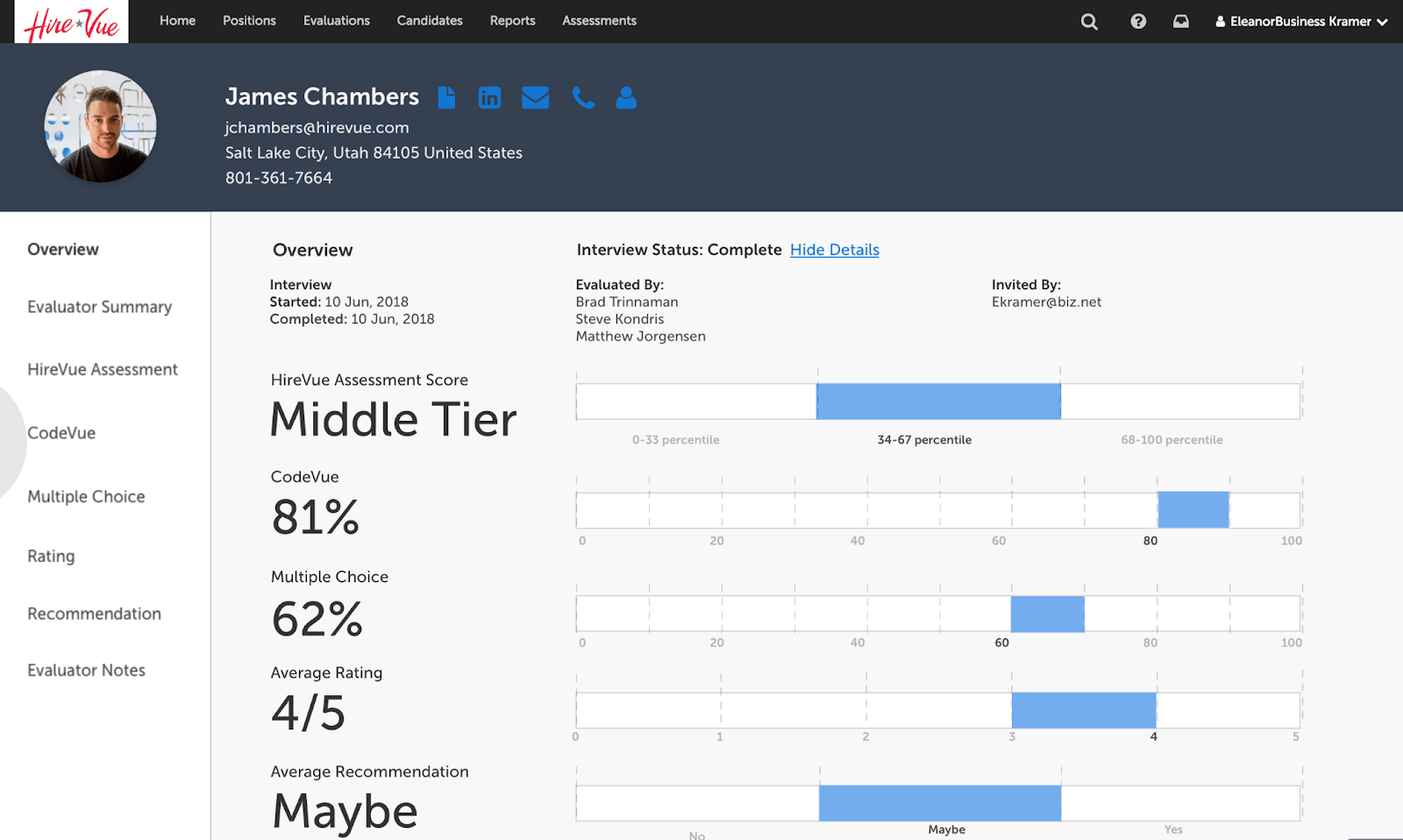
HireVue offers AI-powered hiring solutions that specialize in video interviewing, video assessments, candidate evaluation, and recruitment workflow. It comes with technical, coding, interview, and other skills assessments for the role.
Structured candidate assessment and interview intelligence are strong features of the platform. It can also be integrated with ATS systems to help in recruitment processes.
Key Features:
| Pros | Cons |
|---|---|
| Strong focus on structured interviews and candidate assessments. | More specialised in assessment and interviewing than complete HR management. |
| Provides a broad range of assessment tools. | Enterprise pricing requires a custom quotation. |
| Supports structured evaluation and ATS integration. | Businesses may need additional systems for sourcing and broader HR workflows. |
Best for: Medium and large enterprises that need structured candidate assessments and interview technology.
HireVue is suitable for organisations that want structured digital interviews and assessments to evaluate candidates consistently across large recruitment processes.
Jobvite is a talent acquisition platform that extends ATS features into recruitment marketing and CRM, AI-based matching, interview support, and recruitment analytics.
Organizations with a formalized talent acquisition process can make use of its platform for candidate management, career sites, recruitment marketing, candidate engagement, AI matching, interview support, employee referral, and reporting.
Key Features:
| Pros | Cons |
|---|---|
| Combines ATS, recruitment marketing, CRM, AI matching, and analytics. | Its broad module structure may require more planning during implementation. |
| Supports complex recruitment workflows. | Pricing depends on selected modules and hiring requirements. |
| Provides capabilities beyond basic applicant tracking. | Smaller businesses may not require its full functionality. |
Best for: Medium and large businesses with structured talent acquisition programmes and complex recruitment requirements.
Jobvite suits organisations that want to connect applicant tracking with recruitment marketing, candidate engagement, AI matching, referrals, analytics, and broader talent acquisition workflows.
X0PA AI is a recruitment chatbot featuring AI-driven features such as sourcing, candidate matching, resume screening, recruiting automation, analytics, assessments, and AI agents. It offers various functions based on the needs of the organisation and chosen plans.
It also offers features like job posting, talent pool management, internal hiring, candidate evaluation, multi-step approvals, recruitment dashboards, and integrations.
Key Features:
| Pros | Cons |
|---|---|
| Combines AI matching, screening, automation, and analytics. | Higher-tier functionality can represent a significant investment. |
| Supports AI agents and configurable recruitment workflows. | Businesses should assess which AI capabilities they actually need. |
| Provides different plans based on organisational requirements. | Pricing increases with organisation size and feature depth. |
Best for: Medium and large businesses that want extensive AI recruitment automation and analytics.
X0PA AI is suitable for organisations that want to combine AI matching, screening, recruitment automation, analytics, and AI agents within a broader talent acquisition platform.

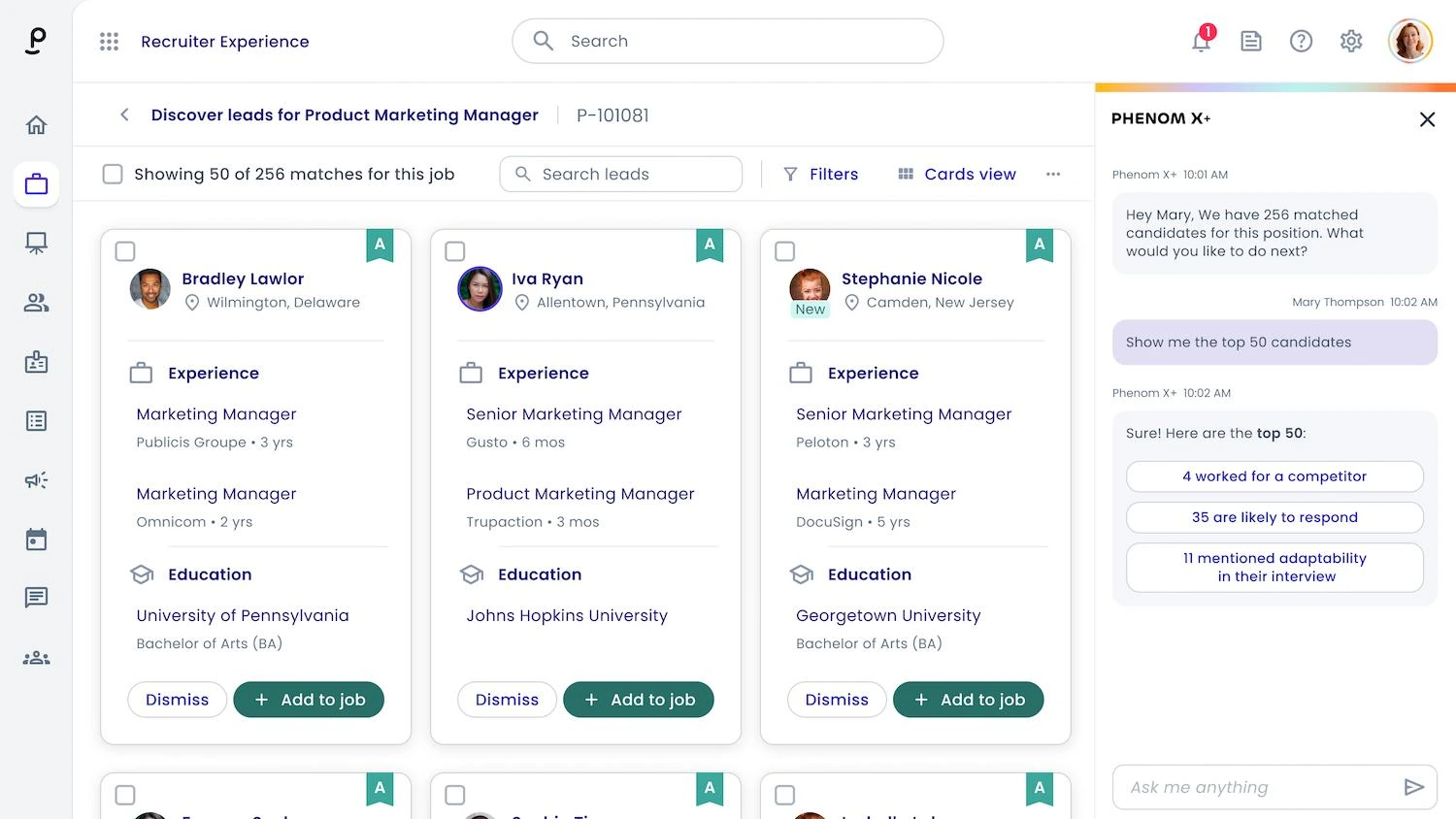
Phenom delivers an AI-powered talent experience platform that spans the full range of talent experience, including candidate experience, recruitment, employee experience, talent intelligence, and workforce development. It offers recruiting features such as AI sourcing, talent CRM, screening, automated scheduling, interview intelligence, and candidate engagement.
Virtual assistants are also capable of handling high-volume hiring needs using their conversational capabilities, AI screening, scheduling interviews, and engaging with candidates. Its global talent arena integrates recruitment, employee development, and internal mobility.
Key Features:
| Pros | Cons |
|---|---|
| Connects recruitment with broader talent experience and workforce management. | Its extensive platform scope may require significant implementation planning. |
| Provides AI sourcing, screening, scheduling, and candidate engagement. | Pricing depends on selected capabilities and implementation scope. |
| Supports both external recruitment and internal talent management. | Smaller businesses may not require the full platform. |
Best for: Large enterprises that want AI recruitment connected with broader talent management and workforce intelligence.
Phenom suits enterprises that want to connect AI-powered recruitment with candidate experience, talent CRM, workforce intelligence, internal mobility, and employee development.
Eightfold AI offers an AI- and skills-based talent intelligence platform. The talent acquisition environment can be used to source, match, engage, screen, interview, schedule, and hire.
The platform also integrates external recruitment and internal mobility, skills intelligence, and workforce planning. It can be used for all aspects of recruitment, ranging from AI sourcing to candidate relationships to interviewing to scheduling to talent analytics and more.
Key Features:
| Pros | Cons |
|---|---|
| Strong skills-based talent intelligence capabilities. | Its enterprise-oriented scope may exceed smaller recruitment requirements. |
| Connects external hiring with internal talent and workforce intelligence. | Implementation can require significant data and workflow planning. |
| Supports AI across sourcing, recruitment, and talent management. | Pricing is based on enterprise requirements rather than a simple public plan. |
Best for: Large enterprises with complex workforce planning, skills intelligence, and talent acquisition requirements.
Eightfold AI suits enterprises that want to use skills intelligence and AI across sourcing, recruitment, internal mobility, workforce planning, and broader talent management.

PeopleCentral is an HR technology firm based in Singapore with an AI platform called HireCentral that focuses on recruitment. HireCentral can help with job description creation, resume screening, chatbot assessment, scheduling interviews, background checks, and onboarding.
Its recruitment capabilities integrate with larger HR systems, including payroll and staff management. This means that the business can carry on candidate information beyond the recruitment process.
Key Features:
| Pros | Cons |
|---|---|
| Strong focus on Singapore recruitment requirements and HR workflows. | HireCentral works within a broader PeopleCentral HR ecosystem. |
| Connects recruitment with onboarding and payroll. | Businesses seeking only a standalone AI sourcing tool may not need the broader HR environment. |
| Supports AI-assisted job descriptions, screening, assessments, and scheduling. | Pricing for HireCentral may vary based on the selected HR scope and requirements. |
Best for: Small and medium Singapore businesses that want AI recruitment connected with HR, payroll, onboarding, and employee-management processes.
PeopleCentral suits Singapore businesses that want AI-assisted recruitment connected with HRMS, payroll, onboarding, and broader employee-management workflows.
Consider what features AI recruitment software offers, such as automation of repetitive tasks, minimizing bias, and seamless integration with your current HR tech stack.
AI candidate sourcing enables recruiters to filter available talent pools and external sources for potential candidates. Advanced platforms can be used to re-find past applications or to determine if there are any candidates who possess similar skills to a position.
Data reported by The Business Times shows that 83% of Singapore employers are facing trouble recruiting skilled talent in 2025, indicating that there is a need to discover talent in a more comprehensive and efficient way. However, businesses should review the origin of the candidate information and the sourcing process to ensure that it adheres to their data protection and recruitment policies.
The candidate data can be retrieved from the resume through the intelligent resume screening feature and compared to job specifications. It is beneficial for the recruiter when a job posting receives hundreds or thousands of applicants.
The screening criteria will be customizable for enterprise recruitment. HR teams should be aware of what qualifications, skills, experience, and more affect the ranking of the output before applying it for hiring decisions.
Businesses with high volumes of candidates can leverage ScaleMind-powered candidate screening to aid in intelligent CV analysis and match with company requirements. This simplifies the screening process on the recruiter’s part, while maintaining the link between recruitment criteria and the overall hiring process.
Skills-based matching is matching candidates based on their skills with a particular position. It could help companies take a more holistic approach to hiring based on relevant past experience, technical skills, and transferable skills, as well as academic qualifications.
The method helps recruiters determine the suitability of candidates for a position based on relevant skills and experience, and instead of focusing on the applicant’s personality or other factors, it focuses on whether the candidate has the skills required for the role.
Candidate engagement automation can be used to send out repetitive messages, respond to frequently asked questions, update candidates, and follow up with applicants. This keeps recruiters in touch if there is a surge in applications.
Businesses need to consider if the system works with the communication channels that their candidates use, and if automated messages will align with the organization’s recruitment policies.
Interviews must be scheduled to ensure candidate and interviewer availability, and to handle invitations, reminders, cancellations, and rescheduling. This can save administration time and eliminate delays from the recruitment process.
It’s also important for businesses to see if the scheduling tool connects to their existing calendars and ATS tools. Even if the scheduling function is correct, poor integration may cause duplicate updates.
Structured questions, transcripts, scorecards, or role-specific evaluations can be generated using AI-assisted interviews and assessments. These benefits may enable hiring staff to evaluate applicants on a more uniform basis.
However, relying on AI assessments for hiring decisions is not foolproof for businesses. HR teams should create scenarios where human intervention is necessary and how they will contest or refute any HR recommendations that are submitted by the AI.
Some of the metrics that can be captured using recruitment analytics are time to hire, application volume, source performance, candidate conversion, recruiter workload, and the outcomes of hiring.
The best platforms will relate these to the various recruitment stages and go beyond the overall dashboard. This enables HR leaders to see where candidates are falling off and where recruiters are investing the most time.
Integration allows recruitment information to move into HRIS, payroll, onboarding, attendance, performance, or workforce systems without repeated data entry. This becomes more important when businesses manage recruitment across multiple departments or locations.
ScaleOcean Atlas integrates recruitment into the broader HR journey, ensuring that candidate data seamlessly flows into onboarding, employee records, payroll, performance management, learning, and other talent management stages. This recruitment-to-talent-lifecycle approach can help minimise the disconnection between recruitment and post-hire Human Resource (HR) operations.
In addition, businesses need to consider data protection needs and the processing of employee and candidate data when deploying in Singapore. If finance modules are included within the overall ERP, businesses can also integrate HR processes with the relevant IRAS and GST workflow. The wider system should facilitate practices related to data protection within the scope of the PDPA.
Explainability helps recruiters understand why a system recommends or ranks a candidate. A useful platform should allow teams to review the criteria behind an AI recommendation instead of presenting an unexplained score.
Also, human override is a major factor. The recruitment process should still be able to accommodate recruiters to view, modify, deviate, and veto AI suggestions where they deem more information is needed to alter their opinions.
Actions like candidate status changes, screening results, approvals, edits, and recruiter actions are all tracked in audit trails. They can assist HR teams with their reviews of recruitment activities and check for inconsistencies.
ScaleOcean Atlas provides role-based access and tracks and controls the workflow to ensure that organizations can exercise greater control over recruitment processes. It is a method by which companies can set who has access to, can see, approve, or change recruitment data based on the needs of their organisation.
AI recruitment software streamlines and improves the recruitment process, which can save up to 30% time-to-hire and lower recruitment costs.
AI can sift through a larger applicant pool than someone who is manually reviewing resumes. Automated screening and matching will help recruiters build a shortlist for further consideration.
This can be very beneficial if a company receives numerous applications for a single position. Quick screening may also help in minimizing the time lag between application and communication to the candidate.
Recruiters spend time on activities such as scheduling, follow-ups, resume sorting, data entry, and status updates. AI automation can handle many of these repetitive tasks.
Reducing administrative work allows recruiters to spend more time on candidate conversations, hiring-manager collaboration, interview preparation, and workforce planning. An Applicant Tracking System (ATS) can further organise candidate information and streamline recruitment workflows.
Having structured screening criteria and standardised assessments can help minimise variance between the evaluation of recruits. The same set of criteria can be applied to many candidates with AI.
But consistency isn’t necessarily fair. Employers should check their criteria to make sure that the system is based on the job requirements, not irrelevant factors.
Communication AI tools and chatbots can communicate with candidates promptly. They can let them know about their application status, raise some queries, and help them get to know the initial steps in the process.
Improved communication speeds up the process for the candidate and helps you keep your best candidates engaged.
AI recruitment platforms can combine candidate, pipeline, recruiter, and hiring data into dashboards. This gives HR leaders a clearer view of recruitment performance.
Teams can use this information to identify slow hiring stages, underperforming sourcing channels, high candidate drop-off, or recruiter workload imbalances.
High-volume hiring strains a recruiter’s capacity, as they’re required to assess a vast number of candidates in a short window. How can AI help? Automate screening, engagement, scheduling, and initial assessments.
Scale Ocean Atlas to help HR teams work on one connected system of record for candidate details and recruitment stages. When business needs evolve, Scale Mind can help to match candidates and provide talent insights.
Companies often overlook previous applicants who may become suitable for future vacancies. Talent-pool functionality allows businesses to retain and organise these candidate profiles for later recruitment.
AI can help identify relevant previous candidates when new positions become available. This can reduce the need to restart sourcing from the beginning for every vacancy.

For Singapore firms, employing AI to recruit personnel needs to take into account process efficiency advantages as well as legal compliance, security, and human intervention.
Recruitment platforms process information such as names, resumes, employment history, contact details, qualifications, and assessment results. Companies must therefore consider how they collect, use, disclose, retain, and protect candidate data.
PDPC guidance explains that organisations should consider the purposes for collecting and using applicant data, while recruitment agencies may also have specific obligations under the PDPA.
AI does not remove an employer’s responsibility to practise fair and merit-based recruitment. MOM states that employers should not discriminate against candidates based on non-job-related characteristics such as age, sex, nationality, or race.
Companies should therefore define AI screening criteria around job-related skills, experience, qualifications, and competencies.
In Singapore, the Workplace Fairness Act was enacted in 2025 and will become law by the end of 2027. The Act expands protections from discrimination in hiring decisions as well.
Employers too will be required to ensure fair and meritocratic employment practices in the use of AI tools, MOM has also said. All businesses should examine their AI recruitment processes now, ahead of the Act’s implementation.
AI is there to assist recruitment decisions – not to abdicate human responsibility. Recruiters and hiring managers need to be able to see what AI recommends, challenge scoring of candidates, and override machine output when it does not align with the role.
Companies should therefore establish clear review procedures for AI-assisted hiring, including defined evaluation criteria, human approval points, and documentation of significant recruitment decisions. This keeps AI as a decision-support tool while maintaining human responsibility throughout the hiring process.
Hiring teams and companies should consider keeping documentation of the criteria, AI suggestions, recruiter choices, the extent of override, approvals, and changes in hiring candidate status. This makes it easier to create a record for HR teams when they need to review a hiring decision.
An auditable recruitment workflow also helps organizations identify problems in screening criteria and continuously improve their talent management system.
To choose the right AI recruitment software, identify your primary hiring bottleneck (such as sourcing, screening, or interview scheduling) and evaluate tools based on matching transparency, integration capabilities, and human oversight.
Learn where recruiters lose the majority of their time. Perhaps the problem is sourcing, reviewing resumes, communicating with candidates, scheduling, conducting interviews, or submitting reports.
This means that companies won’t have to buy AI functionalities that are irrelevant to their real hiring challenges.
Single-point solutions can be a perfect choice when businesses are trying to address a single problem, like AI interviewing or sourcing, for example. However, a complete recruitment platform can be more practical when teams require multiple stages integrated.
Major corporations also need to evaluate if recruitment has to interface with HRIS, payroll, attendance, performance, learning, and more.
Identify how a vendor’s AI produces candidate scores, rankings, or suggestions. Ask your recruitment team about the data being used to produce the output.
An explainer platform. Providing explanations allows HR teams to be able to review a little more information before accepting an AI recommendation.
Review how the vendor stores, processes, transfers, and protects candidate data. Companies should assess access controls, retention practices, encryption, audit trails, and applicable privacy responsibilities.
For Singapore businesses, the assessment should include relevant PDPA requirements and internal data-governance policies.
Determine if the employment platform integrates with HRIS, ATS, payroll, calendar, assessment, job boards, and other recruiting tools being used by the employer.
Integration saves data from being reentered and ensures recruitment information can be carried through to onboarding and employee management.
AI should make recruitment easier for candidates rather than create unnecessary barriers. Companies should test chatbot interactions, application forms, scheduling, AI interviews, communication, and accessibility.
The company should additionally collect feedback from the applicants after working in order to recognize areas where automating leads to a sluggish and frustrating application process.
Cheaper monthly does not always equate to cheaper overall. Think about recruiter seats, AI credits, candidate volume, integrations, onboarding and helpdesk, assessments, and optional modules.
Businesses should calculate the expected cost against their annual hiring volume before selecting a platform that fits their broader human capital management strategy.
A pilot allows HR teams to test AI recommendations using real recruitment scenarios before rolling the system out across the organization.
The pilot should measure screening accuracy, recruiter workload, candidate experience, hiring-stage conversion, integration performance, and governance requirements.
AI recruitment software is a digital hiring solution that uses artificial intelligence and automation to support sourcing, screening, candidate matching, engagement, scheduling, assessments, and recruitment analytics. It can help companies process hiring activities faster while maintaining structured evaluation workflows.
For Singapore businesses, the challenge extends beyond recruitment speed. Skills shortages, high application volumes, fragmented candidate data, specialised talent requirements, and evolving workplace-fairness expectations require companies to combine automation with appropriate human oversight and governance. AI can address repetitive work, but companies still need clear hiring criteria, data protection practices, and accountable decision-making.
ScaleOcean Talent Management System connects AI-assisted recruitment with the broader employee lifecycle, including candidate screening, hiring pipelines, talent pools, onboarding, performance, learning, payroll, and workforce management. Schedule a consultation with ScaleOcean to discuss your recruitment workflow, AI requirements, integrations, and talent management needs.
AI recruitment software uses artificial intelligence to support hiring activities such as candidate sourcing, resume screening, skills matching, candidate engagement, interview scheduling, assessments, and recruitment analytics. It helps recruiters automate repetitive work while keeping human teams involved in hiring decisions.
AI recruitment software analyses candidate and job information against predefined requirements. It can then recommend candidates, screen resumes, communicate with applicants, schedule interviews, or generate recruitment insights depending on the platform’s capabilities.
AI recruitment software should not replace recruiters entirely. It can automate repetitive activities and provide recommendations, while recruiters remain responsible for evaluating candidates, considering context, managing relationships, and making final hiring decisions.
Yes. Small businesses can use AI recruitment software to reduce manual screening, scheduling, and communication work. However, they should select a platform whose pricing and feature scope match their hiring volume rather than paying for unnecessary enterprise functionality.