A bank statement is a document provided by a bank that details the activity and balance of a bank account over a certain period. It typically displays such things as deposits, withdrawals, fees, interest, dates of transactions, transaction descriptions, and opening or closing balances.
For enterprise businesses, the process of bank statement management can get more complex with many bank statements, many banks and entities, many currencies, multiple finance teams, and many transactions. Manual reconciliation will also cause delays in closing the month, limit cash visibility in consolidated reporting, and make transactions that have not been matched more difficult to investigate.
A linked accounting workflow can assist finance teams in consolidating banking transactions and accounting records, receivables, payables, and documents. This helps to facilitate matching, identify discrepancies, keep financial records, and follow through transactions when reporting or complying with audit and tax demands.
Our research into the survey conducted by DBS revealed that manual bank statement reconciliation was a major problem faced by small businesses, with 67% of small businesses identifying it as a challenge. Business owners were also spending an average of 15.5 hours per month manually importing and reconciling bank statements.
Read this article to understand what a bank statement is, what information it contains, how to read and reconcile one, how long businesses should retain it in Singapore, and how accounting software can make bank statement management more efficient.
Key Takeaways
A bank statement is an official record of transactions and balance movements within a bank account over a defined period.
Reviewing bank statementshelps businesses track cash activity, identify errors, support reconciliation, and maintain financial records.
ScaleOcean Atlas provides an integrated accounting environment that connects bank reconciliation with receivables, payables, reporting, and other financial workflows, supporting greater financial visibility for Singapore businesses.
A bank statement is a report that banks generate that details the activity of a particular bank account and is sent periodically. It displays the account balance fluctuations throughout the statement period and offers an account-level record for businesses to double-check cash changes.
In the eyes of businesses, a bank statement is not a substitute for accounting documents. Rather, it is an external document that will be used by finance teams as a reference point to cross-compare with the company’s ledger, payments, invoices, receipts, and other supporting documents.
A bank statement can thus be used to assist in a variety of accounting tasks such as bank reconciliation, cash monitoring, financial reporting, preparation of audits, and verification of transactions.
What Information Is Included in a Bank Statement?
Most bank statements have a few common pieces of information that will help the account holder track their financial activity, although the format differs among banks.
1. Account Holder and Bank Information
The statements usually include the name of the account owner, the bank’s name, the account number or masked account number, and the account type. These details define what bank account the document is referring to.
If your business has several accounts, this information enables the finance team to verify which statement they are viewing and performing transactions and/or reconciliations on.
2. Statement Period
A statement period refers to the starting and ending dates of a document. 1 September – 30 September 2026. This is what is considered “the statement,” and it is what should be included in the transactions.
The time can be used by finance teams to reconcile banking activity and the accounting period. This aids in avoiding transactions being reviewed or recorded in the reporting period when they did not occur or in the wrong period.
3. Opening and Closing Balance
Opening balance refers to how much money was there at the start of the statement period, and closing balance indicates the amount of money at the end of the statement period. These balances will give you a starting and ending point to look at account activity.
These numbers can be used as a reference point during bank reconciliation with finance teams to compare with statements and accounting records. If there is not a logical explanation for the discrepancy, it needs to be investigated prior to closing the period.
4. Deposits and Credits
A deposit or credit is an amount of money that is put into the bank account. Some examples are: customer payments, sales receipts, refunds, transfers received, and interest income.
These transactions are reviewed to ensure that the expected payments are in the account. They can also correlate receipts with invoices and/or payment records or other documents that support the transaction.
5. Withdrawals and Debits
Withdrawals and debits are funds that are going out of the banking account. They can cover supplier payments, payroll, transfers, card payments, loan repayments and bank fees.
These outgoing transactions can be matched against payment records and accounting entries to ensure that everything has been accounted for. Any unusual or unexpected withdrawals may be subject to further review.
6. Transaction Date and Description
The typical transaction contains a transaction date and description, specifying the time of the transaction and what the transaction is related to. Banks can also offer you reference numbers, transaction codes, merchant names, or payment information.
These details enable finance teams to know and classify transactions during reconciliation. Transaction references can also be easier to trace back to an invoice, receipt, or other source document.
7. Bank Fees and Interest
Some bank statements could contain interest income or interest expenses, service charges, transaction fees, foreign exchange fees, or any other charge that may be applied to the account. The volumes can impact the account balance even in the event that the finance teams have yet to record them in their books.
These are things that a finance team should look at and log into the relevant accounts if required. Adding bank-generated charges and interest makes accounting records reflect the actual movement reflected by the bank.
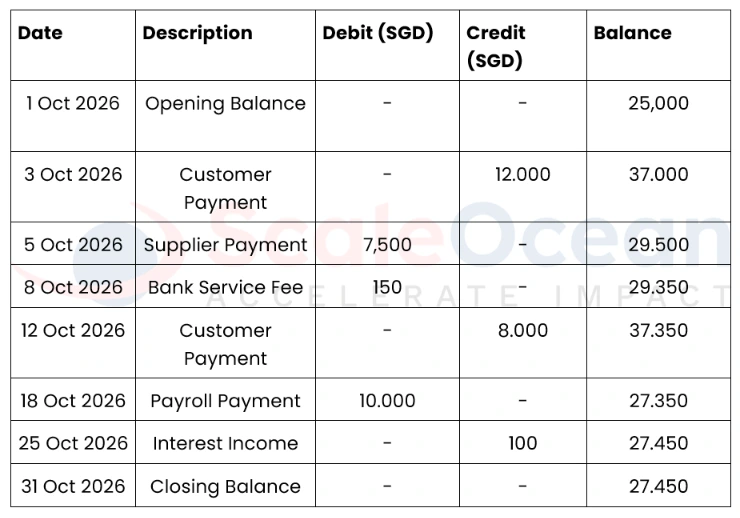
Bank Statement Example and How to Read It
1. Check the Statement Period
Always look at the dates on the bank statement: the beginning and end dates. For instance, if you are making a statement for 1 October to 31 October 2026, you would have transactions that fall during that time period.
This step allows for the financial team to match bank activity to the proper accounting period. It also minimizes the chance of seeing transactions from the previous month or forgetting about transactions that fall within the reporting period.
2. Verify the Opening Balance
The opening balance is the starting balance at the beginning of the statement period. It can be compared to the closing balance of the previous statement or the last reconciled accounting balance.
If the numbers do not match, the team needs to go back to the outstanding items or adjustments and investigate first. If the difference is not explained, it could complicate the reconciliation process for the present period.
3. Review Every Credit and Debit
Check each credit or debit and make sure you know what caused the funds to be credited or debited. There should be a record of customer payments, supplier payments, payroll payments, transfers, refunds and other payments that should be made in the accounting system.
Transaction dates, amounts, references, descriptions, and other information can be matched with invoices, receipts, payments, and other supporting documents by finance teams. This assists in detecting inaccurate, missing, or duplicate transactions.
4. Check Fees, Interest, and Adjustments
There can be service charges, transaction fees, foreign exchange fees, interest income, or interest expenses that appear on bank statements. Even if a finance team hasn’t recorded these items internally, they can impact an account’s balance.
These entries should be reviewed to assess if an accounting adjustment is needed. Note any applicable fees and interest will be recorded, allowing internal financial records to accurately reflect banking activities.
5. Confirm the Closing Balance
The closing balance is the balance that shows as the final balance on the statement period. Finance should reconcile this amount with the accounting balance, taking into account the valid outstanding items.
If the balances are still not equal, the team should find out what the remaining difference is prior to reconciling. The closing balance is a form of confirmation that the closing statement has been set up properly.
What Is a Bank Statement Used For?
A bank statement is a document that shows actual transactions and is used in addition to the company’s financial documents. It’s used for more than just seeing if there are any funds left in a bank account.
1. Tracking Income and Expenses
A bank statement report is useful in tracking business cash flow. Finance teams can view customer payments, supplier payments, payroll payments, transfers, fees, and more to get a better insight into the flow of cash within the business.
These transactions can also be compared to accounting records to check if receipts have been received as expected and if expenses have been recorded as payments have been made. This will serve as a good benchmark for cash activity reviews.
2. Identifying Errors or Unauthorised Transactions
By looking over a bank statement, finance teams can catch anything unfamiliar, double payments, incorrect amounts, or payments that aren’t recorded in their books. These may need to be further explored prior to the end of the accounting period.
Regular reviews also assist businesses to react to unusual activity before it is too late. Bank references and supporting documents can help finance teams track down suspicious transactions, as well as internal approval records.
3. Providing Proof of Address or Financial Activity
A bank statement can be used as a supporting document if an organization requires proof of a bank account holder’s address or activity. Requirements for acceptance may differ from one institution to another that is asking for the document.
It is therefore advisable for businesses to verify if there is specific information to be included, such as company name, registered address, account details, or statement date. If the requesting organization allows electronic documents to be accepted, a digital statement may be accepted.
4. Supporting Loan and Credit Applications
Bank statements are sometimes required by financial institutions as part of the process in determining the financial standing or ability to repay a company. The documents can document actual account activity, cash receipts, and cash payments.
Finance teams should make sure that the statements submitted show the requested time frame and are from the correct business account. This can help supplement financial statements and other documents and offer further context in relation to regular account activity.
5. Supporting Accounting and Financial Reporting
Bank statements are an external document to compare cash movements and accounting documents. They are useful to finance teams when reconciling bank accounts to find missing transactions, out-of-sync timing, bank charges, and more.
Businesses can keep more consistent cash balances in their books using this comparison. It also provides credibility to the finance teams when making financial reports or when examining unusual activity in accounts.
6. Supporting Tax and Audit Records
Businesses can combine bank statements with invoices, receipts, payment records, and accounting entries to back up the transactions that are entered as accounting transactions. This can also facilitate tracking the flow of money throughout the business.
In Singapore, keeping supporting records that are organized is important, especially for tax and GST record keeping. Bank statements, therefore, should be included in a larger document trail and not be the only evidence of a transaction.
Bank Statement vs Transaction History: What Is the Difference?
Bank statements and transaction histories both show account activity, but they serve different purposes. A transaction history generally provides an ongoing view of account movements, while a bank statement provides a formal record for a defined period.
Aspect
Bank Statement
Transaction History
Purpose
Provides a formal record of account activity for a defined period.
Provides an ongoing view of recent account transactions.
Period
Usually covers a specific statement period.
Can often be filtered by selected dates.
Format
Usually available as a formal PDF, electronic document, or printed statement.
Usually displayed directly through online or mobile banking.
Balance Information
Normally includes opening and closing balances.
Usually focuses on individual transactions and the current balance.
Record Keeping
Useful for formal financial record keeping and reconciliation.
Useful for monitoring recent activity and checking individual transactions.
Bank Statement vs Bank Reconciliation
A bank statement is a document issued by the bank, while bank reconciliation is a process performed by the business. Understanding the difference helps finance teams know whether they are reviewing source information or actively checking the accuracy of their accounting records.
Aspect
Bank Statement
Bank Reconciliation
What It Is
A record of transactions issued by the bank.
A process for comparing bank activity with accounting records.
Source
Generated by the bank.
Performed by the business or its accounting system.
Main Purpose
Shows account activity and balances.
Identifies and resolves differences between bank and accounting records.
Output
Statement showing transactions and balances.
Reconciled accounting balance with identified adjustments or outstanding items.
Frequency
Issued according to the bank’s statement schedule.
Can be performed daily, weekly, monthly, or according to business requirements.
Why Can a Bank Statement Differ From Accounting Records?
When there are discrepancies between a bank statement and accounting records, it does not necessarily indicate that one is wrong. There are several reasons for discrepancies between the two records, such as differences in timing, charges created by banks, missed entries, or recording errors.
1. Outstanding Cheques or Payments
A transaction that the business has entered into may not show up on the bank statement if the bank hasn’t transferred it over yet. This results in a temporary mismatch between the accounting balance and the bank balance.
The finance teams need to monitor these outstanding payments and review them periodically. Should the payment be outstanding for an abnormally long period, the team may wish to check with the department or recipient about the status of the payment.
2. Deposits in Transit
A business can book a customer payment even though the bank hasn’t yet deposited the funds. The accounting system will then appear to show the receipt, but the bank statement won’t yet show the amount.
This discrepancy typically clears up when the bank clears the deposit. During recon, the transaction should still be recorded as an outstanding item in the finance team’s books to ensure that the timing difference is recorded.
3. Bank Fees
A bank can charge a service fee, a transaction fee, foreign exchange fees, or other fees directly from the account. These charges can show up on the bank statement prior to finance teams entering them into the accounting system.
Finance staff should check these fees and record them on the relevant accounts as appropriate. The fees are recorded so that the accounting balance of cash will give an accurate picture of the actual cash flow from the bank.
4. Interest Income or Charges
Interest earned or paid by the bank might not have an entry on the statement. This can result in an accounting balance that is different than the bank balance until the transaction is made.
The finance team needs to confirm the amount of interest, the relevant account, and note the transaction. This helps to guarantee that financial records include income and bank charges.
5. Direct Debits and Standing Instructions
Recurring payments such as subscriptions, loan installments, insurance premiums, or other direct debits can appear on the bank statement without a corresponding entry in the accounting records. During bank reconciliation, finance teams should match these transactions with the relevant accounting entries to identify missing records or timing differences.
These transactions should be matched with the appropriate expense, liability, or payment documentation. Recurring transactions are also useful for finance teams to review and find out if there are any deductions or changes in the regular payments.
6. Recording Errors
If accounting balances do not match the bank statement, it could be due to incorrect amounts, duplicate transactions, missing transactions, or transactions being posted to the wrong account.
Finance teams need to look back to the original transaction and documents to see the gap. To ensure more reliable accounting records, the source entry should be corrected as opposed to simply adjusting the final balance.
How to Reconcile a Bank Statement
Bank reconciliation is a procedure that involves accounting for the business’s records against the transactions and balance reflected on the bank statement. This process can assist the financial teams in spotting timing discrepancies, missing items, bank transactions, and possible recording errors.
A regular reconciliation procedure also provides businesses with greater visibility of what cash is really in the bank. Financial disagreement can be straightened out before the end of the month and supporting documents for financial reporting are kept in good order.
1. Compare the Opening Balances
The first step in reconciling a bank statement is to compare the opening bank statement balance with the reconciled accounting balance. The figures are usually balanced, except for known adjustments or outstanding items.
If the balances do not match, the financial teams should look at the previous period’s reconciliation before looking at the current period. If there is an unexplained difference in the opening balance at the end of an accounting period, it can cause problems in the next period when reconciling.
2. Match Deposits and Incoming Payments
Match receipts, transfers, refunds, etc. received from customers with the accounting system. Where available, review the quantity, date, reference, and the payer’s details.
This procedure will help to ensure that the expected receipts have been received by the bank account and the receipts have been recorded properly. Unmatched deposits need to be evidenced for further investigation and should not simply be classified without supporting evidence.
3. Match Withdrawals and Outgoing Payments
Verify supplier payments, payroll, transfers, bank fees with the accounting records. Check transaction amounts and references to verify that there is a posted transaction for each payment.
It would also be wise for finance teams to check any unusual or unexpected withdrawals. These can be a recording error, multiple payments, transactions that have not been recognised or payments that need further checks for approval.
4. Identify Unmatched Transactions
Make a list of the transactions that can be found on one record but not the other. All differences should be identified as timing, no entry, bank-generated transaction, or potential error.
This helps to make the reconciliation process more structured and easier to follow. Finance teams can then concentrate on items that are not resolved instead of manually having to review all transactions repeatedly.
5. Record Bank Fees, Interest, and Adjustments
Crediting outstanding charges from the banking service to the accounting books, including Interest due on the loan and other adjustments. These trades can have an impact on the count of real cash on hand even if they’re not initiated from within.
Once all required entries have been made, the finance teams should recheck the accounting balance with the bank statement. It is here that you will see if the adjustments are accurate or not.
6. Resolve Outstanding Items
Check outstanding payments, deposits, transfers, and unexplained discrepancies. These should be assessed by finance teams to see if they continue to be valid, or if they need correcting or further supporting documents.
If items are not resolved for an extended period of time, it can suggest that there is a fundamental recording or processing issue. Old discrepancies that build up over reporting periods are avoided through regular follow-up.
7. Confirm the Adjusted Balance
Once all the necessary adjustments have been noted, reconcile the accounting balance with the bank balance. The unexplained balance should be accounted for by legitimate outstanding items.
After the balances are agreed, finance teams can make the balance and keep supporting documents. This offers greater grounds for month end closing and financial reporting.
Why Bank Statements Matter for Singapore Businesses
Bank statements provide an external record of actual cash movements and therefore play an important role in Singapore business finance. They can support accounting, reconciliation, tax documentation, and transaction verification.
For businesses managing multiple accounts or high transaction volumes, maintaining organised bank statements also makes it easier to trace financial activity. Connecting these records with accounting workflows can further reduce manual reconciliation work.
1. Financial Record Keeping
Singapore businesses need to retain source documents, accounting records, schedules, and bank statements connected with their business transactions. These records help demonstrate how financial figures were generated and provide supporting evidence when required.
Finance teams should therefore organise bank statements by account, entity, and reporting period. A structured approach makes historical documents easier to retrieve when businesses need to review previous transactions or prepare supporting information.
2. Bank Reconciliation
Bank statements provide the external source that finance teams compare against internal accounting records. Regular reconciliation can help identify missing transactions, bank charges, timing differences, and recording errors.
For enterprises handling high transaction volumes, an automated reconciliation workflow can reduce the amount of manual comparison required. ScaleOcean Atlas can connect financial workflows and support reconciliation processes within a broader accounting environment.
ScaleOcean’s accounting capabilities can help finance teams manage accounting records, bank reconciliation, financial reporting, and connected financial processes through one platform. This can reduce the need to manually consolidate financial information across separate systems.
3. GST and Tax Supporting Records
Bank statements can support records for payments received and payments made, particularly when finance teams need to verify transactions against invoices and other accounting documents. These records can help establish a clearer transaction trail for tax and GST-related activities.
For Singapore businesses, finance teams should maintain bank statements alongside invoices, receipts, accounting records, and other supporting documents. This gives businesses a more complete record when reviewing transactions or preparing information for tax-related requirements.
4. Audit Trail and Transaction Verification
Bank statements provide an external reference for verifying whether recorded financial transactions actually occurred. Finance teams can compare them with invoices, receipts, payment approvals, and accounting entries when preparing audit evidence.
ScaleOcean Atlas can strengthen this process through traceable financial activities, approval workflows, and audit trails. These capabilities help teams review transaction history and identify relevant actions when investigating account movements or preparing supporting information for internal and external reviews.
How Long Should Businesses Keep Bank Statements in Singapore?
Singapore businesses generally need to retain bank statements as part of their broader accounting and tax records. For corporate income tax purposes, IRAS generally requires companies to keep relevant source documents, accounting records, schedules, bank statements, and other transaction records for at least five years from the relevant year of assessment.
For GST purposes, businesses generally need to retain relevant records for at least five years from the end of the accounting period. Businesses should therefore maintain bank statements alongside invoices, receipts, accounting records, and other supporting documents rather than relying on bank statements alone.
For businesses managing large volumes of electronic statements, structured digital storage can make historical records easier to retrieve. Finance teams can organise statements by entity, bank account, currency, and reporting period to simplify future reconciliation and document requests.
Paper Bank Statement vs eStatement
Both paper statements and eStatements can provide account activity for a defined period. The main difference lies in how businesses access, store, search, and use these records.
Aspect
Paper Bank Statement
eStatement
Format
Printed physical document.
Digital document, commonly PDF or another electronic format.
Access
Requires physical access or scanning.
Can usually be accessed through online banking or digital storage.
Storage
Requires physical filing space.
Can be stored digitally and backed up.
Searchability
Requires manual document review.
Can be searched, organised, and retrieved digitally.
Reconciliation
Often requires manual data entry or scanning.
Can be easier to connect with digital accounting workflows.
Long-Term Management
Can become difficult to organise as document volume grows.
Supports structured digital storage and easier retrieval.
How to Get a Bank Statement in Singapore
Bank statements are typically available to businesses via online banking platforms, or by request from their bank. The exact process, periods available, and charges for historical documents may vary from bank to bank.
1. Through Online Banking
Be in the right business banking portal and pick the preferred bank account. Businesses are typically allowed to select the statement period and download a statement in their format of choice, which is typically supported by the bank.
Once you have downloaded the document, finance teams should be able to store it in a uniform naming and filing system. This makes it easier to find the statements when reconciling, preparing a report or for an audit.
2. Through a Mobile Banking App
There are several banks that enable their customers to check or download statements on the mobile banking application. This can offer quick access to the latest activity for the accounts when finance folks need to know about a transaction.
But there might be less to a mobile banking statement retrieval site than there would be to a complete business banking site. When businesses require historic documents or formal records, they should do so through the proper means.
3. Requesting a Printed Statement
When businesses need a digital statement or history that is not available, they can contact their bank or visit a branch. Older and extra statement copies may come with a fee from certain banks.
Finance teams should ensure that they have verified the proper account, statement period, and document format before asking for a physical statement. This will help prevent needless requests and delays.
How Often Should You Review Bank Statements?
The appropriate review frequency depends on transaction volume, number of bank accounts, business size, and financial risk. Businesses with high transaction volumes or frequent cash movements may benefit from daily or weekly reviews, while smaller businesses may use a monthly reconciliation cycle.
Regular check-ups will enable finance teams to catch transactions that are unusual, missing deposits, duplicate charges, and unexpected fees sooner. This provides teams with more time to go through and look into any discrepancies rather than letting them grow until the end of the month.
Common Bank Statement Errors and Red Flags
Bank statement reviews can reveal transactions or patterns that require additional investigation. Some issues result from simple recording mistakes, while others may indicate duplicate payments, missing receipts, or unfamiliar account activity.
Finance teams should investigate unusual items using transaction references, accounting entries, invoices, receipts, and other supporting documents. Maintaining a consistent review process can help businesses resolve discrepancies before they affect financial reporting
1. Duplicate Charges
A duplicate charge occurs when the same payment appears more than once on the bank statement or when the same transaction has been recorded twice internally. Duplicate charges can overstate expenses and reduce the available cash balance.
Finance teams should compare transaction dates, amounts, merchant details, and reference numbers to identify duplicates. They can then confirm whether the issue originated from the bank, payment processor, or internal accounting process.
2. Unknown Transactions
Unrecognized transactions are those payments or receipts that cannot be immediately traced to a known business activity. They can be a result of new merchant descriptions, transfers, bank changes,s or unapproved activity.
Utilize bank references and payment history, as well as employees or departments involved in the transaction, to conduct a team investigation into the transaction. Until the nature of the transaction is known, it should not be classified and/or ignored.
3. Incorrect Transaction Amounts
An incorrect transaction amount occurs when the amount shown on the bank statement differs from the expected amount. This may result from payment errors, adjustments, foreign exchange differences, or incorrect internal records.
Finance teams should compare the bank amount with invoices, payment instructions, receipts, and accounting entries. Resolving the difference at the transaction level helps prevent incorrect balances from carrying into financial reports.
4. Missing Deposits
A missing deposit is when an anticipated customer payment or other receipt is not on the bank statement. The payment could still be pending, or it might have been made to a different account, or it might have been inaccurately posted.
Finance teams can match up expected receipts with bank activity and customer payment records. It’s important to follow up quickly on missed deposits so the business has a better perspective on the cash on hand.
5. Unexpected Bank Fees
Unseen bank charges can range from service fees, transfer fees, foreign exchange fees, or any other fees the finance team didn’t budget for. These amounts may have an impact on cash balances and financial records.
Based on the insights our team gathered from IRAS, bank charges are generally recognised as deductible business expenses when they meet the applicable requirements. Teams should therefore verify the reason for each charge, record the applicable amount in the correct accounting category, and retain supporting records for financial and tax purposes.
6. Old Outstanding Transactions
Old outstanding transactions are payments, deposits, or transfers that have not been reconciled for a long period of time. These may be signs of stale payments, issues with processing, missing records, or possibly incorrect transaction entries.
The finance team should explore these items and not leave them open forever. Analyzing ageing outstanding items can highlight issues in the processes and enhance the quality of the reconciliation.
7. Unexplained Transfers Between Accounts
Should there be a transfer between company bank accounts, it is normally expected that this will be accompanied by a corresponding entry in the accounting system. When an activity has not been identified, it may be a missing entry or the selection of a wrong account or the activity may be a subject matter that needs further investigation.
Financial departments should double-check both sides of the transfer and ensure the movement of funds has been reflected in the sending and receiving accounts. This is particularly relevant if businesses have more than one account or entity.
How Businesses Can Manage Bank Statements More Efficiently
Managing bank statements manually becomes increasingly difficult as businesses add more accounts, entities, currencies, and transaction volumes. A more connected approach can reduce repetitive work while improving visibility into cash activity.
1. Centralise Bank Transaction Data
Businesses managing multiple bank accounts can centralise transaction data to provide finance teams with a more consistent view of account activity. This reduces the need to switch between different banking portals or spreadsheets when reviewing transactions.
A centralized financial environment can also make it easier to compare transactions across accounts and entities. ScaleOcean Atlas connects accounting with broader business processes, helping enterprises manage financial information through a unified ERP environment.
2. Automate Transaction Matching
Manual matching requires finance teams to compare transaction amounts, dates, references, and accounting entries one by one. Automated matching can identify corresponding transactions and reduce repetitive reconciliation work.
Finance teams can establish matching rules based on transaction amounts, dates, references, account numbers, or payment descriptions. Clear matching criteria make it easier to separate transactions that require no further review from those that need manual investigation.
3. Flag Unmatched Transactions
Not every transaction can be matched automatically. Businesses should therefore identify unmatched or unusual transactions for review rather than forcing them into an incorrect category.
An exception-based workflow allows finance teams to prioritise items that require attention. This can help reduce unnecessary manual checking while ensuring unresolved discrepancies remain visible until the team resolves them.
4. Connect Payments With Accounting Entries
Connecting bank activity with receivables, payables, invoices, and accounting entries creates a clearer transaction trail. Finance teams can then trace a payment from the bank statement back to the relevant business transaction.
Maintaining consistent references across these records also makes reconciliation easier. Finance teams can match payment dates, amounts, invoice numbers, and transaction references to verify that cash movements have been recorded correctly.
5. Maintain a Traceable Audit Trail
Businesses should maintain a clear record of transaction entries, adjustments, approvals, and other financial activities. A traceable audit trail helps finance teams understand what changed and investigate discrepancies more efficiently.
Finance teams should also establish consistent review procedures for financial records. Clear approval responsibilities, supporting documentation, and transaction references can make it easier to verify account activity and resolve discrepancies when they arise.
6. Support Multi-Account and Multi-Currency Reconciliation
Businesses operating multiple accounts or currencies need to reconcile more than individual transaction balances. Finance teams may also need to consider foreign exchange movements, entity-level balances, and consolidated financial reporting.
ScaleOcean Atlas supports multi-currency and multi-entity accounting workflows, allowing businesses to manage financial information across different entities and currencies within one connected ERP environment. Configurable workflows, consolidated reporting, approval controls, and audit trails can improve financial visibility while reducing fragmented reconciliation across business units.
For Singapore businesses, the system has been optimized and complies with PDPA regulations and local financial reporting standards, with capabilities supporting GST and IRAS-related financial processes. It can also support digital transformation initiatives related to EDG and CTC grant claims, subject to eligibility and qualifying requirements. Schedule a consultation with ScaleOcean to explore the relevant accounting modules, integrations, and multi-entity requirements.
Conclusion
A bank statement is an official record of transactions and balance movements within a bank account for a defined period. Businesses use it to monitor cash activity, verify transactions, reconcile accounting records, support tax and audit documentation, and investigate discrepancies.
For Singapore businesses, managing bank statements can become challenging when finance teams handle multiple accounts, entities, currencies, and high transaction volumes. Manual reconciliation can increase repetitive work and make discrepancies harder to identify, while a connected accounting environment can help centralise transaction data, automate matching, and maintain clearer financial records.
ScaleOcean Atlas provides an integrated accounting environment that connects bank reconciliation with accounting, receivables, payables, reporting, and broader business processes. Schedule a consultation with ScaleOcean to explore how a connected ERP approach can support your accounting and bank reconciliation requirements.
FAQ Bank Statement:
1. What is a bank statement in simple terms?
A bank statement is a formal record of the transactions and balance movements in a bank account over a specific period. It shows money received, money spent, applicable fees, and the opening and closing balances.
2. Can a bank statement be used as proof of address?
Yes, a bank statement can sometimes serve as proof of address if it shows the account holder’s name and address. However, acceptance depends on the organisation requesting the document and its specific verification requirements.
3. How long should companies keep bank statements in Singapore?
Companies in Singapore generally need to retain relevant accounting and source records, including bank statements, for at least five years. Businesses should keep these records organised and accessible in case they are needed for tax, GST, audit, or financial reviews.
4. Why does my bank statement not match my accounting records?
Differences can result from timing differences, outstanding payments, deposits in transit, bank fees, interest, direct debits, missing entries, or recording errors. Finance teams should perform a bank reconciliation to identify and resolve the difference.














 Key Takeaways