A trial balance is a report used internally that shows the debit and credit balances of the accounts in the general ledger so that the accountant can determine if there is any discrepancy between the debits and credits before preparing the financial statements.
When Singapore businesses receive accounting data from various sources like ERP, point of sale, inventory, payroll system, procurement, and banking, it can be difficult to manage a trial balance. Inconsistent records can also impede month-end closing, reconciliations, financial reporting, and the audit preparation process.
By streamlining general ledger data, updating account balances, and offering greater financial visibility, an integrated accounting system can make this process easier. This provides finance teams with earlier detection of differences and helps them prepare trial balances without a lot of manual work on spreadsheets.
Our team gathered data from The Business Times, which found that 67% of 529 Singapore businesses surveyed stated that digitalization had optimized operations and 58% indicated that it had cut operating costs. The results demonstrate the potential for digital systems to enable more efficient financial and operational processes.
Read this article to learn the meaning, how it works, format, types, some accounting errors, preparing a trial balance, and how accounting software can help these accounts to be automated for growing businesses.
Key Takeaways
A trial balance is an accounting report that summarises debit and credit balances from the general ledger to check whether they are equal.
A trial balance is important because it helps verify debit and credit accuracy, support financial reporting, improve audit readiness, and streamline month-end closing.
Common errors in trial balancesinclude incorrect transaction recording, missing journal entries, duplicate entries, incorrect account classification, wrong debit or credit entries, and omitted transactions.
ScaleOcean Atlas helps businesses manage accounting workflows with real-time financial visibility, automated general ledger synchronisation, and audit trail capabilities.
A trial balance is an internal accounting report that summarizes closing balances of the accounts in the general ledger. For each account, the accountant writes the amount in a debit or a credit column, and then adds up the amounts in each column to see if the total amounts are mathematically equal for each column.
The trial balance is thus more than a mere list of accounts. It serves as an in-house accounting control mechanism to detect errors in the posting and recording of transactions before financial statements are completed.
The trial balance has a direct relationship with several important accounting processes:
General ledger: Account balances are extracted from the general ledger to create the trial balance
Financial statements: Trial balance information provides the basis for preparing financial statements after necessary adjustments.
Month-end closing: Finance teams can use the trial balance to review account balances before closing the accounting period.
Audit preparation: A structured trial balance helps auditors and finance teams trace balances back to underlying accounting records.
A balanced trial balance does not automatically mean that every accounting entry is correct. Certain errors, such as recording a transaction in the wrong account but with equal debit and credit amounts, may not cause the totals to differ.
Why Is Trial Balance Important for Businesses?
A trial balance is an accounting report that verifies that the total of all the debits and credits in the general ledger are mathematically equal when financial statements are not yet prepared.
1. Ensures Debit and Credit Accuracy
A trial balance is a document that lists all the debits and credits in the accounting system and makes sure of the equality of the two sides. When totals are not equal, the finance team can determine that more investigation is needed prior to using the data for financial reporting.
It offers a first control point to verify the consistent posting in the double-entry accounting system of transactions and to identify some simple recording or posting errors.
2. Supports Financial Reporting Preparation
The balance of accounts is used to create financial statements. A well-reviewed trial balance provides finance teams with a logical foundation to build on when preparing the balance sheet, income statement, and other financial statements.
This can minimize the chances of unfinished account discrepancies moving on to later stages of reporting and increase financial information consistency.
3. Improves Audit Readiness
The well-balanced Trial Balance can help ease the task of finance teams and auditors in tracing financial information back to the General Ledger and supporting books. This establishes a transparent audit trail and makes the review more streamlined.
In addition, for businesses in Singapore, it is also significant to keep accounting records in a systematic manner since IRAS mandates that businesses have to keep relevant accounting and transaction records for a span of 5 years.
4. Accelerates Financial Closing
The finance teams are required to review several balances, adjustments, and reconciliations during month-end closing. A trial balance is a consolidated view that makes it easy for the teams to find accounts that need review and follow-up.
Automated account updates allow finance teams to devote more time to account reconciliation, adjustments, and financial analysis without having to spend any time manually compiling balances.
5. Reduces Reconciliation Issues
The figures on a trial balance comparison with supporting schedules may be used to determine if there are differences in accounts receivable, accounts payable, inventory, fixed assets, cash, and other balances. This provides a more transparent foundation for the finance team to examine account movements.
Frequent periods of reconciliation also help to investigate discrepancies before these impact financial reporting, which helps to keep accounting records more accurate and reliable.
6. Helps the Finance Team Identify Anomalies
Unusual account balances can indicate incorrect postings, missing adjustments, duplicated transactions, or other issues that require investigation. Reviewing these movements regularly helps finance teams detect potential problems earlier.
Finance teams can therefore use the trial balance as an early review mechanism rather than waiting until financial statements or audit procedures reveal discrepancies, supporting more proactive financial management.
How Does a Trial Balance Work?
A trial balance is typically created at the end of the transactional accounting process, when account balances are updated. This process gathers balances from the general ledger and arranges them in columns for review, typically debit and credit.
1. Recording Transactions in the General Ledger
The initial steps in business transactions are to make journal entries and then post these entries to the appropriate general ledger accounts. These transactions can be sales, purchases, payments, payroll, inventory, expenses, or any other business transactions.
All transactions should be entered appropriately in the corresponding accounts, ensuring that the balances are accurate representations of the company’s financial transactions. This becomes the basis for preparing the trial balance and then the financial reports.
2. Extracting Account Balances
Once transactions have been posted, the closing balance of each general ledger account is calculated. The difference between the total of the debits and credits in the account during the accounting period is the balance.
In Singapore, 3E Accounting developed a financial report robot that uses a trial balance and profit and loss statement as inputs before automatically analysing and translating the information into financial reporting statements. The company reported that the system reduced the average time spent on each financial statement by 90%, from around 5–8 hours to 30 seconds–5 minutes.
3. Listing Debit and Credit Accounts
All the individual account balances are then entered in the debit or credit column of the trial balance account. This forms a report of the balances that are posted in the general ledger in a controlled manner.
For instance, cash, inventory, accounts receivable, and operating expenses tend to have debit balances, while revenue, liabilities, and equity tend to have credit balances. The classification enables finance teams to systematically review account positions.
4. Comparing Total Debits and Credits
The final step is to add the debit and credit columns and compare the totals. Under double-entry accounting, the two totals should be equal because every transaction involves corresponding debit and credit entries.
If the totals do not match, finance teams need to review the underlying journal entries and ledger accounts to identify potential errors. Even when the totals match, additional reconciliation may still be necessary because some classification or omission errors may not affect the overall balance.
What Are the Components of a Trial Balance?
A trial balance generally contains account identification information and the corresponding debit or credit balance for each account.
Component
Description
Account Code
A unique code used to identify each account within the chart of accounts.
Account Name
The name of the general ledger account, such as Cash, Accounts Receivable, Revenue, or Accounts Payable.
Debit
Shows the closing balance of accounts with debit balances.
Credit
Shows the closing balance of accounts with credit balances.
Total
Summarises total debit and credit balances to determine whether they are equal.
Trial Balance Format and Example
A basic trial balance format normally includes the account code, account name, debit amount, and credit amount. These columns provide a clear summary of each account balance within the accounting period.
The report may also include the accounting period and business entity to help finance teams organise records, compare balances, and maintain clearer financial control across different reporting periods or entities.
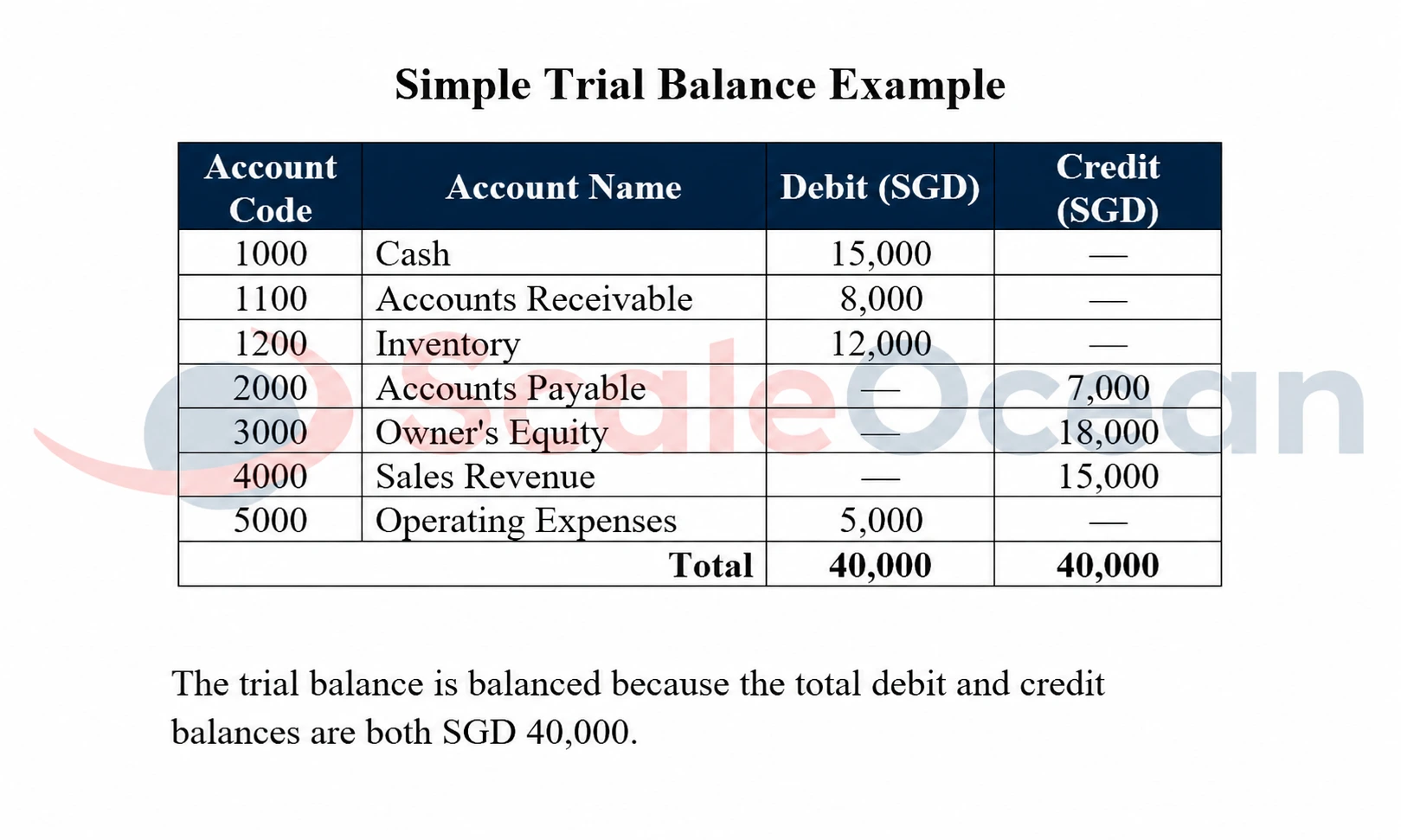
Simple Trial Balance Example
Because the total debit and credit balances are both SGD 40,000, the trial balance is mathematically balanced.
However, this does not guarantee that every transaction has been recorded correctly. Finance teams should still perform reconciliation and review unusual balances before using the information for financial reporting.
Trial Balance Accounting Template for Business
Businesses can use a structured template to organise account balances and verify whether total debits and credits are equal.
The template can be particularly useful for finance teams that still rely on spreadsheets during monthly or periodic accounting reviews.
A Docs Trial Balance Template
A ready-to-use Words template for trial balance accounting.
Businesses may prepare different types of trial balances depending on the stage of the accounting cycle.
Type
Purpose
Unadjusted Trial Balance
Lists account balances before adjusting entries are posted, helping finance teams identify initial discrepancies.
Adjusted Trial Balance
Shows account balances after adjustments such as accruals, depreciation, prepaid expenses, or other period-end entries.
Post-Closing Trial Balance
Confirms that the remaining permanent accounts are balanced after temporary revenue and expense accounts have been closed.
1. Unadjusted Trial Balance
An unadjusted trial balance lists account balances before adjusting entries are recorded. Finance teams typically prepare it after posting regular transactions to check whether total debits and credits are equal.
This initial review helps identify basic posting errors before finance teams record adjustments for items such as accrued expenses, depreciation, or prepaid expenses.
2. Adjusted Trial Balance
An adjusted trial balance includes account balances after necessary adjusting entries have been recorded. These adjustments may cover accrued expenses, depreciation, prepaid expenses, accrued revenue, and other period-end items.
The updated balances provide a more complete basis for preparing financial statements. Finance teams can also review the adjusted figures to ensure account movements reflect the appropriate accounting period.
3. Post-Closing Trial Balance
A post-closing trial balance is prepared after closing temporary accounts such as revenue and expenses. It contains the remaining permanent account balances, including assets, liabilities, and equity.
ScaleOcean Atlas can help finance teams manage connected accounting workflows and maintain clearer visibility into account balances throughout the closing process.
Difference Between Trial Balance and Balance Sheet
Although both reports use accounting balances, they serve different purposes. A trial balance is primarily an internal control report used to check account balances, while a balance sheet presents assets, liabilities, and equity for financial reporting.
Aspect
Trial Balance
Balance Sheet
Purpose
Checks whether debit and credit balances are mathematically balanced.
Shows the financial position of a business.
Main Users
Primarily finance teams and auditors.
Management, investors, lenders, auditors, and other stakeholders.
Accounts
Includes balances from various general ledger accounts.
Groups accounts into assets, liabilities, and equity.
Reporting Role
Supports the preparation and review of financial statements.
Forms part of the financial reporting process.
Difference Between Trial Balance and General Ledger
The general ledger contains the detailed accounting records behind individual account balances, while the trial balance summarises those balances in one report. Therefore, the trial balance can be viewed as a consolidated checkpoint derived from the general ledger.
Aspect
Trial Balance
General Ledger
Purpose
Checks whether total debit and credit balances are equal.
Records detailed transactions for individual accounts.
Level of Detail
Summarised account balances.
Detailed transaction-level information.
Timing
Prepared after account balances are calculated.
Updated as transactions are posted.
Relationship
Uses balances extracted from the general ledger.
Provides the underlying data used to prepare the trial balance.
Common Errors Found Through Trial Balance
A trial balance detects errors that cause total debits and total credits to be unequal, but it does not catch errors where equal debits and credits are entered incorrectly.
1. Incorrect Transaction Recording
The transaction can be entered with either an incorrect amount or to the wrong account. For instance, if SGD 5000 is reported as an expense instead of SGD 5, the balance of the related account will be underestimated.
Checking account balances could be a way for finance teams to identify abnormal activity and determine if the transaction amount, account, date, or documents were properly entered. These errors can also be avoided from being passed on in the financial reports with regular checks.
2. Missing Journal Entries
If a transaction has not been added to the ledger, you may end up with an inconsistent account balance. This may happen if an invoice, payment, adjustment, or other transaction is processed but not added to the accounting system.
Comparing supporting documents to the general ledger can help easily identify transactions not recorded. The finance team can then post the missing entries prior to month-end close.
3. Duplicate Entries
If journal entries or transaction postings are repeated, then the account balances are incorrect, and this could impact the financial statements. For instance, if the same supplier payment is made twice, the expenses might be overstated, or the cash balance may be understated unnecessarily.
Finance teams can check for duplicates by comparing transaction records to invoices, receipts, payment references, and journal entries. This eliminates the double entry, which means that each business transaction will appear only once in the accounting records.
4. Incorrect Account Classification
It is possible to post a transaction to an incorrect account even if the debits equal the credits. For instance, an operating expense may be mistakenly entered in the wrong expense category, or an asset purchase may be incorrectly reported as an operating expense.
It does not necessarily mean that a balanced trial balance is a sign of all classifications being correct. Finance staff should check the content of the accounts, the description of the transactions, and the documents supporting the transactions to make sure they are posted to the correct account.
5. Wrong Debit/Credit Entry
If a posting is made to the wrong side of an account, the sum of the debit and credit balances can be different. For instance, a debit to an asset account, which should increase the asset account, might be entered as a credit.
The kind of error typically necessitates a search by the finance teams for the related balance in the general ledger. Checking the transactions and the accounts should lead to understanding if the amount has been entered on the wrong side of the account.
6. Omitted Transaction
A missing transaction may result in missing entries in accounting records and may not necessarily affect the amounts that appear on the trial balance. This may occur if both the debit and credit sides of a transaction are omitted without being recorded, so that the debit and credit sides of the account are still equal even though the transaction doesn’t exist.
Reconcile with bank statements, invoices, receipts, purchase records, and other supporting documents. These checks are effective in bringing to light transactions that were supposed to be captured but were not done so in the ledger.
7. Duplicated Invoice Posting
Posting the same invoice more than once can inflate expenses, payables, revenue, or receivables. For example, a supplier invoice entered twice could cause the business to report a higher accounts payable balance than the amount it actually owes.
Finance teams can compare invoice numbers, transaction dates, amounts, supplier names, and ledger entries to identify potential duplicate postings. Reviewing these details before closing the accounting period can help prevent duplicated invoices from affecting financial reports.
How to Prepare a Trial Balance Step by Step
You can prepare a trial balance by listing all general ledger account closing balances and verifying that total debits equal total credits.
1. Review the Chart of Accounts
The first step is to review the chart of accounts to make sure all necessary accounts are created and categorized. This ensures uniformity in recording and summarising financial transactions.
A well-defined chart of accounts also simplifies the task of checking account balances and generating financial reports from various departments or businesses.
2. Record All Journal Entries
Make sure that all transactions for the accounting period are recorded and posted in the proper general ledger accounts. This includes transactions of all kinds that involve cash flow, such as sales, purchases, payments, expenses, payroll, adjustments, and more.
Finance departments also need to ensure that every journal entry has the proper amount, accounts, transaction date, and supporting documentation. It is important to review these details before posting so you don’t make any posting mistakes and ensure that you have complete and accurate accounting information in the trial balance.
3. Calculate Account Balances
Close each ledger account after totaling up all the debits and credits. The resulting balance is the account balance for the period of account selected.
Before these balances are incorporated into the trial balance, they should be checked for any abnormal transposition or values. With connected financial data and more transparent reporting in a single platform, ScaleOcean Atlas helps finance teams review account movements.
4. Transfer Balances Into Trial Balance
Write the name of each account and enter the closing balance for each account in the debit or credit column. This will give you a single picture of the balances in the general ledger.
A template can help make the process easier to review the chance of accidentally placing balances in the wrong column.
5. Verify Debit and Credit Totals
Total the two columns and compare the totals. If they do not match, check the journal entries, account postings, and the balances of accounts in the ledgers to find the difference.
Even if the totals are the same, finance teams should still keep reconciling and reviewing accounts, as certain accounting mistakes might not impact the total amount.
Trial Balance Challenges for Businesses
A trial balance is not designed to detect accounting errors, misclassifications, or omissions, although it does show a mathematical equality of debits and credits.
1. Manual Data Entry Errors
Using a spreadsheet makes transferring the balances of the accounts from one record to another require more steps. Errors can be added, such as entering incorrect figures, duplicating entries, missing transactions, or entering them in the wrong format into the system during re-keying.
They can become more complicated to track if the finance team has to deal with many transactions or several reporting periods. A minor input error may also necessitate extra reconciliation efforts prior to closing the trial balance.
2. Difficulty Managing Multiple Business Entities
For companies that have multiple branches or entities, they may have to prepare and consolidate trial balances from various accounting systems, currencies, and chart-of-accounts. The transaction flows and reporting requirements may also vary among each of the entities.
It gets more complex if the finance teams use multiple spreadsheets for every entity. These files can be voluminous, and the process of consolidating and doing the cross-entity recon is time-consuming and can lead to inconsistencies in financial data.
3. Delayed Month-End Closing
One of the challenges that could occur during month-end closing is manual preparation of the trial balance in case account balances need to be collected and reconciled manually. The finance team might have to wait for other departments to provide data before they can finalize reviews.
Such delays may impact financial reporting activities that come after the initial reporting, particularly if there are contradictions that need to be revisited multiple times. This means that management can be receiving financial reports later than they may have hoped for.
4. Lack of Real-Time Financial Visibility
Finance departments might not always be aware of account balances if they only update the data on a regular basis, not in real time. This makes it difficult to interpret the current financial situation between periods.
It can also make unusual movements more difficult to detect early, which will need to be manually checked before having any confidence in financial information being made available to management. There’s more timely visibility of financial transactions and balances within integrated accounting systems.
Best Practices for Managing Trial Balance
A trial balance is a bookkeeping report that lists all general ledger account balances to ensure total debits equal total credits.
1. Perform Regular Account Reconciliation
Reconciliation facilitates regular comparison of the balance in the ledger with supporting documents like bank statements, invoices, inventory records, and subsidiary ledgers.
Regularly carrying out these checks can help uncover discrepancies sooner and help minimize the volume of outstanding problems at month-end closing.
2. Maintain Accurate Chart of Accounts
A consistent chart of accounts helps businesses classify transactions correctly and maintain more reliable financial reports across departments and entities.
Finance teams should periodically review the structure to ensure accounts remain relevant as the business expands, introduces new products, or adds new entities. This also helps maintain accurate general ledger records and consistent financial reporting across the business.
3. Review Unusual Account Balances
Finance teams should not just look at the fact that the trial balance is balancing but also look at unusual increases, decreases, negative balances, and movements that are not expected.
When reviewing these exceptions, it may be possible to discover improper postings, missing postings, or unusual transactions before they become an issue in financial reporting.
4. Automate Financial Reporting Processes
Automation can minimize the repetition of data entry and enable finance teams to get account balances faster. It can also help reduce the number of manual steps needed to move data from a spreadsheet to an accounting record.
In enterprise businesses, workflows can be integrated with accounting data and sales, procurement, and inventory applications, and other business processes, providing a seamless source of financial information.
How Accounting Software Helps Automate Trial Balance Preparation
There are many things that can be automated with accounting software when it comes to gathering account balances and creating a trial balance. This eliminates the manual nature of combining data from a number of different spreadsheets in the finance team.
In addition, accounting workflows that are seamlessly integrated can help to ensure greater accuracy in data throughout financial and operational transactions, and provide finance departments with timely access to current account information.
1. Automated General Ledger Synchronization
When transactions are automatically posted to the general ledger, account balances can be updated without requiring finance teams to manually transfer information between systems.
ScaleOcean Atlas could support automated general ledger synchronisation, helping businesses maintain more consistent account balances across connected business processes.
2. Real-Time Financial Data Updates
An integrated accounting platform can connect finance data with sales, procurement, inventory, and other operational transactions. This helps reduce information gaps between departments.
With more current financial data available in one platform, finance teams can review balances and prepare reports without repeatedly collecting information from separate systems.
3. Faster Month-End Closing
Automated data updates and workflow connectivity can help minimize repetitive reconciliation and consolidation tasks. This frees up time for finance teams to review exceptions and make necessary adjustments.
Improved access to current account data can also help speed up the month-end closing process for businesses that do a large number of transactions.
4. Improved Audit Trail Management
Accounting software can maintain records of transactions, approvals, adjustments, and other financial activities. This creates greater traceability when finance teams need to investigate account movements.
ScaleOcean Atlas provides configurable accounting workflows and audit trail capabilities to support enterprise finance operations. This system has been optimized and complies with PDPA regulations and local financial reporting standards, including requirements related to IRAS and GST. Schedule a consultation with our team to explore an accounting solution suited to your business needs.
Conclusion
A trial balance is an internal accounting control tool that summarises general ledger balances and compares total debits with total credits. It supports financial reporting, reconciliation, month-end closing, and audit preparation.
For businesses managing multiple entities, high transaction volumes, and fragmented financial data, manually preparing a trial balance can create unnecessary reconciliation work and delay financial closing. Integrated accounting software can help by synchronizing ledger data, updating balances, and providing better financial visibility.
ScaleOcean Atlas Accounting Software helps enterprise businesses connect accounting with sales, procurement, inventory, and other business processes through configurable ERP workflows. With automated general ledger synchronisation, real-time financial reporting, and audit trail management, businesses can build a more connected and scalable approach to trial balance preparation and financial control.
Frequently Asked Questions Trial Balance:
1. Does a trial balance need to balance?
Yes. Under double-entry accounting, the total debit and credit balances in a trial balance should be equal. However, a balanced trial balance does not guarantee that every transaction has been recorded or classified correctly.
2. What happens if debit and credit totals do not match?
If debit and credit totals do not match, finance teams should review journal entries, account balances, transaction amounts, and posting errors. The discrepancy should be identified and corrected before the trial balance is used for further financial reporting.
3. How often should businesses prepare a trial balance?
The frequency depends on the business’s accounting process and reporting requirements. Businesses may prepare trial balances during month-end closing, quarterly reporting, year-end procedures, or more frequently when they require closer financial monitoring.
4. Can accounting software generate a trial balance automatically?
Yes. Accounting software can generate a trial balance automatically when transactions are recorded and posted to the general ledger. Integrated systems can also update account balances and reduce manual consolidation work. IRAS encourages businesses to use accounting software to manage business transactions and support record-keeping processes.














 Key Takeaways