



Apparel ERP software is an enterprise resource planning system that connects apparel production, inventory, purchasing, sales, finance, and supply chain operations. For Singapore businesses, it manages styles, variants, materials, deadlines, and margins.
However, apparel companies often coordinate suppliers, factories, warehouses, retailers, and digital channels through disconnected spreadsheets and applications. Consequently, teams can struggle to maintain accurate material availability, production schedules, inventory balances, and profitability.
Apparel operations also face changing demand, shorter product cycles, rising material costs, and strict delivery commitments. Therefore, businesses need connected planning and visibility to coordinate procurement, production, quality, fulfillment, and financial decisions.
For Singapore apparel manufacturers, the right ERP can influence production efficiency, inventory accuracy, cost control, and supply chain responsiveness. This guide compares leading apparel ERP software in 2026 and highlights essential criteria.
 Key Takeaways
- Apparel ERP software is a platform that centralizes operational and financial processes from sourcing through production, inventory, sales, and fulfillment.
- The top 10 apparel ERP software options include specialized fashion platforms and broader ERP systems for different operational needs.
- Choosing apparel ERP software requires evaluating business models, existing technology, integrations, growth stages, implementation requirements, and long-term operational needs.
- ScaleOcean Manufacturing Software connects apparel production, material planning, costing, quality, traceability, and supply chain workflows while providing AI-assisted insights for manufacturers.
What Is Apparel ERP Software?
Apparel ERP software is a platform that centralizes operational and financial processes from sourcing through production, inventory, sales, and fulfillment. Unlike generic ERP systems, apparel platforms typically accommodate styles, colors, sizes, materials, costing, and production.
Because apparel businesses manage numerous product combinations, ERP systems must connect product data with material planning, purchasing, scheduling, inventory, quality, and accounting. This integration improves visibility while reducing duplicate entries and reconciliation.
 Also Read: What is Manufacturing ERP Software? Best 12 System 2026
Summary Comparison of the Best Apparel ERP Software in 2026
The comparison below highlights ten apparel ERP platforms based on positioning, deployment, typical use cases, and publicly available starting prices. Prices vary according to users, modules, implementation scope, integrations, and regional requirements.
For Singapore enterprises, the strongest option depends on operational complexity rather than feature volume alone. Manufacturing-focused companies should prioritize MRP, production scheduling, material control, costing, quality, traceability, analytics, and supply chain visibility.
| Platform | Best For | Pricing |
|---|---|---|
| ScaleOcean | Medium to large enterprise apparel manufacturing, needing smart MRP, integrated production and supply chain management, accurate costing, quality tracking, and AI-assisted insights | Custom pricing with unlimited users and flat pricing |
| AIMS360 | Apparel brands, manufacturers, and multi-channel operations | Custom pricing |
| ApparelMagic | Fashion brands and apparel manufacturing | $337/month |
| Uphance | Multi-channel apparel operations | Custom pricing |
| Aptean Apparel ERP | Apparel, footwear, and accessories businesses | Custom pricing |
| Infor CloudSuite Fashion | Enterprise fashion and textile operations | Custom pricing |
| BlueCherry by CGS | Apparel manufacturing and supply chain operations | Custom pricing |
| MRPeasy | Small and mid-sized manufacturing businesses | $49/user/month |
| Odoo ERP | Configurable manufacturing and business operations | $24.90/user/month |
| Oracle Cloud / NetSuite ERP | Enterprise financial and operational management | Custom pricing |
Top 10 ERP Software for the Apparel Industry in 2026
The following platforms represent different approaches to apparel ERP, from manufacturing-focused systems to specialized fashion platforms and broader enterprise ERP solutions. Their suitability depends on each company’s processes, integrations, and operational requirements.
For apparel manufacturers in Singapore, key evaluation areas include production planning, MRP, fabric inventory, BOM and variant management, costing, quality, traceability, and supply chain visibility. These capabilities help connect operational decisions with production and financial outcomes.
1. ScaleOcean
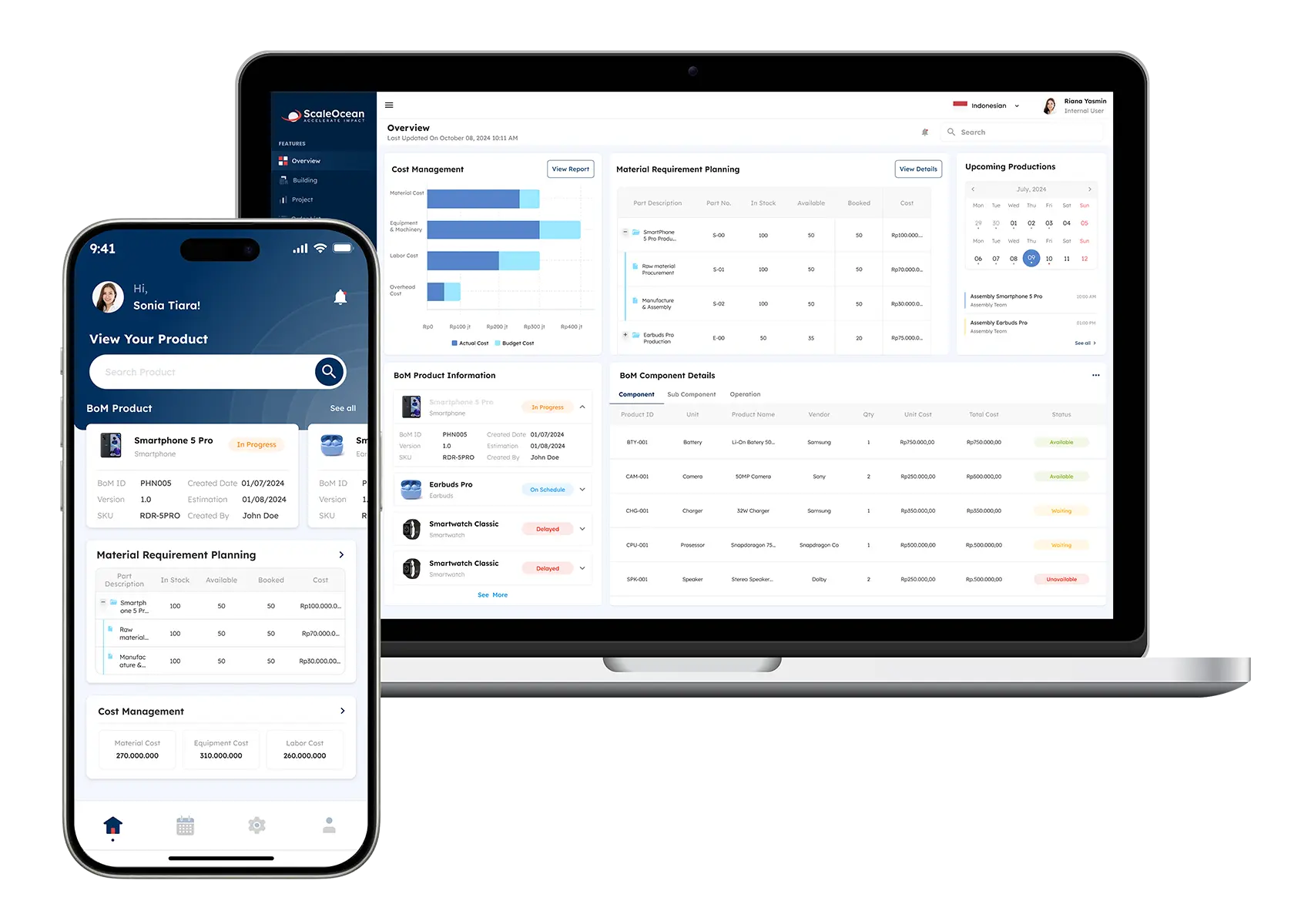
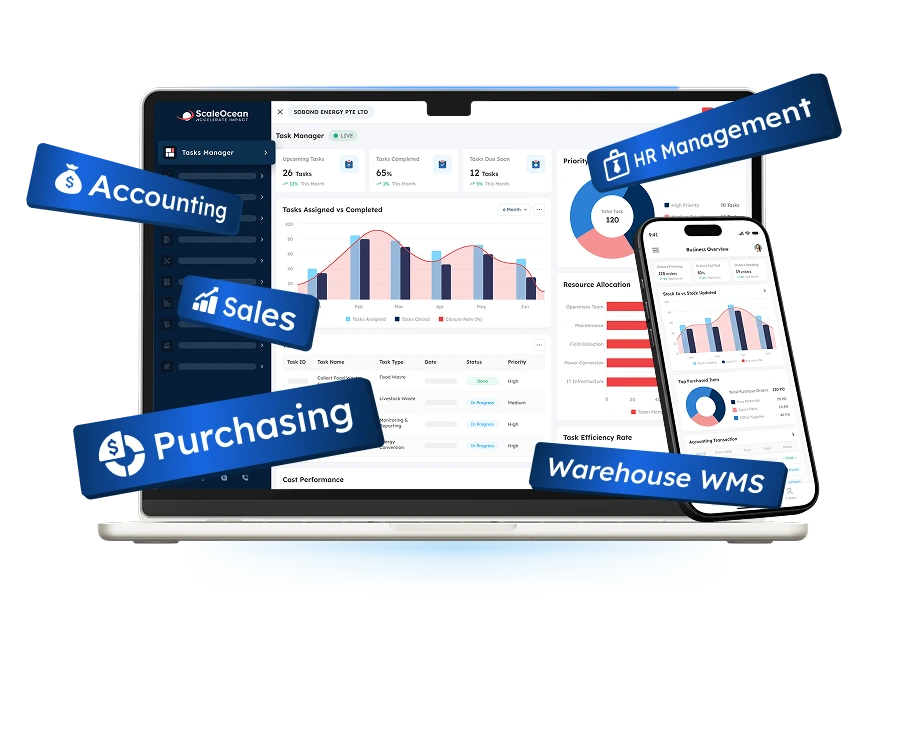
ScaleOcean Atlas for Manufacturing helps Singapore apparel manufacturers move beyond traditional ERP by combining connected manufacturing workflows with ScaleMind AI-powered insights, enabling smarter planning, accurate costing, and greater operational visibility across the apparel value chain.
Additionally, Smart MRP supports material planning, while BOM, costing, scheduling, and supply chain capabilities address key apparel manufacturing requirements. ScaleMind AI can further support manufacturing insights and reporting for more informed operational decisions.
ScaleOcean also supports PDPA compliance, IRAS and GST reporting requirements, and eligibility for EDG and CTC claims, helping businesses operate confidently. Schedule a consultation with our experts to discuss your business requirements and ERP implementation needs to streamline your supply chain activities.
Key Features of ScaleOcean Manufacturing Software:
- Integrated Production Planning & Scheduling: Coordinates production stages, work orders, and deadlines to help apparel manufacturers maintain efficient workflows and meet customer delivery requirements.
- MRP + Fabric Inventory Management: Plans material requirements while tracking fabric inventory, helping businesses reduce shortages, excess stock, and production disruptions.
- BOM & Variant Management: Organizes bills of materials alongside different styles, sizes, colors, and product variants for more accurate production preparation.
- Costing & Profitability Analysis: Tracks production costs across materials and operations, helping management evaluate product profitability and protect margins.
- Quality Management & Traceability: Monitors quality processes and production information to support consistent output, accountability, and greater supply chain transparency.
| Pros | Cons |
|---|---|
|
|
Best For: Medium to large enterprise apparel manufacturers in Singapore needing connected production and supply chain workflows, with precise material planning, variant management, costing, quality tracking, and AI-assisted insights for operational decisions.
ℹ️ Why Choose ScaleOcean for Apparel ERP Software?
ScaleOcean connects production, material planning, inventory, costing, quality, and supply chain processes while supporting PDPA compliance and IRAS and GST reporting requirements. Its ScaleMind AI capabilities also provide manufacturing insights, while EDG and CTC claim eligibility can further support Singapore businesses adopting the platform.
2. AIMS360
AIMS360 apparel ERP software provides cloud-based tools for product management, production, inventory, orders, accounting, and distribution. It is designed for apparel manufacturers, wholesalers, importers, and distributors managing multiple product variations.
Additionally, the platform connects production tracking, vendor management, warehouse operations, sales channels, and financial processes. Its style, color, and size structure helps businesses organize apparel products across different operational workflows.
Key Features:
- Style, color, and size management
- Production and BOM tracking
- Multi-channel order management
- Warehouse and inventory management
| Pros | Cons |
|---|---|
|
|
Best For: Mid-sized to large apparel manufacturers, wholesalers, importers, and distributors managing complex product ranges, multiple sales channels, and interconnected production and inventory processes.
ℹ️ Why Choose AIMS360 for Apparel ERP Software?
AIMS360 can suit businesses seeking an apparel-focused platform that brings product, production, inventory, orders, and financial workflows together within one system.
3. ApparelMagic
ApparelMagic ERP software provides tools for product development, inventory, manufacturing, purchasing, sales, accounting, and wholesale operations. It is designed for fashion and apparel businesses managing products throughout their lifecycle.
Furthermore, the platform supports product variations, raw materials, production activities, forecasting, and business operations. Its functions can help teams manage apparel processes from product creation through sales and fulfillment.
Key Features:
- Product and SKU management
- Manufacturing management
- Inventory tracking
- Wholesale and B2B tools
| Pros | Cons |
|---|---|
|
|
Best For: Small to mid-sized apparel brands and manufacturers that need product, inventory, manufacturing, and wholesale management within a dedicated fashion-oriented business platform.
ℹ️ Why Choose ApparelMagic for Apparel ERP Software?
ApparelMagic can be considered by businesses wanting specialized apparel management functions combined with manufacturing, inventory, wholesale, and financial processes.
4. Uphance
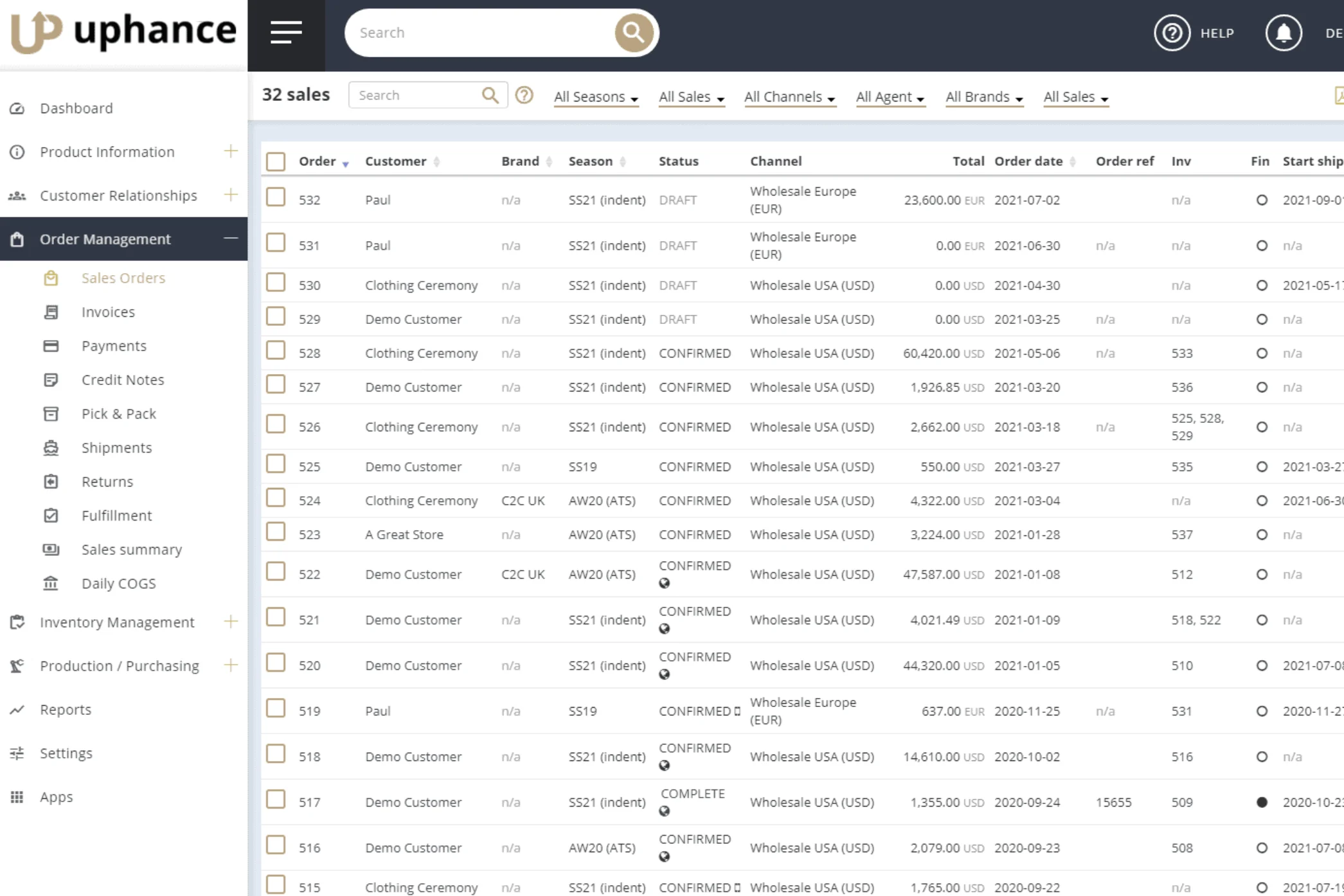
Uphance apparel ERP software combines product development, inventory, production, orders, warehouse operations, accounting, and reporting. It is designed for apparel businesses managing wholesale, direct-to-consumer, and other sales channels.
Moreover, the platform connects product information with production and inventory workflows while supporting business operations across different channels. Its structure helps businesses manage apparel activities without relying entirely on separate systems.
Key Features:
- Product lifecycle management
- Production management
- Inventory and warehouse management
- Order and sales management
| Pros | Cons |
|---|---|
|
|
Best For: Small to mid-sized apparel brands managing product development, production, inventory, wholesale, and direct-to-consumer operations across several sales channels.
ℹ️ Why Choose Uphance for Apparel ERP Software?
Uphance can fit businesses looking for a connected apparel platform that combines product, production, inventory, orders, and warehouse activities in one environment.
5. Aptean Apparel ERP
Aptean Apparel ERP software supports businesses across apparel, footwear, and accessories with functions covering product development, manufacturing, distribution, supply chain, and finance. It is designed for companies with specialized fashion operations.
Additionally, the platform brings operational and financial processes into a connected environment for managing purchasing, inventory, production, sales, and distribution. Its capabilities can support businesses with complex supply chain requirements.
Key Features:
- Apparel production management
- Inventory and purchasing
- Distribution management
- Financial management
| Pros | Cons |
|---|---|
|
|
Best For: Mid-sized to large apparel, footwear, and accessories companies that require integrated manufacturing, distribution, supply chain, and financial management.
ℹ️ Why Choose Aptean Apparel ERP?
Aptean can suit organizations looking for industry-oriented ERP capabilities that connect apparel operations with supply chain, distribution, and financial processes.
6. Infor CloudSuite Fashion
Infor CloudSuite Fashion apparel ERP software provides cloud-based business management capabilities for fashion, apparel, footwear, accessories, and related textile businesses. It combines enterprise processes with fashion-specific operational requirements.
Furthermore, the platform can support areas such as finance, supply chain, product lifecycle management, planning, analytics, and inventory. This broad coverage allows businesses to manage multiple operational functions within a connected environment.
Key Features:
- Fashion product management
- Supply chain management
- Financial management
- Analytics and planning
| Pros | Cons |
|---|---|
|
|
Best For: Large apparel, footwear, accessories, and textile enterprises requiring broad ERP functionality across finance, supply chain, product management, and business operations.
ℹ️ Why Choose Infor CloudSuite Fashion for Apparel ERP?
Infor can be considered by larger organizations seeking cloud ERP capabilities that combine fashion-related processes with wider enterprise management functions.
7. BlueCherry by CGS
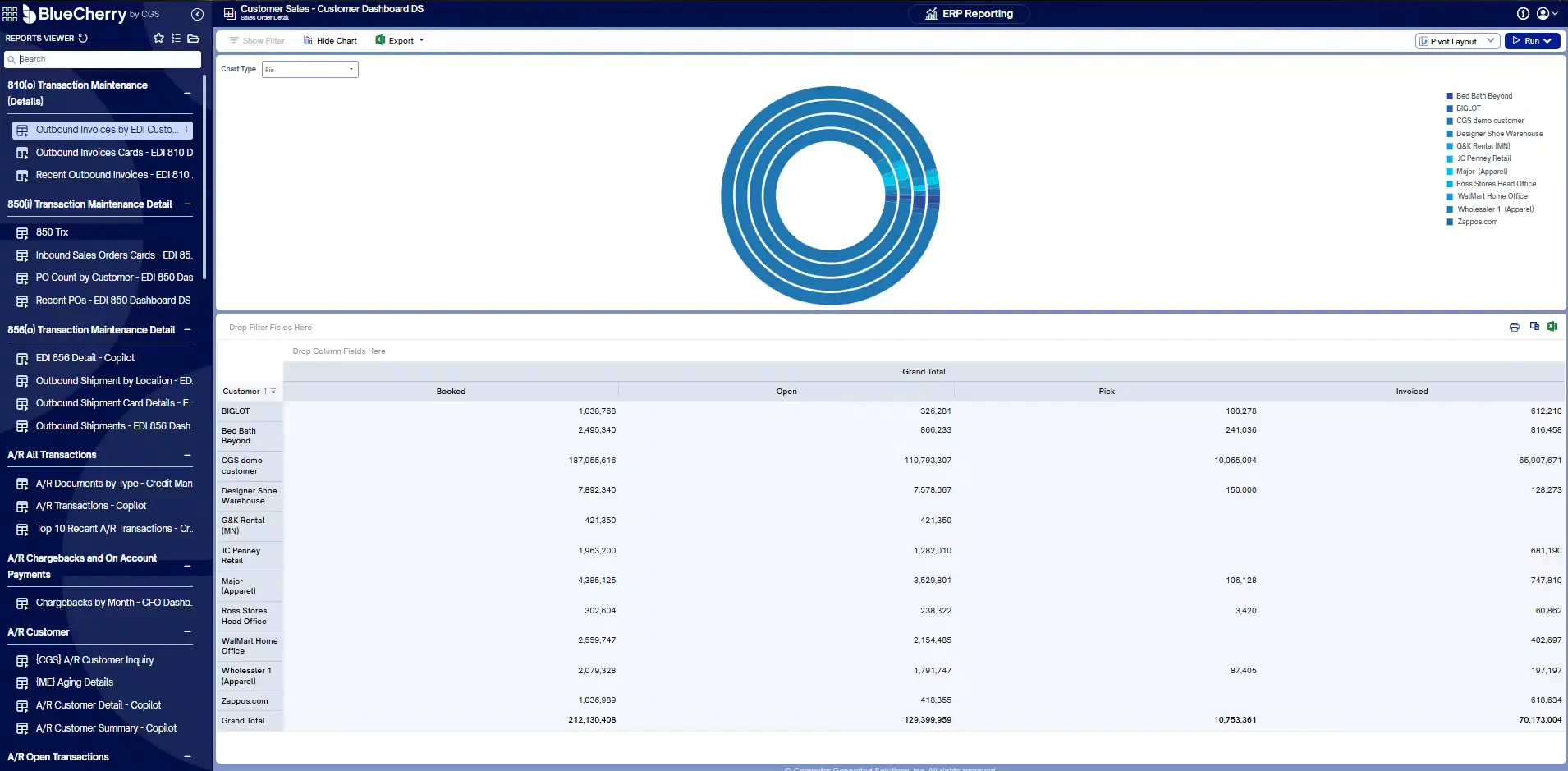
BlueCherry apparel ERP software combines ERP, product lifecycle management, production control, warehouse management, planning, EDI, and analytics. It is designed for fashion, apparel, and related businesses managing connected supply chain activities.
Additionally, the platform supports operational processes such as inventory, costing, order management, and production. Businesses can use these functions to coordinate activities across different stages of the apparel supply chain.
Key Features:
- ERP and production management
- Product lifecycle management
- Warehouse management
- EDI and supply chain tools
| Pros | Cons |
|---|---|
|
|
Best For: Mid-sized to large apparel and fashion businesses that need integrated production, warehouse, product, EDI, and supply chain management across broader operations.
ℹ️ Why Choose BlueCherry for Apparel ERP?
BlueCherry can suit businesses seeking an apparel-oriented platform that combines ERP with production, warehouse, PLM, EDI, and supply chain capabilities.
8. MRPeasy
MRPeasy apparel ERP software provides manufacturing management tools for production planning, inventory, purchasing, BOMs, and shop floor activities. It is designed primarily for small and mid-sized manufacturers across different industries.
However, MRPeasy is a general manufacturing platform rather than an apparel-specific system. Therefore, apparel companies may need additional configuration or integrations when managing specialized style, size, color, or fashion workflows.
Key Features:
- Production planning
- BOM management
- Inventory control
- Purchasing management
| Pros | Cons |
|---|---|
|
|
Best For: Small to mid-sized apparel manufacturers that primarily need production, inventory, purchasing, and BOM management without requiring extensive fashion-specific functionality.
ℹ️ Why Choose MRPeasy for Apparel ERP?
MRPeasy can work for apparel manufacturers prioritizing straightforward manufacturing management and requiring core production, inventory, purchasing, and planning capabilities.
9. Odoo ERP
Odoo apparel ERP software provides modular applications for manufacturing, inventory, purchasing, sales, accounting, ecommerce, and business management. Its manufacturing tools include production planning, BOMs, work orders, quality, and traceability.
Furthermore, Odoo supports product variants, warehouse operations, replenishment, barcode processes, and inventory traceability. Businesses can select applications according to their requirements and connect different operational functions within one ecosystem.
Key Features:
- Manufacturing and MRP
- Inventory and warehouse management
- Product variants
- Accounting and ecommerce
| Pros | Cons |
|---|---|
|
|
Best For: Small to mid-sized apparel businesses seeking configurable ERP applications that cover manufacturing, inventory, ecommerce, accounting, and other general business processes.
ℹ️ Why Choose Odoo for Apparel ERP Software?
Odoo can suit businesses that prefer a modular ERP environment where manufacturing, inventory, sales, e-commerce, accounting, and other applications can be combined.
10. Oracle Cloud / NetSuite ERP
NetSuite apparel ERP software provides cloud-based capabilities for financial management, inventory, procurement, order management, and supply chain operations. It is primarily positioned as a broad enterprise ERP rather than an apparel-specific system.
Moreover, businesses can extend the platform through configurations, integrations, and additional applications for specialized industry requirements. This approach allows companies to manage multiple entities, locations, currencies, and operational processes within one environment.
Key Features:
- Financial management
- Inventory and order management
- Procurement management
- Supply chain management
| Pros | Cons |
|---|---|
|
|
Best For: Mid-sized to large apparel companies requiring broad enterprise management across finance, inventory, procurement, orders, and supply chain operations.
ℹ️ Why Choose NetSuite for Apparel ERP Software?
NetSuite can be considered by businesses seeking a broad cloud ERP foundation that can be configured and integrated around specific apparel business requirements.
Challenges of Apparel Manufacturing Without ERP Software

Without apparel ERP software, manufacturers often manage product styles, materials, production schedules, inventory, purchasing, and accounting across disconnected spreadsheets. Consequently, teams spend more time reconciling information and correcting avoidable data inconsistencies.
- Fragmented Data Management: Teams rely on disconnected spreadsheets and systems, making it difficult to maintain accurate operational information.
- Complex Style and Variant Management: Managing thousands of style, color, size, and material combinations can create errors and duplicated records.
- Inventory Inaccuracy: Limited real-time visibility can cause stockouts, excess inventory, inaccurate availability, and overselling and can be countered by using a manufacturing inventory software.
- Poor Production Visibility: Managers may struggle to track work orders, production progress, bottlenecks, and delivery schedules.
- Material Planning Issues: Without integrated MRP, businesses can experience material shortages, excess purchasing, and production delays.
- Inaccurate Product Costing: Manual calculations can overlook changing fabric, labor, shipping, and overhead costs, reducing profit margins.
- Disconnected Design and Production: Product specifications may require repeated manual transfers between PLM, design, procurement, and manufacturing teams.
- Supply Chain Disruptions: Limited supplier and procurement visibility makes it harder to identify delays, shortages, and sourcing risks early.
- Retailer Compliance Problems: Manual EDI, labeling, documentation, and order requirements can increase administrative work and compliance errors.
- Limited Business Visibility: Without centralized reporting, management may struggle to evaluate production performance, inventory, costs, profitability, and supply chain efficiency.
Why Is ERP Software Important for the Apparel Industry?
ERP software is important for apparel businesses because it connects product development, material planning, production, inventory, sales, and finance through centralized workflows. As a result, teams can coordinate operations using consistent information.
For Singapore apparel manufacturers, integrated ERP capabilities can strengthen supply chain visibility while supporting tighter production schedules and material planning. Furthermore, connected costing and profitability data helps management evaluate margins before committing resources.
Similar integration also benefits other manufacturing sectors, including businesses using ERP for food industry operations to coordinate production, inventory, procurement, and supply chain activities.
1. Master the Complexity of the “Style Matrix”
Apparel companies manage products through combinations of styles, colors, sizes, fabrics, and other attributes. An ERP system structures these variants within centralized product records, helping teams manage complex assortments without creating disconnected inventory entries.
Furthermore, style matrix management connects product variants with purchasing, inventory, production, and sales processes. This approach allows teams to identify availability by specific combinations while reducing manual calculations and product-data inconsistencies.
2. Eliminates Inventory Mistakes and Overselling
Apparel ERP software synchronizes inventory information across warehouses, sales channels, production, and purchasing. Therefore, teams gain clearer visibility into available, allocated, committed, and incoming stock before accepting new customer orders.
Additionally, centralized inventory data reduces the risk of overselling products that other orders have already reserved. Businesses can consequently improve stock accuracy, reduce fulfillment issues, and make replenishment decisions using current information.
A real-world example comes from a case reported by The Golf Wire, which reported that Full Turn Custom Apparel connected its apparel operations to a centralized ERP system and improved visibility across inventory, production, fulfillment, and profitability.
The company reported saving 2–4 hours weekly on inventory availability checks and operating three distinct business lines without adding home-office headcount over five years. This example shows why apparel businesses need ERP systems that connect sales information with operational data.
By maintaining more accurate inventory and production information, businesses can make better availability decisions and reduce manual work across order and fulfillment processes.
3. Connects Design (PLM) Directly to Production
Connecting product lifecycle management with production helps apparel businesses move product specifications into manufacturing workflows more efficiently. Consequently, teams can reduce information gaps between designers, merchandisers, planners, procurement teams, and factory operations.
Moreover, centralized product information can connect materials, specifications, bills of materials, revisions, and production requirements. This integration helps manufacturers maintain consistency when styles change and reduces the risk of producing outdated specifications.
4. Maximizes Profit Margins with Accurate Costing
Apparel ERP software can consolidate material, labor, manufacturing, logistics, and other production costs into centralized costing workflows. Therefore, management can evaluate product profitability more accurately before approving production or accepting customer orders.
Furthermore, integrated costing allows businesses to compare estimated costs with actual production expenses throughout operations. This visibility helps teams identify unfavorable variances, protect margins, and make more informed pricing decisions.
5. Automates Retailer Compliance
Retailers often impose specific requirements covering product information, packaging, labeling, documentation, delivery schedules, and electronic transactions. ERP software helps businesses standardize these requirements within connected order, warehouse, fulfillment, and compliance workflows.
Additionally, automated processes reduce repetitive administrative work when managing multiple retailer requirements. As a result, apparel businesses can improve order accuracy, minimize compliance-related errors, and maintain more consistent fulfillment performance.
Core Features of Apparel ERP Software

Apparel ERP software should combine specialized product management with manufacturing, inventory, supply chain, sales, and financial capabilities. For enterprise businesses, these connected functions create greater operational visibility while reducing repetitive manual processes.
When evaluating platforms, businesses should prioritize capabilities that address apparel-specific complexity rather than selecting software solely based on generic ERP functions. The right system should support product variants, material planning, production control, costing, fulfillment, and compliance.
1. Style, Color, and Size Matrix
A style, color, and size matrix organizes apparel variants within a structured product framework. This feature allows businesses to manage multiple combinations without maintaining separate disconnected records for every individual SKU.
Furthermore, the matrix can connect variants with inventory, purchasing, sales, and production processes. Therefore, teams can identify stock availability and requirements for specific sizes or colors while maintaining more accurate product information.
2. Integrated PLM (Product Lifecycle Management)
Integrated PLM centralizes product specifications, materials, measurements, revisions, and development information throughout the product lifecycle. Consequently, apparel teams can maintain consistent information as products progress from design into production.
Moreover, connecting PLM with ERP enables approved product data to flow into manufacturing and procurement processes. This reduces manual re-entry and helps production teams work with current specifications, materials, and requirements.
3. Omnichannel Order & Inventory Management
Omnichannel order and inventory management connects customer orders with stock across stores, ecommerce channels, warehouses, and other selling platforms. As a result, businesses can maintain more consistent inventory availability across multiple channels.
Additionally, centralized order visibility helps teams coordinate allocations, reservations, fulfillment, and replenishment. This reduces the risk of overselling while helping businesses provide more accurate product availability information to customers.
4. Supply Chain Management
Supply chain management capabilities connect suppliers, procurement, material requirements, inventory, production, and fulfillment activities. Therefore, apparel businesses can monitor material availability and coordinate purchasing decisions with upcoming production requirements.
Furthermore, stronger supply chain visibility helps managers identify delays, shortages, and supplier-related risks earlier. Businesses can then adjust procurement or production plans before disruptions significantly affect customer delivery commitments.
These supply chain requirements also apply to other manufacturing sectors, where ERP for packaging industry operations can help connect purchasing, materials, inventory, and production activities.
5. Production Tracking
Production tracking provides visibility into work orders, production stages, quantities, progress, and completion status. Consequently, managers can monitor whether manufacturing activities remain aligned with planned schedules and customer delivery requirements.
Moreover, real-time production information helps teams identify bottlenecks and unexpected delays earlier. This enables production managers to reallocate resources, adjust schedules, and communicate more accurate completion expectations across departments.
Similar production visibility is important in regulated manufacturing sectors, including businesses using ERP for medical device manufacturers to coordinate production records and operational information.
6. Multichannel Fulfillment
Multichannel fulfillment coordinates order processing, inventory allocation, warehouse activities, shipping, and delivery across different sales channels. This capability helps apparel companies manage wholesale, retail, ecommerce, marketplace, and other fulfillment requirements.
Additionally, centralized fulfillment workflows reduce manual coordination between sales and warehouse teams. As a result, businesses can process orders more consistently while improving shipment accuracy and maintaining clearer fulfillment visibility.
7. EDI (Electronic Data Interchange) Compliance
EDI enables apparel businesses to exchange standardized business documents electronically with retailers, suppliers, distributors, and other trading partners. Therefore, companies can automate transactions such as purchase orders, invoices, shipment notices, and order confirmations.
Furthermore, ERP-integrated EDI reduces repetitive data entry between systems and helps standardize retailer transactions. This can improve processing speed, reduce transmission errors, and support compliance with trading partners’ operational requirements.
8. Accounting Management Integrated
Integrated accounting connects financial records with purchasing, inventory, production, sales, and other operational transactions. Consequently, finance teams can access financial information without repeatedly collecting data from separate operational systems.
Moreover, connecting accounting with manufacturing enables businesses to evaluate production costs, inventory values, revenues, and profitability using shared information. This provides management with stronger financial visibility for operational and strategic decisions.
9. Vendor Relationship Management
Vendor relationship management centralizes supplier information, purchasing activities, performance records, pricing, and relevant procurement data. As a result, apparel companies can evaluate suppliers more consistently while coordinating materials and production requirements.
Additionally, centralized vendor information helps purchasing teams monitor supplier performance, delivery reliability, quality issues, and costs. This supports more informed sourcing decisions and helps businesses respond faster when supplier problems threaten production schedules.
How to Choose the Right Apparel ERP Software
Choosing apparel ERP software requires businesses to evaluate operational requirements, existing systems, integrations, scalability, and implementation capabilities. Therefore, companies should assess software against their actual workflows rather than selecting platforms based solely on features.
1. Define Your Primary Business Model
First, identify whether your business primarily manufactures apparel, operates fashion brands, manages wholesale distribution, sells directly to consumers, or combines several models. Different business models require different ERP capabilities and workflows.
For manufacturers, prioritize MRP, production scheduling, BOM management, material planning, costing, and quality control. Meanwhile, brands may need stronger product lifecycle management, omnichannel inventory, ecommerce, wholesale, and fulfillment capabilities.
2. Evaluate Your Existing Tech
Review your current ERP, accounting software, ecommerce platforms, warehouse systems, PLM tools, spreadsheets, and other applications before selecting replacement software. This assessment reveals duplicate functions, information gaps, and processes requiring integration.
Furthermore, document which systems currently store critical information and identify where employees manually transfer data. This helps determine whether the new ERP should replace, integrate, or retain existing technologies.
This evaluation is equally important for specialized manufacturers, such as companies considering ERP for chemical manufacturers, where existing production and inventory systems may have specific operational requirements.
3. Map Your Must-Have Integrations
List every system that must exchange information with the apparel ERP, including ecommerce platforms, marketplaces, accounting software, warehouses, EDI providers, payment systems, and logistics partners. Prioritize integrations that directly affect daily operations.
Additionally, verify whether vendors provide native connectors, APIs, middleware compatibility, or implementation support for your required systems. This reduces integration risks and helps prevent unexpected development costs after deployment.
4. Match the Software to Your Growth Stage
Consider your current transaction volumes, number of users, locations, product variants, sales channels, and production complexity when evaluating ERP platforms. Therefore, choose software that supports current requirements without creating unnecessary complexity.
However, the system should also accommodate expected expansion into new markets, warehouses, products, channels, or entities. Scalable architecture can reduce the disruption and expense associated with replacing ERP software again.
5. Plan for Implementation Reality
ERP implementation requires more than purchasing software because businesses must prepare data, workflows, integrations, users, training, testing, and change management. Consequently, companies should establish realistic timelines and assign clear responsibilities before implementation begins.
Moreover, evaluate vendor implementation methodology, support availability, migration capabilities, training resources, and post-launch assistance. A practical implementation plan helps organizations reduce operational disruption while improving adoption across departments.
Traditional ERP Software vs. Modern Apparel ERP Software
Traditional ERP software typically focuses on core functions such as accounting, purchasing, inventory, and basic production management. While these capabilities remain valuable, they may require significant customization to accommodate apparel-specific product variants and workflows.
Modern apparel ERP software combines traditional enterprise functions with capabilities designed around fashion and apparel operations. These platforms increasingly connect PLM, style matrices, MRP, production, omnichannel inventory, analytics, EDI, and supply chain management.
Similar industry-specific approaches appear across other sectors, including ERP for FMCG industry operations that require connected inventory, sales, procurement, and supply chain processes.
| Aspects | Traditional ERP Software | Modern Apparel ERP Software |
|---|---|---|
| Product management | Generic item records | Style, color, size, and variant management |
| Production | Standard manufacturing workflows | Apparel-specific planning, scheduling, and costing |
| Inventory | Basic stock tracking | Multi-channel and variant-level visibility |
| PLM | Often separate | Integrated or closely connected |
| Analytics | Standard reporting | Real-time and AI-assisted insights |
| Integrations | Requires customization | APIs, connectors, and industry integrations |
| Deployment | Often on-premise or hybrid | Primarily cloud-based |
| Scalability | Depends on infrastructure | Designed for flexible expansion |
Trends in ERPs for the Apparel Industry
Apparel ERP technology continues to evolve as manufacturers and brands respond to shorter product cycles, supply chain uncertainty, sustainability requirements, and increasingly complex customer expectations. Therefore, businesses should consider emerging capabilities alongside current operational needs.
Modern platforms increasingly combine ERP data with artificial intelligence, cloud infrastructure, automation, digital product information, and connected design processes. These developments can help apparel companies improve responsiveness while reducing manual coordination across their value chain.
1. Generative AI for Supply Chain and Design
Generative AI can help apparel businesses analyze operational information, summarize trends, generate product concepts, and support planning decisions. Consequently, teams can use AI-assisted insights to evaluate demand, materials, production requirements, and potential supply chain disruptions.
Furthermore, AI can help employees interact with enterprise data through natural-language queries and automated recommendations. However, businesses should maintain appropriate controls around data accuracy, permissions, privacy, and human approval for consequential decisions.
2. Digital Product Passports (DPP) & ESG Compliance
Digital Product Passports provide structured information about products, materials, origins, and other lifecycle characteristics. As sustainability expectations and regulatory requirements develop, apparel businesses increasingly need better product-level traceability and information management.
ERP systems can support these requirements by connecting product, purchasing, supplier, inventory, production, and traceability information. Therefore, businesses can establish more consistent data foundations for sustainability reporting and future digital product requirements.
3. Hyper-Automation via Low-Code/No-Code Integrations
Low-code and no-code technologies allow businesses to automate workflows and connect applications without developing every integration from scratch. This can help apparel companies automate approvals, notifications, data transfers, and routine operational processes.
Moreover, configurable automation allows teams to adapt workflows as business requirements change. However, organizations should maintain governance over integrations, access permissions, data quality, and automation logic to avoid creating uncontrolled system dependencies.
4. Direct 3D Design-to-ERP Workflows
Three-dimensional product design can provide detailed digital representations before physical samples reach production. Connecting these design environments with ERP and PLM systems can reduce repeated data entry and improve communication between development and manufacturing teams.
Furthermore, digital design information can support faster product development and sampling decisions when connected with material and production data. This creates a more continuous workflow from product concept through manufacturing preparation.
5. Omnichannel Agility & Unified Commerce
Omnichannel commerce requires businesses to coordinate product information, inventory, orders, pricing, fulfillment, and customer experiences across multiple channels. Therefore, ERP platforms increasingly provide centralized operational data to support consistent availability and order processing.
Additionally, unified commerce helps businesses connect wholesale, retail, ecommerce, marketplaces, and other channels within coordinated workflows. This improves inventory visibility while enabling companies to respond faster when demand shifts between sales channels.
6. Specialized Cloud Infrastructure for Sub-Sectors
Cloud ERP infrastructure continues becoming more specialized for industries with distinct operational requirements, including apparel, footwear, accessories, and textile manufacturing. These platforms can provide configurable capabilities without requiring businesses to maintain extensive on-premise infrastructure.
Moreover, specialized cloud systems can support scalability, remote collaboration, centralized data, and frequent software updates. For Singapore apparel enterprises, this approach can provide greater flexibility when coordinating regional suppliers, production partners, warehouses, and sales channels.
Conclusion
Apparel ERP software connects production, inventory, costing, supply chain, and financial processes, helping businesses manage product variants, materials, schedules, and profitability more efficiently across complex apparel operations.
ScaleOcean supports connected production and supply chain workflows with Smart MRP, costing, quality, traceability, and ScaleMind AI insights. It also supports PDPA compliance and IRAS and GST reporting requirements.
For Singapore apparel businesses seeking visibility, ScaleOcean provides an integrated foundation for smarter planning and decisions. Schedule a consultation with our experts to discuss implementation and EDG and CTC claim options.
FAQ Apparel ERP Software:
1. Is apparel ERP software suitable for apparel brands, garment manufacturers, or both?
Apparel ERP software can support both apparel brands and garment manufacturers. Brands can manage products, inventory, orders, and supply chains, while manufacturers can manage materials, production, costing, quality, and scheduling.
2. What is the difference between apparel ERP software and generic manufacturing ERP?
Apparel ERP software includes industry-specific tools for style, color, size, variants, product development, and apparel production. Generic manufacturing ERP typically provides broader functions for production, inventory, purchasing, and costing.
3. What software integrations should apparel businesses consider when choosing an ERP?
Apparel businesses should consider integrations with accounting, ecommerce, POS, CRM, PLM, WMS, EDI, logistics, payment gateways, and marketplace platforms. The right integrations depend on sales channels, production workflows, and supply chain needs.
4. What company size needs apparel ERP software in Singapore?
Small apparel businesses can benefit from ERP as operations grow, while mid-sized and large companies often need it for complex production, inventory, and supply chains. The right timing depends on operational complexity rather than headcount alone.




















.png)