











ScaleOcean vs Tigernix ERP compares two enterprise resource planning platforms that help Singapore businesses coordinate finance, operations, inventory, and workforce activities. However, selecting the right system requires more than reviewing feature lists.
Many enterprise buyers understand their ERP requirements, yet struggle to identify which platform genuinely fits existing workflows and operational priorities. Therefore, vendor comparison must examine business fit, scalability, customization, and implementation.
As business complexity increases, companies need software that expands without creating expensive customization projects or disconnected processes. Meanwhile, decision-makers expect ERP platforms to transform operational data into practical insights for faster decisions.
This comparison evaluates ScaleOcean and Tigernix through those priorities, helping Singapore enterprises assess functionality, flexibility, deployment considerations, and long-term value. Ultimately, the goal is to identify which ERP better supports sustainable growth.
 Key Takeaways
- ScaleOcean vs Tigernix ERP comparison highlights differences in functionality, customization, scalability, implementation, and suitability for Singapore enterprises.
- User feedback reveals ScaleOcean’s strengths in implementation support, customer service, integration, and value, while comparable Tigernix ratings remain limited.
- ScaleOcean and Tigernix pros and cons offer distinct advantages and limitations, requiring businesses to evaluate customization, complexity, implementation, scalability, and operational priorities.
- ScaleOcean helps Singapore businesses streamline operations through industry-specific solutions, integrated departments, ScaleMind AI, configurable workflows, scalability, and consultation-based implementation.

ScaleOcean vs Tigernix ERP: Quick Comparison Overview
ScaleOcean and Tigernix ERP both support business operations, but their positioning differs across enterprise requirements and implementation priorities. The following comparison highlights where each platform may fit, helping Singapore businesses evaluate their options more effectively.
| Aspect | ScaleOcean ERP | Tigernix ERP |
|---|---|---|
| Target Business | Medium to large-sized enterprises with complex business workflows that require highly configurable ERP modules. | Businesses seeking industry-focused ERP solutions across diverse operational environments. |
| Deployment | Cloud, on-premises, and hybrid deployments, depending on your business requirements, with configurable implementation options. | ERP solutions with deployment and implementation options that depend on business requirements. |
| Industry Solution | Manufacturing, distribution, construction, F&B, professional services, retail, logistics, and other industries. ScaleOcean can also tailor its processes according to any business industry. | Over 30 industries, including manufacturing, aerospace and defence, automotive, and telecommunications. |
| AI Capability | ScaleMind AI supports intelligent business analysis and decision-making. | AI capabilities should be confirmed with Tigernix based on the selected solution and current implementation |
| Customization | ScaleOcean offers over 200+ modules and 1,000+ features, enabling businesses to configure workflows, dashboards, and processes to fit their operational needs. | Broad ERP functionality with varied features for different industries |
| User Management | Configurable user access and role-based permissions for different business functions. | User access and permissions depend on the selected ERP configuration and implementation. |
| Implementation | With a customer-centric implementation, ScaleOcean assesses business needs, configures and implements the ERP system, trains users, and provides go-live support. | Implementation approach depends on the selected solution, business requirements, and project scope. |
| Modules | ScaleOcean integrates finance, CRM, inventory, manufacturing, procurement, and HR, while supporting industry-specific processes such as project management, distribution, retail, and construction, and others. | ERP modules for industry-specific |
ScaleOcean’s strongest comparison point is its configurable structure, which allows businesses to select modules and adapt workflows without treating every requirement as a separate software purchase. Tigernix, meanwhile, offers broad industry coverage that may appeal to businesses seeking specialized solutions.
However, feature availability alone does not determine the better ERP choice. Singapore enterprises should also evaluate implementation scope, integration requirements, user adoption, and whether each vendor can support their operational complexity over time.
 Also Read: ScaleOcean vs Oracle: Best ERP Option for Your Company
What Do Users Say About ScaleOcean and Tigernix ERP?
User reviews can provide useful insight into software adoption, implementation experiences, customer support, and perceived business value. However, buyers should distinguish between verified product ratings, individual customer experiences, and broader vendor impressions. On G2, ScaleOcean currently has a 5.0/5 rating from two reviews, while no verified Tigernix ERP product rating was available in the reviewed G2 results.
The available ScaleOcean reviews highlight several positive aspects of the platform, including implementation support, integration with existing software, ease of transition, and perceived value for money. One reviewer described the implementation process as straightforward, suggesting that the platform can be introduced without creating unnecessary complexity for the business.
Another reviewer reported strong early ROI and a smooth transition, supported by ScaleOcean’s customer service team. These comments may be particularly relevant for businesses that want an ERP provider to remain involved beyond the initial software purchase.
The reviews also suggest that ScaleOcean’s customer support can play an important role during adoption. ERP implementation often requires businesses to adjust workflows, migrate data, configure user permissions, and connect the system with existing tools.
Positive feedback about support and transition can therefore indicate that the vendor is responsive during the early stages of deployment. Still, businesses should confirm how this support is structured, including the availability of training, onboarding assistance, technical support, and post-implementation guidance.
ScaleOcean’s review profile should also be considered alongside its configurable ERP approach. Businesses with different departments, approval processes, reporting requirements, or industry workflows may value the ability to adapt the system rather than rely on a fixed configuration. User feedback about integration and implementation is therefore useful because it relates to practical adoption, not only the number of available features.
Prospective buyers should evaluate the platform through a product demonstration, request references from businesses with similar requirements, and ask how ScaleOcean handles data migration, customization, integrations, training, and ongoing support.
Tigernix’s lack of a visible G2 rating also does not establish poor performance. It simply means that comparable verified review data was not available in the reviewed results. Businesses considering Tigernix should request relevant customer references, review case studies where available, and compare the proposed implementation scope with ScaleOcean’s offering before making a decision.
What Is ScaleOcean ERP?
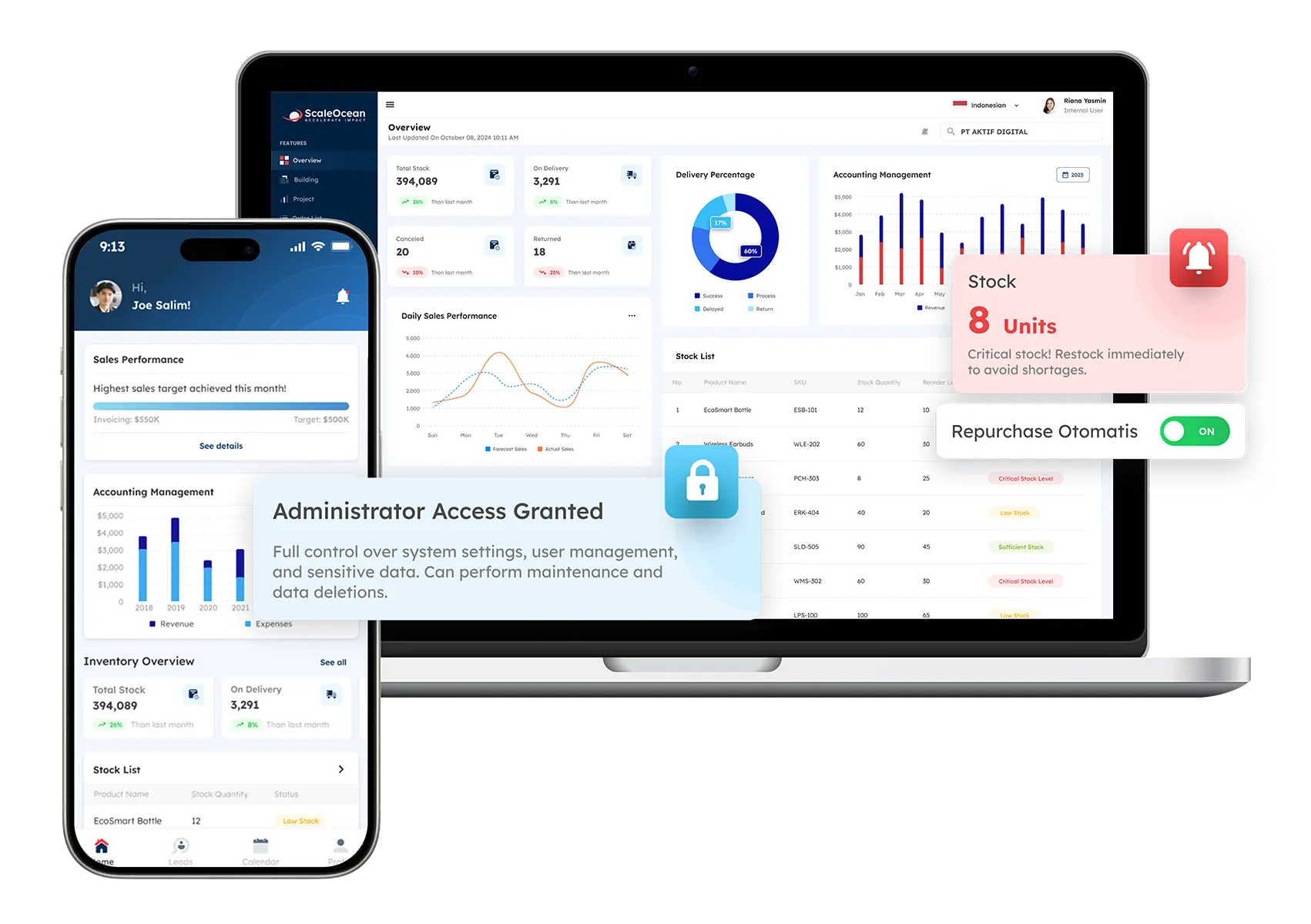
ScaleOcean ERP is an AI-powered, customizable enterprise resource planning platform designed to connect business operations through configurable modules and centralized data. It supports finance, warehouse and inventory, procurement, HR, CRM, and industry-specific workflows within one integrated system.
Its flexibility allows businesses to configure workflows, dashboards, and processes around their operational requirements. With 200+ modules and 1,000+ feature choices, companies can select the capabilities they need and adapt the system as their processes evolve.
For Singapore businesses, ScaleOcean supports local requirements through Singapore-focused financial and tax capabilities, including GST-related processes and reporting aligned with IRAS requirements. The platform can also support eligible digital transformation initiatives structured around programs such as EDG and CTC, subject to applicable requirements.
ScaleOcean also supports unlimited users without additional per-user licensing costs, making it suitable for growing companies that need to expand system access across departments. As the business adds employees, functions, or operational complexity, companies can extend their ERP instead of replacing the system with a larger platform.
What Is Tigernix ERP?
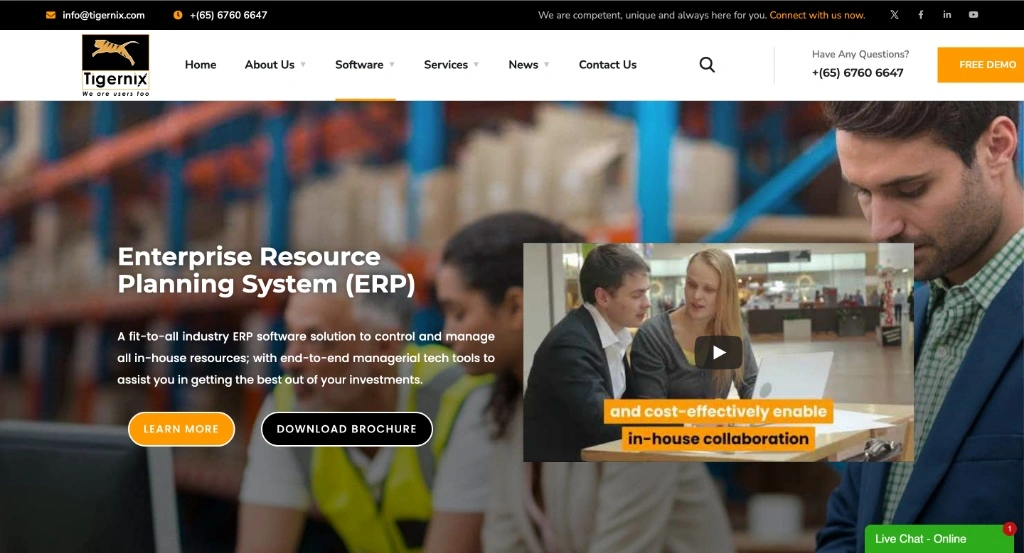 Tigernix ERP is an enterprise software provider offering industry-based ERP solutions across more than 30 sectors. Its industry coverage includes manufacturing, aerospace and defence, automotive, and telecommunications, reflecting a focus on supporting different operational environments.
The platform’s industry-oriented approach may benefit businesses that prefer a solution aligned with their sector’s operational requirements. However, the exact modules, customization scope, and implementation approach should be confirmed against the selected Tigernix solution rather than assumed across every industry.
For enterprises comparing Tigernix with ScaleOcean, the key question is whether the preferred platform can support current workflows while remaining adaptable as the business grows. ScaleOcean’s modular configuration is a strong consideration for companies prioritizing flexibility, while Tigernix’s industry breadth may be valuable for businesses seeking sector-focused ERP capabilities.
Pros and Cons: ScaleOcean vs Tigernix
Comparing ERP strengths and limitations helps businesses understand which platform better matches their operational priorities. Therefore, the following assessment combines documented product characteristics with practical considerations for Singapore enterprises.
ScaleOcean ERP Pros and Cons
Pros:
- Integrated AI capabilities: ScaleOcean combines ScaleMind AI with AI Business Assistant, AI Forecast, AI Insights, and Smart Alerts to support automation, forecasting, recommendations, and proactive operational monitoring across business processes.
- Unlimited users with flat pricing: Businesses can extend ERP access across departments without additional per-user licensing fees. This approach supports wider adoption while keeping software costs more predictable as organizations expand.
- Modular and cost-efficient: ScaleOcean allows companies to activate capabilities according to their requirements rather than adopting every function immediately. Consequently, businesses can expand their ERP environment without replacing the existing foundation.
- Singapore-focused functionality: The platform supports Singapore GST requirements and local financial reporting practices. Therefore, finance teams can manage relevant processes through workflows designed around the local business environment.
- Supports digitalization initiatives: ScaleOcean can support eligible businesses pursuing Singapore digital transformation programs such as EDG and CTC. Eligibility and support, however, depend on the specific project scope and prevailing grant requirements.
- Highly configurable workflows: Businesses can configure approval hierarchies, operational processes, multi-entity structures, and industry-specific workflows. As a result, the ERP can accommodate existing processes instead of requiring companies to standardize everything around fixed workflows.
- Broad integrated functionality: ScaleOcean provides more than 200 modules and over 1,000 business features spanning finance, procurement, inventory, manufacturing, CRM, HR, projects, and reporting within one centralized environment.
- Designed for growing enterprises: The platform can support organizations as they add departments, locations, subsidiaries, and increasingly complex processes. Consequently, companies can consolidate operations rather than continuously adding disconnected software.
- Localized implementation support: ScaleOcean provides guidance across discovery, configuration, training, and go-live activities. This structured involvement can help businesses prepare users and workflows before the system becomes part of daily operations.
- Flexible deployment options: Businesses can select cloud or on-premises deployment according to their security requirements, compliance considerations, and infrastructure preferences. This flexibility allows different organizations to adopt an appropriate operating model.
- Broad industry adaptability: ScaleOcean supports sectors including manufacturing, construction, distribution, retail, F&B, hospitality, healthcare, professional services, and project-based businesses. Therefore, companies can configure processes around their particular industry requirements.
Cons:
- Better suited to complex operations: ScaleOcean provides extensive functionality for businesses managing multiple departments, locations, or workflows. Therefore, smaller companies requiring only basic accounting or inventory management may find a simpler system more appropriate initially.
- Requires structured business discovery: Extensive configurability means organizations should clearly map processes before implementation. This preparation helps ensure the selected modules, workflows, permissions, and integrations accurately reflect operational requirements from the beginning.
- Organizational readiness remains important: ERP implementation depends on clean data, stakeholder participation, process alignment, and user training. Consequently, businesses should allocate sufficient internal resources rather than treating implementation as purely a software installation.
- Feature depth may exceed smaller requirements: Companies with straightforward operations may not immediately need ScaleOcean’s broader functionality. However, those additional capabilities can provide expansion capacity when the business eventually develops more complex operational requirements.
Tigernix ERP Pros and Cons
Tigernix ERP focuses on delivering customizable and scalable ERP solutions tailored to Singapore’s regional compliance and operational standards. Its platform emphasizes flexible modular integration, automated business processes, and comprehensive enterprise resource management for small, medium, and large-scale enterprises.
Pros:
- Broad modular functionality: TigernixERP provides more than 200 customizable modules covering areas such as finance, inventory, procurement, HR, CRM, manufacturing, and project management. This breadth can support varied operational requirements.
- Web-based accessibility: TigernixERP operates as a web-based platform, allowing authorized users to access business information remotely through supported browsers. This approach can support organizations with distributed teams or locations.
- Industry adaptability: TigernixERP supports multiple industries and provides configurable capabilities for sectors including manufacturing, logistics, construction, healthcare, education, and government. Therefore, organizations can align modules with sector-specific operations.
- Real-time reporting and dashboards: TigernixERP provides dashboards, graphical data representation, reporting tools, and real-time data access. These capabilities can help management monitor operations and evaluate information across different business functions.
- Singapore localization: TigernixERP supports Singapore GST requirements, making its financial functionality relevant for businesses operating within Singapore’s regulatory environment. However, companies should confirm specific compliance requirements during vendor evaluation.
Cons:
- Configuration can require additional expertise: External software documentation notes that complex module configurations may require professional training and onboarding. Consequently, organizations should account for user enablement when planning their implementation.
- Implementation duration can vary: TigernixERP implementation timelines may depend on the level of customization required for a particular business. Therefore, enterprises should clarify project scope, configuration requirements, and expected deployment timelines before committing.
- Advanced functionality may increase setup effort: Organizations adopting more extensive functionality may require additional configuration and implementation resources. This consideration becomes particularly relevant when businesses want workflows that differ substantially from standard configurations.
- Legacy integrations may require testing: External documentation identifies integration with outdated legacy systems as a potential area requiring additional configuration and testing. Therefore, businesses with older infrastructure should assess integration requirements during technical discovery.
ScaleOcean vs Tigernix ERP: Feature Comparison

ScaleOcean and Tigernix both provide broad ERP functionality, including finance, inventory, sales, purchasing, and operational management. However, their feature approaches differ, particularly around AI-assisted decision-making, industry specialization, and configurable workflows.
For Singapore enterprises comparing platforms, the distinction matters because feature quantity alone does not determine business fit. Instead, buyers should assess how effectively each ERP connects processes, adapts workflows, and supports expansion.
For another Singapore-focused ERP comparison, readers can also compare ScaleOcean vs SynergixTech to evaluate differences in features, customization, implementation, and business fit.
ScaleOcean Key Features
Through its flagship platform, ScaleOcean Atlas combines core ERP functions with ScaleMind AI, helping businesses move beyond transaction recording toward assisted analysis, forecasting, insights, and operational alerts across connected business processes and daily operations.
The platform also emphasizes industry-specific solutions, configurable workflows, modular scalability, and consultative implementation. Together, these capabilities position ScaleOcean as an option for enterprises planning sustained operational growth and expansion.
Key Features of ScaleOcean:
- Embedded ScaleMind AI: Uses AI-assisted capabilities to support business analysis, forecasting, actionable insights, and smart operational alerts, helping management make decisions using connected ERP data.
- Industry-specific ERP solutions: Through ScaleOcean Atlas, ScaleOcean provides tailored ERP approaches for industries such as manufacturing, logistics, distribution, construction, retail, hospitality, F&B, professional services, and real estate.
- Configurable workflows: Allows businesses to adapt approval processes, operational workflows, dashboards, and other ERP configurations around their existing business requirements.
- Scalable modular architecture: Enables organizations to expand ERP capabilities as departments, operations, locations, and business requirements become more complex.
- Integrated business ecosystem: Connects functions including finance, inventory, procurement, manufacturing, sales, CRM, HR, projects, and reporting within a centralized ERP environment.
- Enterprise-oriented functionality: Supports organizations that require broader process coverage and centralized management across multiple business functions.
- Consultative implementation: Emphasizes implementation support alongside configuration and adoption, helping businesses align the platform with operational requirements before deployment.
- Singapore-focused capabilities: Supports business requirements relevant to Singapore enterprises, including GST-related accounting and localized financial processes.
Tigernix Key Features
TigernixERP also covers the major functions expected from a general ERP, including accounting, inventory, purchasing, sales, manufacturing, CRM, HR, and project management. Its web-based architecture and configurable modules allow businesses to activate functions according to their operational requirements.
For an additional side-by-side reference, readers can explore the ScaleOcean vs Tigernix ERP comparison on SourceForge to review the platforms’ features and capabilities.
Key Features of Tigernix ERP:
- Accounting and Financial Management: TigernixERP includes general ledger, accounts payable, accounts receivable, management accounting, budgeting, GST computation, reconciliation, and financial reporting.
- Inventory Management: The ERP provides web-based inventory management alongside stock-related controls and purchasing processes, helping businesses monitor products and coordinate replenishment activities.
- Purchasing Management: Purchase requests and purchase management are included within the ERP, allowing procurement activities to connect with inventory and financial processes.
Manufacturing and MRP: TigernixERP includes manufacturing management and material requirements planning for businesses that need production-related planning and control. - Sales Management: Web-based quotation and sales management tools support sales processes from quotation through subsequent business transactions.
- CRM: TigernixERP connects customer information with sales, purchasing, inventory, accounting, and other business functions. It also supports opportunity tracking, customer activities, help desk functions, and sales pipeline reporting.
- Human Resources Management: The platform includes an HRMS module as part of its broader ERP offering, allowing workforce-related processes to operate alongside other business functions.
- Project and Costing Management: Project management and costing functions are included among TigernixERP’s general ERP modules, supporting businesses that manage projects alongside financial and operational activities.
Overall, both ERP platforms provide substantial coverage across core business operations. However, ScaleOcean has a stronger differentiator in its combination of broad modular coverage, extensive configuration options, and integrated AI capabilities, while Tigernix emphasizes a web-based ERP with established modules across accounting, inventory, manufacturing, CRM, HR, and project management.
ScaleOcean vs Tigernix ERP: Which One Is Better for Singapore Businesses?

Neither ERP is universally better for every Singapore business because the choice depends on priorities, complexity, and growth. However, ScaleOcean stands out when enterprises prioritize AI-assisted decisions, industry-specific workflows, and scalable customization.
G2 currently lists ScaleOcean at 5.0/5 from two reviews, highlighting implementation support, integration, customer support, and value. Tigernix should be assessed through demonstrations and references because comparable verified G2 data remains limited.
| Business Situation | Recommended ERP |
|---|---|
| Need AI-powered ERP | ScaleOcean |
| Need industry-specific workflows | ScaleOcean |
| Want configurable business workflows | ScaleOcean |
| Planning enterprise expansion | ScaleOcean |
| Need scalable modules for growing operations | ScaleOcean |
| Want consultative implementation and ongoing support | ScaleOcean |
| Need finance, inventory, purchasing, and manufacturing modules | Both |
| Require extensive ERP customization | Both |
For enterprises choosing a long-term platform, ScaleOcean becomes particularly relevant when ERP requirements extend beyond traditional transaction management. Its combination of ScaleMind AI, industry-focused solutions, configurable workflows, and scalable architecture addresses the broader needs of businesses preparing for operational growth.
Tigernix remains a viable option for organizations prioritizing established ERP functions, web-based access, broad modules, and customization. Therefore, the final decision should consider each company’s workflows, implementation requirements, existing systems, and expected growth rather than relying solely on feature counts or ratings.
Businesses comparing different ERP platforms can also review the ScaleOcean and NetSuite comparison to understand how ScaleOcean differs from another established enterprise ERP option.
Why Singapore Businesses Choose ScaleOcean ERP
Singapore businesses often need ERP software that can accommodate local requirements while supporting increasingly complex operations. ScaleOcean addresses these needs through industry-focused solutions, integrated modules, AI capabilities, flexible customization, scalability, and consultation-based implementation.
As a practical example of ScaleOcean ERP in Singapore, Sobono Group has used the platform for 7 years to streamline operations across inventory, projects, budgets, delivery scheduling, and finance.
The company manages more than 150 new projects weekly and processes over 10,000 request orders monthly. As activity expanded, centralized visibility became increasingly important for coordinating resources, costs, milestones, and operational decisions.
ScaleOcean helped Sobono Group connect inventory, procurement, project management, budgeting, delivery scheduling, and finance through one platform. The company can track inventory, monitor projects, and manage budgets more accurately.
The implementation delivered measurable outcomes, including an 87% increase in profitability and financial reports generated in approximately 10 seconds. These results demonstrate how integrated ERP functionality can support efficiency as businesses scale.
Sobono Group’s Founder and Managing Director, Wee Khoon OH, also highlighted the platform’s impact on daily operations:
“Since we started using ScaleOcean, it’s been so much easier to track our inventory, project milestones, and budgets, faster and more accurately.”
The full implementation story shows how Sobono Group uses ScaleOcean to improve inventory visibility, delivery coordination, financial management, and project monitoring across its operations. Watch the Sobono Group ERP implementation story: