Choosing the right ERP software matters because it affects daily operations, data accuracy, team productivity, and long-term growth. When the system does not match business needs, companies may face scattered data, manual work, slow reporting, and limited visibility across departments.
That is why ERP selection should not rely only on brand popularity or initial license cost. Businesses need to ensure the system can support workflow complexity, transaction volume, integrations, local reporting needs, and future expansion without creating new operational bottlenecks.
NetSuite is commonly recognized as a cloud ERP platform for companies that want to manage finance, inventory, order management, procurement, and reporting in one system. In comparison, ScaleOcean is built for businesses that need a more adaptable ERP structure, with flexible modules, local support, and workflows that can align with real operational processes.
For Singapore businesses, ScaleOcean can be a practical option when flexibility, predictable costs, and stronger operational control are key priorities. With unlimited user access, customizable modules, and cloud, on-premise, or hybrid ERP deployment, ScaleOcean helps companies shape the system around their workflow instead of forcing teams to adjust to a fixed structure.
Gartner forecasts that over 70% of ERP projects launched in the last five years will be expected to not meet their initial business objectives by 2027. This is one reason why it’s essential to compare ScaleOcean with NetSuite properly before making your decision on ERP software for business longevity.
Read this article to get to know the differences between ScaleOcean and NetSuite at various levels, such as features, ratings of reviews, pricing model, business growth flexibility, localization, and suitability. With this Comparison ScaleOcean vs NetSuite, you can make your decision on which ERP system would work better for your company.
Key Takeaways
ScaleOcean ERP helps businesses unify daily operations through configurable modules for finance, procurement, inventory, warehouse, sales, HR, manufacturing, project, and reporting.
NetSuite ERP is a cloud-based ERP platform used by companies that need financial management, inventory control, order management, procurement, and multi-entity business visibility.
The best ERP choice should be based on workflow fit, implementation readiness, pricing structure, localization needs, scalability, and how easily teams can adopt the system.
ScaleOcean is considered by growing businesses that need flexible configuration, unlimited users, need-based pricing, local implementation support, cloud, on-premise, and hybrid ERP options.
What ScaleOcean ERP and NetSuite ERP Offer to Businesses
ScaleOcean ERP
ScaleOcean ERP is an integrated business management system designed to tie all business functions, including finance, procurement, inventory, warehouse, sales, HR, manufacturing, project, asset, and reporting processes together in a single platform. It is meant for medium-to-large-sized businesses requiring flexible modules, custom execution, and ERP implementation that follows real business processes.
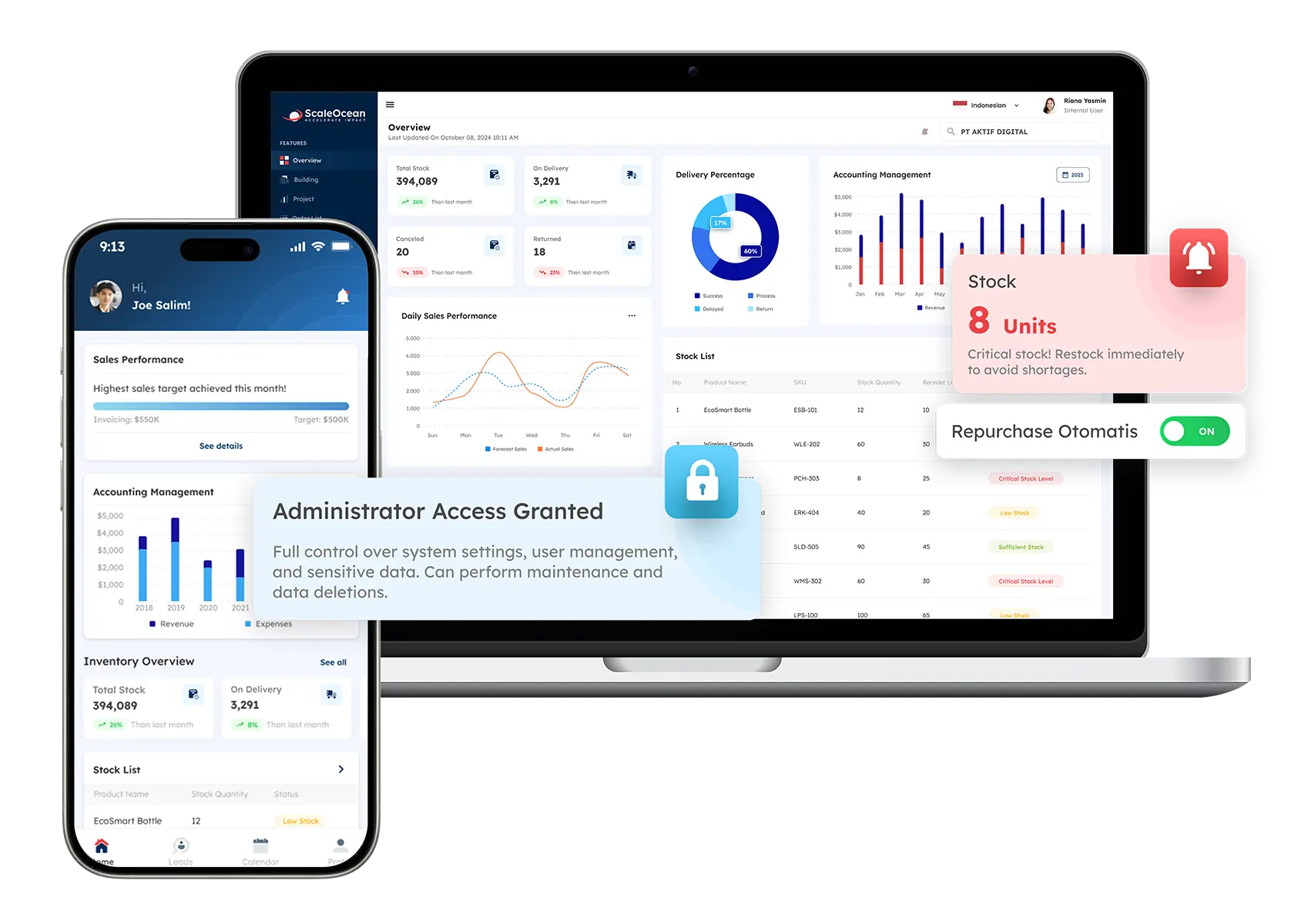
Beyond integration, ScaleOcean ERP helps teams work with cleaner data, faster approvals, and stronger operational visibility. As an AI ERP platform, This software can deliver accurate, complete, and real-time operational data through simple prompts. With AI Copilot, Generative AI, real-time reporting, workflow automation, and API support, businesses can reduce manual work, connect existing systems, and make decisions based on updated information.
ScaleOcean is also built as an industry-focused ERP, making it flexible for different business needs across sectors. Whether used in manufacturing, distribution, retail, construction, F&B, education, or service-based operations, the system can adapt to specific workflows, departments, and business models while keeping every process connected in one centralized platform.
If companies require more control over their workflows and across departments, ScaleOcean can complement any end-to-end process of ERP without imposing a template on the team. The modules, approval flows, reports, dashboards, and integrations can all be tailored to the internal processes of businesses, making it ideal for use in various industries, including manufacturing, construction, logistics, distribution, retail, and even professional services.
NetSuite ERP
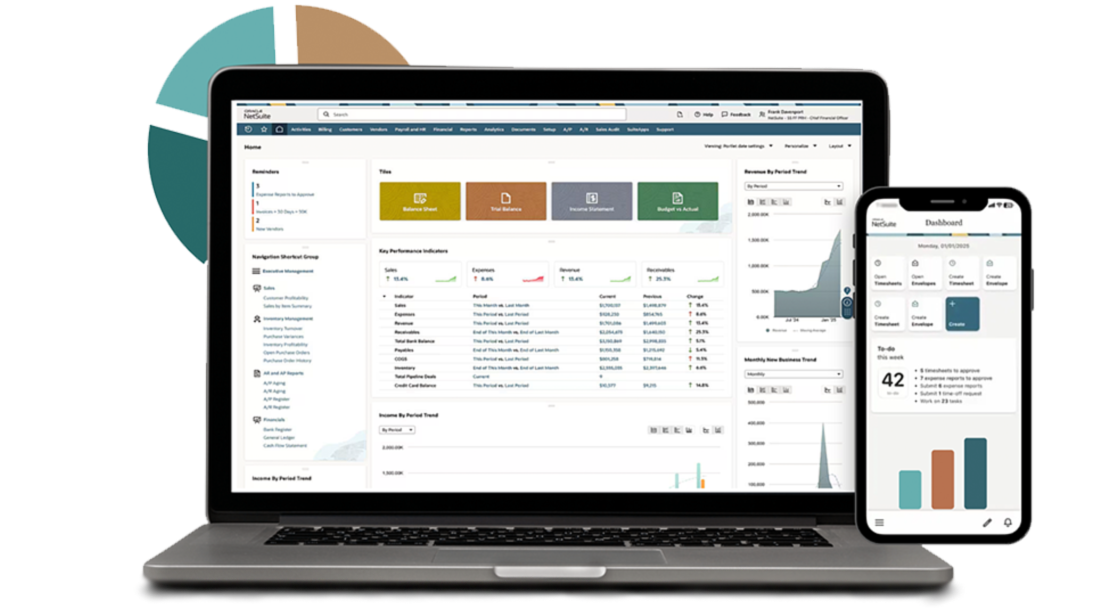
NetSuite ERP is a cloud ERP solution that provides business users with an integrated platform for managing core business functions. It helps companies centralize financial and operational data, giving teams better visibility and control over performance metrics through AI-supported business insights.
The platform features modules like accounting, financial management, inventory management, order management, supply chain management, and warehouse management. The modules enable businesses to move data to a central place across all modules, particularly if they want a cloud ERP architecture for reporting, operations, and finance.
In the ScaleOcean vs. NetSuite comparison, NetSuite represents a mature global cloud ERP platform, while ScaleOcean offers a more flexible ERP approach for growing businesses that need stronger workflow adaptability. With unlimited users, flat pricing, local implementation support, AI-supported insights, configurable modules, and more practical for companies that want ERP to follow their real operational processes.
How are ScaleOcean and NetSuite Reviews from Real Users?
Based on the data our team got from G2.com, ScaleOcean has a 5.0 rating based on 2 verified reviews, with all reviews receiving 100% 5-star ratings. Furthermore, G2 also has ScaleOcean under the ERP Systems category, which is also applicable for businesses that wish to check the ERP vendors according to the feedback from existing users.
The results from ScaleOcean’s G2 Satisfaction signal are good, particularly for companies that prioritize ERP usability, implementation support, and system usability. The volume of its public review is still small in comparison to the bigger global vendors, so the rating should be taken as a first reference point, and the demo results and workflow requirements should also be checked, as well as the scope of implementation.
In the ERP Systems category, G2 rates NetSuite a 4.1-star rating based on 4,690 reviews. It indicates a wider base of global reviews, but review volume doesn’t necessarily mean that NetSuite is the ideal ERP for a company’s internal process, cost, localization, or team readiness.
That is why companies should compare both platforms beyond ratings. For businesses that need more adaptable workflows, local implementation support, unlimited users, and flexible deployment options, ScaleOcean can be considered as one relevant option in the ERP evaluation process, especially when the system needs to follow specific operational requirements.
This means both platforms show positive review signals, but they represent different evaluation contexts. NetSuite has a wider review volume as a mature global ERP platform, while ScaleOcean shows strong early satisfaction and can be more relevant for businesses that prioritize flexible setup, direct implementation support, unlimited users, and workflows adjusted to local operations.
How ScaleOcean and NetSuite Compare Across Core ERP Needs?
Before choosing between ScaleOcean and NetSuite, companies should compare both systems based on real ERP requirements. This includes pricing structure, localization, workflow flexibility, scalability, implementation model, and how easily the system can support future growth.
Aspect
ScaleOcean ERP
NetSuite ERP
Best For
Medium-to-large enterprises that need an ERP built around complex workflows, industry needs, and internal business structures.
Companies that need a mature cloud ERP platform for finance, inventory, reporting, and multi-entity operations.
Pricing Structure
Need-based pricing with unlimited users, adjusted by scope, selected modules, and implementation complexity.
Subscription pricing based on platform access, users, modules, implementation, and support needs.
Singapore Localization
Supports IRAS GST workflows, tax invoice records, GST reporting, GST InvoiceNow readiness, PDPA-aligned data handling, and business transformation needs related to EDG and CTC Grant priorities.
Supports global operations, while the Singapore-specific setup may depend on configuration and implementation partners.
Custom Setup & Execution
Highly configurable for modules, approvals, reports, dashboards, integrations, and department-specific workflows.
Offers cloud ERP configuration, but setup may require deeper planning and technical resources.
Scalability & Flexibility
Modules can be activated gradually, with cloud ERP, on-premise ERP, or hybrid ERP options based on business needs.
Scales through added users, modules, subsidiaries, and configurations within a cloud-based ERP structure.
Growth-Ready
Built for growing enterprises that need end-to-end ERP, AI-supported insights, and a consultative implementation approach.
Suitable for businesses with standardized processes, broader ERP budgets, and internal readiness for larger rollout.
This comparison can be an early guide before your company evaluates deeper technical requirements. NetSuite’s official pricing explanation states that users subscribe through an annual license fee made up of the core platform, optional modules, and the number of users, plus a one-time implementation fee for initial setup.
With ScaleOcean ERP, companies can build the system around actual enterprise needs, not a fixed one-size-fits-all structure. Modules, approval flows, reports, dashboards, and integrations can be configured based on business priorities, helping teams reduce manual consolidation, access updated data faster, and make decisions with clearer operational visibility.
For businesses that want to compare ScaleOcean ERP with other software, you can compare ScaleOcean ERP vs. Synergix Tech ERP to better understand the capabilities of other software besides NetSuite.
Advantages and Considerations of Using ScaleOcean ERP
For businesses with the need for a system that allows for flexible operations and complex workflows, there are several advantages that can be gained from using ScaleOcean ERP. The fact that it is modular makes it easy for businesses to manage their finance, purchasing, sales, inventory, warehouse, project, HR, manufacturing, and reporting processes inside one ERP ecosystem.
The ScaleOcean capabilities highlighted by Software Advice include business process automation, reporting and analytics, AI Copilot, API, business intelligence, forecasting, Generative AI, integrated business operations, real-time data, visual analytics, warehouse management, and workflow management. Businesses requiring connected data and smarter operational control will find these capabilities the most relevant.
Advantages of ScaleOcean ERP
Flexible setup based on business workflows: ScaleOcean can be configured around approval rules, department processes, reports, dashboards, and industry-specific needs. This helps companies avoid forcing unique operations into generic ERP settings.
Unlimited users with predictable access: Its unlimited-user structure helps companies expand ERP usage across branches, departments, and operational roles without adding pressure from user-based license costs.
No hidden cost and pricing transparency: ScaleOcean’s flat pricing model can make planning ERP investments easier. Selected modules and the scope of implementation can be tailored to real-life priorities.
Cloud, on-premise, or hybrid deployment: ScaleOcean can scale depending on the company’s needs, from cloud ERP access, on-premise control, to a hybrid ERP deployment model.
Integrated ERP ecosystem: ScaleOcean connects finance, sales, purchasing, inventory, warehouse, manufacturing, HR, project, CRM, and reporting into one system. This reduces scattered tools and improves cross-department visibility.
AI and BI integration: With AI insights, automation, analytics, and reporting tools, ScaleOcean enables teams to track performance, uncover problems, and make quicker decisions during daily operations.
Considerations of ScaleOcean ERP
Requires proper discovery before rollout: The customisability of ScaleOcean means businesses must have their workflows, approval processes, data structures, and integration needs well defined before deployment begins.
May feel too broad for very small businesses: Companies with very simple operations may not need all available modules at the beginning. However, the modular structure allows businesses to start from priority needs first.
Custom setup takes alignment time: Not only is a mass-template approach used with ScaleOcean. Each setup is customised to the workflow of the company, and this means the implementation planning is an important aspect of success.
ScaleOcean is ideal for businesses that must adapt to the operational requirements instead of forcing them to fit into a template. This can assist growing companies to avoid common ERP failures, including insufficient workflow fit, adoption difficulties, and inadequate planning, and cut back on disorganized systems.
For Singapore businesses that need more practical execution, ScaleOcean can be positioned as a strong NetSuite alternative, especially when comparing ScaleOcean vs. Oracle. Its ERP supports flat pricing, unlimited users, flexible deployment, industry-based modules, and AI-supported insights that help teams manage operations with better visibility.
Advantages and Considerations of Using NetSuite ERP
NetSuite ERP is a mature cloud ERP platform that supports finance, inventory, procurement, order management, warehouse, supply chain, production, and reporting in one integrated suite. NetSuite ERP is known as an AI-powered cloud business management solution that automates core processes and provides real-time visibility into operational and financial performance.
According to the review published on The CFO Club, NetSuite ERP is a cloud ERP for finance leaders to manage accounting, operations, and compliance in a single platform. It emphasizes NetSuite’s live visibility, automation, scalability, extensive integrations, and capabilities for organizations seeking to grow and handle complex reporting.
Advantages of NetSuite ERP
Strong cloud ERP foundation: NetSuite is a cloud-based ERP solution that provides businesses with access to business data from a distance and the ability to manage business operations without the need for an on-premise system.
Broad ERP module coverage: NetSuite integrates accounting, financial management, global business management, inventory, order management, supply chain management, warehouse management, and procurement.
Real-time visibility: NetSuite enables companies to track the performance of their finances and operations through dashboards, reports, and integrated data across all business functions.
Multi-entity and global operations: NetSuite supports multiple subsidiaries, business units, legal entities, currencies, and reporting structures, making it useful for companies with international operations.
Customization and integration options: The CFO Club mentions that NetSuite’s Suite Cloud tools enable customization of workflows, dashboards, reports, and applications.
Considerations of NetSuite ERP
Pricing can require deeper evaluation: NetSuite pricing depends on the core platform, optional modules, users, implementation, and support needs. The CFO Club notes that NetSuite is generally on the higher end of the pricing spectrum for cloud ERP solutions.
Costs may grow with modules and users: The CFO Club explains that NetSuite uses a modular subscription pricing structure based on a base platform license, user licenses, and optional add-on modules. Implementation, customization, integrations, and ongoing support can also increase the total cost of ownership.
Implementation may feel complex: Because NetSuite is built for broader ERP needs, implementation usually requires careful planning, configuration, data migration, user training, and internal readiness.
Onboarding can be more complex: The CFO Club notes that NetSuite’s onboarding can be more complex than some alternatives, and its interface may feel overwhelming for smaller teams. This means companies should prepare proper training, internal ownership, and implementation support before rollout.
NetSuite remains a strong ERP choice for companies that need scalability, broad cloud ERP coverage, and mature financial management capabilities. However, businesses should still evaluate cost predictability, implementation readiness, user adoption, and local workflow fit before choosing NetSuite as a long-term ERP platform.
Choosing Between ScaleOcean and NetSuite for Your Company
The decision to pick the ScaleOcean or NetSuite comes down to the company’s workflows, budget, implementation preparedness, localization requirements, and future expansion objectives. In addition to vendor reputation, the most suitable ERP should enable teams to operate faster, ensure complete data visibility, and streamline day-to-day operations without significant operational discontinuities.
Businesses can also review ScaleOcean ERP vs Tigernix ERP when evaluating ERP platforms based on customization, implementation, and workflow flexibility.
When ScaleOcean ERP Can Be the Better Fit?
If your business processes require specific workflows like approval rules, procurement policies, warehouse processes, project costing, production stages, and multi-branch reporting, ScaleOcean ERP can prove to be a better fit. This lends it to business organizations that can not stick to the generic settings of ERP.
ScaleOcean also offers unique advantages for growing companies, including unlimited users, need-based pricing, and flexible deployment through cloud ERP, on-premise ERP, or hybrid ERP. These options help companies control ERP access, system structure, and infrastructure choices based on real operational needs.
When local support and implementation guidance are relevant, Singapore businesses have reason to be concerned about ScaleOcean. Businesses can configure ERP systems to meet the reporting requirements in their respective regions, deal with GST requirements, manage workflows, and provide support to their end-user teams.
ScaleOcean is also ideal for companies needing an ERP phased rollout. You can begin with the modules that are priorities for your business, like accounting, inventory, purchasing, sales, HR, warehouse, manufacturing, project, or reporting modules, and add more of these as you move ahead and your business becomes more complex.
Its artificial intelligence ERP feature can also enable quicker operational insights. AI-assisted analysis, performance tracking, issue identification, and data review with prompts enable teams to review data more efficiently in finance, inventory, procurement, sales, and reporting.
When NetSuite ERP Can Be the Better Fit?
NetSuite ERP can be considered by companies that need a global cloud ERP platform with broad module coverage. It is generally relevant for businesses that manage finance, inventory, procurement, order management, warehouse, supply chain, and reporting through a standardized system structure.
NetSuite might also work for businesses with multi-entity or international operations. For organizations that are managing multiple subsidiaries, global reporting, multi-currency transactions, and a standardized financial process, they can determine if NetSuite’s cloud ERP model is suitable for their business.
Companies should also consider their internal readiness before choosing NetSuite. ERP rollout often involves configuration, data migration, integrations, user training, and ongoing system ownership, so the decision should be supported by clear project planning and adequate internal resources.
Ultimately, in the ScaleOcean vs. NetSuite comparison, the best ERP is the one that fits your company’s scale, needs, and team readiness. Evaluate both platforms based on real business conditions, so your ERP investment can support daily operations, improve visibility, and deliver long-term value.
For businesses looking for a NetSuite alternative, ScaleOcean can be a strong choice to consider. Explore ScaleOcean’s free demo to see how its ERP can fit your business workflow before making a final decision.
Why ScaleOcean Can Be a Strong NetSuite Alternative?
ScaleOcean can be a strong NetSuite alternative for local and regional businesses that need enterprise ERP capabilities, but still require flexibility in daily execution. The system is designed for companies with complex workflows, industry-specific requirements, and operational structures that cannot always rely on a generic ERP setup.
ScaleOcean is based on business fit, configurability, and implementation relevance. The modules, approval flows, reports, dashboards, UI, and integrations can be customized to fit internal processes, as the system works with how each department works.
This is crucial for enterprises that experience visibility problems between their finance, inventory, procurement, sales, project, and warehouse departments. When each team uses different tools, business leaders often struggle to track costs, stock movement, approvals, and reports in real-time.
ScaleOcean can address this by bringing operational data together in one system. From the connected data, teams can keep an eye on inventory, projects in progress, request orders, budgets, procurement progress, and financial reports without manual consolidation.
One example of how ScaleOcean helps companies grow is the Sobono Group. ScaleOcean can help you with operational growth, as with the Sobono Group. ScaleOcean has been a long-time technology partner of Sobono Group for the last 7 years, supporting the company in optimizing business processes between different departments.
By implementing ScaleOcean ERP, Sobono Group can track inventory in real time, monitor ongoing projects with greater visibility, and manage budgets with increased precision. These capabilities help the company improve operational efficiency, minimize unnecessary costs, and ensure every project is executed more smoothly.
The impact can also be seen from Sobono Group’s operational metrics. The company can handle more than 150 new projects per week, process more than 10,000 request orders per month, increase profitability by 87%, and generate financial reports in only 10 seconds through system-supported automation.
The results demonstrate the ability of ScaleOcean ERP to shift away from administrative reporting to actual operational execution. Teams will have greater visibility throughout the day and be able to manage project activities, request orders, inventory movement, budget control, and reports in a faster and more accurate way.
Key features of ScaleOcean ERP include:
Configurable enterprise workflows: Modules, approval rules, reports, dashboards, and integrations can be tailored to each company’s internal process.
Phased ERP implementation: Companies can activate priority modules first, then scale the system gradually based on operational readiness.
AI ERP insights: Teams can use AI-supported insights and prompt-based data requests to review performance, detect issues, and support faster decisions.
Industry-based ERP structure: ScaleOcean supports specific workflows across manufacturing, construction, logistics, distribution, retail, and professional services.
Scalable pricing model: Pricing is adjusted based on scope, selected modules, and implementation complexity, so companies pay for what they actually use.
You can request a free demo of ScaleOcean ERP to see how its configuration, AI insights, phased modules, and implementation support fit your company’s workflow before committing to a long-term ERP investment.
Conclusion
The ERP ScaleOcean vs. NetSuite comparison reveals that both ERP systems can be used to support finance, operations, reporting, and integration. NetSuite offers a robust, global cloud ERP solution that’s ideal for businesses with advanced requirements for scalability, multi-entity management, and extensive module integration.
Meanwhile, ScaleOcean fits growing Singapore businesses that need flexible workflows, predictable ERP access, unlimited users, local implementation support, and configurable modules that follow real operational needs. Its cloud, on-premise, and hybrid ERP options also give companies more freedom to choose the system model that works best for them.
When considering ERP, evaluate your workflow complexity, team configuration, integration requirements, reporting requirements, and readiness for implementation, as well as your future growth plans. Before investing in ERP, you can map your real business process with configurable modules, phased implementation, AI ERP insights, and consultative support on a free demo from us.
FAQ:
1. Which ERP is more cost-effective, ScaleOcean or NetSuite?
ScaleOcean can be more cost-effective for growing businesses because it offers need-based pricing with unlimited users. NetSuite uses a subscription model that may increase as more users, modules, integrations, and implementation needs are added.
2. Which is better for growing companies, ScaleOcean or NetSuite?
ScaleOcean is often better for growing companies that need flexible workflows, phased implementation, and scalable ERP access without user-based cost pressure. NetSuite can suit companies with mature global operations and stronger internal IT readiness.
3. Can ScaleOcean support multi-branch and multi-department operations?
Yes, ScaleOcean supports multi-branch and multi-department operations by connecting finance, inventory, sales, purchasing, HR, warehouse, manufacturing, project, and reporting workflows in one integrated ERP system.
4. Does ScaleOcean include AI features for ERP operations?
Yes, ScaleOcean includes AI features that help teams analyze data, monitor performance, detect operational issues, and access business insights faster across finance, inventory, procurement, sales, reporting, and other ERP workflows.














 Key Takeaways