3PL logistics software is a specialized logistics management software that assists 3PL logistics companies in handling complex logistics operations across multiple clients, multiple warehouses, shipments, and fulfillment on a single integrated platform. 3PL solutions are more capable of handling multi-tenant operations, which involve different customers with different inventory and reporting needs.
With the increased complexity of logistics networks, many enterprise 3PLs in Singapore are dealing with some operational issues. The lack of a single source of truth for data in WMS, TMS, and ERP systems, and the manual handling of multiple clients, multiple warehouse activities, shipment updates, and billing processes can add up to a loss of visibility and errors.
An adequate 3PL software package allows logistics companies to centralize their operations data, automate repetitive tasks, and enhance the visibility of their end-to-end system that covers inventory, warehouse, and customer management. Tools like multi-client inventory management, automated billing, and real-time reporting help to create scalable and efficient logistics operations.
Our team conducted data analysis of Workforce Singapore’s data to find that around 34% of logistics job roles analyzed are likely to see moderate shifts in technologies adopted, such as Industry 4.0 technologies like IoT, AI, and big data analytics. This underscores the critical role that digital platforms are playing in facilitating logistics providers to gain better visibility of operations.
Before choosing logistics software solutions, it is crucial to understand the difference between 3PL logistics software and other logistics platforms. To get a clear understanding of what 3PL software is, its important features, its advantages, and the 12 best 3PL software recommendations businesses can consider in 2026, read this article.
Key Takeaways
3PL logistics software is a digital solution that helps third-party logistics providers manage multi-client inventory, warehouse operations, and shipment coordination through one connected platform.
Businesses should compare 3PL software based on operational scale, warehouse complexity, integration capabilities, automation needs, pricing approach, and long-term scalability.
Top 12 3PL software recommendations in 2026include ScaleOcean, ShipHero, Mintsoft, Clarus WMS, Made4net, Blue Yonder, Logiwa WMS, Extensiv, Deposco, Magaya Supply Chain, FarEye, and Manhattan Active Warehouse Management.
ScaleOcean logistics ERP softwareprovides an integrated ERP-based logistics platform that connects warehouse, inventory, purchasing, accounting, and operational workflows to support scalable 3PL operations.
3PL logistics software is an electronic solution specifically designed for 3PLs that manage various clients’ storage, fulfillment, distribution, and transportation. The platform offers a standard service to logistics companies to oversee their operations, handling inventory management, warehouse administration, order processing, shipping tracking, and customer billing.
3PL solutions are different from traditional logistics software because they can be adapted to handle any number of different customers, some of whom have different inventory ownership, service contracts, and reporting styles. That allows a logistics company to deal with a number of accounts in an effective manner, maintaining accurate records and transparency in the way that they run their business.
An important aspect of 3PL logistics software is the ability to integrate warehouse operations with the wider logistics operations. The system enables providers to handle stock changes, manage fulfilments, automate calculation of invoices, and provide customers with greater visibility of logistics operations.
3PL warehouse software provides additional capabilities for businesses that have multiple customer warehouses to ensure warehouse location, receiving, picking, packing, shipping, and inventory accuracy. Logistics integration is the integration of logistics management, customer management, and billing management, which can help them build a logistics network that is more efficient in the long run.
Brief Reviews of 12 Popular 3PL Software Solutions
Choosing the right 3PL logistics software depends on a company’s operational complexity, warehouse requirements, customer volume, integration needs, and scalability goals. Each platform offers different capabilities, from warehouse management and fulfillment automation to inventory visibility, billing management, and logistics coordination.
The following comparison highlights 12 popular 3PL software solutions to help businesses evaluate their suitability based on target users, pricing approach, and accessibility. This overview provides an initial reference before exploring the detailed features, advantages, and limitations of each platform.
Software or Tools
Best Used For
Best Pricing
Mobile Access
ScaleOcean
Medium and large 3PL enterprises requiring warehouse management, inventory visibility, order fulfillment, billing, logistics operations, and ERP integration in one configurable platform.
Pricing is customized based on required modules, warehouses, integrations, customization scope, and deployment options. Supports flexible implementation without relying on fixed packages.
Yes, with access to operational data, inventory updates, approvals, and logistics workflows.
ShipHero
E-commerce fulfillment providers and 3PL warehouses managing online orders, inventory, and shipping operations.
Subscription-based pricing depending on warehouse requirements, order volume, and selected features.
Yes, through mobile warehouse management capabilities.
Mintsoft
Small to medium 3PL providers managing fulfillment, courier integrations, and warehouse operations.
Tiered pricing based on order volume, users, and operational requirements.
Yes, supporting warehouse activities and order management.
Clarus WMS
Warehouse operators and 3PL companies requiring inventory control, warehouse automation, and fulfillment management.
Custom enterprise pricing based on warehouse complexity, modules, and implementation scope.
Supported through warehouse operational applications.
Made4net
Medium and large warehouses requiring advanced WMS capabilities and supply chain execution.
Enterprise quotation based on warehouse requirements, integrations, and deployment needs.
Yes, through warehouse execution tools.
Blue Yonder
Large enterprises requiring supply chain planning, warehouse management, and logistics optimization.
Custom enterprise pricing based on modules, users, and implementation complexity.
Supported through connected supply chain applications.
Logiwa WMS
High-volume fulfillment operations and 3PL providers managing complex warehouse workflows.
Customized pricing based on fulfillment volume, warehouse requirements, and features.
Yes, supporting warehouse activities through mobile functionality.
Extensiv
E-commerce fulfillment companies and 3PL providers managing multiple sales channels.
Subscription pricing varies based on products, integrations, and operational scale.
Yes, with inventory and fulfillment management access.
Deposco
Growing and enterprise logistics companies requiring cloud-based warehouse and fulfillment management.
Custom pricing based on warehouse operations, integrations, and business requirements.
Supported through cloud-based operational access.
Magaya Supply Chain
Freight forwarders and logistics providers managing transportation, warehouse, and supply chain processes.
Customized quotation based on modules, users, and logistics requirements.
Yes, through connected logistics applications.
FarEye
Logistics providers focusing on transportation visibility, delivery management, and route optimization.
Enterprise pricing based on shipment volume, integrations, and solution scope.
Yes, supporting delivery tracking and logistics execution.
Manhattan Active Warehouse Management
Large enterprises requiring advanced warehouse automation and omnichannel fulfillment management.
Enterprise quotation based on implementation scope, integrations, and warehouse complexity.
Yes, through warehouse execution capabilities.
Full Reviews of the 12 Best 3PL Software Solutions of 2026
Selecting the right 3PL logistics software requires more than comparing available features. Each platform is designed with different operational priorities, from warehouse execution and fulfillment management to transportation visibility, automation, and enterprise-level logistics coordination.
To help businesses make the best decision when selecting 3PL software, the following reviews explain the skills, attributes, advantages, and disadvantages of some of the most widely used options.
1. ScaleOcean
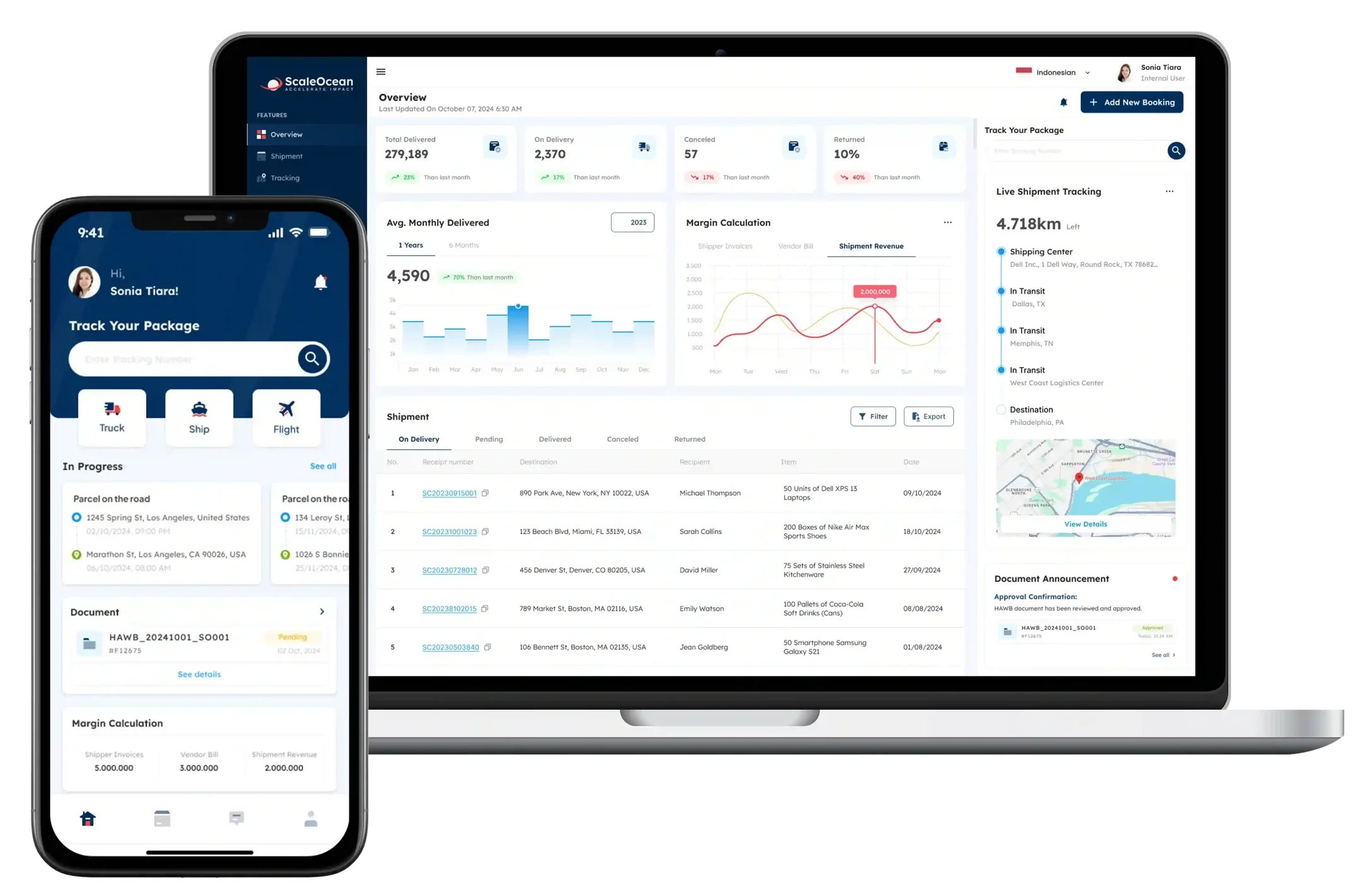
ScaleOcean is a full-featured logistics ERP system for medium and large businesses requiring one seamless solution to deal with complex 3PLs, such as multi-client inventory, warehouse operations, tracking shipments, and financial workflows. It enables logistics providers with multiple warehouses and approvals to be managed by setting up workflows.
ScaleOcean Atlas for 3pl logistics connects warehouse, inventory, purchasing, sales, accounting, and transportation processes to optimize end-to-end logistics operations. Rather than functioning as a standalone logistics tool, ScaleOcean Atlas provides a centralized business platform that can be adapted based on each company’s operational requirements.
Embedding ScaleMind, as an AI Business Assistant, enables logistics teams to gain access to business information, summaries, insights, and recommendations from connected operational data. This allows users to analyze the inventory status, shipment activities, customer information, and logistics performance without the need for separate reporting systems.
The platform caters to companies that demand adaptable logistics processes, visibility across multiple locations, and seamless operational management. This system has been streamlined and meets PDPA requirements and local financial reporting requirements such as IRAS and GST requirements in Singapore.
It can also be customized to meet the needs of the EDG/CTC depending on the project scope and the eligibility of the companies. Schedule a consultation with the ScaleOcean team now to see how their flexible and configurable logistics workflows, unlimited-user capabilities, and deployment options can benefit your 3PL operations.
Key features:
Multi-client inventory and warehouse management
Real-time shipment and order visibility
Automated billing and customer charge management
Multi-warehouse and multi-location operations
Integrated accounting, purchasing, sales, and inventory modules
Configurable approval workflows
Cloud, on-premise, and hybrid deployment options
Pros
Cons
Provides an integrated ERP foundation that connects logistics operations with finance, inventory, purchasing, sales, and other business functions.
Its enterprise-level capabilities may be more extensive for small businesses requiring only basic shipment tracking or warehouse tools.
Uses a consultative implementation approach that analyzes logistics processes, customer requirements, operational structures, and workflow needs.
Implementation scope and pricing require assessment because requirements differ based on modules, locations, integrations, and complexity.
Offers configurable workflows and unlimited-user options, allowing enterprises to adapt the system based on operational growth.
The platform prioritizes accurate configuration and long-term scalability rather than quick generic deployment.
Supports gradual module activation, allowing businesses to expand capabilities according to operational priorities.
Best for: Medium and large 3PL providers, logistics enterprises, freight forwarding companies, manufacturers with internal logistics operations, distributors, and multi-location businesses.
ℹ️Why choose ScaleOcean?
ScaleOcean helps logistics businesses manage multi-client operations, warehouse activities, inventory, billing, and connected business workflows through one configurable ERP platform.
2. ShipHero
ShipHero is a warehouse and fulfillment management platform designed to help e-commerce businesses and third-party logistics providers manage inventory, order processing, warehouse activities, and shipping operations through one centralized system. The platform focuses on helping fulfillment teams coordinate high-volume orders while improving warehouse visibility and operational efficiency.
The solution supports 3PL providers that manage fulfillment services for multiple brands by connecting inventory management, order workflows, shipping processes, and customer operations. Its capabilities are commonly used by companies that require faster fulfillment execution and better control over warehouse activities.
Key features:
Warehouse inventory management
Shipping label management
Barcode scanning support
E-commerce platform integrations
Warehouse team management
Returns management
Pros
Cons
Provides fulfillment-focused tools that help warehouses manage order processing and shipping activities efficiently.
Organizations requiring broader ERP-level integration may need additional business management systems.
Supports e-commerce fulfillment operations through marketplace and storefront integrations.
Large enterprises with highly complex logistics structures may require deeper customization.
Helps warehouse teams improve order accuracy through operational visibility.
The platform may be more suitable for fulfillment-focused operations than diverse logistics environments.
Best for: Small to medium 3PL providers, e-commerce fulfillment companies, direct-to-consumer brands, and warehouses managing online order volumes.
ℹ️Why choose ShipHero?
ShipHero helps fulfillment teams manage inventory, orders, warehouse workflows, and shipping activities through a centralized platform designed for high-volume operations.
3. Mintsoft
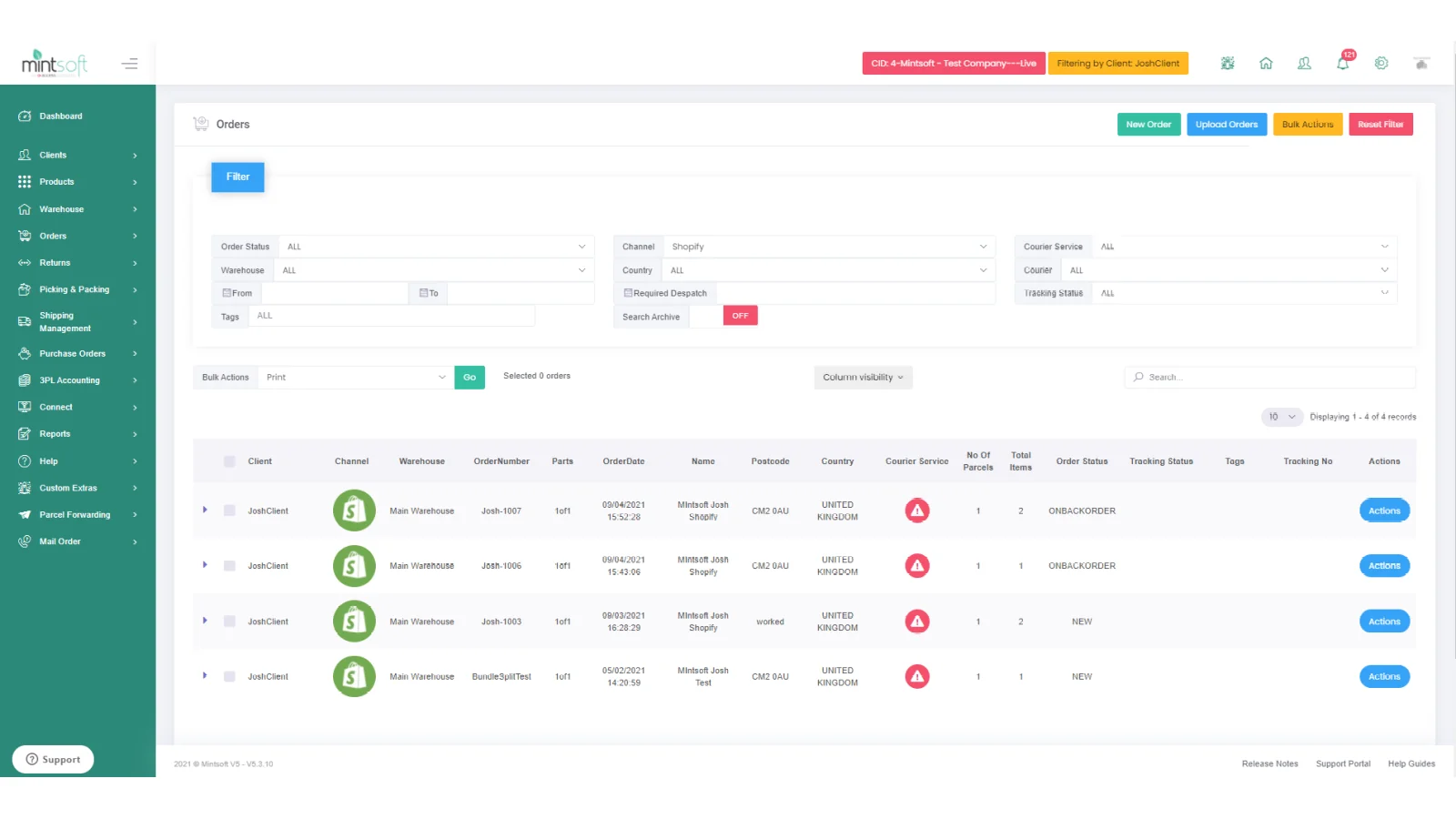
Mintsoft is a warehouse management and order fulfillment platform designed for third-party logistics providers, fulfillment companies, and businesses managing multiple inventory operations. The system helps organizations coordinate warehouse activities, customer accounts, courier services, and order processing through one connected platform.
The platform is commonly used by growing logistics providers that need to manage multiple clients while improving warehouse efficiency and fulfillment visibility. It supports integrations with e-commerce platforms, courier services, and operational systems to simplify logistics workflows.
Key features:
Inventory tracking
Courier integrations
Customer portals
Stock reporting
Returns management
Pros
Cons
Provides warehouse and fulfillment capabilities designed specifically for third-party logistics operations.
Businesses requiring extensive enterprise resource planning may need additional systems.
Supports multi-client inventory management for fulfillment providers handling different customers.
Advanced customization requirements may require additional implementation planning.
Provides integrations that help connect warehouse activities with sales channels and courier services.
Large enterprises may need to evaluate scalability across multiple regions and complex operations.
Best for: Small and medium 3PL providers, fulfillment centers, e-commerce logistics companies, and businesses managing multiple customer accounts.
ℹ️Why choose Mintsoft?
Mintsoft helps logistics providers manage warehouse operations, inventory, fulfillment, and customer workflows through a centralized logistics management platform.
4. Clarus WMS
Clarus WMS is a warehouse management system designed to help organizations optimize warehouse operations, inventory accuracy, and fulfillment processes. The platform supports businesses that require structured warehouse execution, including receiving, storage management, picking, packing, and shipping activities.
For 3PL providers, Clarus WMS can support warehouse environments that require better operational control and visibility across inventory movements. The system focuses on improving warehouse productivity through process automation and real-time operational information.
Key features:
Warehouse inventory control
Barcode scanning
Warehouse reporting
Labor management
Shipping coordination
Pros
Cons
Provides structured warehouse execution capabilities for improving inventory and fulfillment accuracy.
Companies seeking broader customer management or financial workflows may require additional platforms.
Supports warehouse automation and operational standardization.
Implementation scope depends on warehouse complexity and integration requirements.
Helps warehouse teams improve visibility into inventory movement and execution processes.
Organizations managing multiple business functions may require complementary systems.
Best for: Medium warehouses, logistics providers, distributors, manufacturers, and companies requiring structured warehouse management.
ℹ️Why choose Clarus WMS?
Clarus WMS helps organizations improve warehouse operations through inventory control, workflow management, and fulfillment execution capabilities.
5. Made4net
Made4net is a warehouse management platform designed to help organizations optimize complex warehouse operations, inventory control, and fulfillment processes. The platform provides tools for managing warehouse execution, labor activities, inventory movement, and order processing across different operational environments.
For 3PL providers, Made4net supports warehouse operations that require structured workflows and better visibility across inventory activities. The system is commonly used by organizations managing high-volume distribution operations that require scalable warehouse execution capabilities.
Key features:
Warehouse execution management
Inventory tracking and control
Order fulfillment optimization
Labor management
Automation support
Integration capabilities
Pros
Cons
Provides advanced warehouse management capabilities for businesses handling complex distribution operations.
Smaller logistics providers may find its enterprise capabilities more extensive than their immediate requirements.
Supports warehouse automation and operational standardization to improve execution consistency.
Implementation requires proper planning to align workflows, integrations, and operational processes.
Helps organizations manage inventory visibility and fulfillment activities across complex warehouse environments.
Companies looking for a complete ERP ecosystem may require additional business applications.
Best for: Medium to large 3PL providers, distribution companies, manufacturers, and enterprises managing complex warehouse operations.
ℹ️Why choose Made4net?
Made4net supports warehouse-intensive businesses with structured warehouse execution, inventory management, and fulfillment capabilities designed for complex operations.
6. Blue Yonder
Blue Yonder is a supply chain management platform that helps enterprises optimize logistics, warehouse operations, planning, and fulfillment processes. The solution focuses on improving supply chain visibility by connecting operational data, automation, and analytics across different business functions.
For large-scale 3PL providers, Blue Yonder supports complex logistics environments that require advanced planning, warehouse management, and supply chain coordination. Its capabilities are designed for organizations managing extensive networks, multiple facilities, and high-volume operations.
Its broad functionality may require significant planning for businesses with simpler logistics needs.
Supports large-scale operations requiring advanced planning and optimization capabilities.
Enterprise implementation typically requires dedicated resources and integration planning.
Helps businesses improve supply chain visibility through connected data and analytics.
Smaller organizations may not require the full range of available capabilities.
Best for: Large enterprises, global logistics providers, manufacturers, retailers, and organizations managing complex supply chains.
ℹ️Why choose Blue Yonder?
Blue Yonder helps enterprises manage complex supply chain operations through integrated planning, warehouse management, automation, and analytics capabilities.
7. Logiwa WMS
Logiwa WMS is a cloud-based warehouse management solution designed for high-volume fulfillment operations and third-party logistics providers. The platform helps businesses manage inventory, warehouse workflows, order processing, and fulfillment activities through a centralized digital environment.
The solution is designed for companies that need scalable warehouse operations, particularly those managing multiple customers, sales channels, and fulfillment requirements. It supports real-time operational visibility to improve warehouse productivity and order accuracy.
Key features:
Cloud warehouse management
Multi-client inventory management
Order fulfillment automation
Barcode and scanning support
Warehouse analytics
Batch and wave picking
E-commerce integrations
Pros
Cons
Provides cloud-based warehouse management suitable for growing fulfillment operations.
Businesses requiring broader financial or enterprise management functions may need additional solutions.
Supports high-volume order processing and multi-client warehouse environments.
Configuration requirements may increase depending on warehouse complexity.
Helps improve fulfillment visibility through automation and real-time warehouse data.
Organizations with highly customized workflows may require additional assessment.
Best for: Medium and large 3PL providers, fulfillment centers, e-commerce logistics companies, and high-volume warehouse operations.
ℹ️Why choose Logiwa WMS?
Logiwa WMS supports fulfillment-focused businesses through cloud warehouse management, inventory visibility, and automated order processing capabilities.
8. Extensiv
Extensiv is a logistics and fulfillment platform designed to help third-party logistics providers and e-commerce businesses manage inventory, warehouse operations, order processing, and sales channel connections. The platform focuses on simplifying fulfillment activities across multiple channels and customer requirements.
For 3PL providers, Extensiv supports warehouse and order management processes by connecting inventory information with fulfillment workflows and marketplace integrations. This makes it suitablefor businesses managing diverse order sources and customer fulfillment requirements.
Key features:
Inventory management
Warehouse management
Order processing
Multi-channel fulfillment
Returns management
Pros
Cons
Provides fulfillment and inventory tools that support multi-channel order management.
Large enterprises with complex global operations may require additional enterprise capabilities.
Helps connect warehouse activities with e-commerce platforms and sales channels.
Businesses should evaluate integration requirements before implementation.
Supports fulfillment providers managing multiple orders and inventory sources.
Organizations requiring highly customized workflows may need additional configuration.
Best for: Small to medium 3PL providers, e-commerce fulfillment companies, online retailers, and businesses managing multiple sales channels.
ℹ️Why choose Extensiv?
Extensiv helps businesses manage inventory, fulfillment, and multi-channel logistics operations through connected warehouse and order management tools.
9. Deposco
Deposco is a cloud-based warehouse and fulfillment management platform designed to help businesses optimize inventory operations, order processing, and warehouse execution. The platform supports companies that require flexible warehouse management capabilities to handle changing order volumes, multiple sales channels, and complex fulfillment requirements.
For 3PL providers, Deposco helps manage warehouse activities by connecting inventory visibility, order workflows, automation processes, and operational reporting. Its cloud-based approach allows logistics businesses to adapt warehouse operations while maintaining centralized control over fulfillment activities.
Key features:
Cloud-based warehouse management
Inventory visibility
Multi-channel order management
Operational analytics
Supply chain integration
Pros
Cons
Provides cloud-based warehouse management capabilities that support scalable fulfillment operations.
Businesses with simple warehouse requirements may not require its broader functionality.
Supports flexible workflows for businesses managing complex order and inventory environments.
Implementation planning is required to align workflows and integrations with operational needs.
Helps improve warehouse visibility through centralized inventory and fulfillment information.
Companies seeking complete ERP capabilities may need additional business management solutions.
Best for: Medium to large 3PL providers, fulfillment centers, distributors, retailers, and companies managing complex warehouse operations.
ℹ️Why choose Deposco?
Deposco helps businesses improve warehouse and fulfillment operations through cloud-based inventory visibility, automation support, and scalable warehouse management capabilities.
10. Magaya Supply Chain
Magaya Supply Chain is a logistics management platform designed for freight forwarders, logistics providers, and supply chain companies that manage transportation, warehousing, customs, and shipment processes. The platform connects different logistics activities to provide better visibility across the movement of goods.
For 3PL providers, Magaya supports operations that require coordination between warehouse activities, transportation processes, customer communication, and supply chain documentation. It is commonly used by logistics companies managing international shipments and complex supply chain workflows.
Key features:
Freight management
Warehouse management
Shipment tracking
Customer communication tools
Inventory management
Supply chain reporting
Pros
Cons
Provides logistics capabilities covering freight, warehouse, and supply chain processes.
Companies focused only on warehouse fulfillment may not require its broader freight functionality.
Supports logistics providers managing international shipments and documentation requirements.
Businesses should evaluate configuration requirements based on their operational structure.
Helps connect transportation and warehouse activities within one logistics environment.
Organizations requiring extensive enterprise customization may need additional assessment.
Best for: Freight forwarders, international logistics providers, 3PL companies, and businesses managing transportation and warehouse operations.
ℹ️Why choose Magaya Supply Chain?
Magaya Supply Chain helps logistics businesses manage freight, warehouse, documentation, and supply chain activities through an integrated logistics platform.
11. FarEye
FarEye is a logistics technology platform focused on transportation visibility, delivery management, and last-mile optimization. The platform helps logistics providers monitor shipments, improve delivery coordination, and optimize transportation workflows through real-time operational data.
For 3PL businesses, FarEye supports transportation-related activities by connecting shipment tracking, route planning, delivery execution, and customer communication. The platform is suitable for organizations seeking better visibility across delivery networks and logistics operations.
Key features:
Route optimization
Delivery management
Driver and fleet coordination
Customer notifications
Transportation analytics
Digital proof of delivery
Pros
Cons
Provides strong transportation visibility and delivery management capabilities.
Businesses primarily focused on warehouse management may need complementary solutions.
Helps logistics providers improve delivery coordination through real-time tracking.
Integration requirements may vary depending on existing logistics systems.
Supports data-driven transportation decisions through analytics and visibility tools.
Organizations requiring full warehouse and ERP capabilities may require additional platforms.
Best for: Medium and large logistics providers, courier companies, transportation businesses, and organizations managing delivery networks.
ℹ️Why choose FarEye?
FarEye helps logistics organizations improve transportation visibility, delivery performance, and customer communication through digital logistics management tools.
12. Manhattan Active Warehouse Management
Manhattan Active Warehouse Management is an enterprise warehouse management platform designed to support complex distribution and fulfillment operations. The solution helps organizations manage warehouse execution, inventory movement, automation, and omnichannel fulfillment processes.
For large-scale 3PL providers, Manhattan Active WMS supports advanced warehouse environments that require high levels of automation, operational visibility, and scalability. The platform is commonly used by enterprises managing multiple facilities and complex supply chain networks.
Key features:
Advanced warehouse management
Inventory optimization
Warehouse automation support
Labor management
Omnichannel fulfillment
Supply chain analytics
Pros
Cons
Provides advanced warehouse capabilities for enterprise-scale distribution operations.
Its enterprise focus may be excessive for smaller logistics providers with simpler processes.
Supports automation and complex fulfillment workflows across large warehouse networks.
Implementation requires detailed planning due to operational complexity.
Helps large organizations improve warehouse visibility and execution accuracy.
Companies looking for lightweight warehouse solutions may not require its full capabilities.
Best for: Large enterprises, global 3PL providers, retailers, manufacturers, and organizations operating complex distribution networks.
ℹ️Why choose Manhattan Active Warehouse Management?
Manhattan Active Warehouse Management supports enterprise logistics operations through advanced warehouse execution, automation, inventory management, and fulfillment capabilities.
Key Features to Look for in 3PL Software
When choosing 3PL logistics software, businesses must assess the software’s ability to handle the complexities of operations, customer needs, and expansion.
When assessing 3PL software, there are a number of features that businesses cannot afford to be without.
1. Multi-Tenant Inventory Management
With multi-tenant inventory management, 3PL providers can optimize inventory for multiple customers in a single system, while maintaining clear separation of each client’s data, stock ownership, and operations.
This is key for third-party logistics providers since the rules governing inventory, requirements for space, or reporting may vary among customers. On the other hand, a proper system can assist in having an accurate view of the stock throughout the warehouses and minimizing some of the manual reconciliation processes.
2. Client Portals
Customer portals provide clients with logistics data of interest to them, including their stocks, order status, shipment status, and operational reports.
Customer portals offer 3PLs more visibility and reduce the use of manual communication. Customers will not be bothered by the logistics team providing regular updates to keep them informed on the logistics activities on their assets, and the logistics team can focus on logistics execution rather.
3. Automated 3PL Billing
With automated billing, logistics service providers can correctly calculate billing based on different types of activities, including storage fees, handling fees, transportation services, and others.
Clients can have different pricing models, and automation can help to streamline the billing process and cut down on administrative workloads. This lets providers create bills more efficiently and have much better monetary records.
4. Multi-Channel Integrations
Multi-channel integration enables the 3PL software to integrate with other platforms such as eCommerce marketplaces, ERP, warehouse, transportation, and customer platforms.
If your businesses are synchronized with each other, you share the info of your orders, stock, and shipment status in a synchronized and coordinated way. This minimizes data duplication and enhances data consistency across various channels.
5. Optimized Order Fulfillment
Logistics companies can use order optimization to process all the way through order processing, up to picking, packing, and shipping.
An advanced 3PL solution will aid in ensuring the fulfillment process, warehouse visibility, and warehouse structure are accurate. This helps businesses to process more orders without compromising on service.
6. Real-Time Dispatch Management
Real-time dispatch management offers visibility of the transport activities, shipment preparation, and delivery status.
This functionality supports logistics teams in streamlining their delivery operations, tracking progress, and reacting quicker to any delays. It also helps to facilitate communication between the warehouse staff, drivers, and the customer.
7. Automated Route Planning and Scheduling
Automated route planning and scheduling help logistics service providers optimize the delivery routes, allocate logistics resources, and improve delivery efficiency.
Operational data can be used to analyze information, which can help businesses reduce unnecessary delays and improve the utilization of resources.
8. Fleet and Transport Management
Fleet and Transport Management solutions monitor vehicles, drivers, and delivery and transportation performance.
The benefit of this feature is for 3PLs who have in-house fleets to monitor or coordinate their transportation partners, allowing them to keep better tabs on their shipments, schedule maintenance, and manage transportation.
Benefits of 3PL Software
Third-Party Logistics (3PL) Software is automated and optimizes the management of warehouse operations, client billing, and inventory. Unified logistics information and automation of repetitive tasks equate to efficiency and a more scalable business operating model.
1. Automated 3PL Billing
3PL software facilitates the billing process for logistics providers, that are calculated according to various customer agreements, storage use, handling activities, transportation services, and other logistics needs.
This minimizes manual work involved in creating invoices and enhances billing precision when dealing with multiple clients that have varying pricing models. The automatic process also ensures that businesses have more accurate financial records and can speed up the invoicing process.
2. Optimized Labor Efficiency
By providing structured workflows, task management, and visibility into operations, 3PL software aids warehouse and logistics teams in better managing their daily activities.
This will streamline the workflow and help employees focus on more value-adding operations, thereby boosting their productivity and improving the efficiency of the organization’s labor.
3. Self-Service Client Portals
By enabling customers to view essential logistics data directly, client portals can help reduce customer attrition. Client portals can help diminish customer attrition by giving customers access to vital logistics information directly, such as inventory status, order updates, shipment progress, and operational reports.
This makes it easier for customers to keep track of their project’s status and streamlines the process of handling repetitive status inquiries. Logistics companies can increase engagement with customers through quicker and easier information.
4. Near-Perfect Order Accuracy
The 3PL software ensures accurate orders by allowing inventory data, fulfillment processes, and shipment details to be integrated into a single system.
Barcode support, real-time inventory updates, and automated fulfillment processes help minimize picking mistakes, ensure reliable shipments, and guarantee that businesses deliver top-notch service.
5. Automated Storefront Syncing
The latest 3PL software platforms can integrate seamlessly with online selling platforms and digital marketplaces to keep orders and stocking information in sync.
By doing this, fulfillment teams will be able to process incoming orders more quickly with the assurance of accurate stock availability across different selling platforms.
6. True Multi-Tenancy
Multi-tenancy allows 3PLs to run for multiple customers from a single platform, having different inventory, billing, workflows, and reporting requirements.
It’s an essential component for logistics service providers with diverse customers to perform efficiently without needing to consolidate customer data and processes.
7. Data-Driven Insights
The 3PL software collects data from warehouse operations, inventory, shipments, and customer transactions to provide actionable data.
By gaining these insights, logistics managers can assess performance, uncover operational challenges, track service levels, and make informed decisions using real-time data.
8. Seamless Growth Trajectory
Logistics operations expand, and businesses need to have a system that can handle the increasing number of orders, more warehouses, more customers, and more complex processes.
3PL software provides scalability to allow businesses to grow without worrying about segmented systems and manual workload.
Additionally, ScaleOcean Atlas Logistics offers a scalable ERP base, allowing companies to tailor the platform to meet their evolving demands and needs, such as incorporating extra modules, workflows, and integrations.
What is 3PL Warehouse Software?
3PL warehouse software is a specialized warehouse solution used by 3PLs to operate, handle, monitor, and fulfill orders with various clients, including their own customer-specific requirements. 3PL warehouse software is designed for a shared warehouse setting in which various customers could own different stock and have unique workflows.
The primary benefit of 3PL warehouse software is its ability to integrate warehouse functions such as receiving, putaway, inventory management, picking, packing, shipping, and reporting into a single platform, thereby enhancing warehouse visibility and accuracy. This allows logistics companies to efficiently run their warehouse processes and keep track of every client’s information.
Businesses with complex logistics networks can benefit from 3PL warehouse software for automating repetitive tasks in the warehouse and giving them real-time inventory visibility. The system enables warehouse staff to keep track of the movement of stocks, utilize storage space effectively, and coordinate between the warehouse and the customer effectively.
While warehouse tools are largely geared towards inventory management within a warehouse, 3PL (Third Party Logistics) caters to the needs of logistics providers that handle products from a variety of companies. It allows providers to handle multiple customer accounts, monitor service activity, and offer improved operational visibility with built-in reporting and customer-facing features.
For logistics providers managing complex operations, an integrated platform can help connect warehouse activities, inventory, fulfillment, billing, and customer requirements within one system. ScaleOcean Atlas Logistics provides configurable workflows that support multi-client logistics operations, helping businesses improve coordination across departments.
What Does 3PL Warehouse Software Do?
There are several processes in a warehouse that 3PLs can streamline with warehouse software to optimize efficiency, accuracy, and customer service. 3PL, or third-party logistics, warehouse software coordinates inventory, fulfillment, and shipping for various clients from a single warehouse.
1. Inventory Receiving and Putaway Management
The 3PL warehouse software allows warehouse teams to document incoming goods, verify quantities, and allocate storage areas as per operational need. Companies can achieve more accurate inventory management records and minimize manual data entry inaccuracies in inbound operations by digitizing the receiving process.
The system also enhances putaway efficiency, allowing teams to find optimal storage areas for products according to product data, warehouse capacity, and operational rules. This boosts warehouse efficiency and aids in finding the product in the future when it is time to be fulfilled.
2. Inventory Tracking and Visibility
The system offers live visibility of stock levels, movements, and locations of products in the warehouse. This helps logistics companies to keep an eye on customers’ stock, track the movement of the stock, and have control over the goods stored for other clients.
Integrating inventory data allows businesses to minimize the risk of inventory discrepancies and enhance coordination and communication between warehouse staff and customers. Real-time data also aids managers in quicker decisions for replenishment, ordering, and inventory allocation.
3. Picking and Packing Optimization
Structured picking and packing workflows are enabled with warehouse software to enhance picking and packing speed and ensure accuracy. With barcodes, picking instructions, and automated task assignment, warehouse staff can speed up the order fulfillment process with less manual effort and fewer mistakes.
Optimized picking and packing processes further enable 3PLs to perform at peak service levels despite increased order volumes. When this is done, businesses can correlate fulfillment activities to inventory and order details, which helps to enhance shipment accuracy and ensure that customers receive the goods they ordered.
4. Multi-Client Warehouse Management
As 3PL providers maintain multiple customers’ inventory, the software aids in distinguishing customer data, inventory possession, billing data, and service requirements in a single platform.
This enables companies to run a common warehouse environment while keeping a record of each customer.
5. Order Fulfillment Coordination
3PL warehouse software integrates customers’ orders and warehouse operations to ensure products are processed, packed, and shipped as per service requirements. Logistics can then use this integration to enhance order fulfillment coordination and minimize delays during the order fulfillment process.
This enhances order accuracy and helps ensure logistics service providers have consistent fulfillment. In companies with complex fulfillment processes, ScaleOcean Atlas Logistics offers configurable workflows to link order management, inventory, warehouse, purchasing, and financial processes in a single platform.
6. Warehouse Reporting and Performance Monitoring
Operational reports for inventory accuracy, warehouse productivity, order performance, and customer activities are produced by the system.
With these insights, logistics managers can assess warehouse performance and be able to understand the areas to improve.
Key Differences Between 3PL WMS vs. Standard WMS
The primary difference between a 3PL WMS (Third-Party Logistics Warehouse Management System) and a standard WMS is that a standard WMS is aimed and directed toward a single owner to manage their own stock, while a 3PL WMS is created to serve many different clients who have their own stock.
The key differences between both systems are emphasized below:
Comparison Aspect
3PL WMS
Standard WMS
Primary Purpose
Designed for third-party logistics providers managing warehouse services for multiple customers.
Designed for businesses managing their own internal warehouse operations.
Inventory Management
Supports multi-client inventory management with separate ownership records, storage rules, and customer requirements.
Typically manages inventory owned by one company or business entity.
Customer Management
Provides tools to manage multiple clients, service agreements, reporting requirements, and customer visibility.
Focuses mainly on internal warehouse users and company operations.
Billing Management
Supports automated billing based on storage, handling, fulfillment, and customer-specific agreements.
Usually focuses on inventory and warehouse costs rather than external customer billing.
Reporting
Provides customer-specific reports, operational analytics, and visibility across multiple accounts.
Provides internal warehouse performance reports.
Scalability
Built to support growing logistics providers adding customers, warehouses, and service offerings.
Suitable for companies expanding their own warehouse operations.
Integration Needs
Often integrates with customer systems, e-commerce platforms, ERP, transportation systems, and marketplaces.
Primarily integrates with internal business systems.
There are two options when considering a 3PL WMS or traditional WMS. For businesses that supply logistics solutions for a range of customers, it’s essential to have a system in place that can accommodate several different accounts, billing methods, and logistics needs, while companies that run an internal warehouse may just need basic warehouse functionality.
Logistics service providers looking for more capabilities can make use of solutions like the best logistics management software to assess and compare platforms that can integrate warehouse visibility, inventory management, transportation coordination, and business process integration.
Latest General Pricing of 3PL Logistics Software in Singapore for 2026
In 2026, the pricing structure for 3PL (Third-Party Logistics) software in Singapore spans from affordable SaaS subscriptions for small-to-medium operations up to major capital investments for enterprise or custom builds. Costs depend on order volume, user seats, and integration needs.
Small Logistics Operations
Small 3PL providers or fulfillment businesses usually require essential capabilities such as inventory tracking, order management, warehouse visibility, and basic integrations.
The cost of 3PL software depends on factors such as business size, required modules, number of users, warehouse complexity, integrations, and customization needs. For small 3PL logistics providers, pricing typically ranges from SGD 100 to SGD 1,000 per month, while enterprise solutions may require customized pricing based on operational requirements.
Suitable solutions usually include:
Basic warehouse management
Inventory tracking
Order fulfillment
Courier integration
Simple reporting
These systems are suitable for businesses with lower order volumes and limited warehouse complexity. However, companies should consider future scalability if they expect to add more customers, warehouses, or fulfillment services.
Mid-Sized Logistics Operations
Mid-sized 3PL logistics providers typically need more advanced software capabilities to manage multiple customers, warehouse locations, billing structures, and operational reporting. Pricing for this segment usually ranges from SGD 1,000 to SGD 5,000+ per month, depending on the required modules, integrations, and business complexity.
Common requirements include:
Multi-client inventory management
Automated billing
Customer portals
Warehouse automation
ERP and e-commerce integrations
Advanced reporting
At this stage, businesses often need a platform that can support operational growth without requiring multiple disconnected systems.
Large Enterprise Logistics Operations
Large 3PL providers managing multiple warehouses, regional operations, and complex supply chains typically require enterprise-grade software with extensive customization, advanced integrations, and scalable capabilities. Pricing for this segment usually starts from SGD 5,000 per month and may vary based on operational complexity, modules, users, and implementation requirements.
Enterprise solutions typically include:
Multi-warehouse management
Advanced workflow configuration
Enterprise integrations
Supply chain analytics
Role-based access control
Compliance and reporting capabilities
For enterprise logistics providers, pricing is commonly customized based on implementation scope, number of users, locations, integrations, and required modules.
Factors That Influence 3PL Software Pricing
Several factors can affect the total investment required for implementing 3PL logistics software, including:
Number of warehouses and operational locations
Monthly order and shipment volume
Number of customers managed within the platform
Required integrations with ERP, marketplaces, or transportation systems
Custom workflow requirements
Cloud, on-premises, or hybrid deployment options
Implementation and training requirements
A suitable 3PL software investment should align with operational requirements, helping businesses improve efficiency, reduce manual processes, and support long-term scalability.
How to Choose the Right 3PL Logistics Software for Your Operations
The Singapore 3PL market is expected to increase by USD 1.62 billion between 2024 and 2028, with a compound annual growth rate (CAGR) of 6.78% as per our team’s data from Technavio’s Singapore 3PL Market Analysis. This growth is attributed to increasing demand for logistics services, the e-commerce boom, and the adoption of tech solutions.
A thorough evaluation of logistics operations, customer needs, warehouse complexity, integration requirements, and expansion plans is necessary when selecting 3PL logistics software. The solution should enable operational scaling with improved visibility of inventory, fulfilment, billing, and transportation.
Step 1: Define Your Core Logistics Niche
Depending on the type of 3PL company, operational priorities can vary. A fulfillment company that manages e-commerce orders would require different functionality than a freight company that operates international shipments or a global logistics entity managing multiple warehouses.
Identifying the niche helps in selecting the correct software features to supplement business processes.
Emerging & Mid-Sized 3PLs
Expanding 3PL companies usually search for software to move from manual processes to a foundation for sustainable growth. Necessities include visibility into inventory, customer management, warehouse workflow automation, automated billing, and reporting at scale.
ScaleOcean Atlas Logistics helps emerging and mid-sized 3PLs by connecting warehousing operations, inventory, order fulfillment, billing, and business processes, providing a flexible and configurable platform. Growing businesses, therefore, can simply activate features according to business priorities without having to purchase another solution when the company grows.
Enterprise & Large-Scale 3PLs
Multi-warehouse-dependent organizations with complex customer agreements, vast shipments, and varied operations need software that can manage advanced workflows, provide multi-location visibility, facilitate third-party system integrations, and enable approval-structured workflow management.
ScaleOcean Atlas Logistics is designed for enterprise environments that require connected logistics operations across inventory, warehouse management, accounting, purchasing, sales, and other business functions. With configurable workflows and unlimited-user options, the platform helps enterprises manage complex operational structures while maintaining visibility across different locations and departments.
E-Commerce & DTC Fulfillment
E-commerce and direct-to-consumer fulfillment businesses require fast order processing, accurate inventory synchronization, marketplace connectivity, and efficient warehouse execution. The software should support multiple sales channels while maintaining real-time stock availability.
ScaleOcean Atlas Logistics assists fulfilment businesses with a unified platform to manage order management, warehouse operations, inventory, customer relations, and other business processes. Enhanced supply chain visibility becomes a reality through integrated workflows.
B2B & Retail Distribution
Distributors often need comprehensive inventory controls with scheduled deliveries, while also catering to custom client-specific requirements and managing orders with meticulous accuracy. The chosen software must efficiently manage distribution workflows and ensure consistent data across both locations and clients.
ScaleOcean Atlas Logistics supports distributors by connecting inventory, sales, purchasing, warehouse, and financial processes. This enables businesses to manage customer orders more efficiently while improving coordination between operational departments.
Specialized Freight & Cold Chain
Specialized logistics providers, including freight and cold chain operators, require stronger monitoring capabilities due to specific handling requirements, compliance standards, and shipment conditions.
ScaleOcean Atlas Logistics provides configurable logistics workflows that can support businesses managing specialized operations by connecting inventory information, shipment processes, documentation, and operational data. This helps companies maintain better visibility while adapting the system based on their industry requirements.
Step 2: Evaluate Multi-Client and Billing Requirements
Companies must consider whether the logistics software can simultaneously manage multiple clients, each with unique service agreements, item ownership, billing rates and structures, and payment terms.
A good 3PL platform must facilitate automatic billing calculation, facilitate personalized reports for clients, and ensure that operational information is recorded consistently to lower administration and errors.
Step 3: Review Integration Capabilities
Successful modern logistics operations involve connecting systems. Enterprises require an integrated approach to support e-commerce platforms, marketplaces, third-party logistics software(s), accounting ERP software, and customer systems.
Robust integration capabilities of logistics software help businesses avoid data discrepancies and provide easy access to more valuable data across business processes.
Step 4: Assess Warehouse and Operational Usability
The logistics software must be practical and easy to use on the warehouse floor. Warehousing staff must be able to process tasks from receiving to picking to shipping and generate the relevant reports without much struggle.
User-friendly software boosts user adoption and reduces operational errors in daily operations.
Step 5: Review Customer Visibility Features
Increased customer expectations for timely communication and end-to-end visibility necessitate 3PLs providing access to various customer visibility tools. Key features include shipment-tracking capabilities, inventory updates, operational summaries, and customer portals.
These visibility features help logistics service providers to improve their customer communication and foster long-term relationships.
Step 6: Compare Total Cost of Ownership (TCO) vs Budget
The cost of 3PL software should be evaluated beyond subscription fees. Companies should consider implementation, customization, integrations, training, maintenance, and scalability when calculating total investment.
A suitable platform should provide long-term operational value by reducing manual work, improving efficiency, and supporting business growth.
Conclusion
3PL logistics software is a specialized digital solution that helps third-party logistics providers manage complex operations, including warehouse activities, fulfillment processes, and shipment coordination within one connected platform. By replacing fragmented systems with integrated workflows, businesses can improve visibility, reduce manual processes, and create more scalable logistics operations.
As logistics requirements continue to evolve, selecting the right platform requires businesses to evaluate their operational complexity, customer requirements, warehouse needs, integration capabilities, and long-term growth plans. The ideal solution should not only support daily logistics activities but also provide flexibility, automation, and accurate data visibility to improve decision-making.
For enterprises seeking an integrated platform to manage logistics operations, ScaleOcean logistics ERP software connects warehouse management, inventory, purchasing, sales, accounting, and logistics workflows within one configurable ecosystem. With ScaleMind embedded as an AI Business Assistant, businesses can gain faster access to operational insights while adapting the system based on their specific logistics requirements.
FAQ 3PL Software:
1. Is 3PL logistics software suitable for logistics providers or e-commerce businesses?
Yes, 3PL logistics software is suitable for both logistics providers and e-commerce businesses that require better control over inventory, fulfillment, warehouse operations, and shipment management. Logistics providers use it to manage multiple clients, while e-commerce businesses can use it to improve order processing and fulfillment visibility.
2. How does 3PL logistics software help logistics providers manage multiple clients?
3PL logistics software helps providers manage multiple clients by separating customer inventory, billing structures, service requirements, and reporting information within one platform. This allows logistics companies to operate shared warehouses efficiently while maintaining accurate records for each customer.
3. Can 3PL logistics software integrate with e-commerce platforms?
Yes, many 3PL logistics software solutions can integrate with e-commerce platforms, marketplaces, ERP systems, and other business applications. These integrations help synchronize orders, inventory data, and shipment updates to improve fulfillment efficiency.
4. How do I choose the right 3PL logistics software based on monthly order volume?
Businesses should evaluate software based on order volume, warehouse complexity, number of clients, required integrations, automation needs, and future growth plans. Smaller operations may require essential fulfillment tools, while enterprise providers typically need configurable platforms with advanced logistics capabilities.













 Key Takeaways