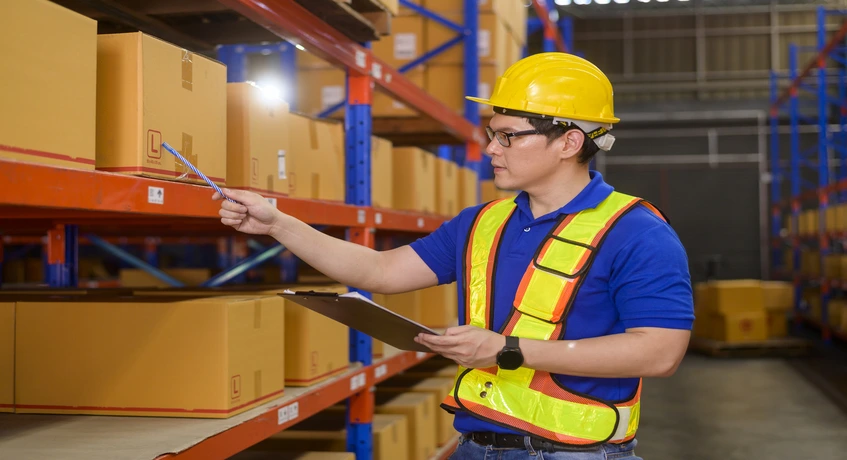
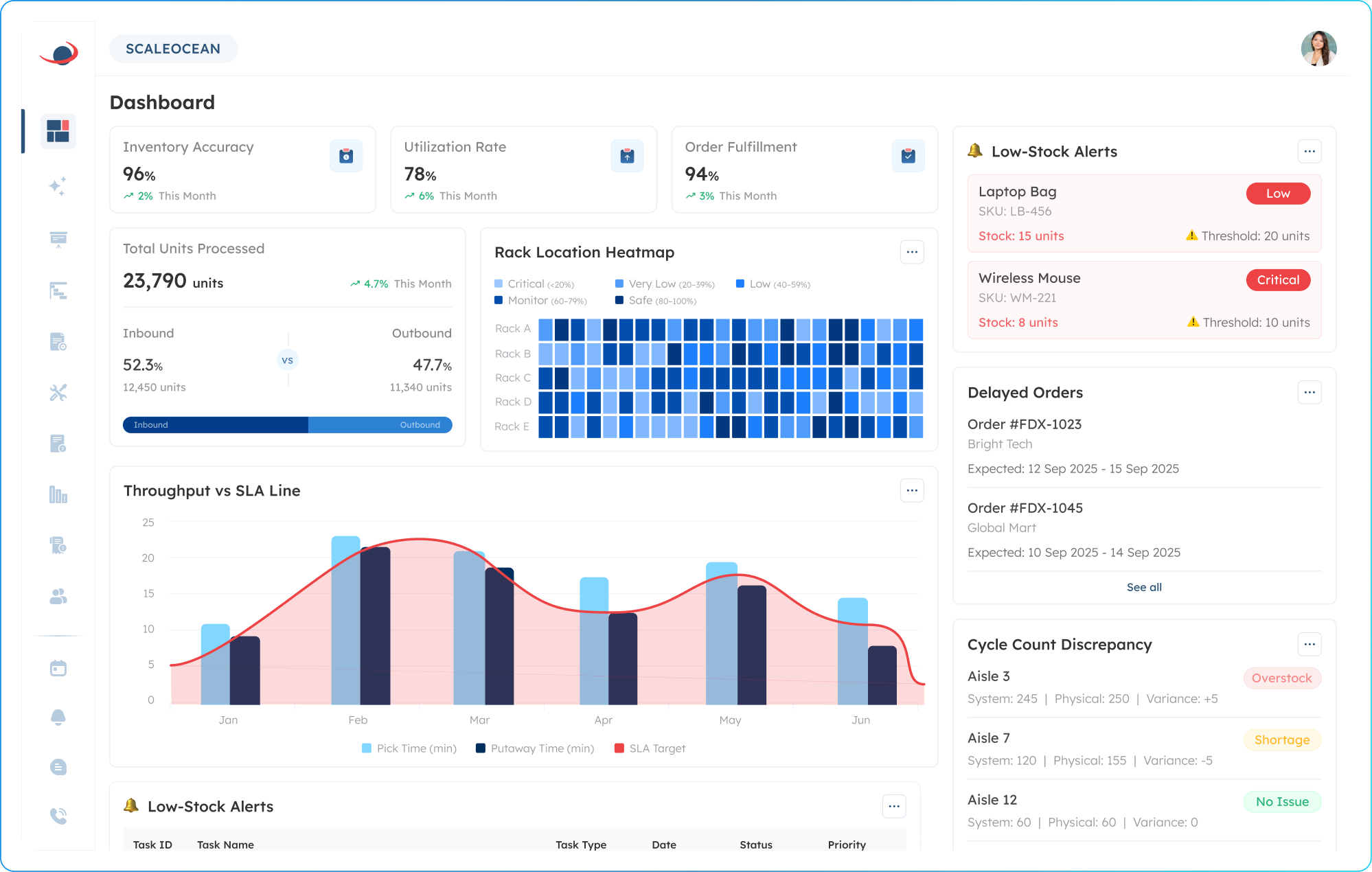
Warehousing is the storage of merchandise in a warehouse until it is to be sold to a retailer, distributor, or customer. It involves activities like inventory management, order picking, packing, and final dispatch. Structured warehousing helps companies gain better control of their inventory, streamline shipping operations, and ensure a more streamlined business process across multiple channels.
Enterprise warehouses often face operational challenges such as inaccurate inventory records, limited storage capacity, manual workflow bottlenecks, and poor process visibility. These issues can delay order fulfillment, increase storage costs, reduce picking accuracy, and make it harder for teams to respond quickly to customer demand.
From the data from Real Estate Asia, warehousing demand in Singapore has been rising, with total warehouse leasing activity climbing about 6.9 percent in 2025, the highest level in 25 years, driven by strong interest in modern logistics and cold storage facilities that support supply chain and e-commerce operations. Vacancy rates held steady even as new supply came online, and rents for prime warehouse space continued to grow, reflecting sustained demand for advanced storage and distribution infrastructure.
These trends show that Singapore’s warehouse sector remains a key component of the logistics ecosystem, as businesses prioritize efficient inventory handling and space capable of supporting automation and higher throughput. A robust leasing market and continued interest from third-party logistics providers and e-commerce operators highlight the importance of data-driven warehouse management for smooth and responsive supply chains in the city-state.
A business needs to know about current concepts, technologies, and management approaches in warehousing to enhance its warehouse performance. We will delve into the various warehouse activities and the different types of warehouses, as well as the technologies that are revolutionizing the industry and how ScaleOcean’s WMS can enhance operations, increase inventory accuracy, and help grow your enterprise.
Key Takeaways
Warehousing is a dynamic process of receiving, storing, and distributing goods, acting as a central logistics hub in the supply chain.
Warehousing is the organized process of storing different products for distribution before they move to retailers or customers. A warehouse should be an organized space for the efficient availability, security, and efficiency of products.
Today, warehousing plays a wider role in inventory management, order processing, and efficient distribution logistics. Businesses have dedicated areas and strategies in place to ensure products are always available, properly handled, and delivered on time.
As the market becomes more dynamic, Singapore businesses need to implement advanced warehousing services to optimize complex logistics, be agile to demand fluctuations, and continue to provide their clients with an outstanding experience. The use of technology to monitor and optimize workflows in real-time ensures that warehouses operate actively and support a responsive supply chain.
Effective warehouse management is used to avoid delays and ensure a level of service that meets ever-changing customer demands, while maintaining adequate inventory levels. Warehouses are a critical part of the supply chain, and smart processes and systems can help companies reduce operating costs, prevent stockouts, and ensure a smooth flow of products.
What Activities are Carried Out in the Warehousing?
The concept of warehousing is a set of uniform and synchronized tasks that allow for efficient storage, organization, and control of items. It allows for the best flow of products through the supply chain, better order delivery, and streamlining operations.
Core Warehousing Activities:
1. Inventory Control
Managing stock is something that occurs in a warehouse. This means keeping track of all the products and making sure all the records are up to date. Using a warehouse barcode system can further streamline this process, ensuring accuracy and efficiency in inventory management.
Modern technology is involved in inventory management these days. Bar code systems, inventory software, and other utilization tools enable managers to know what is happening with their stock now. The inventory software and barcode systems are really important for managing the inventory.
2. Supporting the supply chain
Warehouses ensure the efficient and prompt movement and storage of goods, ensuring products are delivered smoothly and swiftly from manufacture to the destination.
Warehouses utilize supply chain software to provide you with insights into what’s happening and greater control over what’s occurring in warehouses. This allows managers to determine the future of traffic and make the best use of existing resources while adapting to change.
3. Receiving & Inspection
The receiving process is the first step in warehouse management. Goods are received here, and you will confirm whether they are the same as the purchase orders. This is done by inspecting paperwork to ensure only the right items are received at the warehouse.
This involves inspecting the products for quality and condition. Using automation helps with this. It identifies errors, maintains records, and ensures uniformity of the receiving. By doing this, we can be confident in the quality of the products.
4. Storage & Slotting
Storage and product placement optimization is about finding the spot for a product in the warehouse. We have to think about the size of the product, how much it weighs, and how often we sell it. The goal is to use as much space as we can in the warehouse.
If we put the products that people want to buy a lot in easy-to-reach places, the people working in the warehouse do not have to move as much. There is software that can help us figure out the way to set up the warehouse. This software can help us get work done and use the whole warehouse.
5. Picking & Packing
Picking is the action of pulling goods out of the warehouse to meet the needs of an order. We do have many kinds of warehouses with different sizes and plans, so we pick goods with many different picking methods, such as pick item by item, pick same location, item and etc.
Packing goods involves protecting goods and identifying items. We can prevent mistakes and damage to goods if we are supported by computer systems to help us to arrange the picking list, to do order consolidation, and to get the goods to the customer.
6. Shipping & Logistics
Shipping is the part that happens in the warehouse. It is when we pack goods for the customer and prepare the documents required for shipping. If we plan well enough, the shipment is ready to get to the customer at the correct delivery time.
The computer systems enable us to track and follow the shipments at the appropriate time, determine the optimal delivery route, and to provide transparent service towards the customer and eventually to satisfy the customer’s requirement to obtain good delivery.
7. Quality Control
Quality control is a continuous process that occurs throughout the warehouse from arrival until departure. In the warehouse, quality control includes an inspection of incoming goods and an inspection of outbound products.
The overall benefit of the quality control procedures is maintaining brand equity, diminishing returns, and the creation of customer reliance on the company for delivering satisfactory products from the warehouse and of the brand.
Why is Warehousing Important?
Warehousing is a crucial function of modern businesses, offering a centralized space, organization, and management of goods. By efficiently storing, picking, packing, and dispatching processes, effective warehousing allows businesses a competitive advantage by ensuring that goods are delivered accurately and on time.
Below are the key importance of warehousing for business operations:
1. Reduced Operating Costs
Warehousing contributes to reducing overall operational costs by streamlining and consolidating both storage and dispatch processes. Efficient management and storage of goods allow for cheaper acquisition and logistics strategies, lowering the cost of inventory.
Smart warehouse layouts and streamlined workflows reduce wasted employee time and effort. Proper management of each warehouse receipt also improves operational accuracy, increases productivity, and helps lower overall business costs.
2. Improved Accuracy
Accuracy in warehouse operations is essential when fulfilling orders, tracking inventory, and stocking goods. Maintaining clear standards for handling the goods and implementing correct receiving, picking, and storage procedures reduces potential mistakes.
The use of technologies such as scanners and warehouse management systems helps businesses improve their overall accuracy. Real-time tracking for each of the items stocked allows for a decrease in error rates, thereby boosting order reliability and customer trust.
3. Real-Time Visibility
Warehousing provides managers with a real-time view of the company’s inventory, which allows for quick decisions to be made regarding stock requirements and customer demand. The increased visibility throughout the warehouse increases efficiency.
Using modern systems, businesses have a real-time view of both stock levels and order progression. This provides the capability of predicting and preventing operational problems before they affect business.
4. Storage of Goods
A warehouse offers a secure and well-organized area in which to store items. It allows companies to maintain sufficient levels of stock and buffer against changing demand throughout the market.
Automated systems for goods storage, as well as climate-controlled sections, can protect items against both physical damage and spoilage, preserving their quality and integrity.
5. Product Security
Warehouses offer a way of protecting stock against theft, damage, and environmental factors. Systems such as security cameras and controlled access areas help maintain safety and accountability.
Items stocked in a climate-controlled environment will retain their quality longer and prevent spoilage or damage. Well-organized sections allow businesses to preserve the quality of products stocked, saving on losses and reducing product issues.
6. Increase Inventory and Re-Order
Warehouses provide the necessary storage for companies to increase and maintain the amount of stock it holds, which in turn allows for better profit margins and allows goods to be bought in larger quantities.
To handle larger inventories with greater efficiency, businesses can leverage ScaleOcean Warehouse Management Software, a top solution for optimizing stock control. Click this banner to schedule a free demo and see how ScaleOcean can help your company maintain optimal stock levels and maximize profitability.
What are the Types of Warehousing Services?
Warehousing services types can be classified by factors like ownership, storage period, or the specific needs of the products. When choosing a warehousing service, consider the nature of the goods, the scale of operations, the business strategy, and logistics.
The most common types include:
1. Private Warehouses
The company owns and operates the warehouse, which gives it full control over operations, storage, and warehouse design. This setup works best for large manufacturers and big retailers that need to handle large amounts of goods regularly.
With private warehousing, a company can fully control its facility, including the layout, technology, and staff. However, building and running a private warehouse can be quite costly due to expenses for construction, maintenance, and staffing.
2. Public Warehouses
A public warehouse facility is owned by a third-party service provider that can store goods for numerous customers. They are often suitable for firms with fluctuating inventory levels, offering services on a temporary, short-term basis, and minimizing initial investment costs.
Public warehouses not only offer basic storage but also additional services like fulfillment. However, a company does not have that much operational control as with a private facility, and must also manage potential conflicts arising from shared resource usage.
3. Bonded Warehouses
This type of warehouse is licensed by customs to store imported products, where payments on import duties and taxes will only be paid after goods have been cleared for sale into a country, enabling businesses to manage cash flow and deferred payments.
Goods will also be kept under the supervision of customs authorities for customs purposes. Such warehouses are highly applicable for international traders and firms that wish to re-export goods into foreign countries without bearing any local import duties.
4. Cooperative Warehouses
The warehouse facility is collectively owned by several businesses that are often in similar industries or regions. A cooperative warehouse has similar benefits as a private warehouse but without requiring the high capital expenditure on the part of an individual firm.
However, successful cooperative warehousing needs great collaboration from all members to facilitate and maintain operations smoothly and efficiently.
5. Automated Warehouses
Automated warehouses make use of robotic and automated equipment to operate storage, retrieval, handling, and processing systems to perform most storage-related tasks without human involvement.
These facilities are suitable for businesses with enormous quantities of similar products to optimize processing speeds, improve accuracy, and reduce labor costs.
6. Cold Storage Warehouses
The company has specialized warehousing facilities for goods that can only be maintained at specific low temperatures for their shelf life. Food products and other chemical products can benefit from cold storage warehouses in order to maintain quality and safety and meet the required regulatory standards.
The energy and special equipment costs to maintain the optimum temperatures for cold storage warehouses are quite high compared to typical warehouse operations.
How to Manage Warehousing Properly?
Effective warehousing management involves the complete control of goods flow while maximizing space and minimizing handling.
By optimizing space, employees, and processes, you can achieve a level of accuracy and efficiency that is critical to the long-term success of your logistics network.
1. Optimize Spatial Layout
Your warehouse’s physical space dictates the efficiency of your day-to-day operation. A strategically planned layout that directs goods logically from receiving to shipment minimizes redundant travel, which makes up most of your hourly operation time.
Effective slotting is the implementation of placing fast-moving items in optimum and accessible locations. Easy-to-navigate aisles and the use of your vertical space with modern racking systems avoid bottlenecks and congestion.
2. Streamline Core Workflows
Outside of the arrangement of physical goods, standardize the workflow throughout your operation in order to avoid costly downtime. Each phase of warehouse operations, from receiving to shipping, should be analyzed to remove inefficient processes.
Implementing an advanced warehouse execution system is critical to your operation. These software packages will organize your employees and machines, ensuring that your entire production operation is never idled.
3. Implement Technology and Automation
Your warehouse operation requires high-quality tools to remain productive while handling high quantities of inventory accurately. Utilizing a robust Warehouse Management System (WMS) combined with a bar code scanner is important for acquiring data quickly and eliminating written processes.
Based on data found by our team, recent Forbes analysis shows warehouse automation adoption is rapidly increasing. Gather AI provides a real example of how AI can transform warehouse processes. Warehouses that previously relied on manual tracking, picking, and dispatching can now automate these operations, improving accuracy, speeding up fulfillment, and giving real-time visibility across inventory, turning traditional warehouses into efficient, data-driven operations.
4. Foster Labor and Safety Standards
Your employees are just as important to your warehouse operation as the facility’s space and technological advancements are. Management communication and employee tracking software will streamline workforce scheduling and improve accuracy.
The safety of your employees is also vital to avoiding lost workdays and protecting them. Maintaining a well-disciplined operation through security measures and regular equipment maintenance will reduce accidents and incidents on your warehouse floor.
Trends & Technologies That Must Be in the Warehousing
The warehousing business has transformed to being data-driven, and the increased consumer expectations of delivering packages anywhere quickly require innovative processes to be installed in the warehousing business, such as AI-based inventory forecasting, a warehouse management system in the cloud, robotic automation, etc.
These trends are responsible for current warehouse functionality:
1. Automation Systems
A robotic automation system has been installed in many modern warehouse facilities, and it is capable of transferring products from AGVs to robotic arms, transferring products with rapid picking and packing.
Despite the high initial cost of capital investment, the long-term return is undeniable due to the continuous 24-hour operations it allows, and reducing the costs related to labor and errors from human involvement, with a growing number of easier and more accessible technologies and increasing order volumes.
2. Smart Warehouse
A smart warehouse is a new approach to a highly responsive logistics operation through the integration of interconnected technologies. A warehouse with embedded Internet of Things (IoT) devices places sensors on products, storage devices, and any machine within the warehouse and collects real-time data on various information.
All the collected data will be consolidated and further analyzed by an AI-based algorithm in order to efficiently allocate resources, such as maintenance of forklift routes with predicted malfunctions. A proactive rather than a reactive warehouse operation will also ensure fewer potential issues and no machine downtimes.
3. Omnichannel Fulfillment
The rapid fusion of digital and brick-and-mortar commerce means consumers desire and expect the same experience from online and in-store shopping channels, and the demand is handled through omnichannel fulfillment.
For this to happen, the warehouse management systems must be tightly integrated, and data must be shared instantly. From individual shipments for B2C to large-scale bulk pallet orders for B2B, which required particular specialized software to allow accurate delivery for a varied and huge number of consumers.
4. Warehouse Management System
A powerful warehouse management system acts as a control and decision center within the entire warehousing process. The existence of a WMS allows businesses to get an infrastructure that controls and coordinates every part of their warehousing operations.
Furthermore, warehouse management systems (WMS) provide important data that is utilized in further decision-making processes by integrating with the enterprise resource planning system of businesses, minimizing manual handling for inventory tracking.
How to Easily Optimize and Track Your Warehousing?
Improving warehouse efficiency is simpler with a system that tracks all warehouse movement, picking, and dispatch in one single place. Instead of manual methods, warehouse software can help business track their inventory in real-time, reduce errors from operations, and ensure that all workflows operate in a more efficient manner in receiving, storage, picking, packing, and delivery stages.
Improving warehouse efficiency is easier with software that tracks all movements, picking, and dispatch in one place. Unlike manual methods, it provides real-time inventory visibility, reduces errors, and streamlines workflows across receiving, storage, picking, packing, and delivery.
Such visibility is increasingly critical for businesses in Singapore, with complex multi-branch warehouse operations, rapid order fulfillment times, and the pressure to be error-free. With warehouse software that integrates control of inventory, procurement, logistics, and reporting within one system, it can empower teams with cleaner data for faster, more accurate decisions.
ScaleOcean Warehouse Management Software gives businesses full control of operations. With unlimited free users, companies can scale easily, while its All-in-One ERP integrates warehouse management with inventory, purchasing, logistics, finance, and over 200 other modules.
For even greater efficiency, ScaleOcean AI for warehousing helps automate stock tracking, optimize picking and dispatch processes, and provide real-time insights to streamline operations further.
This software supports various customizations of workflow, multi-branch integration, IIoT integration, smart configuration, and automation of business processes, which can enable businesses to track stocks, automate major warehouse processes, improve management of receiving and dispatch processes, and coordinate well across many warehouses or distribution centers.
With ScaleOcean, warehouse performance will improve with real-time visibility, continuous after-sales service, a flat rate, and the ability to be flexibly configured. Check out the free demo today to optimize your warehouse management system.
Conclusion
Warehousing is the organized storage and management of goods to ensure smooth flow, timely distribution, and accurate inventory tracking across the supply chain. Warehouse management software centralizes these operations, automating inventory updates, stock transfers, picking, packing, and reporting for maximum efficiency.
By using warehouse management software ScaleOcean, companies can streamline storage layouts, monitor stock movements in real-time, and improve order fulfillment accuracy. This solution allows businesses to optimize workflows, reduce errors, and enhance operational efficiency. Experience the impact firsthand with this system by trying a free demo today.
FAQ:
1. Why is it called a warehouse?
A warehouse gets its name from being a “house” for storing “wares.” The term originates from the mid-14th century, combining “ware” (goods or merchandise) with “house” (a building or structure).
2. What is the purpose of a warehouse?
A warehouse’s main role is to safely store, manage, and distribute inventory, serving as a central hub in the supply chain. It streamlines logistics by balancing supply and demand, cutting costs, and speeding up order fulfillment.
3. What are the 7S rules in a warehouse?
Derived from principles like Sort, Set in order, Shine, Standardize, Sustain, Safety, and Security, the 7S rules in the warehouse go beyond mere cleanliness.
4. What are the four activities of warehousing?
Knowing the four key functions of a warehouse, which are receiving, storage, picking, and shipping, is crucial for optimizing operations and maintaining a smooth supply chain.












 Key Takeaways