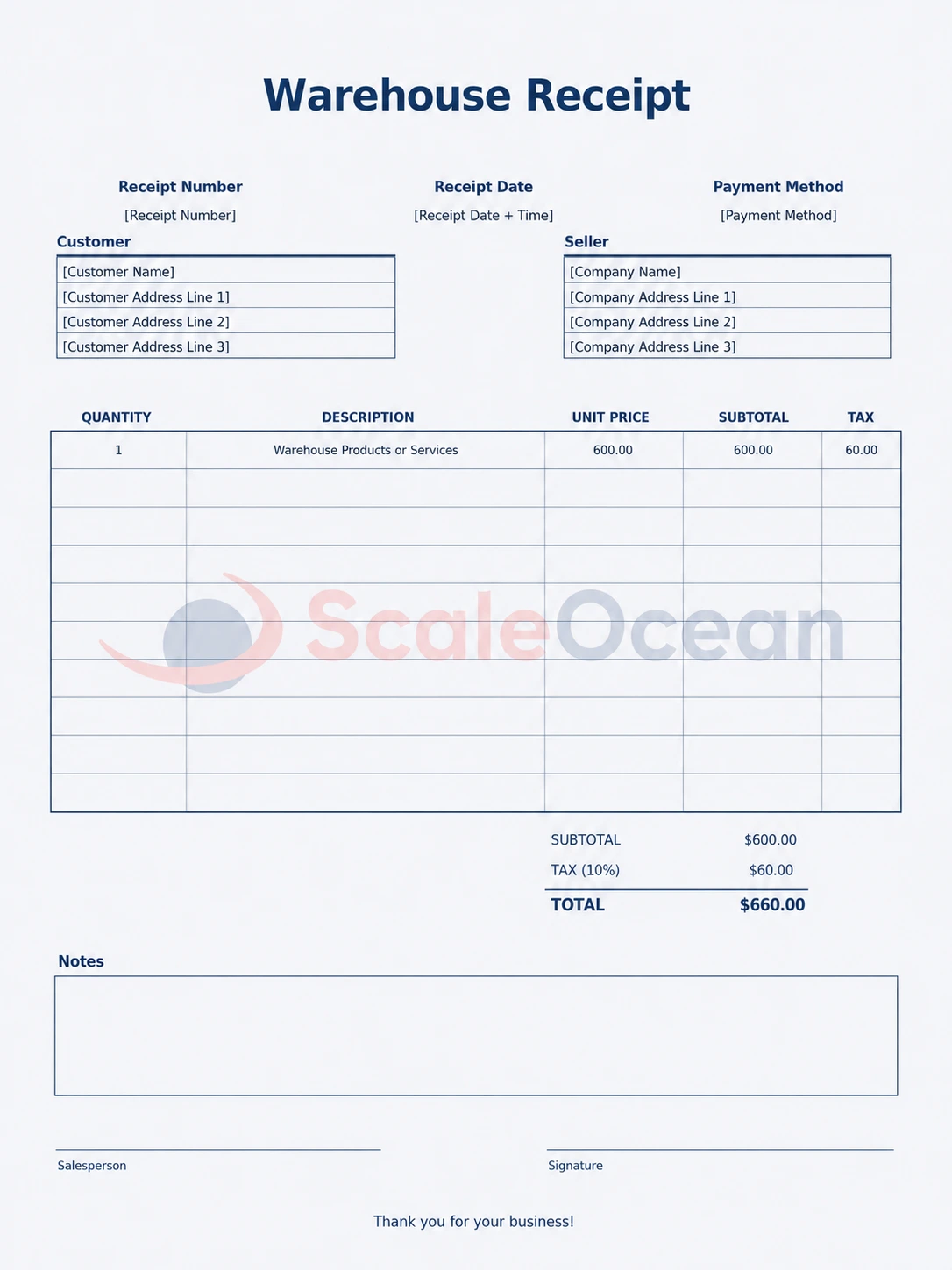
A warehouse receipt is a document that serves as proof that things have been received and stored in a warehouse. It documents the quantity, quality, ownership, condition, and storage location of items. It is also used as proof of inventory ownership and can be used to facilitate warehouse receipt financing in trade and finance.
For many warehouses, receiving problems start when physical stock does not match system records. Goods may arrive without a PO reference, ASN number, batch details, QC status, or clear ownership data. This creates delays in putaway, supplier disputes, invoice matching issues, and poor visibility across the warehouse, finance, procurement, and sales teams.
A structured warehouse receipt can help address this issue by providing a documented record of all inbound activity. Businesses can capture SKU information, lot numbers, storage zones, damaged goods, ownership, approval history, and more in a single controlled workflow rather than using hand-written notes or various spreadsheets.
Approximately 13.2% of food is lost in the supply chain from post-harvest to the retail stage, based on data we collected from FAO. This underscores the importance of the structured warehouse receipt systems that provide businesses with greater transparency of goods, inventory management, financing options, and less loss due to inadequate storage control.
Read this article to understand what a warehouse receipt is, how to create one, what components it should include, how negotiable and non-negotiable receipts differ, and how digital warehouse software can improve receipt control.
Key Takeaways
A warehouse receipt is a document that confirms a warehouse has received goods from a depositor, supplier, trader, manufacturer, or logistics partner.
Key benefits of warehouse receipts include better financing access, lower price risk, stronger quality assurance, clearer ownership proof, and more traceable warehouse control.
ScaleOcean’s Warehouse Softwarehelps manage the data and documentation needed for warehouse receipts, ensuring accuracy and efficiency in your operations.
A warehouse receipt is a document acknowledging receipt of goods from a depositor, supplier, trader, manufacturer, or logistics partner by a warehouse. Typically contains such information as the warehouse name, storage location, owner name, item description, quantity, quality, batch number, storage terms, and authorized signature.
This document serves as a record in the warehouse for daily operations that items have actually entered the warehouse. It also clarifies ownership of the goods, where they are stored, if the goods can be released, financed, transferred, inspected, and held for further approval.
To CEOs and decision makers, the benefit of a warehouse receipt is more than just a piece of paper. It turns into a management document that links with receiving, inventory, quality control, finances, procurement, and customer service. If the receipt is incorrect, all downstream processes are more difficult to trust.
That’s why lots of businesses are relocating manual receipt templates to electronic warehouse systems. A warehouse receipt format Excel file may suffice for small teams, but larger businesses typically require features such as barcode scanning, automatic stock update, approval trails, batch tracking, and integration with the finance or procurement system.
Process for Making Warehouse Receipts
There is much more to making a warehouse receipt than filling out a form. The process should confirm that the goods are expected, physically received, inspected, recorded, stored, and approved before the receipt is valid.
The workflow should ultimately link inbound references, inventory data, QC results, supplier documents, storage location, and finance records. This will help minimize receiving mistakes and will make each receipt easier to confirm at a later time.
1. Commodities for Physical Delivery
The process begins when goods are prepared for physical delivery to the warehouse. These goods may include raw materials, finished products, spare parts, FMCG items, regulated goods, commodities, or customer-owned inventory handled by a 3PL provider.
Before receiving, the warehouse team should verify the delivery against a purchase order, transfer order, inbound schedule, ASN, or customer instruction. This helps prevent wrong stock acceptance, mixed ownership, missing documents, and disputes with suppliers or customers.
2. Certificated Stock
Once goods are received, the warehouse will determine if the goods can be officially received. The team checks the authenticity, quantity, quality, packaging condition, batch data, expiry date, serial number, and supporting documentation before confirming storage.
This step helps to ensure the warehouse receipt is not based on the supplier’s claim, but rather the actual goods received. When stock appears to be short, damaged, at risk of expiry, or quantity discrepancies are to be noted prior to the stock being available for sale, production, or delivery.
3. Warehouse Receipts
After the goods have been confirmed, the warehouse provides a warehouse receipt as evidence of storage. The document must contain information about the warehouse, the owners, the description of the goods, the quantity, the storage location, the term of the fees, the delivery terms, and approval.
A digital warehouse receipt can also be linked with purchasing, inventory, finance, QC, and sales workflows. With a system like ScaleOcean Warehouse Software, teams can track invoice matching, stock movement, audit trails, putaway, and goods release from one system, supported by barcode/RFID validation, real-time inventory updates, approval workflows, and AI Smart Alerts for discrepancy detection.
Types of Warehouse Receipts
Warehouse receipts are generally divided into negotiable and non-negotiable documents. The difference affects ownership transfer, financing potential, claim rights, and how goods can be released.
Under commercial document-of-title rules, a document is negotiable when goods are deliverable to bearer or to the order of a named person; otherwise, it is treated as non-negotiable.
Aspect
Negotiable Warehouse Receipt
Non-Negotiable Warehouse Receipt
Main Purpose
Supports ownership transfer of stored goods through proper endorsement, delivery, or assignment.
Confirms that goods are stored for a specific named depositor or owner.
Transferability
Can be transferred to another eligible party when the required document process is followed.
Usually cannot be freely transferred without separate authorization or assignment.
Financing Use
Often used in commodity trading, collateralized lending, and warehouse receipt financing.
More commonly used for internal records, storage confirmation, and customer inventory control.
Claim Rights
The eligible holder may claim the goods based on the receipt terms.
The named party generally remains the party entitled to claim the goods.
Best Use Case
Commodity markets, inventory financing, futures delivery, and transferable ownership transactions.
A negotiable warehouse receipt is a receipt given for goods stored in a warehouse that can be transferred to another party. This type is widely employed in commodity trading, inventory-based loans, and other cases that may involve goods’ ownership being transferred without any physical change.
Due to the possibility of ownership transfer, it is necessary to have strict document control of this receipt. Warehouses are required to confirm the ownership rights of the goods before releasing the goods to avoid double financing, unauthorized release, transfer, and ownership disputes.
2. Non-Negotiable Warehouse Receipts
A non-negotiable warehouse receipt serves as a receipt of goods for storage for a particular named party. It’s typically utilized for everyday warehousing, internal inventory control, 3PL, branch transfer records, and customer-owned inventory management.
This receipt is not a document that can stand alone to communicate ownership, but it facilitates operational control. It is utilized by businesses for audit records, customer reporting, supplier disputes, insurance claims, inventory visibility, and release authorization, among other applications.
Essential Components of a Warehouse Receipt
A good warehouse receipt should be able to provide sufficient details to enable traceability, control of liability, ownership identification, fee computation, and execution of the operation. The problem with incomplete receipts is that they can create disputes and undermine the accuracy of inventory.
Under UCC Section 7-202, a warehouse receipt does not need one fixed form, but key details include facility location, issue date, unique identification code, storage charges, goods description, and warehouse signature.
1. Facility Location
Facility location identifies where the goods are physically stored. It may include warehouse name, branch, address, zone, aisle, rack, bin, cold room, bonded area, or other location details used by the warehouse.
It is crucial for businesses that have multiple warehouses, branches, or 3PL partners. Removing location data creates opportunities to lessen misplaced inventory, streamline picking, enhance putaway, and provide management with improved inventory visibility.
2. Date of Issues
The date of issue will reflect the date of the warehouse receipt. It aids in the determination of the storage start date, the stock ageing, fee calculation, warranty tracking, expiry monitoring, and audit cut-off.
If the product is perishable or regulated, then this date is linked to the manufacturing date, the expiry date, and the inspection status. This helps teams keep track of FEFO rules and prevents the release of expired or limited stock.
3. Unique Identification Code
Each warehouse receipt is identified by a unique identification code, which ensures its traceability. May be a receipt number, barcode, QR code, doc ID, or system-generated transaction number.
When two or more deliveries come in from a supplier, a customer, or a branch, this code will not be confused. It also connects the receipt to purchase orders, inbound shipments, invoices, batch records, and stock movements.
4. Delivery Time
Records delivery times for when the goods arrive, when they are checked, and when they are available. The data is used to track receiving speed, put-away delays, dock capacity, and stock readiness.
It also provides accountability in case of damage, delay, or ownership issues. The use of clear time stamps will help the teams to see if an issue occurred before they received it, during inspection, or after they had stored it.
5. Fee Schedules
Storage charges, handling fees, loading fees, inspection fees, demurrage or late pickup costs are all explained in the fee schedules. This helps to avoid billing conflicts between the warehouse and the owner of the inventory.
For 3PL and commodity storage, fees need to be clear because items can be stored for varying periods. The rules underlying the charges will be more easily understood by customers, and the finance team will be able to validate the invoices more easily.
6. Inventory Description
The basic information in a warehouse receipt is the inventory description. Should contain the name of the item, SKU, quantity, UOM, grade, batch number, lot number, serial number, expiry date, packaging type, and condition.
This information should be based on what is actually received. Damaged, short, over-delivered, expired, mixed, or missing labels should be noted on the receipt.
7. Authorized Signature
An authorized signature is a valid signature that verifies that the warehouse receipt has been inspected and approved. It can be issued by any of the following representatives, such as a warehouse supervisor, QC, a customer representative, an authorized manager, or a warehouse agent.
This can be accomplished through approval processes, role-based access controls, timestamps, and audit trails in digital systems. This provides greater accountability than unsigned paper records or uncontrolled spreadsheet records.
Warehouse Receipts Examples
A warehouse receipt example should be clear, easily verifiable, and thorough for warehouse, finance, procurement, and audit staff. The document number, warehouse identity, depositor information, inventory lines, storage location, quantity, condition, fees, and approval section should be included.
Many teams are still looking for a warehouse receipt format Excel because it is easy to copy and modify. While this is fine for basic documentation, high-volume businesses can prevent duplicate records by implementing controlled numbering, validation rules, approval flows, and real-time inventory updates.
Use these sample templates as a practical reference:
Key Benefits of Warehouse Receipts in Trade & Finance
The advantage of warehouse receipts is that they transform tangible commodities into tangible assets. It helps companies do a better job of accessing financing, minimizing trading disputes, and developing confidence in the quality of stock and ownership.
A structured receipt also helps with warehouse control, as each receiving record will be able to be traced back to the actual stock received, the actual quantity received, the warehouses where it is stored, and the individuals responsible for it. This is particularly key for commodity, 3PL, manufacturing, and distribution companies.
1. Collateral for Financing
Warehouse receipt financing is a method of taking the backing of stored goods. The owner can present the receipt to a lender and ask them to lend money based on the inventory in the store.
A coffee trader, for instance, can put his coffee, rice, maize, or wheat in a certified warehouse and receive financing based on the receipt. This will keep the business afloat until the conditions are better for selling.
2. Price Risk Mitigation
Businesses can use warehouse receipts to mitigate price risk, providing greater flexibility with the timing of their sale of stored items. This comes in handy when prices are fluctuating in commodity markets after harvest, due to seasonal demand or because of scarcity of supply.
For instance, during low price periods, an exporter can hold products and sell them during high price periods. The company can move with greater confidence in the management of its stocks when it receives clear data about its receipts.
3. Quality Assurance
Quality assurance is provided by warehouse receipts, which note the condition and specification of the goods when received. Facts like grade, moisture, packing condition, QC, batch number, and expiry date minimize controversy.
For regulated goods, however, this documentation is all the more significant as buyers and lenders, auditors and warehouse teams require verified information. A clear receipt provides a guarantee that stored products are released for use, financing, or resale to standards agreed upon.
Warehouse Receipt vs Shipping Certificate: What’s the Difference?
A warehouse receipt and a shipping certificate can both appear in commodity delivery processes, but they serve different purposes. A warehouse receipt confirms goods received and stored, while a shipping certificate usually represents a commitment to deliver goods under specific delivery terms.
The main distinction for those running the warehouse is the responsibility to operate it. The warehouse receipts are strongly associated with inventory stored, the condition of the stock, ownership records, and release control. Shipping certificates emphasize the obligation of delivery and movement of the goods.
Feature
Warehouse Receipt
Shipping Certificate
Main Meaning
Confirms that goods have been received and stored in a warehouse or storage facility.
Confirms a delivery commitment under specific shipping or commodity delivery terms.
Physical Goods
Usually tied to goods already stored in a specific warehouse location.
May focus more on future delivery than immediate storage proof.
Issuer
Issued by a warehouse or storage facility after goods are received and verified.
Issued by an approved delivery or shipping-related party based on agreed terms.
Common Use
Used for storage proof, ownership control, inventory financing, and warehouse documentation.
Used for delivery arrangements, shipping commitments, or commodity movement processes.
Collateral Role
Can support inventory-backed financing when lenders accept the stored goods as collateral.
Usually needs additional review because it may not directly prove stored inventory ownership.
Operational Risk
Risk depends on stock accuracy, goods condition, ownership control, and receipt validity.
Risk depends on delivery readiness, shipping terms, and the issuer’s ability to fulfill delivery.
What is the importance of the Warehouse Receipts System (WRS)?
A Warehouse Receipts System, or WRS, is important because it creates a trusted structure for receiving, storing, documenting, financing, and releasing goods. It connects warehouse operations with trade, finance, ownership control, and audit requirements.
If the WRS is unreliable, then a business is likely to be experiencing issues with physical stock differences, missing receiving references, not knowing who the owner of the stock is, matching invoice payments late, having poor batch traceability, as well as supplier or customer disputes.
In companies with warehousing in several sites, WRS helps to make better management of the main office. A single source of truth enables managers to track the status of receipts, get warehouse location, owner, condition, quantity, putaway progress, and release readiness.
This is even more relevant in cases where goods are regulated, customer stock is managed by 3PL, products have expiring dates, and high-value goods inventory. Compliance, customer trust, working capital, and speed of fulfillment are all possible negative impacts of a weak receipt process.
ScaleOcean warehouse software helps strengthen WRS by automating receipt creation, real-time inventory updates, barcode validation, RFID tracking, 3D warehouse visibility, audit trails, approval workflows, and multi-warehouse dashboards. The system can also connect warehouse receipts with purchasing, sales, finance, procurement, accounting, and 3PL operations.
AI Insight & Smart Alert allow ScaleOcean to help identify quantity discrepancies, late putaway, damaged stock, missing QC, and PO mismatch before it becomes a problem for fulfillment. This provides better control to the warehouse, procurement, finance, QC, and management over the day-to-day receiving operation.
Conclusion
A warehouse receipt is more than a receiving document. It confirms that goods have entered storage, records their quantity and condition, identifies ownership, and supports traceability from inbound receiving to release. In trade and finance, it can also support collateralized lending and commodity transactions.
When receipts are created manually, teams can miss PO references, batch numbers, QC results, storage locations, or ownership details. A structured receipt workflow helps reduce disputes, speed up invoice matching, improve audit readiness, and keep warehouse data reliable across departments.
ScaleOcean warehouse software can help businesses manage warehouse receipts through real-time inventory visibility, automated receipt creation, barcode and RFID validation, audit trails, approval workflows, AI-powered alerts, multi-warehouse control, and integration with ERP modules. Try our free demo to see how your warehouse can reduce manual work and manage receipts with stronger operational control.
FAQ:
1. How does a warehouse receipt benefit commodity markets?
Warehouse receipts benefit commodity markets by making stored goods easier to verify, finance, transfer, and trade. It supports trust because buyers, lenders, and traders can review quantity, quality, ownership, and storage location before making decisions.
2. How do warehouse receipts support inventory financing?
Warehouse receipts support inventory financing by allowing stored goods to be used as collateral. A lender can review the receipt, assess the stored goods, and provide working capital without requiring the owner to sell inventory immediately.
3. Are warehouse receipts legally binding documents?
Warehouse receipts can be legally significant because they record storage, ownership, delivery rights, and warehouse obligations. However, legal treatment depends on jurisdiction, receipt terms, warehouse licensing, and applicable trade or commercial regulations.
4. How can WMS software improve warehouse receipt management?
WMS software streamlines warehouse receipt management by automating document creation, inventory updates, QC checks, barcode validation, approvals, and audit trails. It also links receipt data with inventory, finance, procurement, and reporting for better accuracy and visibility.













 Key Takeaways