

Tax clearance in Singapore is the IR21 process employers use when qualifying non-Singapore citizen employees cease employment, leave Singapore, or begin overseas postings. It helps companies settle outstanding tax obligations before departure.
However, employee exits can reach HR teams too late, leaving limited time to prepare payroll records and submit Form IR21. Consequently, delayed action can increase compliance risks and disrupt final payroll arrangements.
For enterprises managing hundreds of expatriate employees, the challenge becomes greater because employee departures occur across departments, entities, and payroll cycles. Moreover, HR and finance teams must coordinate information before filing.
Therefore, companies need a structured tax clearance process that connects employee exit information with payroll, finance, and tax workflows. This approach reduces manual coordination while helping teams track IR21 obligations centrally.
 Key Takeaways
- Tax clearance in Singapore is the process employers use when qualifying non-Singapore citizen employees cease employment, leave Singapore, or begin overseas postings
- Tax clearance applies to eligible non-Singapore citizens, including EP, S Pass, Work Permit, PEP, ONE Pass, and certain PR employees.
- The IR21 workflow covers compliance checks, withholding monies, digital submission, IRAS processing, settlement, and final payment release procedures.
- ScaleOcean connects HR, payroll, finance, and tax workflows, helping enterprises manage IR21 processes, approvals, payment holds, and compliance visibility in one place.

What is Tax Clearance (IR21) in Singapore and Why is it Important?
Tax clearance in Singapore requires employers to notify IRAS (Inland Revenue Authority of Singapore) when qualifying non-Singapore citizen employees cease employment, leave Singapore for more than three months, or begin certain overseas postings. Employers generally file Form IR21 at least one month beforehand.
Form IR21, formally called the Notification of a Non-Citizen Employee’s Cessation of Employment or Departure from Singapore, records employment income relevant to the employee’s tax assessment. IRAS then determines the applicable tax liability.
The process also protects tax collection because employers must withhold monies due to the employee from the date they become aware of the impending cessation or departure. This withholding continues until IRAS provides clearance instructions.
Consequently, tax clearance affects more than payroll administration because inaccurate income reporting or delayed filing can disrupt final payments and create compliance exposure. Employers may face fines of up to SGD 5,000 for late or non-filing.
 Also Read: Top Tax Software 2026: Review and Guide
When must you File Form IR21?
Employers should submit Form IR21 at least one month in advance when a qualifying non-Singapore citizen employee is leaving Singapore. The same notice period applies when the employee goes on an overseas posting or leaves Singapore for more than 3 months.
For instance, if an employee resigns with a definite leaving date, the employer must schedule the filing deadline around that cessation date. Employers who cannot give one month’s notice should describe the situation on IR21.
Goods and services tax clearance is applicable in respect of the relevant income earned during the current year and any previously earned income which has not yet been assessed. Accordingly, payroll teams should reconcile salary, allowances, benefits and other taxable payments for submission.
Furthermore, the business must submit an Additional or Amended Form IR21 when a subsequent amount becomes payable after the initial submission. This prevents the company from releasing additional sums without obtaining the requisite further tax clearance.
Who Needs Tax Clearance?

Tax clearance is for non-Singapore citizen employees, including EP, S Pass, WP, Personalized EP, and ONE Pass holders. You will need to apply for tax clearance when you leave the country, when employment with the company ends, when you are sent on a foreign assignment, or when you are leaving Singapore for more than 3 months.
Employees generally need to be cleared when they leave (resignation, dismissal, or contract expired for the employer in Singapore). Likewise, an overseas posting or departure for a certain period may trigger the employer’s obligation to notify IRAS and deduct the relevant amounts.
A Singapore Permanent Resident may also need to apply for tax clearance when they permanently depart Singapore upon the cessation of employment. An SPR who still resides in Singapore subsequent to the cessation of employment typically would not be required to submit Form IR21, subject to IRAS conditions.
As a result, HR should evaluate employees’ citizenship and departure situations instead of applying a single rule to everyone. IRAS offers a Tax Clearance Singapore Calculator to help determine whether reporting is required, which is great for those of you who struggle with figuring out how to calculate tax clearance Singapore.
1. EP (Employment Pass)
Employment Pass holders are non-Singapore citizen employees and are normally within the scope of IR21 upon expiration of employment or upon departure, depending on the conditions applicable to the Employee. Employers should check their status before making final payroll payments to employees.
If an EP holder resigns, is terminated, or leaves Singapore for more than three months, the employer should check immediately whether IR21 is needed. The company should deduct the money as soon as it knows the EP holder is leaving Singapore.
2. S Pass
S Pass holders are also subject to the special tax clearance rules for non-Singapore citizen employees. The employer must therefore consider IR21 requirements for any S Pass employee who leaves employment or departs Singapore under qualifying circumstances.
The company will arrange the employee’s resignation date, work reference, payroll record, withholding amount, and the timetable for submitting Form IR21. This avoids a mismatch between the work reference and the income statement to IRAS.
3. PR (Permanent Resident)
We handle SPR cases differently depending on whether you plan to leave Singapore permanently after your work period. If an SPR application indicates that you will not leave Singapore if you will stay in Singapore, then Form IR21 is not required.
However, an outbound SPR departing Singapore can obtain tax clearance, while their qualifying overseas posting shall also receive tax exemption treatment. Employers should collect evidence if needed, and verify whether the employees qualify.
Tax Clearance Exemptions: When is a Company Exempt from IR21 Obligations?
For Singapore Citizens, companies are not required to submit Form IR21, and most SPR employees will be eligible for exemption if they are not leaving Singapore permanently. For SPR cases, the company should keep the Letter of Undertaking (LOU) on record.
Some foreign employees can be granted administrative relief if they were working for 60 days or less during a calendar year. This relief cannot be granted to company directors, public entertainers, or employees of any other similar professional or vocational position.
Where other foreign employees have satisfied the service and income conditions mentioned above, and they also fall into a case with 183 days or more and an annual income of less than SGD 21,000, certain further concessions may apply. Previous employment in Singapore will be considered in these cases.
Employers do not have to complete IR21 for the following, if certain criteria are met: qualifying internal transfers, certain overseas postings of six months or less, and certain training or business absences. Employers should check the circumstances carefully before using an exemption.
Tax Clearance (IR21) Workflow for Corporate HR and Finance Teams

A reliable IR21 workflow starts when HR identifies an employee exit or qualifying departure and confirms whether tax clearance applies. This early assessment gives payroll and finance enough time to prepare.
Step 1: Trigger & Compliance Check
The procedure begins once HR receives a resignation, termination decision, end-of-contract notification, foreign posting, or extended departure. How do we proceed? The appropriate team should establish whether the employee falls under the IR21 requirement or an available exemption.
Next, HR will verify the individual’s citizenship, work pass status, cessation date, intended departure date, and employment history before departure. Using the IRAS Tax Clearance Calculator can also reduce the risk of misjudging whether clearance applies.
Step 2: Financial Withholding (The Freeze)
As soon as the tax clearance is required, the employer should deduct, from the date the employer is informed of the employee’s stopping or leaving, all dues payable to the employee. These dues can be Salary, overtime, leave pay, allowance, reimbursement, gratuity, etc.
This practice can therefore create a de facto withholding during the time IRAS considers the employee’s taxation. For this reason, payroll must spot all payments not yet made and reconcile the totals before reporting them using Form IR21.
Step 3: Digital Submission (Form IR21)
Employers are encouraged to submit Form IR21 via the myTax Portal electronically, as e-filing submissions tend to be processed faster than paper submissions. The submission should include the particulars of employee(s) and employment income for the cessation year and relevant previous period.
Users with approval can log in to the appropriate tax clearance service through the myTax Portal from an approved organization account. Ensure that income, cessation, withholding amounts, and other reportable remuneration are checked with finance and HR before submission.
Step 4: Processing Window
IRAS normally takes up to 7 working days to process e-filed Form IR21 and up to 21 days for paper submissions. However, it may take longer if IRAS receives an incomplete form or needs additional information. Businesses should also maintain accurate GST records, including input VAT and output VAT in Singapore, to support proper tax reporting and compliance.
Employers can view the Form IR21 and related tax clearance status in myTax Portal during processing. Proactive planning is recommended, as clearance timing can affect when withheld employee monies are released.
Step 5: Settlement & Final Release
Following the deduction, IRAS will send out a Directive to Pay Tax or a Notification to Release Monies. An employer who receives a payment directive from IRAS must pay the prescribed sum within ten days of the directive date. IRAS will issue a Notification to Release Monies to approve the deducted payment.
The employer should also finalize the employee’s final payroll settlement in line with the clearance directive. Retaining filing records, payment documentation, and payroll evidence can also help finance teams prepare for future audits.
An effective IR21 process requires timely coordination from employee cessation through final payment release. However, disconnected systems can force HR and finance teams to exchange spreadsheets, emails, and manual updates.
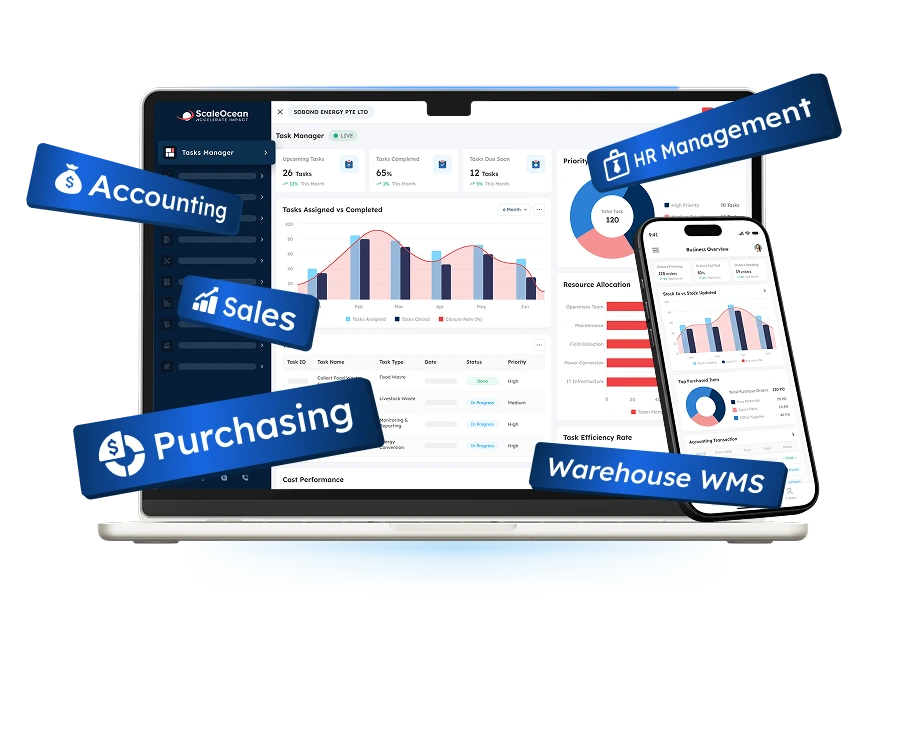
You can consider ScaleOcean, which provides configurable workflows that connect employee cessation, payroll reconciliation, withholding, approvals, and final payment release, giving authorized teams clearer visibility throughout each tax-clearance case.
The platform supports multi-entity tax-clearance management, helping regional enterprises monitor expatriate cases across subsidiaries and shared-service operations. Role-based access and audit trails strengthen governance between HR, payroll, finance, tax, and management.
Additionally, ScaleMind AI can highlight missing data, unusual income changes, deadline risks, and pending actions. Schedule a consultation with our experts to discuss a tax-clearance workflow suited to your operations.
Legal Risks and IRAS Fines if a Company Neglects to Process Tax Clearance
Companies that fail to process tax clearance can face consequences beyond delayed employee payments. IRAS states employers may face fines of up to SGD 5,000 for failing to meet filing obligations.
Employers must generally submit Form IR21 at least one month before a non-citizen employee ceases employment, although IRAS provides a 10-day grace period. If shorter notice applies, employers should explain circumstances such as their GST filing.
Employers must also withhold monies due once they learn about an impending cessation, termination, or qualifying overseas posting. If they fail to withhold required amounts, they may become liable for tax owed.
Therefore, companies should treat IR21 as a controlled payroll process rather than a form completed after departure. Early alerts, accurate income records, and approval steps can reduce filing risks.
Clearance Directive: When Can Companies Forward Remaining Salaries to Employees?
After IRAS processes Form IR21, employers receive either a Directive to Pay Tax or a Notification to Release Monies. The document determines whether withheld funds go to IRAS or are returned to the employee.
A Directive to Pay Tax specifies the amount the employer must remit to IRAS, with payment generally due within ten days. The amount may also include outstanding tax identification number Singapore balances from earlier years.
When IRAS issues a Notification to Release Monies, employers should release withheld amounts as directed. However, an amended or additional Form IR21 requires employers to wait for another clearance directive.
Consequently, payroll should not automatically release final salary after an employee’s last working day. Finance should first verify the latest IRAS clearance status and retain evidence supporting the final payment.
Real-Case Tax Clearance Scenarios in Singapore and How to Overcome Them
The Straits Times reported that Singapore recorded 14,490 retrenchments in 2025, with business reorganization and restructuring remaining a major driver of workforce changes. MOM also reported that non-resident employment increased by 43,900 during 2025, highlighting the scale of workforce administration that companies may need to manage.
For enterprises managing many expatriates, each departure can require a separate IR21 assessment, income reconciliation, withholding process, and clearance-status check. Consequently, relying on spreadsheets or disconnected payroll records can make it harder to identify which employees require clearance and whether their payments remain frozen.
So, companies should maintain a centralized employee-exit register containing work-pass status, cessation date, IR21 requirement, filing date, withheld amount, and clearance status. HR and finance teams can then monitor multiple employee cases from one workflow instead of tracking each departure manually.
However, when HR, payroll, and finance operate separately, teams may struggle to identify every affected employee. ScaleOcean Atlas connects HR, payroll, finance, and tax data within one operational workflow, helping teams centralize employee income, final payments, approvals, and clearance status across departments and entities.
For Singapore enterprises, ScaleOcean’s flagship platform, ScaleOcean Atlas, supports configurable IR21 clearance workflows, payment holds, role-based approvals, and audit trails, while supporting PDPA-aligned data handling and Singapore financial reporting requirements, including GST-related processes.
Moreover, ScaleMind AI helps teams identify missing information, deadline risks, unusual income changes, and pending actions before they become operational issues. Schedule a consultation with our experts to explore the workflow.
Conclusion
Tax clearance in Singapore requires employers to manage Form IR21, withholding, filing deadlines, and clearance directives carefully. A structured workflow helps HR and finance teams maintain compliance while avoiding unnecessary payroll delays.
ScaleOcean Atlas connects HR, payroll, finance, and tax data to streamline employee clearance workflows, approvals, payment holds, and audit trails. Moreover, ScaleMind AI helps identify missing information, deadline risks, and pending actions.
For enterprises managing multiple employees or entities, ScaleOcean Atlas provides centralized visibility across tax-clearance cases and supports Singapore compliance requirements. Schedule a consultation with our experts to explore how ScaleOcean Atlas can support your workflow.
FAQ Tax Clearance (IR21):
1. When should an employer file Form IR21 for tax clearance in Singapore?
Employers should generally file Form IR21 at least one month before a non-Singapore citizen employee ceases employment, leaves Singapore for more than three months, or begins a qualifying overseas posting.
2. Is tax clearance required if an employee has worked in Singapore for less than 183 days?
Not necessarily. The 183-day rule can affect tax-clearance obligations, but exemptions depend on the employee’s circumstances, income, and employment history. Employers should check the applicable IRAS conditions before deciding.
3. Can an employer release the employee’s final salary before tax clearance is completed?
Generally, no. Employers must withhold monies due to a qualifying employee once they become aware of the impending cessation or departure, and should release withheld amounts only after receiving the appropriate IRAS clearance.
4. How are unvested share options treated during tax clearance in Singapore?
Unvested share options may be treated as taxable gains under Singapore’s deemed exercise rules when an employee ceases employment or leaves Singapore. Employers should report relevant benefits in Form IR21 and follow IRAS requirements.





















.png)