GST filing in Singapore refers to submitting a GST return to IRAS, declaring supplies, purchases, output tax, and input tax for an accounting period. Accurate filing keeps reporting aligned with transactions and deadlines.
However, GST compliance is becoming increasingly digital across Singapore, with IRAS requiring businesses to transmit invoice data via the InvoiceNow network. Therefore, reliable transaction records and integrated accounting processes are increasingly important.
According to IRAS, from 1 April 2026, businesses applying for voluntary GST registration must comply with the GST InvoiceNow Requirement, regardless of incorporation date or structure. Existing registrants enter phases from April 2028 through April 2031.
For businesses, the challenge extends beyond completing GST F5, as sales, purchasing, AP, AR, imports, exports, intercompany, and cross-border transactions must be assigned to the correct GST period. Stronger data controls reduce issues.
Key Takeaways
A GST return is a declaration of your business’s taxable activities for a prescribed accounting period, including supplies, purchases, output tax, and input tax.
GST filing deadlines generally fall one month after each accounting period, making timely preparation essential for avoiding unnecessary compliance issues.
GST return details vary across F5, Nil, F7, and F8 forms, depending on reporting, correction, or deregistration requirements.
ScaleOcean Accounting Software centralizes financial transactions and workflows, helping businesses streamline GST preparation, strengthen traceability, and reduce repetitive reconciliation.
A GST return is a declaration of your business’s taxable activities for a prescribed accounting period, including supplies, purchases, output tax, and input tax. GST-registered businesses submit it electronically through the myTax Portal.
Form GST F5 is the standard return for periodic GST filing, and IRAS Singaporerequires that 15 boxes be completed. All figures must be reported in Singapore currency, including foreign currency transactions.
Importantly, businesses must file a return even when they have no transactions during the accounting period. In that situation, they submit a Nil return by entering zero across the applicable boxes.
Step-by-Step Guide to Filing Your GST Return via MyTax Portal
IRAS provides a structured e-Filing process through the myTax Portal, while authorized accounting software can also support direct submission. Following each step helps businesses validate information before transmitting the return.
Before filing, businesses should reconcile sales, purchases, tax codes, and supporting records against their accounting system. Then, authorized users can complete the return, submit it, and arrange payment.
1. Prepare Your Records and Documents
First, prepare sales invoices, purchase invoices or receipts, credit notes, import and export documents, and accounting records covering the GST (Goods and Services Tax) collected and paid during the accounting period. IRAS requires GST-registered businesses to retain these records for at least five years.
Company GST filing must have treatment for standard-rated, zero-rated, exempt, and out-of-scope transactions before filing. This review helps prevent incorrect output tax, input tax, or transaction values from being entered into the return.
2. Authorize Access for GST Filing
Next, the business should use Corppass to assign the appropriate GST e-Services to the users responsible for filing. For GST returns, the relevant service is GST (Filing and Applications).
After authorization, the assigned user can access the myTax Portal using Singpass and retrieve the business’s GST return. Therefore, businesses should confirm access before the filing deadline to avoid administrative delays.
3. Use Accounting Software
Accounting software can consolidate transaction data, apply GST tax codes, and prepare draft returns before submission. Moreover, IRAS supports accounting software that can validate and submit GST returns directly through APIs.
However, software does not replace review and accountability because businesses remain responsible for the accuracy of submitted returns. Therefore, finance teams should reconcile the draft return against source documents before submission.
4. Log in to the myTax Portal
Once records and access are ready, log in to the myTax Portal and select the GST services available to the authorized user. The portal allows businesses to retrieve and file GST returns electronically.
If the return cannot be retrieved, check the Corppass assignment and GST e-Service authorization first. If access has expired, the Corppass administrator should extend or recreate the relevant authorization.
5. Fill out and Complete Form F5
Next, complete the GST F5 using the figures from your reconciled accounting records. IRAS requires fifteen boxes, covering supplies, purchases, GST amounts, revenue, and other applicable transaction categories.
Review each figure before submission, especially output tax and input tax clearance (IR21) Singapore, because incorrect values can create underpayments or overclaims. Additionally, ensure every amount is reported in Singapore currency as required.
6. Submit and Pay
After reviewing the completed return, submit it electronically through myTax Portal or supported accounting software. The business should retain the electronic acknowledgment as evidence that the return was successfully filed.
Payment is due on the same deadline as the GST return, one month after the accounting period ends. Therefore, businesses should arrange GIRO or another approved method before the due date.
Deadlines for Filing GST Returns
For most GST-registered businesses, filing and payment are due one month after the accounting period ends. This GST filing deadline applies unless IRAS specifies a different date for a special accounting period.
GST Accounting Period
Filing & Payment Due Date
January – March
30 April
April – June
31 July
July – September
31 October
October – December
31 January (following year)
IRAS GST filing generally does not grant extensions simply because a business needs more time to prepare its return. However, newly registered businesses and acceptable cases may request an extension before the deadline.
Required Details for Various GST Returns in Singapore
The GST return type determines which information a business must report to IRAS. Although F5 is the standard periodic return, F7 and F8 address specific circumstances involving corrections and GST deregistration.
Businesses should identify the correct return before preparing figures, because each form serves a different compliance purpose. Using the appropriate form helps ensure corrections, final liabilities, and periodic reporting are handled properly.
Regardless of the return type, businesses should retain supporting transaction records and reconcile reported amounts before submission. This approach improves consistency between accounting records, the tax identification number in Singapore, and information transmitted to IRAS.
1. GST F5 Return
GST F5 is the standard return for periodic GST filing and contains fifteen boxes that businesses must complete. These boxes capture supplies, purchases, GST amounts, revenue, and other relevant transaction information.
Businesses should report standard-rated, zero-rated, and exempt supplies separately, while also declaring taxable purchases and the corresponding GST amounts. All figures must be stated in Singapore currency before submission.
2. NIL Return
A Nil return applies when a GST-registered business has no transactions during the prescribed accounting period. Even without business activity, the business must still e-file by entering zero in all fields.
Therefore, businesses should not assume that inactivity removes the filing obligation. Submitting a Nil return on time keeps the GST account compliant and helps businesses maintain proper records when managing input VAT vs. output VAT for future tax reporting.
3. GST F7 Return
GST F7 is used to disclose and correct errors made in previously filed GST returns. Businesses can request the form through the myTax Portal and must e-file it within fourteen days.
The F7 requires revised figures, including corrected values for the relevant boxes, together with a description explaining the errors. Once submitted, the F7 supersedes the earlier GST F5, F7, or F8 return.
4. GST F8 Return
GST F8 is a return required after IRAS approves cancellation of GST registration. It accounts for GST up to the last day of registration and is due within 1 month of that period.
Unlike F5, the final F8 also accounts for GST on qualifying business assets and certain supplies spanning the period from the cancellation date. Businesses should therefore review assets and outstanding transactions before filing.
Late Penalties for GST Return
Missing the GST return deadline can trigger financial penalties and recovery actions from IRAS. Therefore, businesses should treat filing and payment as separate checks because both obligations carry consequences.
IRAS may issue an estimated Notice of Assessment when a GST F5 or F8 is not filed on time. Consequently, businesses can face additional administrative and cash-flow pressure while resolving the return.
Strong filing controls help businesses avoid these costs by monitoring deadlines, reconciling records early, and assigning clear responsibility for submission and payment. This is especially important for enterprises managing multiple entities.
Our team found an IRAS case involving two GST-registered companies that used counter-supplies and credit notes to offset transactions. The arrangement resulted in under-accounted output tax, and IRAS ultimately recovered nearly SGD 5 million in GST shortfall and penalties from the businesses.
For businesses handling exports, IRAS highlights another important risk: zero-rated export sales require proper supporting export documents. Without sufficient evidence that the goods left Singapore, IRAS may apply the standard rate to the supplies and recover the corresponding GST.
1. Late Filing Penalty
IRAS imposes a SGD 200 late-submission penalty if a GST F5 or F8 is not filed by the due date. An additional SGD 200 applies for each completed month the return remains outstanding.
The maximum late submission penalty is SGD 10,000 for each outstanding F5 or F8 return. Additionally, IRAS may issue an estimated assessment or take further recovery action when businesses continue failing to file.
2. Late Payment Penalty
A 5% late payment penalty applies when GST remains unpaid by the due date, including tax arising from an estimated assessment. This penalty can apply even when the business filed correctly.
If tax remains unpaid for 60 days after the 5% penalty is imposed, an additional 2% penalty may apply for each completed month. The additional penalty cannot exceed 50% of unpaid tax.
Who is Required to File GST Returns in Singapore?
GST-registered businesses must file GST returns and pay any tax due within one month after each accounting period ends. This obligation applies regardless of whether registration was compulsory or voluntary.
Businesses become GST-registered when they cross Singapore’s SGD 1 million taxable turnover threshold or qualify for voluntary registration. Once registered, they must maintain records, charge GST where applicable, and file returns.
However, registration status can affect additional obligations, especially for businesses entering Singapore’s phased InvoiceNow requirements. Therefore, finance teams should understand which rules apply before preparing each GST return.
1. Compulsory Registrants
Businesses must register compulsorily when taxable turnover exceeds SGD 1 million on a retrospective basis, or when they reasonably expect taxable turnover to exceed SGD 1 million over the next 12 months.
After registration takes effect, compulsory registrants must charge and account for GST on standard-rated supplies and submit accurate returns through the myTax Portal. They must also pay any GST due.
2. Voluntary Registrants
Businesses below the compulsory threshold may voluntarily apply for GST registration when they meet the IRAS qualifying conditions. For example, they may make taxable supplies or certain qualifying overseas transactions.
Voluntary registration creates the same core GST filing responsibilities as compulsory registration, including timely returns, accurate records, and tax payment. However, IRAS also imposes additional conditions on voluntary registrants.
3. Resident and Non-Resident Taxable Persons
Singapore businesses that make taxable supplies may need to register for GST if their annual turnover exceeds SGD 1 million. Once registered, they must file GST returns in accordance with their assigned accounting periods.
Non-resident businesses can also have GST obligations when they make taxable supplies in Singapore or fall under specific GST regimes. Overseas entities may need registration when Singapore taxable supplies exceed SGD 1 million.
Tired of Quarterly Rush? A Smarter Way to Handle GST Filing in Singapore
Before submitting a GST return, businesses should verify transaction classifications, reporting periods, GST amounts, and supporting records. IRAS requires Form GST F5 to contain fifteen boxes, with all figures reported in Singapore currency.
Moreover, finance teams should reconcile sales, purchases, and tax figures before filing to identify discrepancies early. This becomes increasingly important as Singapore progressively requires GST-registered businesses to transmit invoice data directly to IRAS through InvoiceNow.
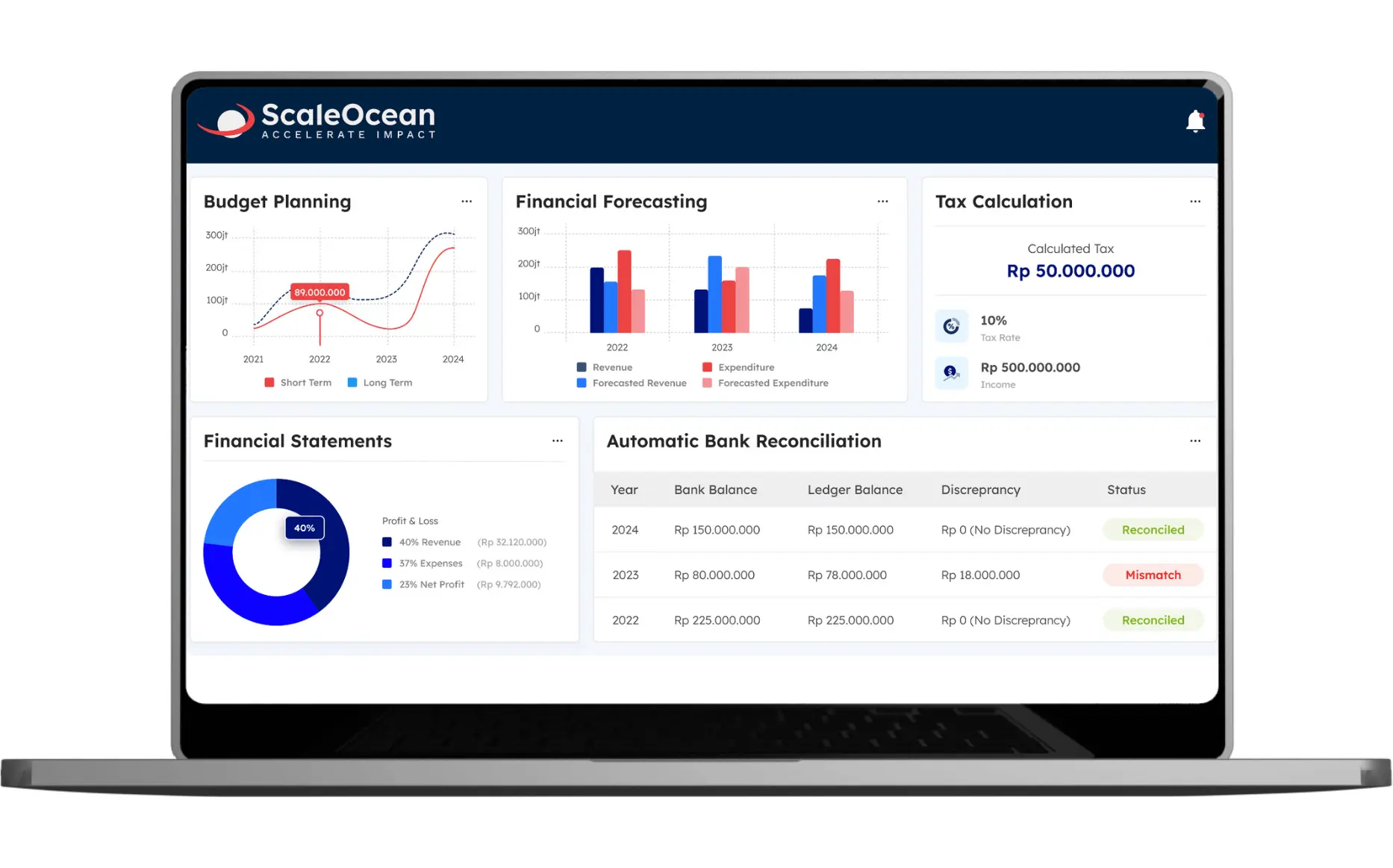
Using GST filing services instead of compiling GST data manually at quarter-end, ScaleOcean Accounting Software connects financial transactions across sales, purchases, AP/AR, and other workflows. Consequently, finance teams can work from more consistent transaction data when preparing GST returns.
With its flagship platform, ScaleOcean Atlas, businesses can configure tax codes, approval workflows, and multi-entity processes according to their operational requirements. The platform also supports automatic tax calculations, reconciliation, and financial reporting, helping reduce repetitive preparation work before filing.
As an additional intelligence layer, ScaleMind can support finance teams during review by helping locate transaction information, identify items requiring attention, and summarize relevant adjustments. This approach strengthens traceability from reported GST figures back to underlying transactions and documents.
For Singapore businesses, ScaleOcean is also positioned around PDPA-aligned data governance and local financial reporting requirements, while its accounting capabilities support reconciliation and reporting. Therefore, businesses can build a more structured GST workflow rather than relying on last-minute quarterly consolidation.
Conclusion
GST filing in Singapore requires accurate transaction classification, complete supporting records, correct GST calculations, and timely submission through the myTax Portal. Returns and payments are generally due one month after each accounting period.
ScaleOcean Accounting Software helps centralize sales, purchases, AP/AR, journals, and supporting documents within connected workflows. Consequently, finance teams can prepare GST returns using consistent transaction data while reducing repetitive reconciliation.
With ScaleOcean Atlas and ScaleMind, businesses can configure tax workflows, review transactions, trace supporting documents, and strengthen reporting processes. You can schedule a consultation with our experts to explore a smarter approach to GST filing in Singapore.
FAQ GST Filing in Singapore:
1. How often should a company complete GST filing in Singapore?
GST-registered businesses must file GST returns for each prescribed accounting period, usually quarterly. The return and payment are due one month after the accounting period ends.
2. How are foreign currency transactions reported in GST filing?
Convert foreign currency transactions into Singapore dollars using an approved exchange rate. For sales, report the SGD amounts shown on the tax invoice; for purchases, use the SGD GST amount shown on the supplier’s invoice.
3. Does GST filing become more complex for businesses with import and export transactions?
Yes. Businesses must correctly classify imports and exports, reconcile customs documents with accounting records, and report them in the appropriate GST return boxes. Accurate documentation is therefore essential.
4. How should import transactions be handled in GST filing?
Report imports in Box 5 based on the import value, while claiming eligible import GST in Box 7 based on the GST shown on the import permit. Approved schemes may require additional reporting in Box 9.
5. How should export sales be reported in a GST return?
Qualifying exports are zero-rated and should be reported in Box 2, Total Value of Zero-Rated Supplies. Businesses must also retain supporting export documentation to substantiate the zero-rated treatment.














 Key Takeaways