Cost of capital, a measure of a company’s funding sources, whether equity, debt, or both, is an important financial indicator of a company’s financial status. Distributed Platforms businesses must control their cost of capital to optimize the use of assets and to maximize returns.
We came across a study that looked at the companies that were listed on the Pakistan Stock Exchange, which showed that there was a significant negative correlation between the purchases of capital and the performance of the firm.
This means that the lower the return on assets (ROA) and return on equity (ROE) data, the higher the WACC. All this indicates that poor cost of capital management can directly impact the profitability and financial performance of businesses. Read on to better understand the expenses of capital and how you can use your understanding to enhance your business’s finances.
Key Takeaways
The cost of capital refers to the cost a business incurs to obtain funds, whether through debt or equity.
Cost of capital is essential for making investment decisions, as businesses need to ensure that their returns exceed their cost of capital to create value.
What is The Meaning of The Term “Cost of Capital”?
What is the cost of capital in finance? Cost of Capital is the cost to a business of raising funds either as debt or equity. Cost of capital is also known as the discount rate, is the earnings per sharethat investors would expect for investing in the company.
The cost of capital determines if an investment or project will yield sufficient returns to meet the cost of funds invested in the project and is crucial in optimising businesses’ financial performance, and hence their business decisions, in Singapore.
Given that all businesses in Singapore have a fair amount of knowledge about the cost of capital, they will know that if they invest with it, their return on investment will be higher than the cost of that investment.
For a business, profit margin refers to how the company maintains its profit and loss statements. Profit margin for a business is defined as the way in which the company keeps its profit and loss statements.
So, what is the formula for calculating the cost of capital? The cost of capital is the amount of money a business spends to obtain funds from earnings on the business’s assets or from the sale or fund sale of the business’s shares.
It is crucial for making investment decisions; businesses must make sure that their returns are higher than their cost of capital in order to create value. The various components of the Cost of capital formula are The Cost of Debt, the cost of Equity, and the Weighted Average Cost of Capital (WACC).
Each of the following is how to determine the cost of capital in this way:
1. Cost of Debt
The cost of debt is the effective rate that a company pays on its borrowed funds, such as loans or bonds. It reflects the interest expense a company incurs to borrow money.
Formula for Cost of Debt:
Cost of Debt = Interest Rate × (1−Tax Rate)
Interest Rate: The annual interest rate the company pays on its debt.
Tax Rate: The company’s tax rate, as interest payments are tax-deductible.
How to calculate it:
If a company borrows at an interest rate of 6% and the tax rate is 20%, the cost of debt is:
Cost of Debt = 6% × (1−0.20) = 6 % × 0.80 = 4.8%
2. Cost of Equity
What is the cost of equity capital? The cost of equity is the return that investors expect for providing capital to a company in the form of equity (stocks). It represents the risk that investors take by investing in the company.
The Weighted Average Cost of Capital (WACC) is the primary cost of capital symbol, is the average rate of return a company needs to pay to finance its operations through debt and equity. WACC considers the relative proportions of debt and equity in the company’s capital structure.
Formula for WACC:
WACC = ( E/V × Cost of Equity) + (D/V × Cost of Debt × (1−Tax Rate))
E: Market value of equity.
D: Market value of debt.
V: Total market value of the company’s capital (E + D).
CostofEquity: As calculated above.
Cost of Debt: As calculated above.
Tax Rate: Company’s tax rate.
How to calculate it:
If a company has:
Market value of equity (E) = S$500,000
Market value of debt (D) = S$300,000
Cost of equity = 9%
Cost of debt = 4.8%
Tax rate = 20%
First, calculate the total value of the company’s capital:
By that calculation, we found that the Weighted Average Cost of Capital (WACC) is 7.065%.
Why Is the Cost of Capital Important?
The cost of capital is one of the essential financial parameters that greatly influences any number of business decisions. We will go over the importance of the cost of capital for your business:
Investment Decisions: It is essential to make proper investment decisions as it is the representation of the minimum return that a business should obtain on its investment to meet its investors.
Valuation: Properly determining the value of capital can ensure the company is valued properly, taking into account the cost of capital and the returns it is expected to create.
Capital Structure Allocation: Appointing capital structure (Debt and Equity) the optimal combination can help the businesses to reduce the overall cost of capital and create value for shareholders.
Valuation and pricing: Assessing and setting the price of new securities properly ensures that businesses can attract the same amount of funds they need without imposing on their shareholders or lenders too high a cost.
Strategic Planning: Measuring returns consistently with the cost of capital is a way of ensuring that businesses are capitalizing on their strategies and objectives in a manner that is correlated with the amount of capital they can spend.
Cost of Capital Examples
From the previous paragraph, we can understand that the cost of capital in economics is of major importance in the following business decisions.
From Arthshastra Indian Journal of Economics & Research, we have learnt that it directly impacts making investment decisions and resource allocation across competing projects among the firms. In terms of uses, the cost of capital plays an important role in ‘strategic merger and acquisition policies’, ‘capital restructuring’, and investment in R&D.
Let’s see below cost of capital examples and solutions:
1. Mergers and Acquisitions (M&A)
Company A is interested in taking over Company B. Company A has a cost of capital of 8%, while the target company, Company B’s cost of capital of 10%. If company A expects a 12% return from the acquisition.
The revenue management would generate a profitable one, because the probable return is more than the cost of capital for either of the companies. If the expected return from the acquisition is just 6%, however, then it’s intuitively likely that the acquisition would be a poor investment since the cost of the capital would exceed the returns, thus resulting in value destruction.
2. Capital Restructuring
Company X is looking at changing its capital structure and leveraging up. It currently has a WACC of 9%, but with a higher level of debt and a lower level of financing with equity, it believes that the WACC could be reduced to 7%.
This should lower the total cost of capital of this business, and the profitability ratioof profit might be improved. While a high debt-to-capital ratio improves the company’s profitability, they do not putthe companys into bankruptcy, as this may end up driving their cost of capital even higher.
The cost of capital plays a vital role in such an instance in making the best decision among the debt-secure financing and equity-secure financing options and in maintaining a reasonable level of risk to ensure that the optimal balance of the two is obtained so that the company’saccounts receivable and financing cost are minimized.
3. Investment in Research and Development (R&D)
A technology company (ABC) is interested in investing in a new product development through research and development. The company’s cost of capital is 10 %. The new product line can be expected to return 15% on the investment.
With this in mind, it does seem reasonable to invest in R&D where the ROI is better than the cost of capital, as though likely to provide the company with value. However, if the expected return on R&D is only 6%, increases in R&D expenditure will not result in sufficient increases in the return on capital and may be reconsidered or delayed.
Cost of capital is essential as it helps firms to make profitable choices that maximise the value of shareholders as well as minimise the risks of the firm. Why not sign up for afree demoof ScaleOcean and see how you’ll benefit from its ability to facilitate the cost of capital calculation and enhance your financial decision-making?
Cost of Capital vs. Discount Rate: What is the Difference?
When making investment decisions or evaluating projects, understanding the concepts of cost of capital notes, and discount rate is crucial. Both are financial metrics used to assess the required returns on investments, but they serve different purposes and are applied in distinct ways. Here’s a breakdown of their differences:
Cost of Capital
Discount rate
Definition: The rate of return a company must earn on its investments to satisfy its investors.
Purpose: Used to evaluate the profitability and feasibility of investments or projects.
Components: A combination of the cost of debt and the cost of equity.
Calculation: Calculated using the Weighted Average Cost of Capital (WACC) formula.
Impact: Helping companies decide if the cost of funding for a project is worth the expected returns.
Definition: The rate used to discount future cash flows to their present business valuation.
Purpose: Used in Discounted Cash Flow (DCF) analysis to convert future cash flows into their present value.
Components: It can be the cost of capital in many cases, but could also be higher or lower based on other factors.
Calculation: Often derived based on the cost of capital, but can vary depending on the level of risk or desired return.
Impact: Determining the present value of future earnings or cash flows.
Cost of Capital vs. Cost of Equity: What is the Difference?
The cost of capital and the cost of equity are both important financial metrics used by businesses to assess the required return on investments. While they are related, they represent different concepts and are used in distinct contexts. Understanding the differences between cost of equity vs cost of capital can help businesses make more informed financial decisions.
Cost of Capital
Cost of Equity
Definition: The rate of return a company must earn on its investments to satisfy its investors.
Calculation: Calculated using the Weighted Average Cost of Capital formula (WACC).
Components: A combination of the cost of debt and the cost of equity.
Scope: Broader in scope, as it takes into account both equity and debt financing.
Impact: Helping companies decide if the cost of funding for a project is worth the expected returns.
Definition: The return that investors expect for investing in the company’s equity (stocks).
Calculation: Typically calculated using the Capital Asset Pricing Model (CAPM).
Components: Focuses solely on the return expected by equity investors.
Scope: Narrower in scope, focusing only on the return required by equity investors.
Impact: Primarily affects decisions related to equity financing, such as issuing new shares or repurchasing stock.
How to Calculate Cost of Capital Automatically with ScaleOcean?
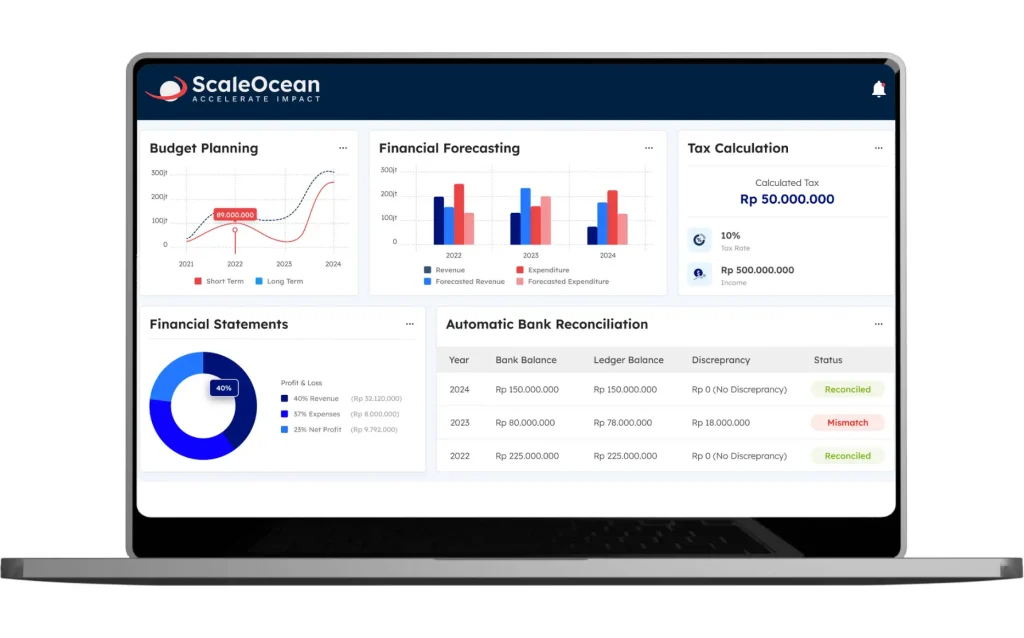
ScaleOcean Accounting Software offers innovative all-in-One Module Integration that integrates various modules with finance, asset management, and analytics to manage cash flow, expenses, and investment planning more effectively.
Our system’s high flexibility makes it easy to fit specific workflows, dashboards, and business processes for each department, along with configurations without altering the core system, while providing flat pricing and unlimited users with no hidden fees.
ScaleOcean ensures that capital cost management is carried out with an approach that aligns with industry standards and applicable regulations, making it a perfect match for CTC Grant Requirements, with eligibility up to 70% grant.
Here are the key features of ScaleOcean Accounting Software:
Tax Compliance & Automatic Tax Shield (IRAS-compliant): Automatically calculates Corporate Income Tax (CIT) Rebate, and CIT Rebate Cash Grant up to $2,000, as well as claims accelerated asset depreciation (Section 19/19A) so the company can achieve early tax savings, which theoretically increases free cash flow and reduces reliance on external capital.
Grant & Incentive Tracking: Capable of separating grant funds from operating income, and monitoring grant claim conditions to ensure timely fund disbursement, maintaining liquidity.
Multi-Currency Integration & SIBOR/SORA Tracking: If the company has local bank loans, the software will assist in retrieving the latest interest data to calculate the Cost of Debt in real-time, with a hedging feature if the company’s capital is sourced from overseas (USD/EUR) to mitigate capital costs due to business fluctuations.
AI-based WACC Analysis Dashboard: Provides a detailed visualization of capital components, such as debt vs equity composition, and offers what-if scenario simulations.
Digital Banking Integration: Automatic bank reconciliation with local banks (DBS, OCBC, or UOB) for instant monitoring of cash inflows and outflows, along with cash flow optimization tracking to determine the company’s cash position, enabling quicker repayment of high-interest debt, thus reducing overall capital costs.
AI ROI Analysis: This feature helps the company to measure capital efficiency, ensuring that the capital costs incurred provide an adequate return.
Real-Time Financial Reporting: Directly monitors and analyzes the impact of capital costs on the company’s finances, including the effect of interest on debt, dividends, and investment returns on the total cost of capital.
ScaleOcean is designed to help your business optimize its cost of capital by streamlining operations and enhancing efficiency across all departments. With a flat pricing model that eliminates additional user fees, ScaleOcean ensures that your investment remains predictable and cost-effective.
Take advantage of a free demo today to explore how ScaleOcean can help you lower your cost of capital while providing the scalability and flexibility your business needs to grow.
Conclusion
Mastering the cost of capital in Singapore businesses is not just about finding a magic number; it’s about maintaining a delicate balance in your company’s capital. For local enterprises, the objective remains clear: optimizing the Weighted Average Cost of Capital (WACC) to unlock long-term valuation.
ScaleOcean can help your business streamline financial management and reduce the overall cost of capital by providing a comprehensive ERP system that integrates finance, budgeting, and investment tracking.
With real-time analytics, multi-currency support, and cost optimization tools, ScaleOcean ensures that your business makes the best use of its capital. Try ScaleOcean’s free demo today to see how our system can help reduce your cost of capital and improve your business’s financial efficiency.
FAQ:
1. What is the weighted average cost of capital?
The Weighted Average Cost of Capital (WACC) is a financial metric that calculates a company’s cost of capital, weighted by the proportion of each source of capital (debt and equity) in the company’s capital structure.
2. How to find the equity cost of capital?
The cost of equity refers to the return required by investors who provide capital through equity ownership. It compensates investors for the risk of owning the company’s stock, as equity holders take on more risk than debt holders.
3. What is the opportunity cost of capital?
The opportunity cost of capital refers to the potential return that is forgone by choosing one investment or project over another. It represents the return on the next best alternative investment that a business could pursue using the same capital.
4. Why is the cost of capital important?
The cost of capital is a crucial concept that helps businesses make informed investment, financing, and strategic decisions. It ensures that investments generate returns that exceed the cost of obtaining capital.













 Key Takeaways