

Inventory control is a significant process for an organization to ensure it has the right number of stocks to meet the demands without being stocked out or overstocked. Better inventory control decreases costs incurred, saves on storage space, and also improves operational efficiency.
Yet there are a lot of problems experienced by businesses, such as not recording stocks properly, stockouts, and ineffective procedures, which ultimately affect operations and customer satisfaction.
Inventory control is important for the business as companies grow and demand for products rises and falls. The business losses, stockouts, and overall operation can be improved by effective business operations and methods of inventory control.
Below is the complete explanation of inventory control, how to improve it, and its various methods, as well as some examples. Read to find out!
 Key Takeaways
- Inventory control is the practice of overseeing how goods are purchased, stored, and used to keep stock at ideal levels.
- The importance of inventory control is to reduce overstocks and stockouts, improve cash flow, enhance customer satisfaction, optimize storage costs, and streamline operations
- Inventory control Techniques are JIT, EOQ, ABC analysis, FIFO, LIFO, VMI, Barcode inventory, RFID, QR code inventory, JIC, Dropshipping, inventory optimization, and stocktaking
- Best practices of inventory control are implementing inventory tracking, optimizing stock rotation, streamlining supplier relationships, automating with an inventory management system, and more
- ScaleOcean’s WMS provides an integrated solution to enhance efficiency, minimize human error, optimize stock levels, and improve overall inventory control in a warehouse.

What Is Inventory Control?
Inventory control is about managing how your products are purchased, stored, and how they are used to keep stock at optimal levels. The idea behind inventory control is to be able to meet customer demand without overspending and wasting money.
It involves keeping track of all stock and products. The main tools you use to implement inventory control include order purchasing and bar code technologies, used to ensure the accurate management of data.
This process is important because organizations need to ensure that they have the right level of merchandise in stock or in hand at all times. It consists of managing merchandise in such a way that demand is met without having overstocked the products, which may result in higher costs.
Good management of merchandise could allow companies not to have stock-outs and, at the same time, reduce waste and maximize cash flow. This process involves different tools and tactics to monitor stock movement and to manage merchandise based on forecasting.
If inventory is managed correctly, businesses are able to increase customer satisfaction and at the same time, lower operating costs.
The Importance of Inventory Control
Inventory control plays an important role in the smooth running of any business, as it helps maintain correct stock levels, thereby avoiding delays in production or sales. It ensures that there are no stock-outs or excesses.
It optimizes the supply chain, reduces operating costs, and enhances profitability. With the competitive environment of today, efficient inventory control is necessary for customer satisfaction.
Maintaining the correct stock helps establish and build customer loyalty. Lack of it would mean missed sales, stock-outs, and loss of revenue. Below is a detailed description of the benefits and importance of inventory control:
1. Reduces Overstocking and Stockouts
The primary purpose of an effective inventory management and control system is to eliminate the risks of stock-outs and overstocking. Stock-outs cost the company not only revenue lost, but also unsatisfied customers.
Overstocking, on the other hand, leads to high carrying costs and the possibility of wastage of merchandise. With efficient demand forecasting and proper monitoring of the stocks, businesses can eliminate overstocking.
Similarly, if businesses can make good predictions about sales and consumption, there is no possibility for stock-outs.
The stock level maintained by the company can hence not be too high nor too low, which results in maximizing the benefit. It will also aid in reducing losses because of non-moving merchandise, which ultimately leads to maximization of cash flows.
With better demand forecasting, companies can also respond promptly to changes in market demands so that the stock level is maintained in line with market demands, so as to have neither overstock nor stock-out of items. This maximizes the profit by reducing wastage and utilizing sales opportunities.
2. Improves Cash Flow
Good inventory control increases cash flow by enabling businesses to get money tied up in goods that are not moving released and available for other uses.
When a business manages inventory levels efficiently, resources can be freed up to invest in other areas such as advertising, product development, or expansion of the business. Good inventory control will also make a business attractive to business grants or other sources to fund expansion plans.
For instance, a business using a just-in-time (JIT) method may only stock products or materials they need immediately, and thus reduce the need for storage of unwanted or unnecessary goods. This also reduces the risk of investment in poor-performing products.
Improved cash flow increases the likelihood that the company will qualify for loans or grants, as efficient management of inventory increases profitability.
3. Enhances Customer Satisfaction
Inventory control ensures that businesses have the right products available at the right time, which is crucial for meeting customer demand. Businesses that maintain proper stock levels can reduce lead times and fulfill orders more quickly, thereby improving the customer experience.
This leads to enhanced customer satisfaction, loyalty, and repeat business. Furthermore, constantly meeting client demands strengthens a company’s dependability and reputation. Customers are more inclined to return if they believe things will always be available when they need them, which increases brand loyalty and satisfaction.
According to the data we found from Forbes, organizations that prioritize inventory management and keeping stock levels in line with consumer demand are better positioned to develop long-term client loyalty and satisfaction.
4. Optimizes Storage Costs
Proper inventory control enables firms to manage storage expenses by keeping inventory levels in line with demand. Overstocking increases storage prices, but understocking might create delays or operational problems. Businesses can save money on storage by tracking stock levels and modifying them to meet actual demand.
Efficient inventory control also guarantees that enterprises do not have surplus stock that will go unsold, eliminating the need for larger storage facilities. This simplifies the entire supply chain and eliminates superfluous operational expenses, resulting in better cost management.
5. Streamlines Operations
A well-organized inventory system improves business operations by minimizing supply chain delays and inefficiencies. Businesses that check their stock levels accurately can respond promptly to demand swings and maintain smooth production cycles.
This reduces bottlenecks and ensures that resources are directed to where they are most needed. Furthermore, an effective inventory system delivers real-time stock status updates, allowing firms to make more educated purchase and distribution decisions.
This eliminates operational friction, increases communication, and speeds up the movement of commodities from suppliers to customers, resulting in overall increased efficiency.
Common Inventory Control Processes

Inventory control is critical for ensuring optimal stock levels and avoiding disruptions. It entails meticulously tracking inventory to ensure that businesses can satisfy demand without overstocking.
Effective inventory control reduces costs, increases productivity, and prevents lost sales. A simplified approach ensures that firms have the correct products on hand at the appropriate time. The following are the essential processes in the inventory control process that most firms adopt.
1. Stock Replenishment
Stock replenishment involves determining the right time to reorder items based on current inventory levels. Companies use demand forecasting to predict stock needs and reorder points, ensuring that customer demand is met without overstocking.
This balance is crucial for maintaining efficiency while avoiding stockouts. By aligning stock replenishment with the product life cycle stages, businesses can streamline the process and minimize disruptions.
Automated systems and real-time data tracking help ensure timely orders, while strong supplier relationships and accurate tracking are essential for effective restocking and smooth operations.
2. Stock Auditing and Monitoring
Stock auditing involves assessing stock levels and correcting any deviations. Audits allow companies to have updated records of all stock and thus to reduce the risk of fraud, error, or theft.
Companies can monitor the inventory level to be aware of how the goods are moving and take necessary action to avoid the issue of either having a lot of stock in a warehouse (overstocking) or having a deficit (stockout).
Companies that continuously monitor their stock can monitor the flow of items and so reduce the issue of having stock piling up in warehouses, or having shortages in the market. Therefore, they would have information relating to stock levels that is more in touch with reality.
Companies that combine manual stock checks with computerized checks can have increased levels of accuracy and a greater sense of transparency.
By implementing automated inventory management systems, the company will have a more time-efficient way to track the movement of goods and provide insightful reports. Audits are a way to guide a company into making better decisions.
With a greater sense of control over the stock, which allows them to make informed decisions that relate to stock and future trends. By taking regular stock control and making informed decisions, a company is able to control future trends regarding stocking and sales methods, therefore achieving better results.
3. Order Processing and Fulfillment
Order processing is a crucial part of inventory management that ensures the management of received customer orders. Order fulfillment involves picking the right products and delivering them at the right time, in the right place, and by the right method.
This means the system starts when the client places the order, and the system will either show that it is stocked, send the item, or, if not, it will tell me I have to reorder. Both the accuracy of the stock level and perfect communication between departments are essential throughout this part of the process.
Organizations integrate their inventory management system with their selling system to have real-time updates and to minimize any risks concerning order processing.
Order fulfillment processes, once perfectly mastered, increase client satisfaction, loyalty, and the overall reputation of the company, as well as its sales and sales.
4. Demand Forecasting
Demand forecasting refers to estimating the expected amount of product that is required based on patterns found in past sales, current industry trends, and seasonality variations.
The organization should anticipate inventory needs, avoiding a lack of available stock and the lost sales that result from a stockout. By understanding trends of customers, organizations can maintain their inventory levels based on forecasted demand.
Effective demand forecasting applies data-driven methods along with sophisticated analysis to anticipate changes in purchase behavior, and considers external factors like the economic cycle, promotions, and activities from competitors.
With appropriate tools, demand forecasting helps in making better purchasing decisions and assures that the company is not overcommitting resources to maintain an adequate level of inventory, and reduces holding costs.
5. Inventory Storage and Organization
Proper inventory storage and management are critical for ease of access, accurate tracking, and minimizing product damage. Businesses should categorize products depending on size, shelf life, and frequency of usage.
This arrangement makes it easier to manage inventory and streamline picking procedures during order fulfillment. A well-organized warehouse slotting allows for speedy product retrieval while also maintaining inventory accuracy.
Shelving units, barcode systems, and RFID technology can all help optimize the storage process. Businesses can reduce error rates and enhance overall operational efficiency by optimizing storage and organizing. Proper organization also helps to reduce handling expenses and the danger of product damage.
13 Inventory Control Techniques and Methods
Effective inventory control systems are essential for firms to run smoothly and meet client demand. These tactics aid in inventory tracking, waste minimization, and storage space optimization, resulting in lower operational expenses and more customer satisfaction.
The best technique varies according to the business type and supply chain complexity. With technological developments, inventory control has expanded to encompass automated systems and real-time tracking technologies.
These solutions simplify operations and enable data-driven decisions to improve inventory management. The following are eight regularly utilized approaches for helping firms improve their inventory control.
1. Just-in-Time (JIT) Inventory
The Just-in-Time (JIT) inventory system lowers inventories by ordering things just as they are required for manufacturing or sale. Close supplier coordination is required for timely delivery that adheres to production schedules.
This reduces stockpiles, saves storage space, and lowers inventory expenses. JIT is suitable for businesses with variable demand, such as fashion and technology, according to Investopedia.
JIT lowers inventory holding costs, releasing capital that would otherwise be locked up in surplus goods. It helps to reduce the danger of product obsolescence and waste, particularly in fast-moving sectors.
The method increases cash flow and operational efficiency. JIT preserves a competitive advantage by encouraging lean operations and supporting good stock management.
2. Economic Order Quantity (EOQ)
Economic Order Quantity (EOQ) is used for determining the optimal order quantity that minimizes the overall costs of inventory. It balances ordering and holding costs by optimizing the inventory level with the help of a mathematical formula.
This strategy prevents overstocking the inventory and helps businesses maintain a just-enough quantity required to meet demand.
By balancing it out, EOQ helps businesses not carry excess inventory and thereby helps avoid storage expenses, allowing for cost-effective purchasing without needing excess inventory.
It is also efficient in saving storage expenses by making optimum use of warehouse space, enabling businesses to continue their operations smoothly without stockouts or excess inventory.
3. ABC Analysis
ABC analysis breaks down inventory into three categories of value, which are A (high-value), B (moderate-value), and C (low-value), and helps management identify and prioritize critical high-value inventory.
By concentrating resources on these critical items, the business can ensure its most important products remain in stock at all times, making efficient resource allocation possible and avoiding overstocking and stockouts.
Implementing ABC analysis saves on operational costs by allocating resources effectively based on stock value. It reduces the amount of inefficiencies by putting value on high-value products and controlling stock more effectively, allowing the organization to streamline its operations and ensure profitability.
4. First-In, First-Out (FIFO)
FIFO guarantees that older inventory is used or sold first, which is critical for reducing waste and spoilage, particularly with perishable commodities. This approach is commonly used in industries such as food and pharmaceuticals, where product shelf life is important.
By prioritizing older stock, FIFO protects product quality and decreases the risk of obsolete items. It also helps organizations meet safety regulations by ensuring inventory is used on time.
This strategy reduces waste and avoids loss due to expired supplies. FIFO also improves inventory control by shifting older stock first. It ensures that clients receive fresh, high-quality products, which increases their pleasure.
5. Last-In, First-Out (LIFO)
LIFO assumes that the most recently received inventory is sold first, which helps to manage costs in volatile markets. This strategy is effective in businesses where product prices are constantly changing, such as raw materials.
It enables organizations to successfully manage expenses during inflation by prioritizing newer stock. LIFO can aid in accurately reflecting current market conditions in financial reports.
LIFO minimizes taxable revenue as inventory prices rise, which benefits firms financially. It also ensures that older inventory is available for long-term use. This strategy is particularly useful for controlling costs during periods of price volatility. However, it may not be appropriate for every industry.
6. Vendor-Managed Inventory (VMI)
Vendor Managed Inventory (VMI) is a method by which suppliers are given the ability to monitor and manage their inventory levels, and they have access to information on demand and are required to automatically reorder and replenish their products when inventory levels get too low.
This technique saves organizations time by reducing their task load of monitoring and replenishing inventory regularly. VMI increases cooperation between suppliers and customers and helps to make the supply chain operate with more efficiency, ultimately preventing stockouts.
By handing over the responsibilities to suppliers, organizations are provided with a highly efficient and manageable supply chain solution, as it reduces their workload in managing inventory, and hence, they don’t end up ordering excessively large quantities of inventory, thereby saving cost on storage.
It reduces the manual effort required for tracking and monitoring inventory levels, and it helps prevent stockouts and hence ensures that the products are replaced promptly. It further leads to enhanced relationships with suppliers as they have all the necessary information related to the demand.
This allows the supplier to efficiently manage and replenish inventory to a desirable level.
7. Barcode Scanning Inventory Control
Barcode scanning tracks inventories by recognizing the unique codes present on each product through a barcode scanner, thus updating them in real-time on the inventory list. Barcode scanning contributes significantly to increasing the accuracy and efficiency in managing inventory levels.
It reduces instances of manual error and enhances efficiency by ensuring that there is no loss of any inventory items while tracking their movement.
It helps in real-time update of the inventory levels and thus increases the visibility and overall stock management operations by saving significant time on data entry.
Barcode scanning also helps organizations in maintaining optimum stock levels at all times, thereby reducing the chances of overstocking and stockouts. The effective implementation of barcode scanning leads to efficient management of inventory resources.
8. Radio Frequency Identification (RFID)
RFID tracks inventories through a combination of electromagnetic fields and tags that allow for real-time updates on inventory levels, which increases the efficiency and accuracy of inventory management and tracking systems throughout the supply chain.
RFID improves inventory management systems by providing detailed and accurate information regarding products’ whereabouts throughout the distribution chain. This technology helps in minimizing manual errors and increasing operational efficiency while reducing time.
RFID makes it easy for an organization to track inventories and items in multiple locations, giving a superior alternative for tracking compared to bar codes, thus providing higher security throughout the supply chain.
It further provides accurate, up-to-the-second information, helping the organization make effective and timely decisions regarding its stock levels, thereby achieving cost-effective and efficient inventory management systems.
9. QR Code Inventory Control
QR code inventory control system functions the same way as bar codes do in inventory management, but it represents inventory data in a 2-dimensional space.
QR codes also hold more data than bar codes and can be easily scanned by smartphones, so they can be a good alternative for inventory control for smaller businesses or those who may not have expensive scanners.
These offer real-time data updates, providing a convenient alternative for businesses looking for inventory management flexibility.
10. Just in Case (JIC)
Just in Case (JIC) is the most conservative of the stock control methods, as businesses stock ample extra product to cover all possibilities, such as unexpected demand or an inability to get the required supplies.
However, this method often increases inventory carrying costs and can be very wasteful. It is mostly used for industries where lead times are significant or uncertainty is prevalent.
11. Dropshipping
Dropshipping is a type of retail model whereby a business does not maintain inventory of the products. Whenever a customer places an order for a particular item from the business, the product is automatically shipped to the customer directly from the supplier.
While this technique is very good in terms of saving on storage and handling expenses, it does mean longer delivery times and less control over inventory management. So this technique is best suited for businesses with less capital.
12. Inventory Optimisation
Inventory optimization is the process of strategically managing inventory levels to meet demand while minimizing holding costs.
It involves forecasting future demand and using that information to plan appropriate inventory levels, ordering appropriate stock quantities to avoid overstocking or understocking of items.
This technique helps companies reduce holding costs by storing a smaller quantity of inventory, which also reduces the risk of losses due to obsolescence or spoilage.
13. Stocktaking
Stocktaking refers to the process of physically counting the amount of stock held at any given time.
Stocktaking is important for many businesses as it allows you to identify what you actually have in stock as compared to what your records say you have, which can prevent stockouts, lost sales, and ensure stock is available to meet customer demand.
Types of Inventory Control Systems
Inventory control plays a critical role in every business as it helps maintain the equilibrium between the demand and supply of items while reducing wastage to the maximum extent. Different types of inventory control systems are prevalent today, which help organizations in monitoring their stock levels.
The selection criteria for the system are dependent on factors like the scale of the business, the volume of products, and its needs. The following are the different types of inventory control systems:
1. Periodic Inventory Control System
The periodic inventory control system requires manual counting of stock at a predetermined interval, such as at the end of the month or year. It’s only after this count that businesses can analyze their current stock level.
While it is a simpler and cost-effective way to manage stock for small businesses, it does lead to inaccuracies regarding the real-time monitoring of stock levels.
2. Perpetual Inventory Control System
The perpetual inventory control system, also called the continuous inventory system, is an automatic inventory system that continuously keeps updated data on the stock level.
Every transaction, purchase, sale, and return causes an automatic update to the record, which makes it ideal for businesses with a large volume of stock.
Although it is more expensive due to the required technological investment, it offers more control over inventory levels to prevent stockouts and overstocking.
3. Achieve Operational Excellence
Achieving operational excellence in inventory management implies utilizing the appropriate strategies, procedures, and technology in conjunction to optimize inventory control and operations management for best performance.
It refers to the best fit of resources and business processes to increase output while decreasing waste. In inventory control, organizations leverage technology, staff training, and data analysis to enhance overall inventory performance and efficiency.
Inventory Control Policies and Processes
Inventory control policies and processes are guidelines used by businesses to ensure efficient inventory management. These policies describe how organizations should order, store, and track inventory.
The goal is to maintain stock levels that meet demand without overstocking. Well-defined inventory control procedures assist businesses in boosting operational performance.
They do this by ensuring consistent product handling procedures and avoiding stockouts, overstocking, and holding costs, so that companies obtain the best value from their inventory, enabling more streamlined operations.
Key Performance Indicators in Inventory Control
Key Performance Indicators (KPIs) are vital metrics that businesses use to evaluate their inventory management practices.
These metrics allow organizations to quantify, monitor, and track their inventory-related performance through elements such as the stock level, order accuracy, and inventory turnover rate.
KPIs enable businesses to identify where inventory management practices may need improvement. Businesses utilize this information to increase efficiency, make informed decisions, and ensure optimum performance in inventory management.
1. Inventory Turnover Rate
The inventory turnover rate refers to how many times inventory has been sold and replaced over a specific period. A high inventory turnover rate demonstrates a company’s efficient inventory management and product turnover in inventory.
This is achieved by analyzing this rate and seeing how frequently inventory is sold and replaced, so businesses can understand how well demand forecasting strategies are performing and determine the items that are selling slowly or have high levels of inventory.
2. Stockout Rate
The stockout rate tracks how frequently an item is out of stock. A high stockout rate suggests issues with the organization’s demand forecasting, planning, and inventory levels, resulting in reduced sales and poor customer service.
Monitoring the stockout rate can help businesses identify where inventory levels need to be adjusted in order to maintain an optimal stock level to prevent stockouts.
3. Carrying Cost of Inventory
Carrying cost of inventory relates to the expenses a company incurs for holding inventory that it does not sell. This can range from warehousing expenses, insurance, inventory carrying fees, and taxes on goods held in inventory.
By measuring carrying costs, organizations can gauge how efficiently their current inventory levels contribute to revenue. High carrying costs usually signify the fact that the organization is storing too many items.
4. Order Accuracy
Order accuracy is used to measure how accurately a business has fulfilled customers’ orders. Customers expect accurate and timely delivery of products, and measuring order accuracy gives them insight into how well the company is serving its customers.
A business with high order accuracy is more likely to retain its customers than one with a low order accuracy, as well as increasing the speed at which customer order fulfillment takes place.
5. Lead Time
Lead time refers to the period from when a product is obtained from the manufacturer up to the point at which the customer receives the item. Measuring this statistic allows a business to estimate the total duration required before a product is available again.
Lead times that are longer than necessary or unpredictable can increase the likelihood of a business running out of products, as well as damaging customer relations.
6. Inventory Accuracy
Inventory accuracy measures how well the current inventory count aligns with the inventory levels recorded in an organization’s system. It measures how well an organization’s internal data matches its physical stock on hand.
If inventory levels are high compared to their respective system levels, then that product can lead to overstocking, and if their physical stock is lower than that of its system levels, then the product is likely to experience a stockout due to theft or loss.
Challenges in Inventory Control and Their Solutions
Effective inventory control is paramount to ensuring business operations are smooth and profitable. However, businesses encounter several issues that impact inventory management, resulting in inefficiencies and financial losses.
Poor inventory control can have an impact on every part of the organization, from cash flow to customer satisfaction, and stockouts, overstocking, and incorrect stock tracking are just some issues that could occur without proper management.
As the size of a business and the intricacy of its supply networks grow, managing these issues and ensuring stock levels is becoming increasingly vital. Below are some of the more prevalent inventory control issues faced by organizations, along with their respective remedies:
1. Overstocking and Understocking
Overstocking means holding inventory at a higher level than that which can be sold in a reasonable period of time. This ties up important working capital in addition to storage costs and the increased risk of goods becoming obsolete, whereas understocking results in lost sales and customer dissatisfaction.
Striking the balance between stocking adequate quantities to meet customer demand without committing excessive capital to inventory can be critical. Just-in-Time (JIT) inventory systems are among the most effective techniques companies employ to prevent overstocking or understocking items.
JIT focuses on carrying minimal stock levels so that businesses can order goods on demand. Utilizing forecasting technologies also aids organizations in predicting future sales volume and managing their stock levels effectively.
2. Poor Inventory Tracking
Relying on manual inventory monitoring results in errors and discrepancies, making it difficult for businesses to maintain accurate data. Mismatches between stock count records and the number of items in stock may lead to misunderstandings between departments or managers, overordering, or stockouts.
Automated inventory tracking systems, such as Radio Frequency Identification (RFID) or barcode scanning technologies, will offer the best solution to the problem of poor inventory tracking.
These systems improve visibility of inventory by eliminating manual data entry, ensuring businesses have an accurate view of inventory stock at all times and minimizing discrepancies, which can then optimize store usage and enhance inventory order fulfillment rates.
3. Inefficient Stock Rotation
For an industry like food, medicine, and electronics, failure to rotate stock properly can lead to unsaleable or obsolete inventory or an expiry of the product. This can result in waste and loss in the business.
Failure to employ a correct stock rotation can also lead to decline. When using a stock rotation method, organizations should use either the FIFO or the LIFO method (First In, First Out and Last In, First Out, respectively) depending on the products the organization deals with.
The FIFO method ensures the earliest goods are used first, reducing waste and increasing the turnover rate. These stock rotation techniques can also assist companies to stay organized, keep stock fresh, especially when dealing with perishable products.
4. Inadequate Supplier Relationships
When there is an inconsistent supply chain, inventory shortages and delays in delivery will hinder any sales and manufacturing plans. The lack of a solid relationship with suppliers could be the cause of unpredictable lead times and stockouts that limit the ability to meet customer demands.
Organizations can ensure timely delivery and improve inventory replenishment through communication with suppliers and having clear agreements.
Companies should consider developing alternative suppliers to reduce reliance on one source, which can lead to stockouts due to various reasons in the business.
5. Lack of Real-Time Data
Real-time data is crucial for organizations in making optimal inventory decisions. Lack of precise and up-to-date data might lead to imbalanced stock levels, inefficient purchasing, and missing sales.
Adopting a real-time inventory tracking software or integrating inventory management systems with analytics tools will equip businesses with valuable insights into stock levels, sales trends, and overall inventory performance.
Businesses can leverage these tools to refine inventory plans and better meet customer demand while minimizing waste and overstocking.
How to Improve Inventory: Best Practices Methods
Efficient inventory control plays an integral part for companies to fulfill customers’ orders while eliminating excess inventory. Good inventory management would save the business costs and improve productivity.
Managing inventory can be quite overwhelming when companies grow and scale their operations. Businesses can optimize their inventory control procedures and avoid understock and overstock by adopting a couple of effective methods and techniques.
Both constant monitoring and an appropriate inventory system and smart tools would play a part in inventory management. Here are the tips and methods that can help businesses to improve inventory control processes:
1. Implement Real-Time Inventory Tracking
Real-time inventory tracking systems are vital to the efficient management of inventory. Such technologies as barcode scanners or RFID can trace all inventory items and products in real-time, thus minimizing manual entry mistakes.
The inventory records will always be up-to-date, so that it becomes easier for managers to control the levels and avoid discrepancies.
Through real-time tracking, organizations are also able to react instantly to changes in demand and supply chain disruptions. If a stock runs low or customer demand suddenly increases, organizations will be able to adjust ordering and stock levels as needed.
2. Utilize Inventory Forecasting Tools
Accurate demand forecasting is necessary for managing demand and supply. Inventory forecasting technologies, along with smart warehousing technology, rely on historical data, trends, and several other factors to predict future demands.
Organizations may use these tools to reduce overstocking and understocking, as well as to make better purchasing decisions. Forecasting is important in order to plan for fluctuations in demand due to seasonality and promotions, and to have the correct level of inventory at the right time.
This will also reduce surplus inventory and the risk of stockout, thus increasing cash flow and preventing excessive cash being tied up with unsold goods.
3. Optimize Stock Rotation
Good stock rotation should make sure that stock is not left to expire or become outdated. This is paramount in some sectors where items are perishable or have an expiry date.
Inventory methods like FIFO (First In, First Out) and LIFO (Last In, First Out) are essential to keep stock up to date. Stock must be consumed first, meaning the oldest products are always used to cut down wastage and increase the stock turnover rate.
Efficient stock rotation should reduce waste but also increase efficiency by ensuring that the oldest stock reaches staff first to avoid stock going bad or being stuck in a particular area of the warehouse.
4. Streamline Supplier Relationships
A good and working relationship between a business and its suppliers is very important to keep inventory in control. If a business has poor relations with suppliers, then it will inevitably run into issues such as delayed stock or no stock at all.
Effective communication and beneficial deals between the business and suppliers must be conducted so that there is a continuous delivery of products and replenishment of inventory levels.
Diversification of suppliers ensures that a business is not over-reliant on just one supplier to provide a particular product to a business.
5. Automate Inventory Management Systems
Automation of inventory control procedures will surely increase the efficiency of businesses within the company. Businesses will be able to eliminate tedious, manual tasks, which in turn will increase the efficiency and profit of inventory control systems.
This will help the business to have an accurate record of stock levels and eliminate discrepancies in its inventory control reporting. This would allow staff time for strategic work, such as analyzing inventory data to reduce costs.
6. Regularly Audit Inventory
Regular audits of inventory can help a business identify the difference between the actual inventory stock and the recorded levels.
By regularly auditing inventory, a business can tackle problems as they are found and try to work on getting them fixed to reduce problems before they escalate to a large-scale problem. Auditing helps a business keep its accounts in check and also ensures no stock has gone missing.
Businesses use several methods to audit inventory, which the two methods are cycle counting and annual stocktakes. These types of methods help a business keep a clear understanding of inventory on hand.
7. Improve Warehouse Organization
It is extremely important to organize the warehouse space well when it comes to controlling inventory. Organizing a warehouse through systematic label usage on shelves, organizing by location of stock, would reduce the time taken to count and locate stock within a warehouse.
This not only helps businesses locate stock faster but also ensures that counting stock does not contain any discrepancies. Proper organization can also help increase safety levels within the warehouse.
The best way to organize a warehouse is to have a logical, ordered warehouse layout design that allows for rapid movement of products within the business.
8. Monitor Inventory KPIs (Key Performance Indicators)
The use of key performance indicators is an important part of inventory control. Indicators such as stock turnover rate, order accuracy, number of stock-outs, and carried stock need to be observed.
By analyzing this data, businesses will be able to work out where the problems are in inventory control, such as if a business is having a high number of stock-outs, then they know they need to increase the forecast or supplier order.
Monitoring of KPIs should also be based on profit, using the level of carrying costs within the business.
9. Set PAR Levels
PAR levels represent the predetermined minimum quantity of each product that will trigger an order. By setting proper PAR levels, companies can maintain stock to satisfy customer demand without excess stock.
The appropriate PAR levels should be regularly evaluated and adjusted as changes in inventory are affected by customer demand and selling behavior.
10. Correctly Classify Products
Categorization ensures your products are stored properly to take advantage of space and improve traceability.
When you categorize your products based on things such as frequency of sale, product size, or utilization, inventory processes are improved, and different types of products can be managed with a variety of appropriate control methods.
Using the best warehouse management software available to you to improve inventory control will make everything much easier.
ScaleOcean’s warehouse software allows for efficient inventory management with features of an integrated solution and enables tracking current stock in real time so inventory levels are correct and discrepancies are eliminated.
Its multi-location capacity also supports optimal stock transfers among warehouses, which reduces the risk of overstocking or stockouts and makes operations efficient. Request for a free demo of the solution.

Differences Between Inventory Control and Inventory Management
Some people use the terms “inventory control” and “inventory management” interchangeably. These two different terms, however, are related to different stages in the supply chain.
Inventory control refers to holding correct stock levels, keeping track of inventory, and performing stock checks so as to prevent stockouts or overstocking, by keeping the right balance of stock to fulfill demand without being excessively in stock or running out.
Inventory management, on the other hand, refers to a set of strategies relating to the purchase, storage, distribution, and control of inventories so as to ensure optimal stock levels.
It is the management of a whole inventory lifecycle, from ordering the inventory right through to getting it to customers.
Charts of Inventory Control
Inventory control charts are incredibly useful for businesses trying to find the optimal stock levels that are needed to keep inventory control within the optimal range.
These charts show you when and how much stock to order, and what stock buffer should be kept so that operations are uninterrupted. It’s useful to understand the basics of charts in relation to how to optimize inventory control.
1. Min Stock
The minimum stock level defines the lowest quantity of an inventory that should be held on record. The level of minimum stock acts as a prompt to reorder stock.
By setting the right levels, the business doesn’t end up without any of its critical stock, while at the same time, there’s no overstocking, and the capital is readily available for other usage.
2. Max Stock
The maximum stock level specifies the highest quantity of inventory that is best to be kept on hand for a particular stock item. The stock level at this amount will prevent overstocking and storage waste from increasing costs unnecessarily.
By keeping the amount within the limit, overinvestment will be minimized, while also maintaining optimal rates of inventory turnover.
3. Safety Stock
Safety stock refers to the amount of additional stock that is kept on hand as an extra measure to provide the business protection against uncertain and unexpected spikes in demand or delivery delays.
Safety stock helps to minimize the chances of stockouts during fluctuating lead times, and therefore it is best kept within reasonable amounts to maintain customer demand, without being a burden on capital.
4. Lead Times
The term lead time refers to the time that is involved in receiving an order from the time that it was originally placed with the supplier.
You need to maintain this lead time accurately, so as to know how and when your orders are best placed. This means that your stock can be ready for sale before stocks run out, and also, there will be no overstocking.
5. Rate of Sale or Use/Rate of Consumption
The rate of sale or use is how fast stock levels decrease based on the demand of consumers over a specified period.
By maintaining the rate of sale, a business can predict when it is going to run out of stock based on trends, so it has adequate time to procure more before running out completely. This helps a business maintain its levels of demand with efficient usage, while avoiding overstocking.
6. Reorder Points
Reorder points are the levels at which stock is ordered again to replenish supplies that will be sold to the customer before stock runs out completely.
When calculating reorder points, a business should factor in lead time as well as the rate of sale or consumption. This will ensure that orders arrive and are restocked in time to meet customer demand, without overstocking.
Examples of Inventory Control
There are numerous different ways that companies control stock. These ways vary greatly based on how the company is functioning, its size and industry, and the specific product they are working with. Some of the main ways that businesses implement inventory control are:
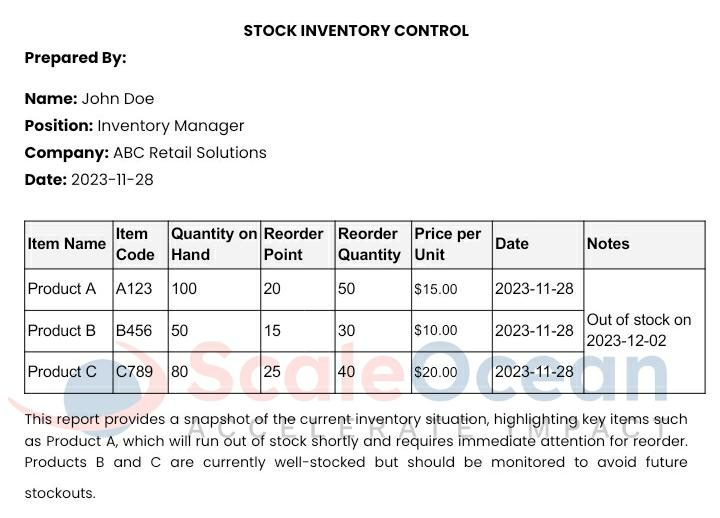
1. Manual Inventory Control System
This type of inventory control system involves manually checking and tracking the stock count in a company. The advantages of the system include its affordability.
The disadvantages of manual inventory control are its labor intensity, its tendency to commit human error, and the time taken for an entire stock check.
It is most suited to small businesses with smaller levels of stock, as larger businesses often find this form of inventory control less useful. Some templates used in manual systems include the following:
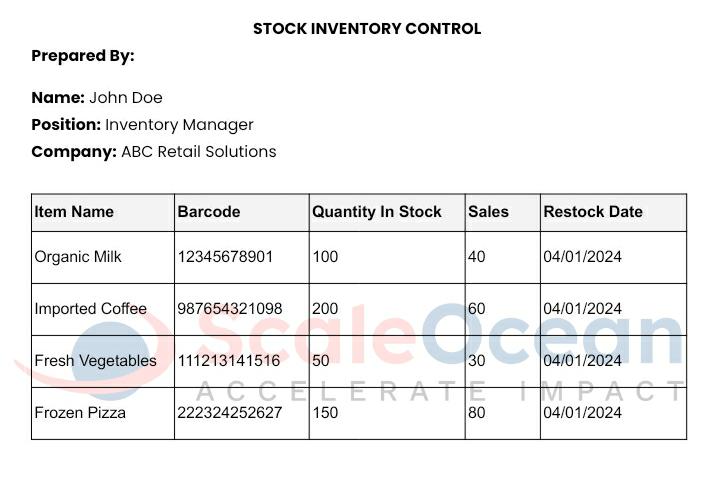
2. Barcode-Based Inventory Control System
With this system of inventory control, each product is given a barcode label that will identify its uniqueness. Stock is scanned as it goes out and/or is restocked to keep track of stock levels.
Some of the advantages of using barcodes are that errors will not be made and that the whole inventory tracking process is much faster and more efficient than manual stock control.
Barcodes are widely used for the control of stock, especially for stock being controlled by a retail or warehouse-based system. An example barcode system template is below:
3. Radio Frequency Identification (RFID) System
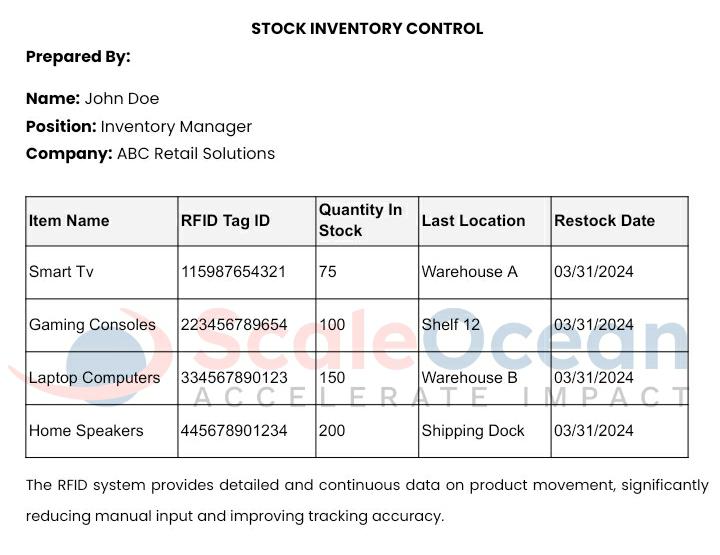
The system of radio frequency identification allows businesses to collect data from items that will soon expire, or simply to know what is being purchased, without having to go near the goods where the RFID is located.
Advantages of using RFID systems include their high level of accuracy, speed, and efficiency over a barcode system, and also that no direct scanning point is required as long as it is anywhere near.
RFID systems are best suited for controlling high volumes of products and goods. RFID inventory template below:
4. Just-in-Time (JIT) Inventory System
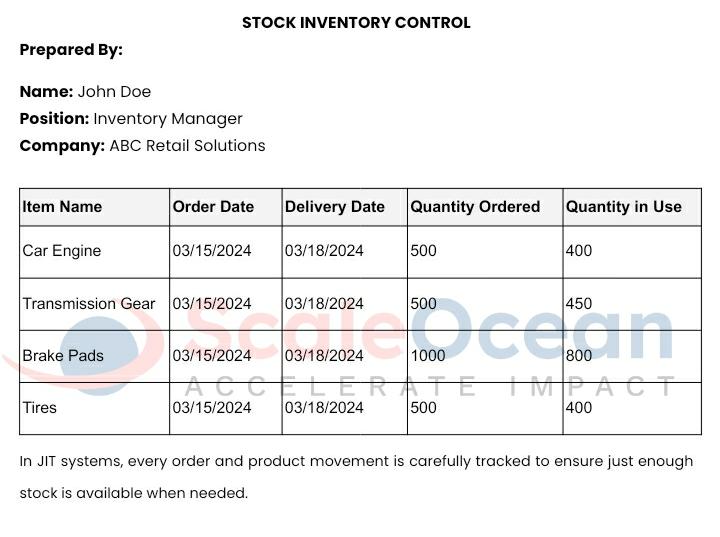
This system of inventory control ensures that orders of stock are only placed to ensure they will arrive on the same day that they are needed.
This system is perfect for a business that cannot afford to keep large amounts of stock or where stock takes up too much room.
JIT does allow the business to save on the cost of storage of goods, but does create pressure if the suppliers do not work to schedule, and therefore will deliver late, so it is good practice to ensure that your suppliers are dependable before considering JIT. JIT inventory templates can include:
5. Economic Order Quantity (EOQ) System
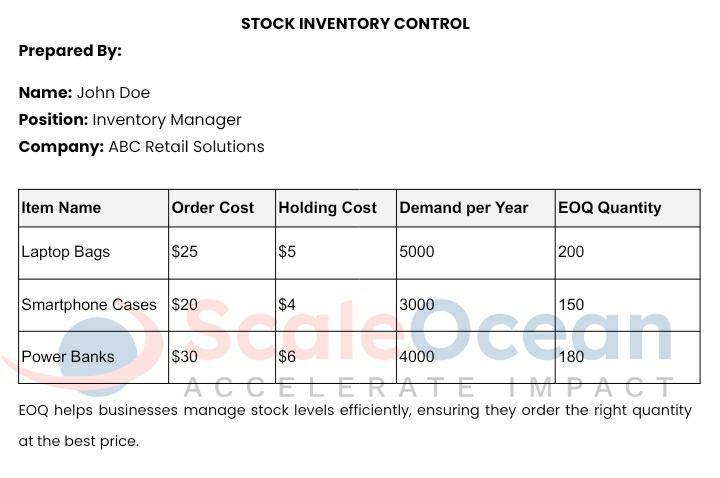
The economic order quantity is used as a formula to determine how many orders should be placed for items that will be used consistently and where storage is an issue.
The optimal ordering quantity can be figured out based on an estimate of how many items will be sold or used. The result allows a business to use the least amount of storage space, whilst also maintaining stock levels so that customer demand is met.
The EOQ formula is based upon how much an order costs to have shipped and also how much an order costs to hold. The formulas involved generally require figures collected from inventory templates.
Monitor Inventory Control in Real-Time and Integrated with ScaleOcean WMS Software
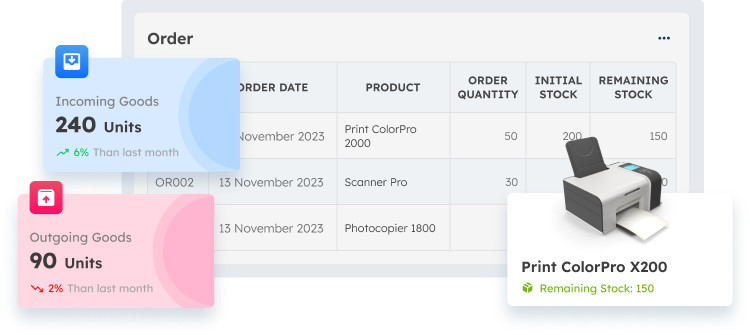
Poorly controlled inventory poses a serious challenge for businesses today, as the task is even harder when product numbers increase, and stock movements become increasingly complex.
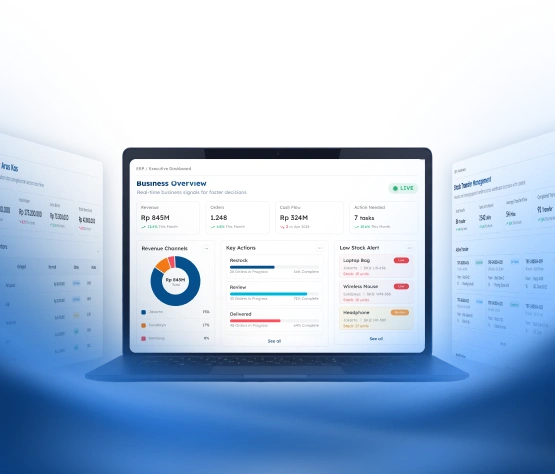
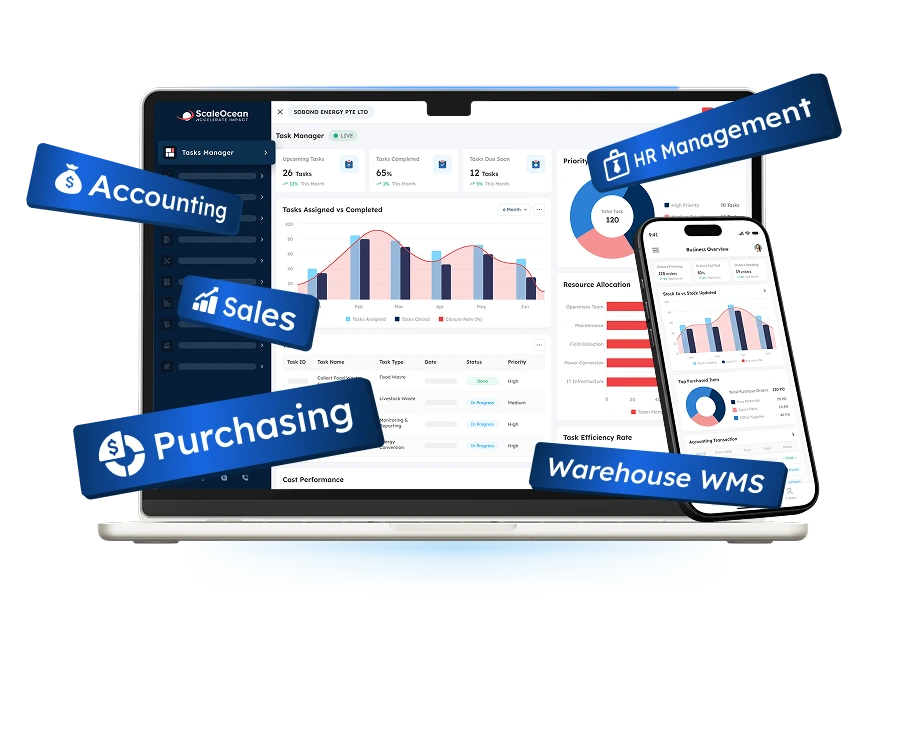
Reliable WMS (Warehouse Management System) software is essential for managing stock, making this problem easy to overcome. With ScaleOcean WMS Software, you can track the stock levels of your products in real-time and gain visibility of goods movement from the warehouse to the customer.
When the products of a business use the ScaleOcean WMS Software, overstocking and understocking, which cause serious impacts on a company’s profit, will be minimized.
When a business uses the ScaleOcean WMS software, stocks are managed very simply, and the information that you get about stocks is extremely accurate for making better decisions in your business. The benefits of using ScaleOcean’s WMS software include many key features:
- Real-Time Stock Monitoring: ScaleOcean provides businesses with complete visibility into inventory, helping to balance supply and demand while preventing stockouts and overstocking.
- Automated Stock Recording: WMS ScaleOcean automates stock updates as goods are received or transported, eliminating manual tracking errors. This increases accuracy, speeds up inventory audits, and reduces the risk of mistakes.
- Low Stock Alerts: ScaleOcean WMS’s low stock alert feature automatically notifies businesses when inventory is low, allowing for quick reorders and preventing stockouts. This ensures smooth operations, avoids missed sales, and maintains product availability for customers.
- Multi-location Inventory Management: WMS ScaleOcean enables businesses to manage inventory across multiple locations on a single platform, providing a unified view of their stock. This centralized control helps optimize stock distribution, reduce shortages, and prevent excess inventory at different sites.
- Comprehensive Stock Reporting and Analytics: ScaleOcean provides detailed stock reporting and analytics, helping businesses track inventory levels, turnover rates, and stock movements for better decision-making.
You can use the features above to control stock levels efficiently within your business, reducing human error and time spent, and keeping it to an optimum level. Request your free demonstration of this software now, so as to experience efficient inventory control.
Conclusion
All of the inventory control systems mentioned above play an important role for businesses in the modern market, ensuring they have optimum levels of stock that are never too high or too low, while not increasing costs.
Each inventory control system works effectively within the needs of a particular business, and by looking at your own business needs, it should not take long before you find one that suits you best.
ScaleOcean’s Warehouse Management System (WMS) solution helps best through real-time tracking, automated replenishment, barcode scanning, and integrated systems with other parts of your business. Book a free demo now to find a solution for your business and inventory workflow.
FAQ:
1. What is the role of an inventory controller?
An Inventory Controller is a specialist tasked with overseeing inventory levels, ensuring precise tracking of stock, and streamlining inventory management procedures to reduce costs and enhance operational efficiency.
2. What is the golden rule for inventory?
The golden rule of inventory management is straightforward: “Keep inventory levels optimized.” This means having enough stock to fulfill customer needs without overstocking or creating waste. Achieving this balance helps reduce holding costs and boost profitability.
3. Is ERP used for inventory?
Process: ERP systems consolidate inventory data, offering real-time visibility into stock levels, order management, and supply chain activities.
Benefit: This ensures consistent and accurate information is accessible throughout the organization, enhancing decision-making and improving coordination.
4. How many steps are there for controlling inventory?
5 key steps. A well-organized inventory management process includes: planning and forecasting, purchasing and ordering, receiving, storing, and packing, inventory tracking, and finally, order fulfillment.





















.png)