

The world of business today is all about data, but data is only useful if you are measuring what matters, like performance metrics. Performance metrics are simply quantifiable measures that are used to assess and evaluate the state of a particular business process.
Also, we have an example from Statista, which estimates that revenue will grow at a 2.97% CAGR from 2025 to 2030 and will reach US $190.35m in that period, which highlights just how important the role of performance metrics can be to future financial performance.
This article details the definition of performance metrics, the vital role they play in sustainable business growth, and practical strategies you can implement in order to leverage them, thus equipping you to turn these insights into sound strategic decision-making for your business.
 Key Takeaways
- Performance metrics are the crucial measurements that offer clear insight into your business’s health and trajectory. By tracking specific outcomes over time, they can eliminate guesswork.
- Businesses track performance metrics to make informed decisions, identify operational weaknesses, and align teams toward common strategic objectives for better outcomes.
- There are various types of performance metrics, including financial, sales, operational, and employee performance metrics, each offering a distinct view of the business.
- ScaleOcean ERP helps you manage and integrate all your performance data, providing a single source of truth to overcome tracking challenges.
What Are Performance Metrics?
Performance metrics are a critical measurement that can provide clear insight into business health and trajectory by monitoring specific outcomes over time-eliminating guesswork and enabling targeted strategies for improvement.
Performance metrics set a benchmark to analyze performance and efficiency within any organizational tier, from a single employee to an entire enterprise.
These metrics are at the core of a results-driven approach and serve as valuable information for business decisions. They are also of several kinds, as below:
1. Buckets of Performance Metrics: Quantitative vs. Qualitative Metrics
First up, when we hear the term ‘quantitative metric’, we usually think of the ones that are centered around numbers and cold, hard facts such as your company’s sales revenue, the volume of traffic to your website, or even simply the number of products produced per day.
The polar opposite is a ‘qualitative metric’, which is more based on descriptive observations and potentially opinion-based statements, and can relate to aspects such as employee morale, customer satisfaction, or product quality, but provides important context that is beyond pure numbers and helps paint a more accurate picture of business performance.
2. Categories of Performance Metrics: Leading vs. Lagging Indicators
Next, we have the leading indicators, which are more predictive performance metrics, telling you what is likely to happen in the future by anticipating your performance.
These lead indicators are the key indicators that will allow you to plan, since they have a direct correlation to business performance. For instance, the number of leads generated during a specific month predicts future revenue, hence being a vital business tool.
Lagging indicators, however, actually measure performance in the past and determine what has occurred during a certain period.
For example, your profit margins and customer churn rates, or the overall revenue that a specific month has generated, are examples of lagging indicators because they show us what has happened but do not do a good job of informing future decisions.
Key Aspect of Performance Metrics
Not all performance metrics are equally valuable, and for a metric to actually serve its purpose, it needs to deliver actionable insights that in turn will enable efficient business decisions and achieve successful business outcomes; otherwise, they simply become a burden on databases.
Key aspects of performance metrics are:
1. Goal-Oriented
It goes without saying that the first prerequisite for any performance metric is that it should directly relate to a fundamental business goal; it should allow the tracking of what’s needed in order for your business to achieve its objectives.
Without a goal orientation, any performance metrics measured have little to no value whatsoever, as it fails to communicate anything worthwhile about the company’s path.
Performance metrics are goal-oriented because they provide a sense of context and meaning and answer the question “why are we measuring this?” This makes performance metrics a more manageable process to execute and ensures that teams focus their energies on activities that bring the most quantifiable value to the organization.
2. Data-Driven
Good performance metrics should absolutely be based on reliable and accessible data. These can not simply be the opinion of one person, and with accurate and timely data, there is little room for error and decision-making based on assumptions.
Strong systems are necessary to gather all required data for metrics to maintain their accuracy. Having a metrics-based system provides a more objective and unbiased source of information, which is acceptable to everybody throughout the organization.
These systems reduce the debate around what information to consider and also help to keep a constant record of what went down, which will be vital for performance metric analysis.
3. Scalable
Another aspect of performance metrics that you need to keep in mind is that as your business grows and becomes larger, the performance metrics need to adapt accordingly.
For instance, performance metrics that work for a team of 5 will likely fail as soon as a company reaches 50. As the business scales up, so should performance metrics so that they can accommodate a larger range of outcomes.
It is also incredibly important that the way that data is collected for performance metrics is scalable, as that is likely the most common challenge when businesses look to grow beyond their current status.
Heavily manual data collection is only sustainable until your business begins to expand and demands more comprehensive and detailed performance data analysis.
4. Actionable
Arguably, the most important characteristic that a performance metric should possess is that it needs to be actionable.
These performance metrics will give the necessary insight that allows you to make certain decisions and take concrete steps. Without this, the metrics are just there to be observed and hold no value for your daily business operations.
Actionable performance metrics can highlight specific problems and new opportunities, and if a performance metric reveals, for example, that your customer acquisition cost has dramatically increased over the past months, it will enable you to get to the root of the issue to find a solution or find out where you can excel to generate more profit.
Why Track Performance Metrics?

Performance metrics are key to successful business growth, transforming the overall approach from being reactive to a predictive business; they ensure that data-driven decisions are made on a timely basis.
Tracking performance metrics allows the company to maximize efficiencies and optimize all resources, solidifying its position within the competitive market.
They also cultivate a sense of accountability across teams to ensure they meet objectives, enabling the team members to have a greater sense of ownership, whilst strong business analytics allow for increased analysis to pinpoint areas of business weakness and subsequently uncover areas of opportunity and innovation.
7 Types of Performance Metrics and Examples
Organizations need tailored performance metrics aligned with their industry, objectives, and business model. Grouping these metrics into categories provides a comprehensive view, covering financial stability to customer loyalty. Performance metrics examples include NPS and CLV. Here are 7 types of performance metrics:
1. Business Performance Metrics
These metrics are usually high-level ones that measure the overall health of the organization, reported to the board and investors. According to SingStat, over 70% of value added came from services, while about 25% came from goods-producing industries. Examples include NPS and CLV.
Market share is another vital business performance metric, representing your company’s sales as a percentage of total industry sales. This metric clarifies your competitive standing and overall positioning. Ultimately, these high-level insights empower leadership to make critical strategic decisions regarding the future direction of the company.
2. Financial Performance Metrics
Financial metrics are, arguably, the most tracked category out there, as they directly measure the profitability and financial stability of the business, which is, of course, very important. Common examples often include Gross Profit Margin, Net Profit Margin, and Return on Investment (ROI), things like that.
Other important financial metrics include Operating Cash Flow, which clearly indicates the cash generated by regular business operations, and the Current Ratio, which assesses liquidity. These numbers are truly vital for sound financial planning, budgeting, and securing investment when you need it.
3. Operating Performance Metrics
Operating metrics measure the efficiency and effectiveness of core internal processes. For manufacturers, this includes “units produced per hour” or “machine downtime,” directly assessing production line smoothness. This data helps you understand the daily operational flow.
Service-based companies, for example, track equally vital metrics like “first response time” or “order fulfillment time.” These indicators are essential for identifying bottlenecks, reducing waste, and continuously improving service quality, ensuring the business operates optimally every day.
4. Sales Performance Metrics
Sales metrics track your team’s performance and the overall sales process, making them crucial for sustained growth and revenue generation. Key examples include month-over-month sales growth, average deal size, and the lead conversion rate, which signals sales effectiveness.
Other vital sales metrics include sales cycle length, which reveals the time needed to close a deal, and Customer Acquisition Cost (CAC). Tracking these allows sales managers to improve coaching, refine the sales funnel, and accurately forecast future revenue, the true engine of company growth.
5. Project Management Performance Metrics
For project-based businesses, these metrics are vital for ensuring timely completion, adherence to budget, and quality standards, a challenge in itself. Metrics like schedule and cost variance compare plans versus actuals, offering a real-time view. This provides critical early warnings if a project strays off track.
Other key metrics include resource utilization, showing how efficiently team members are deployed, and the milestone completion rate. These help managers allocate resources, handle stakeholder expectations, and consistently deliver success. They are fundamental for maintaining control and visibility over complex ERP-driven initiatives.
6. Marketing Performance Management Metrics
Marketing metrics are essential for measuring the real impact and ROI of campaigns, especially in the data-rich digital age. Key examples like Cost Per Lead (CPL), website traffic, and social engagement help teams understand how effectively they reach and interact with their target online audience.
The Conversion Rate is another critical metric, tracking the percentage of visitors who complete a desired action, such as a purchase or sign-up. These metrics enable marketers to optimize campaigns, justify budgets, and clearly demonstrate their contribution to the bottom line, shifting marketing into a measurable revenue driver.
7. Employee performance metrics
Employee performance metrics focus on the productivity, engagement, and effectiveness of your workforce, your most valuable asset. These measures, encompassing both individual and team-based results, offer a comprehensive view of operational health. Examples include productivity rate, absenteeism, and satisfaction scores.
The employee turnover rate is another crucial metric, as high turnover is costly and disruptive. Active tracking helps HR and managers identify top talent, address underperformance issues, and build a better work environment. A productive workforce is a significant, undeniable competitive advantage.
 Also Read: What is Enterprise Management and Its Features
How to Set Performance Metrics
Setting performance metrics requires strategic planning, prioritizing the aspects most critical to the business. First, clarify your objectives, as ambiguous goals lead to wasted effort. Metrics must align directly with these objectives to effectively drive performance in the desired direction.
With clear objectives, you must identify key activities and outcomes that contribute to those goals. Cross-departmental collaboration ensures all perspectives are integrated. Essential support systems, like ERP for data and enterprise risk management (ERM), help to identify and mitigate potential pitfalls.
Pros and Cons of Using Performance Metrics
While performance metrics offer significant benefits, misuse can lead to unexpected challenges, like increased workload or unintended consequences. To ensure these powerful tools add real value, especially within an ERP system, it’s crucial to understand both their advantages and disadvantages. Here are the pros and cons:
1. Benefits of Using Performance Metrics
Performance metrics deliver objective data, enhancing decision-making and the development of effective strategies. They optimize resource allocation and foster cross-team alignment, significantly boosting accountability and organizational cohesion. These outcomes drive improved performance and collaboration. Key benefits include:
- Improved Decision-Making: Performance metrics provide objective data, helping businesses make decisions based on facts rather than assumptions, leading to more effective strategies and higher chances of achieving business goals.
- Enhanced Accountability: When employees know exactly what they’re being measured against, they focus on specific tasks, aligning their efforts with organizational objectives, boosting overall performance and teamwork.
- Better Resource Allocation: By tracking performance metrics, businesses can allocate resources more effectively, ensuring that investments are directed toward areas that contribute the most to achieving goals and improving efficiency.
- Increased Organizational Alignment: Metrics ensure everyone is on the same page, driving alignment across teams and departments. This coordination fosters a unified effort toward common goals, enhancing overall organizational performance and cohesion.
- Encouragement of Continuous Improvement: With performance metrics, businesses can track progress over time and identify areas for improvement. This ongoing analysis encourages teams to adapt and refine strategies to continually enhance performance.
2. Challenges of Using Performance Metrics
A major challenge with performance measurement is deciding which metrics to focus on. Companies often measure what is easy to measure instead of what is meaningful, leading to the creation of teams that seem busy but actually go nowhere.
In addition, most performance metrics are unable to capture the qualitative data that needs to be focused on, with common issues being:
- Wrong metrics: Businesses have to rely on simple, measurable metrics in order to gain focus instead of business goals. The issues with this approach include looking like you are meeting business goals in all areas of business performance, future growth potential of a company, and long-term success of a business plan.
- Gaming the System: By focusing on the easy metrics and the business goals, businesses have a tendency to manipulate performance data in order to create a positive perception or impression of a company, instead of making a positive change to a business goal or overall performance of the business.
- Overuse of Quantitative Data: Overuse of numbers makes it hard to see into the employees’ or clients’ state of mind (morale and relationships, respectively). This information is crucial when you look at business performance.
- Not Seeing the Bigger Picture: The metrics themselves sometimes lack any relation or context to the overall health of a business. Even with useful information, the metrics have no real context behind their results to make them fully valuable to a business plan or strategy.
- Difficulty in balancing both types of data: Achieving the perfect blend of qualitative and quantitative information is difficult but absolutely crucial for making good decisions with regard to business performance.

What Do You Use Performance Metrics For?
Metrics are not just used for dashboard review; they should also be a driving factor in everyday business practices.
Metrics affect decisions across all areas of a business, from executive leadership to client-facing customer service professionals. Here are the areas where performance metrics can be utilized:
1. Business Strategy and Planning
Metrics are a tool that allows strategic goals to be put in place and monitored as supported by business process management. Metrics give business leaders the data they need to guide a business in its strategic direction and are also a signal for when strategy must be modified.
The metrics allow for adaptive business planning and give businesses the competitive advantage they need in the fast-paced marketplace of today. Beyond strategy, they assist with long-term planning and large-scale investments.
Analyze performance to identify new growth strategies or determine how investment capital can be better utilized towards new technology or employees.
2. Operational and Process Improvement
Metrics are at the forefront of the continuous operation and process improvement of a business. They can be used by managers to pinpoint areas where waste or inefficiency is present. Metrics can be used in methodologies such as Lean and Six Sigma to increase process improvement rates.
Operations that utilize operational metrics improve operational costs and product quality; these are important business objectives. The most common example is the logistics company using its “on-time delivery rate” metric to continuously improve product quality for their clients.
3. Employee and Team Management
Metrics are useful for all aspects of people management and development. They provide an objective way to measure performance and reduce bias in employee evaluation.
The performance measurement gives clear goals to all employees as well as the areas in which an employee needs to develop more, both professionally and personally.
Metrics greatly help managers identify where there are top performers ready for promotion and where more coaching or training is needed for lower performers. Metrics can motivate a group and make performance measurement a less arbitrary process.
4. Financial Forecasting and Health
Financial management relies heavily on performance metrics that focus on profitability, cash flow, and revenues to accurately describe financial performance and help with forecasts.
Tracking performance information is critical to maintaining budget stability, making sensible investment decisions, and day-to-day stability.
Performance metrics are important to predict how a business will fare financially in the future with models that simulate business performance. With predictions of future financial performance, a business can better prepare for situations that could result in a negative impact on a business plan.
5. Stakeholder Communication and Transparency
Performance metrics are very important in communications with outsiders to a business, which include investors, boards, and lenders.
These outside parties require clear, concise, quantitative data that is easy to understand and in which they can have trust in the management and performance of a business.
Transparency is crucial inside a business as well. Sharing these metrics with employees helps them to understand how they play a part in the overall performance and success of the business.
Who Uses Performance Metrics?
Performance metrics are used by all business levels and are not limited to executives and business planners. From C-level executives to front-line associates, all use performance metrics to understand how they can be successful. Key users include:
- C-Level Executives: Use performance metrics to guide strategy, business decision-making at a higher level, and determine the direction of the overall business.
- Managers and team leaders: Focus on specific team/department level performance metrics to determine how they can improve their team’s productivity and work quality.
- Front-line employees: Use metrics to increase their productivity and improve work performance.
- Department heads: Monitor performance of their departments to determine how successful the department is in reaching the business objectives and in need of improvement.
- Data analysts/HR Teams: Evaluate employees’ work performance to identify their potential and level of commitment.
Industries that Use Performance Metrics
Performance metrics are used across a wide range of industries to increase efficiency.
These businesses range from manufacturing and retail businesses that rely on “overall equipment effectiveness” and “sales per square foot” to software companies and businesses that rely on “monthly recurring revenue.” Some industries that use performance metrics are:
- Manufacturing: used for optimizing production through metrics such as “overall equipment effectiveness” and “defect rate.”
- Retail: “Sales per square foot” and “inventory turnover” measure store performance to contribute to profits in the industry.
- Technology (SaaS): used to measure growth and the confidence that investors have through “monthly recurring revenue” and “churn rate.”
- Healthcare: “Patient satisfaction” and “treatment success rate” are used to increase performance within the industry.
- Finance: use “Return on Equity” (ROE) and “operating profit margin” to identify how healthy the business is financially.
- Hospitality: measure how profitable and efficient hotels are by tracking the “occupancy rate” and “Average Daily Rate” (ADR).
- Education: identify how a university or school is performing through “graduation rate” and “student satisfaction.”
- Logistics: “On-time delivery rate” and “shipment accuracy” contribute to efficient logistics operations and client satisfaction.
Key Strategies for Creating and Managing Performance Metrics
An effective performance metrics program does not consist of merely selecting a few metrics. This requires a sustainable strategy that will allow for metric adjustments and changes as the business evolves to remain influential and relevant over the long term for organizational sustainability.
Some key strategies include:
1. Strategic Alignment
Quite honestly, nothing is more important for any performance metric than its alignment to strategic business objectives. In fact, I believe that every metric should have a direct path back to a higher-level business objective, which verifies that you are truly measuring what truly defines your success.
It is important to reassess each metric to ensure it is relevant.
Business priorities can change from year to year, and the metric that you thought was the most important last year might not have quite as much significance this year, so continuing to make that reassessment to your performance metrics program will give you the most insight for your strategy.
2. Involving Stakeholders and Ensuring Buy-In
It’s critical to involve stakeholders when you create new performance metrics. This ensures the metric is accurate, fair, relevant, and practical. Gaining a high level of stakeholder buy-in is perhaps the most important factor in ensuring that the performance metrics will be adopted and successful.
Without stakeholders having buy-in, no matter how effective the metrics are in providing the right measurements, they will likely not be successful.
Employees will not buy into measurement if they do not believe they are being measured accurately and fairly, thus ensuring the metrics truly offer a collaborative effort that will develop and improve them continually.
3. Operationalizing the Metrics
Operationalizing the metrics simply means ensuring they are implemented into everyday operations.
This can mean that reports, dashboards, and meeting agendas are all developed around these key metrics so that this information is accessible when you have your daily meetings and make key decisions about the direction of your business.
Technology can really help when integrating metrics. The utilization of a robust ERP system will help you to automate the collection of this data and develop appropriate reports in real time to facilitate your metric integration process.
Of course, it’s essential to have a robust application integration plan that will facilitate the information that you are looking to bring into the single source of data for your business.
4. Review and Adaptation
A robust performance metrics program needs to be flexible enough to support changes when necessary. The marketplace is changing at a very fast pace, and your business needs change along with it.
Reviewing metrics regularly, at least quarterly, or on an annual basis, is a necessary component of ensuring they continue to drive behavior that matters.
When undertaking a review of the current performance metrics program, it’s important to critically question: “Is this metric still strategically aligned with my goals?” and “Is it prompting the behaviors that I want it to?” Continuous refinement of the measurement system is what separates outstanding companies from good companies.
The Difference Between Performance Metrics and KPIs
Many people get performance metrics and Key Performance Indicators (KPIs) confused; however, they are not the same thing. All KPIs are a performance metric, although not all performance metrics are KPIs. It is important to understand the distinction for strategic business management:
A KPI is a specific performance metric that is related to a core business objective, and it must influence it for it to qualify as a KPI. For example, Customer Acquisition Cost (CAC) is a KPI because it can directly influence profit, whereas website visits are merely a helpful performance metric.
Manage Comprehensive and Integrated Performance Metrics Data with ScaleOcean ERP
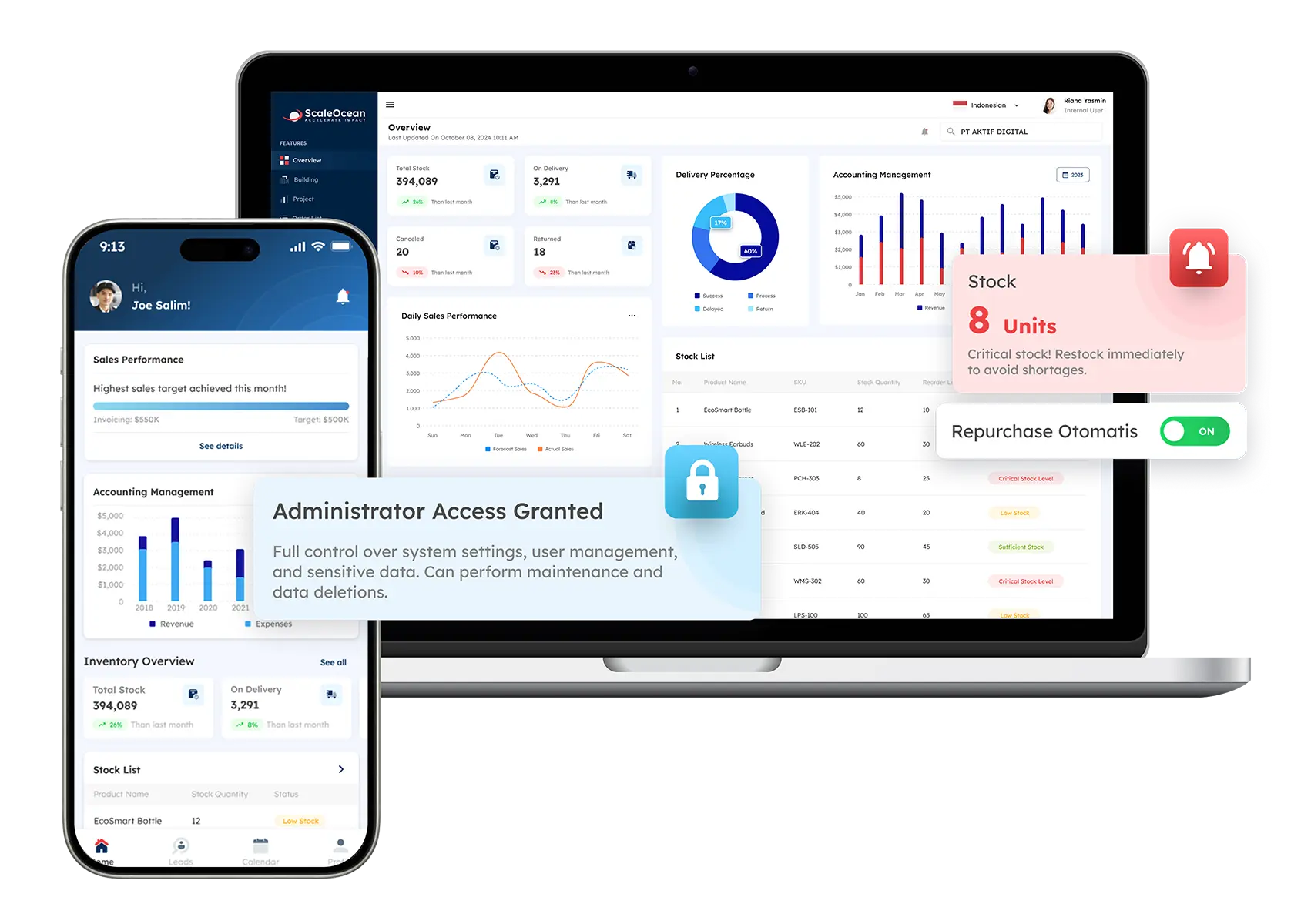
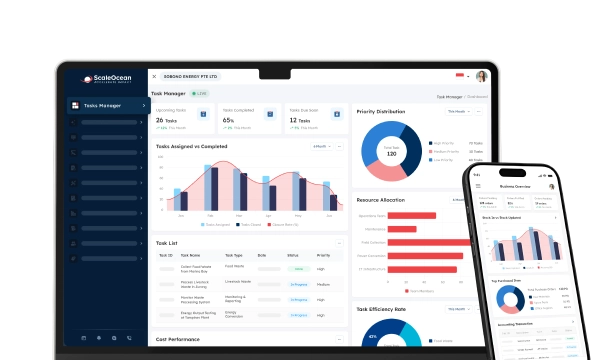
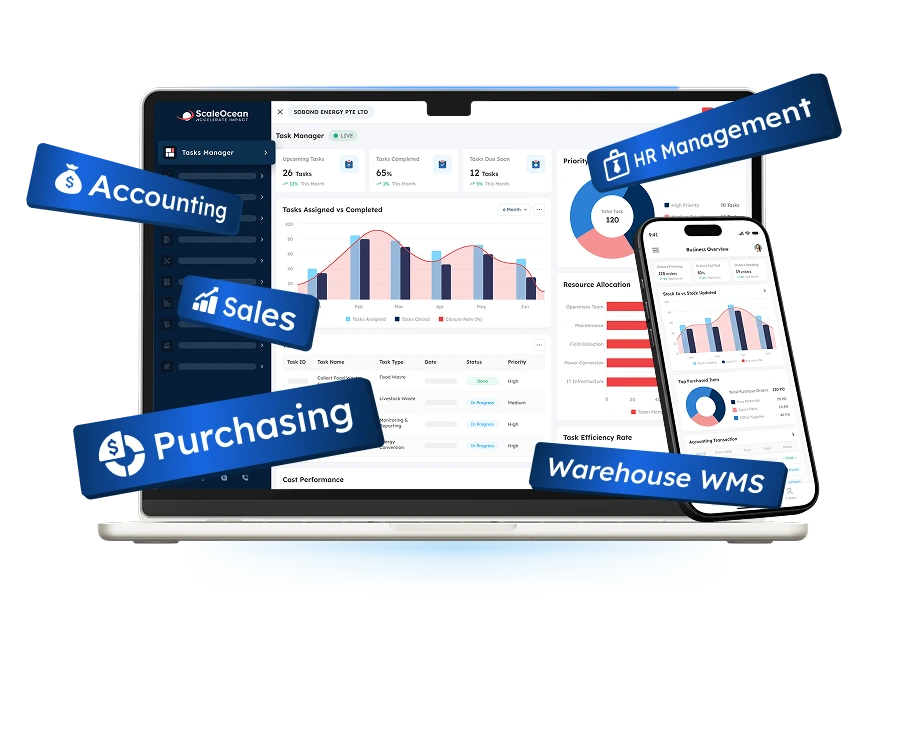
An ERP system, such as the ones provided by ScaleOcean’s ERP, consolidates all of the business’s data in one single place; the data that is collected from the entire organization (from Finance all the way to HR).
Features include unlimited users, no extra costs, scalable industry configurations, and powerful BI using AI-driven reports to make accurate strategic decisions for your business.
ScaleOcean ERP enables decisions on the most relevant metrics through its real-time data and performance metrics optimization features; it is an incredibly powerful yet simple system that will revolutionize your business at an affordable price, and with affordable implementation through the CTC Grant, there is no excuse not to get on board. Some key features:
- AI Integration for Predictive Analytics: AI predicts and optimizes decisions, offering recommendations to improve performance and reduce costs.
- KPI Scorecard for Strategic Monitoring: Tracks business performance against strategic goals, ensuring alignment and growth across departments.
- Customizable Business Intelligence Reports: Offers custom BI reports and interactive dashboards tailored to business needs for real-time insights.
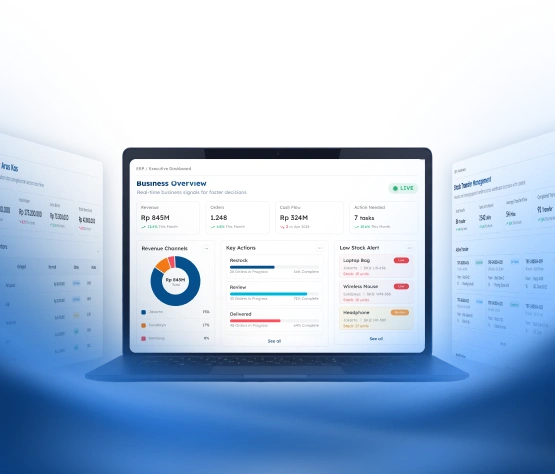
- Interactive Dashboard for Real-Time Insights: Provides interactive dashboards for up-to-date performance metrics, enabling timely decision-making.
- Seamless Data Integration Across Departments: Centralizes data from all departments, providing a unified view for better collaboration and decision-making.
Conclusion
Performance metrics have the potential to bring focus, clarity, and sustainability to your business. Strategic goal alignment with well-chosen metrics is a necessity for navigating business today and being able to have long-term business success.
Without appropriate software, the management of performance data can become somewhat convoluted.
ERP software solutions such as ScaleOcean’s ERP can facilitate cross-departmental data integration and allow the company to make important decisions in real-time due to the reporting features and overall control over the metrics that are driving business success.
Schedule a free demo of ScaleOcean’s capabilities today.
FAQ:
1. What are the most important performance metrics?
The most important performance metrics vary by business type but often include financial metrics like revenue growth, profit margin, and return on investment (ROI). Customer metrics such as satisfaction and retention rates are also crucial for long-term success.
2. What are the most common performance metrics?
Common performance metrics include revenue growth, customer satisfaction, employee productivity, and profit margin. Other metrics like customer retention rate, operational efficiency, and market share are also frequently used across industries for performance tracking.
3. What are KPI and metrics?
KPIs (Key Performance Indicators) are specific performance metrics tied to strategic goals, while metrics are broader measurements of any business process. KPIs focus on critical outcomes, whereas metrics track overall performance and operational progress in various areas.
4. What are metrics with examples?
Metrics are measurements used to track business performance. Examples include sales growth, average order value, customer acquisition cost, and employee turnover rate. These help businesses assess efficiency, productivity, and areas needing improvement for better decision-making.





















.png)