



Prorated salary is when an employee’s salary is adjusted according to the amount of time worked over a specific period. Employers pay workers in accordance with the number of days, weeks, or months they work. It ensures fair compensation for part-time, new hire, and departing employees during the middle of a pay period.
Employers must make payments of salaries no less frequently than once a month and no later than seven days after the end of the salary period (as per the Ministry of Manpower). Companies cannot refuse to maintain their adherence if they don’t take care of their payroll activities.
Pay estimates in Singapore are vital for legal and tax purposes, specifically when it comes to prorated pay. This article discusses the notion of prorated salary and its importance. We’ll explain how to figure out the prorated compensation for months, weeks, and days. Employers will be provided with simple formulas for every technique, ensuring proper payroll management.
 Key Takeaways
- A prorated salary is a payment adjustment made when an employee works part of a pay period rather than the entire period.
- Prorated pay impacts employee benefits such as retirement contributions, health insurance, paid time off (PTO), and bonuses, modifying them proportionally to the time worked.
- In Singapore, the formula to calculate prorated salary is: Prorated Pay = (Proportion of Time Worked) x (Full Monthly Salary).
- HRIS Software by ScaleOcean Atlas streamlines the management of prorated salaries, ensuring accuracy and compliance by automating calculations and integrating with time tracking systems.

What is a Prorated Salary?
A prorated salary is adjusted when a worker only works part of a pay period. Typically covers an employee who starts or leaves mid-month, works part-time, or takes unpaid leave and is due payment for that time.
For instance, if a worker joins a business halfway into the month or leaves early, then the pay will be calculated for the days/hours of work. In like manner, those persons who have broken through their work or who do not have full-time employment will receive a lesser amount of payment to cater for the lesser hours spent at work.
This helps to ensure a level playing field in remuneration and ensures that only time spent for the firm will be paid for.
How to Calculate Prorated Salary in Singapore?
There are a few different ways of calculating prorated salary in Singapore, depending on how the salary is structured and how long the employee has been with the company. Employers usually follow the rules laid down by the Inland Revenue Authority of Singapore (IRAS) in terms of the number of days or the number of weeks that the employees are actually working during the pay cycle.
There are three common methods of calculating prorated salaries:
1. Calculate the Employee’s Monthly Salary
The first step to finding a prorated salary is determining the employee’s monthly pay. This is usually based on their gross monthly income for working a full month, excluding additional payments such as bonuses or commissions.
If they work on an hourly basis, it may be possible to convert to a monthly salary. For instance, a worker’s base salary is SGD 30,000 per month. The number is provided as a starting point for the proration calculation, which is based on the actual portion of a period that they worked.
2. Establish the Reference Period
After that comes picking the time frame used to split up costs, often the stretch between paychecks, say weekly or monthly. When someone clocks in for just a chunk of those dates, measure how many they put in against the full count possible in that cycle.
Take someone who showed up for work just ten days in a thirty-day month, figuring out that slice of time means matching pay to actual effort. Their take-home amount ties directly to those logged days, nothing more.
3. Calculate the Time Worked Proportion
Some days count more when sorting pay; split the worker’s actual workdays by all possible days in that stretch. That piece of the whole shows what fits their paycheck. Their effort fills part of the payment picture.
Imagine someone clocking in 10 days within 30 days. Their work share lands at one-third, right around 0.33. That fraction turns into 33% of the total month spent on the job. Pay follows that slice exactly; 33% of the standard monthly amount shows up.
4. Compute the Prorated Salary
Now that you have the time worked proportion, multiply it by the employee’s monthly salary to determine the prorated pay. This gives you the amount they should be paid for the days they actually worked during the pay period.
For example, if the employee earns SGD 4,500 per month and works 52% of the month, their prorated salary would be SGD 4,500 × 0.52, which equals SGD 2,340. That’s the amount they should receive for the partial month worked.
And here is the formula based on Singapore’s Ministry of Manpower Employment Act Part 3, Section 21:
MOM Prorated Pay = (Monthly basic rate of pay ÷ Number of working days in that month) x (Full Monthly Salary)
To calculate prorated pay, you first need to determine the proportion of time worked in a given pay period. For example, if an employee works 12 days in a 23-working-day month in January, the proportion would be 12/23, or 0.52, representing 52% of the month worked.
Once you have the proportion, multiply it by the employee’s full monthly salary to find the prorated pay. For example, if the monthly salary is SGD 4,500, the prorated pay would be 0,52 × SGD 4,500, which equals SGD 2,340. This calculation ensures fair compensation for both the company and the employee.
Examples of Prorated Salary Calculation
It is crucial to calculate a person’s prorated salary properly to ensure that he or she is paid fairly if working through part of a pay period. Prorating helps ensure that employees receive fair compensation when they join or leave the organisation in the middle of the month, or are required to work part-time or go on unpaid leave.
Here are some examples of how prorated salary can be calculated:
Converting Annual Salary to Monthly Pay
To convert an annual salary to monthly pay, divide the annual salary by 12, the number of months in a year. For example, if the annual salary is SGD 48,000, dividing by 12 months gives a monthly pay of SGD 4,000.
If the employee works only part of the year, multiply the monthly pay by the number of months worked. For instance, if they join the company in September and work for 4 months until December, their prorated salary would be SGD 4,000 × 4, totalling SGD 16,000 for that period.
Converting Annual Salary to Weekly Pay
To convert an annual salary to weekly pay, divide the annual salary by the number of weeks in a year. For example, if the annual salary is SGD 52,000, dividing by 52 weeks gives a weekly pay of SGD 1,000.
If the employee works a portion of the year, multiply the weekly pay by the number of weeks worked. For instance, if they work 10 weeks, their prorated salary would be SGD 1,000 × 10, totalling SGD 10,000 for the period.
Converting Annual Salary to Daily Pay
To calculate the daily pay from an annual salary, divide the annual salary by the number of working days in a year. For example, if the annual salary is SGD 48,000 and there are 250 working days, the daily pay would be SGD 192.
If the employee works a partial period, multiply the daily rate by the number of days worked. For example, for 15 days worked, the prorated salary would be SGD 192 × 15, giving the employee SGD 2,880 for that period.
Prorated Salary with Deductions
When calculating prorated salary with deductions, first determine the prorated pay based on the time worked. Then, apply any deductions such as taxes, benefits, or other withholdings proportionally based on the prorated amount.
For instance, if an employee’s prorated salary is SGD 2,500 and the total deductions are SGD 500, the employee would receive SGD 2,000. This ensures that both the pay and deductions are adjusted fairly to reflect the actual time worked.
AWS (Annual Wage Supplement) Proration
The Annual Wage Supplement (AWS), commonly known as the 13th month bonus, is an additional payment made to employees on top of their regular monthly salary.
While AWS is not legally mandated under Singapore’s Employment Act, it is a common contractual entitlement that many Singapore employers include in employment contracts and collective agreements.
For example, an employee in Singapore earns a monthly salary of SGD 4,500 and has an AWS entitlement of one month’s salary. The employee joins the company on 1 April and works until 31 December, a total of 9 months.
Prorated AWS = (SGD 4,500 × 1 × 9) ÷ 12 = SGD 3,375
The employee receives SGD 3,375 as their prorated AWS for the year, reflecting the 9 months of service rather than the full 12.
May All Employees be Paid a Pro-rated Salary?
While it is common practice to pay some employees on a pro rata basis, this does not apply to all employees. These can include people who are new to the company, workers who are leaving the business halfway through the month, part-time staff, and people with flexible hours.
Prorated pay refers to the process of adjusting an employee’s salary to account for the amount of time they worked to compensate them for the length of the job. According to Hawksford, the common law of employment is applicable to practically anyone who is on a contract of service (COS) except seamen, domestic workers, and government workers.
Although prorated comp is often linked to salaried positions, hourly staff members can be subject to similar modifications. Those who are employed are paid according to the number of hours they work, in a set period.
This ensures that the compensation is commensurate with hours worked, whether part-time, full-time, or flexible.
What is the Impact of Prorated Pay on Employee Benefits?
Prorated pay influences not only an employee’s income but also the benefits they receive. Because prorated compensation represents the amount of time worked, benefits like retirement contributions, health insurance, paid time off (PTO), and bonuses can be modified proportionally.
Businesses with employees across different markets may also need to manage multi-country payroll requirements alongside Singapore payroll obligations.
Prorated pay adjustments can affect human resource retention if employees feel their compensation or benefits are unfair, highlighting the need for careful management to reduce turnover. Here’s a closer look at how prorated pay can affect the following major areas of employee compensation:
Retirement Contributions
Retirement contributions are many times tied to an employee’s pay. If they get prorated pay, they may be receiving less into their retirement plan, such as a pension plan.
Because the compensation is lower for the period, the employer’s matching contribution (if applicable) will be proportional to the amount received, implying that employees on prorated pay will notice a loss in their retirement savings during that time.
Health Insurance
Health insurance coverage is usually provided on a full-time basis. Employers can reduce coverage or premiums for individuals who are working prorated hours as compared to full-time workers because they have fewer hours in which to work.
This reduction varies depending on corporate policies and the degree of benefits provided, and employees may find that their coverage is less complete while working on a prorated pay basis. Additionally, employers need to consider factors like corporate tax in Singapore when determining how benefits are adjusted for prorated pay.
Paid Time Off (PTO)
Paid time off is another benefit impacted by prorated pay. Part-time employees, temporary workers, and others who have reduced hours may earn fewer hours of paid time off (PTO) that are calculated per hour worked.
For example, if an employee earns a prorated wage and works part-time, their annual and sick leave will be modified accordingly, resulting in less PTO than a full-time employee.
Bonuses and Incentives
Bonuses and incentives are typically based on performance or whether or not they are full-time employees. If the company’s bonus or incentive system is strengthened, it can offer reduced amounts of bonus or incentive to employees working on prorated pay.
These benefits are frequently prorated to match the actual number of days or hours worked during the period, so the total bonus that the employee receives is closely related to their work schedule for that specific period.
Singapore employers should note that CPF contributions remain payable on prorated salary amounts, calculated at the applicable age-banded rates on the employee’s ordinary wages for that month. For companies employing foreign workers, the foreign worker levy is a separate employer obligation and is not affected by employee salary proration.
What are the Legal Requirements for Prorated Salary in Singapore?

Prorated salaries must be calculated within the legal framework in Singapore to ensure a fair salary. Ratalina guides the calculation of prorated amounts, which employers must abide by with regard to the rules on minimum wage, overtime, equal pay, and employment contracts.
Companies can maximise the benefits of using the best payroll software. To achieve efficient prorated salary payment and comply with the requirements of the law. Such software simplifies payroll computation, processes correct tax deductions, and assists in complying with labour regulations.
Here is a summary of the main considerations surrounding the legal aspects of prorated salary:
- Minimum Salary Standards: Employers are required to pay workers a minimum wage, not just for hours they actually work but for the number of hours that they were contracted to work, even if they report to work and are at the worksite for fewer hours.
- Overtime Compensation: Overtime must be paid according to the overtime compensation rates in accordance with the law, and the hourly compensation rate must be prorated to match employee overtime requirements.
- Pay Equity and Anti-Discrimination: When salaries are prorated, they must be based on pay equity concepts, and all workers will be paid the same amount per unit of work, not only when they are compared to their direct counterparts, but even when the work is done on a part-time basis.
- Employment Contracts and Negotiated Agreements: Explicit guidance on how to work out prorated salaries should be prominently written in employment contracts or Collective Agreements. These documents list the salary adjustment for part-time or mid-period employees.
- Annual Wage Supplement (AWS) Eligibility: If the employee is paid on a prorated salary, they could still be eligible for the AWS due to contract terms. Typically, the AWS is determined by the annual compensation and then apportioned, as needed, across a year’s time.
When Should You Pay Employees on a Pro-Rata Basis?
Prorated pay is required in many cases to ensure that employees are adequately reimbursed for the time they labour. There are various situations in which pro-rata compensation is required, and knowing when to utilise it helps maintain labour law compliance and assures equitable treatment for both employers and employees.
This is especially important when adjusting the payroll cycle to reflect the actual days worked within the period. Here are the situations where pro-rata pay applies:
- New Hires or Terminations Mid-Pay Period: Pay is prorated for employees who join or leave mid-period based on the days worked. This ensures fair compensation and accurate business expense management.
- Part-Time Employees: Part-time employees are compensated based on hours worked. Their pay is prorated, ensuring fairness while also simplifying business expenses tracking. The payslip process reflects this adjustment for temporary or seasonal workers.
- Flexible Work Schedules: Employees with flexible schedules receive prorated pay for the hours worked. This ensures they are paid fairly while helping businesses manage expenses accurately.
- Unpaid Leaves of Absence: Employees on unpaid leave have their pay adjusted based on the days worked. This guarantees fair pay and ensures business expenses reflect the time off taken.
- Mid-cycle Salary Increase: Salary increases mid-period are prorated based on the new rate for days worked. This ensures employees are fairly compensated while keeping business expenses up to date.
A Simple Guide on How to Calculate Prorated Deductions
Prorated deductions ensure employees are fairly compensated based on the time worked during a pay period. When calculating deductions for partial periods, businesses need to adjust statutory and pre-tax deductions accordingly to reflect the actual time worked.
Here are the key steps to calculate prorated deductions:
1. Identify the statutory deductions
Figuring out what’s required by law comes first; CPF and tax amounts need sorting. Depending on how much someone earns, these numbers shift each pay cycle. Laws change over time, so the rules used today might differ later, and each person’s take-home amount hinges on accurate math done right.
Start by checking the right rates for mandatory withholdings. Getting these numbers wrong could mean falling short of the law’s rules when pulling money from workers’ paychecks.
2. Determine pre-tax deductions
After that, look at amounts taken out before tax, such as health coverage or pension payments. Take off wages ahead of the tax calculation and split them by how many days the worker was active during the payment cycle.
Start by checking pre-tax cuts when hours change and when work shifts happen; calculate those amounts so they match up. Matching timing keeps things right-sized for what people actually did on the job. Fairness sticks around that way.
3. Determine the deduction amount per day
Start by splitting the total deduction by the number of days in the pay cycle; this gives a daily value. Next up, take that figure and run it through the count of actual workdays instead; that shift reveals what sticks after adjusting for partial time.
Each day worked pulls just that share from pay; when hours shift, what comes out shifts too, matching effort to cost without guesswork.
4. Apply deductions to the salary
Lastly, deduct the prorated deductions from the employee’s gross income. This will ensure that the net pay is calculated and that all deductions will be applied correctly, depending on the employee’s actual work time for the period.
Once deductions (work rations will be applied accordingly are made, the employee will see the work period on their pay. The approach guarantees fair compensation and improves adherence to statutory and pre-tax deduction rules.
How to Explain Prorated Salary Policy
It is essential to communicate the prorated salary policy clearly to your employees so they know how to be paid, particularly if they work part-time, start midway through the month, or go on to leave the company without payment. When everyone is not on the same page, clear communication can help to minimise confusion.
Here’s how to effectively communicate the prorated salary policy:
1. Make Clear Policies During Onboarding
It is also best to take time to discuss during new employee orientation how prorated salary is determined by an employee’s date of hire or termination. Be sure they know how to adjust their pay for partial months, part-time hours, or absences.
You establish early on expectations and avoid potential misunderstandings. Knowing their salary will be computed mathematically for the entire duration of the working period is also helpful to the workers in managing their finances better.
2. Offer Clear and Concise Examples
Sometimes an easy-to-follow example can ease the understanding of prorated pay. Discuss situations that include working part of a pay period or being away for an entire period, and demonstrate the impact on the worker’s pay.
When employees can see the concept in real-life terms, it’s easier for them to understand. This gives them the confidence and information about how their pay is being calculated, particularly if they’ve taken some leave or partial periods.
3. Include the Policy in the Employee Manual
Be sure the values of the prorated salary policy are explicit in the employee handbook. By doing this, staff can easily access it at any time if they need clarification, as it would ensure consistency and transparency in the interpretation of the policy.
It is easily accessible and official to have the policy in the employee manual. It gives employees an easy reference for knowing how their pay will be prorated if they have any questions later.
Manage Prorated Salary Easily and Stay Compliant with HRIS Software by ScaleOcean Atlas
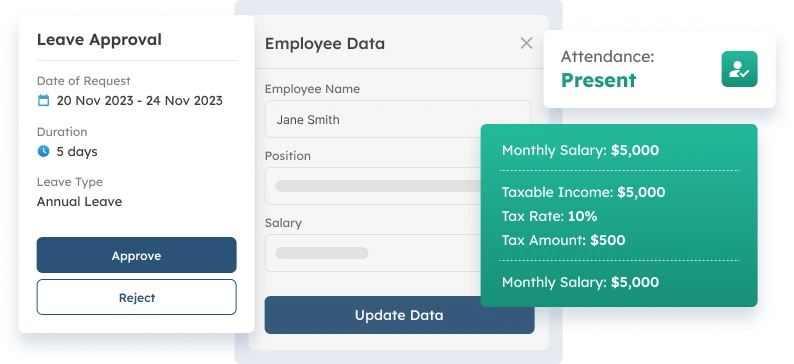
HRIS software by ScaleOcean Atlas provides an efficient solution for handling prorated salaries, allowing organizations to conduct payroll with ease and precision. The software’s automatic functions prevent manual errors and save time by calculating prorated pay according to preset parameters.
The seamless interaction with time monitoring systems guarantees that salary calculations accurately reflect actual working hours. ScaleOcean offers a scalable solution for complex payroll situations and helps you keep up with changing legislation.
If you’re looking for a simple, compliant way to handle prorated salaries, ScaleOcean offers a free consultation with our team of expert to get started. Additionally, ScaleOcean Atlas is eligible for the CTC (Career Transition Progamme) grant up to 75% of funding, making it a more appealing solution for firms improving payroll management.
The following is a list of ScaleOcean Atlas’s unique selling points (USPs):
- Automated calculation: Easily calculate prorated salary with automated tools, reducing errors and time spent on manual calculations.
- Time tracking integration: Seamlessly integrate time tracking with payroll systems to ensure accurate salary payments.
- Customizable rules: Tailor prorated pay rules to meet your company’s specific needs and adjust based on employee work schedules.
- Automatic updates: Stay up to date with any regulatory changes in salary calculations or tax rates.
- Compliance and reporting: Ensure compliance with local regulations and generate necessary reports for payroll audits.
- Self-service portals: Allow employees to access their pay details and track their work hours through a convenient self-service portal.
Conclusion
Understanding prorated salary calculations is critical for ensuring equitable compensation, particularly for employees who work half pay periods. Prorated pay guarantees that employees are equitably compensated, whether they are new hires, part-time workers, or operate on flexible schedules.
Prorating by months, weeks, or days ensures payroll accuracy and fairness. It is also critical to understand how prorated pay affects employee benefits and to comply with legal requirements, particularly in Singapore.
HRIS Software by ScaleOcean Atlas provides a comprehensive solution for firms looking to handle prorated salaries more efficiently. Features like automated calculations, time tracking integration, and customized rules ensure payroll accuracy. Compliance reporting enables firms to stay on track with rules.
ScaleOcean also offers self-service portals, making payment information conveniently accessible. Sign up for a free consultation today to learn how ScaleOcean can enhance your payroll management.
FAQ:
1. What is a prorated payment?
A prorated payment is a partial payment calculated according to the amount of service, time, or usage provided. In payroll, it ensures employees are paid fairly for the exact period they worked rather than receiving the full monthly salary.
2. What does it mean to have a salary prorated?
A prorated salary means an employee receives only a portion of their full salary based on the actual period they worked. This usually applies when an employee starts or leaves a job in the middle of a salary period, takes unpaid leave, or has changes to their employment terms.
3. How do I calculate my pro rata salary in Singapore?
To calculate prorated pay, you first need to determine the proportion of time worked in a given pay period. For example, if an employee works 12 days in a 23-working-day month in January, the proportion would be 12/23, or 0.52, representing 52% of the month worked. Once you have the proportion, multiply it by the employee’s full monthly salary to find the prorated pay. For example, if the monthly salary is SGD 4,500, the prorated pay would be 0,52 × SGD 4,500, which equals SGD 2,340. This calculation ensures fair compensation for both the company and the employee.
4. Is salary calculated based on 26 days or 30 days in Singapore?
For prorated salary calculations in Singapore, the calculation is generally based on the actual number of working days in that month, not a fixed 26 or 30 days. For accurate payroll processing, businesses should follow the employment contract, company payroll policy, and applicable Singapore Ministry of Manpower (MOM) guidelines.
Words: 49
Characters: 331






















.png)