



Multi-country payroll refers to managing employee salaries, taxes, benefits, and statutory requirements across multiple countries through coordinated processes. For Singapore enterprises, this approach becomes essential as international operations increase.
However, paying employees across borders creates complex compliance obligations because every jurisdiction applies different tax rules, reporting deadlines, currencies, and employment regulations. As a result, manual payroll processes can expose enterprises to costly penalties.
Moreover, global payroll teams often struggle to consolidate information from separate systems, spreadsheets, banks, and providers. Without reliable integration, finance leaders may lack one accurate view of workforce costs and payroll liabilities.
Therefore, multi-country payroll software helps enterprises centralize payroll operations while supporting local compliance, HRIS integration, automation, and global reporting. This creates stronger governance while reducing administrative effort across expanding international workforces.
 Key Takeaways
- Multi-country payroll is a centralized approach for managing employee compensation, taxes, benefits, and statutory requirements across multiple countries.
- Multi-country payroll management models include global software platforms, Employer of Record arrangements, and local entities for different employment structures.
- Top multi-country payroll software automates international payroll calculations, compliance processes, employee payments, reporting, and workforce data management across countries.
- ScaleOcean HRIS Software integrates payroll, HR, accounting, workflows, reporting, and ScaleMind AI support to simplify multi-country payroll management and improve workforce visibility.
What is Multi-Country Payroll?
Multi-country payroll is a payroll management approach that coordinates employee compensation, deductions, taxes, benefits, and statutory reporting across several countries. It combines centralized oversight with country-specific payroll requirements.
Unlike domestic payroll, this model must account for different currencies, tax structures, employment laws, reporting obligations, and payment practices. Consequently, enterprises need standardized processes without ignoring each jurisdiction’s local requirements.
 Also Read: Top 12 Payroll Software For Businesses in Singapore 2026
Why Is Multi-Country Payroll Important for Enterprises?
For enterprises, multi-country payroll becomes increasingly important when international headcount expands, and payroll responsibilities spread across subsidiaries, branches, or remote teams. A coordinated model gives leadership stronger control over workforce administration.
Additionally, centralized payroll management can reduce fragmented processes across countries while improving visibility, consistency, and operational control. The following benefits explain why enterprises increasingly prioritize structured global payroll capabilities.
1. Absolute Compliance & Risk Mitigation
Multi-country payroll strengthens compliance by applying country-specific tax, employment, and statutory rules within controlled payroll workflows. As a result, enterprises can reduce errors that might otherwise trigger penalties, disputes, or delayed filings.
Moreover, centralized controls can standardize approvals, calculations, documentation, and audit trails across international payroll operations. This helps finance and HR teams identify compliance gaps earlier while maintaining accountability for local requirements.
2. Radical Operational Efficiency
Automating repetitive payroll tasks can significantly reduce administrative workloads across multiple countries and payroll cycles. As a result, teams can spend less time reconciling spreadsheets, checking calculations, and coordinating routine payroll inputs.
Integrated workflows can connect employee data, attendance, benefits, deductions, approvals, and payroll calculations in one process. This reduces duplicate data entry while improving processing consistency across geographically distributed teams.
3. Centralized Financial Data and Reporting
Centralized payroll data gives finance leaders a clearer view of salaries, employer costs, deductions, and workforce expenses across countries. As a result, management can compare payroll performance using consistent, consolidated financial information.
Additionally, standardized reporting supports budgeting, forecasting, reconciliation, and management analysis without requiring teams to manually compile disconnected country-level reports. This creates stronger visibility into global labor costs and payroll liabilities.
4. Elite Employee Experience
Employees expect accurate and timely salary payments regardless of their work location or employing entity. By coordinating payroll processes, enterprises can reduce payment errors and provide more consistent employee support across countries.
Moreover, localized payroll capabilities can accommodate different currencies, deductions, benefits, and statutory requirements while preserving a consistent employee experience. This helps international employees receive accurate compensation with fewer payroll-related disruptions.
5. Scalability and Operational Efficiency
Multi-country payroll can support workforce growth by providing repeatable processes for onboarding employees, processing salaries, and managing statutory requirements. Therefore, enterprises can expand into additional markets without rebuilding payroll operations from scratch.
Furthermore, automation allows payroll teams to handle larger employee populations without proportionally increasing administrative workloads. This creates a more scalable operating model while helping organizations respond faster to changing workforce requirements.
6. Centralized Global Expansion
Centralized payroll infrastructure can give enterprises a stronger foundation for entering new markets and coordinating workforce operations. Instead of managing every country through isolated processes, leaders can establish consistent governance across locations.
Additionally, a unified payroll framework helps organizations evaluate expansion costs, operational requirements, and local compliance considerations more systematically. This enables faster coordination between HR, finance, legal, and leadership teams during international expansion.
Common Multi-Country Payroll Management Models
Companies can manage multi-country payroll through several operating models, depending on their legal presence, workforce structure, compliance capabilities, and expansion strategy. Each model offers different levels of control, cost, and operational responsibility.
Therefore, enterprises should select an approach based on where employees work, whether local entities exist, and how much payroll administration the organization wants to retain internally. Three models dominate international payroll management.
1. Global Software Platforms
Global software platforms centralize payroll administration across multiple countries while supporting localized calculations, compliance requirements, reporting, and integrations. This model suits enterprises that want greater visibility without managing each payroll process separately.
However, platform capabilities vary by country, so enterprises should verify supported jurisdictions, statutory coverage, integrations, data controls, and local expertise before implementation. A strong platform should balance centralized governance with necessary localization.
2. Employer of Record (EOR)
An Employer of Record manages employment administration for workers in countries where the client may not maintain its own legal entity. Consequently, companies can hire internationally without immediately establishing local corporate infrastructure.
However, EOR services generally provide less direct control over employment administration and may involve higher per-employee costs. Enterprises should therefore carefully evaluate pricing, contractual responsibilities, compliance coverage, and long-term expansion plans.
3. Local Entities
Using local entities gives enterprises direct control over employment, payroll, banking, taxation, and workforce administration within each country. This approach can suit organizations with established operations and substantial long-term headcount.
Nevertheless, maintaining multiple entities increases administrative responsibility because each jurisdiction requires local registrations, compliance processes, financial controls, and specialist knowledge. Enterprises must therefore invest in capable teams, systems, and governance frameworks.
What Do Companies Need to Run Multi-Country Payroll?

Running multi-country payroll requires more than payroll software because enterprises must establish legal, financial, compliance, and operational foundations in every relevant jurisdiction. These requirements determine whether payroll processes can operate accurately and sustainably.
Furthermore, companies need coordinated systems and specialized expertise to connect employee data, statutory obligations, banking, and reporting. Building these foundations helps organizations reduce errors while maintaining consistent payroll governance across countries.
1. Entity Infrastructure (The Legal Foundation)
Enterprises need a legal structure before running payroll in many jurisdictions, particularly when employing workers through subsidiaries or branches. This infrastructure establishes responsibility for employment contracts, payroll obligations, taxation, and statutory compliance.
Therefore, companies should confirm entity requirements before launching payroll operations in a new market. The right structure aligns employment administration with local regulations while reducing legal and operational uncertainty.
2. Local Tax & Statutory Registrations
Payroll operations require accurate registrations for relevant tax, social security, employment, and statutory reporting obligations in each jurisdiction. These registrations enable employers to calculate deductions correctly and submit required information to authorities.
Additionally, enterprises must monitor changes to local rules, thresholds, deadlines, and reporting formats over time. Keeping registrations current and maintaining compliance calendars help prevent avoidable filing errors, penalties, and payroll disruptions.
3. Cross-Border Banking & Treasury Solutions
International payroll requires reliable banking arrangements that can process payments across currencies, countries, and payment networks. Enterprises must also manage exchange rates, funding schedules, transaction controls, and reconciliation processes effectively.
Furthermore, treasury coordination helps finance teams maintain sufficient liquidity for payroll obligations across different jurisdictions. Integrated banking workflows can improve payment visibility while reducing manual reconciliation between payroll and financial records.
4. Localized Compliance & Labor Expertise
Local payroll expertise helps enterprises accurately interpret employment rules, statutory deductions, leave requirements, benefits, and reporting obligations. This knowledge becomes particularly important when regulations differ significantly between countries or change frequently.
Consequently, organizations should combine centralized governance with reliable local expertise rather than applying identical payroll rules everywhere. This balance supports consistent processes while respecting each jurisdiction’s specific legal and labor requirements.
5. Consolidated Software & Integrations
Consolidated payroll software connects employee records, HRIS platforms, accounting systems, attendance data, benefits, banking, and reporting workflows. As a result, enterprises can reduce duplicate entries and create more consistent payroll data.
Moreover, strong integrations help synchronize information between departments while supporting automated approvals, calculations, and reporting. This creates a connected payroll environment that improves accuracy, operational visibility, and governance across international teams.
When Should Companies Implement Multi-Country Payroll?
Companies should consider multi-country payroll when they employ workers across several jurisdictions and face increasing complexity in salaries, taxation, benefits, reporting, and statutory obligations. Early implementation becomes especially valuable as international headcount grows.
Enterprises should also evaluate implementation when payroll teams rely heavily on spreadsheets, disconnected providers, or repetitive manual reconciliations. These warning signs often indicate that existing processes cannot efficiently support international workforce expansion.
Companies expanding into new markets can also benefit from implementing structured payroll infrastructure before international hiring accelerates. Consequently, establishing centralized processes early can reduce future migration challenges, compliance risks, and administrative disruption.
Finally, enterprises should implement multi-country payroll when leadership requires consolidated visibility into global labor costs and payroll performance. A unified system can support faster decisions while strengthening financial and operational governance.
Must-Have Features for Multi-Country Payroll Systems
A capable multi-country payroll system should combine global payroll visibility with localized compliance, currency management, automation, and integration capabilities. These features allow enterprises to standardize operations without overlooking country-specific payroll requirements.
The right system should also connect payroll with existing HR, finance, banking, and workforce systems. This creates a more reliable data environment while reducing manual intervention across international payroll processes.
1. Multi-Currency Support
Multi-currency support allows enterprises to calculate and process payroll using different currencies across international workforces. Therefore, payroll teams can manage salary payments while maintaining accurate currency values and financial records.
Additionally, effective systems should support exchange-rate management, currency conversion, and consolidated reporting across currencies. This helps finance teams understand total workforce costs without manually converting country-level payroll information.
2. Compliance Automation
Compliance automation helps payroll teams apply relevant tax, deduction, reporting, and statutory requirements according to each jurisdiction. As a result, enterprises can reduce manual compliance checks and lower the likelihood of calculation errors.
Moreover, automated compliance capabilities can help organizations respond to regulatory changes more efficiently. Instead of repeatedly rebuilding payroll rules, teams can manage requirements through structured and configurable system workflows.
3. Central Dashboards
Central dashboards provide management with consolidated visibility into payroll costs, employee numbers, payment statuses, and country-level payroll performance. Consequently, finance and HR leaders can monitor international payroll without switching between disconnected systems.
Furthermore, dashboards can highlight exceptions, pending approvals, and unusual payroll movements that require attention. This allows teams to identify issues earlier while improving oversight across geographically distributed payroll operations.
4. Statutory Automation
Statutory automation manages recurring payroll obligations such as deductions, contributions, calculations, and required reporting according to applicable regulations. Therefore, payroll teams can reduce repetitive administrative work while improving consistency across countries.
Additionally, automated statutory processes can support more reliable deadlines and documentation. This becomes particularly useful for enterprises managing multiple jurisdictions where requirements, reporting schedules, and contribution structures differ substantially.
5. Entity & Contractor Blending
Entity and contractor blending enables enterprises to manage employees, contractors, and workers operating through different employment arrangements within coordinated payroll processes. This flexibility supports modern workforces that combine permanent staff with external talent.
Moreover, unified workforce management helps organizations maintain clearer visibility into total labor costs and worker classifications. Consequently, finance teams can analyze workforce expenses more comprehensively across entities and engagement models.
6. System Integration
System integration connects payroll with HRIS, accounting, attendance, benefits, expense, banking, and other business systems. As a result, employee and financial information can flow between platforms without repeated manual data entry.
Furthermore, integrated architecture improves data consistency across departments and reduces reconciliation effort. Enterprises can therefore create smoother workflows while maintaining more accurate information throughout the employee lifecycle and payroll cycle.
Challenges of Multi-Country Payroll Management
Managing payroll across countries introduces operational complexity because enterprises must coordinate different tax systems, currencies, privacy requirements, communication practices, and workforce regulations. Without strong governance, these differences can increase administrative risks.
International payroll also requires collaboration among HR, finance, legal, payroll specialists, and local stakeholders. Therefore, enterprises need clear processes and technology to manage these challenges consistently as operations expand.
1. Tax and Contribution Fragmentation
Each country can apply different income taxes, social contributions, payroll deductions, thresholds, and reporting requirements. As a result, payroll teams must maintain accurate, country-specific calculations instead of relying on a single universal payroll configuration.
Moreover, regulatory changes can increase this complexity because local authorities may periodically update rates, thresholds, or reporting requirements. Enterprises therefore need reliable compliance monitoring to keep payroll calculations current.
2. Currency and Funding Logistics
International payroll requires companies to manage multiple currencies, exchange rates, payment schedules, and funding requirements simultaneously. Therefore, finance teams must ensure sufficient funds reach the correct accounts while minimizing unnecessary foreign-exchange costs.
Furthermore, currency fluctuations can affect consolidated workforce expenses and financial forecasting. Integrated treasury and payroll processes can help organizations improve payment planning while maintaining greater visibility into international funding requirements.
3. Data Security and Privacy
Payroll systems process sensitive information including salaries, bank details, identification information, tax records, and employment data. Consequently, enterprises must implement strong access controls, encryption, governance, and security practices across international payroll environments.
Additionally, organizations must consider different privacy regulations when transferring employee data across borders. Strong governance helps limit unauthorized access while supporting responsible handling of payroll information throughout international operations.
4. Cross-Border Communication Gaps
International payroll teams often coordinate across different time zones, languages, working practices, and organizational structures. As a result, unclear communication can delay approvals, employee responses, payroll inputs, or resolution of payroll discrepancies.
Furthermore, centralized workflows can establish clearer responsibilities, deadlines, and escalation paths across countries. This structure helps teams coordinate more effectively while reducing misunderstandings between headquarters, local payroll teams, and employees.
5. Lack of Internal Expertise
Enterprises may lack specialists who understand payroll regulations across every country where they operate. As a result, organizations may struggle to interpret local requirements accurately while maintaining consistent global payroll processes.
Moreover, hiring dedicated expertise for every jurisdiction can significantly increase operational costs. Enterprises can address this challenge through specialized providers, local advisors, and technology that incorporates country-specific payroll capabilities.
What’s the Difference Between Multi-Country Payroll Software and an EOR?
Multi-country payroll software and Employer of Record services both support international workforce management, but they address different operational requirements. Software primarily provides technology and centralized payroll capabilities, while EORs assume specific employment responsibilities.
| Comparison Aspect | Multi-Country Payroll Software | Employer of Record (EOR) |
|---|---|---|
| Primary purpose | Centralize and automate payroll operations | Employ workers on behalf of another company |
| Legal employer | Client company or local entity | EOR provider |
| Local entity requirement | Usually required for direct employment | Often unnecessary in supported countries |
| Payroll processing | Managed through software and configured workflows | Typically managed by the EOR |
| Compliance support | Software-based rules, automation, and reporting | Provider-managed local employment compliance |
| Employee employment contract | Usually with the client entity | Generally with the EOR |
| Operational control | Higher control over payroll processes | More responsibilities delegated to provider |
| Best suited for | Enterprises with established entities and internal payroll ownership | Companies hiring internationally without local infrastructure |
| Scalability | Suitable for established multi-country operations | Useful for entering markets without entities |
How to Successfully Manage Multi-Country Payroll?

Successful multi-country payroll management requires enterprises to establish legal clarity, financial coordination, suitable technology, and continuous review processes. A structured implementation approach helps organizations address operational complexity before it affects payroll accuracy.
Furthermore, companies should treat payroll as an interconnected business process rather than an isolated administrative function. Coordinating HR, finance, compliance, banking, and technology builds a stronger foundation for sustainable international payroll management.
A practical example of multi-country payroll transformation is Tata Consultancy Services (TCS), which modernized its global payroll operations through a unified cloud-based environment. Reported by Express Computer, the project aimed to improve consistency, scalability, compliance, and operational resilience across international payroll processes.
TCS implemented the transformation through phased migration, mock payroll cycles, and parallel payroll execution to minimize disruption and validate accuracy. The company reportedly achieved 30–40% faster payroll processing, standardised global payroll with local flexibility, and integrated more than 20 high-volume interfaces across HR, finance, and third-party systems.
This example shows why enterprises need more than separate country-level payroll tools when managing international employees. A unified system can connect payroll with HR and finance data, improve reporting visibility, support local requirements, and create a more scalable foundation for regional workforce expansion.
Phase 1: Determine Legal and Employment Status
Companies should first determine where employees work, which entity employs them, and whether each worker qualifies as an employee or contractor. This assessment establishes the appropriate legal, payroll, tax, and compliance responsibilities.
Additionally, enterprises should identify countries requiring local entities, registrations, or alternative employment arrangements. Completing this assessment early helps prevent incorrect worker classification and ensures payroll processes align with local employment requirements.
Phase 2: Centralize Financial and FX Logistics
Next, enterprises should establish consistent processes for funding payroll, managing currencies, handling exchange rates, and reconciling international payments. Centralized financial coordination helps finance teams control payroll liquidity while improving payment visibility.
Organizations should also define payment calendars, approval requirements, banking responsibilities, and reconciliation procedures across countries. These controls reduce funding disruptions while helping payroll and finance teams coordinate international payments more efficiently.
Phase 3: Choose Your Technology Architecture
Enterprises should select technology based on workforce size, countries covered, existing systems, compliance requirements, and desired operational control. The architecture should connect the payslip template with HR, finance, banking, attendance, and relevant workforce systems.
Moreover, organizations should evaluate localization, integrations, security, reporting, scalability, and automation before implementation. Choosing technology around actual operating requirements helps prevent fragmented systems and costly future restructuring.
Phase 4: Establish Ongoing Data and Review Workflows
After implementation, companies should establish recurring processes for data validation, payroll review, compliance monitoring, reconciliation, and system updates. Continuous oversight helps identify inconsistencies before they affect employees or financial reporting.
Additionally, enterprises should regularly review payroll controls, access permissions, integrations, and regulatory requirements across countries. This ongoing approach keeps international payroll accurate, secure, and aligned with changing operational and compliance needs.
Comparing Multi-Country Payroll Software Providers
Choosing a multi-country payroll provider requires comparing its target business segment, geographic coverage, and core capabilities. Therefore, enterprises should prioritize providers that align with their workforce structure and expansion plans.
The table below compares leading platforms by positioning and primary strengths, with country reach reflecting the provider’s stated coverage. Coverage can vary by payroll model, entity requirements, and available services.
| Providers | Best Segment | Country Reach Market | Primary Strengths |
|---|---|---|---|
| ScaleOcean | Singapore-based companies and enterprises managing multiple entities globally | Singapore based businesses, with international branches and sites | Integrated ERP payroll connected with HR, accounting, attendance, and finance; configurable multi-entity workflows, ScaleMind AI insights, automated payroll calculations, real-time workforce cost reporting, unlimited users, and scalable modules |
| Remote | Remote-first companies and growing international teams | Multiple countries for its in-house global payroll infrastructure | Global payroll, HR, benefits, compliance, and remote workforce management |
| Deel | Startups, mid-market, and enterprises | Multiple countries; payroll engine in 50+ countries | Global payroll, EOR, contractors, compliance, FX, payments, and centralized reporting |
| Rippling | Mid-market and enterprise businesses | Global workforce coverage across multiple countries | Unified HR, payroll, IT, and workforce management |
| Papaya Global | Mid-market and large multinational enterprises | Global payroll and payments across numerous markets | Payroll orchestration, workforce payments, compliance, and centralized visibility |
| ADP GlobalView | Large multinational enterprises | 40+ countries directly; 140+ with broader ADP Global Payroll capabilities | Enterprise payroll, compliance expertise, centralized reporting, and HCM integration |
| Oyster HR | Startups, distributed teams, and international employers | 180+ locations | EOR, contractor management, global hiring, compliance, and employee experience |
| Lano | International SMEs and mid-market companies | 170+ countries | Payroll consolidation, local payroll partners, global payments, and workforce management |
| BIPO Service 160+ global markets | APAC-focused businesses and multinational enterprises | 160+ global markets | Multi-country payroll, local compliance, multi-currency payments, and regional expertise |
| Talenox | Singapore, Malaysia, and Hong Kong SMEs | Singapore, Malaysia, Hong Kong, plus global-plan support | Localized payroll, HRIS, multi-entity management, and statutory calculation |
Top 10 Multi-Country Payroll Software Platforms: Complete Reviews
The best multi-country payroll platform depends on the organization’s size, employment model, geographic footprint, and desired level of payroll control. Consequently, Singapore businesses should compare localization, integrations, compliance capabilities, and scalability before choosing.
Below are ten platforms worth evaluating, ranging from Singapore-focused HR and ERP solutions to global payroll providers supporting international employees, contractors, entities, and expansion. Each platform offers a different approach to managing cross-border payroll complexity.
1. ScaleOcean
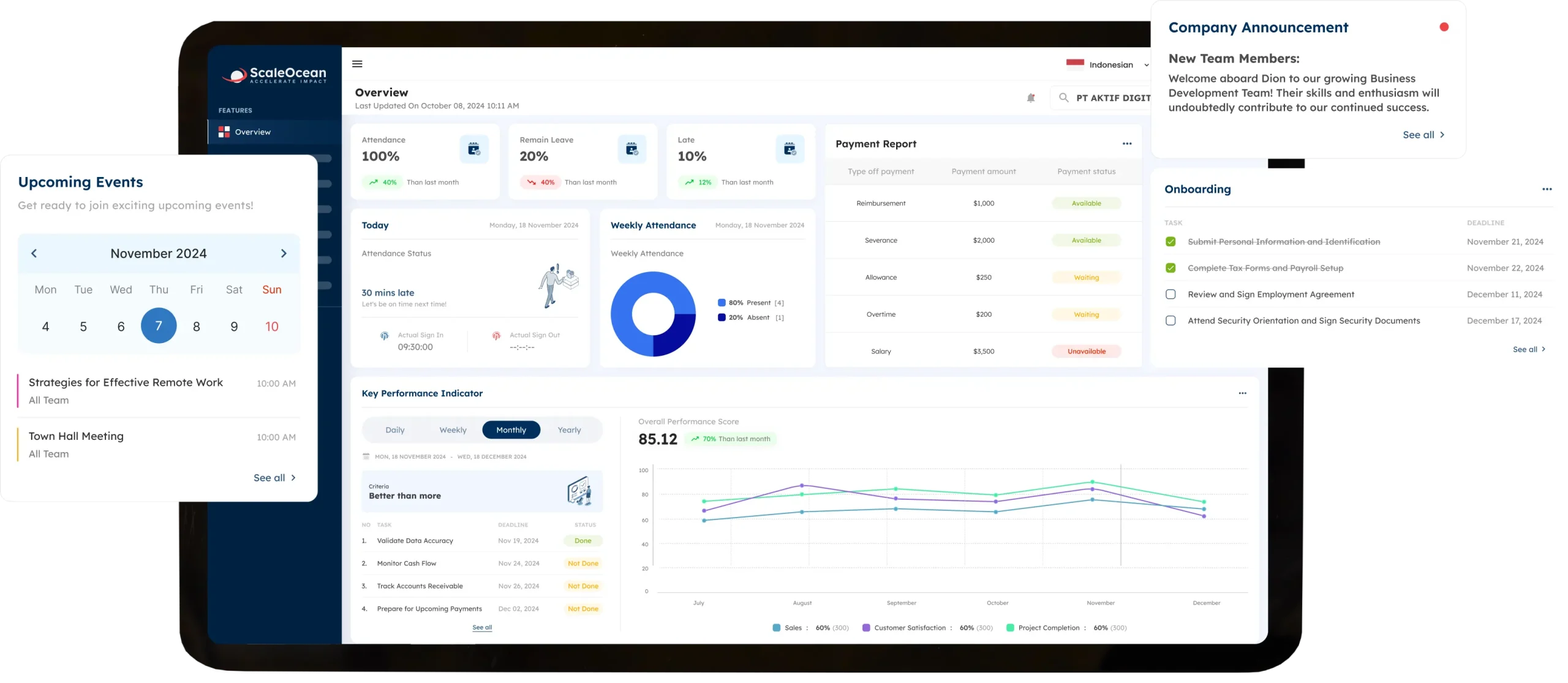
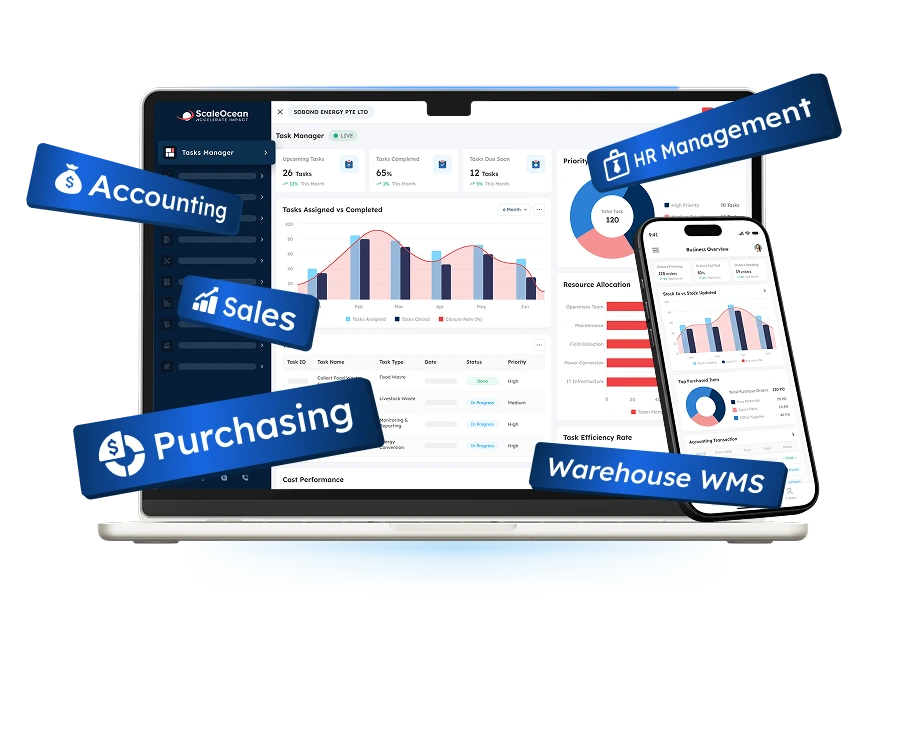
ScaleOcean HRIS Software helps Singapore enterprises manage multi-country payroll through one integrated platform, connecting payroll, HR, accounting, attendance, benefits, and employee data to reduce fragmentation and improve operational visibility.
With ScaleOcean Atlas’ configurable workflows and multi-entity capabilities, it supports businesses managing regional branches, while automated payroll calculations, compliance support, real-time reporting, and scalable infrastructure improve accuracy and workforce cost control. Additionally, ScaleMind AI Business Assistant provides intelligent support for payroll analysis and business decision-making.
ScaleOcean is optimized for Singapore’s PDPA requirements and local financial reporting standards, including relevant IRAS and GST considerations. To explore how integrated payroll can support your regional operations, schedule a consultation with our experts and discover a scalable workforce management solution.
Key Features of ScaleOcean HRIS:
- Unlimited Users: for HR, finance, management, and other stakeholders
- Scalable Infrastructure: that supports business growth and increasing employee numbers
- Employee Portal: for payslips, personal information, leave, and payroll-related requests
- Integration Capabilities: with other business systems and operational modules
- Flexible Configuration: to accommodate different payroll policies and business processes
| Pros | Cons |
|---|---|
|
|
Best For: ScaleOcean is best for Singapore-based companies and enterprises managing multiple entities globally, growing regional operations, or complex payroll workflows. It suits businesses seeking integrated HR, payroll, accounting, compliance support, and real-time workforce insights within one scalable ERP platform.
ℹ️ Why Choose ScaleOcean
ScaleOcean integrates payroll, HR, accounting, attendance, and workforce management into a configurable ERP platform, reducing data fragmentation and streamlining multi-entity operations for Singapore enterprises. Its automation, real-time reporting, scalable infrastructure, and ScaleMind AI improve payroll accuracy, efficiency, and workforce cost visibility, supporting regional business growth.
2. Remote
Remote multi-country payroll software helps businesses manage international employee payroll, payments, compliance, and related workforce processes. It is designed for companies that employ workers across different countries and need centralized payroll administration.
The platform supports global payroll, EOR, and contractor services, allowing businesses to manage different employment arrangements. Its payroll capabilities cover local calculations, compliance requirements, payments, and workforce information across supported markets.
Key Features of Remote:
- Global payroll processing
- EOR and contractor management
- Local compliance support
- International payments
| Pros | Cons |
|---|---|
|
|
Best For: Remote is best for small to mid-sized companies with distributed teams that need payroll alongside international hiring or EOR services. It can also suit growing businesses entering multiple markets without building extensive local payroll capabilities.
ℹ️ Why Choose Remote for Multi-Country Payroll Software
Remote provides payroll together with international employment services, making it suitable for businesses that want to manage payroll and cross-border workforce administration through a single provider.
3. Deel
Deel multi-country payroll software provides payroll management for employees and contractors across international markets. It combines payroll processing, compliance, payments, and workforce information within a centralized platform.
The platform supports both self-managed and managed payroll models, depending on the country and business requirements. It also provides country-specific calculations, compliance updates, reporting, and international payments through the same environment.
Key Features of Deel:
- Global payroll processing
- Automated compliance
- Multi-currency payments
- Payroll reporting
| Pros | Cons |
|---|---|
|
|
Best For: Deel is best for small, mid-sized, and large businesses managing international employees, contractors, or EOR workers. It is particularly suitable for companies that expect their workforce to expand across multiple countries.
ℹ️ Why Choose Deel for Multi-Country Payroll Software
Deel combines payroll, compliance, payments, and different employment models, giving international businesses a single platform for managing diverse global workforce requirements.
4. Rippling
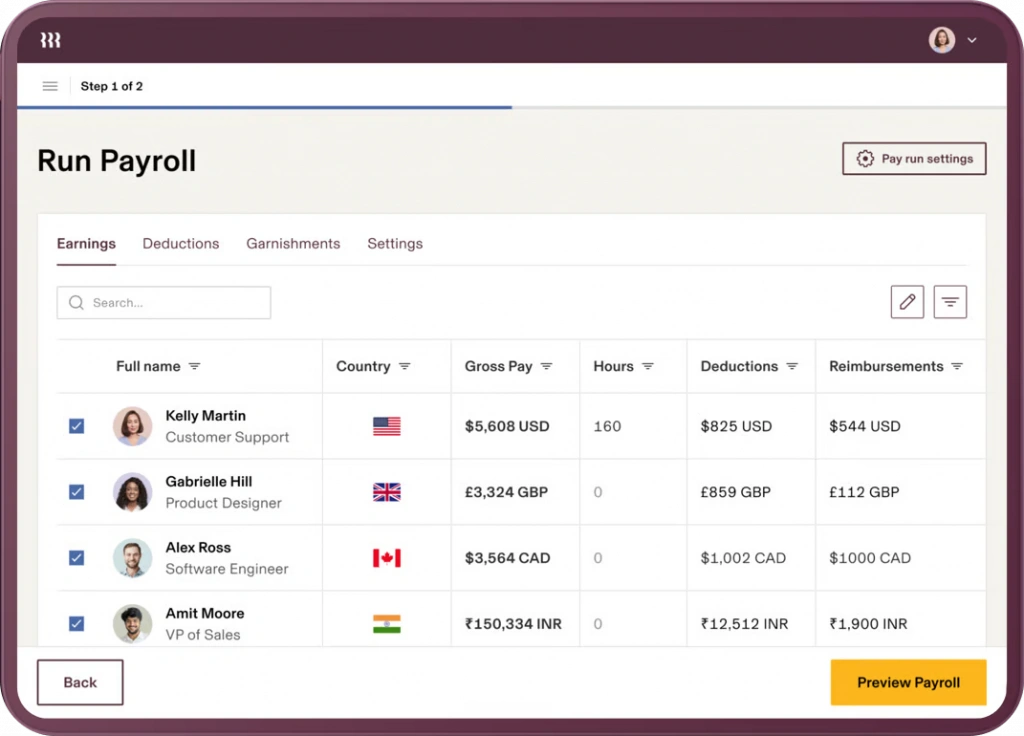
Rippling multi-country payroll software combines international payroll with HR and workforce management. It lets businesses manage employees across countries while connecting payroll with broader HR information and business processes.
Its global payroll capabilities include local-currency payments, tax calculations, payroll integrations, and compliance support. The platform also connects payroll with employee data, benefits, time off, and accounting workflows.
Key Features of Rippling:
- Global payroll processing
- HRIS integration
- Local-currency payments
- Tax and compliance automation
| Pros | Cons |
|---|---|
|
|
Best For: Rippling is best for mid-sized and large businesses that want payroll closely connected with HR and workforce management. It can also suit growing companies that want to consolidate several employee-related systems.
ℹ️ Why Choose Rippling for Multi-Country Payroll Software
Rippling connects global payroll with HR, benefits, employee data, and accounting, making it useful for businesses seeking a broader workforce management environment.
5. Papaya Global
Papaya Global multi-country payroll software helps businesses manage international payroll, payments, workforce data, and compliance through one platform. It supports different worker types and provides services across more than 160 countries.
Its platform focuses on payroll automation, centralized workforce information, global payments, and reporting. Businesses can also consolidate payroll data from different countries while maintaining visibility over international workforce costs.
Key Features of Papaya Global:
- Global payroll processing
- Payroll payments
- Workforce data management
- Payroll analytics
| Pros | Cons |
|---|---|
|
|
Best For: Papaya Global is best for mid-sized and large businesses managing employees and contractors across many countries. It is particularly suitable for organizations that need centralized payroll data and international payment capabilities.
ℹ️ Why Choose Papaya Global for Multi-Country Payroll Software
Papaya Global combines payroll, workforce data, payments, and reporting across international markets, helping businesses reduce fragmentation between country-level payroll operations.
6. ADP GlobalView
ADP GlobalView multi-country payroll software is designed for large multinational organizations managing payroll across multiple countries. It provides centralized payroll administration, reporting, employee access, and HR-related capabilities through a global payroll environment.
GlobalView Payroll supports payroll across 42 countries, while ADP can extend broader coverage through its Celergo solution to more than 140 countries. This structure makes it suitable for organizations with complex multinational payroll requirements.
Key Features of ADP GlobalView:
- Multi-country payroll
- Payroll reporting
- Employee self-service
- HR administration
| Pros | Cons |
|---|---|
|
|
Best For: ADP GlobalView is best for large enterprises and multinational companies with substantial international employee populations. It suits organizations that require structured payroll administration, reporting, and established enterprise HR capabilities.
ℹ️ Why Choose ADP GlobalView for Multi-Country Payroll Software
ADP GlobalView provides centralized payroll management for large multinational organizations, with additional ADP solutions available when businesses require wider country coverage.
7. Oyster HR
Oyster HR multi-country payroll software supports international employee payments, payroll, benefits, and employment administration. Its platform focuses strongly on distributed teams and international hiring across more than 180 countries.
The platform combines payroll-related services with EOR capabilities, allowing businesses to employ workers internationally without establishing local offices in supported markets. It also connects with HRIS, accounting, and other workforce systems.
Key Features of Oyster HR:
- Global payroll support
- EOR services
- International benefits
- HR system integrations
| Pros | Cons |
|---|---|
|
|
Best For: Oyster HR is best for small and mid-sized companies building distributed international teams. It can also suit larger organizations that need EOR support when entering countries without established local entities.
ℹ️ Why Choose Oyster HR for Multi-Country Payroll Software
Oyster combines international employment, payroll, benefits, and HR support, making it suitable for companies that prioritize global hiring alongside workforce administration.
8. Lano
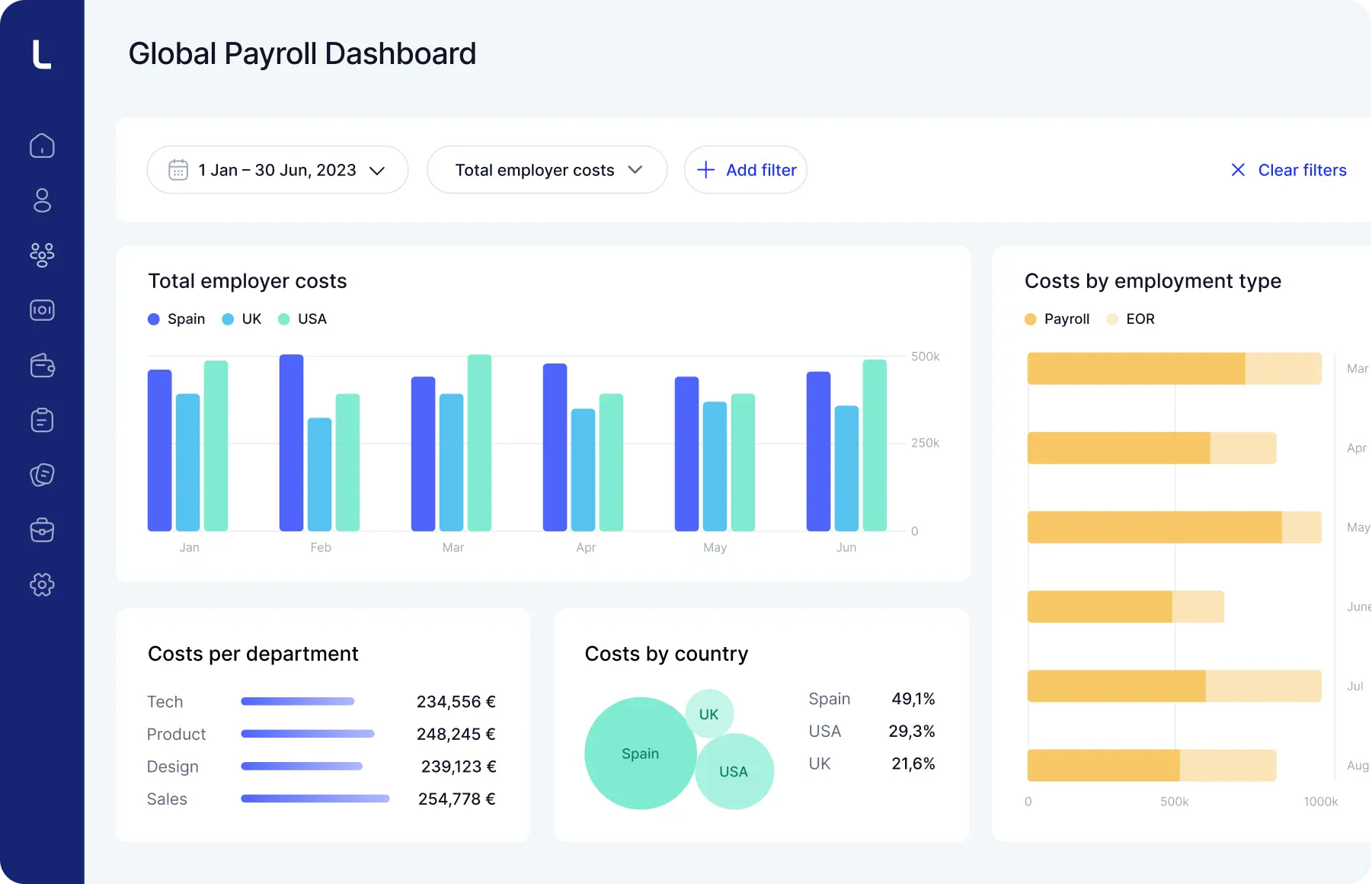
Lano multi-country payroll software helps businesses manage payroll data, international payments, and workforce administration across more than 170 countries. It uses a network of local payroll partners while providing a centralized platform for payroll operations.
Its payroll consolidation capabilities allow companies to connect existing payroll providers and standardize information across countries. Lano also supports international salary payments in 28 currencies and provides reporting and integration options.
Key Features of Lano:
- Payroll consolidation
- Global payroll services
- Multi-currency payments
- Payroll integrations
| Pros | Cons |
|---|---|
|
|
Best For: Lano is best for mid-sized and large companies managing payroll through multiple local providers. It is also suitable for businesses that want centralized payroll data without completely replacing existing country-level payroll arrangements.
ℹ️ Why Choose Lano for Multi-Country Payroll Software
Lano consolidates global payroll information and connects local providers through one platform, helping businesses manage fragmented international payroll operations.
9. BIPO Service
BIPO Service multi-country payroll software supports payroll administration across international markets through technology and local payroll expertise. Its multi-country payroll services cover more than 160 markets and address different local regulatory requirements.
The platform and service model can support payroll outsourcing, compliance management, and international workforce administration. This approach allows businesses to coordinate payroll across countries while using local expertise for jurisdiction-specific requirements.
Key Features of BIPO Service:
- Multi-country payroll
- Payroll outsourcing
- Local compliance support
- HR management
| Pros | Cons |
|---|---|
|
|
Best For: BIPO Service is best for mid-sized and large businesses operating across Asia-Pacific and other international markets. It suits organizations that prefer combining payroll technology with local payroll expertise and managed services.
ℹ️ Why Choose BIPO Service for Multi-Country Payroll Software
BIPO combines payroll technology with local expertise and outsourcing services, providing an option for businesses that want support with international payroll administration and compliance.
10. Talenox
Talenox multi-country payroll software combines payroll and HR management for businesses operating primarily across Singapore, Malaysia, and Hong Kong. Its platform focuses on localized payroll processes and employee administration for regional businesses.
For Singapore users, Talenox supports payroll-related processes, including IR8A and Appendix 8A and 8B generation. It also provides HR functions that help businesses manage employee information alongside payroll activities.
Key Features of Talenox:
- Localized payroll
- Employee management
- Leave management
- IR8A processing
| Pros | Cons |
|---|---|
|
|
Best For: Talenox is best for small and mid-sized businesses operating mainly in Singapore, Malaysia, and Hong Kong. It is particularly suitable for companies that prioritize localized regional payroll rather than extensive worldwide payroll management.
ℹ️ Why Choose Talenox for Multi-Country Payroll Software
Talenox provides payroll and HR functions with a strong Southeast Asian focus, making it a practical option for businesses whose international operations remain concentrated within the region.
What Does Multi-Country Payroll Software Do?
Multi-country payroll software centralizes payroll information and automates processes across multiple jurisdictions while supporting local tax, statutory, currency, and reporting requirements. As a result, enterprises can manage international payroll through standardized workflows without eliminating country-specific configurations.
Additionally, the software can connect employee information with HR, accounting, attendance, benefits, banking, and financial systems. This integration reduces duplicate data entry and creates more consistent information across payroll and finance operations.
A multi-country payroll system can also automate prorated salary calculations, deductions, approvals, payment preparation, and reporting across different countries. Payroll teams can reduce repetitive administration while improving accuracy and processing consistency.
Centralized dashboards also give finance and HR leaders clearer visibility into global payroll costs, employee populations, payment statuses, and payroll performance. This enables management to identify discrepancies and make better-informed workforce decisions.
Finally, advanced platforms can support governance through controlled access, audit trails, standardized workflows, and consolidated reporting. For enterprises operating across borders, these capabilities create a more scalable payroll environment while strengthening operational control.
How to Choose the Right Multi-Country Payroll for Businesses in Singapore
Businesses in Singapore should evaluate multi-country payroll based on their employment structure, compliance responsibilities, geographic coverage, integration requirements, and financial processes. A structured evaluation helps enterprises avoid selecting systems that cannot support future expansion.
1. Choose Your Employment Model First
Companies should first determine whether they employ workers through Singapore entities, overseas subsidiaries, contractors, or an Employer of Record arrangement. This decision establishes the payroll responsibilities, compliance requirements, and technology capabilities they need.
Enterprises should also assess whether their employment model may change as international operations expand. Choosing technology that supports employees and contractors can provide greater flexibility while reducing future payroll system changes.
2. Core Compliance Requirements for Singapore Hubs
Singapore-based regional headquarters should prioritize payroll systems that support local tax, statutory contributions, reporting requirements, and employment obligations. This foundation helps organizations maintain accurate payroll operations while coordinating requirements across their regional workforce.
Additionally, enterprises should verify whether the system can accommodate Singapore-specific requirements alongside foreign worker levy jurisdictions. A suitable platform should therefore combine localized compliance capabilities with centralized controls for regional payroll administration.
3. Evaluate Regional vs. Global Footprint
Businesses should assess whether their workforce operates primarily across Asia-Pacific or spans multiple continents before selecting a payroll solution. Regional systems may satisfy focused requirements, while global platforms can support broader geographic expansion.
Moreover, companies should examine supported countries, local compliance coverage, payroll currencies, and available integrations. Evaluating the expected geographic footprint helps enterprises choose technology that remains suitable as international operations develop.
4. Technical Integration & Currency Management
Singapore enterprises should evaluate how payroll technology integrates with HRIS, accounting, attendance, banking, benefits, and other business systems. Strong integration reduces duplicate data entry while improving consistency between workforce and financial information.
Companies should also assess multi-currency calculations, exchange-rate management, payment workflows, and consolidated reporting capabilities. These functions help finance teams manage international payroll costs while maintaining clearer visibility across different currencies and jurisdictions.
Conclusion
Multi-country payroll helps Singapore enterprises centralize international payroll, automate compliance, manage currencies, and improve workforce visibility. Therefore, choosing scalable technology becomes essential for efficient cross-border payroll operations.
ScaleOcean HRIS Software supports this need through integrated payroll, HR, accounting, configurable workflows, real-time reporting, and scalable infrastructure. Its platform also supports Singapore’s PDPA requirements, along with relevant IRAS and GST reporting considerations.
For enterprises seeking greater payroll accuracy and operational control, ScaleOcean provides a connected foundation for regional workforce management. Schedule a consultation with our experts to explore how the platform can support your multi-country payroll requirements.
FAQ Multi-Country Payroll Software:
1. What countries can be managed with a multi-country payroll system?
Multi-country payroll systems can manage employees across many countries, depending on the provider’s coverage. Leading platforms support payroll across dozens of countries, with localized tax, currency, and compliance capabilities.
2. Do I need a legal entity in every country to use multi-country payroll?
Not always. Companies can use an Employer of Record (EOR) when they lack a local entity, allowing a third party to legally employ workers and manage payroll, taxes, and compliance.
3. How many employees can be managed through a multi-country payroll platform?
The capacity depends on the platform and plan. Modern multi-country payroll systems can support small teams and enterprises managing thousands of employees across multiple countries and entities.
4. How does multi-country payroll support companies expanding internationally?
It centralizes payroll, employee data, compliance, payments, and reporting across countries. As a result, companies can enter new markets more efficiently, reduce administrative complexity, and improve control over international workforce operations.





















.png)