


E-invoicing is the electronic sharing of structured invoice information between businesses, allowing financial systems to send or receive invoices electronically without manual input. In Singapore, InvoiceNow offers the national network.
Rather than emailing PDF invoices and having recipients re-key the details, companies can now send structured information from one finance system to another. This reduces admin costs and improves transparency and efficiency.
Meanwhile, businesses in Singapore are experiencing an clear shift in compliance, as IRAS encourages the use of InvoiceNow to transmit invoice data for GST-registered businesses. As a result, businesses should be aware of the requirements ahead of the deadlines.
For companies still processing invoices manually, the move can reveal process shortcomings, undocumented inconsistencies, and unnecessary hold-ups among finance staff. Starting early enables firms to streamline processes while ensuring compliance with Singapore GST rules.
 Key Takeaways
- E-Invoicing is Singapore’s national e-invoicing network, based on the Peppol standard for exchanging structured invoice data between finance systems
- Types of e-Invoicing Systems include portals, accounting software, ERP integrations, Peppol-ready solutions, and API-based systems for different business requirements.
- Key benefits of e-Invoicing include faster payments, fewer errors, seamless tax reporting, improved efficiency, and stronger connectivity with business partners.
- Requirements for e-Invoicing in Singapore cover business identification, Peppol registration, compliant software, feature activation, verification, and proper authorization.
- ScaleOcean Accounting Software streamlines invoicing, accounting, and GST workflows, helping Singapore businesses prepare for InvoiceNow compliance through integrated financial management.
What is e-Invoicing (InvoiceNow) in Singapore?
InvoiceNow is Singapore’s national e-invoicing network, based on the Peppol standard for exchanging structured invoice data between finance systems. It enables companies to send and receive invoice data electronically without manual input.
Unlike a proforma invoice, which generally provides estimated costs and terms before a transaction is completed, an e-invoice communicates structured transaction data electronically between connected business systems.
Unique to InvoiceNow, instead of sending a PDF invoice via email, the data is transferred from system to system in structured form via an Approved Provider. This enables finance teams to automate, reduce paperwork, and increase visibility.
Singapore links the InvoiceNow platform with the GST administration via the IRAS. GST-registered companies need to send invoice data using InvoiceNow-ready solutions. This improves tax compliance and supports cost-effective, efficient processes.
 Also Read: Top 15 Invoicing Software For Small Business in Singapore
Implementing the e-Invoicing Timeline in Singapore for Businesses
Singapore is phasing in the GST InvoiceNow Requirement, giving businesses more time to set up systems, processes, and controls before the scheduled implementation date. The most recent IRAS schedule has set the mandatory requirement for April 2031.
For companies, apply the right phase based on whether you are registered for GST, when you were incorporated, or your annual supplies, where necessary. This schedule reflects the latest requirements from IRAS, including Phase 2029 and 2030.
We therefore encourage businesses to review their GST position, annual supplies, and existing invoicing systems well ahead of their due date. This will enable them to plan the steps their finance teams need to take to change workflows and data requirements gradually.
Types of e-Invoicing Systems
Businesses in Singapore can choose different e-invoicing systems depending on their transaction volume, existing software, and automation requirements. The main options generally include web portals, accounting software integrations, ERP systems, and Peppol-ready solutions.
- Web-Based e-Invoicing Portals: Suitable for small businesses needing basic invoice creation, sending, and receiving without complex system integration.
- Accounting Software Integration: Connects e-invoicing capabilities with accounting platforms, reducing manual data entry and improving transaction record accuracy.
- ERP-Integrated e-Invoicing: Embeds invoicing within broader ERP workflows, connecting sales, purchasing, inventory, finance, and tax processes.
- Peppol-Ready Solutions: Enables businesses to exchange structured invoices through Singapore’s InvoiceNow network using the Peppol interoperability framework.
- API-Based e-Invoicing: Connects existing business applications directly with e-invoicing networks, supporting automated invoice transmission and higher transaction volumes.
Choosing the right system requires businesses to consider integration capabilities, transaction volume, scalability, and compliance requirements. Additionally, companies should verify that their chosen solution supports InvoiceNow requirements and can transmit relevant GST invoice data to IRAS.
Key Benefits of e-Invoicing

e-Invoicing offers more than digital invoice delivery because it connects invoicing with broader financial and compliance workflows. As a result, companies can reduce repetitive administration while improving transaction visibility.
Furthermore, structured invoice data allows businesses to automate processes that traditionally depend on manual document handling and data entry. This creates more consistent financial records while helping finance teams respond faster to transactions and exceptions.
Understanding invoice vs receipt also helps businesses maintain accurate transaction records, because invoices request or document payment obligations while receipts generally confirm that payment has been made.
1. Faster Payments
InvoiceNow enables customers to receive and process invoices faster and with less manual effort by electronically transferring formatted data to connected systems.
Faster processing enables finance teams to detect overdue invoices earlier and reduces follow-up emails chasing late payments. Companies can also integrate invoicing and payment processes, improving cash flow visibility in accounts receivable.
2. Reduced Errors
E-invoicing in a structured format reduces errors because information is sent system-to-system rather than copied manually from paper documents. It helps companies reduce errors related to incorrect figures, missing fields, and repetition.
Another key benefit of automation is that it eliminates labor-intensive data entry, as most Accounting and ERP systems can import data directly from invoices. Consequently, companies not only increase accuracy but also save time, allowing employees to focus on exceptions and high value-added finance tasks.
3. Seamless Tax Reporting
InvoiceNow enables efficient tax reporting by submitting invoice information to IRAS. InvoiceNow-Ready Solutions removes the hassle of manual data preparation, helping businesses maintain more consistent transaction records.
Because invoice data is transmitted electronically through a formal system, companies can improve GST compliance and make audit preparation easier. According to IRAS, electronic transmission of invoices can facilitate GST audits and refunds.
4. Global Connectivity
InvoiceNow applies the Peppol framework, a global framework designed to facilitate the seamless transmission of electronic business documents between connected networks. This enables Singapore businesses to conduct electronic business with partners whose systems are compatible with the Peppol framework.
This interoperability reduces reliance on exclusive invoice formats when enterprises collaborate across different financial systems or with foreign entities. As a result, enterprises can facilitate cross-border payments effectively and adopt uniform digital invoice procedures.
What are the Requirements for e-Invoicing in Singapore?
Before sending data to IRAS for InvoiceNow, companies looking to adopt the system must meet certain technical and registration requirements. These requirements enable companies to share structured invoices and meet the GST InvoiceNow requirements. Businesses should distinguish an InvoiceNow transaction from a tax invoice, which serves specific GST and tax reporting purposes.
1. Valid Corporate Identity
Companies need a valid UEN (Unique Entity Number) to provide when registering for InvoiceNow and when obtaining a Peppol ID. Submit the UEN when registering the company in the Singapore Peppol Directory with the solution provider/Access Point.
A valid corporate identity also ensures the invoice transaction is linked to the correct registered business entity. Therefore, business entities are advised to confirm their UEN and business details before starting the InvoiceNow onboarding process.
2. Peppol Network Registration
To use the InvoiceNow network and trade electronic invoices, companies need to register with the Singapore Peppol Directory. An accredited InvoiceNow-Ready Solution Provider or Access Point Provider can register the company with UEN.
Once registered, the company obtains a Peppol ID, which will be used to identify it in the network. As a result, customers and suppliers with compatible software can send and receive electronic invoices.
3. Peppol-Ready Software
Companies must have an InvoiceNow-Ready Solution to send invoice data over the InvoiceNow network to comply with current GST rules. Businesses can choose from approved accounting, financial, or ERP systems that already have InvoiceNow functionality built in.
An IMDA-accredited Access Point Provider, instead of an in-house enterprise systems, can help the company set up the required network connection. This also allows larger organizations to keep their current system and connect to InvoiceNow.
4. Verify Software Status
However, before implementation, check whether your accounting or finance software is listed on IMDA’s accredited InvoiceNow-Ready Solution Provider list. This check helps prevent selecting software that may not support the desired InvoiceNow connection.
Businesses may also want to confirm whether the solution supports GST InvoiceNow submission, not just electronic invoice submission. Doing a capability check up front helps avoid future configuration changes or system replacement during onboarding.
5. Activate the Features
Once an appropriate solution has been chosen, the business will need to enable the GST InvoiceNow submission function to send the invoice data directly to IRAS. The solution should also be tested to ensure invoice submission to IRAS is successful.
For in-house systems, companies should work with their Access Point Provider to set up the required connection and activate submission capability. This helps finance teams diagnose technical problems before deadlines.
6. Register Through Corppass
Corppass is used by businesses to access the e-Invoice Singapore government digital services and to manage authorized business transactions. During InvoiceNow onboarding, we register the business using its UEN through either its InvoiceNow-Ready Solution Provider or its Access Point.
Hence, companies need to ensure their authorized representatives can access relevant government services via Corppass to complete the rest of the GST registration and compliance process more smoothly, aligning InvoiceNow administration with implementation.
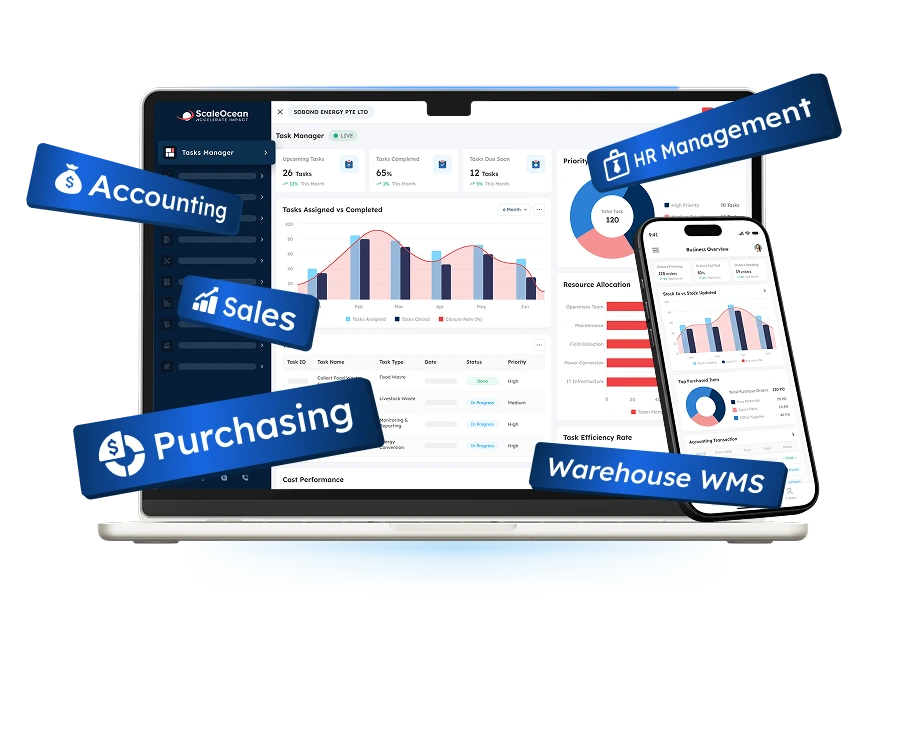
Managing requirements manually can cause unnecessary work in coordinating invoicing, accounting, tax records, and other financial processes. ScaleOcean Accounting Software connects these workflows within one centralized system, helping businesses manage financial data more efficiently while supporting Singapore’s GST requirements.
Its flagship platform, ScaleOcean Atlas, with configurable workflows and integrated financial management and ScaleMind AI insights, helps businesses reduce repetitive data entry and improve visibility across their operations. Schedule a consultation with our experts to discuss how ScaleOcean can support your InvoiceNow implementation and broader accounting requirements.
How Does InvoiceNow Work?

InvoiceNow links companies on Singapore’s regional e-invoicing network, utilizing the global Peppol standard to share structured invoice information. If both users are integrated, suppliers can push their invoices straight from their system to their customers’.
The process starts when a supplier enters the invoice on an InvoiceNow-Ready Solution and submits it to an authorized Access Point. The network will then forward the structured invoice to the recipient’s connected system.
For GST-registered businesses that have this requirement, InvoiceNow can also send a copy of the GST invoice data to IRAS. This is enabled when the GST InvoiceNow submission function is switched on.
However, businesses may still receive invoices from outside the Peppol network, whether PDF or paper invoices. These invoice transactions can be recorded in an InvoiceNow-ready solution and submitted to IRAS through a solution-extracted submission method, where appropriate.
As covered by GovInsider, Singapore has demonstrated InvoiceNow adoption through its “queen bees” approach, where IMDA worked with large enterprises to encourage their business partners to use the e-invoicing network. Participating organizations included Sheng Siong, Konica Minolta, and Singapore Institute of Technology.
The approach also extended to government procurement, with IMDA and the Accountant-General’s Department enabling vendors to send e-invoices to government agencies through InvoiceNow. This illustrates how interconnected systems can reduce manual data entry while encouraging wider e-invoicing adoption across business networks.
E-Invoicing Exemptions in Singapore
While Singapore is gradually imposing the GST InvoiceNow Requirement on all GST-registered businesses, some businesses do not fall within the scope of the requirement. IRAS has so far only applied the Overseas Business and GST Registration Liability solely due to Reverse Charge to the scope of the GST InvoiceNow Requirement.
Overseas Vendors registered under Singapore’s Overseas Vendor Registration regimes that do not have GST registration are also not subject to the GST InvoiceNow Requirement. Businesses should carefully evaluate their GST registration status to determine whether the InvoiceNow requirements apply.
However, exemption from the GST InvoiceNow Requirement does not mean that all other GST requirements are exempt. The business still has to keep proper records, file GST returns, and meet invoicing requirements in the relevant context.
Furthermore, certain types of transactions do not require submitting invoice data to IRAS even if the business is under the InvoiceNow Requirement. For example, Reverse-Charge transactions, exempt financial services, and import permits for imported goods.
How to Get Started with InvoiceNow
Getting started with InvoiceNow involves preparing business identification, registering within the Peppol network, and connecting a compliant accounting or finance system. IRAS recommends checking software readiness before registering and activating GST invoice-data submission.
To support this transition, the Singapore Government provides financial grants of up to S$1,000 for SMEs and up to S$5,000 for larger enterprises. Therefore, eligible businesses can offset part of their implementation costs while upgrading their invoicing processes.
Businesses can use an accredited InvoiceNow-Ready solution provider for standard accounting or finance software. Meanwhile, organizations using in-house enterprise solutions can engage an IMDA-accredited Access Point Provider for network connectivity and integration.
Choosing the right accounting or ERP system simplifies InvoiceNow implementation by centralizing invoicing, finance, and taxes. ScaleOcean Accounting Software provides configurable workflows and supports Singapore GST requirements, helping businesses prepare for evolving digital invoicing obligations.
Instead of managing compliance and financial processes across disconnected tools, ScaleOcean can streamline operations through one integrated platform. Schedule a consultation with our experts to explore how ScaleOcean can help your business implement e-Invoicing while improving overall financial management.
1. Unique Entity Number (UEN)
The UEN is used as the business identifier when registering the business in the Singapore Peppol Directory, so the business should ensure its UEN is correct before the solution provider or Access Point starts the registration.
After the UEN is issued, the InvoiceNow-Ready Solution Provider or Access Point can register the business in the SG Peppol Directory, which creates the business identity for InvoiceNow.
2. Peppol ID Registration
Once the business has a UEN, it can obtain a Peppol ID from the InvoiceNow-Ready Solution Provider or Access Point. The Peppol ID identifies the business in the invoiceNow network and routes the invoice.
The business shall ensure the Peppol ID is registered correctly before sending invoices through the network. This lets suppliers and customers route structured invoices to the right person without back-and-forth emails.
3. Compliant Accounting System
Businesses need an InvoiceNow-ready accounting, finance, or ERP solution that can handle the required invoice data transmission. Before implementing, companies should check that the solution is on IMDA’s accredited list.
Once the system is connected, companies should enable GST InvoiceNow submission and test it before going live. This ensures GST is submitted successfully and provides a chance to troubleshoot configuration problems beforehand.
Conclusion
e-Invoicing through InvoiceNow helps Singapore businesses exchange structured invoices, reduce errors, accelerate payments, simplify GST reporting, and prepare for progressively mandatory digital invoicing requirements across different business categories.
ScaleOcean Accounting ERP Software centralizes invoicing, accounting, and financial workflows while supporting Singapore GST requirements and configurable processes. Businesses can therefore improve operational visibility while preparing for InvoiceNow adoption more efficiently.
With integrated financial management, businesses can reduce manual administration and strengthen control over transaction data across departments. Schedule a consultation with our experts to discover how ScaleOcean can support your e-Invoicing implementation.
FAQ e-Invoice or InvoiceNow:
1. Is e-invoicing mandatory in Singapore?
Yes. Singapore is progressively making InvoiceNow mandatory for GST-registered businesses, with requirements phased from November 2025 through April 2031. Your specific deadline depends on your GST registration status and annual supplies.
2. Does my business need to be GST-registered to use e-invoicing in Singapore?
No. Businesses do not need to be GST-registered to use InvoiceNow voluntarily. However, the mandatory GST InvoiceNow Requirement applies progressively to GST-registered businesses based on IRAS’s implementation timeline.
3. How do I know my e-invoicing compliance deadline in Singapore?
Check your GST registration date, incorporation status, and annual supplies against IRAS’s InvoiceNow timeline. New GST registrants and existing GST-registered businesses have different implementation dates through April 2031.
4. What accounting software supports e-invoicing in Singapore?
InvoiceNow supports accounting and ERP solutions accredited as InvoiceNow-Ready Solution Providers. Software such as ScaleOcean can help businesses centralize accounting and invoicing workflows while preparing for Singapore’s digital invoicing requirements.



















.png)