

AI agent is an intelligent software agent that independently plans, reasons, and acts using artificial intelligence. Yet many Singapore companies still face repetitive operations, delayed decisions, and siloed workflows.
In contrast to traditional automation, AI agents constantly process data, adapt to dynamic environments, and perform tasks with minimal human input. Consequently, businesses benefit from increased efficiency with fewer hard labor requirements in a variety of areas.
Furthermore, AI agents used by employees can manage routine tasks, offer additional data, and synchronize activities across multiple systems. Consequently, the company can anticipate faster response times, more consistent service and product delivery, and better resource utilization.
The adoption of AI agents continues accelerating across Singapore as organizations prioritize productivity, automation, and digital transformation initiatives. Furthermore, Smart Nation Singapore‘s national AI strategy continues encouraging enterprise AI adoption through governance frameworks and industry support.
For this reason, understanding AI agents allows companies to explore the business benefits before deploying intelligent automation projects. This article will describe what an AI agent is, how it operates, and its business value.
 Key Takeaways
- AI agents are autonomous systems that reason, learn, and execute business tasks, improving productivity through intelligent decision-making and automation.
- Core components enable AI agents to analyze information, plan actions, and continuously improve operational performance across workflows.
- Businesses use various AI agent types and industry applications to automate operations, enhance customer experiences, and optimize organizational efficiency.
- Following best AI practices strengthens AI security, transparency, monitoring, and performance while maximizing long-term business value from intelligent automation initiatives.
- ScaleOcean streamlines enterprise AI adoption through ScaleOcean Atlas with embedded ScaleMind, automating workflows while maintaining security, governance, and compliance.
What are AI Agents?
AI agents are independent computer systems that receive data, process it, and act towards fulfilling specific goals. They are not automatic systems that follow a specific procedure, but each agent learns and improves its behavior.
Furthermore, these AI agents integrate AI, reasoning, records, external methods, and large language models to achieve more sophisticated business functions. For this reason, companies employ them to automate customer service, record management, analytics, sourcing, and operational decisions with more freedom.
Core Components of AI Agents
An AI agent depends on many related parts that allow logical reasoning, autonomous actions, and adaptive decision-making. These components help agents solve problems, often through automation and other simple means.
1. The Brain (LLM)
The large language model acts as a deliberative reasoning module that decodes instructions, comprehends context, and produces valid outputs. As such, this allows AI agents to assess the situation and decide on the next course of action or recommendation.
Additionally, LLMs allow the processing of structured and unstructured data concurrently by understanding links between different business situations. As a result, businesses have more natural interactions, reasoning in context, and better decision accuracy over complex workflows.
2. Tools
Tools broaden what an AI agent can do by interfacing to outside applications, databases, APIs, and enterprise software systems, enabling agents to access and update data, create reports, and interact with various systems automatically.
Additionally, tool integration helps AI agents engage with conventional enterprise systems, further minimizing their autonomous nature. As a result, organizations can use their existing technology infrastructure while designing automated, unified processes across divisions.
3. Memory
Memory enables AI agents to remember relevant information from past conversations, completed tasks, or histories of their actions. As a result, agents can provide more personalized responses and sustain consistency during business processes.
Moreover, memory allows artificial agents to recall repeated patterns, user preferences, and previous consequences for taking similar future actions. Consequently, the organization saves time and costs by not having to issue the same instructions again and again, along with the specific context.
4. The Autonomous Loop
The autonomous loop allows AI agents to keep iterating, reassessing, rewriting, and composing-working towards reaching the goal without a fixed endpoint. This means agents don’t have to be constantly overseen and can deliver multi-step business processes on their own.
Additionally, this iterative cycle reinforces planning, execution, assessment, and modification in ever-changing operational scenarios. Hence, AI agents adapt to unforeseen conditions or novel facts encountered during task completion.
How Do AI Agents Work?

AI agents operate through a systematic process, converting goals into final actions using ongoing reasoning and adjustment. Each phase ensures precise decision-making with minimal human interaction.
1. Goal Initialization and Planning
AI agents analyze user commands and goals, determine the best way to reach them, and then brainstorm how to implement the plan. They then break large goals into small, attainable tasks to optimize the implementation process.
In addition, good planning enables agents to identify activities based on resources, dependencies, and constraints. As a result, organizations can be successful in complex multi-step processes across multiple functions.
2. Reasoning with Available Tools
The AI agents then identify the available tools to integrate for the task at hand, meaning the resources they can call upon. They then decide on one of those applications rather than internal knowledge during execution.
Furthermore, AI agents assess existing outputs to determine the most logical next step in the process. By combining this capability with AI chatbots, companies can generate more accurate responses using live enterprise data and connected systems.
3. Learning and Reflection
AI agents learn from observing actions taken by other agents to discover lessons learned and optimize future navigation. As they learn, AI agents tend to normalize their decision-making performance and effectively eliminate recurring errors in similar situations.
Furthermore, reflection allows AI agents to tailor recommendations based on performance feedback and the state of the business. Consequently, organizations need not continually optimize each automated procedure to operate more efficiently.
4. Acquire Information
AI agents collect pertinent information from internal sources, enterprise applications, documents, websites, and interconnected digital services before taking action. After that, they synthesize the information into contextually significant data for rational thinking and directed actions.
In addition, collecting and obtaining information enables agents to act appropriately whenever new business information is available, supporting smooth operations. So, managers can make well-informed decisions based on recent information rather than historical data.
5. Implement Tasks
Lastly, the AI agents carry out the supervised actions by informing systems, individuals, or system operators, or enhancing operational workflows and producing auto-generated content. Thus, instead of mulling over office tasks, workers have more opportunities to allocate their time to strategic obligations.
Next, execution results are monitored for success, as AI agents check whether the desired achievements have been met after each task is carried out. Thus, companies can run more effectively while achieving better precision, accuracy, uniformity, and efficiency.
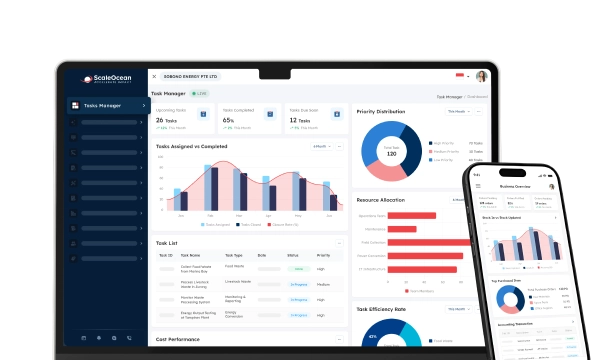
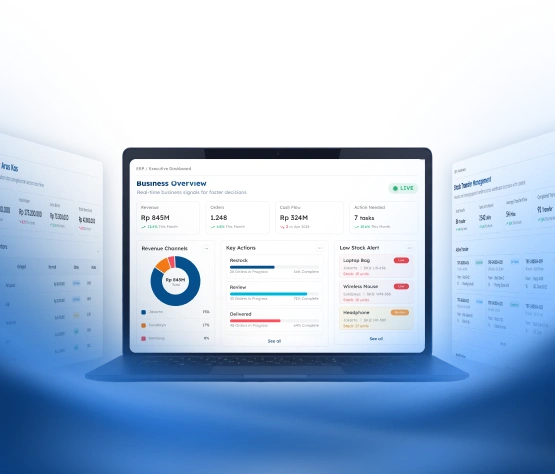
Understanding AI agent workflows becomes more valuable when connected directly to enterprise operations instead of isolated demonstrations. ScaleOcean Atlas embeds ScaleMind into its AI-powered ERP, allowing users to retrieve operational insights, analyze cross-functional data, and initiate business workflows from natural language prompts.
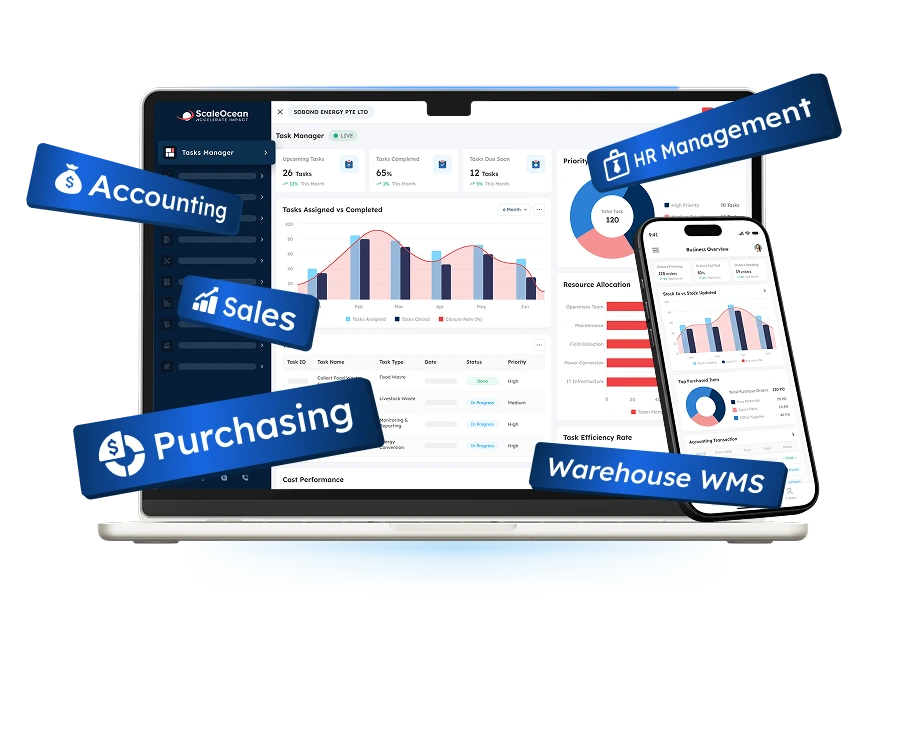
Unlike standalone AI assistants, ScaleMind connects finance, sales, procurement, inventory, CRM, HR, and operational modules within one system. Consequently, it delivers contextual answers, drafts transactions, assigns follow-up tasks, and supports approvals while remaining aligned with company workflows and user permissions.
What is the Difference Between AI Agents, AI Assistants, and AI Copilots?
Although these technologies all use artificial intelligence, they serve different purposes within business operations. Therefore, understanding their differences helps organizations choose solutions that match operational requirements and automation goals.
Generally, AI assistants respond to user requests, AI copilots collaborate during work, and AI agents independently execute complete workflows. Consequently, businesses should evaluate autonomy, decision-making, and execution capabilities before selecting an AI-powered solution.
| Feature | AI Agents | AI Assistants | AI Copilots |
|---|---|---|---|
| Primary Role | Autonomously complete tasks and workflows | Respond to user queries and requests | Collaborate with users while completing tasks |
| Autonomy | High | Low | Medium |
| Human Supervision | Minimal | Continuous | Frequent |
| Decision Making | Independent and goal-driven | User-directed | Recommendation-based |
| Workflow Execution | Multi-step and end-to-end | Limited to requested actions | Assists within existing workflows |
| Learning Capability | Continuously improves through memory and feedback | Limited contextual memory | Learns user preferences and work patterns |
| Common Examples | Supply chain automation, procurement agents, IT operations | Chatbots, virtual assistants | Coding assistants, writing assistants, productivity assistants |
| Best For | Business process automation | Information retrieval and customer interaction | Employee productivity and collaboration |
AI Agent Reasoning Paradigm
The need for intelligent agents to perform autonomous actions before implementation prompted search-based methods as a systematic approach to decide their activities. As a result, various perspectives on reasoning behave differently in business applications.
1. ReAct (Reasoning and Action)
ReAct integrates reasoning with actuation for AI agents to contemplate before execution. As a result, agents cross-check subresults and tailor their decisions upon new information throughout execution.
Moreover, the incremental nature of these logics tends to minimize mistakes since they reset with new observations each time they generate an action. As a result, ReAct applies to customer service, troubleshooting, and enterprise workflow automation that demands flexible actions.
2. ReWOO (Reasoning without Observation)
ReWOO decouples planning and execution by doing reasoning first before interacting with external systems or tools. Thus, AI agents observe less without losing execution efficiency in mundane business workflows.
Furthermore, we observed that offline reasoning can reduce repetitive computational costs across complex workflows with predictable goals, resulting in faster execution when tasks are time-consuming but the environment does not change.
What are the Types of AI Agents?
Various AI agents address different problems in processing based on their autonomy, reasoning ability, and environmental complexity. Hence, before deploying intelligent automation across business functions, a company must be familiar with each of these AI agent examples.
1. Simple Reflex Agents
Simple reflex agents act on pre-established conditions based on fixed rules. They do not take into account any previous knowledge but immediately take action, like Generative AI. Consequently, they automate easily repetitive tasks requiring repetitive actions at fixed inputs and well-defined results.
Moreover, these agents are fast as they take into account only the current state while behaving. But they find it difficult to work in the environment when one has to work in a non-deterministic way or within a context.
2. Model-Based Reflex Agents
Model-based reflex agents use an internal model of the world to make decisions. They can use past information to help inform their decision-making process.
These agents also perform better in partially observable environments than simple reflex agents. Hence, businesses prefer to use these agents where conditions change frequently during execution.
3. Goal-Based Agents
Goal-based agents consider various alternatives and then select the best actions to reach specified goals. Hence, these agents show more flexibility than rule-based automation since, during complex processes, they can take various decisions.
Furthermore, these agents persistently evaluate achievement of goal states and modify execution procedures to optimize performance when conditions change. Consequently, organizations enhance task performance in ever-changing business settings.
4. Utility-Based Agents
A utility-based agent evaluates several outcomes and picks the actions that lead to the greatest overall utility. A utility-based agent chooses the actions that maximize decision efficiency, minimize cost or risk, or maximize customer satisfaction.
Similarly, utility assessment can direct such agents to make trade-offs among various conflicting objectives, rather than focusing only on single pre-specified objectives. As a result, enterprises can attain a more optimal operation in a dynamic environment.
5. Learning Agents
Learning agents improve their performance through experience, evaluation, and historical implementation results. That’s why they’re increasingly precise and don’t need to be programmed.
Additionally, ongoing learning enables them to adjust to a changing business environment and changing organizational needs. Thus, these agents are known to be adaptable over time even as the complexity of operation increases.
6. Single Agent
This refers to a KBS formed of a sole autonomous AI. Systems take charge of executing specified goals solely in given environments. This explains why they are easier to implement and control.
Furthermore, single agents work well in tasks where there are few dependencies within the flow, and decisions are made centrally. This is why most companies start implementing AI in this architecture before moving on to the others.
7. Multi-Agent System (MAS)
An MAS is an architecture involving multiple AI agents working together to address complex organizational issues at the same time. Then, each agent has a particular function or task but works together toward common organizational goals.
Additionally, collaborative execution enhances scalability, resilience, and efficiency for distributed, integrated business processes. As such, MAS facilitates enterprise-wide automation across dozens of operational areas.
How is the Market and Implementation of AI Agents in Business in Singapore?
AI agents are gaining ground in Singapore as more organizations seek to boost productivity and automate processes as part of investing in digital transformation initiatives. Moreover, government-backed AI schemes are enabling businesses to embed high-end AI capabilities into standard application workflows.
- Growing Enterprise Adoption: Companies increasingly deploy AI agents across finance, manufacturing, logistics, healthcare, and retail to automate repetitive tasks, improve customer experiences, and accelerate operational decision-making.
- Government AI Initiatives: Singapore’s National AI Strategy supports enterprise AI adoption through innovation programs, industry collaboration, and practical implementation frameworks that strengthen long-term business competitiveness.
- Productivity and Workforce Support: AI agents complement employees by handling repetitive administrative responsibilities, allowing professionals to focus on strategic analysis, innovation, and customer relationship management instead.
- Integration with Enterprise Systems: Organizations increasingly connect AI agents with ERP, CRM, HR, and supply chain platforms, enabling intelligent automation across interconnected business processes and operational workflows.
Recently, HSBC announced it will establish a dedicated AI centre in Singapore while hiring more than 100 AI specialists to expand AI-driven wealth management, digital payments, and treasury solutions. This reflects how businesses increasingly view AI agents as strategic enterprise capabilities rather than experimental technologies.
Use Cases of AI Agents
AI agents are playing a vital role in facilitating a wide range of business processes and activities by making automated decisions, optimizing workflows, and enhancing operational efficiencies. Hence, companies are further broadening the use of AI.
1. Customer Support
AI agents handle customer inquiries and request processing by autonomously delivering personalized responses across multiple customer communication channels. This results in faster resolution times, improved contact center efficiency, and lower costs.
While many businesses previously relied on AI chatbots for answering customer inquiries, AI agents extend these capabilities by reasoning, accessing enterprise systems, and completing multi-step tasks autonomously.
2. Employee Support
AI agents are helping employees by providing answers to internal questions, finding documents, scheduling meetings, and automating administrative tasks. This results in employees having more time for strategic and high-value tasks.
Furthermore, AI agents improve information sharing by offering quick retrieval of data within the organization and company policies, enhancing office productivity by eliminating repetitive manual requests.
3. Creative Support
AI agents and researchers produce content ideas, prepare marketing material, synthesize research, and help create media efficiently. Consequently, creatives can deliver projects faster and sustain coherent communication.
Additionally, smart recommendations provide employees with a way to enhance current content rather than eliminate human ingenuity. As a result, employers can increase creative outputs without compromising uniqueness.
4. Data Support
AI agents automatically gather, systematize, analyze, and summarize business data retrieved from multiple enterprise systems. This means that decision-makers get business intelligence more rapidly without manually processing the enormous arrays of operational data.
Furthermore, automated analysis can reveal potential trends, abnormalities, and performance metrics to support effective strategic decisions. In conclusion, real-time business intelligence will be used to reinforce organizationsorganizations’planning.
5. Software Development Agents
Software agents that help developers by producing code, checking software quality, debugging, and recommending performance improvements automatically. As a result, development teams speed up software delivery without losing their consistent coding style.
In addition, intelligent code analysis decreases repetitive engineering activities and enhances documentation quality in many development projects. As a result, organizations increase software productivity without sacrificing reliability.
6. Security Agents
AI agents monitor systems constantly, identify abnormal transactions, and then implement countermeasures against cyberattacks before too much damage is done. As a result, companies benefit by both increasing security and decreasing the time taken to detect and address possible attacks.
Meanwhile, intelligence-driven monitoring integrates the significant number of security events that are beyond human operational capacity. As a result, businesses can better identify attacks and enable advanced security management.
7. Supply Chain
AI agents maximize procurement, inventory planning, logistics orchestration, and demand forecasting by modeling real-time operational data. This results in shorter response times and increases inventory availability and on-time delivery.
Moreover, complete decision autonomy ensures that entrepreneurs react instantly to environmental disturbances and variable market demand. As a consequence, supply chain robustness is enhanced together with remarkable operational performance.
8. Personal Assistance
AI agents that automatically schedule your calendar, sort through your email, turn a meeting into action items, and take care of routine day-to-day admin tasks mean that you don’t have to. This leads to professionals using up less time on mundane activities and more time on high-level agendas.
On the other hand, personal recommendations and scheduling can change to suit individual users’ preferences and schedules over time, based on past work history. This ensures individuals become more productive with less administration.
While many AI tools only answer questions, ScaleOcean enables businesses to move beyond conversational AI through ScaleOcean Atlas, an AI-powered ERP with embedded ScaleMind. Using real operational data stored across the ERP, ScaleMind identifies overdue invoices, low inventory, delayed purchase requests, declining sales performance, and operational bottlenecks before recommending the next appropriate action.
Furthermore, organizations can configure ScaleMind according to internal approval structures, workflows, and business policies instead of generic AI behavior. Therefore, every recommendation, transaction draft, reminder, or workflow follows existing operational procedures while remaining fully traceable through comprehensive audit logs.
How AI Agents Are Used in the Business Industry

AI agents transform industries by automating operations, supporting employees, and improving decision-making through intelligent workflows. Consequently, organizations increase productivity while responding faster to changing market demands and customer expectations.
1. Healthcare
AI agents assist healthcare providers by scheduling appointments, analyzing medical records, and supporting clinical decision-making with relevant information. Consequently, medical professionals reduce administrative workloads while improving patient care efficiency.
Furthermore, AI agents monitor operational workflows and optimize resource allocation across hospitals and healthcare facilities. Therefore, organizations improve service quality while reducing delays throughout patient treatment processes.
2. Manufacturing
Manufacturers deploy AI agents to monitor production, predict equipment failures, and continuously optimize factory operations. As a result, production efficiency increases while unexpected downtime and maintenance costs decrease significantly.
Additionally, AI agents coordinate inventory, quality inspections, and production scheduling using real-time operational information. Consequently, manufacturers improve resource utilization while maintaining consistent product quality standards.
3. Financial Services
Financial institutions use AI agents to automate customer onboarding, fraud detection, compliance monitoring, and financial reporting. Therefore, organizations improve operational efficiency while strengthening regulatory compliance and risk management capabilities.
Moreover, AI agents analyze financial data rapidly before generating recommendations supporting lending, investment, and operational decisions. Consequently, businesses provide faster services while maintaining greater decision accuracy.
4. Retail and E-commerce
Retailers implement AI agents to personalize recommendations, manage inventory, forecast demand, and automate customer interactions efficiently. Consequently, businesses improve shopping experiences while increasing operational efficiency across multiple sales channels.
Furthermore, AI agents continuously analyze purchasing behavior and inventory levels to optimize product availability. Therefore, retailers reduce stock shortages while improving customer satisfaction and sales performance.
5. Energy and Utilities
Energy companies use AI agents to monitor infrastructure, optimize energy distribution, and proactively predict maintenance requirements. Consequently, organizations improve operational reliability while reducing equipment failures and service interruptions.
Additionally, intelligent automation continuously analyzes consumption patterns and operational performance across distributed utility networks. Therefore, businesses strengthen resource efficiency while supporting sustainable energy management initiatives.
6. Transportation and Logistics
Transportation companies deploy AI agents to optimize routing, coordinate deliveries, and monitor fleet performance using operational data. Consequently, organizations reduce transportation costs while improving delivery speed and supply chain visibility.
Furthermore, AI agents adapt logistics plans according to traffic conditions, customer demand, and shipment priorities. Therefore, businesses respond quickly to disruptions while maintaining efficient transportation operations.
7. Telecommunications
Telecommunication providers implement AI agents to automate customer support, network monitoring, and service issue resolution effectively. Consequently, organizations improve service reliability while minimizing operational downtime and customer complaints.
Additionally, AI agents identify network anomalies and automatically recommend corrective actions for technical teams. Therefore, providers strengthen infrastructure performance while enhancing customer service quality.
8. Education
Educational institutions use AI agents to personalize learning experiences, automate administrative processes, and support academic services efficiently. Consequently, educators dedicate more time to teaching while reducing repetitive operational responsibilities.
Furthermore, AI agents provide learning recommendations based on student performance and engagement throughout educational programs. Therefore, institutions improve learning outcomes while supporting individualized academic development.
Challenges with Using AI Agents
Although AI agents deliver significant business value, organizations must address several implementation challenges before achieving sustainable adoption. Therefore, understanding these obstacles helps businesses develop effective governance and deployment strategies.
1. Data Privacy Concern
AI agents frequently process sensitive organizational and customer information across multiple connected business systems. Consequently, businesses must implement strong security controls while complying with applicable data protection regulations.
Furthermore, improper access management increases the risk of unauthorized data exposure and privacy violations. Therefore, organizations should establish comprehensive governance before deploying enterprise-wide AI solutions.
2. Ethical Challenges
AI agents may unintentionally produce biased recommendations when trained using incomplete or unbalanced datasets. Consequently, organizations should regularly evaluate fairness, transparency, and accountability throughout AI deployment processes.
Additionally, ethical governance ensures AI supports responsible business decisions without creating unintended organizational consequences. Therefore, continuous oversight remains essential for maintaining stakeholder trust and regulatory compliance.
3. Technical Complexities
Integrating AI agents with existing enterprise applications often requires extensive technical planning and system customization. Consequently, organizations may encounter compatibility issues while connecting legacy software and modern AI platforms.
Furthermore, maintaining reliable AI performance requires continuous monitoring, updates, and infrastructure optimization after implementation. Therefore, businesses should prepare sufficient technical expertise before large-scale AI deployment.
4. Limited Compute Resources
Advanced AI agents require substantial computing power for reasoning, learning, and executing complex operational workflows efficiently. Consequently, limited infrastructure may significantly reduce response speed and overall system performance.
Additionally, organizations should evaluate processing capacity before expanding AI workloads across multiple departments simultaneously. Therefore, scalable infrastructure becomes essential for supporting long-term AI adoption successfully.
Key Importance of Using AI Agents
AI agents deliver measurable business value by improving operational efficiency, supporting employees, and enabling intelligent automation across enterprise workflows. Consequently, organizations achieve greater productivity while responding faster to changing business requirements.
1. Task Automation
AI agents automate repetitive administrative processes that previously required significant employee time and manual intervention. Consequently, organizations reduce operational costs while allowing employees to prioritize strategic business activities.
Furthermore, automation minimizes human errors across standardized workflows involving data processing and operational coordination. Therefore, businesses improve consistency while increasing overall organizational efficiency.
2. Better Performance
AI agents analyze information rapidly before executing decisions according to predefined objectives and business priorities. Consequently, organizations improve operational performance while accelerating response times across multiple departments.
Additionally, intelligent optimization continuously refines workflows based on historical outcomes and real-time operational conditions. Therefore, businesses maintain consistent performance despite changing operational environments.
3. Response Quality
AI agents generate accurate, context-aware responses by effectively combining reasoning, memory, and real-time enterprise information. Consequently, customers and employees receive more relevant support across everyday business interactions.
Furthermore, continuous learning improves response quality through feedback and historical operational experience over time. Therefore, organizations strengthen customer satisfaction while maintaining consistent communication standards.
4. Risks and Limitations
Despite their advantages, AI agents present operational risks that organizations should carefully manage before enterprise-wide implementation. Consequently, understanding these limitations supports responsible deployment and sustainable long-term business outcomes.
5. Multi-Agent Dependencies
Multi-agent environments require continuous coordination between specialized AI agents handling interconnected business responsibilities simultaneously. Consequently, communication failures may reduce workflow efficiency and delay operational decision-making processes.
Furthermore, organizations should establish clear coordination mechanisms to maintain consistent collaboration across distributed AI systems. Therefore, effective orchestration becomes essential for reliable multi-agent performance.
6. Infinite Feedback Loops
AI agents may repeatedly reinforce incorrect decisions when feedback mechanisms operate without appropriate validation controls. Consequently, organizations risk amplifying errors across automated workflows before human intervention occurs.
Additionally, continuous monitoring helps identify abnormal behavioral patterns before they affect broader business operations. Therefore, governance policies remain critical for preventing undesirable autonomous system behavior.
7. Computational Complexity
Sophisticated AI agents perform complex reasoning that increases computational requirements as operational tasks become more advanced. Consequently, execution costs and processing times may grow alongside expanding business workloads.
Furthermore, optimizing algorithms and infrastructure helps organizations balance performance with available computing resources effectively. Therefore, scalable architecture supports sustainable AI deployment without unnecessary operational inefficiencies.
Best Practices of Using AI Agents in Business
However, employing the right AI agent alone is not enough to produce successful AI implementation. Rather, it is governance, monitoring, and operational design that lead to sustainable success. So organizations should set structured practices to achieve maximum business value, with the smallest operational risk.
1. Activity Logs
Providers must keep detailed activity logs that track all actions, decisions, and connections to systems made by the AI agent automatically. As a result, teams increase visibility while streamlining audits, troubleshooting, and regulatory compliance throughout the organization.
Secondly, comprehensive logging supports reviewing agent performance, enabling continuous optimization. In this way, the company enhances accountability and the sustainability of operational dependability.
2. Interruption
Organizations might develop right principles that propose to develop interruptions that enable employees to stop, modify, or make an autonomous agent to execute instantly. In this way, organizations avoid unintended consequences beforehand by impacts to the workflow.
Furthermore, interruption ability enables more flexible operation when inevitably applying policies or human decisions to unpredictable situations. Businesses have more control over autonomous business processes in this way.
3. Unique Agent Identifiers
Unique IDs should be provided to each process to identify its responsibilities, permissions, and activities across multiple enterprise systems. This helps organizations to monitor and avoid confusion.
Additionally, persistent identification enhances security by providing unified access control, auditing, and agent-specific performance monitoring. Thus, enterprises will reinforce governance in booming AI ecosystems.
4. Human Supervision
While AI agents are autonomous, organizations should retain human oversight over critical decisions when financial, legal, or operational risk is at stake. Thus, companies lean toward responsible oversight and accountability versus automation efficiency.
Furthermore, human assessment ensures the accuracy of sophisticated suggestions before they are executed on delicate operational business tasks. In this way, organizations mitigate operational risks and ensure confidence in AI-based decisions.
5. Unlock Enterprise Value from AI Agents
AI agents should be aligned with enterprise applications, business processes, and organization-wide goals to maximize value. Therefore, smart automation entails end-to-end adoption, not a bunch of tasks.
Also, AI initiatives focused on definable business objectives result in a higher ROI and long-term acceptance. Hence, strategic AI deployment provides enterprises with maximum benefits.
6. Control Flow & Loop Architecture
As a result, enterprises should design control flow and loop architecture clearly to control task running order, decision paths, and execution boundaries. As a result, AI agent workflows can be completed efficiently, while unnecessary cycles can be omitted.
Also, designing workflows in a structured way helps control unbounded execution paths, which can happen during a business process with multiple steps and multiple ‘autonomous’ decision points. This improves reliability and reduces errors.
7. Context Window & Memory Optimization
Organizations should optimize context windows and memory management to ensure AI agents retain relevant information without unnecessary computational overhead. Consequently, responses remain accurate while using resources efficiently across operational workflows.
In addition, good memory optimization can improve long-term reasoning and manipulation by retaining relevant history and eliminating obsolete data. As a result, the enterprise ensures better AI performance and limits infrastructure expense.
8. Production Operations & Observability
Businesses need to have at least basic monitoring of AI agents through observability, defining metrics for performance, reliability, system health, and operational results. This way, the technical team can identify anomalies early when the quality of service has not yet been seriously affected.
Production monitoring also enables the foundation for continuous improvement, with analytics, notifications, and operational diagnostics throughout enterprise environments. Thus, organizations confidently ensure reliable AI operations while deploying intelligent automation.
Businesses achieve the greatest value when AI operates securely within existing enterprise systems rather than independently. ScaleOcean Atlas combines AI-powered ERP capabilities with role-based access, audit trails, configurable workflows, and human approval controls, enabling organizations to automate processes while maintaining governance and operational oversight.
Moreover, the system has been optimized to comply with Singapore PDPA requirements and local financial reporting standards. It also satisfies the digitalization requirements for EDG and CTC grants. Schedule a Consultation with our experts to discover how ScaleOcean Atlas can help your organization implement secure, compliant, and scalable AI agents that deliver measurable business value.
Conclusion
AI agents help businesses automate workflows, improve decisions, and increase operational efficiency through intelligent reasoning and task execution. Understanding their capabilities, challenges, and best practices enables organizations to adopt AI responsibly and effectively.
ScaleOcean Atlas embeds ScaleMind within its AI-powered ERP, connecting prompts directly to enterprise data, workflows, and approvals across finance, sales, procurement, inventory, HR, and operations. Consequently, organizations gain contextual insights and automate business processes securely.
Additionally, ScaleOcean Atlas provides role-based access, audit trails, configurable workflows, and compliance with Singapore PDPA and local financial reporting standards while meeting EDG and CTC grant requirements. Schedule a Consultation with our experts to explore enterprise-ready AI adoption.
FAQ AI Agents:
1. What are the regulations for using AI Agents in Singapore?
Singapore has no AI agent-specific law, but businesses must comply with the PDPA while following IMDA’s Model AI Governance Framework for Agentic AI and AI Verify guidance for responsible deployment, transparency, accountability, and human oversight.
2. What is the estimated cost of implementing an AI Agent for businesses in Singapore?
Implementation costs vary by complexity. Basic AI agents typically start from a few thousand Singapore dollars, while enterprise solutions with ERP integration, custom workflows, and governance features can range from tens to hundreds of thousands.
3. How can you ensure business data remains secure and protected from leaks when using an AI Agent?
Apply role-based access controls, encrypt sensitive data, limit agent permissions, maintain audit logs, monitor agent activities, and comply with Singapore’s PDPA. Regular security testing and human oversight further reduce data leakage risks.
4. What are the initial steps (step-by-step) for businesses in Singapore who want to implement an AI Agent?
Start by identifying a business use case, assessing data readiness, selecting an AI platform, defining governance policies, integrating systems, testing in a pilot environment, training employees, and continuously monitoring performance and compliance.




















.png)