


Generative AI (Gen AI) is a type of AI that, after analyzing huge amounts of data and learning from it, can generate new, unique content, such as text, images, audio, and code. So instead of analyzing data as other traditional AI does, Gen AI can generate new information.
For many businesses in Singapore, the problem is not a lack of data but rather too much data because data in a business is not organized (it can be spread around in the CRM, ERP, e-mail, spreadsheets, compliance documents, financial documents, sales proposals, and customer conversations).
When businesses start using generative AI, the priority is to apply it to practical workflows that directly support decision-making. Companies can use it to summarize operational reports, identify unusual patterns, generate compliance checklists, and recommend follow-up actions for specific business issues. However, these outputs will only be useful when generative AI understands the real business context behind each process.
In Singapore, this issue is becoming more relevant as AI adoption accelerates across businesses and among workers. The data from IMDA reported that AI adoption among SMEs rose to 14.5% in 2024, while non-SMEs increased from 44.0% to 62.5%, partly driven by ready-to-use generative AI tools.
At the workforce level, MDDI also stated that 3 out of 4 workers surveyed already use AI tools regularly, with 85% saying AI makes them more efficient and improves work quality. This shows why companies need AI that connects with real-time ERP data to support more accurate decisions across accounting, stock, and client data.
This article will discuss the concept of generative AI, how it works, the timeline, the architecture, pros and cons, business applications, its role in Singapore, and responsible enterprise applications for business operations.
 Key Takeaways
- Generative AI (Gen AI) is a branch of Artificial Intelligence (AI) that creates original content, including text, images, code, audio, and video, by learning patterns from massive datasets.
- Gen AI models and architectures are transformers, variational autoencoders (VAEs), diffusion models, and generative adversarial networks (GANs).
- The opportunities of generative AI include improving productivity, accelerating decision-making, automating repetitive tasks, and creating more personalized customer experiences with less manual effort.
- ScaleOcean’s AI ERP Software helps businesses leverage generative AI, turning complex data into actionable insights and optimizing operations for sustainable growth.

What is Generative AI, or Gen AI
Generative AI (Gen AI) is a branch of Artificial Intelligence (AI) that creates original content, including text, images, code, audio, and video, by learning patterns from massive datasets. It can generate text, images, software code, audio, videos, summaries, product descriptions, reports, proposals, and suggestions based on certain prompts or business context.
Gen AI is adaptive and more context-dependent. They predict the most appropriate next word, pixel, sound, code structure, or reply depending on the user prompt and data pattern. This is really valuable for text processing, language, reasoning, creating content, processing documents, and making decision support.
For individuals, generative AI can be used to write e-mails, summarize lengthy documents, translate languages, develop learning modules, and craft job applications. For businesses, it can be used for customer service, finance, procurement, HR, Sales, Compliance, Logistics, Manufacturing, and Business Reporting.
Its effectiveness lies in the quality of data and its workflow integration, control, and human intervention. Its integration with business ERP data can lead to more relevant outputs and insights, leveraging the actual business data concerning sales, inventory, finance, procurement, and customers.
What is the Timeline of Generative AI Evolution? (1930s – Now)
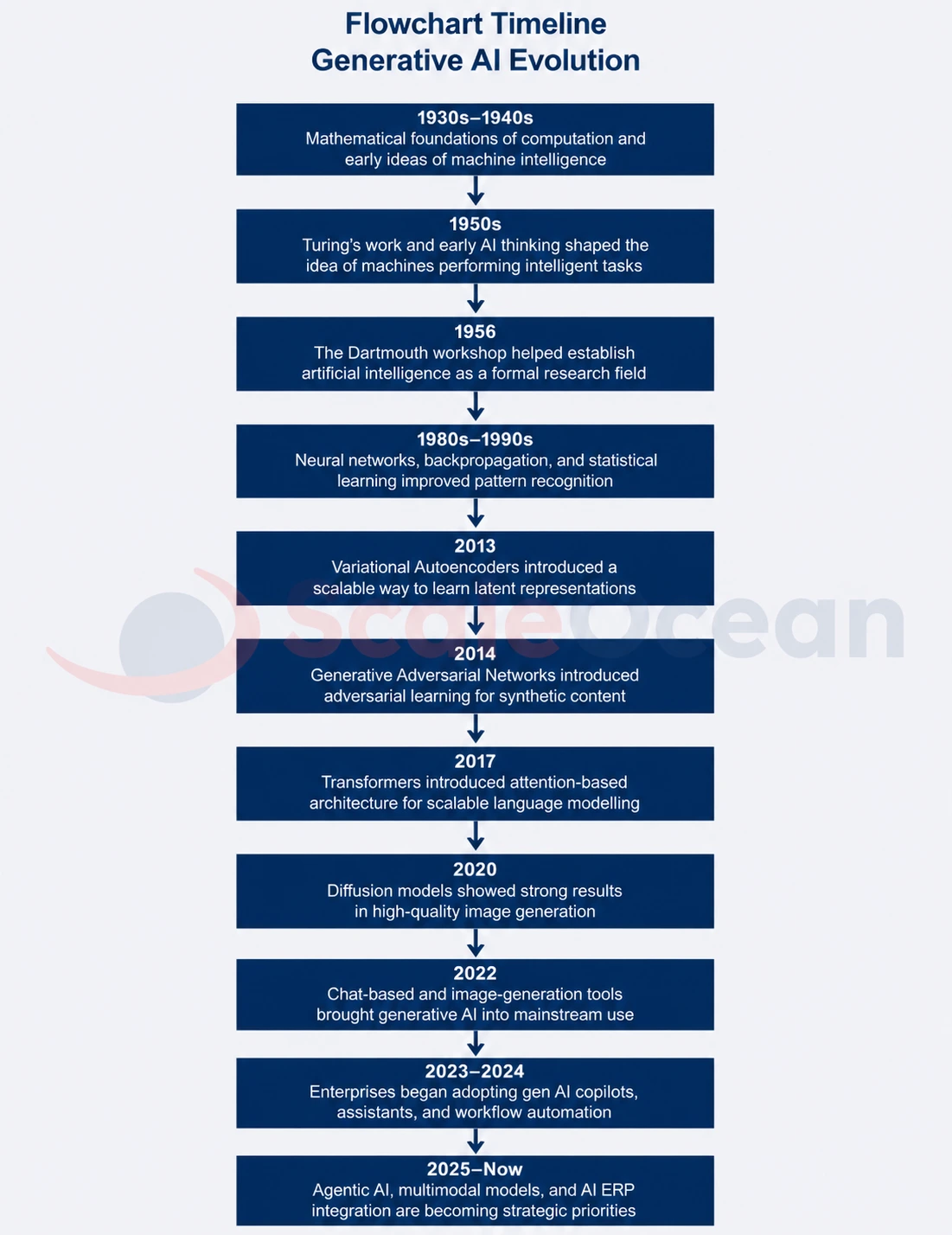
Before reaching today’s advanced AI tools, generative AI went through decades of development. Its evolution started from early theories about computation and machine intelligence, then continued through the rise of neural networks, statistical learning, generative models, and large-scale AI systems.
Each stage helped shape how machines learn, recognize patterns, generate new content, and support decision-making across business operations.
1930s–1940s: The foundations of computation and early ideas of machine intelligence began to take shape. During this period, researchers explored how machines could process information, follow logical rules, and perform tasks that previously depended on human reasoning. These ideas became the base for later AI research.
1950s: Turing’s work and early AI thinking helped shape the idea that machines could perform intelligent tasks. His concept encouraged researchers to question whether computers could imitate human thought, solve problems, and communicate in ways that appeared intelligent.
1956: The Dartmouth Workshop became an important milestone because it helped establish artificial intelligence as a formal research field. From this point, AI was no longer just a theoretical discussion, but a structured area of study focused on building machines that could reason, learn, and solve complex problems.
1980s–1990s: Neural networks, backpropagation, and statistical learning improved AI’s ability to recognize patterns from data. Instead of relying only on fixed rules, AI systems started to learn from examples, making them more flexible in handling tasks such as speech recognition, image analysis, and prediction.
2013: Variational Autoencoders introduced a scalable way for AI models to learn latent representations. This helped models understand hidden patterns in data and generate new outputs based on what they had learned. It became one of the key steps in the development of modern generative AI.
2014: Generative Adversarial Networks introduced adversarial learning, where two models work against each other to improve output quality. This approach allowed AI to create more realistic synthetic content, especially in image generation, and became one of the biggest breakthroughs in generative AI research.
2017: Transformers introduced attention-based architecture, which allowed AI models to process language more efficiently and understand context at a larger scale. This innovation became the foundation for many large language models and significantly improved the quality of AI-generated text.
2020: Diffusion models showed strong results in high-quality image generation. By learning how to gradually remove noise from data, these models made it possible to create more detailed, realistic, and visually accurate images, pushing generative AI further into creative fields.
2022: Chat-based and image-generation tools brought generative AI into mainstream use. Tools for generating text, images, and other creative outputs became more accessible to the public, helping more people understand how AI could support daily work, content creation, and problem-solving.
2023–2024: Enterprises began adopting generative AI copilots, assistants, and workflow automation. Businesses started using AI not only for content generation, but also to improve productivity, automate repetitive tasks, support customer service, assist coding, and analyze operational data more efficiently.
2025–Now: Agentic AI, multimodal models, and AI-integrated ERP systems are becoming strategic priorities for businesses. At this stage, generative AI is moving beyond simple prompt-based outputs and becoming part of wider business ecosystems, helping companies connect data, automate workflows, and make faster, more reliable decisions.
How Does Generative AI Work?
Generative AI works using several technical stages that take raw data and develop it into a model capable of generating useful output. The idea underlying the model is that it learns patterns, tunes them to a particular behavior, is prompted, and generates output, and then returns the best possible output to the user.
1. Training
The model is trained using large amounts of data, such as text documents, code, or business records. It then learns how to recognize, interpret, and analyze this information to support applications such as AI chatbots.
The importance of training data cannot be overstated, and businesses that train on poor data will obtain poor output. For this reason, companies must have a clean, linked, and reliable data stream before concluding using the results from the generative AI model.
2. Tuning
Tuning makes sure that the AI adheres to business needs. While a general AI model is capable of understanding many different things, it needs to be taught the specific company policies, jargon, brand voice, and approval workflows required by its task.
In enterprise use, tuning helps gen AI produce more relevant outputs. For example, it can follow finance reporting formats, customer service SOPs, procurement rules, or HR policy guidelines.
3. Generative, Evaluation, and Returning
After receiving a prompt, the model generates an output based on learned patterns and available context. This output may be a summary, answer, report, recommendation, email draft, or business explanation.
The output should still be evaluated before use. In business workflows, human review, data validation, and approval layers are important to reduce errors, bias, and unsupported recommendations.
For companies that want to apply this in connected operations, AI ERP solutions such as ScaleOcean can be considered to align generative AI with reliable business data and structured approval workflows. You can explore the free demo to see how this approach fits your business needs.
What are the Architectures of Generative AI Models and How Do They Work?
The generation of new content by deep learning models in the form of images, text, or sound is referred to as generative AI models. These work by identifying patterns in massive datasets and using their distribution to construct new data.
1. Generative Adversarial Networks (GANs)
GANs consist of two models. The generator model creates an artificial dataset, and the discriminator then evaluates it to detect any fakes.
Image generation, simulations, synthetic data, and visual quality assessment may all utilize this type of model. Businesses can use GANs for the simulation of products, creation of digital twin representations, detection of anomalies, and visual quality assessment in manufacturing.
2. Variational Autoencoders (VAEs)
VAEs create encoded data of a small representation and subsequently decode it to an output. Through this process, they extract the most salient patterns within complex data.
In the enterprise context, VAEs are used to identify unexpected trends in operational data, as a component of customer behavior analytics and recommendation engines, and to generate synthetic data.
3. Diffusion Models
Diffusion models create new output from noise. This method is commonly used for generating photorealistic imagery and also for creative visual content.
In business, diffusion models can help create marketing visuals, product mockups, campaign concepts, and design variations. However, companies still need review processes to protect brand consistency and copyright compliance.
4. Transformers
Most modern language models rely on the transformer architecture. They are designed with an attention mechanism for processing extensive textual information and a conceptual understanding of its content, relatedness, and overall meaning.
Transformers offer enterprises significant value through applications in areas such as the examination of documents, provision of customer support, drafting of reports, writing of code, and analysis of business data. They are also capable of producing operational insights when integrated with enterprise data in ERP systems.
What are the Benefits and Opportunities of Using Generative AI?
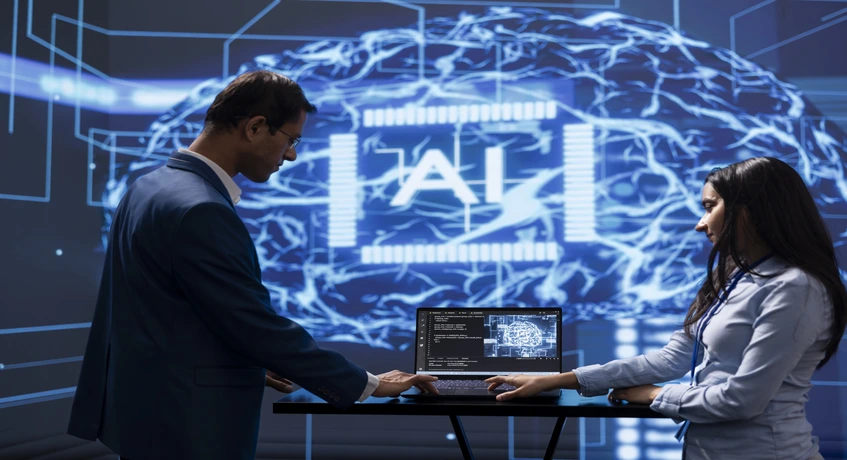
Generative AI creates opportunities for both individuals and organizations. Its strongest value comes from reducing repetitive work, improving access to information, speeding up content creation, and helping teams convert data into usable insights.
1. How Generative AI Help Individuals in Their Everyday Lives?
As an individual, Gen AI can act as a personal assistant, helping individuals at work, school, when communicating, and making decisions.
This becomes particularly useful when an individual’s working life involves dealing with large volumes of emails, meeting notes, long reports, contracts, policies, or technical papers.
Key individual benefits include:
- Email and meeting productivity: Gen AI can summarize long threads of email, write emails, and turn meeting notes into a task.
- Career preparation: Resumes, cover letters, and answers to job interviews can be created on the fly, tailored to the job on offer.
- Learning support: The AI can expand complex concepts and write learning sequences along with a practice question.
- Writing improvement: Spelling, grammar, tone, structure, and wording can all be improved by using Gen AI.
- Document understanding: Contracts, policies, forms, and terms of service can be summarized before deciding.
- Data privacy support: AI can be programmed to remind users to remove private information from documents before they upload or share them.
It is important to remember that an individual needs to check the answers. They often are good for speeding things up and structuring information, but lack context, can supply wrong information, or omit something that is important.
2. How Generative AI Help Businesses Optimize Operations?
In the business world, Gen AI helps to take the manual process and shift it into an integrated system that will enable faster turnaround.
For example, it speeds up reports, responds to frequently asked questions, processes documents, prepares proposals, helps with information searching over disparate systems, and helps in managing time spent working on data.
Key business opportunities include:
- Customer service acceleration: AI can write replies, summarize a customer’s history, and provide solutions based on the Standard Operating Procedures.
- Finance productivity: Review invoices, explain variations, flag anomalies, and write financial notes.
- Sales enablement: Teams can create proposals, tender responses, account summaries, and industry-specific messaging faster.
- Compliance readiness: Gen AI can prepare checklists, summarize policy updates, and support audit documentation.
- Operational monitoring: Highlight strange changes in inventory, costs, shipping times, and production.
- Management reporting: Managers can query and gain insight into the information in the reports when they require it instead of needing to wait for a report to be generated.
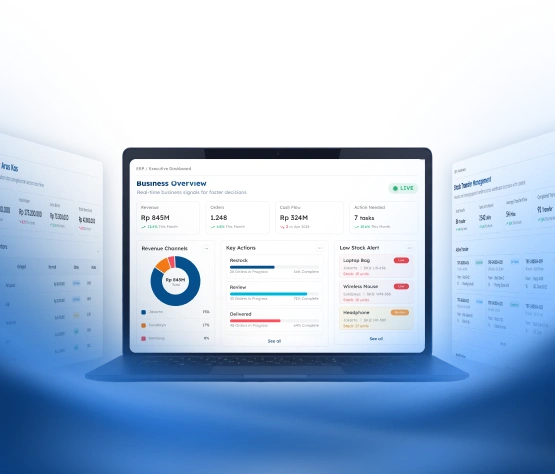
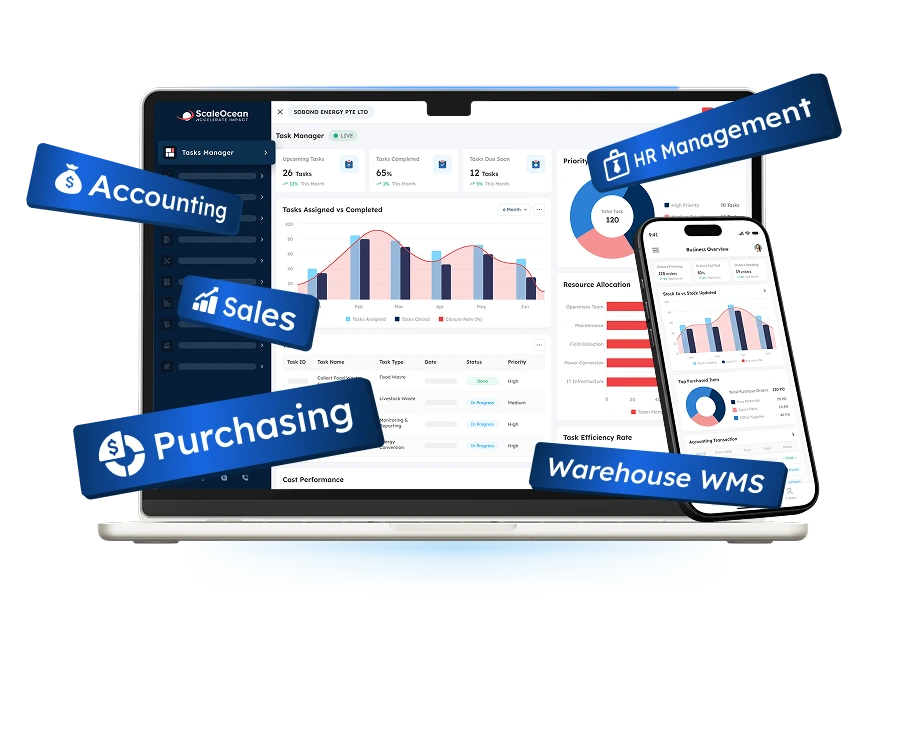
These tasks are all possible on ScaleOcean AI ERP, a unique one-stop solution that supports multiple users, tailored workflows, real-time reporting, and visibility across all branches. Gen AI has the ability to access and utilize linked business data.
See how ScaleOcean can turn connected business data into faster decisions, automated workflows, and better control across every branch. Start with a free demo and discover how your business can work smarter with AI-powered ERP.
What are the Challenges, Limitations, and Considerations of Using Generative AI?
It’s important to have a balance between powerful innovation and risk when utilizing generative AI. Most importantly, issues of factual inaccuracy, privacy and security concerns, intellectual property issues, and algorithmic bias need to be addressed.
Appropriate human oversight and data governance processes must be developed and used when working with generative AI tools.
Main issues and limitations:
1. Accuracy
It is critical that any company utilize generative AI along with verification systems. This should include source references, human approval, access to credible information, an audit log, and permissions by role.
This can be avoided by integrating AI with ERP systems with real-time business data rather than educated guesswork in any area, such as accounting, stock, and client data.
2. Copyright & Bias
Companies should establish rules for when generated AI text is to be used, who should review the content, and the need for any approval by legal or compliance departments. Business users will also avoid putting confidential customer data into public tools not authorized by their business.
In response to the rapid rise in the usage of AI in Singapore’s businesses, companies need to adopt ethical practices in this evolving technological landscape.
3. Technical & Practical Limitations
Practical limits include the quality of prompts, latency, cost, training, and change management. Staff members need to be reminded of when to utilize AI, when to check and verify AI data, and what data not to send to the AI.
ScaleOcean offers software with custom integrations to connect the various business functions across different ERP’s and thus enable relevant AI use cases instead of testing against fictional or hypothetical scenarios.
4. Ethical Concerns
Gen AI should be used as an augmentation rather than a replacement of human responsibility within companies, to simplify repetitive tasks, to enhance the quality of decisions made, and yet human responsibility is still expected and demanded in more sensitive issues.
This applies to top management in business too, and not just in a reduction of speed and cost, but to improve quality, governance, documentation, and capacity of its people.
5. Regulatory and Responsible Use
It is crucial to ensure Generative AI is utilized ethically and responsibly. This is particularly relevant in industries with significant regulatory obligations. The aspects that companies must take into consideration include transparency and accountability, data protection, and an approval process.
It is also important that clear parameters are set for AI usage, that a review process is initiated, and that a protocol for risk management is implemented.
What is the Difference Between Generative AI vs. Traditional AI?
Traditional AI and generative AI are different, although both are aspects of the larger Artificial Intelligence technology. Traditional AI technologies use existing data to classify, predict, detect, or recommend. Generative AI generates novel text or solutions based on learning from these data patterns.
| Feature | Traditional AI | Generative AI |
|---|---|---|
| Main Purpose | Analyses existing data to classify, predict, detect patterns, or recommend specific outcomes | Creates new outputs such as text, images, code, reports, summaries, or recommendations |
| Output | Produces labels, forecasts, alerts, scores, classifications, or predefined recommendations | Produces human-like responses, documents, creative content, explanations, and business-ready drafts |
| How It Works | Uses rules, statistical models, or machine learning to process structured data and identify patterns | Learns patterns from large datasets and predicts the most relevant output based on context |
| Common Use Cases | Fraud detection, demand forecasting, risk scoring, anomaly detection, and process automation | Customer reply drafting, report summarization, proposal creation, code generation, and document review |
| Interaction Style | Usually works in the background through dashboards, alerts, workflows, or automated system rules. | Often works through prompts, chat interfaces, AI assistants, or natural language commands. |
| Business Value | Helps businesses monitor performance, predict trends, and automate repetitive operational decisions | Helps teams work faster, access knowledge, create content, and support decision-making |
| Best Fit | Suitable for structured tasks with clear rules, historical data, and measurable patterns | Suitable for knowledge work, communication, document-heavy workflows, and contextual analysis |
| Limitations | Can be rigid when business rules change or when available data is limited | May produce inaccurate outputs without trusted data, governance, and human review |
These are utilized in separate ways. Traditional AI analyzes and makes use of information; generative AI applies the learned patterns to create text or data or to automate certain processes. Real-world enterprise systems will likely use a combination of both technologies.
For example, traditional AI can identify an anomalous movement of stock, but it will need the support of generative AI to explain what happened and present it understandably for business users, along with recommendations.
Use Cases, Applications, and Examples of Using Generative AI
Case Study: Klarna’s Use of Generative AI in Customer Service
A practical example of generative AI implementation can be seen in Klarna’s customer service operations. Before using AI at scale, Klarna had to manage high chat volumes, repetitive customer questions, multilingual support needs, and pressure to resolve issues faster across many markets.
To solve this, Klarna implemented an AI assistant inside its app to support customer service and shopping-related interactions. Based on Klarna Bank AB’s announcement, the assistant handled two-thirds of customer service chats in its first month and completed 2.3 million conversations.
The application of gen AI in Klarna’s case covered several practical areas. The assistant supported 24/7 customer service, multilingual conversations, refunds, returns, payment-related questions, cancellations, disputes, invoice inaccuracies, outstanding balance updates, payment schedule information, and purchase power explanations.
For example, customers could use the AI assistant to ask about refunds, returns, payment issues, or invoice problems without waiting for human agents. The assistant also helped users understand upcoming payments and spending limits, making it useful not only for support but also for financial guidance inside the shopping experience.
After implementation, Klarna reported that the AI assistant performed work equivalent to 700 full-time agents, supported customers in 35 languages across 23 markets, and reduced repeat inquiries by 25%. Average resolution time also improved from 11 minutes to less than 2 minutes, while customer satisfaction remained on par with human agents.
This case shows how gen AI can support high-volume operations when applied to the right workflow. For enterprise businesses, similar results require connected customer data, clear escalation rules, reliable system integration, and human review for sensitive or complex cases.
For companies using AI ERP software, this approach can go beyond customer service. ScaleOcean AI ERP can connect gen AI with CRM, sales orders, invoices, inventory, delivery status, and complaint history, helping teams generate replies and recommendations using real operational data.
How is Generative AI Used and the Impact of Generative AI in Singapore Today?
Generative AI adoption in Singapore is moving from curiosity to business implementation. Based on the data reported by our team gathered from IMDA’s Singapore Digital Economy, AI adoption among SMEs tripled from 4.2% to 14.5% in 2024, while non-SME adoption increased from 44.0% to 62.5%.
This shows that larger enterprises are moving faster, but SMEs are also beginning to adopt AI more actively. Therefore, AI-using firms mostly rely on off-the-shelf generative AI tools, followed by domain-specific AI-enabled solutions and customized or proprietary AI tools.
This reflects a common adoption pattern, which companies start with simple tools, then move toward industry-specific and integrated AI when they need stronger control, accuracy, and business relevance.
In Singapore enterprises, gen AI is especially relevant for knowledge-heavy and compliance-driven work. Finance teams can use it to explain reports, customer service teams can use it to draft replies, sales teams can prepare proposals faster, and compliance teams can summarize policy updates or prepare audit checklists.
For CEOs and decision-makers, the impact is not only productivity. Generative AI can improve visibility across departments when it connects with ERP data. For example, a leader can ask why the margin dropped in a business unit and receive a summary that includes pricing, inventory cost, procurement changes, and sales performance.
Singapore is also strengthening AI governance through frameworks that give businesses clearer guidance for responsible adoption. The Model AI Governance Framework for Generative AI by AI Verify Foundation provides a useful reference.
Businesses that use gen AI with secure workflows, audit trails, and human review can build stronger long-term value. In this context, AI ERP solutions such as ScaleOcean can be considered to help connect generative AI with structured business data, approval processes, and more accountable operations.
The Future of Generative AI
The future of generative AI will move beyond content creation. The next phase will focus on AI agents, multimodal systems, workflow automation, real-time decision support, and deeper integration with enterprise platforms.
Instead of only answering questions, future AI systems will help complete tasks. They may prepare reports, compare suppliers, detect risks, schedule follow-ups, draft approvals, monitor inventory exceptions, and recommend operational actions based on live business data.
For businesses, this means AI readiness will become a strategic capability. Companies need clean data, connected systems, clear governance, employee training, and leadership direction before they can scale generative AI effectively.
This is where AI ERP becomes increasingly important. ScaleOcean AI ERP provides an integrated foundation through custom workflows, real-time analytics, inter-branch integration, unlimited users, industrial IoT support, and adaptive modules. With these capabilities, companies can turn gen AI from a standalone productivity tool into a secure operational assistant.
The companies that benefit most will not be the ones using the most AI tools. They will be the ones connecting generative AI to the right data, the right workflows, and the right business problems.
Conclusion
Generative AI is an advanced form of artificial intelligence that can create new outputs, such as text, images, code, reports, summaries, and recommendations, based on patterns learned from data. Unlike traditional AI that mainly analyses or predicts, gen AI helps businesses generate useful content and insights for faster decision-making.
For many enterprises, the main challenge is managing scattered data, repetitive workflows, slow reporting, and inconsistent customer or operational responses.
ScaleOcean AI ERP helps address these issues by connecting business data across departments, enabling teams to use generative AI with real operational context, clearer workflows, and better visibility. Try ScaleOcean’s free demo today to see how AI ERP can support smarter and faster business operations.
FAQ:
1. Is ChatGPT a generative AI?
ChatGPT is a generative AI Because ChatGPT built on OpenAI’s neural network, specifically designed for natural language processing (NLP), known as a generative pre-trained transformer (GPT).
2. What is generative AI?
Generative AI is an advanced form of artificial intelligence that can create new outputs, such as text, images, code, reports, summaries, and recommendations, based on patterns learned from data.
3. What are the top 5 generative AI tools?
The top five generative AI tools are ChatGPT, Google Gemini, Midjourney, GitHub Copilot, and gemibn, each serving different productivity, creative, coding, and video needs.
4. Which 3 jobs will survive AI?
Energy experts, biologists, and programmers are among the jobs most resilient to AI because they require human judgment, creativity, technical depth, and complex problem-solving.





















.png)