

Artificial intelligence (AI) is the solution that businesses today must find to remain competitive in a world where success is determined by speed, precision, and flexibility. AI can automate tasks, turn data into decisions, and open up new business prospects.
For businesses, AI promises unprecedented growth and efficiency, yet its adoption is often met with hesitation. Concerns surrounding data security and privacy, a significant skills gap within teams, the need for accuracy and reliability, and the unpredictable risk of AI hallucinations are holding many companies back.
As business accelerates, relying on traditional, non-AI systems is costly, causing missed opportunities, bottlenecks, and a loss of competitive edge. Comprehensive AI knowledge is now essential for confident implementation and risk mitigation.
So what is artificial intelligence, how does it actually work, and what does it really mean for your business? This artificial intelligence overview and guide of artificial intelligence will give you everything that you need, from its core definition and key technologies to real-world use cases, and how AI in ERP Software can transform everyday operations.
 Key Takeaways
- What is Artificial Intelligence? AI is an area of computer science that uses machines to replicate human cognitive capabilities like learning, reasoning, problem-solving, and critical decision-making.
- The way AI currently works is by using complex algorithms to analyze vast amounts of data, find patterns, make predictions, and adapt to new data, resulting in very precise business outputs.
- Challenges and Risks of AI: Companies must proactively manage data integrity, model reliability, and legal compliance to address urgent ethical concerns like algorithmic bias and lack of transparency.
- ScaleOcean AI ERP Software: ScaleOcean’s AI-powered ERP acts as a double-power engine to handle execution, automate complex actions, and provide integrated, data-driven insights for businesses.

What is Artificial Intelligence (AI)?
Artificial Intelligence (AI) is a field of Computer Science that aims to mimic human cognitive functions like learning, reasoning, problem-solving, and decision-making using machines.
By leveraging the use of data, algorithms, and models, AI systems can automate processes, enhance productivity, and uncover trends across various industries.
AI isn’t just a fad because it’s a crucial component of today’s business landscape. AI enables decision-makers to make informed choices based on data by turning raw information into a strategy as organizations gather more data from their operations and digital channels.
While more data is being produced from operations and digital channels, AI also offers a clearer artificial intelligence definition for decision-makers in the format of a strategy, such as turning raw data into information.
Rather than going on a gut feel, leaders rely on AI-based insights to gain a deep insight into what is happening in their business and why. These tools are a game-changer in driving sustainable growth and innovation by moving beyond intuition to data-driven action.
The question “What is artificial intelligence?” is not a straightforward one. It is, in reality, a comprehensive suite of artificial intelligence technology and techniques that come together to automate processes, including machine learning and natural language processing.
This overview of AI can help you grasp its applications in the financial world and how it’s impacting every aspect of the value chain. Businesses that adopt these capabilities from the start will have an edge in fast-changing markets as capabilities evolve.
So, it’s essential to grasp the meaning of artificial intelligence, but it’s not enough. Now, it’s important to understand how AI works in practice, transforming data into decisions.
How Does AI Work?
AI functions by analysing extensive amounts of data using algorithms that learn patterns, adjust to new data input, and produce results. It is the combination of data, models, and computing power to automate tasks, predict outcomes, and improve decision-making.
The fundamental principle of AI is that it uses algorithms to enable machines to learn from examples instead of relying on explicit rules. These algorithms adapt over time by training, that is, gradually presented with data until they learn to accurately predict.
In today’s day and age, modern artificial intelligence technology combines scalable computing, quality data, and sophisticated algorithms to enable businesses to transition from reactive reporting to proactive and predictive insights.
Generative AI brings together three core components, like data as the raw material, computing power to process information at scale, and models that transform inputs into actionable outputs.
This cycle of learning and refinement allows the AI systems to continuously evolve, grow more reliable and effective in their real-world applications.
Machine Learning (ML)
Machine Learning is a subset of AI that allows systems to learn from data without being explicitly programmed. It operates by learning models from data to learn patterns and make better predictions as time passes.
Machine Learning constructs algorithms that self-learn from data. In contrast to the rigid instructions that programs in a traditional computer are given, ML learns and adapts. ML is very versatile and thus is well-suited for dynamic environments.
For instance, recommendation engines improve the suggestions they make as they learn the tastes of the customers. This versatility makes ML an essential aspect of AI, driving progress in fraud detection, predictive maintenance, and many more.
Deep Learning (DL)
Deep Learning is one of the sub-disciplines of machine learning that deals with complex datasets by employing multi-layer neural networks. It allows complex operations like image recognition and natural language interpretation, which are similar to the way the human brain learns.
With deep learning, the machines analyze the data in increasingly abstract ways by using multi-layered artificial neural networks. The technique is multi-layered and allows progress in computer vision and voice recognition, where standard algorithms are not sufficient.
Because of its ability to learn through deep structures that mimic the human brain, deep learning plays a vital role in advanced AI applications, including the development of an AI chatbots.
Generative AI
Generative AI produces novel content, text, images, or audio by recognizing patterns and transforming them into new content. It operates on a massive amount of data and produces content that mimics human creativity and capabilities, such as chatbots and image generators.
Generative AI goes beyond just analyzing data. It creates new things as well, such as writing articles, creating music, or creating realistic images and videos.
AI also frequently makes use of a model such as a GAN (Generative Adversarial Networks) that enhances outcomes by having two networks compete against one another. It has the potential to impact many industries, from shaping marketing campaigns to developing drugs, showing its transformative power.
Natural Language Processing (NLP)
NLP is the branch of artificial intelligence that deals with learning and producing human speech. It works by analyzing text and speech to enable applications like chatbots, translation, and sentiment analysis.
NLP is a way of connecting human communication with machine understanding. It enables computers to understand, react to, and even produce natural language.
From customer support chatbots to real-time translation, NLP is a crucial component of digital transformation. NLP is a blend of linguistics and machine learning that allows businesses to communicate better and more naturally with their customers.
Computer Vision
Computer Vision is a technology that enables machines to understand and process visual information. It functions by analysing images and videos to identify objects and patterns, and automates visual tasks in various sectors.
Computer Vision allows machines to “see” and comprehend visual inputs. It can be anything from identifying faces, spotting defects, or analysing medical scans.
This technology is based on deep learning models that are trained on large-scale image databases, which can recognize images with great accuracy. Industries like healthcare, manufacturing, and retail use computer vision to enhance efficiency, safety, and customer experience.
Neural Networks
Neural networks are artificial intelligence models that are modeled after the brain. They operate by creating chains of nodes that are responsible for data processing to facilitate learning and decision-making, including voice recognition and predictive analysis.
Neural networks consist of a series of interconnected nodes (neurons) that are grouped into layers in order to process information. These layers change the data before passing it along for further analysis. This architecture enables machines to understand complex relationships.
It’s ideal for applications such as image categorization and natural language processing. The flexibility and scalability of neural networks make them the foundations for modern AI systems.
Generation, Evaluation, More Tuning
AI models are refined, generated, evaluated, and tuned. They perform the following functions: creating outputs, checking for accuracy, and adjusting parameters so as to improve performance and reliability.
AI development is a process that is iterative. Outputs are produced by models and are compared to benchmarks or actual data. This refinement guarantees that AI systems operate effectively, adaptively, and in line with business objectives.
AI agents and Agentic AI
AI agents are self-contained systems that operate with little to no human intervention. Agentic AI combines reasoning, planning, and action, enabling machines to operate independently in dynamic environments.
AI agents are decision makers who can perform tasks without needing to be closely supervised. They can anticipate, adjust, and react to variations.
The evolution can unlock possibilities for advanced automation in supply chain management, as well as customer experiences that are tailored to each individual.
Types of Artificial Intelligence

To provide an overall perspective of artificial intelligence, knowledge of its various forms, including those now available and those that are emerging, is essential, as well as understanding what it is.
There are two approaches to categorizing AI: by capability, by functionality. These categories provide insight into today’s capabilities and what might happen in the future.
AI can be categorized by capability, which includes Artificial Narrow Intelligence (ANI) that is capable of performing specific tasks, Artificial General Intelligence (AGI) who learning to the level of a human, and Artificial Superintelligence (ASI) exceeding human intelligence.
Based on functionality, AI can be classified as Reactive Machines, Limited-Memory systems, Theory-of-Mind models, and Self-Aware Machines. These are the different ways by which AI interacts with the data, learns from the experience, and adapts in its environment.
AI Types by Capability
There are various types of Artificial Intelligence (AI) depending upon their capability, and they can be classified into task-specific AI to human levels and eventually to superhuman levels of intelligence.
The categories are used to convey the state of, and the potential for, AI technology to researchers and the public.
- Artificial Narrow Intelligence (ANI): This AI can perform a task or perform a limited set of tasks, such as voice assistants. It has a lot of knowledge in a specific domain, but cannot transfer its knowledge to other domains or to new problems.
- Artificial General Intelligence (AGI): An AI that has the capability to learn and reason in any field, as humans do. Its goal is to learn to do whatever mental tasks a human being can.
- Artificial Superintelligence (ASI): A future system that exceeds all human minds in all fields. It offers great potential for innovation and significant ethical and control issues.
AI Types by Functionality
Based on functionality, the field of Artificial Intelligence can be divided into various categories. These categories, from Reactive Machines to theoretical Self-Aware AI, provide a glimpse into the state of AI development.
It also distinguishes between simple task systems and those with generalized intelligence and provides a roadmap for the grand vision of AI research and innovation.
- Reactive Machines: A simple machine that reacts to the current inputs without having to store them in memory. They are good at rule-based tasks, such as chess programs playing the game in real time.
- Limited Memory AI: These systems learn from data from the past to make better decisions in the future. This is used by self-driving cars to drive safely, based on the latest sensor data.
- Theory of Mind: This high-level AI is designed to know human emotions and motives. It would enable machines to socially interact and to understand different mental states.
- Self-Aware AI: A hypothetical kind of AI with its own consciousness. While these machines would know about their own internal states, which is something we still have a ways to go, they would understand how to leverage their internal state to gain insights into their surrounding environment.
Benefits of AI
Artificial Intelligence delivers transformative advantages across industries, reshaping how organizations operate and compete. Its ability to automate tasks, improve accuracy, and provide continuous availability makes it a cornerstone of modern business strategy.
AI is a present-day reality driving innovation. Successful enterprises integrate AI solutions from optimizing supply chains with predictive analytics to enhancing customer service via intelligent chatbots, deeply into their operations. The strategic adoption of AI unlocks efficiency and provides a competitive edge in the evolving global market.
A survey conducted by IMDA unveiled that 3 in 4 workers are using AI tools regularly, with 85% of the AI-using workers polled finding that AI helps them to work faster and better.
By leveraging data-driven insights, companies can adapt more quickly to market changes and unlock new growth opportunities. This adaptability ensures that businesses remain competitive in environments where speed and precision are critical.
Automation of Repetitive Tasks
AI is highly adept at performing repetitive and time-consuming tasks efficiently and accurately. This automation allows workers to dedicate more time to creative, strategic, and customer-focused tasks that provide more value.
This saves companies time and money, boosts productivity, and ensures consistency in their daily operations. AI automation has a profound impact on various industries, including manufacturing, finance, and customer service.
AI can handle mundane tasks, freeing up human resources to focus on innovation and strategy. It not only helps to save time, but also helps to increase the morale of the employees by eliminating repetitive work.
More Faster, More Accurate
AI systems can handle a large amount of data that can’t be processed by humans. They are more efficient and provide timely and accurate results for businesses to make better decisions in a timely manner. This is particularly useful in sectors where time and accuracy play a critical role in the results.
AI’s swiftness and precision yield tangible benefits in the healthcare industry, notably in diagnostics, fraud detection, and logistics optimization. In industries where precision and speed can make all the difference, AI offers a significant advantage over manual analysis.
Reduce Human Error
Humans are fallible, particularly in stressful situations and with complex data. AI decreases expensive mistakes by utilizing reliable, data-driven models that are more reliable. The uniformity of this guarantees that the critical processes are carried out more precisely and with less risk.
This reliability is crucial for industries like aviation, medicine, and finance, which require it for safety and trust. This reduces the risk of human error, leading to safer and more reliable operations that help safeguard customers and employees.
Enhanced Decision-Making
AI can process vast amounts of data and identify patterns and trends that humans may not notice. It provides leaders with increased confidence in their ability to make informed decisions with strategy.
Complex information can be quickly processed, enabling businesses to make quick decisions in uncertain conditions.
AI-driven decision-making enables organisations to be agile, from market forecasting to risk management. Being able to forecast trends and respond promptly is one of the significant benefits in competitive markets, where it is all about time.
24×7 Availability
AI systems are able to run around the clock without getting tired or disrupted. It provides 24/7 access to customer service, monitoring, and operations. AI can help businesses ensure that their services are provided consistently across different time zones.
Being available all the time means being responsive and enhancing customer satisfaction. Companies can provide continuous services and maintain better customer relationships by meeting the demands of the globe.
Infinite Availability
AI systems can easily scale to process an infinite number of requests at once. This unlimited availability enables companies to cater to greater numbers of users without extra costs. Scalability means organizations can expand without having to be limited by people.
This scalability is especially useful in digital environments with sudden and erratic demand, such as social media. This scalability is especially beneficial when there is unpredictable demand, like in social media. It helps organisations manage peaks in workload without affecting quality or performance.
Reduced Physical Risks
AI can do tasks in dangerous environments, which helps to safeguard human workers from danger. It also helps minimize physical hazards in industries like mining, construction, and hazardous chemical processing.
If you are using AI robots or monitoring systems, they can also increase work safety, providing, for instance, the deployment of AI-powered robots in the workplace to improve safety.
It can aid in productivity without putting workers in harm’s way. The balance between safety and efficiency allows organizations to achieve operational goals while safeguarding human lives.
Accelerated Research and Development
AI can help drive innovation by quickly analysing complex data and providing insights. It cuts down on research time and accelerates the product development process in all industries. The faster the analysis time, the sooner progress can be made in months rather than years.
AI can transform the process of drug discovery to material science, providing advancements that would otherwise take much longer to achieve using traditional methods. It has facilitated businesses to achieve a competitive advantage in the industry where innovation is the key to success.
By investing in AI technology now, companies create a future-proof foundation for ongoing optimization, quicker innovation, and long-term digital transformation.
Challenges and Risks of AI
While Artificial Intelligence presents boundless opportunities, it is also accompanied by significant risks that need to be managed. In this sense, it is crucial to strike the right balance between innovation and responsibility to ensure the adoption of AI does not risk compromising safety, fairness, or trust.
AI has great potential, but also poses certain risks that must be managed proactively to ensure the safety of individuals, organizations, and society. For any responsible implementation of the technology, it is crucial to identify and address such hazards.
Data Quality, Model reliability, Operational resilience, and legal compliance are among these risks. AI-powered tools require robust governance and monitoring mechanisms to minimize risks and ensure alignment with business goals.
Amid the drive for innovation, there are some pressing ethical issues that consumers, industry leaders, and policymakers need to take the lead on to ensure that AI is a force for good.
Data Risks
The quality and integrity of data are crucial for AI systems. Inaccurate or incomplete information can result in inaccurate forecasts, adverse consequences, and injustice to people.
There are also risks of data breaches and privacy violations. Strong data governance, encryption, and access control measures are critical to protect customers and organizations.
Model Risks
When deployed to new environments or when the data distribution changes, AI models can come across as being inaccurate. This can cause hidden failure modes, drift, and overfitting, which decrease reliability and can result in expensive errors during production.
There is a need to continue validation and monitoring to ensure the performance. Stress testing and scenario analysis help to ensure that the models are resilient and accurate in real-world conditions.
Operational Risks
When implementing AI in business processes, complexity and dependency are added. If the deployment, scaling, or maintenance is not correct, it might affect the services and lead to loss of trust with the customers and partners.
It’s important to have clear processes and cross-team collaboration for resilient operations. For instance, by facilitating cross-functional cooperation, AI systems operate seamlessly and adjust to changing business demands.
Legal Risks
AI systems frequently raise regulatory and compliance issues of data usage, liability, and consumer protection. Fines, litigation, or product changes may be the consequences of noncompliance.
All rollouts should include a legal review and privacy impact assessment. Compliance frameworks help safeguard customers and organizations by ensuring that systems adhere to ethical and legal guidelines.
AI Bias
This can lead to unfair or discriminatory results if they are based on training data that are biased or from a model designed for a particular population. Improperly managed bias is detrimental for customers and puts organizations at risk for ethical and legal liability.
Conducting bias audits and using diverse datasets and fairness metrics are practical ways to identify and mitigate bias. By proactively tackling bias, companies can create more fair and reliable AI systems.
AI Transparency and Explainability
Many AI models are opaque, and hence it is difficult to explain decisions to stakeholders or regulators. The lack of transparency does not foster trust and creates challenges for accountability if there are competing results.
Using models and documentation that can be understood by humans enhances trust in AI. Explanation tools enhance understanding of outputs and build confidence and compliance.
Deepfakes
Generative models can produce realistic, but fake, audio, images, or video that can fool people. Deepfakes pose a risk to brand integrity, can be used to commit fraud, and have the potential to deceive and make people distrustful of public discourse.
Detection tools, tracking of origin, and well-defined policy are key weapons in the fight against misuse. In order to protect the credibility and security of the organization, investments must be made in the protection of synthetic media.
AI Ethics and Governance in Singapore
AI ethics and governance frameworks are a key component of responsible AI usage in Singapore. Governments are putting the focus on ethical guidelines to ensure that AI development is aligned with the values and interests of society, and benefits both businesses and citizens.
Also, we found an announcement from White & Case, on the Budget Statement 2026, the Singapore government announced the formation of a new National AI Council, led by the Prime Minister.
This council aims to drive Singapore’s AI agenda and provide strategic direction for the country’s evolving AI landscape. Key Components of the Ecosystem of AI Governance and Safety:
To turn high-level principles into real-world practice, Singapore has built a practical ecosystem of tools, frameworks, and training programs. The key components of the Ecosystem of AI Governance and Safety:
- Model AI Governance Framework: This guide helps firms embed ethical AI into their internal operations. The 2024 update now includes specific rules for Generative AI.
- AI Verify: This software toolkit empowers businesses to test their AI performance. It measures systems against 11 core ethical principles like fairness and safety.
- Agentic AI Guidelines: These 2026 rules manage the deployment of autonomous agents. They emphasize human accountability and strict risk management throughout the process.
- AI Ethics and Governance BoK: The Singapore Computer Society offers training and certification via this BoK. It enables practitioners to work with AI ethically.
With the increasing use of AI, it is crucial to establish clear boundaries. This is reflected in a set of core principles and focus areas in Singapore on the design, deployment, and management of AI:
- Human Centricity: AI is not meant to take the place of human decisions.
- Explainability and Transparency: Users should be able to know how and why the AI came to a particular decision.
- Fairness: Bias reduction and inclusive growth continue to be a focus.
- Transparency: AI systems should be transparent, with clear accountability regarding their outcomes.
History of AI
The official birth of AI was in the 1950’s, which is when the Dartmouth Conference took place in 1956, and John McCarthy was the one who gave AI its name. Initial studies were on symbolic reasoning, logical programs, and neural networks, which would serve as the basis for decades of development.
The field has progressed through the 1970s-80s with the rise of expert systems, and has experienced two periods of downturn, dubbed “AI winters.”
Then, in the 2000s, a major paradigm shift took place when data-driven machine learning models emerged, giving rise to today’s generative AI models. Below are the important milestones in AI that you need to know about:
- Birth of AI (1950–1956): Alan Turing’s 1950 paper Computing Machinery and Intelligence presents the Turing Test. The Dartmouth conference was a major event in 1956 that defined AI as a formal discipline by John McCarthy, Marvin Minsky, Nathaniel Rochester, and Claude Shannon.
- Early Optimism & Symbolic AI (1950s–1960s): Programs such as Logic Theorist (1955) and ELIZA (1966) were successful in their ability to solve problems and understand and generate natural language. The early successes gave rise to hope that machines could have human intelligence.
- The First AI Winters (1970s–1980s): The “high hopes were not followed by significant achievements” as computing power turned out to be inadequate. Financial support, interest fizzled, and the progress stalled, prompting scientists to rethink their strategies.
- Expert Systems & Machine Learning (1980s–1990s): AI revived with expert systems that emulated human experts, Expert Systems & Machine Learning (1980s – 1990s). In 1997, IBM’s Deep Blue beat the world chess champion Garry Kasparov, marking a historic achievement.
- The Neural Network Revolution (2000s–Present): Progress in big data and computing power led to breakthroughs in deep learning. Some notable milestones are AlexNet’s achievement in image recognition, voice recognition systems, and generative models such as ChatGPT, which creates human-like text.
AI in Action and Use Cases in Business

Artificial Intelligence is now a part of the business environment. AI is revolutionizing various industries, from manufacturing to healthcare, by enhancing efficiency, cutting costs, and providing better customer experiences. It is versatile and can transform the scene in various industries.
The true power of AI comes to life in action through real-life examples of its application, such as automation, personalization, risk detection, and strategic planning.
After the artificial intelligence’s meaning is clear, in many areas such as finance, operations, supply chain, and customer experience, companies are able to easily map AI capabilities to real business challenges.
AI is utilized in businesses for predictive analysis, automation, and personalization. These applications enable companies to innovate more quickly, recognize risks, and understand what customers need ahead of time. With AI integration, organizations can stay ahead in the game in a changing market.
AI in the Manufacturing Industry
AI helps manufacturers improve their production lines and minimize downtime. Costly equipment failures and efficiency improvements are prevented with predictive maintenance using artificial intelligence. It provides seamless functioning and increased production.
In addition, AI also improves quality control by identifying defects in real time. Automated inspection systems increase accuracy and minimize waste, saving time and resources. These enhancements increase the competitiveness in the global markets.
AI in the Retail Industry
AI helps retailers in the customization of customer shopping and inventory management. Recommendation engines predict products from user behaviour to improve user satisfaction and sales! It makes the customers’ journey more interesting.
AI also enhances supply chain management with demand forecasting. Retailers can better minimize stockouts (or overstocks) by making accurate predictions to ensure smoother retailer operations. This efficiency means improved margins and confidence in the customer.
AI in Healthcare Process
AI is applied to diagnostics, drug discovery, and patient monitoring in healthcare organisations. The use of AI in medical imaging and data analysis can help in identifying diseases at an earlier stage and with greater accuracy. It enhances patient outcomes and decreases costs.
AI also expedites research by analyzing intricate information. A quicker time to analysis reduces development durations for new treatments and therapies. These breakthroughs enhance the effectiveness and accessibility of health care.
AI in Banking
AI is used by banks for fraud detection and process automation. With AI systems, you can keep track of all transactions in real time, detecting suspicious transactions before they can cause damage. This enhances the security and trust of customers.
AI also provides some support for personal finance services. Customers can efficiently manage their accounts and investments with the assistance of chatbots and advisory tools. That is some innovation to make things more convenient and loyal.
AI in Customer Experience and Support
Customer support is available around the clock with the help of artificial intelligence (AI) chatbots and virtual assistants.
They can easily solve common problems in a timely fashion, thus enhancing satisfaction and decreasing waiting time. It will make sure that there is uniformity of service throughout the channels.
AI also measures customer feedback to take into account trends. Sentiment analysis can provide valuable insights for companies to improve products and services. The result is improved relationships and customer experiences.
AI in Personalized Marketing
AI can be used by marketers to create personalized campaigns based on customer information. Personalized recommendations enhance engagement & conversion. This helps to make marketing more effective and efficient.
AI also helps optimize ad spend by forecasting the best channels to use. Knowing what resources should be used, and where, is crucial, and data-driven insights help with that. Efforts to maximize return on investment.
AI in Human Resources and Recruitment
AI helps HR teams to improve the hiring process and talent management. Also, AI software helps to quickly review resumes and find matches for job opportunities. This helps to minimize bias and accelerate hiring.
Data analysis is another feature that AI provides to help with employee engagement. With insights, HR can craft more effective training and retention programs. This boosts the organizational culture and performance.
AI in Application Development and Modernization
AI is revolutionizing software development by streamlining coding and testing processes. AI-powered tools reduce errors and speed up the delivery of applications. This makes it easier for development teams to be productive.
Another way AI helps with modernization is by streamlining outdated processes. AI can also help with modernization by optimizing legacy systems. Machine learning can be used to pinpoint inefficiencies and suggest improvements. This will help businesses remain competitive and agile.
In all of these use cases, the message that emerges is that complex and interconnected industries, such as modern industries, require more than just simple AI solutions.
AI will play a growing role in ERP software, particularly for improving data analysis and predictive forecasting, and will be the key to scaling automation, data analysis, and accurate forecasting. It can manage finance, supply chain, sales, and operations all in one system.
In this context, AI in ERP software isn’t simply about completing mundane tasks, but also streamlining complex processes and providing in-depth analysis, precise forecasting, and other intelligent, customizable features that can enable businesses to make faster, more accurate, and measurable decisions.
In addition, it’s used to determine more accurate decisions, and it serves as an important key in optimizing performance and resilience in the business industry.
Improve business processes with Integrated AI ERP
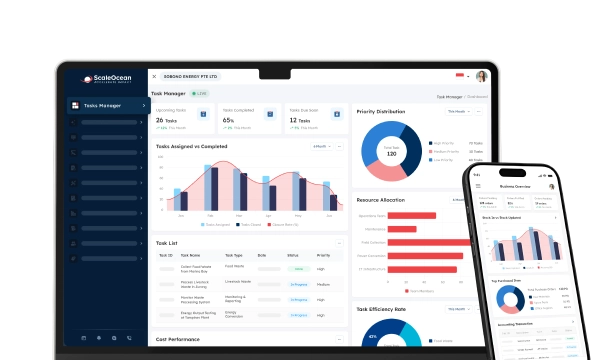
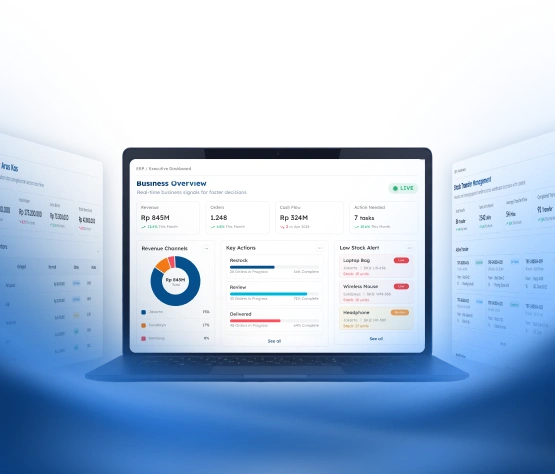
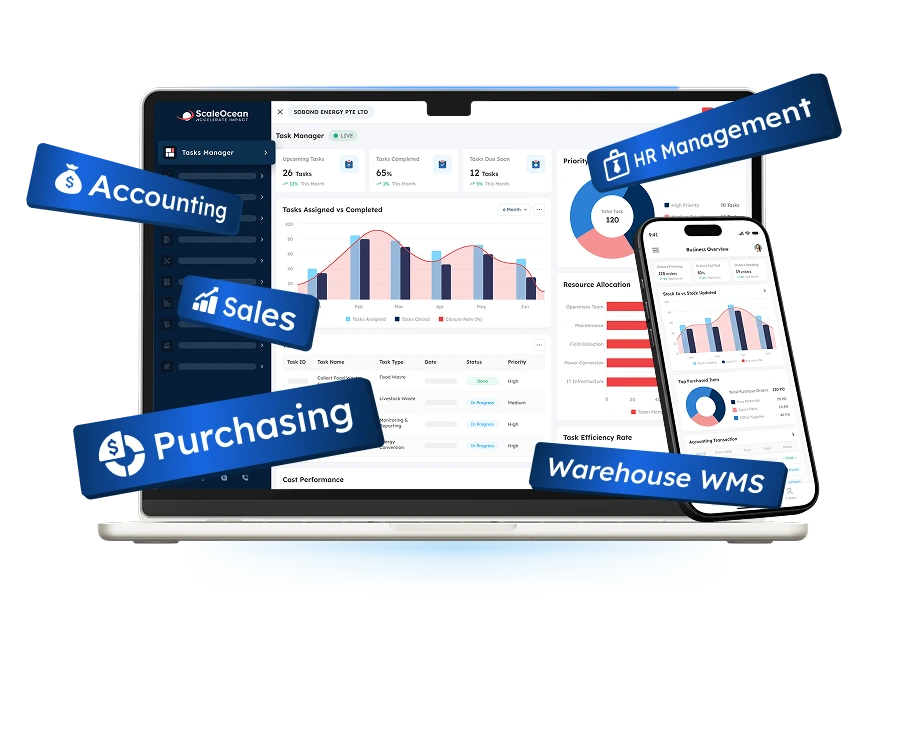
ScaleOcean’s AI ERP platform that goes beyond traditional forecasting and analytics. Instead of only showing what might happen, ScaleOcean’s AI ERP acts as a “double power” engine that also helps execute decisions across your core business processes.
From finance and inventory to sales and operations, this AI ERP fits right into your workflows, so your team can turn insights into action within a single system. ScaleOcean is designed to feel intuitive for every user while keeping it plenty powerful for your technical experts.
This platform offers an all-in-one solution that you can customize to match your specific processes, approvals, and reporting needs. ScaleOcean also aligns with Singapore’s CTC grant, so eligible businesses can modernize their operations with helpful government support.
- Trusted Data Privacy and Security: ScaleOcean’s AI ERP handles data safely and follows GDPR standards. It protects user privacy even as the AI deepens its analysis.
- AI-Generated Reports and Explainers: ScaleOcean automatically turns financial data into clear narrative reports. The AI explains exactly why your key metrics change.
- AI-Powered Report Generation: Users create custom reports using natural language. Simply ask for specific data to get instant, accurate dashboards and tables.
- Integrated Business Intelligence (BI): We build advanced BI into the ERP to provide a single source of truth. Use interactive dashboards and predictive tools to see the facts.
- Data-Driven Prompts: The platform suggests your next best move using real-time data. It flags low stock or at-risk customers before small issues escalate.
- Automation of Business Actions: The system handles routine tasks like auto-approving transactions and triggering purchase orders. This speeds up your daily execution.
- Anomaly Detection: AI monitors your data to catch unusual patterns. It identifies fraud or equipment failures early to reduce your unplanned downtime and costs.
- Smart Workload Routing: AI analyzes customer inquiries for intent and urgency. It routes every task to the best agent to increase your resolution speed.
By integrating AI directly into ERP workflows, ScaleOcean’s AI ERP software helps businesses operate with greater speed, accuracy, and control, turning data into real, measurable outcomes.
Conclusion
Artificial intelligence is no longer an experimental concept, as it is now a practical engine for efficiency, innovation, and growth. From automating repetitive tasks to enhancing decision-making and unlocking new business models, AI is reshaping how organizations operate across every industry.
For business leaders, the real advantage comes from moving beyond basic awareness of what artificial intelligence is to understanding how to apply it responsibly and at scale. That means recognizing both its benefits and its risks, investing in governance and ethics, and building capabilities that turn data into tangible outcomes across finance, operations, and customer experience.
This is where integrated platforms like ScaleOcean’s become essential. By embedding AI directly into your core workflows, ScaleOcean helps you connect data, processes, and teams in one system so you can move from insight to action faster.
Organizations that start building an AI-powered foundation today, supported by solutions such as ScaleOcean, will be better positioned to adapt, innovate, and lead in a digital economy where speed, accuracy, and efficiency define long-term success. Discover how ScaleOcean’s AI ERP software can streamline your workflows and get a free demo today.
FAQ:
1. What jobs will AI not replace?
AI struggles to replace jobs requiring high emotional intelligence, complex creativity, critical thinking for unpredictable situations, or specialized physical dexterity. Therefore, roles in healthcare, skilled trades, education, creative arts, and high-stakes legal/management areas.
2. What are 5 examples of AI?
Artificial intelligence (AI) is utilized widely. Examples include smartphones, digital assistants, chatbots, and social media. It’s integrated into home electronics like robot vacuums and security systems, and classic applications such as auto-navigation and robotics.
3. What is the 30% rule in AI?
The AI “30% rule” suggests that AI technology should handle about 30% of job tasks (data-intensive, repetitive) to augment human workers. This frees humans to focus on the remaining 70%, which requires complex judgment, ethics, and creativity, ensuring AI enhances, not replaces, human skills.
4. How is AI used in daily life?
AI is an essential, often invisible, aid that enhances daily digital life. Its broad applications power voice assistants (Alexa, Siri), personalize streaming (Netflix, Spotify) and social media, optimize navigation (Google Maps), and enable smart technologies.





















.png)