




ERP for oil and gas industry is a platform that integrates finance, operations, procurement, maintenance, inventory, and compliance. Managing operations becomes costly and complicated when incompatible systems are not integrated.
Oil and gas companies operate refineries, pipelines, terminals, offshore facilities, storage tanks, and transmitters simultaneously. But with maintenance schedules dispersed, they will have more time to repair and incur higher operating costs while keeping the most vital assets up and running.
In addition, compliance with strict environmental standards and safety regulations, as well as commodity price volatility, requires precise visibility into operations. Firms using spreadsheets and disconnected applications often experience disparate reporting and slow business decisions.
Accordingly, ERP for the oil and gas industry in Singapore offers centralized data, automated workflows, and real-time operational insights. It allows companies to increase asset reliability, remain compliant with all regulations, achieve high operational efficiency, and reduce costs.
 Key Takeaways
- ERP for the oil and gas industry is a platform that centralizes finance, maintenance, procurement, inventory, and compliance to improve operational efficiency and business visibility.
- Common problems for oil and gas companies include asset failures, safety risks, compliance challenges, information silos, and sustainability pressures that undermine operational performance.
- Comparing leading ERP software such as ScaleOcean, Oracle, and SAP allows businesses to evaluate capabilities, deployment approaches, and suitability.
- ScaleOcean ERP Software helps medium- to large-sized oil and gas enterprises streamline complex operations with an AI-powered, customizable ERP tailored to Singapore’s business requirements.
Understanding ERP for Oil & Gas Industry
ERP for the oil and gas industry integrates upstream, midstream, and downstream processes through a centralized business platform. It connects finance, procurement, maintenance, inventory, projects, and compliance using synchronized real-time information.
In addition, contemporary ERP systems automate operational processes and enhance visibility at the plant and departmental levels. This helps entities reduce administrative effort, enable faster decision-making, and sustain stable performance amid ever-growing industry complexity.
What are the Issues Facing the Oil and Gas Industry?
Oil and gas companies operate highly complex assets, and each must strive to meet production targets, regulatory requirements, and workforce safety and environmental standards. As a result, any operational interruptions will soon have enormous financial and operational impacts.
1. Asset Failures
After installation, pumps, compressors, pipelines, and tanks require ongoing maintenance throughout their life cycle. However, because the maintenance record is spread across various sources, it often takes time to reach the inspection point and the final equipment breakdown.
Unexpected breakdowns halt production plans and increase maintenance costs and emergency repair costs. In addition, spare part shortages often occur due to unplanned maintenance stemming from a lack of proper operational insight.
2. Harsh Environments
These are often sited on offshore platforms, in remote fields, in deserts, or in corrosive industrial environments. Equipment then suffers accelerated degradation, making maintenance planning more challenging.
Extreme weather, limited accessibility, and a harsh operational environment also reduce workforce productivity and inspection rates. As a result, it poses higher operational risks for companies when maintenance jobs are delayed or not carried out efficiently.
3. Safety Hazards
Oil & gas production facilities regularly work around dangerous chemicals, flammable materials, confined spaces, and high-pressure equipment. That is why tight safety controls must be enforced on all activities.
But delays in permit approval, separate safety records, and irregular inspections all greatly increased the chance of an accident. The information also hadn’t been received quickly enough for workplaces to make changes to fix the problem.
4. Compliance Fines
The oil and gas industry is subject to strict environmental, financial, operational, and workplace safety regulations at all times. Yet manual reporting increases the risk of errors and delays.
Incomplete audit trails and disparate operational records also pose challenges for regulatory and internal compliance audits. As a result, companies may incur financial penalties, face operational restrictions, or suffer reputational damage for failures to comply.
5. Green Transition
Governments and investors are pushing for oil and gas producers to cut emissions and improve sustainability reporting. Hence, firms need to know how to quantify carbon emissions from their assets and operations accurately.
Unfortunately, emissions data can be scattered across departments and across various reporting systems. Consequently, it is difficult to track, analyze, and improve upon sustainability initiatives.
6. Information Silos
Operational teams often use various separate applications for Finance, Maintenance, Purchasing, Inventory, and Project Management. As a result, significant business-critical information is coming from several separate, disconnected systems.
Operations lack access to up-to-date information during daily business processes, and double data entry makes the process ineffective and more burdensome.
What Advantages does ERP Offer to the Oil & Gas Business?

ERP enables oil & gas companies to standardize their operations and link all functions through a centralized business platform, resulting in organizations becoming more operationally effective, more compliant, and more resilient.
1. Global Currency Management
Firms that use the best ERP for oil and gas industry often make deals in several countries using various currencies and tax systems. ERP automatically adjusts the exchange rate and simplifies international payments.
Furthermore, ERP reduces errors and complexities in financial reporting. Automated currency conversion enables consistency in financial reporting amongst subsidiaries and global projects. Companies enjoy increased financial visibility.
2. Predictive Asset Maintenance
ERP integrates maintenance timetables based on the equipment list, its production history, and operating conditions to estimate the failure date before a machine stops operating. Hence, the maintenance team can focus on rectification based on actual production conditions.
Major maintenance also prolongs equipment life while minimizing costly crisis shutdowns and manufacturing disruptions. Additionally, companies improve spare-parts availability through precise maintenance planning.
3. Unified Data Hub
ERP integrates operational, financial, purchasing, inventory, and maintenance information into a single system. Thus, all business functions on a common system have access to the same data.
Additionally, centralized information reduces data duplication and creates more accurate reporting throughout the organization. Use up-to-the-minute operational data to make faster, fact-based decisions.
4. Automated Regulatory Reporting
An ERP system automatically gathers operational and financial data for businesses and generates regulatory and compliance reporting documents. As a result, organizations cut down administrative labor manually.
Automated workflows also keep auditors happy by providing full audit trails of approvals, operational activities, and financial transactions. So, organizations can prepare regulatory submissions in less time while de-risking compliance.
5. Carbon Footprint Monitoring
ERP captures energy usage, operational emissions, and carbon output at the facility level through centralized sustainability data. As a result, businesses have quantifiable insight into their environmental performance and ways to improve it.
Further, automated ESG reporting facilitates sustainability initiatives and reduces the complexity of carbon emissions disclosure. Companies may follow up on the progress of emission reduction with more precise dashboards.
Quick Comparison of the Best ERP Software for the Oil and Gas Industry
Choosing the right ERP depends on your company’s operational complexity, deployment preferences, and industry-specific requirements. While every platform offers core ERP capabilities, some provide deeper functionality for oil and gas operations such as asset management, production accounting, and compliance.
| Software | Best For | Why It Stands Out |
|---|---|---|
| ScaleOcean | Medium to large enterprises in Singapore that need integrated accounting, GST readiness, approval workflows, customizable workflows, and real-time financial control. | Built for complex operations with over 200 customizable modules & 1000+ features. It also offers unlimited users without additional licensing fees, flexible implementation, AI-powered ERP automation, and transparent flat pricing. |
| SAP S/4HANA | Large enterprises with global operations | Comprehensive finance, supply chain, and manufacturing capabilities with strong scalability. |
| Oracle Cloud ERP | Enterprises focused on financial management | Strong financial controls, procurement, project accounting, and enterprise reporting. |
| Enertia Software | Upstream exploration and production companies | Specialized in production accounting, land management, and Joint Interest Billing (JIB). |
| IFS Applications | Asset-intensive businesses | Combines ERP with asset management and field service capabilities. |
| Microsoft Dynamics 365 | Companies using Microsoft products | Integrates finance, supply chain, inventory, and business analytics. |
| Infor CloudSuite | Process manufacturing and industrial companies | Supports manufacturing, supply chain, asset management, and operational planning. |
| Odoo | Small businesses with basic ERP needs | Modular ERP with accounting, inventory, CRM, and purchasing features. |
8 Best ERP Software for the Oil and Gas Industry in 2026
Selecting the best ERP software in Singapore depends on your operational complexity, compliance requirements, and long-term business objectives. These solutions offer different strengths, helping oil and gas companies improve financial control, asset management, maintenance, and operational efficiency.
Beyond core ERP functionality, many oil and gas companies are also adopting AI to improve accounting accuracy and efficiency. AI allows finance teams to focus on analysis rather than repetitive administrative work.
A recent industry report from Deloitte also highlights growing adoption of AI for financial reporting, compliance, and back-office automation in the oil and gas sector. Finance teams are increasingly using AI to automate invoice processing, reconciliations, anomaly detection, and financial forecasting.
1. ScaleOcean
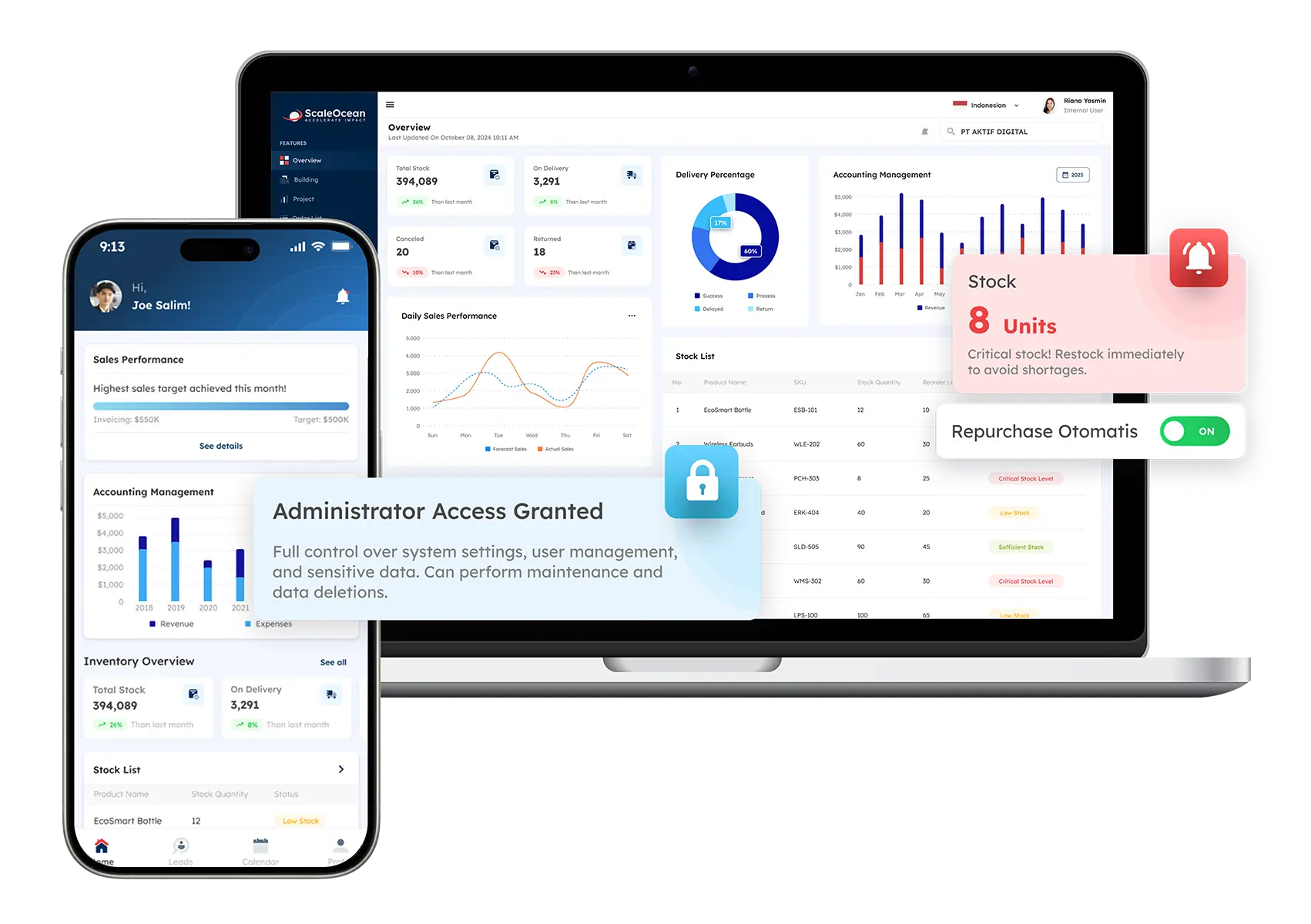
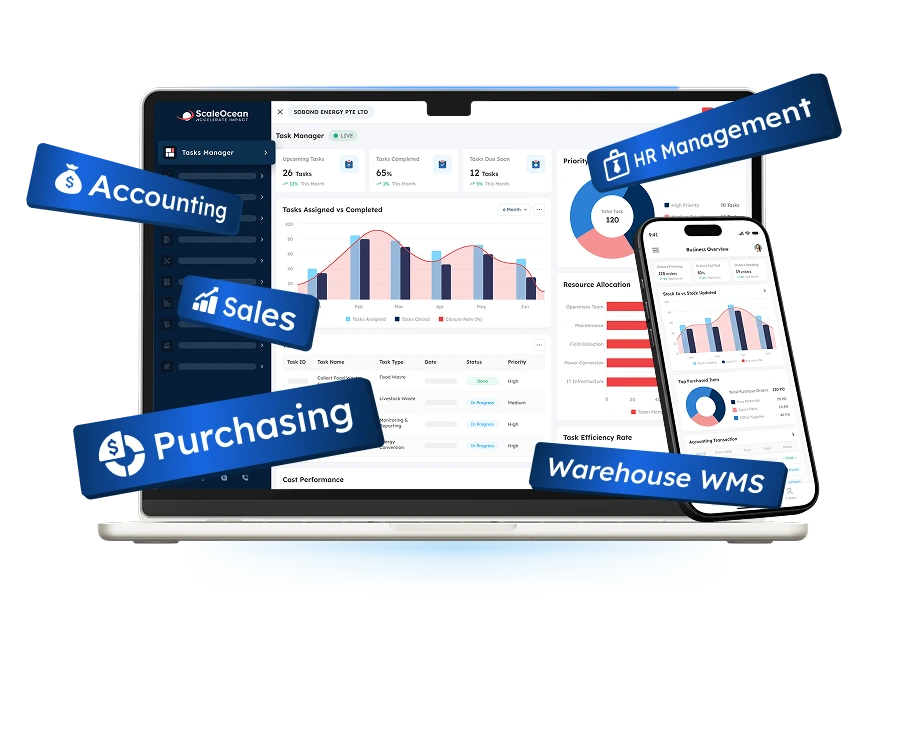
ScaleOcean ERP software is an AI-powered ERP designed to streamline complex oil and gas operations through a single integrated platform. It has over 200+ customizable modules, 1,000+ software features, unlimited users, and flexible implementation. It helps manage finance, procurement, asset maintenance, inventory, and compliance, supporting long-term growth.
Additionally, ScaleOcean is optimized for Singapore GST compliance and local financial reporting standards, making it well-suited for businesses operating in Singapore. The system meets EDG and CTC Grant requirements, offering a cost-effective digital transformation with flat pricing, real-time analytics, and configurable workflows.
To see how ScaleOcean can improve operational efficiency, reduce downtime, and simplify compliance, schedule a free demo with our team.
Key Features of ScaleOcean ERP for the Oil and Gas Industry:
- HSSE Management: Centralizes permits, incident reporting, inspections, and risk assessments to strengthen workplace safety and regulatory compliance.
- Permit-to-Work Workflow: Digitizes approval processes for high-risk activities and links permits to maintenance schedules and operational assets.
- Bunkering & Marine Fuel Documentation: Manages bunker delivery notes, vessel records, and marine fuel documentation with complete digital traceability.
- Mass Flow Meter Integration: Connects MFM data with delivery, inventory, invoicing, and reconciliation to improve quantity accuracy and reduce disputes.
- Inventory Traceability: Tracks fuel, chemicals, spare parts, and materials across terminals and warehouses for better stock control and compliance.
| Pros | Cons |
|---|---|
|
|
Best For: Medium to large upstream, midstream, and downstream oil & gas companies requiring a highly configurable ERP to manage operations, maintenance, projects, inventory, and financial control.
ℹ️ Why Choose ScaleOcean ERP for the Oil and Gas Industry?
ScaleOcean ERP helps medium-to-large oil and gas companies streamline finance, maintenance, procurement, inventory, and compliance through a single AI-powered platform. With 200+ customizable modules, unlimited users, and support for Singapore GST, local reporting standards, and EDG and CTC Grants, it delivers a scalable solution for long-term growth.
2. SAP S/4HANA
SAP S/4HANA ERP software helps enterprises manage finance, procurement, manufacturing, and supply chain operations on a single platform. It supports standardized business processes while improving enterprise-wide reporting and operational visibility.
Additionally, the platform offers industry capabilities for asset-intensive businesses through integrated planning and analytics. Organizations can centralize operational data while supporting decision-making across multiple departments and business units.
Key Features of SAP S/4HANA:
- Financial management
- Supply chain management
- Asset management
- Business analytics
| Pros | Cons |
|---|---|
|
|
Best For: Large oil and gas enterprises operating across multiple countries that require standardized financial management, supply chain coordination, asset management, and enterprise-wide reporting across complex business operations.
ℹ️ Why Choose SAP S/4HANA for the Oil and Gas Industry?
SAP S/4HANA supports large enterprises with integrated finance, supply chain, manufacturing, and asset management. It is suitable for organizations requiring standardized processes across global operations.
3. Oracle Cloud ERP
Oracle Cloud ERP software helps businesses manage finance, procurement, projects, and core business operations through a cloud-based platform. It centralizes financial information while supporting standardized enterprise processes across multiple departments.
Additionally, the software provides reporting and planning tools that improve operational visibility across business functions. Organizations can manage financial performance while maintaining consistent workflows throughout daily operations.
Key Features of Oracle Cloud ERP
- Financial management
- Procurement management
- Project accounting
- Business intelligence
| Pros | Cons |
|---|---|
|
|
Best For: Medium to large oil and gas companies seeking cloud-based financial management, procurement control, project accounting, and enterprise reporting across multiple operational locations.
ℹ️ Why Choose Oracle Cloud ERP for the Oil and Gas Industry?
Oracle Cloud ERP provides cloud-based financial management, procurement, and project accounting. It is suitable for companies prioritizing financial visibility and centralized enterprise management.
4. Enertia Software
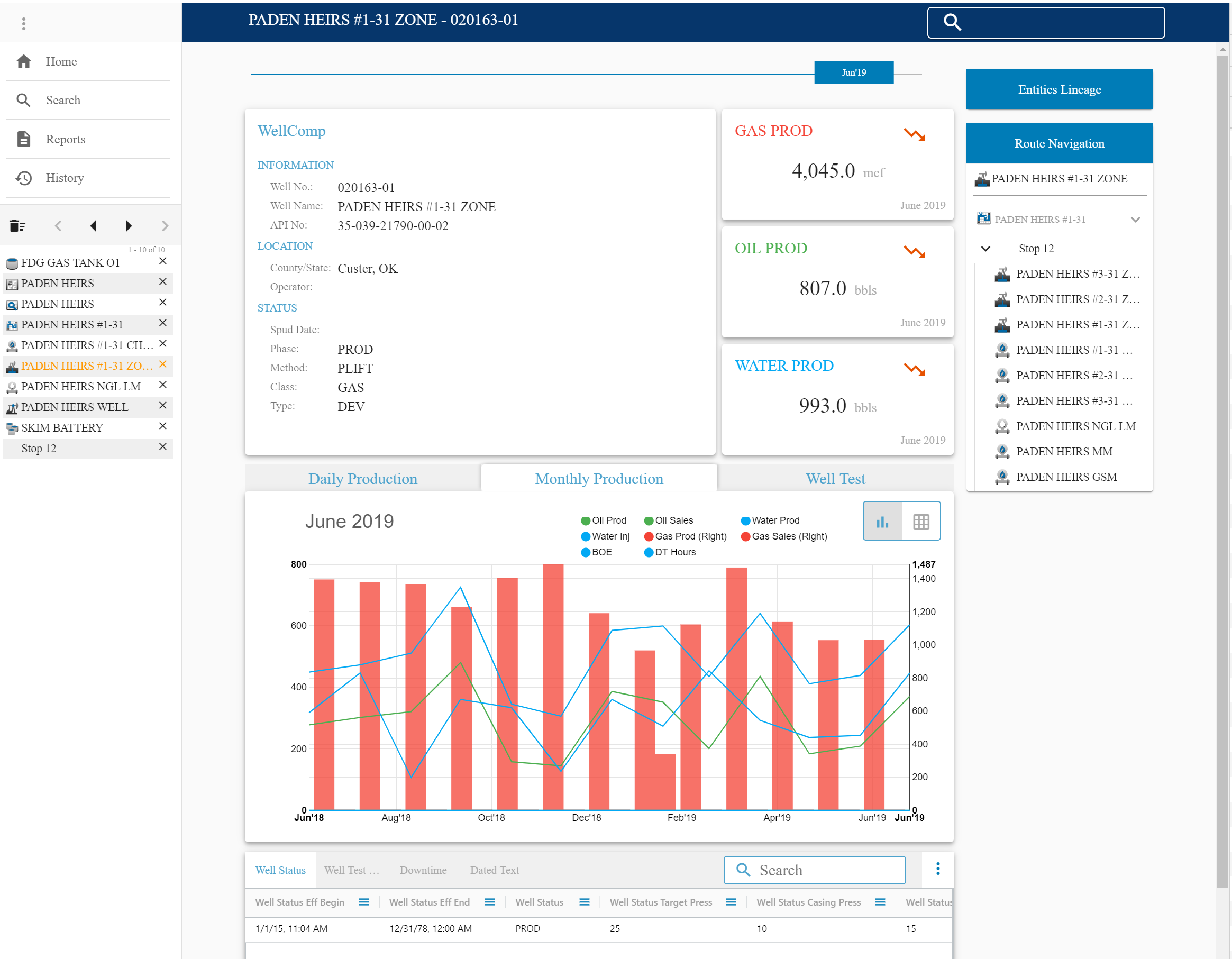
Enertia ERP software supports upstream oil and gas businesses by managing production accounting, land administration, and financial operations. It focuses on improving visibility across exploration and production activities.
Furthermore, the software helps companies organize operational and financial records within a centralized environment. It supports routine accounting processes while streamlining administrative tasks for upstream operations.
Key Features of Enertia Software:
- Production accounting
- Joint Interest Billing
- Land management
- Revenue accounting
| Pros | Cons |
|---|---|
|
|
Best For: Medium to large upstream oil and gas companies managing exploration, production, land administration, and Joint Interest Billing across multiple operating assets.
ℹ️ Why Choose Enertia Software for the Oil and Gas Industry?
Enertia Software focuses on upstream operations with features for production accounting, land management, and Joint Interest Billing. It is best suited for exploration and production businesses.
5. IFS Applications
IFS Applications ERP software manages finance, procurement, maintenance, and field service through an integrated enterprise platform. It supports organizations operating equipment-intensive assets across multiple business locations.
Additionally, the software emphasizes asset management and maintenance planning alongside standard ERP capabilities. Organizations can coordinate operational activities while improving visibility across equipment and service operations.
Key Features of IFS Applications:
- Enterprise asset management
- Maintenance planning
- Procurement management
- Field service management
| Pros | Cons |
|---|---|
|
|
Best For: Medium to large oil and gas enterprises managing maintenance-intensive assets, field service operations, and equipment lifecycle management across multiple facilities.
ℹ️ Why Choose IFS Applications for the Oil and Gas Industry?
IFS Applications combines ERP with enterprise asset management and maintenance capabilities. It is suitable for companies managing equipment-intensive operations and field services.
6. Microsoft Dynamics 365
Microsoft Dynamics 365 ERP software combines finance, purchasing, inventory, and supply chain management within a cloud-based business platform. It integrates closely with Microsoft’s productivity and business applications.
Moreover, the software provides centralized business information to support operational planning and financial reporting. Organizations can streamline routine processes while maintaining consistent workflows across different departments.
Key Features of Microsoft Dynamics 365:
- Financial management
- Supply chain management
- Inventory management
- Business reporting
| Pros | Cons |
|---|---|
|
|
Best For: Medium to large oil and gas companies already using Microsoft business applications and requiring integrated finance, procurement, inventory, and supply chain management.
ℹ️ Why Choose Microsoft Dynamics 365 for the Oil and Gas Industry?
Microsoft Dynamics 365 integrates finance, inventory, procurement, and supply chain management within the Microsoft ecosystem. It is suitable for businesses already using Microsoft business applications.
7. Infor CloudSuite
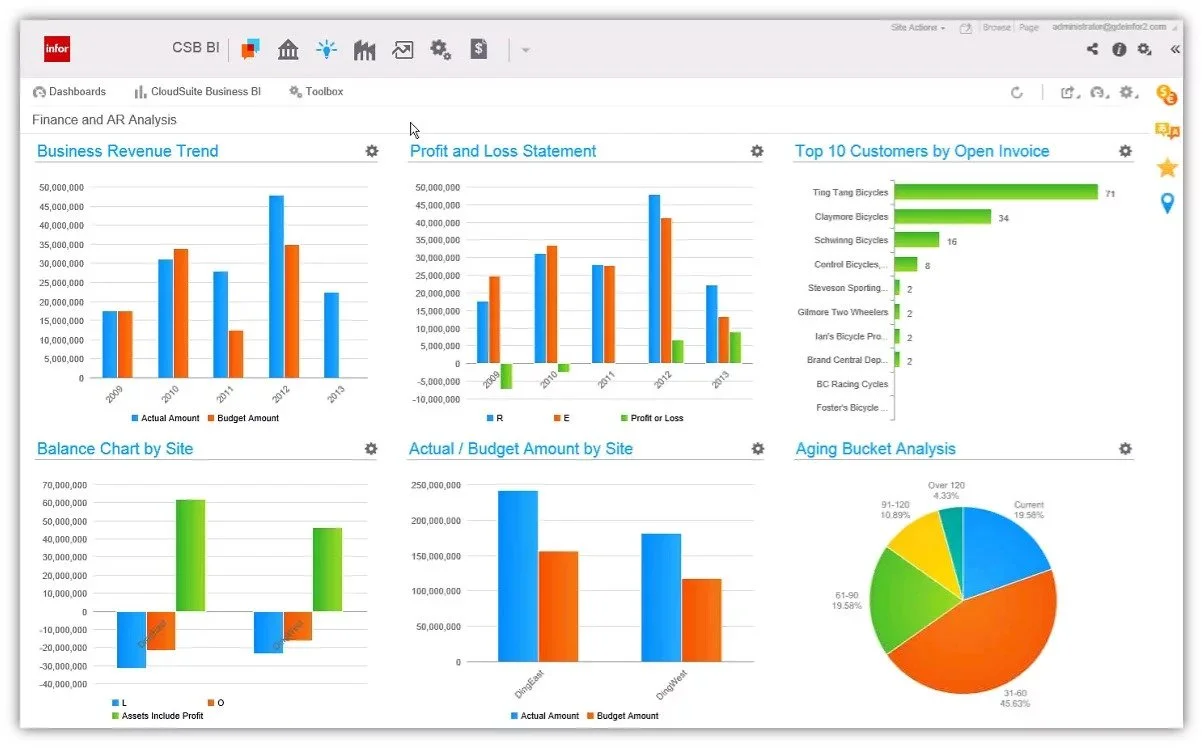
Infor CloudSuite ERP software supports manufacturing, finance, procurement, and supply chain operations within an industry-focused business platform. It helps organizations standardize operational processes across industrial environments.
Additionally, the software provides business planning and reporting tools that improve operational coordination between departments. Organizations can manage manufacturing and supply chain activities using centralized business information.
Key Features of Infor CloudSuite:
- Manufacturing management
- Supply chain management
- Financial management
- Asset management
| Pros | Cons |
|---|---|
|
|
Best For: Medium to large oil and gas companies operating refineries, processing facilities, or industrial manufacturing environments that require integrated operational management.
ℹ️ Why Choose Infor CloudSuite for the Oil and Gas Industry?
Infor CloudSuite supports manufacturing, supply chain, financial management, and industrial operations. It is suitable for companies operating refineries and process manufacturing facilities.
8. Odoo
Odoo ERP software offers modular business applications covering accounting, inventory, purchasing, and customer relationship management. Companies can activate modules according to their operational and business requirements.
Furthermore, the software supports general business management through a flexible application ecosystem. Organizations can expand functionality gradually as operational needs continue growing over time.
Key Features of Odoo:
- Accounting
- Inventory management
- Purchasing
- Customer relationship management
| Pros | Cons |
|---|---|
|
|
Best For: Small to medium-sized oil and gas service providers or distributors seeking a modular ERP solution to manage accounting, inventory, purchasing, and everyday business operations.
ℹ️ Why Choose Odoo for the Oil and Gas Industry?
Odoo provides modular applications for accounting, inventory, purchasing, and CRM. It is suitable for smaller oil and gas businesses seeking a flexible ERP platform with essential business functions.
Any Singapore-based business looking for an industry-ready ERP can consider ScaleOcean, which offers more than 200 customizable modules to support finance, procurement, inventory, maintenance, projects, and compliance in a single integrated platform. The solution is also optimized for and aligns with Enterprise Development Grant (EDG) and CTC Grant requirements.
If you’re evaluating ERP software for your oil and gas business, request a free demo of ScaleOcean to see how it fits your operational requirements.

Key Features of Oil and Gas ERP Solutions
The best ERP for oil and gas industry Singapore now includes both traditional business management software features and those unique to the oil and gas industry. Such integrated oil and gas ERP packages enable a business to gain a better grip on its operations, finances, compliance, and asset reliability in complex business environments.
1. Joint Interest Billing (JIB)
Joint Interest Billing is used to calculate cost sharing in joint ventures involving two or more partners engaged in exploration and production activities. Consequently, each partner is billed correctly in accordance with the terms of ownership in the joint venture.
In addition, the system streamlines expense reconciliation and mitigates manual accounting errors in joint ventures. With reliable financial reporting, finance teams enhance transparency, hasten settlements, and build stronger relationships with partners.
2. Asset Lifecycle Management
Asset lifecycle management tracks equipment operation from purchase through maintenance, necessary upgrades, and phase-out. As a result, this enables organizations to make the most effective use of equipment while mitigating unplanned breakdowns and replacements.
Furthermore, ERP preserves the full maintenance history, inspection records, and asset documentation in a single access platform. Thus, maintenance teams schedule preventive activities more effectively and ensure longer asset lifespans.
3. Supply Chain & Inventory
ERP brings together all procurement, warehouse operations, inventory, and supplier management across several operational sites. Consequently, an enterprise keeps the production materials available without such high interest income.
Enhanced real-time visibility into spare parts inventory is equally useful for planning spares required for critical equipment and for routine and scheduled maintenance. Automated replenishment will prevent stock-outs, thereby ensuring continuity in production.
4. Authorization for Expenditure (AFE) Management
Authorization for expenditure controls the nature of project budgets prior to project initiation, either for drilling, construction, maintenance, or capital investments. Organizations impose expenditure approvals for each project based on flowcharts and parameters.
ERP enables real-time financial monitoring by comparing actual costs to approved budgets. This results in decision-makers being proactive about budget overruns and maintaining control over project costs and financial management.
5. Compliance & Safety
ERP consolidates safety inspections, permit tracking, mishap reports, and regulatory documents into a single integrated business operation. As a result, companies have enhanced compliance and less administrative work.
Automated alerts and approval processes enhance workplace safety by promoting uniform operational procedures. This not only reduces the risk of compliance violations but also defends the workforce, contractors, and key business assets.
6. Production & Royalty Accounting
Production accounting reflects extraction volumes, product movements, revenues, and operational performance across production facilities. This is contrasted by royalty accounting, which automates payments based on contracts and regulations.
Integrated financial calculations enhance reporting accuracy and can minimize manual reconciliation across various production activities. As a result, companies can preserve the transparency of their financial reports while fulfilling contractual obligations.
7. Pipeline & Terminal Management
Pipeline and terminal management involves monitoring movement and terminal capacity, as well as scheduling and transfer activities. As a result, companies take control of logistics and always have up-to-date stock data during transit.
The presence of ERP in the company’s processes supports efforts to analyze operational performance across all transactions, distributed across different plants and terminals. The consequence of this is a more effective distribution process and fewer operational bottlenecks and delays.
8. Gate Pass & Security Controls
Gate pass management maintains records of personnel, contractor, vehicle, and material movements in and out of the operational plant. Hence, plants improve their security measures without compromising the available record of entry by contractors and visitors for audit trail.
The use of integrated approval workflows eliminates unauthorized transfers through automatic granting and verification mechanisms. Hence, a company enhances operational security with lower administrative overheads and fewer compliance off-takers.
9. Refinery Manufacturing (BOM)
Refinery manufacturing functionality handles Bills of Materials for refining, blending, and finished petroleum products. This enables companies to maintain standard production recipes and improve manufacturing quality.
ERP additionally monitors raw material consumption, production yields, and manufacturing expenses in real time. As a result, refinery managers enhance resource usage, production planning, and operational gains.
Future of ERP in the Oil & Gas Industry

Digital transformation continues to transform oil and gas enterprises through intelligent automation, connected assets, and real-time insights. Upcoming ERP systems will be more efficient, predictive, and resilient for complex businesses.
1. AI & Predictive Analytics in ERP
By using artificial intelligence, ERP systems can automatically analyze patterns in operations, surrounding equipment, and the enterprise’s financial performance. Therefore, organizations can identify potential breakdowns, schedule maintenance effectively, and refine planning strategies in advance.
Similarly, it helps with demand forecasting, procurement planning, and production optimization by leveraging current and historical operational data. This, in turn, results in greater certainty in decision-making and allows businesses to make rapid, intelligent operational decisions.
2. IoT Integration
IoT technology connects sensors, machinery, pipes, tanks, and production equipment directly to ERP systems. As a result, asset performance is constantly tracked by the organizations using detailed real-time operational data.
Furthermore, its connection to various network devices enables automated maintenance notifications when they exceed certain operational and performance thresholds. Thus, organizations reduce equipment downtime and enhance their facilities’ efficiency.
3. Mobile ERP for On-the-Go Access
Mobile ERP software enables field engineers, maintenance technicians, and supervisors to access operational information from anywhere in the world. As a result, the team uses their smartphones and tablets to access and update work orders, inspections, approvals, and inventory.
Real-time mobile access also speeds up communication between home offices and field sites during day-to-day work, making organizations more responsive and reducing paper and administrative processing delays.
How to Choose the Best ERP System for the Oil & Gas Industry
Choosing the appropriate ERP will be a tough task for an organization, as Operational needs (upstream, midstream, or downstream) vary. Hence, one needs to select a solution that offers either Custom ERP and off-the-shelf ERP software.
- Industry-specific capabilities: Opt for an ERP that includes functionality for asset management, Joint Interest Billing, Authorization for Expenditure (AFE) management, refinery operations, production accounting, and compliance.
- Scalability & Flexibility: Choose software that supports a wide range of facilities, scales with operations, and allows business processes to evolve without costly system upgrades or redevelopments.
- Real-Time Integration: Make the ERP extend its capabilities, covering all the supply chain-related information such as finance, procurement, maintenance, inventory, production, and operations, to make faster decision-making possible and reporting more accurate.
- Robust Compliance Features: Seek out automated audit trails, eco-reports, safety records, and oversight processes for regulatory compliance that not only make compliance easier but minimize admin time and operational risk.
- Equipment Reliability Management: Seek ERP systems with robust preventive and predictive maintenance capabilities to minimize ERP system failures, improve maintenance efficiency, and enhance long-term reliability.
- Ease of deployment: Ease of installation and implementation, including an intuitive interface, comprehensive implementation support, customizable workflows, and continuous training, is expected to promote faster deployment.
Any Singapore-based business looking for an industry-ready ERP can consider ScaleOcean ERP, which provides more than 200 customizable modules, unlimited users without an additional per-user license fee, and flexible deployment options.
Schedule a free personalized demo to explore how ScaleOcean can streamline your oil and gas operations, improve asset management, and support long-term business growth with a solution tailored to your requirements.
Conclusion
ERP for oil and gas industry helps businesses integrate finance, maintenance, procurement, inventory, compliance, and production into one centralized platform. Companies enhance efficiency, reduce downtime, boost compliance, and make decisions faster with accurate real-time data.
For medium to large oil and gas enterprises in Singapore, ScaleOcean offers an AI-powered ERP tailored to complex operational requirements. With over 200 customizable modules, transparent business-based pricing, and compliance with Singapore GST and local financial reporting standards, it supports sustainable digital transformation.
If you’re looking for an ERP that adapts to your business rather than forcing process changes, request a free demo of ScaleOcean today to see how the software can improve your company’s efficiency, asset performance, and long-term business growth.
FAQ ERP Software for Oil & Gas Industry:
1. Why should oil and gas companies invest in ERP software?
ERP helps oil and gas companies integrate finance, maintenance, inventory, procurement, and compliance into one platform. This improves operational visibility, reduces downtime, streamlines workflows, and supports faster, data-driven decision-making across complex operations.
2. How does ERP improve asset maintenance in oil and gas operations?
ERP centralizes asset records, maintenance schedules, inspections, and equipment performance data. It enables preventive maintenance, reduces unexpected failures, extends asset lifespan, and improves maintenance planning to minimize costly production disruptions.
3. How can ScaleOcean ERP support oil and gas companies in Singapore?
ScaleOcean helps oil and gas companies manage maintenance, procurement, inventory, finance, and assets through one integrated ERP. It also supports Singapore GST compliance, local financial reporting standards, and aligns with EDG and CTC Grant requirements.
4. Which ERP modules are most important for oil and gas companies?
The most essential ERP modules include Asset Management, Inventory Management, Procurement, Accounting & Finance, Project Management, and Contract Management. Together, they improve equipment reliability, operational efficiency, financial control, and regulatory compliance.




















.png)