



Handling HR operations is becoming more challenging in Singapore’s business environment. Businesses are constantly seeking to do more and effortlessly optimise workforce operations; today, the value of an HRIS system is key.
It is no longer the luxury it once was; rather, a Human Resource Information System (HRIS) has become a necessity. To illustrate the impact of technology on company processes, Singapore’s digital economy contribution to GDP currently touches an almost S$1 in every S$6, according to IMDA. It shows that technologies like Human Resource Information System (HRIS) are essential for growth and efficiency.
This article will cover the crucial functions of HRIS for your business, making a connection from their everyday functions to their strategic value to demonstrate their genuine importance. We will also be introducing you to some of the best and right HRIS Systems in Singapore, including ScaleOcean, Rippling, Gusto, FactoHR, and more, to help you find the best and right HRIS System for your business.
 Key Takeaways
- A Human Resources Information System (HRIS) is software that centralizes and automates core HR functions, such as payroll, benefits, and data management.
- The HRIS system delivers major benefits, including strategic, operational, and employee-focused benefits, driving efficiency and better decision-making across the entire organization.
- Discover the top HRIS software in Singapore that is suitable for your business, like ScaleOcean, Rippling, Gusto, FactoHR, and more.
- ScaleOcean’s HRIS Software offers a comprehensive solution designed to overcome these challenges and unlock your company’s full potential for sustainable growth.
What is the Human Resources Information System (HRIS)?
A Human Resources Information System (HRIS) is software that centralizes and automates core HR functions, such as payroll, benefits, and data management. By unifying this data, an HRIS helps businesses process employee tasks efficiently, boosting decision-making and overall operational performance.
The HRIS’s automation features virtually eliminate manual work while ensuring accurate and timely reporting. Companies use it to optimize HR operations, improve compliance, and create better employee experiences, making it a truly essential tool for modern HR.
How is HRIS Different from HRMS and HCM?
For businesses, it’s important to get a clear idea of the differences between these three HR software programs. It is important to make an informed choice that suits your HR requirements, as each system has its own unique characteristics. Therefore, here are the differences between HRIS, HRM, HRMS, and HCM:
1. HRIS
The main purpose of a Human Resources Information System (HRIS) is to serve the needs of handling the vital data of human resources and fundamental administration errands. It deals with essentials such as payroll, health and wellness, and timekeeping and acts as a primary element in organising your vital employee records.
By consolidating vital HR data into one centralized system, an HRIS dramatically improves accessibility and organization. It helps HR teams streamline routine tasks and ensure compliance, significantly reducing the burden of manual record-keeping and time-consuming administrative work.
2. HRMS
While HRIS is primarily concerned with managing data, a Human Resource Management System (HRMS) is designed to do so and incorporate many more functions than HRIS. It also comes with tools, functionalities, and features for talent management, recruitment, performance management, and learning, making it a holistic solution to overall HR processes.
With automation at its core, an HRM approach optimizes HR workflows, cutting down on repetitive tasks while boosting efficiency. Its ability to provide valuable insights into employee performance makes HRMS an essential tool for both workforce management and strategic planning.
3. HCM
Human Capital Management (HCM) is more advanced and more comprehensive, incorporating all of the greatest aspects of HRIS and HRMS. While HCM systems aren’t solely about admin, they’re also about the improvement of employees, in-depth engagement, and plans for future growth and the management of talent.
An HCM solution provides a comprehensive framework that truly integrates HR functions with your broader business objectives. It allows organizations to align HR practices with company goals, fostering a productive environment and actively supporting the overall growth of the workforce.
The Major Benefits an HRIS Brings to Your Company

An HRIS can provide several benefits to your company. An HRIS can offer your company several benefits. An HRIS is much more than a tech upgrade; it’s a strategic move. HR teams can automate essential functions such as payroll, and leaders have access to real-time data for making better decisions.
Employees enjoy self-service, contributing to an enhanced experience and overall efficiency. With this in mind, let’s take a look at the major advantages an HRIS provides in four broad sectors to have a clear notion regarding the importance of such a system in your business. It’s definitely more of a sense of what it can do for you.
Listed below are the big advantages segmented into 4 categories:
1. Strategic & Managerial Benefits
Let’s take advantage at a higher level, let’s take advantage in a manner that really guides the company in a direction that makes a distinction. Ultimately, it’s a vastly improved understanding and control of workforce dynamics, and that’s where an HRIS really becomes a strategic tool.
Basically, an HRIS provides the leaders with the kind of information that is essential to make informed, long-term decisions, and surely that is the key to the punchline. It ensures that HR goes against the grain of the business, which is a pretty powerful alignment; everybody goes against the same goal, which is the business goal.
a. Data-Driven Decision-Making
The point being that an HRIS is one easy-to-access, central location for all your employee info. The concept is that an HRIS is more or less one platform that has everything relating to employees within it. This enables details to be dug up by the leaders into matters like staff turnover, salary standards, and staff performance direction.
b. Improved Workforce Planning and Oversight
Of course, one of the biggest advantages is having a whole workers’ picture so that you can see at a glance the skills that you are missing in your team, begin planning the hiring you need to do now and in the future, and manage succession much better. Scrutineering can go a long way toward making sure that you’re staffing the right people at the right time in the right position.
c. Increased Efficiency and Productivity
Basically, once you automate your HR processes, managers can have a more hands-on approach to the business than getting themselves hung up on paperwork. This efficiency gain is a blessing to them in the sense that they’ll think about building their team’s level of performance, not efficiency.
d. Scalability for Business Growth
Naturally, you will be expanding businesses, so more and more complexities are coming your way in HR. It is in these ways that a successful Business HRIS will grow with you. It’ll be able to handle more employees, more data, more processes, especially more complicated processes, and maintain its speed.
2. Operational Benefits
If you’re inhibited by what you have to go through for the task of the day, an HRIS can make a huge difference in how your HR function performs. It’s quite impactful. Together, it promotes those mundane chores to take a lot of time but much less in total, and you’ll be able to see the instant benefits in your workflow.
These operational wins significantly cut down on the manual work your HR team typically handles, which is a huge relief for them. This means they can finally focus on activities that truly add more value, like fostering better employee relations and getting into some proper strategic planning.
a. Streamlined HR Workflows
Consider taking an automated look at leave requests, expense allowances, time sheet approvals, and so much more; all of these can be taken out of the manual system and run directly from the system, which is super convenient. This essentially creates a standardised and effective workflow that eliminates those problematic workflow bottlenecks across the board.
b. Reduced Administrative Burden
Then your HR team has an HRIS to come to its rescue to do all those repetitive, time-consuming tasks, and it brings a huge relief to your HR team. This substantial reduction in administrative burdens is really a significant advantage; they can seriously concentrate on more human-centred concerns.
c. Faster and More Accurate Data
If anyone knows anything about manual data entry, there’s always going to be room for inaccuracies, particularly in payroll. With HRIS, the accuracy of data is assured the first time it’s entered, and it’s then standardised throughout the system, ultimately yielding more accurate information to all who use it.
d. Enhanced Compliance with Singaporean Regulations
So in Singapore, there are certain rules that you have to abide by, such as CPF contribution, leaves, and all the employment laws that you have to deal with. In fact, an HRIS can be designed to stay current with these guidelines, which can assist in keeping your company compliant and, most importantly, will decrease legal dangers considerably.
3. Employee Experience and Engagement Benefits
Perhaps it couldn’t be any cleaner, given that an HRIS isn’t merely a games player for managers or HR. It truly makes a positive difference in your employees’ lives directly, too, and that’s great. It provides them with resources and information that make their daily lives easier.
It’s not very unusual to see employee satisfaction or engagement improving when they feel empowered and supported in the systems implemented by their company. Basically, this means the company is investing in its employees’ experience, which can help to lift employee morale.
a. Enhanced Recruitment and Better Onboarding
An HRIS can seriously streamline the whole recruitment journey, right from putting job postings out there to keeping tabs on applicants, which is a huge time-saver. The system streamlines onboarding, helping new hires feel welcomed and integrated from their very first day.
b. Employee Self-Service (ESS)
An Employee Self-Service (ESS) portal is a saviour that allows staff members to manage their own data, such as setting up their own profiles, accessing payslips or applying for vacation days, and doing it all on their own. It provides employees with control and independence, and decreases HR enquiries, making more time for them to spend on their work.
c. Less Stress for Both Staff and The Company
An HRIS helps eliminate the mundane tribulations people tend to encounter in their day-to-day lives, in large part because it can simplify HR admin and provide instant access to information. Companies can use such features as performance management and setting up goals, demonstrating to employees how much they contribute to the company’s success, which adds clarity and engagement.
4. Data Security Benefits
Safeguarding employee data is a vital concern in today’s digital era. The PDPA supports the flow of data to better safeguard Singapore’s reputation as a trusted data hub, says the PDPC. An HRIS is equipped with robust security features that are essential for businesses to protect sensitive information.
Quite honestly, it’s a much safer way to store data than simply storing it in a spreadsheet or in that physical file that seems like one of the old methods, which is usually risky. This is a better way to keep both the business and, most importantly, the valuable employees safe.
a. Centralized and Secure Data Management
All employee information is in one central database, and multiple layers of security are applied, that’s the way it should be. Role-based access allows permitted users to access sensitive information without exposing data to unauthorized parties, ensuring a secure and dependable single source of truth.
b. Improved Data Protection
Among the advantages of most modern HRIS solutions is that it all conforms with important information security laws, such as Singapore’s PDPA (Personal Data Protection Act). They have encryption and other security measures in place to help them prevent data breaches, and that’s what you need to be sure that your employee data will be safe and sound.
Essential Features of a Modern HRIS
When you’ve got a choice of HRIS software, it can be challenging to think of the right one for your company. Despite all that, certain aspects are essential in pretty much every modern HRIS and would certainly not do a good job without them. These additions are no random ones; they are what make a good HRIS.
They really put together an all-in-one platform to oversee your workers that will ease the process. But let’s delve deeper into how HRIS could be relevant for these key attributes:
1. Recruitment and Onboarding
Your HRIS should be able to extend its support starting from the beginning stage and right to the end of the entire talent acquisition process. From posting jobs, monitoring your applicants, scheduling a job interview, and more, all the way to a completely seamless hiring process.
The system should also allow for a successful onboarding experience once hires have been secured, which provides a streamlined way for new hires to obtain all the information and documents they need upon starting their roles. It definitely gets them started on the right foot, and in nearly every instance, this is a good way to welcome new employees.
2. Payroll and Benefits Administration
Honestly, this is probably one of the most critical features you’ll find in any HRIS; the system absolutely has to automate payroll calculations, things like taxes, CPF, and other deductions. This really ensures accurate and timely payments for everyone on the team, which is non-negotiable.
Beyond payroll, managing employee benefits like health insurance and leave entitlements is crucial. With , employees can easily view and select their benefits through the system, simplifying this complex yet essential HR task.
Actually, this is one of the most vital reasons, if any of the HRIS ever exists, it should be able to do our tax calculations, CPF, deductions, etc. This really does mean that no matter the situation, those performing will be paid rightfully and on time.
Payroll is not the only area of employee management that is important; employee benefits, such as health insurance, leave, and more, are just as critical. Payroll solutions in Singapore make it easy and simple to consider and plan your employees’ benefits, making this a highly complex and vital HR function easy.
3. Employee Performance Management
An HRIS ought to also provide tools that are useful for establishing objectives, tracking progress, and conducting key assessments of performance. The features certainly help managers to give frequent feedback and to support employee development, ideal components of maintaining a leading and performing culture.
Through this capability, they will be able to adopt a continuous and equitable approach to performance assessment, instead of the traditional annual review process. Feedback can be timely, relevant, and meaningful, and can motivate an employee and contribute to improving your business with enterprise HRIS management software.
4. Training and Development Tracking
Having a way of letting employees know about their growth and training truly is quite necessary if you want them to grow. Finally, an HRIS could prove to be a valuable asset for managing training programs, tracking certifications, and even uncovering skill gaps, and fostering a culture of ongoing learning.
All this information in one good package makes it possible for patients to make better strategic decisions on training, which obviously a good thing. It also ensures that the employees you are training your business needs them to master in the future, making it a no-brainer situation.
5. Employee Self-Service Portal
An ESS portal is a must-have feature of any advanced HRIS. It allows employees to have direct access to their personal HR data, empowering them. Individuals have the option of editing their own data, and staff will now have access to the pay slip template.
Staff also go on Leave without HRs. This saves everybody lots of time. This isn’t just an improvement in the employee experience; it’s also an improvement in the employee experience! It’s a real morale booster for your HR team, as well. These give them more time to concentrate on strategic projects and a reduced amount of time devoted to questions that would happen regularly, most often resulting in better overall efficiency.
6. Customisable Reporting and Analytics
Finally, a reliable HRIS should provide robust analytics and make it easy to generate customized reports across key HR metrics. As demonstrated by ScaleOcean for Beumer Group, these insights support more informed, data-driven workforce decisions.
System dashboards will display, and meaning will be added to the visualizations, this makes it simple to locate patterns and truly comprehend matters. A great way to get a glimpse of your employees even inside. Results in strategic decisions. It turns raw data into actionable intelligence.
10 Best HRIS Systems for Your Businesses in Singapore
Selecting the right HRIS system is crucial for Singapore companies as it can help them simplify HR processes, improve employee management, and meet compliance standards. However, some HRIS systems are essential to really consider, no matter how big or small the business is. So here are the top 10 HRIS systems you need to seriously consider:
1. ScaleOcean
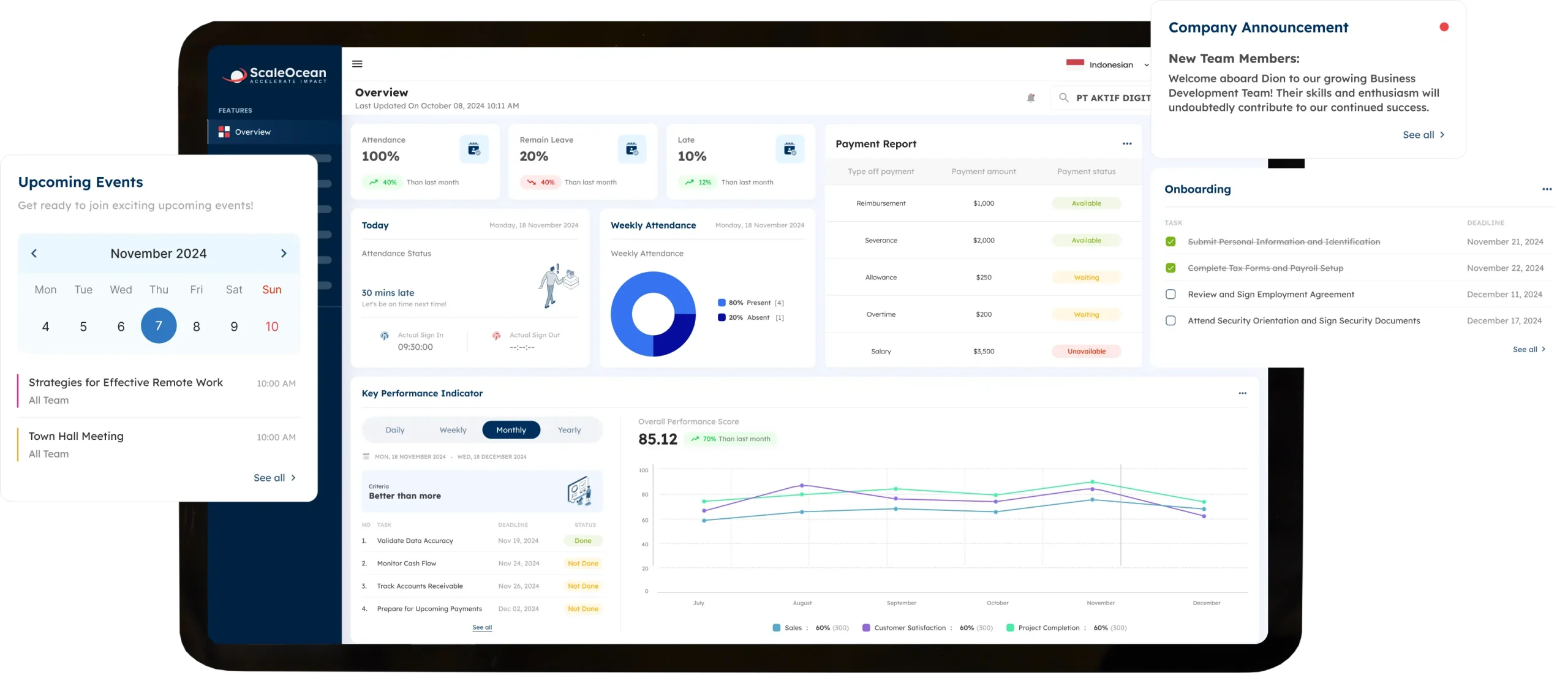
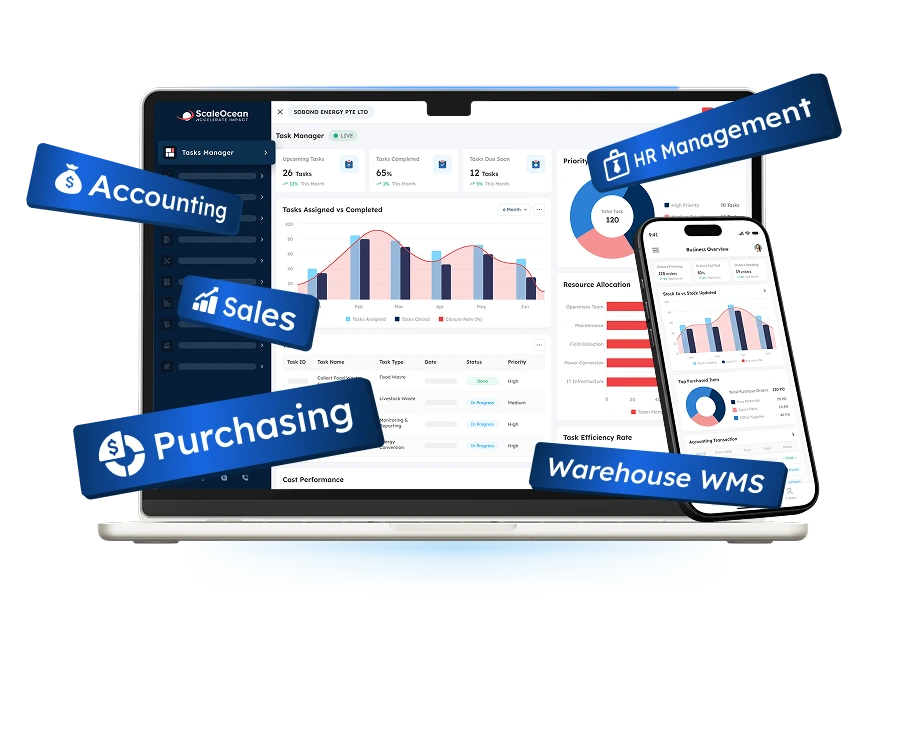
ScaleOcean’s HRIS software is designed to integrate payroll, performance, and attendance management systems into a single system. It provides businesses with flexibility to automate tasks that would otherwise require a lot of manual work, thereby reducing downtime. It helps businesses to automate various HR tasks; the manual effort is reduc, ed and actua,lly the overall efficiency of the business is improved.
HRIS software actively contributes to business expansion with its customization capabilities, ensuring scalability for growing teams. They also provide a trial version for free demo, allowing your company to experience it yourself. Not only that, but with the added advantage of CTC grants available for implementation, companies can easily use this solution to streamline their HR processes and expand.
Key Features:
- Automation of HR Processes: Streamlines HR tasks like payroll, attendance, and recruitment, reducing manual effort and enhancing efficiency.
- Centralized Employee Data: Consolidates all HR data in a single platform, ensuring easy access and better data management.
- Real-time Performance Tracking: Allows automatic monitoring of employee performance based on predefined KPIs, supporting regular evaluations.
- Employee Self-Service Portal: Provides employees with easy access to personal information, payslips, and leave requests through a user-friendly portal.
- Leave and Attendance Management: Using the right software is one of the best absence management methods to automate the tracking of employee attendance and leave requests, improving accuracy and reducing administrative workload.
| Pros | Cons |
|---|---|
|
|
Best For: Optimizing pricing and forecasting for businesses using AI with ScaleOcean’s revenue management software. It is also highly scalable, has the ability to provide industry solutions, and it is flexible. It’s also scalabindustry-friendlyndly, and flexible, all great traits for any company looking for an efficient data-driven growth solution.
2. Rippling
Rippling is a cloud-based HRIS that automates personnel management, payroll, and benefits across numerous platforms. It integrates effortlessly with existing company technologies, streamlining HR operations and increasing operational efficiency.
Rippling’s adaptable design enables firms to manage several HR functions through a single system. The software supports the entire employee lifecycle management process, from recruitment to offboarding.
Key Features:
- Payroll and benefits integration.
- Employee onboarding and offboarding tools.
- Recruitment and applicant tracking system (ATS).
- Customizable reporting and analytics.
- Integration with third-party applications.
| Pros | Cons |
|---|---|
|
|
Best For: Rippling is ideal for businesses of various sizes, particularly those with distributed teams, that require a centralized HRIS to automate employee management, payroll, and benefits, as well as integrate seamlessly with other business tools.
3. Gusto
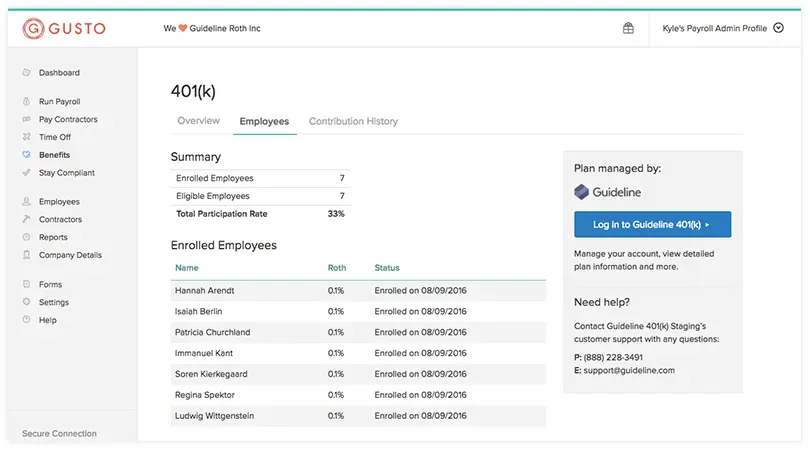
Gusto is a small to medium-sized business (SMB) HRIS that features easy time management, benefits, and payroll tools. Its cloud-based platform makes HR work easy, making it ideal for businesses with simpler needs.
Gusto’s integration with accounting and time-tracking software offers a more seamless experience for businesses. It features options for hiring, performance management, compliance, and more, as well as the ability to manage HR tasks from one place.
Key Features:
- Payroll management and compliance.
- Employee benefits administration.
- Time tracking and attendance management.
- Recruitment and hiring tools.
- Performance management integration.
| Pros | Cons |
|---|---|
|
|
Best For: Gusto is suitable for small to mid-sized companies seeking a user-friendly HRIS to handle payroll, benefits, and compliance duties. It is user-friendly and automated, making it ideal for businesses that have simple HR requirements.
4. FactoHR Software
FactoHR is a cloud-based human resources (HR) software that is specifically designed for small and medium-sized companies. It offers a wide range of HR use cases, including attendance, payroll, and recruitment, all accessible through one central platform that can be easily managed.
The solution provides real-time reporting and analytics, helping companies to make data-driven HR decisions. It is flexible and adaptable to the needs of each company, with its customizable features.
Key Features:
- Attendance and leave management tools.
- Payroll and compliance automation.
- Real-time reporting and analytics.
- Recruitment and onboarding features.
- Employee self-service portal.
| Pros | Cons |
|---|---|
|
|
Best For: FactoHR is designed for small to medium-sized businesses that require a straightforward HRIS for payroll, attendance, recruitment, and employee performance management, offering simplicity and efficiency without overwhelming features.
5. BambooHR
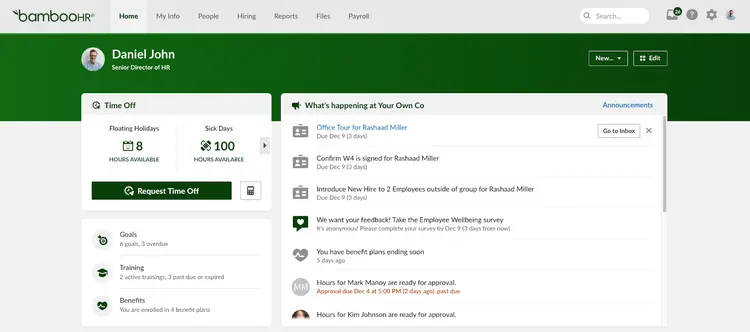
Besides its main label, BambooHR answers to simpler terms: an organized way to manage employee info, time off filings, and performance checks, and its strength lies less in flashiness, more in stripping complex human resources duties into clear steps, giving companies tools that actually fit real workflow demands.
Smooth operations continue even when firms adjust personnel duties to fit their needs, and insights emerge clearly through built-in reporting that does more than just summarize. External software links in effortlessly, broadening capabilities while keeping pace, and the whole setup adapts without dragging performance down.
Key Features:
- Time-off and attendance tracking.
- Employee performance and development tools.
- Customizable reporting and dashboards.
- Onboarding and recruitment features.
- Integration with third-party applications.
| Pros | Cons |
|---|---|
|
|
Best For: BambooHR is best suited for small and medium-sized businesses that require an easy-to-use HRIS for employee performance, time-off handling, and recruitment. It’s the perfect option for companies that want simplicity with essential HR needs.
6. SAP SuccessFactors
SAP SuccessFactors is a comprehensive human resource information system (HRIS) specifically designed for big businesses. It gives a series of answers for individual management, payroll, and functionality evaluations, tying HR functions to company processes in numerous regions.
SAP SuccessFactors offers a holistic reporting and analytics solution, facilitating data-driven decision-making. It is suitable for international corporations that have multi-jurisdictional HR needs.
Key Features:
- Talent and performance management tools.
- Payroll and compensation management.
- Learning and development tracking.
- Global compliance and regulatory support.
- Analytics and reporting tools.
| Pros | Cons |
|---|---|
|
|
Best For: SAP SuccessFactors is suited for large enterprises with complex HR and global compliance needs, offering a comprehensive suite of HR tools for talent management, payroll, performance, and analytics across multiple regions and business units.
7. UltiPro
UltiPro is an all-in-one Human Resource Information Systems software that includes payroll, benefits management, and talent acquisition capabilities. It is designed to satisfy advanced human resource requirements, which can be useful for significant enterprises from start to finish in the employee’s life.
This system is rolling out an integrated HR performance management and analytics tool suite that enables companies to see their people and make informed human resource management (HRM) decisions. There are also customization options to meet different industry requirements with UltiPro.
Key Features:
- Payroll and benefits management.
- Recruitment and applicant tracking system (ATS).
- Performance and goal management tools.
- Employee self-service options.
- Reporting and analytics integration.
| Pros | Cons |
|---|---|
|
|
Best For: UltiPro is best for large businesses seeking an all-in-one HRIS solution that integrates payroll, performance management, recruitment, and analytics. It is ideal for businesses that require robust HR features and customizable workflows for complex needs.
8. Workday
Workday is an HRIS intended for businesses of an enterprise level that features integration between HR and finance administration services. Offers a wide range of options for recruitment, HR administration, and employee development, which makes it a great solution for big companies.
Having a sophisticated reporting and analytics tool like Workday, businesses can make informed decisions. The platform is very adaptable and can cater to your large company’s different needs.
Key Features:
- HR and financial management integration.
- Recruitment and talent management tools.
- Employee performance tracking and goal setting.
- Time tracking and payroll automation.
- Robust reporting and analytics.
| Pros | Cons |
|---|---|
|
|
Best For: Workday solves the need for large businesses needing a robust HRIS that secures the management of HR and financial tasks well. Great for enterprises that want powerful reporting and can easily expand their capacity for different departments.
9. Optimum
Optimum HRIS offers a streamlined cloud-based solution for employee data, payroll, and performance. The platform has been designed to streamline HR tasks and provide a holistic workforce perspective to the organizations.
It has time-off and attendance-tracking features, which can assist companies in simplifying their HR processes. In addition to HRIS features, Optimum HRIS offers performance tracking and compliance monitoring, making it suitable for both small and large businesses.
Key Features:
- Employee data management.
- Payroll and performance management tools.
- Time-off and attendance tracking.
- Compliance management features.
- Customizable reporting.
| Pros | Cons |
|---|---|
|
|
Best For: Optimum HRIS suited to small and medium-sized enterprises (SMEs) that need a cost-effective, user-friendly, and reliable HRIS system that makes it easy to manage payroll, attendance, and employee information, with flexibility and remote access for employees.
10. Namely
Midsize companies often find that Namely fits their needs well, and their performance tracking shows up alongside payroll tasks inside one system benefits administration works smoothly within the setup. A straightforward layout makes navigation simpler for users, which, for smaller HR crews, handles duties without extra stress. The platform adjusts easily when teams grow or shift, while handling people operations feels less overwhelming over time.
Namely helps teams manage hiring, bringing people into roles, and then reviewing how they do over time. Right after that comes the part where everything links up smoothly with software already running in companies. This setup keeps work flowing without hiccups across departments, from beginning to end, and it supports what human resources handles day by day.
Key Features:
- Payroll and benefits management.
- Recruitment and onboarding tools.
- Performance management and reviews.
- Employee self-service options.
- Integration with third-party applications.
| Pros | Cons |
|---|---|
|
|
Best For: Namely is ideal for scaling up to mid-size businesses that require an HRIS solution with user-friendly capabilities for managing employee lifecycle activities like workflow organisation, performance management, recruitment, and benefits management. Easy system-to-system integration lets businesses operate seamlessly.
Benefits of a Cloud HRIS System
From HRIS, modern businesses are smartly adopting cloud HRIS for centralizing employee data, enhanced flexibility, scalability, and accessibility over older, on-premise solutions. The cloud allows HR teams to manage processes remotely, making it easier to scale and ensuring vital business continuity. Plus, it cuts expensive IT infrastructure needs.
Cloud HRIS truly offers fantastic advantages for streamlining HR tasks, boosting overall efficiency, and ensuring compliance. By automating routine administrative work, businesses can free up time to truly focus on more strategic HR goals. Let’s dive into the details now:
1. Faster and More Accurate HR Administration
A cloud HRIS system automates many of those routine HR tasks, like payroll, benefits management, and attendance tracking, which significantly reduces human error and minimizes frustrating delays. This level of automation ensures that every process runs much more quickly and with greater accuracy.
By eliminating manual data entry and repetitive tasks, HR teams finally have the space to focus on more strategic aspects of human resource management. The system ensures employees get accurate pay and benefits on time, boosting operational reliability and cutting the risk of costly mistakes.
2. Enhanced Employee Experience
Cloud HRIS systems let employees access their personal data, track benefits, and request time off directly through a simple self-service portal. This easy access truly empowers your staff, giving them more control and helping them manage their own HR needs quickly.
Thanks to self-service, employees can quickly check pay slips, request leave, and update personal info without waiting for HR staff. You can also utilize leave management software. This capability saves everyone time, boosts overall satisfaction, and significantly reduces the HR team’s workload, making the whole process efficient.
3. Improved Efficiency
A cloud HRIS system is brilliant for eliminating paper-based HR tasks, like manually filling forms or tracking attendance. Automation truly streamlines your workflows, allowing HR teams to manage tasks much more effectively and significantly boosting overall departmental productivity.
Since cloud solutions handle HR tasks in real-time, employees can instantly manage their schedules and time-off requests. This speed really enhances HR operations and ensures a more responsive, seamless, and efficient work environment for everyone.
4. Supports Compliance Efforts
Staying compliant with labor laws and company regulations is absolutely critical, and cloud HRIS systems make this much easier. With automatic updates, these systems ensure your HR processes always align with the very latest legal requirements without constant manual effort.
A cloud HRIS handles many compliance tasks, like accurate tax calculations, secure data management, and generating audit reports. These features really help businesses avoid penalties and dramatically reduce the risks of non-compliance, especially when managing remote teams.
5. Advanced Security Features
Cloud HRIS systems securely store sensitive employee data using advanced protection like encryption, firewalls, and multi-factor authentication. These strong security protocols are in place to ensure your confidential employee information remains truly safe from any unauthorized access.
Given the rising risk of data breaches, cloud HRIS offers robust data protection, giving businesses true peace of mind. Cloud storage also lets HR securely back up data, guaranteeing business continuity even when unforeseen disruptions occur.

Potential Challenges of HRIS Implementation
While we all know the key benefits of an HRIS. Actually implementing a new human resource information system is a big project. It comes with its own challenges. Being aware of these potential hurdles right from the start means you can really plan for a successful implementation.
Overlooking these challenges can lead to real headaches. Project delays. Budget overruns. Sometimes employees simply refuse to use the new system. So, let’s talk about some common issues companies often face. These points should help you navigate the process much more smoothly.
1. High Initial Cost and ROI Justification
Bringing in an HRIS can be a pretty significant financial investment, especially for smaller and medium-sized businesses. The costs involved, like software licenses, implementation fees, and hardware upgrades, can add up quickly. Proving clear ROI to stakeholders can be a major challenge.
To really get over this hurdle, building a solid business case is absolutely crucial. It needs to highlight not just the obvious cost savings but also those indirect, long-term benefits like improved productivity and just making better decisions, showing the overall long-term value.
2. Resistance to Change from Employees
People naturally tend to resist changing their established ways of working, and introducing a new HRIS is definitely a big change for everyone. Employees and managers may feel comfortable with existing processes. They might not be efficient. Gaining their buy-in is essential for the project’s success.
Effective change management really is the key here. This involves making sure everyone understands the benefits of the new system through clear communication. Provide thorough training. Involve employees in the implementation process itself.
3. Data Migration and Integration Issues
Moving all your existing data from old systems into a new HRIS can be an incredibly complex and time-consuming process. The data might be in different formats or scattered across various locations, and just making sure everything is accurate and complete during migration is a huge task, meaning data integrity is paramount.
Then there’s the integration part. The new HRIS often needs to connect with other systems, like accounting or project management. Ensuring smooth integration requires careful planning and thorough testing before launch.
4. Choosing the Right Vendor
The market has many HRIS vendors with varying features and pricing, so choosing the right partner is critical. A vendor that isn’t a good fit can cause unmet needs or poor support, creating significant business risk.
It’s super important to do your homework with thorough research and due diligence. This means getting demos. Checking references. Ensuring the vendor understands your business needs in Singapore. The goal is a partner, not just an HRIS supplier.
5. Ensuring Data Security and Privacy
An HRIS holds a vast amount of incredibly sensitive employee data, from personal details to salary information. Ensuring this data remains secure is a major responsibility. The system must comply with PDPA regulations. A data breach can have severe consequences.
Ensure your vendor provides strong security measures, and set clear internal policies for accessing and managing company data. This approach helps to protect both your company and your employees from potential risks.
How to Select the Right HRIS Software?
Choosing the right HRIS software is vital for streamlining HR, boosting efficiency, and ensuring compliance. With so many options out there, you need to evaluate your company’s needs, scalability, and integration ease to make a truly informed decision. Here are the key factors to consider when choosing the right HRIS software:
1. Assess Business Needs and HR Requirements
Before selecting any HRIS software, you need to assess your business’s specific HR needs. Think about your employee count, current processes, and the exact features you genuinely require, like payroll, benefits, or performance tools, especially when considering payroll software in Singapore.
It’s crucial to understand what your HR team truly needs for their daily operations. This ensures you choose software that’s a perfect fit, offering just the essential tools to streamline tasks and ultimately guarantee a much better return on your investment (ROI).
2. Consider Scalability and Flexibility
Scalability is absolutely key for any HRIS. As your business grows, the software should easily adapt to handle more employees, evolving processes, and expanding functions. Flexibility ensures the system can quickly adjust to new HR practices and regulations.
Choosing truly scalable software helps you avoid costly future upgrades or system changes as your business expands. Look for an HRIS that can handle both current and future needs, supporting more users, complex workflows, and any new HR features you might require.
3. Evaluate Integration with Existing Systems
Your HRIS absolutely needs to integrate seamlessly with existing software, like payroll, finance, or CRM systems. This link improves data accuracy and truly streamlines processes, helping you avoid duplicate entries and those tricky manual data transfers between systems.
Make sure the software is fully compatible with your current tools and workflows. Proper integration is great because it reduces data silos, significantly enhances collaboration across all departments, and ultimately saves time, boosting your operational efficiency.
4. Examine User-Friendliness and Accessibility
HRIS software really needs to be easy to use for everyone, both HR teams and employees. A friendly interface with clear navigation ensures quick adoption, cutting down on training time and ultimately improving efficiency in managing all HR processes and employee interactions.
Always look for software with strong employee self-service features. This lets employees easily access their data, request time off, or update personal information themselves. Accessibility via mobile or web platforms ensures they can engage with HR processes anytime and anywhere.
5. Review Support and Implementation Services
Choosing HRIS software means you absolutely need excellent customer support during and after implementation. Make sure your provider offers great training, technical assistance, and quick, responsive service to handle any issues smoothly as they come up.
Implementation is a key phase, so ensuring the vendor gives clear guidance and setup support is essential. Strong support teams will truly help you navigate any onboarding challenges, guaranteeing a smooth transition and continuous assistance for system optimization later on.
Conclusion
An HRIS is more than just software. It changes how Singapore businesses operate, from strategy to daily operations. It boosts productivity, decision-making, and engagement, but obstacles such as prices and adoption can be overcome with effective planning and assistance.
ScaleOcean offers integrated solutions that simplify HR procedures, increase efficiency, and enable more informed decisions. Businesses can also explore a free demo from ScaleOcean to experience firsthand how its features support smarter workforce management and sustainable growth.
FAQ:
1. What are the 5 types of HRIS?
This guide outlines the various HRIS systems, such as operational, tactical, strategic, comprehensive, and limited-function HRIS. We’ll explain their unique features, the types of organizations and HR teams they suit, and the reasons behind our recommendations.
2. Are HRIS and ERP the same?
While an ERP system manages functions like finance, supply chain, and operations, an HRIS focuses on managing people-related processes. When integrated effectively, both systems complement each other, providing teams with accurate data and enabling HR to use tools specifically designed for their requirements.
3. Is Excel an HRIS system?
No, Excel is not an HRIS system. While it can store employee data, it lacks the automation, security, and HR management capabilities that an HRIS provides.
4. Is CRMana Han an RIS system?
CRM platforms focus on centralizing data related to prospects and customers to enhance sales, forecasting, and retention. In contrast, an HRIS (Human Resource Information System) serves as the digital foundation for managing your people operations.



















.png)