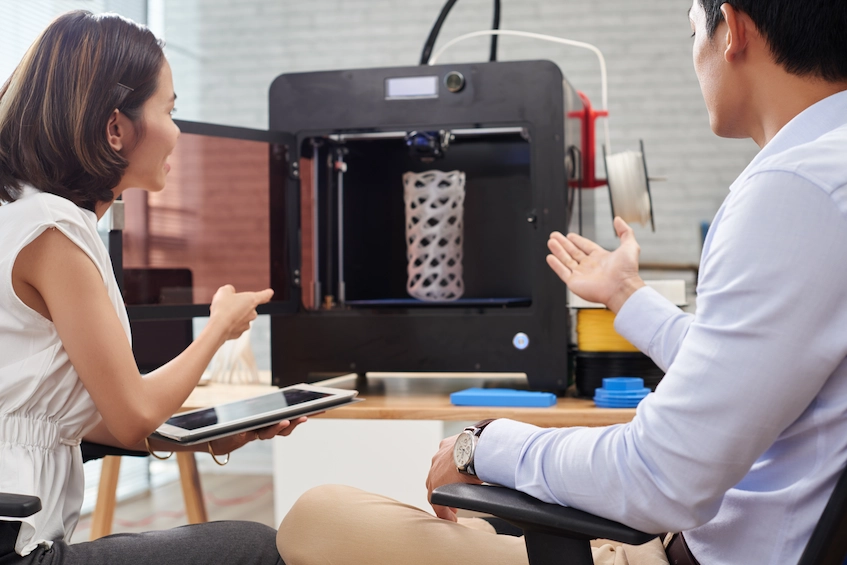
Additive manufacturing AM, commonly known as 3D printing, is the process of creating objects by adding material layer by layer from a digital model. Additive manufacturing enables manufacturers to build objects from the ground up, enabling complex shapes and intricate designs.
We have found research by Grand View Research indicating that additive manufacturing is experiencing significant global growth, with an estimated USD 30.55 billion in 2025 and projected to reach USD 168.93 billion by 2033, growing at a compound annual growth rate (CAGR) of 23.9 %.
These insights show that additive manufacturing is not just a niche technology but a rapidly expanding cornerstone of modern manufacturing. However, like any technology, additive manufacturing comes with its own set of challenges.
Curious about how additive manufacturing is revolutionizing industries? Explore this article to understand additive manufacturing definition, differences with traditional manufacturing, and much more! Let’s read the full article and dive into the latest trends and challenges.
Key Takeaways
Additive manufacturing is the process of building objects layer by layer from a digital file.
ScaleOcean Manufacturing Software is designed with the best business practices and industry standards in mind, enabling companies to tackle more industry-specific challenges with more relevant solutions.
Additive manufacturing is the process of building objects layer by layer from a digital file, also commonly called 3D printing. This is the opposite of conventional production techniques, which often involve removing material from a larger block.
With advantages such as rapid prototyping, reduced material waste, and the ability to create highly complex and personalised goods, additive manufacturing is becoming an increasingly important component for many businesses in Singapore.
The combination of government support, industry innovation, and the unique capabilities of 3D printing is driving its growth, positioning Singapore as a key hub for additive manufacturing in Asia.
Additive Manufacturing vs Conventional Manufacturing
Both additive manufacturing (AM) and conventional manufacturing are widely used to produce goods, but they operate on fundamentally different principles. These differences impact the features, capabilities, and efficiency of each method. Let’sbreak down the key differences between the two:
Feature
Additive Manufacturing (AM)
Conventional Manufacturing
Production
Builds objects layer by layer from digital files, adding material only where it’s needed.
Involves subtractive processes (cutting, drilling) or molding processes
Waste
Minimal waste since the material is deposited only when needed.
High material waste due to the removal of excess material
Flexibility
Enables complex geometries that are difficult to create with traditional methods.
Limited by mold and tool constraints.
Lead Time
Faster turnaround for small-scale or prototype production.
Slower setup times due to tooling, molds, and long lead times.
Cost
Lower upfront cost
because there is no need for specialized tooling or molds.
High initial costs for tooling, molds, and setup.
Why Is It Called Additive Manufacturing?
So, why is it called additive manufacturing? The term AM itself refers to the process of building objects layer by layer, adding material only where it’s needed, based on a digital model.
Unlike traditional manufacturing methods, which often involve subtractive processes (removing material from a larger piece), AM adds material incrementally to create the desired shape.
In short, additive manufacturing is named for its method of creating objects by adding material, as opposed to traditional techniques, which involve subtracting material to form the final product.
Additive Manufacturing and 3D Printing
Additive manufacturing and 3D printing both involve creating objects by building them up layer by layer, but the terms carry different connotations depending oncontext. Both terms are often used interchangeably, but there are subtle differences in their usage and scope.
In essence, 3D printing is a type of AM, but it encompasses a wider array of technologies and is used in moreadvanced industrial applications. Both terms refer to the same core principle of building objects layer by layer. Still, their usage varies depending on the scale and application.
For businesses and industries looking to implement this technology, understanding the full scope of additive manufacturing can help them choose the right method for their needs.
How Does Additive Manufacturing Work?
The additive manufacturing process involves three key components: Software, Hardware, and Materials. These three components have a different role in the process.
1. Software
The journey of additive manufacturing starts with software that translates the design into a format the 3D printer can understand. The software used in AM typically consists of:
3D Modeling Software: Designers create a digital model of the object using CAD (Computer-Aided Design) software. This model represents the object’s shape, dimensions, and structure.
Slicing Software: Once the 3D model is complete, the file is sent to slicing software, which divides the model into thin layers or slices. The slicer also generates instructions for the printer on how to print each layer. These instructions are typically saved in a file format such as STL or G-code.
Pre-Processing Software: Pre-processing tools can also optimize the design for 3D printing, ensuring there are no errors that might affect the object’s quality, strength, or structure.
2. Hardware
The hardware is the machine responsible for physically creating the object by building it up layer by layer. The printer is the centerpiece of this process and consists of the following elements:
Print Bed: A flat surface on which the object is printed. The bed may heat up to help with adhesion and prevent warping during the print.
Print Head or Nozzle: The component that dispenses the material onto the print bed. In some printers, there may be multiple nozzles for different materials.
Movement Mechanism: Motors and rails that move the print head or print bed in precise ways to build up the layers of the object.
Extruder or Laser: Depending on the type of AM, an extruder might melt and deposit the material (for filament-based printers like FDM), or a laser might fuse the material (as in SLA or SLS).
3. Materials
The materials used in additive manufacturing are critical for the strength, flexibility, and overall quality of the printed object. There are several types of materials, depending on the type of 3D printing process:
Plastics: PLA (Polylactic Acid) and ABS (Acrylonitrile Butadiene Styrene) are common thermoplastics used in AM, often in Fused Deposition Modeling (FDM).
Metals: Stainless steel, titanium, and aluminum are often used in Selective Laser Sintering (SLS) or Direct Metal Laser Sintering (DMLS) for applications that require high strength and heat resistance.
Resins: Liquid resins are cured by light in processes like Stereolithography (SLA) and Digital Light Processing (DLP), which produce highly detailed parts.
Composites: Materials like carbon fiber and fiberglass are combined with plastics to enhance strength and durability, particularly for aerospace and automotive industries.
Ceramics: Some advanced AM processes allow the use of ceramic materials for creating high-temperature-resistant parts, often used in industrial applications.
Manufacturing software helps optimize material flow, manage the correct temperature settings, and adjust parameters to prevent material waste, ensuring the most efficient use of raw materials. ScaleOcean can help streamline the integration of AM into your operations.
Additive manufacturing integrated with ScaleOcean Manufacturing Software provides better protection for operational data and enhances overall production processes. Check our banner below to request a free demo and see how ScaleOcean’s flexibility can help customize your business processes according to your specific needs.
15 Categories and Process of Additive Manufacturing
The various additive manufacturing processes offer different benefits depending on the material, precision, and application requirements. It is also the technology of AM that allows for layer-by-layer construction, offering greater design flexibility and reducing material waste.
Here’s a breakdown of 15 major AM processes categorized based on their specific techniques and methods:
1. Binder Jetting
In binder jetting, a liquid binder is selectively deposited onto a powder bed to bond the particles together, layer by layer. This process is commonly used for creating prototypes, casting molds, and full-color models.
2. Directed Energy Deposition (DED)
DED involves using a focused energy source (laser, electron beam, or plasma arc) to melt and deposit material onto a surface. This technique is used for repairing and adding material to existing parts, especially in industries like aerospace and automotive.
3. Material Extrusion
Material extrusion is the most widely used method in 3D printing, where a material (usually plastic filament) is heated and extruded through a nozzle to build an object layer by layer. This process is typically seen in Fused Deposition Modeling (FDM) and is popular for prototyping and low-volume production.
4. Powder Bed Fusion
In powder bed fusion, a laser or electron beam selectively fuses powdered material (typically metal or plastic) to form solid layers. This process is known for its precision and is used in both SLS (Selective Laser Sintering) and SLM (Selective Laser Melting).
5. Sheet Lamination
Sheet lamination involves stacking thin sheets of material (typically metal or paper) and bonding them together using heat or adhesive. This process can be used for creating parts with layered structures and is ideal for low-cost, fast prototyping.
6. Vat Polymerization
Vat polymerization uses liquid photopolymer resins that are cured layer by layer using ultraviolet light. Stereolithography (SLA) and Digital Light Processing (DLP) are common methods in this category, providing high-resolution outputs for detailed prototypes and medical applications.
7. Wire Arc Additive Manufacturing (WAAM)
WAAM uses a welding arc to melt wire material, which is then deposited onto the build surface layer by layer. This method is typically used for large metal parts in industries like aerospace and heavy machinery.
8. Fused Deposition Modeling (FDM)
FDM is one of the most popular AM processes, where a thermoplastic filament is heated and extruded to form layers. It is widely used for rapid prototyping, product development, and low-volume production.
9. Stereolithography (SLA)
SLA uses a laser to cure liquid resin layer by layer, creating highly detailed parts. It is widely used for producing prototypes with fine details, especially in the jewelry, dental, and medical industries.
10. Selective Laser Sintering (SLS)
SLS uses a laser to sinter (fuse) powdered material, typically plastic or metal, into a solid structure. It is known for producing durable, functional parts, especially in the aerospace and automotive industries.
11. Direct Metal Laser Sintering (DMLS)
DMLS is a specific form of SLS that uses a laser to fuse metal powders into solid parts. This process is used for creating high-performance metal components with complex geometries, commonly applied in aerospace and medical industries.
12. Metal Fused Filament Fabrication (MFFF)
MFFF combines the principles of FDM with metal powders embedded in a plastic filament. The material is extruded, and the part is later sintered to remove the plastic, leaving behind a dense metal part. It is used for low-cost metal prototyping.
13. Digital Light Processing (DLP)
DLP is a form of vat polymerization where a digital light projector is used to cure resin layer by layer. It is faster than SLA and is commonly used for high-resolution prototypes and parts in jewelry and dentistry.
14. Electron Beam Melting (EBM)
EBM uses an electron beam to melt metal powder in a vacuum environment. The process is similar to SLS but operates at much higher temperatures and is ideal for producing dense, high-strength parts used in aerospace and medical implants.
15. Multijet Printing (MJP)
In MJP, a print head deposits droplets of photopolymer material onto a build platform, which are then cured by ultraviolet light. This technique is used for creating detailed, functional prototypes with high resolution, often in industries such as aerospace and electronics.
What are the Additive Manufacturing Materials?
Additive manufacturing (AM) uses a wide variety of materials to create objects layer by layer, depending on the specific application and the required properties of the final product. Here’s a list of the key material categories used in AM:
1. Biochemicals
Biochemicals are materials derived from biological sources and are increasingly being used in AM for applications in the medical, biomedical, and environmental fields. They are often used for creating customized implants, prosthetics, and scaffolds for tissue engineering.
Common Types: Biocompatible resins, bio-based plastics, and biodegradable materials.
Uses: Medical implants, tissue scaffolding, drug delivery systems.
Advantages: Biocompatible and environmentally friendly, suitable for healthcare applications where customization and biocompatibility are key.
2. Ceramics
Ceramics are inorganic, non-metallic materials often used in AM due to their ability to withstand high temperatures and their hardness. They are used in industries like aerospace, automotive, and healthcare for creating high-performance parts.
Common types: Alumina, zirconia, and silica.
Uses: Aerospace components, medical implants, dental restorations, heat shields, and sensors.
Advantages: High heat resistance, durability, and strength, particularly suitable for parts exposed to high temperatures and wear.
3. Thermoplastics
Thermoplastics are polymers that become soft and moldable when heated and solidify when cooled. They are the most commonly used materials in AM due to their versatility, ease of processing, and wide availability.
Common Types: PLA (Polylactic Acid), ABS (Acrylonitrile Butadiene Styrene), Nylon, PET (Polyethylene Terephthalate).
Uses: Prototyping, low-volume manufacturing, custom parts, and consumer goods.
Advantages: Low cost, ease of use, and a wide range of material properties, making them ideal for general-purpose applications and prototypes.
4. Metals
Metals are used in AM to produce strong, durable, and high-performance components. Metal AM is commonly employed in industries such as aerospace, automotive, and medical device manufacturing, where precision and material strength are critical.
Common Types: Stainless steel, titanium, aluminum, cobalt chrome, and nickel alloys.
Uses: Aerospace components, medical implants, automotive parts, and tooling.
Advantages: High strength, thermal conductivity, and excellent durability, ideal for producing parts that require superior mechanical properties.
5. Composites
Composites are materials made from two or more constituent materials (typically a matrix and a reinforcing material) that offer unique properties such as enhanced strength, stiffness, or durability. In AM, composites are often used to improve the mechanical properties of printed parts.
Common Types: Carbon fiber-infused plastics, fiberglass composites, metal matrix composites.
Advantages: Enhanced strength-to-weight ratio, increased durability, and improved resistance to high temperatures and wear, making them ideal for demanding applications.
What are the Benefits of Using Additive Manufacturing Technology?
As industries across the globe continue to embrace this technology, the benefits of additive manufacturing are becoming increasingly apparent. Below are some of the key benefits that businesses can gain by integrating AM into their operations.
Increased In-House Production Capabilities
Additive manufacturing allows businesses to bring production in-house, reducing their reliance on external suppliers and manufacturers. This capability provides companies with the flexibility to produce parts or products on demand, increasing responsiveness and control over production timelines.
Cost-Effectiveness
AM significantly reduces costs associated with tooling, molds, and waste material. Since it only uses the material required for each part, there is minimal waste generated. Additionally, businesses can produce low volumes of customized products without expensive setup or production runs, making it cost-effective for prototyping and small batches.
Greater Design Flexibility and Process Adaptability
Additive manufacturing offers unmatched design freedom, enabling the creation of complex geometries that would be difficult or impossible with traditional methods. This technology allows businesses to explore more innovative designs and quickly adapt their production processes without major changes to the equipment or tooling.
Reduced Lead Times
AM significantly shortens the time required to produce prototypes or finished products. Because there’s no need for tooling or molds, the production process is faster, allowing companies to produce items quickly and get them to market sooner.
Accelerated Time to Market
By shortening lead times and simplifying the prototyping process, AM helps companies bring new products to market faster. This gives businesses a competitive edge, especially in fast-paced industries where being first to market is critical to success.
Complete Control Over the Supply Chain
With additive manufacturing, companies gain greater control over their supply chain by enabling on-site, on-demand production. This reduces dependency on external suppliers, cuts down on shipping delays, and minimizes inventory costs, making the entire supply chain more efficient and flexible.
Fostering a Culture of Innovation
AM encourages innovation by providing designers and engineers with the freedom to experiment with new ideas without the constraints of traditional manufacturing processes. The ability to quickly prototype and iterate designs fosters a culture of creativity and innovation, enabling businesses to implement good manufacturing practices.
What are the Challenges of Additive Manufacturing?
Additive manufacturing offers a flexible manufacturing system and innovation, but businesses still face several operational and financial limitations when adopting this technology at scale. Understanding these challenges helps companies plan investments more effectively and align expectations with real-world capabilities.
Mass Production Costs
Producing items in large volumes using AM can be expensive compared to traditional methods like injection molding. While it reduces tooling costs, the per-unit cost remains relatively high, making it less ideal for mass production environments.
Limited Throughputs
AM processes are generally slower than conventional manufacturing techniques. This limitation affects production capacity, especially when businesses need to meet high demand within tight timelines or scale operations quickly.
Software Integration Restrictions
Integrating additive manufacturing systems with existing enterprise software can be complex. Compatibility issues with ERP, CAD, or production management systems may create data silos and reduce overall operational efficiency.
Material Costs
The materials used in additive manufacturing, such as specialized polymers, metals, or composites, are often more expensive than traditional raw materials. This increases overall production costs, particularly for companies with high material consumption.
For manufacturers adopting AM, these challenges can result in higher production costs, longer lead times, and potential product defects. With the right software, manufacturers will be able to test and predict how the printed part will behave during and after production.
ScaleOcean Manufacturing Software can support businesses in overcoming these hurdles through its integrated manufacturing solutions. Our system is designed with the best business practices and industry standards in mind, specifically for manufacturing, enabling companies to tackle more industry-specific challenges with more relevant solutions.
ScaleOcean with unlimited users with no hidden fees, efficient after-sales service, and system customization and IIoT implementation tailored to the specific needs of industries, processes, and workflows of companies in Singapore across various sectors.ensures manufacturers can maintain tighter control over their workflows, improving efficiency and minimizing errors.
State of Current Additive Manufacturing Technology
The current state of additive manufacturing technology reflects steady progress across hardware, connectivity, materials, and standardization. These developments are making the technology more reliable, scalable, and relevant for enterprise-level operations.
Hardware Improvements
Advancements in printer speed, precision, and reliability have significantly improved production outcomes. Modern machines can handle more complex geometries with higher consistency, enabling better quality control and reducing production errors.
Connectivity to Industry 4.0
AM systems are increasingly integrated with Industry 4.0 technologies, such as IoT in manufacturing and real-time data analytics. This connectivity allows businesses to monitor production remotely, optimize workflows, and make faster, data-driven decisions.
Broader Material Compatibility
The range of compatible materials has expanded beyond basic plastics to include metals, ceramics, and composites. This development allows businesses to apply additive manufacturing across more industries, from aerospace to healthcare.
Standards of Additive Manufacturing
Efforts to establish global standards are improving consistency and trust in additive manufacturing outputs. Standardization ensures that products meet quality, safety, and regulatory requirements, which is crucial for industries with strict compliance needs.
How Organizations Use Additive Manufacturing Across Industries?
Additive manufacturing is being utilized across various industries, with each sector applying it to solve unique challenges and improve processes. Here are examples for each of the common uses in various industries:
Aerospace
Example: Our recent research has found that ASTM International revealed that aerospace manufacturer Boeinguses AMto produce lightweight, complex parts for aircraft, such as air ducts and brackets. These parts help reduce the overall weight of the aircraft, leading to fuel savings and improved performance.
Consumer Products
Example:Adidas has publicly announced that they employed 3D printing to create custom shoes for athletes, allowing for personalized designs and improved comfort. They use AM to rapidly prototype and produce innovative footwear designs.
Dental
Example:Stratasys provides 3D printers for dental labs to create personalized dental implants, crowns, and bridges. These parts are custom-fitted to the patient’s mouth, improving comfort and fit.
Energy
Example:GE Renewable Energy uses AM to produce critical components for wind turbines. 3D printing is used to create complex parts that would be difficult or impossible to produce using traditional methods, improving efficiency and performance.
Federal & Defense
Example:The U.S. Air Force is exploring AM to create on-demand spare parts for military equipment. This reduces the need for long supply chains and improves the availability of necessary parts during missions.
Industrial Equipment
Example:Caterpillar uses AM to create heavy equipment parts such as valves and housings, which are more durable and cost-effective than traditionally manufactured components.
Medical
Example:Stryker, a leading medical technology company, uses 3D printing to create custom implants and prosthetics for patients. These implants are designed to fit each patient’s individual anatomy, leading to better outcomes.
Scientific & Laboratory
Example:The University of California, Berkeley, uses 3D printing to create specialized lab equipment and prototypes. Additive manufacturing allows researchers to rapidly develop and test new designs, reducing the time required for experiments and improving research efficiency.
Additive Manufacturing Trends in Industry 4.0
AM is becoming an integral part of Industry 4.0, a new era of smart manufacturing that leverages advanced technologies to optimize production processes. In this section, we explore how these manufacturing trends are shaping the future of additive manufacturing within the framework of Industry 4.0.
Big Data
The integration of big data with AM allows for better decision-making by enabling real-time monitoring of production data. With the ability to collect vast amounts of data from the manufacturing process, organizations can optimize designs, predict maintenance, and improve overall manufacturing efficiency.
Artificial Intelligence (AI)
AI is playing a significant role in enhancing AM processes. It allows for smarter automation, defect detection, and quality assurance by using algorithms to analyze data from 3D printing machines. AI can also optimize print paths, predict machine malfunctions, and adapt designs for improved performance, reducing waste and increasing speed.
Cloud Computing
Cloud computing enables manufacturers to manage 3D printing workflows remotely, collaborate globally, and store vast amounts of design files, data, and production results. With cloud platforms, businesses can use AM in a distributed network, allowing designers, engineers, and manufacturers to work together more effectively across different locations.
Data Analytics
With data analytics, manufacturers can now analyze patterns from additive manufacturing processes to make informed decisions. Predictive analytics can be used to forecast machine performance, material consumption, and operational efficiency.
Additive Manufacturing and Government Programs
Singapore has been actively promoting additive manufacturing AM as part of its broader strategy to strengthen advanced manufacturing and position the country as a leader in Industry 4.0. One key initiative is the National Additive Manufacturing Innovation Cluster (NAMIC).
NAMIC’s efforts accelerate the adoption of AM technologies, which are aligned with Singapore’s Manufacturing 2030 vision, aimed at increasing the manufacturing sector’s value‑add and driving innovation in high‑value production through digital and hybrid manufacturing methods.
In addition, the Singapore government also sponsors specific programmes and collaborations to boost additive manufacturing in strategic sectors. For example, in 2024, joint industry programmes were launched to explore AM applications in areas like maritime parts fabrication, targeting improved supply chain resilience and new design opportunities in electric vessels.
Conclusion
Additive manufacturing in Singapore is rapidly evolving, fueled by government initiatives, industry collaborations, and technological advancements. The government’s support through programs like the NAMIC and joint industry programme, Singapore is establishing itself as a leader in adopting and scaling additive manufacturing processes.
As businesses in Singapore embrace additive manufacturing, ScaleOcean can play a crucial role by providing integrated ERP solutions that optimize companies’ additive manufacturing workflows, improve inventory management, and ensure smoother coordination across departments.
Don’t miss out on transforming your manufacturing processes! Try ScaleOcean’s free demo today to explore how our ERP system can transform your business and support your journey in adopting cutting-edge additive manufacturing technologies.
FAQ:
1. Is CNC harder than 3D printing?
CNC machining is typically thought to be more difficult to learn and operate because of its steeper learning curve, complicated setup, technical software (CAM), and the inherent hazards of a subtractive process, even though both 3D printing and CNC machining require significant ability to master for professional results.
2. Can I do additive manufacturing at home?
Without having to be in the office, engineers can quickly prototype a product part using their home 3D printer to obtain practical testing. The final version can be produced ahead of schedule, and the design process can move forward as planned.
3. What is cold spray additive manufacturing?
Cold spray additive manufacturing is a process where fine metal particles are accelerated to high speeds and then impacted onto a substrate at relatively low temperatures (below the melting point of the material).
4. What is rapid tooling in additive manufacturing?
Rapid tooling refers to the use of additive manufacturing techniques to produce tools, molds, and dies quickly and cost-effectively. This process is used to create production tools for mass production or prototyping, reducing the time and cost associated with traditional tooling methods.












 Key Takeaways