Supply chain network design is the strategic process of locating suppliers, manufacturing facilities, warehouses, distribution centers, inventory, points of customer fulfilment, and how products move between them. The aim is to design a supply chain system to achieve a compromise between operating cost, capacity, delivery performance, resilience, and future business growth.
For enterprise companies in Singapore, network issues may become more apparent as enterprise companies expand their operations across the region. Cost-to-serve, stock at the wrong nodes, sub-optimal distribution routes, supplier concentration, duplicated stock, and over-reliance on a Singapore-only regional footprint all contribute to rising costs and difficulties in maintaining service levels.
Supply chain network design solves these problems by designing the supply chain network before a large-scale investment by modelling facilities, sources, inventory, transport, capacity, and demand. It enables enterprises to analyze the various scenarios of their networks and select the optimal option in terms of cost, service level, working capital, scalability, and resilience.
According to the data our team got from Reuters, Singapore and Malaysia formalized the Johor-Singapore Special Economic Zone in 2025 to improve cross-border movement and regional competitiveness, with a target of attracting 50 projects in its first five years. For Singapore enterprises, this creates more flexibility to decide which supply chain activities should remain locally.
Read this article to understand what supply chain network design is, how it works, common network models, when redesign becomes necessary, key optimization factors, the step-by-step design process, practical business examples, and software that can support supply chain network planning and execution.
Key Takeaways
Supply chain network design helps companies structure suppliers, plants, warehouses, inventory, transport lanes, and customer markets to balance cost, service, capacity, and resilience.
An effective supply chain network helps businesses improve inventory placement, reduce unnecessary logistics costs, strengthen service levels, and prepare for future expansion or disruption.
ScaleOcean Supply Chain Management Software connects network planning with procurement, inventory, warehouses, transportation, finance, and multi-entity operations within One Platform.
Supply chain network design is a strategic planning process that involves determining the physical configuration and structure of a supply chain. It’s a matter of figuring out the best number and geographic location of suppliers, factories, distribution centers, and determining how products move through these nodes to the customer.
Network design differs from the planning that occurs day-to-day because it has a more long-term impact on network operations that lasts several years. A company may evaluate whether to open another warehouse, consolidate two distribution centers, move inventory closer to customers, add a second supplier, change transportation modes, or split regional fulfilment between Singapore and another ASEAN location.
Effective design therefore looks beyond individual logistics expenses. Companies need to understand how sourcing, production, inventory, transportation, customer demand, and facilities interact throughout the broader value chain. A cheaper warehouse, for example, may not improve the network if it creates longer delivery times, higher inventory, or additional cross-border transportation.
The supply chain network design should also be linked to the wider supply chain management. But after the physical and operational network is in place, there are still the sourcing, inventory, fulfilment, logistics, and supplier activities to follow that design.
The first step in designing a supply chain network is to create a model of what the flow of products looks like. The model integrates suppliers, facilities, customers, SKUs, demand, inventory, transportation lanes, capacities, service level requirements, costs, taxes, lead times, and operational constraints.
Teams then establish a baseline before creating alternative configurations. A scenario could test what happens when one Singapore warehouse is replaced with two regional facilities, manufacturing capacity is shifted, a new supplier is introduced, or customers are served through different transport modes.
Optimization models compare those alternatives against objectives such as total landed cost, delivery speed, inventory investment, service level, capacity utilization, profitability, and resilience. The preferred design is therefore rarely the option with the lowest warehouse or freight expense alone.
The final result provides a proposed network structure, including facility roles, sourcing relationships, inventory allocation, customer assignments, transport lanes, capacities, and contingency options. Because demand and external conditions continue changing, network design should be reviewed periodically rather than treated as a one-time project.
When Should a Company Undertake Supply Chain Network Design?
A supply chain can continue operating even when its structure is no longer economically appropriate. Network design is particularly useful when a major business change invalidates assumptions about demand, suppliers, facilities, or customer service.
1. Mergers and Acquisitions (M&A)
An acquisition can leave the combined organization with overlapping warehouses, duplicated suppliers, competing transportation contracts, and facilities serving similar customer regions.
Network modelling helps determine which assets should remain, expand, consolidate, or change roles. It can also estimate the cost and service implications before physical restructuring begins.
2. Geographic Market Expansion
Entering another country or region changes demand locations, customs considerations, transportation lanes, service requirements, and inventory positioning. Simply serving every new market from the existing network can make transportation and working-capital requirements increasingly expensive.
Companies should compare alternatives such as direct shipping, regional distribution centers, local fulfilment, third-party logistics, or a Singapore-plus-ASEAN footprint before committing capital.
A practical example can be seen in the Johor-Singapore Special Economic Zone. The Business Times reported how logistics companies are exploring the complementary strengths of Singapore’s connectivity and Johor’s land, labor, and cost advantages.
For Singapore enterprises, this illustrates how network design can determine which high-value activities remain locally and which storage, manufacturing, or fulfilment capacity can be positioned elsewhere in the region.
3. New Product Launches
New products may require different suppliers, storage environments, production lines, inventory policies, or delivery windows from the existing portfolio.
The product design could affect current facility capacity or identify if a new fulfilment plan is needed.
4. Channel Shifts for Omnichannel Operations
When online sales to consumers and marketplaces rise, this network may fall short of replenishing stores. The business could suddenly find that they need to ship pallets to stores, but then find that they need to be able to deal with thousands of smaller orders.
Companies can model store fulfilment, dedicated e-commerce centers, shared warehouses, micro-fulfilment, and hybrid models before changing their operating footprint.
5. Declining Service Levels
Repeated late deliveries, stockouts, long order cycles, or missed fulfilment targets may indicate a structural problem rather than a day-to-day execution issue.
The network may have insufficient capacity, inventory located too far from demand, unsuitable transport lanes, or customer territories assigned to the wrong facilities.
6. Margin Erosion
Rising revenue does not necessarily mean the supply chain remains profitable. Freight, storage, labor, tariffs, inventory carrying costs, and repeated transfers can gradually increase cost-to-serve.
Network optimization helps reveal whether certain markets, products, customers, or routes generate disproportionate logistics expenses and whether structural redesign can restore margin.
7. Network Capacity Imbalance
Some warehouses may operate close to capacity while others remain underused. Similar imbalances can appear across suppliers, production facilities, ports, or transportation lanes.
Network design identifies whether demand can be reassigned, capacity expanded, inventory moved, or facilities repositioned before operational constraints become service failures. Strong supplier relationship management also helps ensure these decisions reflect supplier capacity, lead times, reliability, and sourcing risks.
For enterprises with complex regional networks, ScaleOcean Atlas connects supplier, procurement, inventory, warehouse, transportation, and financial data within One Platform. Its configurable workflows and multi-entity support help teams align network changes with actual sourcing and operational requirements as the business expands.
What Is the Importance of Supply Chain Network Design?
The importance of supply chain network design is huge, as it influences 70% to 80% of long-term operational costs and determines how well a company can meet its customers’ needs. It maps and configures the suppliers, factories, and warehouses to balance costs with delivery time.
1. Cost Reduction
Supply chain network design analyses the cost of the entire supply chain rather than trying to lower a single cost. Businesses can simulate the transportation, warehousing, inventory, labor, production, taxes, and handling expenses of various network configurations.
This wider perspective enables businesses to prevent taking decisions that might seem to be more cost-efficient at a particular node while resulting in higher costs elsewhere. For instance, cutting down on inventory or delivery time could result in higher inventories and handling in the warehouse, which may not be a worthwhile trade-off.
2. Capital Optimization
There can be a big investment in facilities, automation, fleets, machinery, and inventory. Network modelling assists businesses in finding out exactly where more capacity is actually required and also where existing possessions can possibly sustain future development.
Management can compare viable options prior to investing and invest in the best-returning options for operations. This can help avoid creating facilities that will never be used to capacity or expanding capacity in the wrong location.
3. Working Capital Efficiency
Duplicated safety stocks, excess goods in stock, and slow-moving goods can result if the inventory is distributed over too many locations. An important aspect of supply chain network design is to decide the items to be kept in every node, depending on the demand, service requirement, and replenishment pattern.
Having the right inventory at the right locations can minimize excess inventory and the risk of products being unavailable. It also provides the business with a more solid foundation to make decisions about what should stay in the central location and what should be placed at a closer range to the customer.
4. Faster Delivery Speed
Having the right goods available at the right places can reduce the time and response to goods in transit from the customer’s need. This is particularly applicable for businesses that deal with markets that have demanding delivery cut-off times or volatile order volumes.
However, faster delivery should not automatically mean adding more facilities. Network design helps companies compare the service improvement against additional warehouse, labour, transportation, and inventory costs before expanding the footprint.
5. Risk Mitigation and Resilience
Network analysis is useful to businesses to detect dependency on a single supplier, manufacturing site, warehouse, transportation route, or port. Once these vulnerabilities are exposed, companies can simulate alternative sourcing, capacity, and inventory options, and distribution channels before they are needed.
Even if using backup suppliers, extra capacity, alternative routes, and strategic inventory is not the lowest-cost option in normal times, it can be used in a resilient network. The purpose is to optimize efficiency without compromising flexibility in the event of change.
6. Carbon Footprint Reduction
Supply chain emissions include facility location, transportation distances, shipment consolidation, inventory flows, and transport modes. Network design enables businesses to consider cost and service requirements as well as these environmental factors.
Businesses can contrast situations like moving from air to sea freight, bundling shipments, relocating warehouses, or moving closer to the demand. This ensures that sustainability is incorporated into strategic network decisions, rather than as a separate activity.
7. Customer Satisfaction and Loyalty
Reliable product delivery and availability directly affect the customer experience. An unorganized network will allow for inventory to be in the business but in the wrong warehouse or too distant from the customer who would use it.
An optimized network matches the location of inventory, capacity, and fulfilment with customer demand. This can lead to better order availability, a lower rate of missed orders, and better order service across regions.
8. Agility and Scalability
The scalable supply chain network should take in new customers, products, warehouses, suppliers, and transactions without having to redesign the supply chain each time the company grows. Scenarios also enable management to spot potential places where capacity and service limitations will crop up.
Agility is also essential in the event of fluctuations in demand, suppliers, or new markets. Businesses will be able to experiment with a variety of sourcing, storage, and facility configurations before they need to make a response to issues on the fly.
For enterprises managing complex regional operations, ScaleOcean Atlas connects procurement, inventory, multi-warehouse capacity, transportation, finance, and multi-entity supply chain data within One Platform. Supported by ScaleMind insights, teams can review demand, stock, lead times, cost-to-serve, and network risks more consistently as the supply chain scales.
What Are the Key Factors to Consider When Designing a Supply Chain Network Model?
A reliable model should represent the major economic and operational trade-offs across the network. Incomplete assumptions can produce a mathematically attractive design that performs poorly once implemented.
Financial & Cost Factors
1. Transportation and Logistics Costs
Model inbound, inter-facility, outbound, parcel, ocean, air, road, drayage, handling, and accessorial costs. Transportation should also reflect shipment size, service type, distance, and mode rather than using one average cost.
2. Facility Expenses
Include rent, utilities, labour, equipment, maintenance, automation, security, and facility-management costs. Singapore enterprises should pay particular attention to whether high-value activities justify premium facility costs relative to alternative regional locations.
3. Inventory Holding Costs
Inventory consumes working capital and creates storage, insurance, obsolescence, and handling expenses. Increasing the number of warehouses can improve proximity while also increasing duplicated stock. Effective supply chain risk management helps businesses optimise inventory strategies and maintain better balance between availability and operational costs.
4. Taxes and Tariffs
Cross-border networks may be affected by duties, tariffs, indirect taxes, customs structures, and trade agreements. These factors should be included in landed-cost calculations rather than reviewed after a facility decision has already been made.
5. Cost and Investment Requirements
New distribution centers, automation, equipment, software, relocation, and transition projects require capital. Companies should compare both recurring operating costs and one-time implementation expenditure.
Customer Service & Demand Factors
6. Lead Time and Delivery Windows
Customer promises define how far inventory can practically sit from demand. Same-day, next-day, scheduled B2B, and export orders may each require different network configurations.
7. Demand Geographic Density
A large concentration of customers in one market can justify a local distribution point, whereas dispersed low-volume demand may remain more economical to serve centrally.
8. Order Profiles
Network requirements depend on whether customers order pallets, cartons, individual units, bulk commodities, temperature-controlled goods, or high-value products. Order frequency and seasonality should also be included.
Infrastructure & Capacity Constraints
9. Facility Throughput Limits
Warehouse space alone does not determine usable capacity. Receiving docks, picking rates, staging space, equipment, labor shifts, automation, and dispatch capacity can constrain throughput before the building is physically full.
10. Supplier Capabilities, Networks, and Proximity
Supplier capacity, lead time, reliability, location, minimum orders, and transportation options influence sourcing decisions. A low-cost supplier may become unattractive if long lead times require significantly more inventory.
Risk, Resilience & Geopolitical Factors
11. Single Points of Failure
Identify products or markets that depend entirely on one supplier, facility, transport lane, port, or manufacturing site. Scenarios can then evaluate alternative sources and routes.
12. Geopolitical Stability
Trade restrictions, conflict, tariffs, sanctions, border issues, and regulatory changes can alter the viability of global sourcing and distribution structures.
13. Agility and Flexibility
A network should not only perform under the average forecast. Teams should test whether it can accommodate demand spikes, supplier losses, transport disruption, and rapid changes in product mix.
14. Regulatory Compliance
Food, pharmaceuticals, chemicals, electronics, and other regulated goods may require specific licenses, storage conditions, documentation, and traceability across network nodes.
Sustainability & Environmental Impact
15. Carbon Footprint and CO₂ Emissions
Transportation mode, distance, facility energy consumption, sourcing location, and shipment consolidation influence emissions. These variables can be incorporated as scenario constraints or objectives.
16. Circular Economy Capabilities
Returns, repairs, recycling, refurbishment, reusable packaging, and reverse logistics can require different nodes from the forward distribution network.
Technology Used
17. Advanced Supply Chain Management Software
Modern SCM software connects demand, suppliers, procurement, inventory, warehouse capacity, transportation, and cost information. This creates a stronger data foundation for network modelling and ongoing optimization.
18. Agentic AI
AI-assisted tools can help identify anomalies, summarize network conditions, prepare scenarios, and evaluate changes across large operational datasets. Human review remains important for strategic decisions involving capital, supplier relationships, regulatory requirements, and service commitments.
Step-by-Step Supply Chain Network Design Process
The design of supply chain networks deals with strategic issues regarding the optimal placement of facilities, the design of transportation networks, and the distribution of inventories to meet service goals at least-cost over the long-term. Following this layout will require you to pass through 8 key stages, starting from start to finish, and even up to live execution.
Step 1: Data Collection
Create customer demand, SKU History, suppliers, plants, warehouses, costs, inventory, transport lanes, lead times, capacity, taxes, service requirements, and geographical data.
Transaction-level movement history is particularly useful because product traceabilityhelps teams understand how products actually move through suppliers, warehouses, batches, and customer deliveries rather than relying only on planned flows.
Step 2: Perform a Supply Chain Audit
Document the current network before network redesign. Identify the purpose of each facility, customer placement, supplier connections, inventory practices, transportation practices, exceptions, and cost considerations.
This would become the reference point when considering future scenarios.
Step 3: Supply Chain Network Modelling
Use operational data to build a model that includes suppliers, facilities, customers, products, demand, capacities, costs, flows, and constraints.
The model should be an accurate representation of the existing network so that management can use the output of the model as a baseline to which they can trust before they go on to test out other designs.
Step 4: Conduct Facility Location Analysis
Evaluate where facilities would ideally sit relative to demand, suppliers, infrastructure, labour, cost, and service requirements.
Greenfield analysis can help identify potential locations from scratch, while brownfield analysis evaluates changes involving existing facilities.
Step 5: Make Network and Facility Decisions
Determine which plants, warehouses, fulfilment centers, suppliers, and transport lanes should remain, expand, close, consolidate, or change purpose.
Management should assess operational feasibility alongside mathematical optimization before making capital decisions.
Step 6: Scenario and “What-If” Simulation
Test alternatives such as demand growth, supplier failure, tariff changes, fuel increases, facility closures, new markets, inventory policies, or additional regional warehouses.
Comparing several scenarios reveals which configuration remains effective under multiple conditions rather than only under one forecast.
Step 7: Optimization and Selection
Compare total cost, service, working capital, capacity, profitability, emissions, and risk. The best network is usually a trade-off rather than the absolute minimum of one KPI.
Leadership can then select a preferred design and maintain one or more contingency scenarios.
Step 8: Implementation and Monitoring
Network redesign may involve contracts, inventory transfers, facility openings, supplier changes, system integrations, recruitment, transport tendering, and phased migration.
After implementation, monitor demand, capacity, costs, service, inventory, and risk. Material changes should trigger another design review instead of waiting several years.
What Challenges Do Businesses Face When Designing Supply Chain Networks?
Key challenges for companies in creating supply chain networks are the trade-offs between cost and service speed, and data silos and forecasted consumer demand are highly volatile. Other challenges range from dealing with geopolitical risks, climate risk, and strict sustainability mandates, to convincing customers of the benefit of high software or implementation costs.
1. Data Silos
Data may be part of several systems, including demand data, supplier data, freight data, inventory data, finance data, warehouse data, or customer data systems. A lot of time may be required to ensure that teams are able to reconcile inconsistencies before they can start network modelling.
There can also be departmental conflicting information caused by these silos. If demand, inventory, and cost data are inconsistent, the resulting model might not accurately represent the performance of the real network.
2. Inaccurate Cost Data
Freight rates or parts of the warehouse costs can lead to false network recommendations. The cost of transport and handling, labor, stock, taxes, accessorial costs, and conversion costs are variable and fixed costs that should be taken into account in a realistic model.
In a large number of facilities, products, and transport lanes, small deviations can add up to become big. Therefore, it is crucial to know the cost structures and be able to compare other network configuration options before purchasing the solution.
3. Demand Volatility
History does not necessarily foretell future demand. There are a wide variety of reasons why a static forecast may become even less relevant than it was at the time it was made: new products, changing customer habits, promotions, seasonal trends, market expansion, losses, and many others.
Businesses need to therefore test several different demand scenarios and not just one. This may be beneficial in helping management appreciate the way the network will respond to product growth, product decline, or a sudden change in product mix.
4. Macroeconomic Volatility
The economics of different facilities and sourcing locations can change due to fuel prices, foreign exchange rates, inflation, interest rates, labor costs, and tariffs. What may be the ideal network now, but in the event of any of these parameters changing, it may not be the same network.
Businesses can gain insight into their network’s vulnerability to these changes by using scenario analysis. Then, finance and supply chain will be able to decide what actions are feasible given different economic conditions.
5. Geopolitical Disruption
International trade can be disrupted when there are trade restrictions, conflicts, sanctions, port disruptions, and changing of international borders. A major business dependent on a particular area or transportation route is going to be more susceptible if the transportation situation alters.
Therefore, a resilient design should include alternate suppliers, routes, ports, or inventory buffers, as appropriate. The objective here is to reduce the use of the single point of failure, but not to eliminate risk.
6. Transition Disruption
Even a financially attractive future network can create short-term operational risk during implementation. Inventory transfers, system changes, supplier transitions, warehouse closures, and new transport arrangements can temporarily affect service levels.
A phased transition plan can reduce this disruption by sequencing changes carefully. Companies should define migration priorities, contingency stock, responsibilities, and performance checkpoints before moving from the current network to the new structure.
7. Sustainability and Ethical Sourcing
The lowest-cost sourcing or transportation option may not align with emissions targets, supplier standards, labor expectations, or responsible procurement policies. These constraints increasingly need to be considered alongside cost and service performance.
For enterprises managing complex supplier and logistics networks, ScaleOcean Atlas connects procurement, supplier records, inventory, transportation, finance, and multi-entity operations within One Platform. Supported by ScaleMind insights, organizations can review supplier performance, cost, lead times, network risks, and operational trade-offs more consistently.
What Is Supply Chain Network Design Software?
Supply chain network design software is a digital modelling and optimization software that assesses suppliers, facilities, inventory, transport lanes, customer demand, capacity, costs, risks, and other alternative network scenarios.
Instead of comparing a few spreadsheet designs by hand, teams can draw a variety of designs for the footprints they can think of and calculate the impact on cost, service, capacity, inventory, and resilience for each design.
Some future systems include mathematical optimization, scenario modelling, simulation, greenfield analysis, multi-echelon inventory calculations, risk assessment, and visualization. The purpose is not for a strategy to be decided without any thought but to give a more quantitative basis for the comparison of alternatives.
How Does Supply Chain Network Design Software Help?
Supply chain network design software is used to create, simulate, and analyze the physical configuration and movements of a supply chain network. It employs cutting-edge mathematics and digital twins to identify the optimal locations for warehouses, the optimal stock levels, and to reduce transportation expenses without compromising customer service.
1. Data Aggregation and Automated Cleaning
ERP, WMS, TMS, procurement, sales, finance, supplier, and customer information are required for network modelling.
Software can be used to organize these datasets into a consistent facilities, customers, products, lanes, demands, capacities, and costs framework before modelling.
2. Powerful Mathematical Optimization
Optimization Engines can handle thousands or millions of combinations of facilities, sourcing, and allocation, and ensure the combinations satisfy the capacity and service requirements.
The model can be used to search for a configuration that will minimize expenses, maximize profit, or satisfy some other desired criteria.
3. Automated “What-If” Scenario Simulation
Instead of rebuilding models manually, planners can compare situations such as a facility closure, demand increase, supplier disruption, tariff change, or an additional distribution center.
Scenario comparison shows both the expected benefit and the trade-offs created elsewhere in the network.
4. Risk, Resilience and Sustainability Mapping
The features of advanced platforms, including supplier concentration, facility exposure, transportation dependency, carbon emissions, and others, can be supplemented with the aforementioned risk factors from suppliers, as well as cost and service factors.
This will ensure that the teams don’t choose a cheaper solution that will be unstable.
5. Greenfield Analysis
When companies are not looking at existing warehouse locations as set in stone, greenfield analysis can assist in estimating where the new facilities should be located.
It is especially helpful for market entry, significant expansion, distribution reconfiguration, and initial network design.
Leading Market Supply Chain Network Design Software Providers
Supply chain network design platforms vary considerably in focus. Some specialize deeply in mathematical modelling and simulation, while broader enterprise platforms connect network decisions with procurement, inventory, warehouse, transportation, and financial execution. These platforms offer advanced mathematical modeling, digital twins, and AI-driven scenario planning.
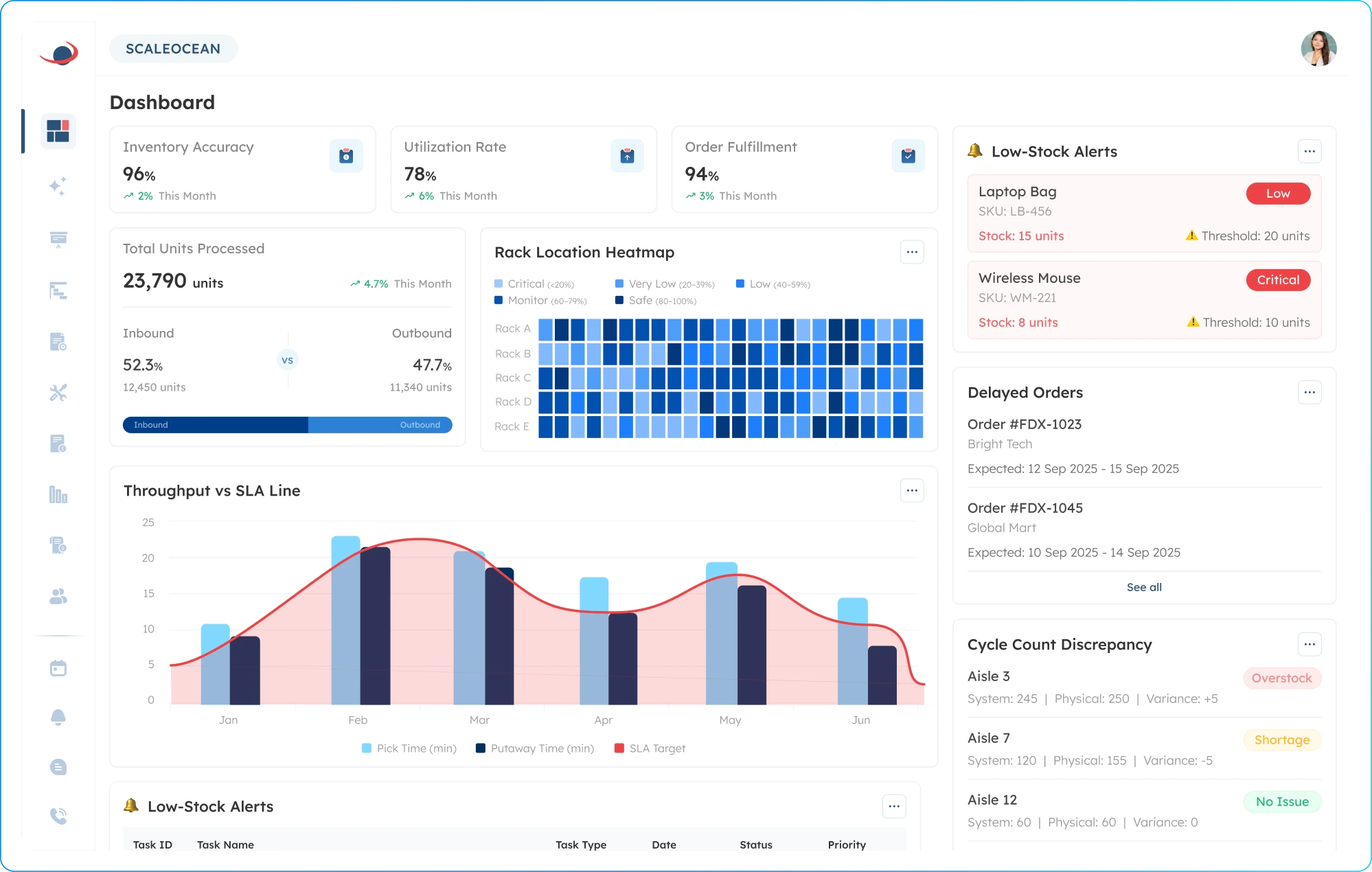
1. ScaleOcean Supply Chain Management Software
ScaleOcean is an integrated supply chain management platform for medium to large enterprises that need to coordinate suppliers, procurement, inventory, warehouses, transportation, distribution, costs, and multi-entity operations in one system. It supports complex supply chain structures across multiple facilities, regions, suppliers, product categories, and operational workflows.
As part of ScaleOcean Atlas, the supply chain management module connects supply chain planning and execution by integrating procurement, sourcing, inventory allocation, warehouse capacity, transportation, landed costs, and financial data within One Platform. Powered by embedded ScaleMind intelligence, it helps enterprises analyze operational conditions, identify risks, and support better supply chain decisions.
With ScaleMind embedded directly into workflows, teams can evaluate supply chain conditions more intelligently, from demand patterns and stock positions to supplier lead times, warehouse capacity, and network risks. This helps enterprises assess potential network changes using connected operational data, while configurable workflows, role-based access, and multi-entity visibility support coordination.
Additionally, ScaleOcean can support data governance in compliance with PDPA and financial requirements in Singapore by integrating supply chain transactions with audit trails and accounting workflows, GST-related records, and IRAS requirements. Schedule a consultation to see how configurable workflows, unlimited users, and flexible deployment can support your supply chain network.
Key features:
Supply chain network scenario planning
Multi-warehouse and multi-location visibility
Demand and inventory allocation insights
Supplier and procurement management
Warehouse capacity monitoring
Transportation and distribution management
Landed cost and cost-to-serve analysis
Pros
Cons
Uses a consultative implementation approach that starts by mapping the company’s supply chain structure, network priorities, operational constraints, and industry-specific requirements.
Its enterprise-level depth may be unnecessary for small businesses that only need basic warehouse-location analysis or simple logistics planning.
Provides flexible configuration for modules, approval flows, reports, integrations, locations, and business rules instead of relying on a fixed one-size-fits-all setup.
Final pricing requires an initial consultation because the quotation reflects the required modules, locations, integrations, deployment, and implementation complexity.
Uses scope-based pricing so enterprises can align their investment with the supply chain capabilities and modules that are actually required.
Implementation prioritizes accurate system design, business readiness, and long-term scalability rather than providing an immediate generic setup.
Supports phased module activation with implementation timelines based on process analysis, allowing companies to address priority workflows first and expand the system as requirements grow.
Best for: Medium and large enterprises, regional headquarters, manufacturers, distributors, logistics businesses, retailers, multi-warehouse organizations, and companies managing supply-chain operations across Singapore and ASEAN.
ScaleOcean connects network planning with procurement, inventory, warehouses, transportation, finance, and multi-entity operations, while ScaleMind provides demand, stock, lead-time, risk, and scenario insights.
2. Coupa Supply Chain Design & Planning
Coupa Supply Chain Design & Planning provides specialized modelling capabilities for companies evaluating global supply-chain structures. Its network-design functions support scenario planning, network optimization, inventory optimization, transportation analysis, demand modelling, and tariff-related planning.
The software can be used to compare facility footprints, sourcing arrangements, inventory policies, and transportation decisions before operational changes are implemented. Its supply-chain design portfolio is particularly relevant to organizations with complex networks requiring quantitative scenario comparison.
Key features:
Supply chain network optimization
Scenario modelling
Inventory optimization
Transportation optimization
Demand modelling
Pros
Cons
Provides a broad set of modelling capabilities covering network, inventory, transportation, and demand decisions.
Complex network models can require experienced users and substantial preparation before analysis begins.
Supports scenario analysis for strategic supply-chain decisions involving disruption, cost, and network changes.
Data harmonization across multiple operational systems can add implementation effort for large organizations.
Can evaluate several interconnected supply-chain planning decisions rather than focusing only on facility location.
Its specialized depth may exceed the requirements of businesses with small or straightforward distribution networks.
Best for: Large enterprises and multinational companies that need advanced network modelling, inventory optimization, transportation analysis, and strategic scenario planning across complex supply chains.
Coupa supports network, inventory, transportation, demand, and scenario modelling for organizations evaluating complex strategic supply-chain decisions.
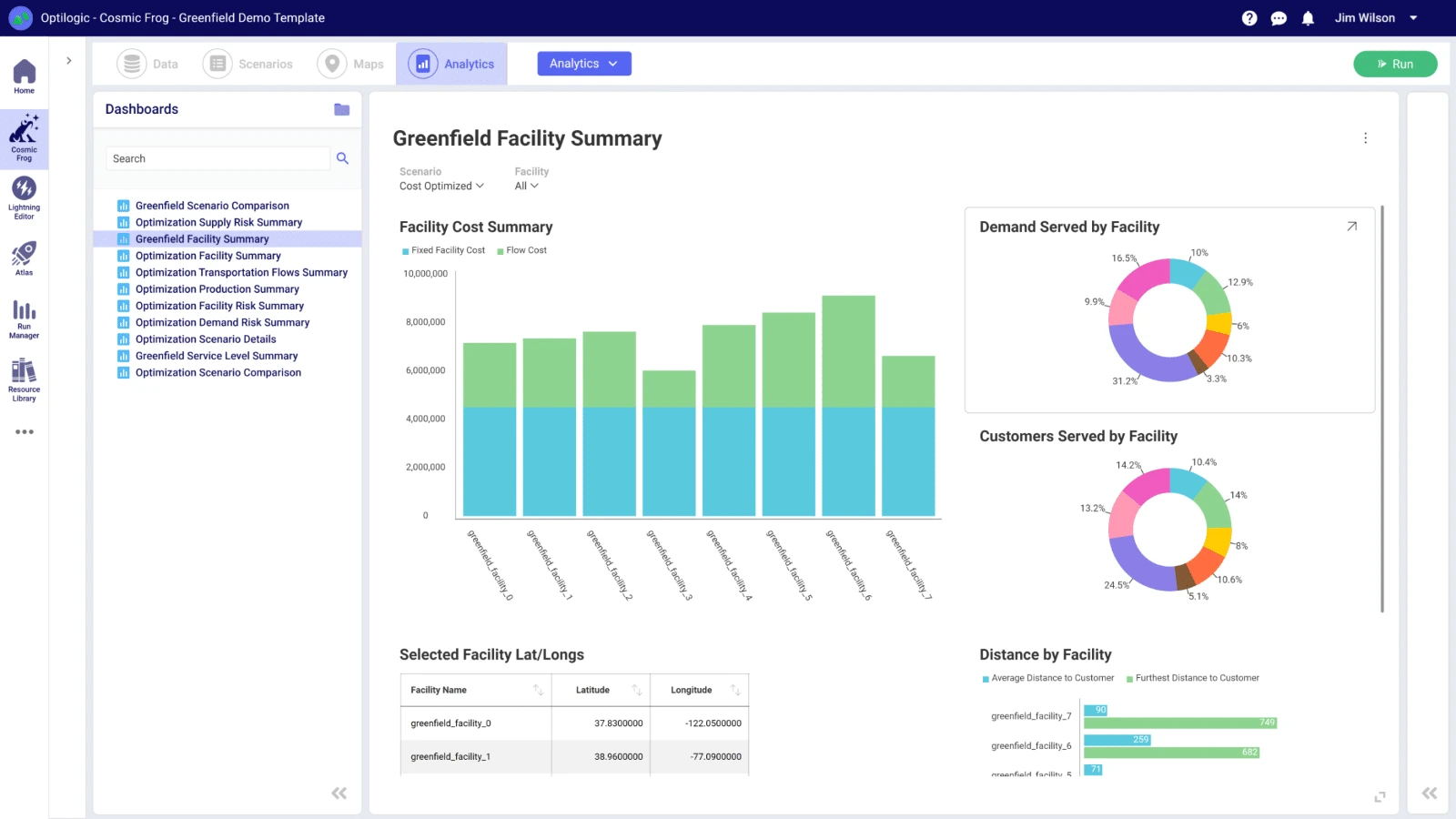
3. Optilogic
Optilogic provides a cloud-based supply chain design platform centred around Cosmic Frog. It combines mathematical optimization, simulation, sensitivity analysis, risk evaluation, and scenario modelling to help teams compare alternative network structures.
Its platform also includes AI-assisted modelling capabilities and risk scoring across suppliers, facilities, customers, and wider networks. This makes it relevant when planners want to test cost, service, and resilience together rather than optimizing only financial outcomes.
Key features:
Network optimization
Supply chain simulation
Risk scoring
Sensitivity analysis
Greenfield modelling
Pros
Cons
Combines optimization, simulation, risk analysis, and sensitivity testing within a specialized design environment.
Advanced modelling still requires reliable supply-chain data and a clear understanding of business constraints.
Supports extensive what-if analysis for strategic network and resilience decisions.
Teams unfamiliar with supply-chain modelling may need time to develop appropriate modelling practices.
Risk analysis enables planners to consider supplier, facility, customer, and network exposure alongside cost.
Companies seeking broader ERP execution may need integrations with separate operational systems.
Best for: Medium and large enterprises with dedicated supply chain planning teams that need optimization, simulation, resilience analysis, and extensive what-if scenario modelling.
ℹ️Why choose Optilogic?
Optilogic combines supply-chain optimization, simulation, scenario analysis, sensitivity testing, and risk assessment for strategic network-design decisions.
4. anyLogistix
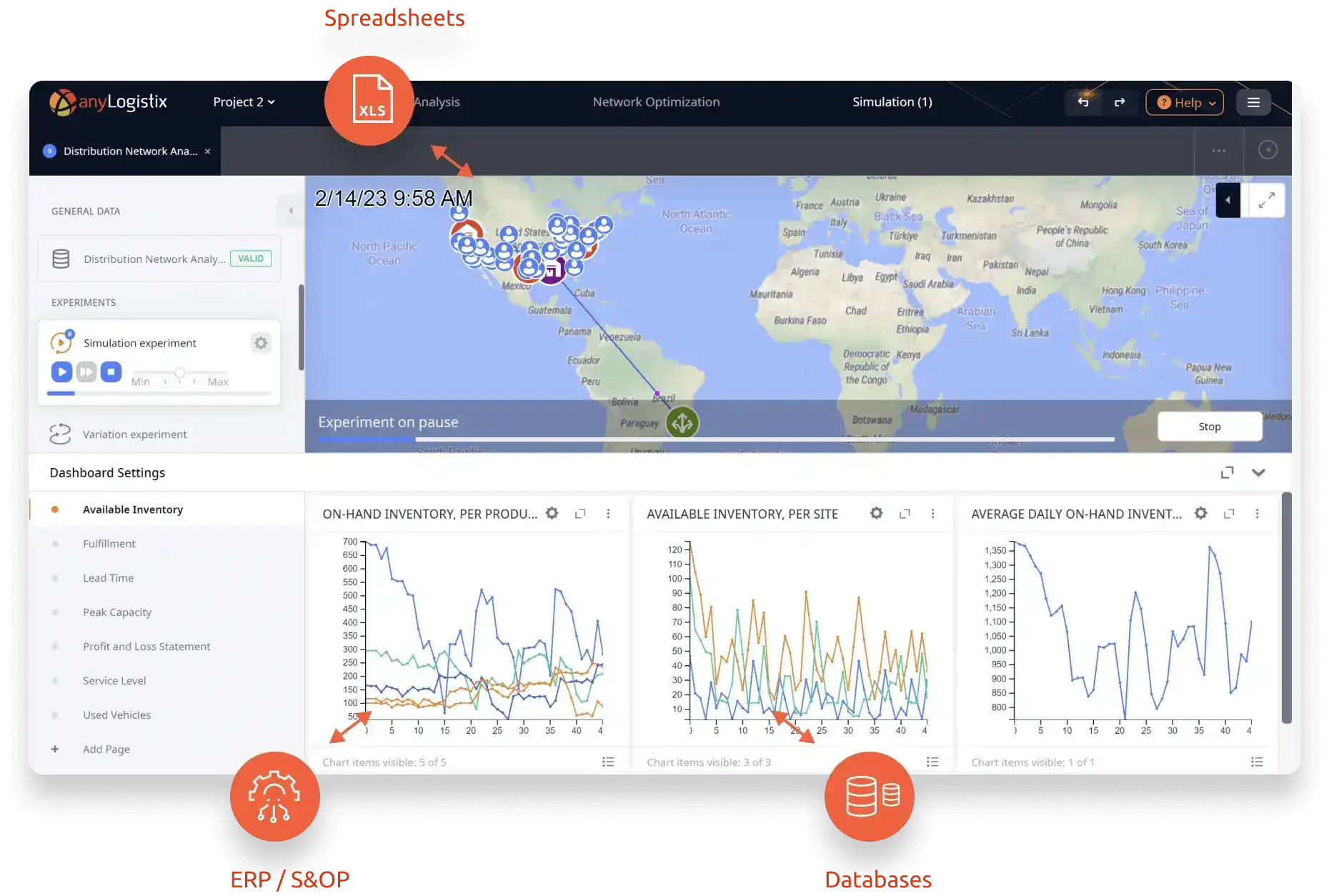
anyLogistix is supply-chain modelling and optimization software that combines analytical network optimization with dynamic simulation. Companies can model suppliers, facilities, customers, product flows, demand, inventory, capacity, and logistics relationships to assess alternative network structures.
Its Greenfield Analysis can help identify potential facility locations from limited initial data, while network optimization compares facility and flow configurations against cost and demand requirements. Simulation can then be used to examine how those designs behave under more dynamic operating conditions.
Key features:
Network optimization
Dynamic simulation
Facility-location analysis
Inventory optimization
Supply-chain risk analysis
Scenario modelling
Pros
Cons
Combines optimization and simulation for testing both ideal configurations and operational variability.
Building detailed simulation models can require specialist modelling knowledge.
Greenfield analysis provides a structured starting point when companies are evaluating facility locations from scratch.
Model quality remains highly dependent on the completeness of cost, demand, capacity, and lead-time inputs.
Supports multiple supply-chain problems, including network design, inventory, risk, and facility analysis.
Organizations seeking integrated transactional ERP execution may need to connect the modelling environment with other business applications.
Best for: Medium and large manufacturers, distributors, logistics companies, and consulting teams that need Greenfield analysis, facility-location modelling, network optimization, and dynamic simulation.
ℹ️Why choose anyLogistix?
anyLogistix combines supply-chain network optimization, Greenfield facility analysis, and dynamic simulation for modelling and testing alternative network configurations.
5. Blue Yonder
Blue Yonder provides network modelling and optimization capabilities within its wider supply-chain planning portfolio. It supports strategic and tactical network analysis across facilities, products, capacity, service, and different time horizons.
Its capabilities include end-to-end network design, dynamic network modelling, digital-twin scenario analysis, and what-if comparison. Organizations can evaluate changes in distribution, facility configuration, product allocation, cost, service, and risk before modifying the physical network.
Key features:
End-to-end network design
Network modelling
Dynamic network design
Digital-twin scenarios
What-if analysis
Pros
Cons
Provides detailed network modelling for both strategic and tactical supply-chain decisions.
Enterprise-scale configuration may require significant implementation and modelling resources.
What-if scenario analysis can compare cost, profit, service, and network outcomes over different time horizons.
Organizations with simple local networks may not require the breadth of an enterprise planning platform.
Can connect network design with wider supply-chain planning processes where the broader platform is deployed.
Achieving broader planning integration can depend on the scope of the Blue Yonder environment implemented by the organization.
Best for: Large enterprises and multinational organizations with complex global supply chains that need network design integrated with broader strategic and tactical supply chain planning.
ℹ️Why choose Blue Yonder?
Blue Yonder supports end-to-end network modelling, dynamic design, digital-twin scenarios, and what-if analysis within a wider enterprise supply-chain planning environment.
How to Choose the Right Supply Chain Network Design Approach to Align Your Workflow
Choosing a supply chain network design approach requires evaluating your business goals, data maturity, and operational complexity. Align your workflow by defining your strategic objectives, auditing your data readiness, selecting the appropriate analytical model (such as optimization or simulation), and testing scenarios to ensure cost and service balance.
1. What Business Decision Are You Trying to Make?
Define whether the objective is expansion, facility consolidation, inventory optimization, sourcing, M&A integration, cost reduction, resilience, or another strategic question.
Clear objectives prevent teams from building an unnecessarily complicated model.
2. Is Your Current Supply Chain Data Reliable?
Review demand, cost, inventory, supplier, lead-time, facility, transportation, and capacity information before selecting modelling technology.
Advanced optimization cannot compensate for incomplete cost structures or inconsistent operational records.
3. Can the Model Reflect Your Real Operational Constraints?
A model should represent capacity, minimum orders, supplier restrictions, customs, service commitments, product compatibility, working calendars, transport availability, and business rules.
Otherwise, an optimized scenario may be impossible to execute operationally.
4. Can Network Recommendations Be Connected to Execution?
Determine how redesigned sourcing, inventory allocation, facility roles, transportation lanes, and replenishment policies will flow into procurement, warehouses, finance, logistics, and other operating systems.
This becomes particularly important for enterprises that need network design to remain aligned with daily workflows rather than operating as an isolated annual modelling exercise.
5. Can the Network Be Re-Evaluated as Conditions Change?
Demand, tariffs, suppliers, freight, costs, and capacity continue changing after implementation. Companies should therefore consider how easily assumptions and scenarios can be updated.
The strongest approach creates a repeatable network-design capability instead of producing one model that becomes outdated after the project ends.
Conclusion
Supply chain network design is the process of structuring suppliers, plants, warehouses, distribution centers, inventory, transportation lanes, and customer markets. Through modelling and optimization, companies can compare network alternatives based on cost, service, capacity, working capital, resilience, and long-term growth.
Without structured network analysis, enterprises may experience high warehouse costs, incorrectly positioned inventory, unnecessary transport distance, duplicated stock, supplier concentration, capacity imbalances, and weak resilience. Network design addresses these issues through accurate data collection, facility analysis, scenario modelling, optimization, and continuous review.
ScaleOcean supply chain management software connects network planning with procurement, inventory, warehouses, transportation, finance, and multi-entity regional operations within One Platform. With ScaleMind supply-chain insights, multi-location visibility, cost-to-serve analysis, and phased implementation, enterprises can connect strategic decisions with actual operations. Schedule a consultation to assess how your current network can be structured for more efficient regional growth.
FAQ Supply Chain Network Design:
1. How do you design a new supply chain network from scratch?
Start by defining customers, demand, suppliers, products, service requirements, costs, and operational constraints. Then use Greenfield analysis to identify potential facility locations, build alternative network configurations, simulate different scenarios, and compare cost, capacity, inventory, service, and risk before selecting the final structure.
2. What data is required for supply chain network design?
Common inputs include customer and SKU demand, supplier locations, facility capacity, inventory, transportation lanes and rates, lead times, warehouse expenses, production costs, taxes, service levels, geographic information, and operational constraints. More accurate inputs generally produce more useful network recommendations.
3. What software is used for supply chain network design?
Companies can use platforms such as ScaleOcean, Coupa Supply Chain Design & Planning, Optilogic, anyLogistix, and Blue Yonder. ScaleOcean is particularly relevant to medium and large enterprises that want network decisions connected with procurement, inventory, warehouse, transportation, finance, and multi-entity operations.
4. What is an example of supply chain network design for a Singapore company?
A Singapore enterprise may compare keeping all regional inventory locally against a hybrid Singapore-Johor network. High-value or time-critical goods could remain in Singapore, while selected storage or fulfilment capacity operates in Johor, with both scenarios evaluated against transport cost, lead time, inventory, capacity, customs, and resilience.













 Key Takeaways