

Procure to pay is the process of requisitioning, purchasing, receiving, paying for, and accounting for goods and services, covering the entire process from the point of order right through to payment.
For many businesses, procurement is still largely paper-based, and only a few businesses use computers for all their work, relying on email for approvals, spreadsheets for tracking, and payment systems that are all different. The process takes a much longer time, with teams having to review and re-review work, check the budgets, and review the suppliers’ information in various systems.
The issue becomes more serious when data entry errors, delayed approvals, and limited spend visibility affect daily decisions. For manufacturers, distributors, and service-based companies in Singapore, these gaps can lead to late material availability, supplier disputes, invoice mismatches, and inaccurate budget control.
Based on data our team collected from APQC benchmarking, best-practice companies spend only 38 cents for every $1,000 in revenue to manage accounts payable, while bottom performers spend 92 cents per $1,000 revenue.
This cost gap often starts from inefficient upstream processes, such as manual purchase requests, delayed approvals, poor supplier control, and disconnected invoice validation. That is why the procure-to-pay process must be well-linked from requisition to payment, as every purchasing decision can directly affect cash flow, cost control, and overall financial performance.
This article explains what procure to pay is, the benefits of having the P2P system in place, and how a Singapore procure to pay platform like ScaleOcean procurement software can benefit businesses by offering more control, compliance, and operational efficiencies.
 Key Takeaways
- Purchase to Pay (P2P) is the end-to-end process of procuring goods and services, from initial request or requisition all the way through to payment and reconciliation.
- The Procure to Pay (P2P) Process includes identifying a need, requisitioning and approvals, sourcing/supplier selection, purchase order (PO), and payment.
- Source-to-pay and purchase-to-pay is different. Source-to-pay covers the entire journey from strategic sourcing to final payment, while purchase-to-pay focuses strictly on the transactional steps from ordering to paying.
- ScaleOcean procurement software helps Singapore businesses automate approvals, supplier management, PO control, GST-ready invoicing, and real-time spend reporting across teams.
What is Procure to Pay (P2P)?
Purchase to Pay (P2P) is the end-to-end process of procuring goods and services, from initial request or requisition all the way through to payment and reconciliation. It encompasses the entire process from placing an order to paying for and getting the goods.
Financial governance is so tightly connected to the procure-to-pay definition that all these transactions must go through approval, purchasing, receiving, invoice validation, and payment control processes. Companies can easily control their out-of-contract spending and have departments more accountable if P2P flows are well-controlled.
In other words, it is the assurance that all purchases adhere to an established purchasing procedure, from approved vendors to the acquisition of items that actually meet the company’s requirements. The CEOs, finance, and other business decision makers then have a clear picture of spending, supplier performance, and if purchases support wider business goals.
Some common issues that Singaporean businesses may encounter when it comes to procurement include dealing with a list of local and overseas suppliers, Singaporean goods and services tax, legal requirements, and the rate of future business operations. If there are no efficient processes in place, the information from the purchase, interaction with suppliers, warehouse information, and payment processes is difficult to maintain.
The Procure to Pay (P2P) Process
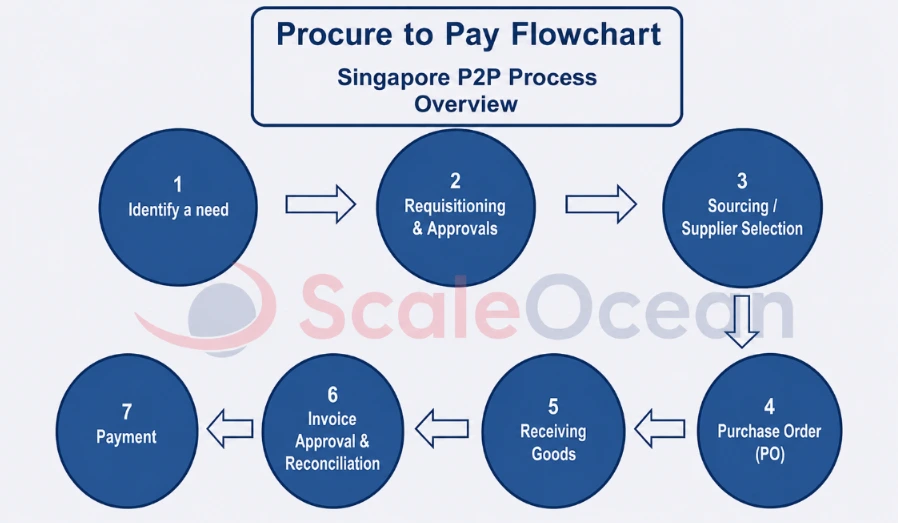
The procure to pay process follows a clear flow from identifying business needs to completing supplier payment. Each stage supports stronger control, better visibility, and smoother collaboration between procurement, finance, warehouse, and business users.
Here is a generalized P2P flowchart that is typically followed by Singapore businesses:
1. Identify a Need
The step starts with the team recognizing a need for the goods or services. A need can arise because of various purposes, such as needs for production, office, in-warehouse replenishment, for a specific project, or from an increase in customer orders.
This is where the requesting department should identify what is required, why, and when it should be made available. Avoid unnecessary purchases, duplicate purchases, and last-minute purchases, which may increase costs, by identifying demand needs properly at this stage.
2. Requisitioning and Approvals
Once a need is identified, the user will create a purchase requisition that usually includes the description of the item, the quantity and amount of the item, the expected delivery date, the estimated costs, the department, and the purpose.
The requisition then goes through the approval stages according to the hierarchy, budgets, and company policies. The use of digital approval avoids delays in decision-making while allowing managers to track, approve, or reject the requests.
3. Sourcing/Supplier Selection
After a purchase requisition is approved, the buying team will select the appropriate supplier to fulfill the purchase based on many factors, such as the price, delivery capabilities, contract terms, compliance status, the quality of service offered, relationship with previous transactions, and past supplier performance, etc.
A good supplier selection process will help a company avoid making poor vendor choices. It can also make it easier for buying teams to make objective comparisons between domestic and overseas suppliers in cases where businesses are performing cross-border procurements.
4. Purchase Order (PO)
Once a decision has been made on the suitable supplier, the company will issue a purchase order. The PO serves as a record of the agreed-upon items and quantities, prices, delivery terms, and the supplier details before any transaction can take place.
The purchase order acts as a critical control document and as a reference tool that allows finance, warehouse, and buying teams to refer back to the exact agreed specification when processing invoices later on.
5. Receiving Goods
Upon the delivery of goods or services, the receiving team will check if the delivery matches the purchase order, which involves ensuring that the quantity and quality of items, the specifications, delivery date, and relevant documentation are as they should be.
If the company has a warehouse system, it should automatically update the stock levels of materials that were received. Stock level discrepancies can be reduced and production/order fulfilment processes expedited when the data integration with inventory management systems is established.
6. Invoicing Approval & Reconciliation
After receiving goods or services, the supplier sends an invoice. Finance then validates the invoice against the purchase order and goods receipt to ensure the company only pays for what was ordered and received.
This step is often known as a 3-way match because it confirms an order (PO), a received good (GRN), and the invoice received. Errors and double payments due to inaccurate details can be eliminated by automating the reconciliation process.
7. Payment
Controlled payment stages give companies stronger visibility over outgoing payments and help ensure suppliers are paid on time. Each payment also leaves a clear audit trail, making it easier for finance and procurement teams to review, verify, and prepare documents when needed.
This level of control becomes easier when the entire procure-to-pay process runs automatically through procurement or e-procurement software. With an integrated system, companies can manage purchase requests, approvals, supplier data, invoice matching, payment schedules, and reporting in one platform, reducing manual errors while improving financial transparency.
For businesses that need stronger payment control and end-to-end P2P visibility, ScaleOcean procurement software can be a recommended solution. Request a free demo today to see how this software helps improve payment control, supplier accuracy, and connected procurement-to-finance workflows in real business operations.
Benefits of Procure to Pay

A well-managed procure-to-pay cycle gives companies better control over spending, documentation, and supplier performance. It also helps leaders make faster decisions because procurement and finance data are connected in one reliable workflow.
Managing the procure-to-pay process with ease allows companies to gain greater control over expenses, documentation, and supplier performance and enables leaders to make better decisions based on data provided by the coordinated efforts between procurement and finance departments.
1. Improved Compliance
The procurement to pay processes will improve compliance of all business purchases with policies, budgets, and supplier terms, and also minimize the risk of unauthorized spending while allowing every department to follow consistent buying procedures.
For Singapore businesses, compliance will also mean keeping necessary documents and records for financial reporting and auditing purposes, as well as governance needs. Having all related data, such as approvals, POs, receipts, invoices, and payment documents, in one place simplifies the whole auditing process.
2. Cost Control & Savings
A good visibility on budgeted and spent expenses at any given point in time helps a lot in cost control. Buying departments are able to compare supplier prices, utilize contracts, and flag expenses that are exceeding budget limitations.
Procure to pay processes will help realize the benefit of negotiable savings into actual financial savings, as teams can agree on favorable supplier terms but fail to maintain those practices through the entire procurement process due to a lack of system control.
3. Increased Speed
P2P process relies on digitized workflow, manual approvals, documents that were misplaced or missing, as well as the chasing process, were removed and sped up operations. The entire process from request, approval, buying, and the finance department can be processed faster since it’s a traceable and visual system.
Speed is also a major requirement in any business, particularly those that require items to be ready at a specific time or services to be provided quickly. Prompt approvals and auto-generation of purchase orders will prevent operations from stopping due to slow purchase orders.
4. Enhance Visibility
Procure to pay provides great visibility of all purchase requests, orders, invoices, and payment data. Senior management would be able to track their spending by business department, by supplier, by item category, by project, and/or by warehouse location.
Clear visibility also helps in identifying the stages where delays occur. For example, whether the approval process, supplier response time, goods receipt verification, invoice payment matching, and payment schedule were causing the delay.
5. Better Vendor Relations
Suppliers appreciate clarity, accuracy, and promptness; thus, a strong P2P system assures them they always have the same purchase order and payment notification. A good supplier relationship can lead to better terms in negotiations, higher reliability in delivery, and better quality service in general.
As a good relationship with a supplier develops over time, a stronger and more long-term relationship can be built with suppliers who successfully meet performance requirements.
6. Increased Transparency
A system with full integration provides transparent views of every step in which procurement transactions have been recorded. Businesses can trace who purchased what, who approved it, who was responsible for delivering the item, and on what day payment was made for it.
According to the data our team gathered from Efficio, 89% of senior procurement and finance leaders believe more than half of their indirect spend is unaddressable. This highlights why an effective purchase system is essential to improve spend visibility, strengthen corporate governance, and reduce blind spots in business expenditure.
7. Reduce Fraud Risk
P2P reduces fraud risk by adding controls at each stage of the purchasing and payment process. Approval workflows, supplier verification, PO validation, and three-way matching make suspicious transactions easier to detect.
Fraud risk often increases when teams rely on manual documents and disconnected systems. With a controlled digital process, businesses can reduce fake invoices, duplicate payments, unauthorized purchases, and supplier-related manipulation.
Challenges of Procure to Pay

Although P2P brings clear benefits, many companies struggle to implement it effectively. The challenges usually come from fragmented systems, manual processes, weak supplier data, and limited coordination between departments.
1. Inefficient Vendor Management
Vendor management becomes inefficient when supplier records are scattered across spreadsheets, emails, and different department files. This makes it difficult to verify supplier status, compare performance, and maintain updated compliance documents.
As the supplier base grows, poor vendor management can create pricing inconsistencies, duplicate supplier records, and higher procurement risk. A central supplier portal helps businesses manage qualification, communication, documents, and performance more effectively.
2. Manual Processing Errors
Manual data entry increases the chance of mistakes in item codes, quantities, prices, tax information, and payment details. Even small errors can create invoice disputes, delayed approvals, and inaccurate financial records.
These errors also consume time because teams must check documents repeatedly. Automating requisitions, PO generation, invoice matching, and approval routing helps reduce rework and improve data accuracy across the process.
3. Lack of Visibility
Many businesses struggle to see the real-time status of requests, orders, deliveries, and invoices. Without visibility, leaders cannot easily know which purchases are pending, which suppliers are delayed, or which invoices require action.
Lack of visibility also weakens budget control. When procurement data is not updated in real time, finance teams may only detect overspending after the transaction has already happened.
4. Compliance and Regulatory Issues
Compliance problems happen when procurement teams do not follow approved supplier rules, documentation standards, tax requirements, or internal approval policies. These gaps can create audit issues and financial exposure.
In Singapore, companies also need clean documentation for GST-related processes and financial reporting. A structured P2P system helps maintain complete records and reduces the risk of missing supporting documents during review.
5. Delayed Approvals and Payments
Delayed approvals often occur when managers depend on email chains or manual forms. Requests may be missed, held by the wrong person, or returned because supporting information is incomplete.
Payment delays can damage supplier trust and reduce the company’s negotiation power. When invoices are validated and scheduled through a controlled workflow, finance teams can pay accurately without losing cash flow discipline.
6. Poor Communication Between Departments
Procurement involves multiple departments, including requesters, approvers, purchasing teams, warehouse teams, and finance. When communication is poor, each team may work with different versions of the same transaction.
This creates confusion around order status, delivery confirmation, invoice approval, and payment timing. A connected P2P platform keeps everyone aligned because updates are recorded in one shared workflow.
Source-to-Pay vs. Purchase-to-Pay: What’s the Difference?
Source-to-pay and purchase-to-pay are related, but they do not cover the same scope. Source-to-pay includes strategic sourcing activities before the purchase begins, while purchase-to-pay focuses on the transactional process from requisition to payment.
In simple terms, source-to-pay is broader because it covers supplier discovery, sourcing events, negotiation, contracting, purchasing, receiving, invoicing, and payment. Purchase-to-pay usually starts after sourcing decisions are made and focuses on executing purchases efficiently.
| Feature | Source-to-Pay (S2P) | Purchase-to-Pay (P2P) |
|---|---|---|
| Main Purpose | Helps companies manage the full procurement journey, from supplier sourcing and negotiation to purchasing, invoicing, and payment. | Focuses on managing daily purchasing activities, from purchase requests and approvals to receiving goods and paying suppliers. |
| Process Scope | Covers strategic sourcing, supplier evaluation, contract management, procurement execution, invoice processing, and supplier payment. | Covers requisition, approval, purchase order creation, goods receipt, invoice matching, and payment processing. |
| Starting Point | Begins when the company identifies sourcing needs, evaluates supplier options, or plans a procurement strategy. | Begins when a department submits a purchase requisition for goods or services needed by the business. |
| Main Focus | Focuses on supplier strategy, long-term cost savings, contract value, and better procurement decision-making. | Focuses on operational efficiency, approval control, invoice accuracy, payment discipline, and spend visibility. |
| Key Users | Commonly used by procurement leaders, sourcing teams, legal teams, finance leaders, and supplier relationship managers. | Commonly used by requesters, approvers, procurement staff, warehouse teams, accounts payable teams, and finance managers. |
| Business Value | Helps businesses choose better suppliers, negotiate stronger contracts, and improve long-term procurement performance. | Helps businesses reduce manual errors, control spending, speed up approvals, and ensure suppliers are paid accurately. |
| Best Use Case | Suitable for companies that want to improve supplier selection, procurement planning, contract control, and sourcing strategy. | Suitable for companies that want to improve purchasing execution, invoice reconciliation, payment control, and day-to-day procurement visibility. |
A company that wants stronger strategic procurement may focus on source-to-pay first. However, a company struggling with late approvals, invoice errors, poor PO control, and payment delays usually needs to strengthen its purchase-to-pay workflow immediately.
Both approaches should support each other. A strong procurement strategy sets the direction, while P2P ensures that daily purchasing activities follow that strategy with proper control.
Purchase-to-Pay Best Practices
Successful P2P deployment requires an integration of process, technology, and cross-department alignment. Organizations not only need to automate their purchasing workflow but also ensure they are maintaining clean data, having clear policies, and building collaborative relationships with suppliers.
1. Automate Procure-to-Pay
Automation allows organizations to eliminate manual processes across requisitioning, approval, PO generation, goods receiving, invoice matching, and payment scheduling. This can free up valuable time for team members to focus on higher-value activities such as supplier value analysis, cost savings identification, and overall process optimization.
When organizations automate their procure-to-pay workflow, they can enforce consistent rules across all of their transactions, whether it’s through approval limits, budget checks, supplier validation, or invoice matching, which are all funneled into the same controlled process.
2. Monitor Data for Ongoing Enhancement
P2P data should be consistently monitored and analyzed in order to identify bottlenecks, cost savings opportunities, areas for improvement, and compliance issues. Organizations can measure and look at various metrics such as time spent in the approval process, supplier delivery performance, invoice mismatch rates, payment cycles, and spending patterns by category.
Through ongoing analysis of this data, organizations will be able to make better business decisions and ensure they are making progress on the procurement lifecycle by having the operational data to accurately assess each stage of the workflow.
3. Set Clear Guidelines for Supplier Collaboration
Clear expectations for documents to be provided, schedules for delivery, standards for invoicing formats, preferred communication methods, and procedures for resolving disputes are crucial for smooth collaboration with suppliers. These guidelines minimize misunderstandings and repeated clarifying questions for each party.
A clear supplier framework should also link with the organization’s overall procurement plan so that efforts from suppliers are aligned with that plan to yield benefits such as better availability of goods, tighter cost control, and improved procurement performance in the long term.
P2P Platforms. How Does it Work?
A P2P platform is a technology that will allow your organization to streamline the flow of money between suppliers and your company with a controlled system that automates your entire procure-to-pay process. You can integrate everything from purchase requisitions, purchase order approval, supplier data, POs, receiving goods, invoice verification, tax records, and paying suppliers from one centralized location.
Instead of dealing with emails, Excel spreadsheets, and disconnected finance records, a P2P platform allows all stakeholders involved to view the status of a transaction, and requesters may place requests, approvers may accept/reject requisitions, the procurement team can manage suppliers, while your warehouse personnel confirm the reception of goods, and finance personnel validate and process payment.
Controlled payment stages give companies stronger visibility over outgoing payments, help ensure suppliers are paid on time, and create a clear audit trail for finance and procurement teams. This level of control becomes easier when the entire procure-to-pay process runs automatically, allowing businesses to manage purchase requests, approvals, supplier data, invoice matching, payment schedules, and reporting in one integrated platform.
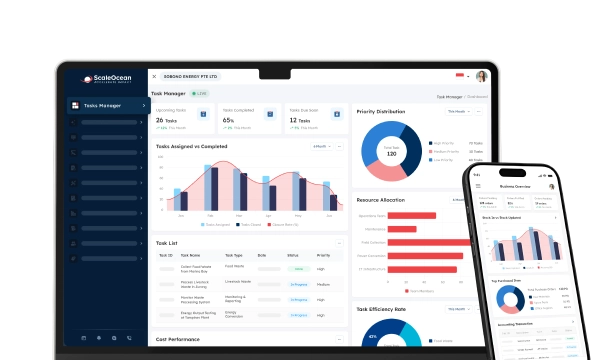
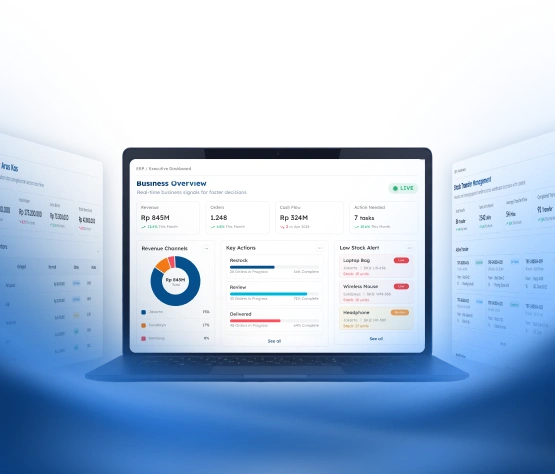
For businesses in Singapore looking for greater control over purchasing, ScaleOcean procurement software can be one of the most recommended solutions. Its integrated system supports purchase requisitions, PO creation, GST calculations, Peppol e-invoicing, inventory integration, and spend reports to automate P2P from end to end. Request a free demo to see how ScaleOcean helps improve payment control, supplier accuracy, and connected procurement-to-finance workflows.
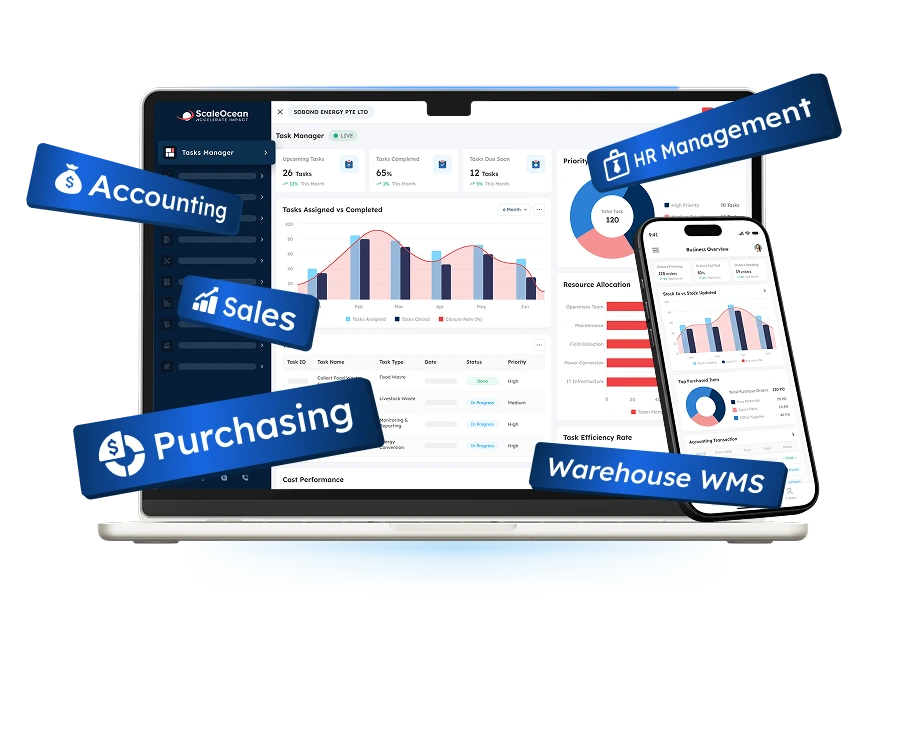
Some key capabilities that support ScaleOcean’s procure-to-pay cycle include e-requisition, approval workflow, supplier management, purchase order automation, three-way matching, and inventory integration. Through these features, companies can manage purchase requests, approvals, supplier records, PO creation, invoice validation, and stock updates in a more connected workflow.
This helps reduce manual work, improve spending control, and give finance and procurement teams clearer visibility before every payment is approved. With these capabilities, ScaleOcean provides its users with an efficient and accurate procure-to-pay cycle, from the first step to pay suppliers. Explore our free demo to get started. Try our free demo and explore how the software can improve your purchasing workflows in one integrated platform.
Conclusion
Procure-to-Pay (P2P) is the end-to-end business process of requesting, purchasing, receiving, and paying for goods and services. It seamlessly connects a company’s purchasing and accounts payable departments to ensure transactions are authorized, verified, and paid accurately.
For Singapore businesses, a structured P2P process helps reduce manual errors, improve compliance, control spending, speed up approvals, and strengthen supplier relationships. It also gives CEOs and decision makers clearer visibility into how purchasing activities affect cash flow and operational performance.
ScaleOcean procurement software helps companies digitize the entire P2P workflow through e-requisition, approval automation, supplier management, PO control, three-way matching, GST-ready invoicing, warehouse integration, and spend reporting. With a free demo, businesses can evaluate how the platform supports more transparent, accurate, and efficient procurement operations.
FAQ:
1. What does P2P mean?
Purchase-to-pay, also known as P2P, is the process of requisitioning, purchasing, receiving, paying for, and accounting for goods and services, covering the entire process from point of order right through to payment.
2. What is P2P and O2C?
P2P is an important element to control the costs, build and manage relationships with suppliers, and obtain operational effectiveness. O2C represents the sale of and collecting payment, while P2P is buying and making payments.
3. What is a P2P process flowchart?
P2P is the entire purchase and payment process, starting with the purchase requisition up to the payment. The process in accounts payable involves receiving the invoice, keying in the data, validating that the invoice is accurate, vouching, and making payment through the method specified by the vendor.
4. Which one is best, P2P or R2R?
Key Takeaways. Procure to pay, or P2P, covers the entire process of purchasing from requisitioning to paying vendors, and is owned by procurement and AP functions. Record to report or R2R covers the process of data capture and validation, and reporting financial information for the required stakeholders (internal or external).


















.png)