



Accounts payable reflect the firm’s short-term business debts to its suppliers, which are due after the firm buys products or services on credit. However, these inaccuracies can lead to significant processing delays, ultimately affecting overall efficiency.
Our team found that Mordor Intelligence valued the global Accounts Payable (AP) Automation and Software market at approximately USD 6.94 billion in 2026, with digital financial transformation initiatives expected to propel the market to USD 12.46 billion by 2031 at a CAGR of 12.44%. Reflecting the rising business demand for faster, more accurate financial operations.
A large number of companies in Singapore continue to process invoices manually over multiple disparate systems, causing delays in approval workflows and inconsistent accounting data. As a result, financial teams spend a significant amount of time resolving unnecessary payment discrepancies.
Additionally, inadequate accounts payable procedures often lead to overpayments, late payments, and weakened relationships with suppliers for many expanding companies. Hence, businesses need more efficient workflows that enable accelerated approvals and greater daily financial transparency.
Therefore, in this article, we will learn how accounts payable works, why efficient management matters, key financial metrics for evaluating performance, and practical strategies for consistently improving operational efficiency, financial accuracy, and supplier relationship management.
 Key Takeaways
- Accounts payable are short-term business obligations owed to suppliers for goods or services purchased on credit.
- Accounts payable financial metrics, including AP Turnover Ratio, DPO, and CCC, help businesses accurately evaluate accounts payable and cash flow performance.
- Businesses improve accounts payable efficiency through automation, supplier management optimization, payment scheduling strategies, and stronger internal financial controls.
- ScaleOcean Accounting Software helps businesses automate accounts payable workflows, improve visibility, and strengthen financial operational efficiency.
What Are Accounts Payable (AP)?
Accounts payable are amounts of money a business owes to its suppliers or vendors for goods or services purchased on credit. Companies mostly consider this as the current liability of an entity. Proper management of accounts payable is crucial for maintaining healthy cash flow and ensuring timely payments to suppliers.
Furthermore, application-specific processes, such as receiving and validating bills and managing approver payments, are part of AP processes performed by the procure-to-pay department. This enables the company to establish long-term, healthy relationships with suppliers while maintaining tight control over business cash flows.
Modern accounts payable also integrates procurement, accounting, and inventory management modules to enhance transaction transparency across all company locations. It results in finance substantially reducing its reconciliation duties and producing standard reports optimized for control and accuracy.
How the Accounts Payable Process Works?
The accounting procedures for incoming transactions are documented as a list of verifications for each business activity to meet the requirements. Further, the standard procedures address errors in misclassified items and are applied across departments.
To coordinate AP processes, many customers set up accounts payable automation software using ERP tools to handle tasks such as invoice approvals, payment routing, and planning. Consequently, AP activities can be accelerated with increased standards of compliance and internal control.
Step 1: Purchase Order Creation
The finance and procurement department issues purchase requisitions for goods or services needed to keep the business functioning. Hence, the preparation of pre-approved levels for ordering, costing, and delivery.
Purchase orders also serve as legally cross-checked references for invoice verification and payment reconciliation across many accounts payable processes. Therefore, companies significantly minimize disallowed spending and increase the purchasing transparency across various departments or sections.
Step 2: Receiving Goods
Warehouse/handover teams in the trading and operations teams inspect and accept the goods received. This is done before the process starts in the company’s financial system by accounts payable. The receiving documentation is cross-referenced with the purchase order for the product quantities and condition.
They also input receipt information into the application’s ERP, enabling automatic stock updates and purchase controls. Hence, accountants authorize invoices sooner, with an average deadline of five days.
Step 3: Invoice Capture
Supplier invoices are provided to accounts payable and purchasing teams via email, the procurement management system, or an integrated ERP system that processes financial data. Consolidated invoice capture is a tool that also helps increase transparency of the finance function.
Current systems also offer automatic invoice extraction using digital recognition methods and enable proper control of the data entry process. For organizations, this means they could reduce their administrative staff and dramatically reduce questions related to invoice registration.
Step 4: Three-Way Matching
In accounts payable processes, the finance department verifies purchase orders, goods receipt slips, and incoming supplier invoices. In this way, firms identify potential over- or under-pricing as soon as possible.
Three-way matching procedures improve the financial responsibility of companies by carefully cross-checking procurement with authorized operations records. As a result, companies avoid paying twice and gain potentially improved standards of financial reporting.
Step 5: Approval Workflow
The managers believe in established approval workflows in which invoices are approved through a defined set of steps to ensure compliance with financial policies. Routing within multiple functional areas can be sped up using automation tools.
Furthermore, electronic approval tools offer audit trails that can be used to enforce compliance norms and enhance financial transparency during procurement transactions. As a result, firms reduce approval bottlenecks and raise internal controls considerably.
Step 6: Payment Execution
The finance department implements payments after fulfilling the necessary approval procedures, and checks in the accounts payable process flow are successful. Scheduled payment systems also support a more effective management of relationships with vendors.
Moreover, it provides automated payment handling, which minimizes processing time. It helps make the correct accounting entry simultaneously in both the accounting and ERP systems.
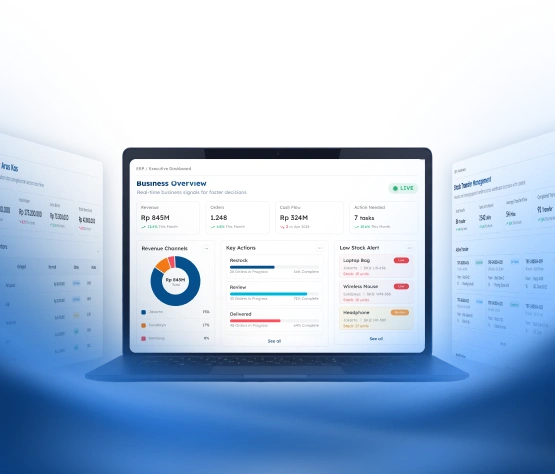
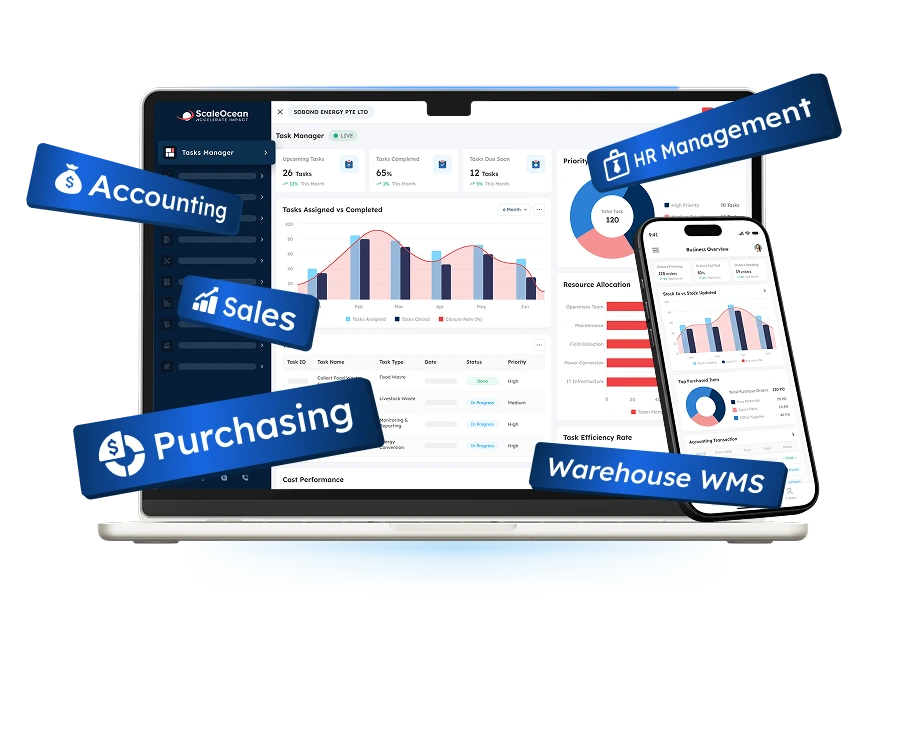
Businesses managing these steps often require centralized ERP systems that integrate purchasing, accounting, and inventory activities into a single operational platform. Hence, ScaleOcean Accounting ERP Software helps organizations reduce invoice discrepancies and strengthen financial coordination effectively.
ScaleOcean additionally automates invoice approvals, payment validations, and transaction recording through integrated digital workflows, continuously supporting operational efficiency. Request a free demo today to explore faster approvals and stronger accounts payable management capabilities.
Examples of Accounts Payable
Every day, businesses handle multiple accounts payable transactions across procurement, operations, and administrative finance. That’s where well-defined workflows are necessary to maintain the accuracy of financial data every time.
Businesses also thoughtfully classify accounts payable operations by operating, payment, period, and supplier relationships. As a result, the finance department helps to enhance the effectiveness of reporting and facilitate better financial decisions.
1. Supplier Invoice
Supplier invoices refer to drawbacks caused by the supplier, resulting from successfully providing goods or services to a designated business procurement consignee. In advance, the organization would implement an appropriate mechanism to verify supplier invoices in accordance with predefined accounts payable procedures.
Finance sections also cross-verify invoiced information against purchase orders before releasing any payment transaction in financial systems, with extreme precision. As a result, organizations secure factual procurement records and significantly protect themselves from invoice errors.
2. Contractor Payments
Contractor names are being used by companies a lot as third-party support for operational projects, maintenance work, or even specialized professional tasks for various organizations regularly, so accounts payable professionals are handling their invoices with rigour before settling them.
Financial procedures for contractor payments include confirmation processes to ensure that the quality and delivery of services provided in completed work activities meet the terms of the official agreement and the expected operational standards. As a result, companies enhance financial responsibility with a drastic reduction of unwarranted project costs.
3. Subscription Services
Organizations also routinely purchase cloud services, digital solutions, and operational tools to run their daily operations smoothly. As such, the finance department routinely handles repetitive invoices through accounts payable solutions.
Payment for subscription-based services must also be systematically scheduled to avoid overlooking renewal bills or incurring unnecessary duplicate charges for recurring transactions. This helps the enterprise maintain uninterrupted access to functionality while substantially enhancing the ability to track finances.
4. Utility and Rent Bills
Operational costs such as electricity, internet services, Water bills, and office rent all contribute to the periodic accounts payable process. Utility and rent expenses are tracked by the finance department, enabling cost management of the business within predetermined budgets.
Moreover, this administration also contributes to controlling operational expenditure effectively. Hence, a firm can protect its business stability and ensure pricing reliability.
5. Purchasing Raw Material or Inventory on Credit
Manufacturing and retail firms purchase inventory or raw materials under supplier credit agreements, thereby enabling continuity of operations. Thus, the AP (accounts payable) team conveniently monitors the timing of payments relative to buy activity.
Credit Inventory Purchases. With new credit standards, it is also necessary to ensure that invoice-matching procedures are correct, so that procurement records reflect financial transactions consistently. It leads to improvement in supplier relations with enterprises.
6. Professional Services
A common practice for firms is to regularly outsource work to “consultants,” “auditors,” “legal agencies,” or “marketing agencies” to support the department’s key activities. Invoices regarding these professional services are duly routed for approvals in the AP systems.
Paid support requires contract validation processes to ensure that the number of services charged is based solely on the organization’s accepted needs. As a result, organizations secure more reliable financial openness while keeping their operating costs in check.
7. Packaging Materials
A manufacturing or distribution firm often needs to buy packaging that facilitates its delivery, branding, or, more often than not, product preservation. Thus, its AP department is constantly processing repeat-purchase invoices.
Ensure that the quantities of purchased packaging material are also verified against the overhead requirements to confirm that the received amount is correct. This helps businesses minimize stock discrepancies and enhance procurement accuracy.
8. Capital Expenditures
Organizations acquire machinery, equipment, vehicles, and operational technology to underpin long-term strategic growth and productivity improvements. Accordingly, accounts payable sections log capital expenditure bills through precise financial approval steps.
Regardless of the nature, capital expenditure transactions need to be recorded appropriately in accounting systems to facilitate efficient depreciation tracking and the long-term administration of assets. As a result, companies report accurately and remarkably enhance the effectiveness of financial investments.
Why Should Businesses Manage Accounts Payable Efficiently?

Effective accounts payable support enables companies to keep correct payment timelines and reliably manage operational costs. Also, well-organized work processes provide superior visibility and minimize administrative waste.
Additionally, companies enhance their relationship with vendors by paying on time, ensuring clear communication, and maintaining an orderly process of tracking financial data. As a result, companies maintain a high operating level without unnecessarily creating discrepancies in accounting.
1. Better Cash Flow Control
Effective accounts payable processes ensure that companies can plan their payments without interfering with daily operating liquidity needs. Moreover, well-planned payments enhance cash flow forecasting at the department level.
Finance can reliably monitor current debts using electronically generated reports and a unified invoice control system, which helps prevent late payments more effectively and supports better working capital management.
2. Provide Reliable Financial Reporting
Precise accounts payable records are maintained to help the business produce reliable financial reports that regularly support operational forecasting and strategic planning. Verified transaction records also significantly smooth out accounting inconsistencies across the company.
Integrated accounts payable systems also automatically update procurement, inventory, and accounting information, all of which are centralized in financial databases. This enables organizations to enhance reporting accuracy and ease reconciliation efforts.
3. Assist in Risk Management and Internal Control
Consistent internal controls, such as each department having an accounts payable process to approve and verify invoices, purchase orders, and procurement transactions, are in place across all operational departments. As a result, the firms would reduce their financial risks and illegal payment activities.
Automated approval mechanisms further ensure clear audit records, systematically facilitating controls and accountability for ongoing financial activities. Hence, organizations enhance governance norms, thereby reducing substantial risk.
4. Maintain Supplier Relationships
Regular invoice payment helps strengthen supplier relationships, leading them to support business continuity and procurement dependability consistently. Also, the suppliers can trust the business with the regular payment practices.
When suppliers consistently make timely payments and maintain transparent financial communication, firms secure better deals due to the purchasing pressure they exert. Eventually, organizations develop advantages in effective purchase arrangements while maintaining sustainable operational alliances.
5. Avoiding Fraud
The accounts payable controls enable businesses to identify fraudulent activity, duplicate invoices, and unauthorized payment requests before losses occur. In addition, automated validation significantly strengthens transaction security.
Finance teams also oversee payment functions via consolidated reporting platforms, enabling complete department-wide financial transparency on an ongoing basis. As a result, corporate bodies reduce the likelihood of fraudulent activity while optimally increasing process accountability.
6. Improves Financial Health
Proper accounts payable management enhances the company’s financial stability through accurate expense recording, smoothed cash flows, and consistent expense management. Also, the company’s financial planning and budgeting process has substantially increased.
Automating invoice processing and eliminating tiresome approval procedures across the organization’s financial activities goes a long way toward reducing costs over time. In the end, firms strengthen their bottom line and sustain efficiency improvements in the long run.
Maintaining efficient accounts payable becomes easier when businesses implement accounting software to improve visibility and consistently centralize procurement management across operational departments. Consequently, ScaleOcean Accounting Software helps organizations improve payment visibility and supplier communication effectively.
ScaleOcean also continuously supports advanced workflow customization for payment approvals, operational hierarchies, and supplier management policies according to company requirements. Request a free demo today to understand how ScaleOcean simplifies supplier and accounts payable processes.
3 Key Metrics to Measure Accounts Payable and Cash Flow Efficiency

The company’s financial indicators, when managed alongside accounts payable, enable businesses to evaluate their payment performance and cash management, and to communicate efficiently during operations and consulting. Additionally, these indicators help substantially with financial transparency and sourcing planning.
Additionally, a company consistently monitors accounts payable metrics to analyze payment behavior, supplier relationships, and cash flow utilization. As a result, the finance department optimizes operating policies while maintaining stable cash flow.
| Metrics | Main Focus | Relationship with Accounts Payable |
|---|---|---|
| AP Turnover | Payment frequency | Measures supplier payment discipline and operational payment consistency regularly. |
| DPO | Payment duration | Helps businesses effectively balance liquidity management with supplier relationship stability. |
| CCC | Working capital efficiency | Connects accounts payable management with inventory and receivable operational performance consistently. |
These three metrics help businesses evaluate accounts payable performance from different financial perspectives, including payment efficiency, liquidity management, and operational cash flow stability. Therefore, understanding each metric supports better financial planning and stronger, more consistent supplier payment strategies.
1. AP Turnover Ratio
Accounts Payable Turnover Ratio measures how frequently businesses pay supplier obligations over specific accounting periods. Therefore, finance teams regularly evaluate payment discipline and operational efficiency using this accounts payable metric.
AP Turnover Ratio Formula:
AP Turnover Ratio = Total Supplier Purchases ÷ Average Accounts Payable
For example, supplier purchases totaling SGD 600,000 and average accounts payable balances of SGD 100,000 generate an AP Turnover Ratio of 6 times per year.
Calculation:
AP Turnover Ratio = SGD 600,000 ÷ SGD 100,000 = 6 Times
2. Days Payable Outstanding (DPO)
Days Payable Outstanding measures the average payment durations before businesses settle supplier invoices across operational activities consistently. Consequently, organizations monitor liquidity management and maintain healthier supplier relationships.
Days Payable Outstanding (DPO) Formula:
DPO = (Average Accounts Payable × Number of Days) ÷ Cost of Goods Sold
For example, an average accounts payable balance of SGD 120,000, annual COGS of SGD 720,000, and 365 operational days result in approximately 61 payable days per year.
Calculation:
DPO = (SGD 120,000 × 365) ÷ SGD 720,000 = 60.83
3. Cash Conversion Cycle (CCC)
Cash Conversion Cycle measures working capital efficiency by combining performance in inventory, receivables, and payables management. Therefore, businesses evaluate operational cash flow efficiency alongside accounts payable effectiveness through this financial indicator.
Cash Conversion Cycle (CCC) Formula:
CCC = Days Inventory Outstanding + Days Sales Outstanding − Days Payable Outstanding
For example, businesses with 50 days of inventory, 30 days of receivables, and 20 days of payables have an overall operational cash conversion cycle of 60 days.
Calculation:
CCC = 50 Days + 30 Days − 20 Days = 60 Days
Things To Do to Improve Your Accounts Payable
Companies achieve efficiency gains simply by applying preemptive automation, controls, and supplier management techniques. Building on this, further gains can be made through structured optimization of processes, minimizing waste and wastefulness, and a marked improvement in health accuracy.
Organizations are additionally strengthening their accounts payable processes by implementing digital platforms that provide real-time payment insights and facilitate operational accountability. This results in more efficient finance teams that avoid the extent of reconciliation issues.
1. Automate the Invoice Workflow
By automating invoice flows, enterprises eliminate processing delays associated with manual processes and consistently ensure the accuracy of business transactions across all financial activities. In addition, automated flows significantly hasten invoice approvals and substantially reduce administrative workload.
Companies also adopted OCR to effectively input information from invoices, whether scanned copies or those sent by suppliers. In addition, digital business processes directed invoices to approvers more quickly, thereby increasing operational visibility.
2. Streamline Supplier Management
Efficient supplier management enables organizations to improve procurement efficiency, payment stability, and financial communication, setting up continuous improvement. Thus, this process allows organizations to build strong supplier relationships and stability effectively.
Ufinance also establishes uniform payment terms with suppliers by selecting strategic suppliers that offer consistent payment terms, such as Net 30 or Net 60. This reduces the complexity of payment scheduling processes and simultaneously enhances cash flow forecasting.
3. Optimize Payment Timing
Optimizing payment timing can help enterprises maintain a fine balance between their operating liquidity and suppliers’ payment obligations throughout their procurement practices. Besides the maneuver operation time, cash flow can be easier and faster with improved vendor trust.
Another focus is for organizations to seek early payment discounts (early pay discounts) by reviewing their terms, such as “2/10, Net 30,” to identify potential cash savings. This greatly helps with procurement cost containment and accounts payable cash efficiency!
4. Segregate Financial Duties
Businesses segregate financial duties to reduce the risk of fraud and consistently strengthen accountability across accounts payable operations. As a consequence, financial institutions reduce the scope of unauthorized payment transactions and efficiently improve internal control levels.
Finance departments also consciously divide invoice approval, payment, and reconciliation tasks among different members of staff. As such, companies reduce operational risks substantially while improving the control environment.
5. Schedule Regular Audits
Scheduled AP audits enable companies to frequently spot operational drawbacks, reconciliation errors, and compliance issues. Additionally, periodic inspections considerably enhance the transparency of financial flows between purchasing and accounting activities.
During banking audits, companies often scrutinize payment records, approval procedures, and supplier records. This helps them improve accuracy and control financial risks. Regular reviews also ensure compliance with regulations and strengthen overall financial integrity.
The use of accounting software automates accounts payable activities across the business’s various departments, making them easier to control and providing a more transparent view of the transactions involved. As a result, approval processes, audits, and vendor payments are handled more effectively through unified, simplified operational platforms.
For example, a recent Fintech article reported that Finofo built an AI-enabled accounts payable tool that helps financial teams streamline invoice processing, approval, reconciliation, and payment, with live tracking, AI-driven coding, and consolidated financial collaboration to eliminate disjointed manual accounting workflows.
Another case from Open Access Government shows how Rockford Associates implemented AI-powered accounting and auditing software that improves organizations’ compliance monitoring, fraud detection, and payment validation processes on an ongoing basis.
Businesses that want to improve their accounts payable will require accurate financial reporting and centralized visibility into transactions using accounting software such as ScaleOcean’s. ScaleOcean Accounting ERP Software provides real-time analytics and integrated reporting, supporting stronger cash flow management effectively.
ScaleOcean additionally connects financial transactions across branches, warehouses, and operational departments through a centralized ERP infrastructure that continuously supports Singapore business operations.
Overall, if your business is seeking the best automation capabilities, it can implement ScaleOcean Accounting Software to consistently improve accounts payable efficiency and financial visibility. You can also request a free demo today to discover how ScaleOcean can improve your financial visibility and operational efficiency.
Accounts Payable vs. Accounts Receivable. What’s the Difference?
Accounts payable refers to the debt a firm owes to suppliers for regular trading on credit. Conversely, accounts receivable represent customer receivables accumulated over time through regular trading.
Both Accounts Payable and Accounts Receivable have a comparable effect on consistent cash flow, financial statement reporting, and the management of working capital. Hence, companies keep a tight rein on both of these functions.
| Aspects | Accounts Payable (AP) | Accounts Receivable (AR) |
|---|---|---|
| Definition | Money owed by businesses to suppliers or vendors | Money owed by customers to businesses after purchases |
| Financial Category | Current liability within financial statements | Current assets within financial statements |
| Main Objective | Manage outgoing payments efficiently and accurately | Collect incoming customer payments promptly and consistently |
| Related Transaction | Purchasing goods or services through supplier credit | Selling goods or services through customer credit |
| Cashflow Impact | Reduces the company’s cash during payment execution | Increases company cash after customer collections |
| Main Responsibilities | Invoice verification, approvals, and supplier payments | Invoice issuance, collections, and customer payment tracking |
Conclusion
Managing accounts payable leads to greater payment accuracy, stronger supplier relationships, cash flow insights, and more transparent reporting as the business grows. Consequently, process workflows help improve operational and financial management.
ScaleOcean Accounting Software combines procurement, invoicing, approvals, and reporting into a structured operational flow for expanding businesses. As a result, it would reduce workload and automate accounts payable functions, leading to fewer reconciliation errors.
ScaleOcean also offers real-time analytics, configurable approvals, multi-branch integration, and automatic reporting tools to support Singapore businesses. Request a free demo today to improve your company’s visibility and efficiency.
FAQ:
1. What are the two types of accounts payable?
Accounts payable are typically divided into Trade Payables, which are amounts owed for purchasing physical goods recorded in Inventory, and Expense Payables, which are amounts owed for goods or services that are expensed. Examples of Expense Payables include costs like advertising, travel, entertainment, office supplies, and utilities.
2. What is another name for accounts payable?
Accounts payable is also known as trade payables or bills to pay. The term trade payables usually refers specifically to credit purchases of inventory. Accounts payable represent a company’s short-term debt or financial obligation.
3. Is accounts payable related to the balance sheet or the profit & loss statement?
Accounts Payable (AP) reflects the amounts a company owes to vendors or suppliers for goods or services received but not yet paid for. As a short-term liability, it is recorded on the company’s balance sheet, not on the profit and loss statement.
4. Where do accounts payable appear on the balance sheet?
Accounts payable are listed under current liabilities on the balance sheet. This entry shows the money owed to suppliers for credit purchases of goods or services. It does not appear on the income statement because it represents a liability, not an income or expense.





















.png)