



CDP (Customer Data Platform) helps Singapore companies collect data from all sources to create a single customer view. Teams can then access a comprehensive profile to better understand customer behavior and serve them across all channels.
That isn’t to say that enterprise customer management hasn’t stumbled along the way. Data constantly flows from multiple systems, is unreliable, and isn’t integrated across channels. As a result, teams spend are time assembling data than putting customers first.
As customer paths get more complicated, companies need a trustworthy solution to link touchpoints across websites, apps, stores, campaigns, and service channels. At the same time, rising data volumes make manual customer management increasingly difficult.
For enterprises in Singapore, safeguarding personal data while still providing valuable business insights is also difficult. Hence, the CDP provides a robust platform for integrated customer information, activation, and governed data sharing.
 Key Takeaways
- A Customer Data Platform (CDP) is software that collects customer data from different sources, unifies it into persistent profiles, and makes those profiles available for analysis and activation.
- CDPs work by collecting, combining, and activating customer data, transforming scattered information into unified profiles that support marketing, service, analytics, and engagement.
- When choosing the best CDP software, evaluate goals, integrations, scalability, governance, usability, activation capabilities, technical requirements, and total costs.
- ScaleOcean CRM Software connects customer data with business operations while ScaleMind AI helps enterprises interpret insights, identify priorities, and take relevant actions.
What is a Customer Data Platform (CDP)
A Customer Data Platform (CDP) is software that collects customer data from different sources, unifies it into persistent profiles, and makes those profiles available for analysis and activation.
Unlike isolated databases, a CDP connects customer information across touchpoints while preserving useful context about interactions, preferences, and behaviors. As a result, teams can work from more consistent customer records.
How Does a Customer Data Platform (CDP) Work?
A CDP typically follows a continuous process that moves customer information from collection through unification and finally into activation. Each stage helps transform scattered records into usable customer intelligence.
The platform integrates data sources, cleanses customer identities, and builds customer profiles that teams can access through the entire marketing, sales, service, and analytics experience. In this way, companies are better able to deliver more consistent customer engagement.
1. Data Collection
Initially, the CDP gathers customer data from various sources, including websites, mobile applications, the best CRM software, e-commerce, POS, and marketing channels. This results in a more comprehensive understanding of customer touchpoints.
The system can import behavior, transaction, demographic, and engagement data based on configured sources and rules. This gives teams more holistic data, without needing to scrape records for the same data repeatedly.
2. Data Combining/Unification
Following this, the CDP unifies data from various channels and platforms for individual customers. It utilizes identity resolution techniques to merge duplicate profiles and unify related customer interactions.
Next, the platform builds a unified, long-term customer profile that improves with subsequent interactions. So, the customer experience teams are able to make use of the customer journey information from a multi-channel perspective instead of a single channel.
3. Data Sharing and Activation
When profiles are available, the CDP can share audiences and customer intelligence with other connected marketing, sales, service, and analytics applications so teams can activate the information rather than duplicating the effort to recreate segments.
Companies have a single profile for targeted marketing, personalized experiences, customer service, and reporting. Controlled data activation also helps teams apply customer data integration across relevant business processes.
What Problems Can a Customer Data Platform (CDP) Solve?
A CDP is designed to solve both operational and analytical issues that arise when customer data is dispersed across platforms. It unifies and activates these records, giving your team more context.
That said, a CDP does not, on its own, address all data issues, as they require proper governance, clean source data, and processes designed to use that data. Hence, organizations must define goals prior to implementation.
1. Addressing Data Silos
Customer data silos happen when teams keep data isolated from each other, such as within CRM, ecommerce, POS, service, and marketing systems. A CDP integrates these different sources so that teams are able to use the same customer data from single profiles.
Businesses can foster better collaboration across departments and reduce manual reconciliations. This enables teams to make decisions based on a complete view of customers rather than segregated data across different systems.
2. Customer Identification
Customers can come from various identifiers in each channel, like email, phone number, AccountID, and device records. CDP enables this by connecting those identifiers.
Correct identification enables companies to determine if contacts are from a single customer or many. This helps teams minimize duplicate contacts, improve journey analysis, and create experiences with higher-quality identities.
3. Segmentation
A CDP lets companies segment customers based on profile information, actions, transactions, engagement scores, and other factors. This enables teams to build audiences based on certain business needs.
Teams are able to activate these segments for campaigns, offers, service strategies, or reporting across connected channels. When customer behaviors shift, lists can be refreshed with more up-to-date information, unlike static lists.
4. Blind Spots and Profile Fragmentation
When different sources have disconnected or partial records, vital customer interactions may be lost. A CDP consolidates this information so teams can pinpoint the holes in the customer experience.
With wider profiles, companies can break down boundaries between previously segregated activities. This way, teams will understand customers’ needs, behaviors, and possibilities with fewer information blind spots.
5. Poor and Irrelevant Personalization
Lack of personalization can occur when companies are missing aspects of a customer’s profile or have old information. A CDP gives more context, enabling teams to use signals that are more relevant. When customers repeatedly receive irrelevant experiences, engagement can decline, contributing to a higher churn rate.
By integrating behavioral and transactional data with your content, offers, or timing, you improve the relevance of your messaging. Personalization becomes truly valuable rather than based on broad assumptions or characterization.
6. Wasted Marketing Budget
Discrepant customer data can lead firms to apply inappropriate targeting, repeat previous campaigns, and fail to identify their customers. This can increase costs and reduce the value derived from campaign spend.
A CDP enables teams to create more accurate audiences and to sync customer data across all activation channels. As a result, marketers can avoid over-targeting and allocate resources only to more business-relevant segments.
7. Privacy and Compliance Risks
If customer data lives in different, unconnected systems, privacy controls, access management, and data handling may be more complicated. CDP provides a centralized database for managing customer data and could help enable more consistent governance practices.
Organizations, however, need to manage permissions, retention, consent, and other controls based on relevant requirements, such as Singapore’s PDPA. For businesses, this means viewing a CDP project as both a technical and a governance project.
History of the Customer Data Platform (CDP)
The Customer Data Platform idea grew out of the need for companies to integrate increasingly fragmented customer data across digital and offline channels. At first, marketers used CRM database, CRM solutions, and campaign tools.
As experiences grew across more touchpoints online, mobile apps, social media, and brick-and-mortar stores, companies demanded technology to link these interactions. That is how CDPs began to develop.
Over time, CDPs added identity resolution, real-time data processing, segmentation, analytics, and activation features. Now, companies are able to unify customer data at various touchpoints and enable more synchronized engagement strategies.
What Types of Customer Data Does a CDP Collect?

The precise data collected varies by source based on an organization’s sources, goals, permission structure, and governance policies. Each organization must identify the meaningful data sources that will add value before integrating other data sources.
1. Identity Data
Identity data refers to information that allows companies to identify customers on a personal level and differentiate between them across various channels and platforms. Examples are name, e-mail address, phone number, customer ID, and account info.
A CDP can join this data to create a single, unified profile for each customer using those identifiers. This way, companies can identify and merge multiple duplicate profiles and create a more uniform set of identities.
2. Interaction Data
Interaction data tracks engagements, for example, sales, visits to a website, a customer service call, a reply to an email, or other interactions you can measure with your business. It gives context to a customer relationship.
A CDP that links channel interactions lets team members see how consumers move through different journey steps. As a result, companies can view engagement trends with a larger set of past data.
3. Behavioral Data
Behavioral data records what a customer has done while engaging with a business’s digital or physical channels. For instance, what pages they looked at, what they searched for, what they put in their cart, what they clicked on, downloaded, or bought.
It lets businesses see customer trends and interests through behavior rather than perception or guesswork. This enables teams to tailor experiences and build more relevant segments.
4. Attitudinal Data
Attitudinal data refers to customer attitudes, choices, reasons for those choices, needs, and perceptions about their experiences. Businesses gather this data via surveys, product reviews, feedback forms, customer interviews, and preference centers.
This contrasts with behavioral data. Attitudinal data helps us understand why customers do what they do, why they prefer one thing over another. Teams can then combine opinions with behavior to increase customer insight.
CDP vs CRM vs. DMP: What is the Difference?
Although CDPs, CRMs, and DMPs all manage customer-related information, they serve different purposes within the technology ecosystem. Understanding these distinctions helps businesses choose platforms based on their data, engagement, and marketing needs.
A CDP primarily unifies customer data, while a CRM focuses on managing customer relationships, and a DMP traditionally supports audience data for advertising. Therefore, businesses may use these platforms together rather than treating them as direct replacements.
| Aspects | CDP | CRM | DMP |
|---|---|---|---|
| Primary purpose | Unify customer data and create persistent profiles | Manage customer relationships and interactions | Manage and activate audience data |
| Main data focus | First-party customer data across multiple sources | Customer, prospect, sales, and service records | Primarily audience and advertising data |
| Identity | Resolves identities across channels | Usually centers on known contacts or accounts | Often relies on cookies, device IDs, or audience identifiers |
| Data sources | Websites, apps, CRM, POS, ecommerce, marketing platforms | Sales, service, customer accounts, and business interactions | Advertising platforms, websites, and audience sources |
| Typical users | Marketing, analytics, customer experience, data teams | Sales, service, marketing, account teams | Advertising and marketing teams |
| Common use cases | Personalization, segmentation, journey analysis, activation | Sales pipeline, customer service, relationship management | Audience targeting, advertising, media optimization |
| Profile persistence | Persistent unified customer profiles | Persistent contact or account records | Often audience-based and less personally identifiable |
| Best suited for | Creating a connected customer view | Managing ongoing customer relationships | Managing advertising audiences |
CDP vs. Marketing Automation: What is the Difference?
CDPs and marketing automation platforms often work together, but they perform different roles within customer engagement operations. A CDP organizes customer information, while marketing automation executes predefined campaigns and communication workflows.
For example, a CDP can identify a customer segment based on recent behavior, while marketing automation can send personalized messages to that segment. Combining both platforms connects better data with coordinated execution.
| Aspects | CDP | Marketing Automation |
|---|---|---|
| Primary purpose | Unify and manage customer data | Automate marketing activities and campaigns |
| Main function | Collect, resolve, unify, segment, and activate customer data | Execute campaigns, workflows, and automated communications |
| Data focus | Broad customer profiles across multiple sources | Marketing engagement and campaign-related data |
| Identity resolution | Core capability | Usually limited or dependent on integrated systems |
| Segmentation | Advanced segmentation using unified customer data | Campaign-oriented audience segmentation |
| Automation | Supports activation but is not primarily an automation engine | Core functionality |
| Typical channels | Multiple connected customer and business channels | Email, SMS, notifications, advertising, and other marketing channels |
| Typical users | Marketing, analytics, data, and customer experience teams | Marketing and campaign teams |
| Best suited for | Building unified customer intelligence | Executing and automating marketing journeys |
CDP vs. Data Warehouse: What is the Difference?
A CDP and data warehouse can both consolidate information, but their objectives and operating models differ significantly. A data warehouse primarily supports centralized storage and analysis, whereas a CDP focuses on actionable customer profiles.
Businesses can connect these technologies when they need both analytical depth and customer activation capabilities. Consequently, a warehouse may provide historical analysis while a CDP turns relevant customer information into operational engagement.
| Aspects | CDP | Data Warehouse |
|---|---|---|
| Primary purpose | Unify customer data for activation and engagement | Centralize data for analysis and reporting |
| Main focus | Customer profiles and journeys | Enterprise-wide structured data |
| Data scope | Primarily customer-related information | Customer, financial, operational, sales, and other business data |
| Identity resolution | Core capability | Usually requires separate logic or processes |
| Data processing | Designed for customer profile creation and activation | Designed for storage, transformation, and analytical queries |
| Real-time activation | Common capability | Usually requires additional tools |
| Typical users | Marketing, customer experience, analytics, and data teams | Data analysts, engineers, business intelligence teams |
| Common use cases | Personalization, segmentation, customer activation | Reporting, business intelligence, forecasting, and analytics |
| Output | Unified profiles and actionable audiences | Analytical datasets and reports |
| Best suited for | Customer engagement and activation | Enterprise data analysis and decision-making |
Quick Review of the Best 10 Customer Data Platform Software
The following comparison provides a quick overview of the 10 CDP software options covered in this article, focusing on their primary fit and practical strengths. Ratings are editorial scores based on overall functionality, usability, integration potential, scalability, and suitability for business use, rather than vendor-published ratings.
These ratings are based on current user-review scores from G2, accessed in 2026, while Composable CDP is the ratings from Gartner. Do remember that these ratings can change as new reviews are submitted.
| Platform | Best For | Rating | Key Strengths |
|---|---|---|---|
| ScaleOcean | Singapore medium-sized to enterprise businesses managing complex, broad customer data and seeking integrated customer and business management. | 5/5 star | Integrated CRM, centralized customer data, embedded ScaleMind AI assistance, omnichannel support, customizable workflows, scalable ERP ecosystem |
| Salesforce Data Cloud | Large organizations already using Salesforce | 4.3/5 star | Salesforce ecosystem integration, unified data, identity resolution, automated insights |
| Twilio Segment | Developer-led teams managing customer event data | 4.5/5 star | Event collection, data routing, extensive integrations, API-based architecture |
| Tealium Customer Data Hub | Enterprises prioritizing data governance | 4.3/5 star | Data collection, customer profiles, consent management, audience segmentation |
| Treasure Data CDP | Large businesses handling complex customer datasets | 4.5/5 star | Large-scale data management, segmentation, analytics, multi-source integration |
| Oracle Unity | Organizations using Oracle business applications | 4.0/5 star | Customer data unification, identity management, segmentation, Oracle ecosystem connectivity |
| Adobe Experience Platform | Enterprises with established Adobe ecosystems | 4.2/5 star | Real-time customer profiles, data integration, audience management, Adobe connectivity |
| Bloomreach | Ecommerce and digital businesses focused on customer engagement | 4.6/5 | Customer data, segmentation, personalization, marketing activation |
| Hightouch | Data teams with mature cloud data warehouses | 4.6/5 | Warehouse-native activation, reverse ETL, audience synchronization, data-driven workflows |
| Composable CDP | Businesses with established data warehouse infrastructure | 4.6/5 | Warehouse-based data activation, modular implementation, reduced data duplication |
ScaleOcean stands apart in this comparison by combining customer-facing capabilities with broader business management functions, including CRM, sales, ecommerce, POS, accounting, and other operational modules. It also emphasizes customizable solutions, scalable infrastructure, unlimited users, and integrated customer data management.
Best 10 Customer Data Platform Software in 2026: The Complete Review
Evaluating Customer Data Platform (CDP) software requires understanding how each vendor manages real-time ingestion, identity resolution, governance, and cross-channel activation.
1. ScaleOcean
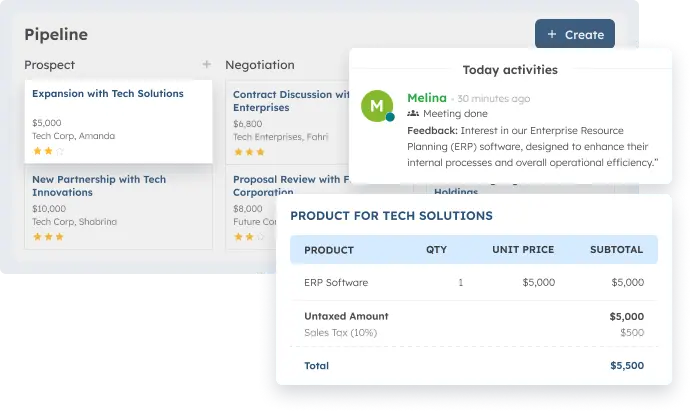
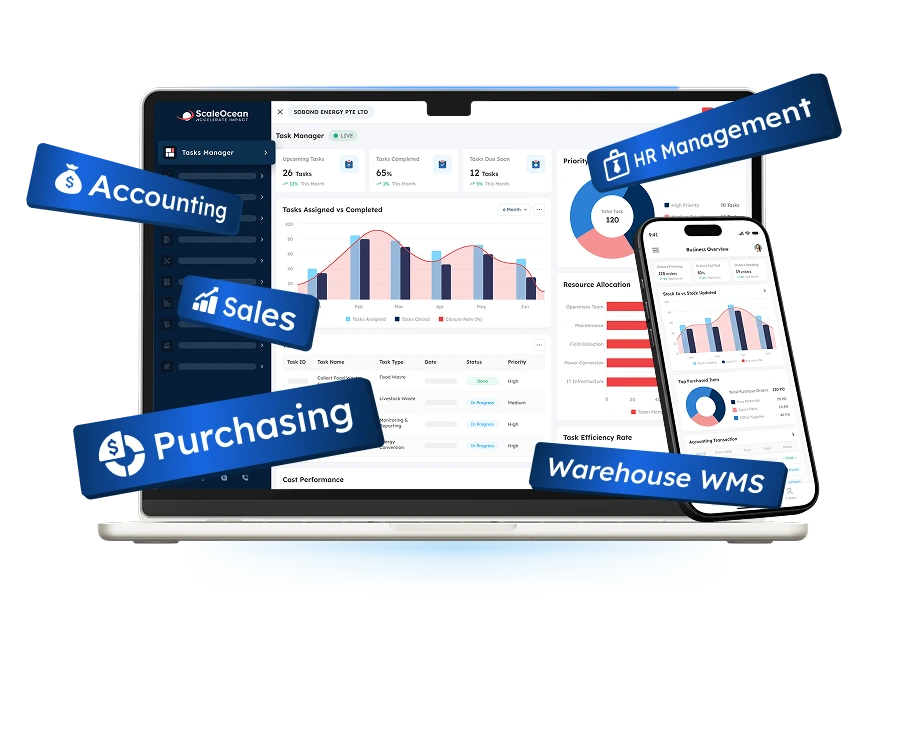
ScaleOcean CRM Software connects customer, sales, transaction, service, finance, and operational data in one platform. Its configurable unified profiles create connected business context beyond a traditional customer database.
ScaleOcean Atlas supports PDPA-aligned governance and Singapore financial requirements, including IRAS and GST-related processes. ScaleMind AI interprets unified customer data, highlights priorities, and assists relevant operational actions.
Schedule a consultation with our experts to explore ScaleOcean Atlas for your customer data needs. We can assess your systems, integration requirements, governance priorities, and implementation approach.
Key Features
- Customer Interaction Tracking: Record customer calls, emails, meetings, and messages to support more informed sales and service activities.
- Omnichannel & System Integration: Connect CRM, ecommerce, communication channels, and existing enterprise applications for consistent customer context.
- ScaleMind AI-Assisted Customer Intelligence: Analyze unified customer data, identify patterns and priorities, and provide relevant business insights through an AI business assistant.
- Enterprise-Scale Customization: Access 200+ modules, 1,000+ configurable feature choices, unlimited users, external integrations, and phased implementation options.
- Customer Segmentation: Group customers based on demographics, industry, interests, purchase history, and other defined criteria.
| Pros | Cons |
|---|---|
|
|
Best For: Medium to large enterprises in Singapore with complex customer management processes, multiple departments, and interconnected operational workflows that require customer data to work alongside sales, finance, inventory, HR, and other business functions.
ℹ️ Why Choose ScaleOcean for a Customer Data Platform?
ScaleOcean serves Singapore enterprises that need customer data integrated into broader operations, not isolated. Its enterprise approach, flexible setup, ecosystem, and scalability suit organizations with complex customer processes and multiple departments.
2. Salesforce Data Cloud
Salesforce Data Cloud is a customer data platform that helps businesses collect, unify, and analyze customer information from different sources. It is mainly used to create connected customer profiles and support data-driven engagement.
The platform can also support segmentation and customer data analysis across Salesforce applications. This makes it more relevant for organizations that already use Salesforce tools in their customer operations.
Key Features of Salesforce Data Cloud:
- Data integration and unification
- Identity resolution
- Customer segmentation
- Real-time data analysis
| Pros | Cons |
|---|---|
|
|
Best For: Large enterprises already using Salesforce applications that need to connect customer information across marketing, sales, service, and other customer-facing operations.
ℹ️ Why Choose Salesforce Data Cloud for Customer Data Platform?
Consider it when a business already operates within the Salesforce ecosystem and wants its customer data capabilities to work alongside existing Salesforce applications.
3. Twilio Segment
Twilio Segment customer data platform helps businesses collect, clean, unify, and send customer data to connected tools. It focuses heavily on customer event data from websites, applications, and other digital touchpoints.
The platform can create unified profiles and route customer information to marketing, analytics, and other systems. Therefore, it is particularly relevant for businesses with digital products and developer-led data environments.
Key Features of Twilio Segment:
- Customer data collection
- Identity resolution
- Audience segmentation
- Data activation
| Pros | Cons |
|---|---|
|
|
Best For: Mid-sized to large digital businesses, SaaS companies, ecommerce companies, and organizations with technical teams that need to collect and route customer event data.
ℹ️ Why Choose Twilio Segment for Customer Data Platform?
It can suit businesses that prioritize digital data collection and need to connect customer events with multiple downstream marketing, analytics, and business tools.
4. Tealium Customer Data Hub
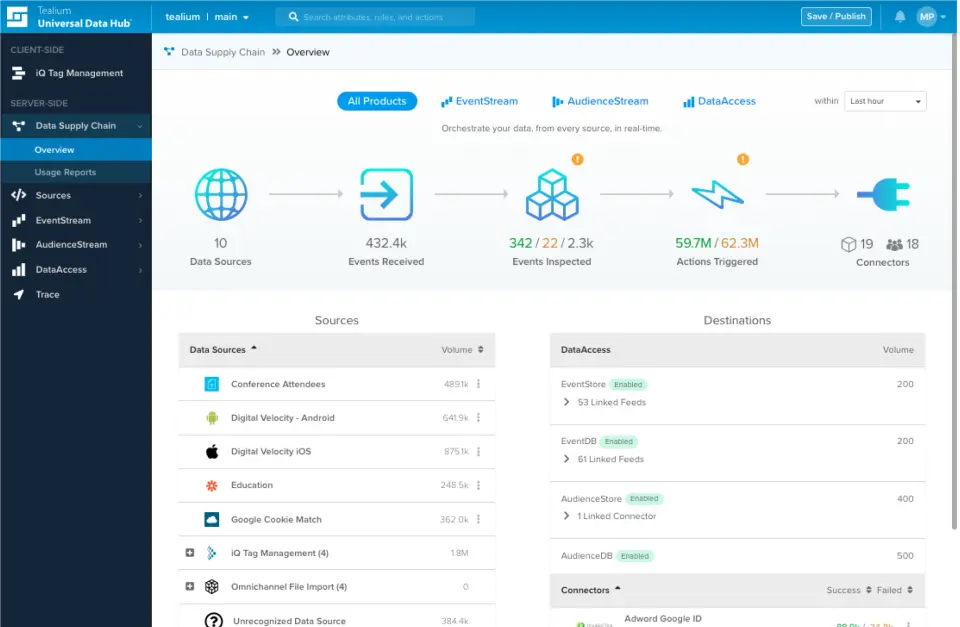
Tealium Customer Data Hub collects and manages information from different customer touchpoints. It helps businesses centralize customer data and make it available across connected technologies.
The platform also supports customer profiles, data enrichment, audience management, and data activation. Its capabilities can therefore support organizations managing customer information across multiple digital and offline sources.
Key Features of Tealium Customer Data Hub:
- Data collection
- Profile management
- Audience management
- Data activation
| Pros | Cons |
|---|---|
|
|
Best For: Medium to large enterprises that manage customer information across many channels and need centralized data collection, profile management, and audience activation.
ℹ️ Why Choose Tealium Customer Data Hub for Customer Data Platform?
Organizations that need a centralized customer data layer across multiple sources, channels, and marketing technologies.
5. Treasure Data CDP
Treasure Data customer data platform helps businesses collect and organize customer information from multiple sources. It focuses on building customer profiles that can support segmentation, analysis, and marketing activities.
The platform is designed for organizations handling large amounts of customer data across different systems. It can therefore support businesses that need broader customer data management without relying on separate data sources.
Key Features of Treasure Data CDP:
- Customer data collection
- Profile unification
- Audience segmentation
- Customer analytics
| Pros | Cons |
|---|---|
|
|
Best For: Large enterprises with substantial customer datasets and multiple data sources that need centralized customer profiles and audience management.
ℹ️ Why Choose Treasure Data CDP for Customer Data Platform?
It fits organizations that need to organize large volumes of customer information and use that data for segmentation, analysis, and engagement.
6. Oracle Unity
Oracle Unity customer data platform helps businesses combine customer information from different sources into unified customer profiles. It is designed to support customer understanding across marketing and other business interactions.
The platform works within the wider Oracle environment and can connect customer data with related Oracle applications. As a result, it can be relevant for organizations already using Oracle business and customer management technologies.
Key Features of Oracle Unity:
- Customer data integration
- Identity resolution
- Audience segmentation
- Customer profile management
| Pros | Cons |
|---|---|
|
|
Best For: Large enterprises already using Oracle applications that want to connect customer information across existing marketing, sales, service, and business systems.
ℹ️ Why Choose Oracle Unity for Customer Data Platform?
It can be a practical option for businesses that want their customer data platform to fit within an existing Oracle technology environment.
7. Adobe Experience Platform
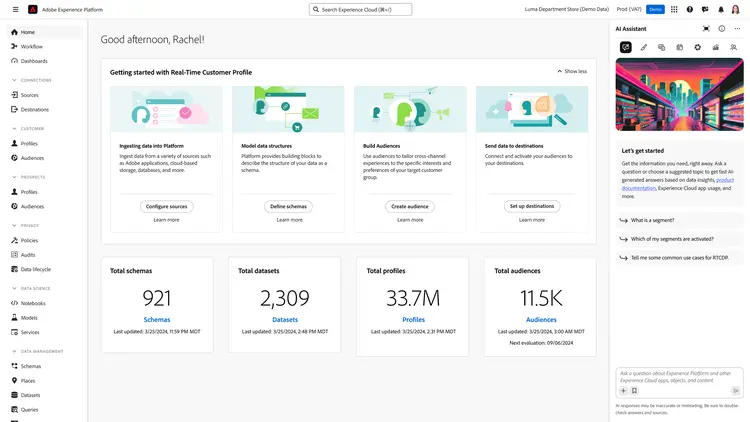
Adobe Experience customer data platform helps businesses collect, organize, and analyze customer information from different sources. It supports customer profiles that can be used across digital experience and engagement activities.
The platform is closely connected with Adobe’s wider experience ecosystem, allowing customer information to support related marketing and experience workflows. This makes it more relevant for organizations already working with Adobe technologies.
Key Features of Adobe Experience Platform:
- Customer profile management
- Data ingestion
- Audience segmentation
- Customer data analysis
| Pros | Cons |
|---|---|
|
|
Best For: Large enterprises and established digital businesses that already use Adobe products and need centralized customer data for marketing and digital experience activities.
ℹ️ Why Choose Adobe Experience Platform for Customer Data Platform?
It can suit businesses that want customer data management to work alongside an existing Adobe-based marketing and digital experience environment.
8. Bloomreach
Bloomreach customer data platform helps businesses organize customer information for digital marketing and ecommerce activities. It combines customer data with engagement capabilities to support more relevant digital experiences.
The platform is particularly associated with ecommerce and marketing use cases, where customer profiles can help businesses understand behavior and create targeted experiences.
Key Features of Bloomreach:
- Customer profile management
- Behavioral data analysis
- Audience segmentation
- Marketing activation
| Pros | Cons |
|---|---|
|
|
Best For: Small to large ecommerce and digital commerce businesses that primarily need customer data capabilities for marketing, personalization, segmentation, and online engagement.
ℹ️ Why Choose Bloomreach for Customer Data Platform?
Consider it when customer data management is closely tied to ecommerce marketing and digital customer experiences.
9. Hightouch
Hightouch customer data platform uses existing warehouse data to create and activate customer audiences. Instead of requiring businesses to move all customer information into another database, it can work with data already stored in the warehouse.
This approach is common among modern data teams that want to connect warehouse data with marketing and operational tools. As a result, it can support businesses with established data infrastructure.
Key Features of Hightouch:
- Warehouse-based customer data
- Audience creation
- Reverse ETL
- Data activation
| Pros | Cons |
|---|---|
|
|
Best For: Medium to large businesses with established cloud data warehouses and technical data teams that want to activate existing customer data across downstream business and marketing tools.
ℹ️ Why Choose Hightouch for Customer Data Platform?
It suits organizations that prefer to keep their data warehouse as the main data source while connecting customer information with operational tools.
10. Composable CDP
Composable CDP customer data platform uses existing data infrastructure, such as a data warehouse, to build customer profiles and audiences. Instead of relying on one traditional CDP database, it connects different components to support customer data management.
This approach gives businesses more control over how customer data is stored, modeled, and activated. However, it generally requires stronger internal data capabilities and a clearer understanding of the underlying infrastructure.
Key Features of Composable CDP:
- Warehouse-based profiles
- Customer data modeling
- Audience segmentation
- Data activation
| Pros | Cons |
|---|---|
|
|
Best For: Medium to large enterprises with established data warehouses, engineering teams, and mature data practices that want greater control over their customer data architecture.
ℹ️ Why Choose Composable CDP for Customer Data Platform?
It can work well for businesses that already have strong internal data infrastructure and prefer building customer data capabilities around their existing warehouse rather than adopting a traditional standalone CDP.
How Do You Choose the Best Customer Data Platform (CDP) Software?
Choosing the right CDP starts with matching the software’s strengths with your business goals, technical skills, and current tools. This approach helps avoid unnecessary complexity and costs.
- Define your business goals: Identify whether your priority is personalization, customer segmentation, data unification, analytics, or cross-channel activation. Then, choose software with capabilities that directly support these objectives.
- Assess data integration capabilities: Check whether the CDP connects with your existing CRM, ecommerce, POS, marketing, analytics, and customer service platforms. Strong integrations reduce manual data transfers and implementation challenges.
- Evaluate identity resolution: Prioritize platforms that can accurately match customer records across channels and devices. Effective identity resolution helps create unified profiles while reducing duplicate or fragmented customer records.
- Consider scalability: Choose software that can handle increasing customer volumes, data sources, users, and business requirements. This prevents enterprises from replacing their CDP when customer operations expand.
- Review privacy and security controls: Ensure the platform supports appropriate access controls, consent management, data retention, and governance requirements. For Singapore businesses, consider how the software supports compliance with applicable PDPA obligations.
- Check usability and technical requirements: Evaluate whether your teams can configure, operate, and maintain the platform without excessive technical resources. A powerful CDP may still be unsuitable if implementation becomes overly complicated.
- Evaluate pricing and total costs: Compare licensing, implementation, integration, maintenance, and additional usage costs, not just subscription prices. A transparent cost structure makes long-term budgeting easier.
What are the Common Use Cases for a Customer Data Platform (CDP)?

CDPs support various customer management activities by connecting information from multiple sources and making unified profiles available for activation. As a result, businesses can apply customer insights across marketing, service, and engagement processes.
1. Personalization
A CDP helps businesses personalize customer experiences by combining identity, behavioral, transactional, and interaction data into unified profiles. Teams can then use this information to deliver content, offers, and recommendations based on customer context.
Instead of treating every customer the same, businesses can adapt experiences based on previous actions, preferences, and engagement patterns. As a result, personalization becomes more relevant while reducing reliance on assumptions or incomplete information.
2. Targeted Ads
Businesses can use CDP data to create advertising audiences based on customer characteristics, behaviors, transactions, and engagement history. These audiences can then support more focused campaigns across connected advertising platforms.
This approach helps marketers avoid repeatedly targeting unsuitable or already-converted audiences when relevant customer information is available. As a result, businesses can improve audience precision and potentially reduce inefficient advertising spend.
3. Customer Support
A CDP can give customer service teams broader context by connecting information from purchases, previous interactions, digital activity, and other relevant touchpoints. This allows representatives to understand customer situations without checking multiple systems.
With more complete profiles, support teams can respond with greater context and consistency throughout customer interactions. As a result, businesses can reduce repetitive questions and create smoother service experiences across channels.
4. Customer Journey Optimization
CDPs help businesses analyze customer journeys by connecting interactions that occur across websites, applications, stores, campaigns, and service channels. Teams can identify where customers engage, disengage, or encounter unnecessary friction.
These insights allow businesses to improve specific stages of the journey rather than optimizing channels separately. As a result, teams can design experiences that better reflect how customers actually move between touchpoints.
5. Cross-Channel Campaigns
A CDP can unify customer information before businesses activate campaigns across email, websites, mobile applications, advertising platforms, and other channels. This helps teams maintain consistent audience targeting and messaging across different touchpoints.
Businesses can also coordinate campaigns based on customer behavior and engagement history. As a result, customers may receive more relevant communications while teams reduce duplicate messages and disconnected campaign activities.
6. Data Integration and Unification
A core CDP use case is connecting customer information from different business systems into unified profiles. This can include CRM, ecommerce, POS, marketing, website, application, and customer service data.
By reducing data fragmentation, businesses can create a more consistent foundation for customer analysis and activation. As a result, teams can spend less time reconciling records and more time applying customer information strategically.
Customer Success Stories in Business Using a CDP
Customer Data Platforms can deliver measurable results when businesses use unified customer information to improve personalization, audience targeting, and engagement. Several real-world cases demonstrate how organizations have translated customer data into business outcomes.
As reported by The Indian Express, the publication company implemented a CDP to address challenges in delivering personalized content across its digital platforms. The solution created a unified view of readers, allowing the publication to use customer interests for tailored content recommendations and targeted messaging.
The results showed a 95% improvement in click-through rate (CTR) for personalized push notifications. Additionally, its personalized “MyExpress” content section generated approximately 300,000 additional monthly pageviews despite initially being tested with only 0.1% of users.
These cases show that CDPs are not limited to storing customer information. When businesses connect data with practical activation strategies, they can improve engagement, personalize experiences, strengthen audience targeting, and create measurable commercial outcomes.
Conclusion
Choosing the right customer data platform helps Singapore businesses unify fragmented information, improve customer understanding, personalize engagement, and support more consistent, data-driven decisions across connected channels and customer journeys.
ScaleOcean connects customer information with broader business processes, helping enterprises understand customer activity within operational context. ScaleMind AI can then turn relevant data into insights and practical priorities.
Schedule a consultation with our experts to assess your customer data requirements and explore ScaleOcean for your business. Our team can recommend an implementation approach based on your systems and goals.
FAQ Customer Data Platform (CDP):
1. How does a customer data platform differ from a CRM?
A CRM tracks intentional, direct interactions like sales pipelines, support tickets, and manual team inputs. In contrast, a customer data platform automatically ingests massive volumes of raw behavioral data from online and offline channels, stitching anonymous and known actions into one continuous timeline.
2. Why do businesses implement a customer data platform?
Organizations use a customer data platform to eliminate data silos across departments. Unifying this information helps marketing, sales, and service teams analyze user journeys accurately, comply with privacy regulations, and deliver highly personalized experiences across digital touchpoints.
3. What types of data does a customer data platform collect?
A customer data platform gathers diverse data types. This includes behavioral data like web clicks, transactional data like order histories, demographic details like names or locations, and psychographic data like product preferences collected across mobile apps, websites, and offline systems.
4. How does a customer data platform benefit marketing teams?
A customer data platform helps marketers create highly targeted campaigns by providing a complete view of user behavior. Instead of guessing, teams can use unified profiles to trigger automated messages at the exact moment a user is likely to buy, improving conversion rates and ad spend efficiency.





















.png)