



A tax identification number is a unique identifier that associates a person or business with their tax filing, payment, financial activities, and tax obligations. There is no distinction in TINs for each Singapore taxpayer. Generally, the NRIC or FIN will be used for an individual, and it is common for registered businesses to use their Unique Entity Number (UEN).
The primary issue for accounting teams is not so much that you don’t have a tax ID as that it doesn’t exist entirely. The more common problem is that UENs, GST Registration Numbers, foreign TINs, and customer or supplier tax references are contained in disjointed accounting files, invoices, bank statements, customs records, and entity databases.
That’s why businesses need centralized tax master data that connects every identifier with the correct legal name, tax residency, GST status, registration period, entity type, and supporting documents. Validated records help accounting teams use the correct number when processing invoices, payments, tax returns, journal entries, and financial reports.
Based on the data our team collected from the IRAS annual report, Singapore collected S$88.9 billion in tax revenue during FY2024/25, representing a 10.7% increase from the previous financial year. This growth reinforces the importance of reliable taxpayer identification, accurate financial records, and connected compliance processes across businesses.
Understand the nature of a Tax Identification Number (TIN) in Singapore, how taxpayers should identify themselves and their businesses, where they can find their tax ID, and how they should use them correctly. It also includes their participation in filing corporate Tax, GST, banking, import/export permits, and commercial transactions.
 Key Takeaways
- A Singapore tax identification number is an official reference that links taxpayers to tax returns, assessments, payments, correspondence, and statutory records.
- There are different tax identifier formats for businesses, like UENs and GST registration numbers, and for individuals, such as NRICs and FINs.
- Managing a Singapore tax identification number should protect sensitive information, document every update, and ensure the correct identifier flows.
- ScaleOcean accounting software can centralize tax records and support accurate multi-entity financial processes.

What Is the Singapore Tax Identification Number (TIN)?
A Singapore tax identification number is the identifying reference used to connect a taxpayer with returns, assessments, payments, correspondence, and statutory records. The appropriate number depends on whether the taxpayer is an individual, a Singapore-registered organization, or a foreign entity with local tax obligations.
Each taxpayer does not have a separate tax number; generally, Singapore reuses identity and registration numbers. TIN is not an identifier that is uniform, and it refers to the identifier in the tax administration process.
The primary Singapore tax identification number categories include:
- Singapore citizens and permanent residents: The NRIC number generally functions as the individual’s tax reference.
- Eligible foreign individuals: The FIN normally functions as the individual’s Singapore tax reference.
- Registered business entities: The UEN generally serves as the organization’s business tax reference.
- GST-registered organizations: A GST Registration Number is used for GST reporting and invoicing.
- Foreign entities without a UEN: A separate tax reference may be assigned based on the entity’s registration and tax obligations.
Accounting teams should store these numbers in separate master-data fields. Combining UENs, GST numbers, foreign TINs, and individual identifiers within one generic tax field may cause the wrong number to appear on invoices, reports, tax submissions, or intercompany transactions.
Businesses seeking a broader understanding of Singapore’s tax administration can also review the role of the IRAS (Inland Revenue Authority of Singapore) in tax collection, filing, assessments, taxpayer services, and regulatory compliance.
Common Actions requiring a Singapore Tax Identification Number
A Singapore tax ID may be required whenever someone or an organization interacts with a tax authority, government body, financial entity, employer, customer, or a foreign counterparty. The number refers to a taxpayer, employee, account-holder, or legal entity in the transaction.
For businesses, the identifier has to be the same for all processes that are connected. The UEN in an invoice should correspond to that in the accounting ledger, bank account, customs permit, GST registration, GST filing Singapore, supplier contract and corporate tax return.
1. Filing Personal or Corporate Taxes (on the IRAS myTax Portal)
People typically access their personal tax information, submit necessary tax data, read notices, make payments and check account balances via their NRIC or FIN. Access is through the appropriate digital identity account with a secure link to the correct taxpayer having the tax information.
Companies utilize their UEN or assigned business tax reference to handle corporate income tax, GST, withholding tax and other requirements. Multi-entity groups need to exercise prudence in identifying the right subsidiary to prepare a return, as the same or similar company names or shared finance teams may make it more difficult to prepare a return under the right legal entity.
2. Opening Commercial or Personal Bank Accounts
Banks may request a customer’s tax residency and corresponding TIN as part of account opening, customer verification, and international financial reporting procedures. An individual may provide an NRIC or FIN, while a registered organization will generally provide its UEN and relevant corporate registration documents.
For businesses, the registered name and UEN provided to the bank should match the information recorded in company documents and internal accounting systems. Inconsistencies can delay onboarding, payment verification, financing applications, or updates to authorized signatories and beneficial ownership records.
3. Processing Local Payroll
Employers use employee NRICs and FINs to connect salary records with the correct employee, taxpayer, and statutory submission. These identifiers may support payroll calculations, employment income reporting, tax clearance in Singapore, benefits administration, and other employment-related processes.
Incorrect identifiers can result in income being assigned to the wrong employee or submitted under an invalid record. Businesses should therefore validate the employee’s name, NRIC or FIN, residency status, pass information, and employment details before completing payroll or transmitting statutory information.
4. Mandatory Central Provident Fund (CPF) Contributions
Employers use employee identification information when calculating and submitting CPF contributions for eligible Singapore citizens and permanent residents. The employee’s NRIC helps ensure that contributions are credited to the correct CPF account, while the employer’s registered entity information identifies the contributing organization.
Payroll teams should confirm that the employee’s citizenship, permanent residence status, wages, age, and identification details remain accurate. Disconnected payroll and CPF records may create rejected submissions, incorrect contribution amounts, or time-consuming reconciliations between employee, payroll, and government records.
5. Completing Global Legal and Financial Compliance
Multinational organizations may need tax identification information for tax residency declarations, international information exchange, transfer pricing, withholding tax analysis, foreign account reporting, intercompany transactions, and customer due diligence. The relevant number depends on the taxpayer’s jurisdiction and legal status.
A Singapore-based individual or entity may hold more than one tax identifier. For example, a foreign employee may have a FIN for Singapore purposes and a separate TIN from another jurisdiction. These numbers should be recorded separately with their issuing country, effective date, verification status, and supporting documentation.
6. Import and Export Permits
Businesses involved in Singapore imports, exports, or transhipment generally need a UEN before activating their Customs Account. The company must then determine whether its products are controlled, establish the necessary payment or security arrangements, and apply for the appropriate permits through Singapore’s electronic trade declaration system.
The UEN connects importers and exporters with permit applications, customs declarations, duties, import Goods and Services Tax (GST), shipping documents, and regulatory approvals. Using an inactive UEN or the number of the wrong subsidiary can delay cargo clearance and create discrepancies between customs, logistics, inventory, and accounting records.
7. Business Transactions
Companies regularly use their UEN on contracts, purchase orders, invoices, receipts, supplier profiles, customer accounts, payment instructions, and other commercial documents. The number helps counterparties identify the registered entity entering into the transaction.
GST-registered businesses must also use their verified GST Registration Number on relevant tax documents. Because the GST number may not always be identical to the UEN, businesses should maintain separate fields and configure invoice templates based on the approved registration information.
And for those looking to streamline their tax processes even further, exploring the best tax software in Singapore can be a game-changer, honestly. These tools, they often integrate directly with government portals, using the TIN to automate filings and reduce those compliance headaches, allowing businesses to focus more on growth and less on administrative burdens.
Types of Tax Identification Numbers in Singapore

A citizen or non-citizen status, immigration status, and legal entity of a taxpayer are some of the multiple identifiers in Singapore. Recognizing these differences enables businesses to decide which number to use and how to employ it.
It is also important for the company to clarify whether it is an employee, customer, supplier, shareholder, or a subsidiary or entity abroad. This is to avoid the reuse of the same identifier in a different legal and financial transaction.
1. National Registration Identity Card (NRIC)
NRICs are issued to Singapore citizens and permanent residents who have been registered as per the provisions. It is the person’s main national identity reference and is typically utilized as their own tax reference for getting to tax services.
Employers may need an employee’s NRIC for payroll, CPF, employment income reporting, insurance, and other legitimate administrative purposes. However, the complete number should not be exposed in general reports or shared with employees who do not require access to sensitive identification data.
2. Foreign Identification Number (FIN)
A FIN is assigned to eligible foreign individuals holding relevant work, immigration, study, or long-term residency passes. It is normally displayed on the individual’s official pass and may serve as the person’s tax reference for Singapore tax matters.
Employers should verify the FIN against an authorized document during onboarding. The record should also be linked to the employee’s legal name, nationality, pass type, pass validity, employment status, and tax residency to prevent payroll and reporting errors.
3. Unique Entity Number (UEN)
A UEN is the standard identification number assigned to registered entities in Singapore. Companies generally receive it when their incorporation or registration is approved, while other entity types may obtain it through the appropriate issuing agency.
The UEN serves as the entity’s primary reference when interacting with government agencies and commercial counterparties. It may be used in tax filing, banking, CPF submissions, customs registration, contracts, invoices, procurement, licensing, and other business processes.
The Format of Tax Identification Numbers in Singapore
There are different tax identifier formats for businesses and individuals in Singapore. The validation of the format may catch easily misspelled numbers, but it cannot determine if a number is a person’s or company’s number.
However, there is a need for businesses to go a step further and integrate format validation with source validation. A properly coded number can be part of another organization, an inactive organization, an expired pass holder, or an unrelated employee.
1. TIN Format for Business Entities
A business TIN commonly takes the form of a nine- or ten-character UEN. Its structure may vary according to the entity type, registration period, and issuing authority. Some UENs begin with numbers, while others contain a combination of letters and numbers.
Companies should not determine validity solely from the length or appearance of the number. The UEN should be checked together with the registered entity name, status, address, incorporation details, and other corporate information before being activated in the accounting system.
2. TIN Format for Individuals
The NRIC and FIN numbers are typically nine alphanumeric characters long. The format has a prefix letter, 7 numerical digits, and a checksum letter at the end. NRIC numbers are often started with S and T, and FIN numbers are often started with F, G or M.
The format check will be able to detect missing characters or obvious typing errors, but the number must still be checked against an approved identity card by the employer. An employee shouldn’t know their payroll ID, nor should it be an estimated or guessed number derived from their name or date of birth.
How to Get Your Singapore Tax Identification Number
The process for obtaining a Singapore tax identification number depends on whether the applicant is an individual or a business entity. In most cases, the tax reference is issued through an existing identity, immigration, or business registration process.
This means that searches for “how to get tax identification number online” may lead to different services. Individuals may need to complete an identity or immigration process, while companies generally receive their UEN after successful registration.
1. Individual Tax Identification Numbers
The general practice in Singapore is not to apply for a TIN individually by Singapore citizens and permanent residents. They receive their NRIC during the national identification procedure and are then used as a tax reference for the relevant tax services for individuals.
Eligible foreigners are typically issued a FIN upon obtaining a work pass, immigration pass, student pass or other valid pathway to residency. After setting up a Singapore tax account, the person can use the FIN and authorized digital access credentials to handle the matters related to the tax account.
2. Business Tax Identification Numbers
A locally incorporated company generally receives its UEN when its registration is approved. The registration outcome and company profile will contain the UEN, which can then be used for tax, banking, licensing, payroll, customs, and commercial purposes.
Obtaining a UEN does not automatically mean that the organization is registered for every tax or regulatory obligation. A business may still need to complete separate registrations for GST, customs activities, licenses, payroll arrangements, or other industry-specific requirements.
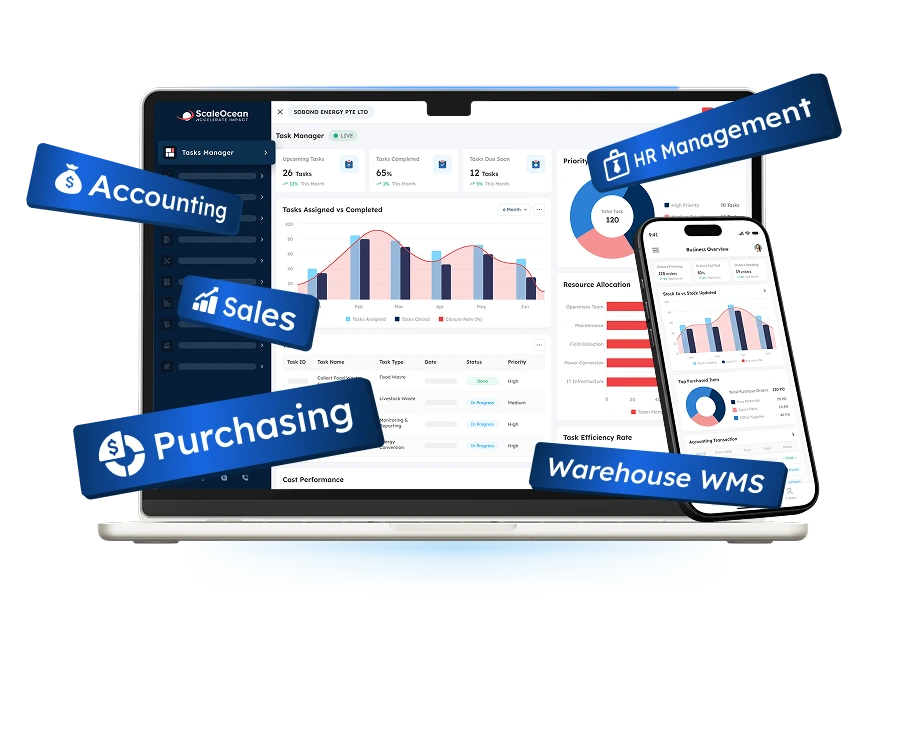
ScaleOcean Atlas Accounting Software helps centralize UENs, GST Registration numbers, foreign TINs, and supporting documents across invoicing, accounts payable, accounts receivable, tax reporting, and financial consolidation. Its multi-entity controls, ScaleMind data validation, approval workflows, role-based access, and audit trails help maintain consistent tax records across financial processes.
Schedule a free consultation with ScaleOcean to explore how our software can improve tax data accuracy, strengthen accounting controls, and support more reliable reporting. The system is optimized for PDPA requirements and local financial reporting standards, while supporting eligible EDG and CTC Grant implementation needs.
How Businesses Can Check Their Tax Identification Number in Singapore

Tax identifiers need to be verified before they are used for paying staff, filing tax returns, issuing customer invoices, keeping supplier records, obtaining customs permits, or for bank instructions. Verification is particularly critical if the information is manually entered or imported from an older system.
The search terms “where to find tax identification number Singapore” might be either an individual’s NRIC or FIN or a company’s UEN and GST Registration Number. It will be based on the taxpayer it will apply to.
1. Individual Tax Identification Numbers
Generally, the tax reference will be available on a person’s NRIC, immigration pass, work pass, or tax correspondence. They can also use the personal tax account via the authorized digital government services.
Employers should verify the number at hiring when someone presents an approved ID. After verifying, the company can record the date of verification and the individual who made the verification without unnecessary and excessive copies of the employee’s ID.
2. Business Tax Identification Numbers
A business is typically able to find its UEN in the documentation related to its incorporation, in its official business profile, in its registration documents, government correspondence, bank records, and in an authorized corporate account. It is also possible for counterparties to check a company’s identity via official entity search services.
GST Registration Numbers should not be verified based on the UEN. Before implementing the GST treatment, the finance team will have to check the legal entity name, legal entity status, legal entity effective date, and legal entity number with the supplier or customer before enabling the treatment or using the supplier or customer in their accounting system.
Best Practices for Managing Your Tax Identification Number Singapore
Managing a Singapore tax identification number involves more than storing it in an employee or supplier profile. Businesses must protect sensitive information, maintain accurate legal entity records, document every update, and ensure the correct identifier flows through each relevant accounting system.
The data that we gathered from IMDA shows that in 2024, 95.1% of Singapore SMEs adopted at least one digital area, compared to 94.5% in 2023. This shift underscores the rising significance of built-in systems that help keep structured tax information, minimize manual mistakes, and facilitate more reliable tax compliance procedures.
1. Protect Your Number Against Fraud and Misuse
NRICs and FINs are personal identifiers which, if not handled with care, can be misused for fraud, impersonation and/or wrongful profiling. The purpose for gathering information, who will have access to it, and how long it will be maintained should be established.
Full identifiers should not appear in unrestricted spreadsheets, general dashboards, email chains, or printed documents. Masking, encryption, controlled exports, access logs, and periodic permission reviews can help prevent unnecessary exposure and identify suspicious activity.
2. Secure Your Digital Access via Singpass
Employees should use their own authorized digital identity when accessing personal or corporate government services. Login credentials should never be shared as a common departmental account because this removes accountability and increases the risk of unauthorized activity.
Businesses should also review corporate permissions whenever an employee changes roles, transfers departments, takes extended leave, or leaves the company. Access to payroll, tax, customs, CPF, and corporate data should be removed promptly when it is no longer required.
3. Ensure Compliance and Timely Updates
Company names, registered addresses, GST status, tax residency, employee pass information, and authorized representatives may change over time. Businesses should create a formal workflow for requesting, verifying, approving, and distributing these updates.
Once approved, the new information should flow consistently into accounting, payroll, banking, procurement, customs, invoicing, and reporting systems. Updating one application while leaving another unchanged can create conflicting records and inaccurate submissions.
4. Establish a Robust Record-Keeping System
Businesses should retain documents that support each tax identifier, registration status, transaction, calculation, and filing. Relevant records may include company profiles, tax notices, GST registration documents, employee identity records, invoices, permits, payroll reports, and tax calculations.
Every document should be linked to the correct entity, employee, transaction, filing period, and tax type. A clear record structure allows authorized users to retrieve evidence quickly without searching through individual email accounts or disconnected personal folders.
5. Keep Accurate Tax Files
Tax files should distinguish corporate income tax, GST, withholding tax, payroll reporting, customs duties, and foreign tax obligations. Although these records may relate to the same organization, they can involve different numbers, filing periods, transaction types, and approval responsibilities.
Companies should use a consistent naming structure and document index. Historical versions should remain traceable so reviewers can identify when information changed, who approved the update, and which supporting document justified the revision.
6. Monitor Your Tax Liabilities Properly
A valid tax identification number is a valid taxpayer, but does not validate the tax calculation. However, there are still many other important aspects to watch for by businesses, including taxable income, deductions, GST, withholding tax, employee income, customs charges, and payment dates.
Management dashboards should connect taxpayer identity with transaction values, filing status, due dates, payments, and outstanding liabilities. Exception reports can then identify missing GST references, inactive entities, unverified suppliers, or employees without complete identification records.
7. Stay Informed About Tax Regulations
Tax rules, invoice requirements, filing platforms, payroll obligations, and reporting standards can change. Finance and HR teams should regularly review official updates and determine whether their internal policies, system configurations, or approval workflows need adjustment.
Every regulatory change should trigger an impact assessment before it is applied. Businesses should test revised fields, calculations, invoice templates, integrations, and reports to ensure that new requirements do not disrupt historical records or current transactions.
Conclusion
A tax identification number in Singapore connects individuals and businesses with their tax and financial obligations. Individuals generally use an NRIC or FIN, while registered companies commonly use a UEN. GST-registered organizations may also hold a separate GST Registration Number.
Because these identifiers are used across corporate tax filing, GST reporting, banking, customs permits, invoices, and other accounting processes, businesses should manage them through verified and centralized records. This helps prevent inconsistent information from affecting transactions, tax calculations, or financial reports.
To support this process, businesses can use accounting software and other integrated solutions within ScaleOcean Atlas. Its multi-entity management, ScaleMind data validation, configurable approvals, role-based access, and audit trails help maintain accurate tax data across financial workflows. Schedule a free consultation with us to explore how these capabilities can strengthen accounting accuracy and compliance across your organization.
FAQ Tax Identification Number Singapore:
1. Is a Singapore tax information number the same as a TIN?
Yes. In Singapore, a tax information number generally refers to the TIN used for tax purposes, such as an NRIC or FIN for individuals and a UEN for registered businesses.
2. Is a UEN the same as a business tax identification number?
A UEN generally functions as the main business tax identification number in Singapore, although companies may also have separate identifiers such as a GST Registration Number.
3. Does a company need to apply separately for a TIN after incorporation?
No. A locally incorporated company normally receives its UEN automatically after registration, although separate applications may still be required for GST, customs, or other regulatory obligations.
4. How can an individual use their tax information number for tax filing?
Individuals can use their NRIC or FIN with authorized digital credentials to access tax services, review income information, submit returns, check notices, and manage payments.





















.png)